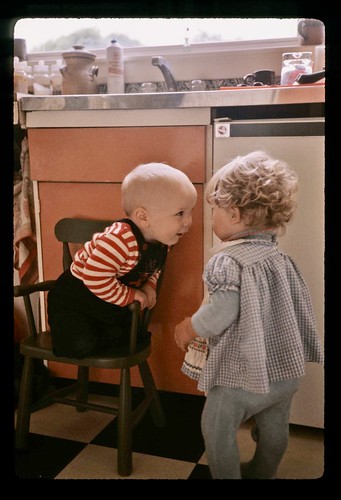
I woke up at 6:00 AM after a night of many trips to the bathroom and unquiet rest. Before going to bed at 9:30 I sat for a while at the kitchen island looking at my hands in the beautiful overhead spotlight, feeling contentment. Joe, Amy, and Jan and the two boys had watched the show I’d been thinking about since I cleaned and scanned the slides in the Art History lab: 150 or so images from 1978 to 1984 projected on the white wall behind the couch. Most of the pictures were of the trip to England we took from Lund in June 1978. Joe was Ethan’s present age and I was two years younger than he is now. It was a time of fulfillment and promise for our young family then, as this is a moment of fulfillment and promise for his young family now. Jan and I pieced together a story line about the trip, and Joe filled in details both of us had forgotten. He marveled at the similarity between my past and his present appearance. The kids watched patiently for more than an hour, even though exhausted, and Ethan asked many questions. We agreed that just as Joe now remembers those events of 31 years past, Ethan will remember this present when he is Joe’s and grandpa’s age.
As I copy these words written a week ago, they recall yet another déjà vu.
At the advice of your office, I am submitting some input on the search for the successor of Warren Baker as President of Cal Poly University San Luis Obispo.
I have taught here since 1988 and am recipient of the University’s Distinguished Teaching Award, the College of Liberal Arts Outstanding Scholarship Award and the CSU Systemwide Quality Improvement Award.
During his tenure President Baker has led Cal Poly to become one of the country’s preeminent Polytechnic Universities. I believe the primary mandate of his successor should be to transform Cal Poly into one of the country’s leaders in Education for Sustainability—the long-term approach to integrated solutions of economic, social and environmental problems.
It is crucial that the Trustees Committee for the Selection of the President incorporate terms in the job description and advertisement that call for successful experience in leading such institutional transformation and that they make promise in advancing sustainability an important criterion for final selection.
Doing so would serve the interests of Cal Poly’s students, who seek employment in emerging fields, of the institution, which needs more cross-disciplinary collaboration in teaching and research, and of the larger community, whose health and welfare depend upon the next generations’ commitment to addressing these problems effectively. (see http://presidentsclimatecommitment.org/documents/Leading_Profound_Change_ExecSum_final7-28-09.pdf)
In support of this opinion, I refer you to the University Sustainability Learning Objectives recently adopted by Cal Poly’s Academic Senate and ratified by President Baker:
Cal Poly defines sustainability as the ability of the natural and social systems to survive and thrive together to meet current and future needs. In order to consider sustainability when making reasoned decisions, all graduating students should be able to:
• Define and apply sustainability principles within their academic programs
• Explain how natural, economic, and social systems interact to foster or prevent sustainability
• Analyze and explain local, national, and global sustainability using a multidisciplinary approach
• Consider sustainability principles while developing personal and professional values
RQ has received a review copy of English Mercuries: Soldier Poets in the Age of Shakespeare by Adam McKeown (Vanderbilt University Press). Would you agree to write a 700 word review due no later than February 10th?
Renaissance Society of America
365 Fifth Avenue, 5400
New York, NY 10016
*******
This book’s scholarly subject is literary works about war produced between 1551 and 1632 by English writers who fashioned themselves both soldiers and poets. Three introductory chapters frame that subject: an account of the author’s experience as an English professor and Marine Lieutenant Colonel deployed in Djibouti during 2006, where questions raised in a class he taught on Shakespeare’s Henry V generated the project, a discussion of an 18th-century pamphlet pretending to collect eyewitness accounts of 16th century warfare, and a description of similarities between the conditions of expeditionary forces under the command of Elizabeth 1 and George Bush 2. The whole book addresses what the author calls a “glaring omission”(11) by voicing perspectives of veterans then and now about war and militarism.
McKeown analyzes texts dealing with military activity during Elizabeth’s regime. “Age of Shakespeare” in the subtitle alludes to a sentimental characterization of Early Modern England he challenges and to responses to Henry V that begin and end the book. His readings undermine the hawkish propaganda usually associated with military writings and critique policies leading to the “calamity” of expeditionary war. Instead, they emphasize the paradoxical, nuanced and invariably tormented experience of soldiers in battle, on deployment or returning home.
In Thomas Churchyard’s 1575 account of The Siege of Leith, McKeown finds both a critique of the military strategy that fruitlessly sacrificed many lives and disdain for the diplomacy that eventually brought peace yet discredited the sacrifices of those who fought.
Contrasting George Gascoigne’s 1576 The Spoil of Antwerp with Alarum for London, an anonymous 1602 play based upon it, McKeown finds the earlier soldier’s account of the English mission in the Netherlands better informed and more judicious than the later adaptation, which converts it into anti-Spanish propaganda.
John Donne’s utterances on the subject “ask their readers to see war as both a testing ground for personal and national valor and a destructive force that ravages human pride and renders whole countries bare, peace both an Eden on earth and a state of gnawing restlessness and internal anxiety.”(19) McKeown states that the purpose of these emblematic paradoxes is to stimulate spiritual awakening, but he finds their source in Donne’s harrowing military experiences in the Cadiz and Azores expeditions.
McKeown juxtaposes John Harington’s popular translation of Ariosto’s war-glorifying Orlando Furioso with his reports on the disastrous Irish campaign for which he volunteered and with his complaints of ingratitude by “the country that scorned him when he came home.”(20)
The book concludes with an affirmation of martial virtue in Ben Jonson’s The New Inn and The Magnetic Lady, where the playwright presents exemplary veteran soldiers who, during the revival of English militarism after the death of King James, warn “Caroline England of its moral and physical unfitness to get involved in foreign war.”(20)
McKeown’s third chapter, “English Mercuries,” begins by presenting a document about heroic soldiers that lionizes Elizabethan military achievements. At the end of a long paragraph he reveals that it is an 18th century hoax often quoted to support 19th century English militarist propaganda. “Mercury” signifies reporter, as in the names of newspapers, and “English Mercuries” is used by the chorus in HenryV (2.0.7) to describe the king’s recruits. The term appears in emblems and a familiar motto signifying the Renaissance ideal of soldier-scholar: Tam Marti quam Mercurio. But Mercury also represents a liar and thief, alluding to the unreliability of both Chorus and King, as witnessed by the play’s cynical other voices. McKeown restores the term’s honorific meaning in reference to his real soldier-poets.
McKeown’s paradoxical method is prominent in the introductory chapter, entitled “Ecole Lemonier” after the “forward antiterrorism base” in Djibouti U.S. forces shared with the French Foreign Legion. Here, McKeown tells us, he taught Henry V to fellow marines who wanted to know if Shakespeare ever served. He describes this class to reporters and to NPR listeners he addressed in a commentary as neither “the story of one sensitive intellectual’s attempt to create a meaningful experience in a war otherwise without meaning” nor that of “a patriot who risked the censure of an elitist and hypocritical academy to serve his country and give Shakespeare back to the regulars guys fighting the war.”(12) Rather he claims, “it was a real war story by real soldier about other real soldiers fighting in a real war.”
The book concludes by repudiating the perennial use of Henry V to promote military adventurism. In the self-portrait on the back cover, the author wears no uniform, but his black t-shirt, shaved head and fierce smile convey the message, “Semper Fi.” Speaking both for and as one of the English Mercuries, he characterizes soldiers as “morally strong people…who are not stooges of the state or servants of its whims…They are above all products of political violence and witnesses to how people come to terms with political violence not as an idea but as an action they must commit or endure.” McKeown provides valuable insight to outsiders about what military people for five hundred years have thought about their profession. But in this age of a volunteer army, I still fail to understand his meaning of “must.”
Awakening and packing on the last day of the hike was accompanied by familiar bittersweet emotions. The amazing winter light painted a picture to remember of the fantasy world we were leaving, framed by the side canyon’s shadows, and it ignited the sparkling white limestone near the South Rim where we were headed.
On a sign detailing the history of property disputes over control of the trail leading down was taped a notice that it would be closed for some time this morning to facilitate a helicopter salvage operation.
The trail itself was wide enough to accommodate hikers side by side with the pack trains led by central-casting mule-skinners.
Surfaced with pulverized sandstone that was soft and springy to the feet and decoratively bordered with stable boulders, it snaked at a gentle grade along ledges carved in the pink sandstone.
Travel along it was once again vertical rather than horizontal–the same stretch of canyon above and below dramatically altering as the changing angle of view hid and revealed features.
An hour or so into the ascent, we heard the thumping of a large helicopter, which appeared in the sunlight above the rim, disappeared behind a buttress and soon reappeared dangling a miniscule-looking car from a long cable.
This, the ranger had informed us, was the remains of a vehicle deliberately driven over the edge by a suicide some months earlier.
As we ascended toward the 7000 foot elevation of the rim, the temperature dropped and the air thinned, requiring regular short pauses for breath. Nevertheless, greeting the steady flow of daytrippers from above swelled our pride in being grubby veteran adventurers.
A tunnel bored through the rock just below the edge marked the trail’s end.
While we stood for our portrait to be taken by some polyester-garbed fellow-retirees in the parking lot, Steve chatted with them about the football team fortunes of their shared alma-mater in Cincinnati, Ohio.
Come rain or shine this day’s destination was eleven miles along the Tonto trail, so we broke camp early and dressed for rough weather, leaving behind a woman in the large group of hikers whom Steve had provided with prescription painkillers he had brought just in case. The night before she was in severe distress because of an injury to her knee, and we expected that she’d either have to be carried the distance by her friends or helicoptered out. An hour down the trail, carrying a full pack, Diana passed us with a smile that was still on her face when we met again at the end of our full day’s trek.
The skies this morning were moody and unstable, reminding me of Powell’s admirable description:
Clouds are playing in the canyon today. Sometimes they roll in great masses, filling the gorge with gloom; sometimes they hang aloft from wall to wall and cover the canyon with a roof of impending storm, and we can peer long distances up and down this canyon corridor, with its cloud-roof overhead, its walls of black granite, and its river bright with the sheen of broken waters. Then a gust of wind sweeps down a side gulch and, making a rift in the clouds, reveals the blue heavens, and a stream of sunlight pours in. Then the clouds drift away into the distance, and hang around the crags and peaks and pinnacles and towers and walls, and cover them with a mantle that lifts from time to time and sets them all into sharp relief. Then baby clouds creep out of side canyons, glide around points, and creep back again into more distant gorges. Then clouds arrange in strata across the canyon with intervening vista views to cliffs and rocks beyond. The clouds are children of the heavens, and when they play among the rocks they lift them to the region above. (p. 256)
Rather than just depicting the landscape, his description recreates it for me. So do the photos I snapped and later processed, which I see now complemented and enhanced by Powell’s account:
Sitting at my computer two weeks after the trip, reviewing his words to stimulate my own, I feel connected with that heroic voyager in 1870 transcribing and embellishing his watersoaked journal to prepare it for publication.
In the late morning as the trail skirted the inner canyon and rounded a turn into the drainage of Salt Creek the sky went threateningly dark. I understood why this section was named on the map as “The Inferno.” The assemblage of fractured, knife-sharp points and ridges lining the great gash in the earth seemed to drink up light like a black hole, recalling Milton’s description of hell as “darkness visible” or Dante’s prospect of the lowest section of the underworld: “We came to the edge of an enormous sink/Rimmed by a circle of great broken boulders” (Canto XI)
It started to rain hard, but just as I unpacked my waterproof pants, to the south the clouds parted to produce another metaphysical sign. It emerged from the depths of the abyss below
and arched from one bank to another of the side canyon
perfectly framing the Isis Temple on the north side of the river.
As the sun achieved dominance and its rays illuminated the inner walls, their colorless obscurity took on a rosy-veined glow.
mirroring the pink spines clustered at the center of a barrel cactus.
In the clear afternoon, it felt like The Great Outdoors was beaming on us as we sauntered along, brimming with joy and awe.
But the blessing was also human: my old Lund companions who got these excursions going, and the gear I wore and carried, which allowed me to range comfortably and safe:
my Dana Designs packsack that Joe had picked out for me in Moab fourteen years ago
my Danner boots from Takkens that I’d just had resoled
my Leki trekking poles that saved my knees on the way down and now, as my wrists swiveled in the straps, advanced me from a two to a four legged creature
my pretty REI tent that took five minutes to pitch and had kept the wind and rain out last night
my Camelback bladder that taught me the difference between drinking and hydrating
my ancient REI down sleeping bag, now patched with duct tape
my Thermarest mattress, easily patched after having been penetrated by a sharp stick while serving as a river raft for grandsons
my new Brunton stove, weighing no more than a pound and able to boil a litre and a half of water in three minutes
my tiny headlamp that never wore out its cheap batteries but provided enough light to work and read in the dark
my Sierra Designs rainshell bought in Powell river in August which had already protected me in four storms
my two layers of well used First Lite merino wool underwear that Kenton had sent last summer
my weightless cashmere scarf that Amy made me for Christmas, soft as her voice, warm as her smile
The Platform flattened and widened as we passed the last four-thousand foot buttress between us and our destination of Indian Gardens. The panorama unfolded: a long reach of the river lined with dozens of brilliantly colored monuments intersected by Bright Angel Canyon, a fifteen-mile perpendicular corridor leading back to the snow-bedecked north rim.
It was a moment I didn’t want to let pass. I walked off the trail and sat in the newly washed desert gravel, stared, meditated and played my recorder.
Then it felt time to go on. A grove of golden cottonwood trees, incongruous but inviting, beckoned from the creek bed ahead. The poles of an old telephone line appeared at intervals at the cliff base. The trail broadened and showed signs of heavy travel and regular maintenance.
We trudged into Indian Gardens campground, admired the stonework of old buildings and walls and the varied assortment of large trees planted a hundred years ago by early tourism developers. We chatted with the voluble ranger who lived here in a house with TV and power, filled our pots with potable water directly from the tap and ate dinner at a picnic table under a steel-roofed shelter. Even though on a gentle grade and a good trail, ten hours of hiking left us ready for our sleeping bags before nine p.m.
The preceding night’s long sleep, the day’s light exertion and even the nap didn’t prevent us from hitting the sack soon after early nightfall. Not only did our creaky bodies crave extra rest since the big descent, living outdoors increased synchronization between the anatomical clock and the seasonal one. Drifting off to sleep felt like hibernating–to conserve and store energy, and also to continue a winter journey into the underworld.
Two days earlier the permit-checking ranger had said that we’d be in for a change in the weather Saturday, and the morning sky seemed to confirm her warning. Our itinerary called only for a five mile hike today, mostly on a good trail, with no great altitude changes, so we dallied at the river, adding stewed dried fruit to our outmeal, brewing an extra pot of coffee, further exploring the little oasis and gawking at dancing patterns of light and shadow projected on the canyon’s walls by thick fast moving clouds.
Relieved of unnecessary weight and the straps better adjusted, on the way up through Hermit Canyon the pack felt more like a strong hug than a troublesome burden, and the effort to escape gravity while ascending was easier on the joints than resisting it on the way down.
Once back on the Tonto trail heading eastward on the Platform, it was possible for the first time to enter the springy rhythm of forward motion propelled by the momentum of extra weight that for me makes hiking a real sport. Cruising this wide plateau–continuous across both banks of the inner canyon, which usually hides, but then suddenly gapes at one’s feet with a fifteen hundred foot drop either to the flowing Colorado or the tributary gullies the trail must circumvent by leading back to the base of walls and buttresses and towers that stretch higher overhead with every step–under a sky that transforms momentarily from a limitless expanse of light to a dampening ceiling of fog made walking feel like flight.
Like the canyon itself the trail’s track through space performed tricks with time. It led a leisurely traverse around the base of Cope Butte, the harshest section of the descent two days ago, and above the river it provided a retrospect of yesterday’s idyll at Hermit Rapids.
As the afternoon shadows deepened we passed along the edge of Monument Creek’s side canyon eager to find the campsite at its head before dark. The trail twisted off the Platform down into a tight gully through which we could hear water flowing toward the river.
After debating which of the many surrounding formations above us could be the named Monument, the answer was suddenly obvious looming from below. The top two thirds of the column consisted of brownish fractured sandstone layers, the bottom third of rounded pink lobes.
As the trail dropped into the basement level of rock formation, the colors on the wall beside it became even more unearthly than those in Hermit Canyon.
This campsite offered the succor of perennial creek water that could be purified and harvested to fill our drinking bladders, coffeepot and dehydrated dinner envelops. In addition it provided a toilet conspicuously absent from last night’s where we had to search fruitlessly for a satisfactory place among the rocks for our leavings and make unpleasant acquaintance with the deposits of others. Like in many other recreational wilderness situations, this is more of a problem than might be expected, and we felt grateful for the stinky and prominent facility here provided.
A large party of backpackers had occupied the marked campsites and so tight was the gully that the sound of their amiable voices boomed around us, so we relocated to a more solitary spot, again unauthorized but well used, to pitch the tent and cook supper in the light of a brilliant sunset and haunting moonrise.
The pole stretching the fly on my two-person tent had become deeply bowed over years of use, and Steve exerted his design skills to straighten it, to great advantage, since in the middle of the night the wind blew and the rain pelted down but inside we stayed cozy and dry.
A few ideas for the future of San Luis Obispo City Agricultural Development at Calle Joaquin
A. This project has many potential benefits
It can produce healthy nourishing food for local consumption with minimal energy and water consumption. The soil is excellent, the water is on site, the market is nearby.
It can provide both a learning experience and employment for farmers, a valuable profession in decline for 50 years but now beginning to revive.
It can serve as site for education about local history and sustainable food systems and for recreation.
It can serve as a wildlife preserve for butterflies, birds and beneficial soil organisms.
It can contribute to the worldwide movement for sustainable agriculture, healthy eating, and stronger local communities.
It can bring fame, fortune and foundation support to the City of San Luis Obispo.
It can provide retraining and employment for people who need it as agricultural and hospitality service workers.
B. The site has many advantages:
Proximity to commercial and residential areas and a huge volume of freeway traffic that will allow for easy publicity of successful development, assuming that poisons are not used.
Proximity to Laguna Lake Park, which already attracts recreational uses which could be linked—e.g. hiking and equestrian trails, wildlife habitat, views of mountains and valley
A varied set of present uses and resources that fit well together for potential development, e.g.
Historic barn and farmhouse—for education center and livestock facilities to be used by public and 4H, Cal Poly Ag Education program, local schools
Creek and tributary riparian areas—for pleasant landscape and riparian uses
Heritage Eucalpytus grove for wildlife habitat and park
Enough class one soil for a variety of sustainable agriculture uses, including leasing to local farmers or coops, e.g. New Frontiers, Cal Poly Organic Farm, Central Coast Ag Coop, community allotment gardens, Non-profits like Growing Grounds
C. Priorities
I believe making a significant portion of this land financially viable as source of local food production is highest priority. Potential for longer term leasing, easy access to water and distribution outlets and a history of successful cultivation could allow for both profitability and a pricing structure making access to organic produce, including perhaps poultry, dairy and eggs, available to lower income customers. Linkage with local Food Stamp and Food Bank and School Lunch programs could be encouraged.
Education is a second priority. The present existence of Ag Education programs in County schools and at Cal Poly promises extensive use of this potential.
Recreation and tourism. Places like Fairview Farms, Avila Barn, the original Knott’s Berry Farm, demonstrate the potential in this area.
After 12 hours of rest, we awakened in the predawn and packed up quickly to vacate the unauthorized spot. I wished we’d had coffee. Before starting out we dutifully stretched,
and as the light came up we descended into a tight curvy canyon gouged out of the shale strata of the Platform that reminded me of the hike through Zion canyon I’d taken with Joe and Amy in 1995, during which he went off into a side canyon with her and proposed.
The sound of flowing water echoed as we approached Hermit Creek graced with little cascades and rich vegetation.
The old trail, originally constructed by the Santa Fe Railroad as part of a luxury resort serviced by a cable tramway from the rim, wound under rock overhangs down to a place where the neat horizontal layers through which we’d descended since yesterday were replaced by swirling shapes of hardened basalt laced with multicolored and multitextured stone. We were entering the “basement” of the canyon, the deepest portion carved by the river and its tributaries that exposed rocks estimated as two billion years old. The shale layers directly above them were supposed to be 500 million years younger, making for the “Great Unconformity,” in which the geological record had disappeared. To mark the change, large clumps of overlying strata had fallen into the canyon on the opposite side of the creek. On the trail side we stopped to marvel at granite embedded with huge flakes of mica interspersed with quartz in bright shades of red, white and black.
As the canyon straightened near the bottom, we suddenly saw the pillar of Ra flaming above us and heard the roar of the river ahead.
Then the walls on our side opened to reveal sky and brilliantly colored cliffs upstream and down. We were at the Hermit Rapids and didn’t have to leave until the following morning!
We had a choice of empty campsites and chose one in soft, warm sand right on the riverbank surrounded by tamarisks and willows .
Before unpacking and lighting the stove for coffee, we clambered over some large rocks for a look at the rapids themselves and were joined by a young woman, Ingrid, one of a group of kayakers and rafters on a 27 day journey on the river.
She was soon surrounded by a crowd of men young and old who charted a course through the fast flowing turbulence.
They had camped here last night after swamping in Granite Rapids upstream and were just ready to take off. Regretting the delayed coffee but excited to watch and take pictures of their daredevilry, we waited beside the clean, green racing river that had carved the masterpiece engulfing us.
The spectacle was worth the delay. First came Ingrid and another kayaker in their tiny solo boats.
Then the rafters, some in twos, some by themselves.
This was no guided tour; they were all highly experienced River Rats who owned their equipment and lived for the sport, according to Mike P., the grizzled rower who left his email address. Once they had all run the rapids, they assembled in the eddy below and then disappeared around the blind curve ahead.
We set up our gear, boiled water for coffee and oatmeal, and luxuriated in the prospect of a day of rest and relaxation. Despite the long sleep the night before and the stimulant, we all napped for a couple of hours, Peter after taking a dip in the icy water that flowed from the bottom of the dam upstream at Glen Canyon.
In the afternoon we went exploring the creek and beaches and rock formations of this wondrous oasis in the midst of vertical walls that otherwise made the river unapproachable from land.
I started reading Powell’s enthralling account of his 1869 trip down the river. He was the one-armed leader of a small expedition of wooden boats, which by the time they had reached here had lost most of their tools and provisions and still had they knew not how far to go and what awaited them ahead.
As I stood munching our lunch of salami and cheese, I looked up at the cliff behind the campsite and saw moving shapes. Two of the canyon’s legendary mountain sheep were browsing on the low ridge line no more than 200 feet away. “Get your cameras,” I whispered, pulling mine from its holster. Eager as any hunter to shoot, we captured the quarry.