
November, 2025 Archive

Nocturia and Poophoria

Thursday, November 27th, 2025

Nocturia is defined by the International Continence Society (ICS) as “the complaint that the individual has to wake at night one or more times for voiding (i.e., to urinate)”.[1] The term is derived from Latin nox – “night”, and Greek – “urine”…Nocturia becomes more common with age. –Wikipedia

I dont remember when I started experiencing this, probably in my early seventies.  The urologist prescribed Flomax, first once then later twice a day.  That reduced waking up to pee to once a night.  A year or so ago, when it got more often she prescribed Myrbetrick and told me to do the onerous job of keeping a urination diary which I refused.  About four months ago I started waking up even more frequently and she told me to stop drinking liquids after 6 p.m. and to cut back coffee and cut out alcohol.  Even more onerous but I did that. It didnt help much.  Then I went to the acupuncturist who applied needles around my bladder every two weeks and told me to gradually stop taking the drugs, which helped more than taking them.  Then I went for physical therapy for knees and shoulders which were preventing me from walking and chainsawing. Doing the exercises, which included 30 squeezes of the glutes, helped more than anything else.  Sometimes now I’m able to go only once, but the average is twice, which I consider tolerable, sometimes it’s still up to three or four.  This makes the formerly unnoticeable activity of an organ, which in another function has taken disproportionate attention, the focus of nightly concern.

Poophoria: The pleasant, full-body sensation after a large bowel movement is a physiological response primarily driven by the vagus and pudendal nerves, along with the release of endorphins and the relief of physical and psychological discomfort” –Google AI

I became fully aware of this around the same time that I started experiencing Nocturia, and over time the intensity of the sensation and my appreciation of it has steadily increased, offsetting the tribulation of the other excretory process. Once more the body has its own agenda, most prominent now with age.
Peter Uhlmann Turns 85.

Thursday, November 20th, 2025

Hello family and friends! I am reaching out because my dad is turning 85 on November 20! I would love it if you would send me a message for him or you could text me a short video that we can share with him on his birthday. 85 is a big milestone and I really want to celebrate him!Hi Tai

Here’s my video:

Yes and it’s wonderful! What fun! I love it with the music in the photos. Sorry for the late response was travelling and busy with work, but finally got to take a look. Xo

Interpreting Academic Acknowledgements

Saturday, November 15th, 2025

This scholarly article from 1999 quotes and analyses the personal acknowledgements in the Preface of Youth Against Age, the 1985 book version of my dissertation, which was completed 1981, fifteen years after it was started. The relevant passage is found on page 265 of the article.

Interpreting Academic Acknowledgement

Shakespearean Encryptions: Image, Injoke, and Allusion in Ben Elton’s Upstart Crow and All is True

Saturday, November 8th, 2025

Abstract

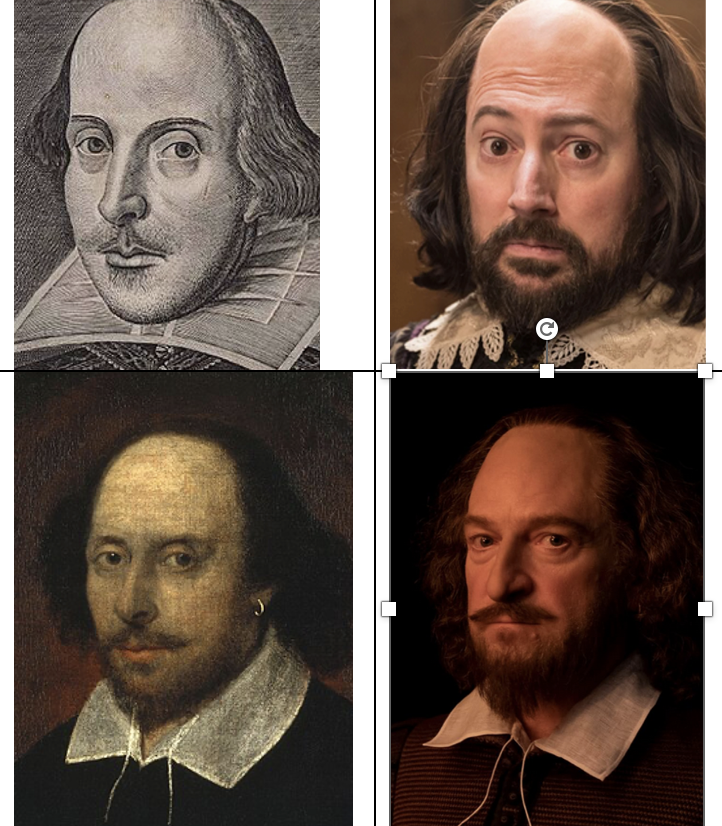
The Droeshut and Chandos portraits, two familiar images, embody two contrasting representations of Shakespeare in Ben Elton’s  biofictions, Upstart Crow and  All is True.

The Droeshut engraving evokes the comic TV sitcom character played by David Mitchell.

The resemblance is short of literal, belied by the presence of a beard absent in the engraving, but richly suggested by the bulbous forehead and receding hairline, topic of a running gag throughout the series.  The actor’s typically bewildered expression conveys what some authorities have found to be a clownish cast in the image.  John Dover Wilson called it “a pudding faced effigy.” Northrop Frye said it makes Shakespeare “look like an idiot.”

The Chandos image renders the melancholy film character played by Kenneth Branagh. The resemblance of images here is unmistakable, confirmed by facial hair and costume, by inclusion of the portrait at the opening of the film, and by Branagh’s statements in interviews that this was his intent and inspiration. Nevertheless, the large prosthetic nose and angry eyes convey a much harder expression than the serene watchfulness of the oil painting. The discrepancy prompts the film viewer to collaborate with its producers in fleshing out a dark view of what Shakespeare’s late years in Stratford might have been like.

This essay explores these correspondences in light of encryption theory, an analytical framework derived from computer science, semantics and evolutionary psychology. (more…)