Author Archive

Zunoquad 3–Canoeing the Teslin and Yukon Rivers (1)

Sunday, September 27th, 2009

Prelude

At the end of last year’s excursion, Peter had suggested that we go on a river trip in “The North.”  Andy came through late in the game, on June 24 with a fully developed proposal:

My work schedule has blown me away for a good part of the year.  As unreasonable as it may seem I have only one window of opportunity for a wilderness trip. I can leave Edmonton on the afternoon of the 8th of September and I have to return to meetings in Vancouver that begin at 6:30 in the evening on the 17th September.

If the timing works then I think we can have a fine time (without the joy of any bugs of the biting variety) in the Yukon from Sept 9th to Sept 17th this year.

http://www.grc.k12.nf.ca/climatecanada/whitehorse.htm

At that time of year the length of day will change from about 13.5 hours to 12.5 hours during that period as the world plunges the North into twilight by November

http://www.timeanddate.com/worldclock/astronomy.html?n=679&month=9&year=2009&obj=sun&afl=-11&day=1

and the temperatures will not sustain black flies and mosquitoes

http://en.wikipedia.org/wiki/Whitehorse,_Yukon#Climate

I am heading up to Whitehorse again on business tomorrow and will try to scope out essentials and good advice from those well disposed to me J in those parts concerning the Teslin River and the Yukon River.

See link below to have confidence that a 7 day trip is possible “ we could likely easily make that distance on our own considering that the guided trip is 7 days on the Teslin¦.I have some friends on Lake Labarge ¦.not related to Sam McGee

http://www.spiritnorth.yk.ca/trips/trip3.html

Within four days ten men had signed up including first timer Allan, a friend of Lionel’s, who volunteered to be head cook.

Steven ordered a crudely produced but authoritative guidebook about the route by local guide Mike Rourke and posted several pages thick with detail. Its  handdrawn maps indicating every riffle and possible campsite proved essential to our daily navigation.

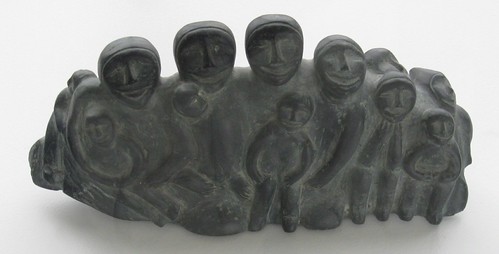
Converging from afar, our group assembled at Vancouver International at the check-in desk of Air North in the early evening, excited to meet again after a year and thrilled by anticipation, a cross between the Fellowship of the Ring and the Three Stooges. The hole left by the absence of Peter, who had bowed out because of a rib injury and family obligations, highlighted the sense of privilege shared by those who managed to get away. The wait in the terminal was enriched by a superb exhibit of Inuit sculpture.

IMG_3347.JPG

Landing in Whitehorse we were greeted by a welcoming face I hadn’t seen in decades: Noah C, whom I, Steve, Ian and Murray knew from Lund since birth, a friend of my son’s, whose parents had also come to live in the woods circa 1970.  He lives there with his family, a teacher of elementary school, handsome, healthy and happy in the place where they say “Down in B.C.”  He agreed to join us at our hotel for dinner.

When we debarked from the airport bus in front of the Best Western Hotel someone in a group of youngsters loitering at the door asked if we were from Whitehorse and when answered no said, “You’re lucky, this place is a hole.”  A few seconds later there was a crash of glass and the smell of gin, followed by a long series of howls as the kids lurched down the street leaving a broken bottle on the sidewalk.

At our long table in the bar, we were also joined by Jonah, a cousin of John’s who lives in Whitehorse, and his partner Monica, two young people employed in the business of recreation that makes this place seem youthful and prosperous –he as a sponsored mountain biker and shop manager and she as a designer.

Day 1

To view a complete set of photos for this trip go here.
To view a slideshow of these photos go here.

Hiking the Nootka Trail (6)

Friday, September 4th, 2009

September 1 Friendly Cove

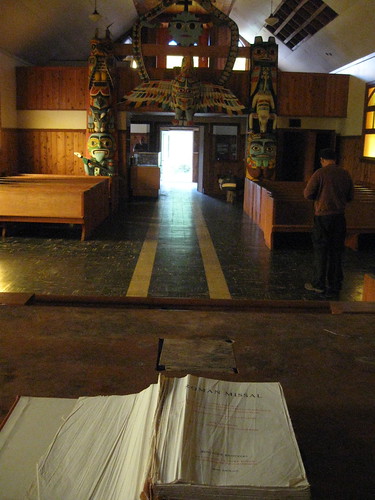
Tuesday morning, we loaded our lightened packs and followed the last part of the trail onto the Yuquot Reserve, passing a group of trim holiday cabins and a cemetery with early 20th century graves marked with stone crosses and a recent one for a seventeen year old girl marked with a carved bear totem. The large campsite adjoining the Church was well mowed but as deserted as the trail had been for the last five days.  We entered the store attached to the church at 10:00 A.M. and awakened the young caretaker, who bore a strong resemblance to the image of Chief Maquinna embroidered on the garments for sale, and who checked our receipts for the $45 we each paid at Gold River for permission to cross tribal land.  He said the boat on which we had confirmed reservations was not expected today and let us into the Church sanctuary, dimly lit by stained glass windows featuring chalices and crosses. On the stripped altar lay an opened Roman Missal, behind it stood two colorful totem poles and at the back of the sanctuary two more flanking a brilliant carved eagle. The incongruous mix of delapidation and restoration was also evident in the vestibule museum, where a ransacked display case and strewn framed historical photographs accompanied posters detailing a recent government plan for developing the whole settlement as a tourist attraction.  Ours were the first signatures in the guestbook for several days, but earlier entries indicated that several hundred hikers had passed through during the current season.

IMG_3264.JPG

IMG_3268.JPG

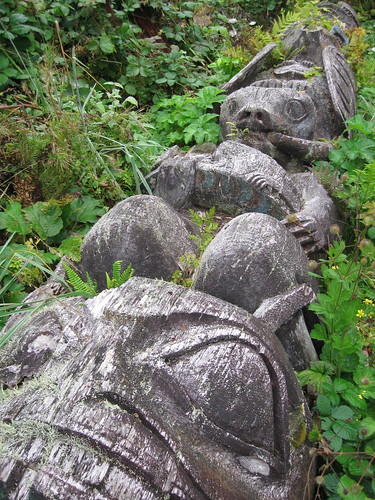
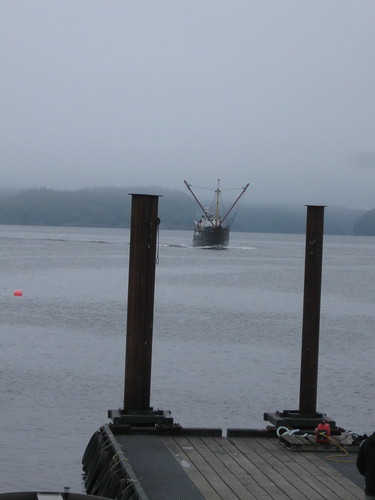
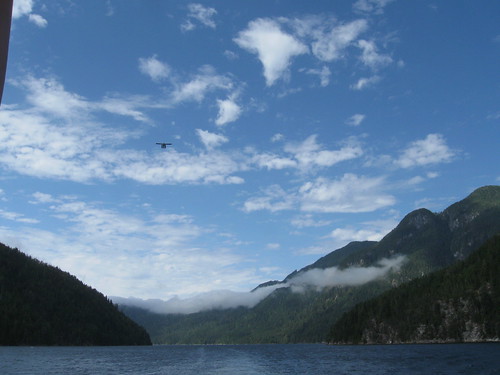
We roamed the paths cut through great mounds of blackberry brambles growing on the site of the old longhouses pictured in the museum and came upon a large fallen totem pole next to a pile of trash.  My book mentioned that this had been carved in 1929 as a gift to the Governor General of Canada who returned it to the Indians along with a chainsaw, which they’d expected in trade.  As we headed for the dock near the Coast Guard station, the caretaker hailed us and said that he’d called the MV UChuck office and confirmed that they were not coming to pick us up today, but that his grandfather could provide us a ride back to Gold River in his speedboat for $300, a discount from the $500 normally charged.  Somewhat perturbed, we thanked him and asked permission to phone ourselves.  The woman at the office said that the boat would be there within the hour as promised, and indeed the elegant old minesweeper turned freighter turned tourist boat soon appeared out of the fog.  In the galley we were amiably welcomed with coffee, home cooked soup and sandwiches. The sky cleared as we steamed up the inlet, escorted by the Air Nootka Cessna overhead.

IMG_3287.JPG

IMG_3291.JPG

IMG_3304.JPG

For a full photoset and slideshow of this day’s sights, go here

Hiking the Nootka Trail (5)

Friday, September 4th, 2009

August 31  Yuquot

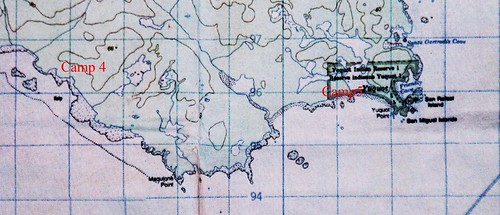
nootkamap_2.jpg

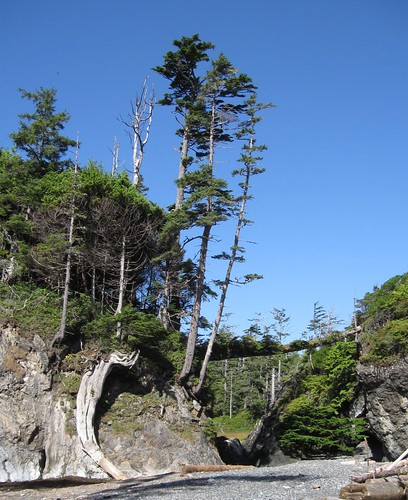
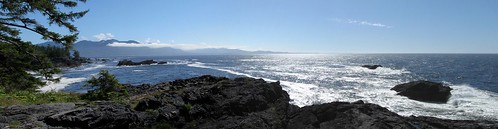
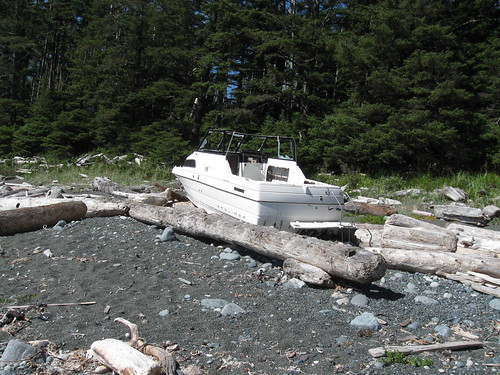
We broke camp early on a dazzling morning, reluctant to leave the cove for the long hike ahead. The trail required travel over headlands with beautiful forest and spectacular views and along small beaches passing a bead curtain waterfall, a thunder hole, ponds and meadows, and a log bridge.  The grandest of the headlands is Maquinna Point, where the coastline turns from facing the open Pacific to Nootka Inlet. We stopped there on a ledge of grass, wild onion and paintbrush to share our last lunch provisions, walk on the jagged abrasive rock and enjoy the 240-degree view. After that we started losing interest in spectacular prospects in preference for flatter ground. The last cove visited by the trail was dominated by a marooned pleasure boat, quite new with hull intact but windshield, cabin and motor smashed and cannibalized.

IMG_3210.JPG

maquinnapointpan.jpg

IMG_3226.JPG

The trail emerged onto the long beach that belonged to the settlement of Yuquot, or Friendly Cove, some of whose history I had read in White Slaves of Maquinna, John Jewitt’s early nineteenth-century account of being held captive by the Nootka chief for two years mostly in this location. (Heritage House Publishing, Surrey BC, 2000) It was the Spring and Summer residence of the Nuuchanulth tribes who resided along the protected beach in long houses that they disassembled every year and transported to their Winter residence up the inlet at Tahsis.  Friendly Cove was also the center of the otter trade during the late18th and early 19th centuries, at one time the most important port north of Mexico. During this time the otter population was virtually wiped out and the native population of the area declined from 200,000 to 40,000. The otters are now making a comeback.

P8290513.JPG

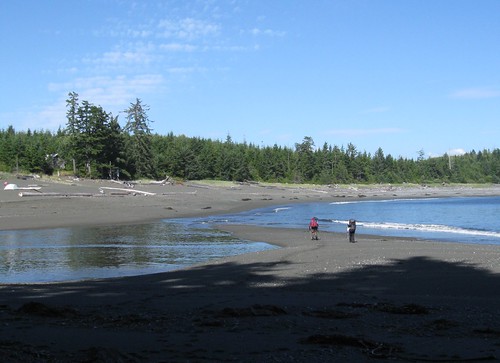
The beautiful views along this beach all seemed to center upon the church with its steep red roof and bright white walls. After Peter’s swim, my nap and Paul’s water gathering, we walked along soft sand and then through the outflow of a tidal lagoon where an older man sat between a small tent and a kayak.  He was waiting for the wind to die down so that he could paddle around Maquinna Point to Calvin Falls to meet a friend of his kayaking from the other direction.

IMG_3228.JPG

IMG_3230.JPG

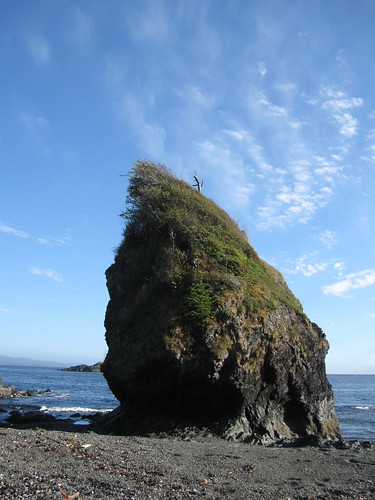
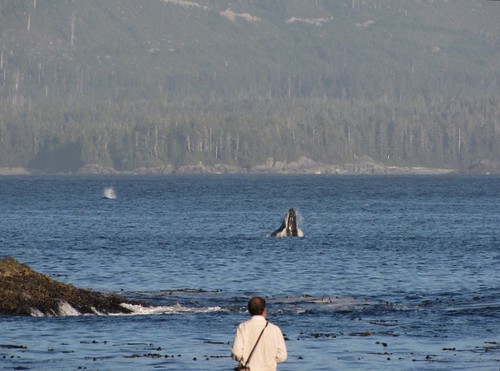
We continued along the beach to a campsite by a seastack, close enough to Friendly Cove to get us to the dock in time for our pickup the next morning. As we unloaded packs, Peter said, “A perfect trip. Cue the whales.”  Within a few minutes the action started out in Nootka Sound, not too surprisingly, since the Indians who lived here were famous as whalers.  First, two Orcas spouting way offshore and coming closer.  Then out near the horizon catching the late afternoon sun, continual explosions of a surfacing humpback, and finally an Orca coming in close enough for Paul to catch him on camera “skyleaping,” a wild behavior that seemed to have no purpose but to entertain us. Peter cooked dinner of beef rotini generously purchased from the Powell River outfitting store, enriched with chanterelles remaining from the earlier harvest.

IMG_3231.JPG

3882161365_731bbf9fca_o.jpg

IMG_3240.JPG

Hiking the Nootka Trail (6) »

For a full photoset and slideshow of this days sights, go here

Hiking the Nootka Trail (4)

Friday, September 4th, 2009

August 30   Marble Cove

nootkamap4.jpg

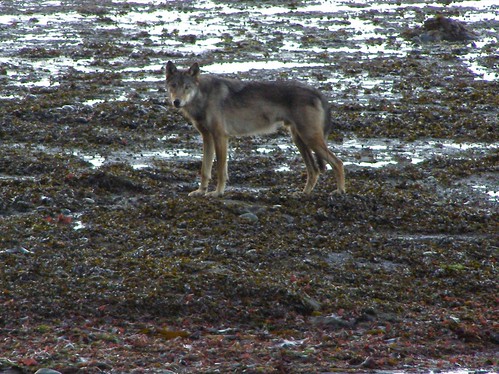
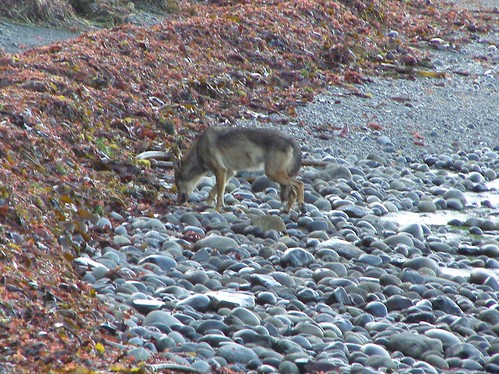
As we loaded our backpacks in the morning, Peter called out “the Wolf !” I looked up, and there it was, fifteen feet away on the other side of the log.  My camera, which I usually carry on my belt, wasn’t working because of a battery malfunction, and I yelled, “get the cameras.” As Peter and Paul scrambled for theirs, the creature stopped and I got my first look at a wolf in the wild.  Rather than the fierce and proud appearance I expected, it seemed hangdog and scrawny, but nevertheless surprisingly large. Its ribs protruded and its face, as it turned toward us, was flat and small-eyed, its legs long, its tail down.  As they snapped pictures, the wolf ambled over to a pile of bull kelp, nosed it disconsolately, stared up at us with an expression of hopeless hunger and moved on.  It recalled the wolf in illustrations of Little Red Riding Hood.

P8280477.JPG

P8280483.JPG

We hiked around the next point and passed a couple of cabins on the bluff above Beano Creek, which our both our trailguide and the pilot had mentioned were not to be disturbed and which were at the end of a logging road that could, before long, allow the trucks into this still unprotected section of the coast to destroy the forests we marveled at. We followed some flagging we thought indicated the trail around the impassable headland ahead up into the bush and ended up behind one of the cabins.  An elderly gentleman yelled across a logged-over patch that we were on the wrong trail and that we should take the bypass further down the beach.  Paul thanked him and then found a ripe red tomato unaccountably left in the middle of the trail. We welcomed it as compensation for our first unsavory reencounter with civilization. An added infusion of fresh produce materialized along one of the arduous bypass trails–a large colony of chanterelles, which Paul and Peter pounced on with expressions of glee.

P8280495.JPG

P8280502.JPG

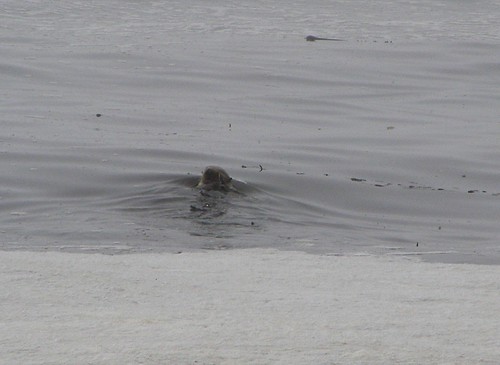
For several hours, the trail alternated between steep headland traverses through old-growth cedar groves and beautiful pocket beaches, including a sighting of a contented looking Pacific otter, the species rendered almost extinct by the fur trade between Indians and Englishmen during the 19th century.  We felt ready to stop at a small cove protected by limestone and marble walls and tall spruce-covered headlands. I climbed a tiny treed promontory that rose from the middle of the beach and Peter and I explored a sea cave at the north end. While Paul set up camp and gathered firewood, Peter took a swim in the rocky surf. I got wet and then lay down and buried myself in warm smooth beach pebbles. Then I cooked dinner of couscous and tuna while Paul sautéed the chanterelles with a garnish of tomato. Sunset and fire rounded off the evening.

P8290520.JPG

P8290541.JPG

IMG_3164.JPG

IMG_3180.JPG

IMG_3181.JPG

Hiking the Nootka Trail (5) »

For a full photoset and slideshow of this day’s sights, go here

Hiking the Nootka Trail (3)

Friday, September 4th, 2009

August 29  Midway between Bajo Point and Bajo Creek

nootkamap3.jpg

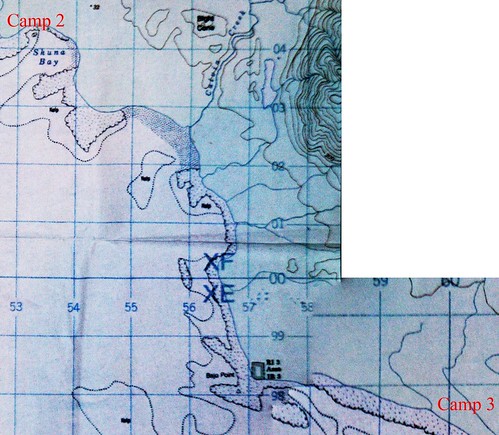
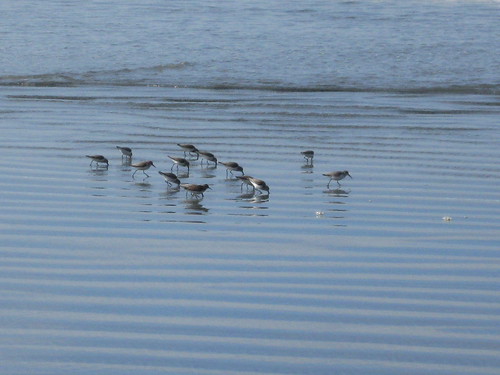
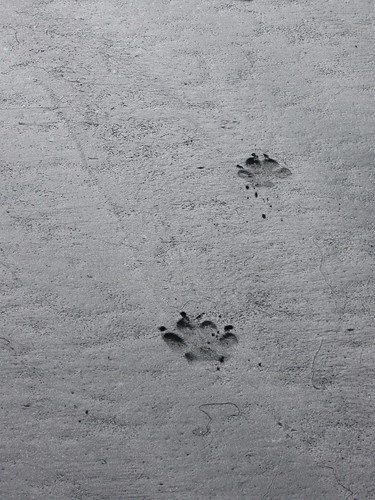
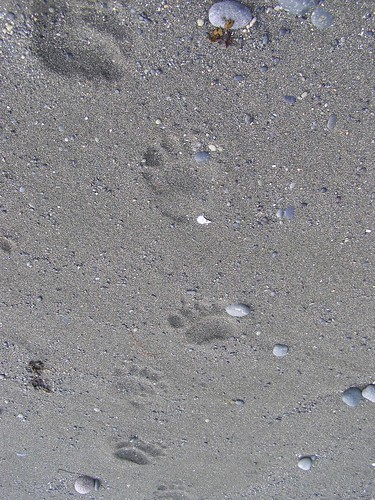
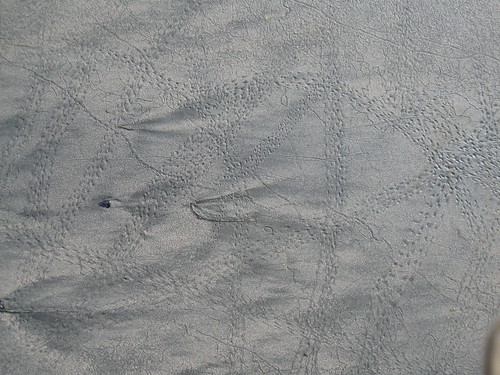
This morning dawned foggy.  Paul had coffee already brewed on his stove as I crawled out of the tent, less stiff and achy than on previous days. Walking on the hard grey sand along the smooth curve of Skuna Bay was fast and fluent.  We were greeted by a flock of killdeer at a little creek’s descent into the ocean.  A distinct track preceded us, which Paul identified as wolf.  For a while it was joined by bear prints and the delicate tracks of killdeer and sanderlings which follow the water’s moving edge, a double oscillation of waves within tides.

IMG_3069.JPG

IMG_3066.JPG

P8280489.JPG

IMG_3063.JPG

As we rounded the point at the south end of Skuna Bay under an awning of horizontal spruces, the sky disrobed, revealing its naked blue splendor and the sun’s brilliance. The top end of the bay where we’d camped remained in clear view, but continued shrinking into the expanding landscape.  Three days now with no trace of other humans”no logged stumps or springboard notches, no boats or planes or even contrails”except for a sprinkling of detritus on the beach: mostly water bottles and net floats.

IMG_3044.JPG

IMG_3062.JPG

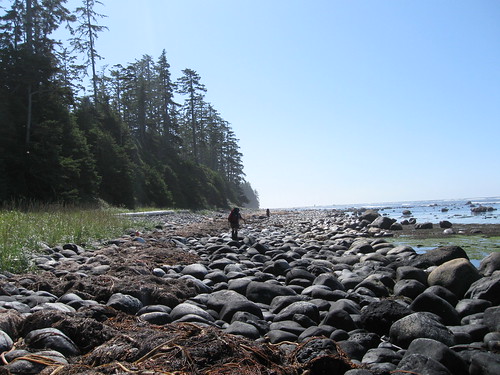
Calvin Falls came into view, a white cascade of fresh water pouring into a deep pool with a slow circular current that empties into an ocean-seeking stream flowing across the wide beach. I welcomed the chance to get out of my wet boots and take a cleansing swim before lunch.  As we continued on, the friendly packed sand was replaced by large polished boulders, at first difficult to negotiate but soon allowing light-footed progress guided by close attention to the steps immediately ahead, enhanced by the stones’ artful variety of texture and color.  Then the boulders got covered with thick deposits of seaweed and eelgrass ripped by storms from kelp beds offshore. We either had to slog through the soft wet piles or balance our way along the driftwood stacked at high tide line. At first the stench was overwhelming but after an hour or so, one got used to it.

IMG_3074.JPG

IMG_3095.JPG

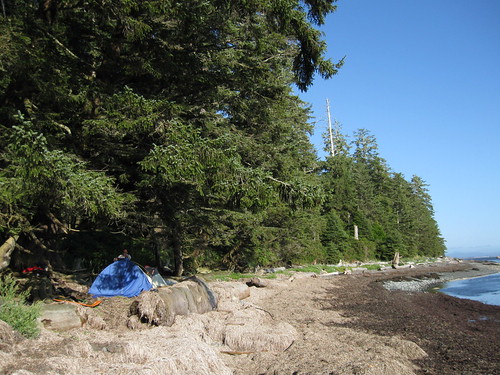
We found a fresh water rivulet and nearby a tent site on a soft bed of rotten eelgrass behind a thin barrier of logs that separated us from mountains of broken bull kelp, giant kelp and other algae that would provide a fortune in sushi, fertilizer and xanthan gum to anyone who could harvest it. After a nap Peter and I headed up into the bush to reconnoiter, drawn by sky visible above the treetops. We tunneled through salal up to a bench where it thins to allow relatively easy walking among widely-spaced first-growth trees and windfalls. We made for a huge gnarled cedar and found around its back traces of removal of cedar planks by native inhabitants long ago. Such “Culturally Altered Trees” provide evidence in present-day land-claims negotiation. We wandered further back along the trunk of a windfall hung up in the crossing of a cedar and a spruce and ended up fifty feet above the forest floor in the middle of the clearing it created.  Peter’s foot dropped through a hole in the moss, but he didn’t fall.  We bushwhacked toward the little creek leading to our campsite on the beach and crossed on a windfall leading to another old-growth cedar with a bear’s lair in its hollow base.  When we returned to camp, we found Paul napping instead of cooking. After a rude awakening he cooked up a much-anticipated meal of jambalaya and sockeye salmon with chocolate pudding for dessert. The incoming tide nudged piles of seaweed into gracefully curved windrows along the shore.

IMG_3147.JPG

IMG_3127.JPG

IMG_3158.JPG

I got up to pee at 1:00 A.M. and was shocked by a bright orange moon sinking behind the shelf it exposed by pulling out the tide.

Hiking the Nootka Trail (4) »

For a full photoset and slideshow of this day’s sights, go here

Hiking the Nootka Trail (2)

Friday, September 4th, 2009

August 28 Skuna  Bay

nootkamap3.jpg

Yesterday’s blasting surf settled to a smooth rush from far offshore across the tidal shelf.  The quiet creek winds through first-growth spruce forest, clear enough for me to explore in my water shoes after the regular post-hike nap.  Many of the spruces are snapped off with a horizontal break at 50, 100 or 200 feet and surrounded by light coming through the hole their fallen tops leave in the canopy.

IMG_3016.JPG

IMG_3012.JPG

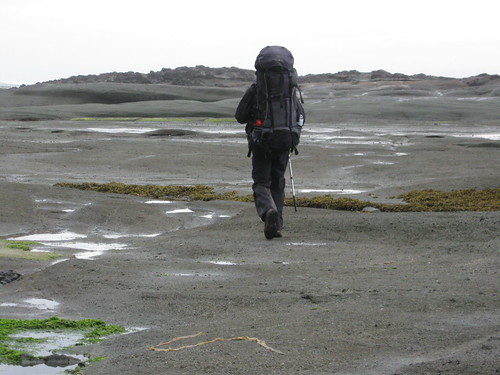
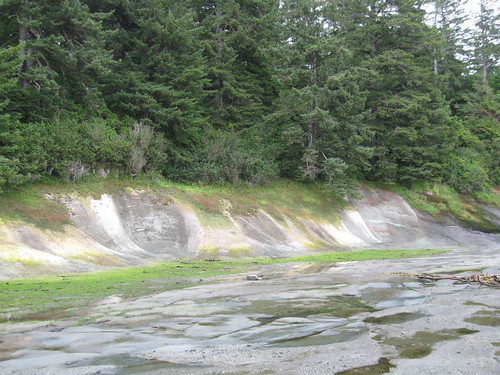
Contrasting to the noise and motion of sea and sky, the creek walk prompted reflection on the unpeopled landscape we’ve been immersed in now for more than 24 hours: the margin of land and ocean varying from forest and rock outcrop to beaches of sand, boulders, pebbles and vast sandstone shelves.

IMG_2987.JPG

IMG_2996.JPG

I wore parka, rainpants and poncho to stay dry through the swamps, fog and drizzle that succeeded the sunshine of our first day. My pants kept slipping down and my glasses kept fogging up from the heat of exertion, especially during the half hour we found ourselves bush-crashing to recover the lost trail.  The weight I’d added to my pack to reduce Peter’s tortured my shoulders until Paul showed me the proper strap adjustment to bring it closer to my back.

P8270416.JPG

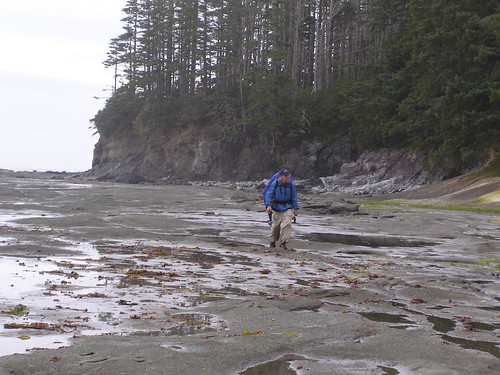
The series of headlands requiring diversions through the bush ended and the beach turned into a flat tidal shelf of sandstone with good traction extending for a mile seaward and disappearing into the fog.

IMG_3026.JPG

Drifting off to nap after the day’s six-hour trek, I counted primal contraries revived by backpacking: wet-dry, hot-cool, cold-warm, hungry-full, thirsty-slaked, tired-rested, anxious-relieved. Now my boots, soaked in the last creek crossing, have dried and warmed by the fire.

Peter provided dinner of Annie’s organic Mac and Cheese, my grandsons’ favorite.

Hiking the Nootka Trail (3) »

For a full set of images and slideshow for this day, go here

Hiking the Nootka Trail (1)

Friday, September 4th, 2009

Prelude

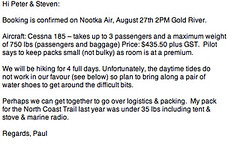
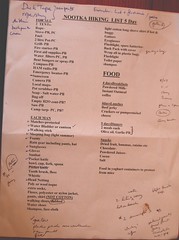
Peter B. had proposed a backpacking trip between the time Jan left B.C. for California and before our trip to the Yukon.  He invited his hiking buddy Paul C. to join us on the West Coast Trail from Tofino to Bamfield, but there were no reservations available for that heavily traveled route, so he suggested we do the Nootka Trail, a less known but comparably grand and remote wilderness experience. I agreed, as usual, to follow his lead, and he and Paul together did the research and made the necessary preparations, including getting plane and boat reservations, trailguides and maps.  After it took me almost a full day just to shop for my own provisions and pack for a six-day expedition, I felt grateful for all their legwork.

flightreserv.jpg

IMG_8193.JPG

August 27  South of Third Beach

nootkamap1.jpg

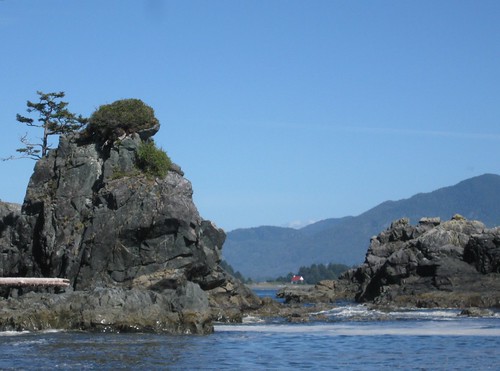
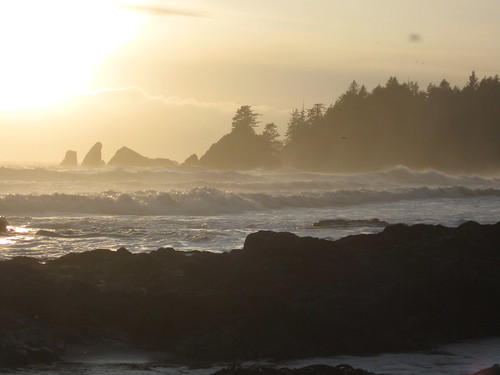
The sun drops into a rising fog bank above distinctive trapezoidal rocks and a tree-topped headland. The waves’ roar has been unabated since I first heard it deep in the forest on the trail from Louis Lagoon.  White tips are painted on the crests of broken rollers. The thunder of water colliding with stone vibrates in my gut. Thick foam left by turbulence and mashed red-tide algae accumulates on the beach. This is wilderness West Coast.  Nothing but the tiny settlement of Friendly Cove until Tofino, 75 miles to the south and only small towns fifty miles back up the inlets where the mills used to churn.  But before contact with Europeans in the late 18th century, this seacoast was home to hundreds of thousands of people for five thousand years.

IMG_2975.JPG

IMG_2957.JPG

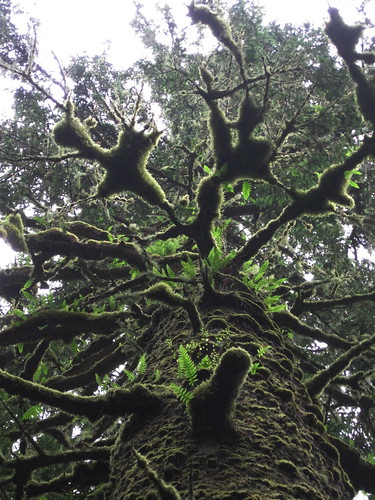
We were conveyed here by ferry across the Georgia Strait from Powell River, by Subaru to Gold River, by Nootka Air Seaplane to the Lagoon and by our feet across an isthmus of old growth cedar, hemlock and spruce on a rough trail cut and maintained by volunteers.  It winds through tangles of roots and windfalls obscuring the borders between ground and growth, living and dying. Immense trees, leaning and erect, sprout from fallen nurslings and grizzled snags to reach for sky.  Underfoot, ferns and bunchberry capture spots of sunlight that penetrate the dark canopy.

IMG_2921.JPG

tallcedartilt.jpg

I walked at a slug’s pace to balance the weight of the pack and spare my knees, and also to gaze at a living world hardly disturbed by humans.  It feeds, aspires, grows, strengthens, procreates, cooperates and competes, weakens and dies as we do, at a different temporal scale and speed.

IMG_2930.JPG

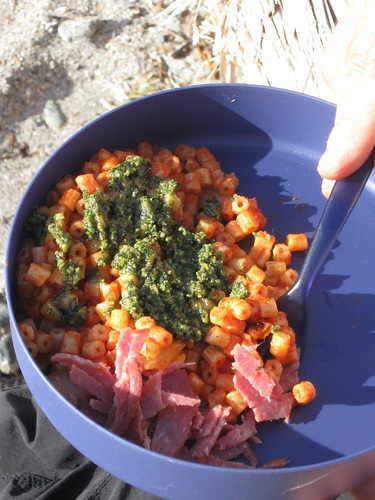
We found this campsite not indicated in the guidebook. It provides water to try out Peter’s fancy ozone generating purifier kit, which no one likes.  After an aperitif of whiskey from the plastic bottle, we were excited to share our first dinner: sautéed garlic and onion, tiny pasta rings, tomato sauce, fresh pesto I bought from Pat Hanson, and a little bit of sliced cervelatwurst, a guilty pleasure on my cholesterol-free diet.

IMG_2965.JPG

IMG_2972.JPG

For a full set of images and slideshow for this day, go here

Hiking the Nootka Trail (2) »

Alone

Tuesday, August 25th, 2009

Those morbid reflections were interrupted by Jan’s suggestion we go on a hike this last morning of her stay.  She’d been gloomy about leaving without me to face family and political challenges alone in San Luis for several days, and I welcomed the idea of doing something before Juliets birthday party in the late afternoon.  It was a brilliant day and we agreed on trying out the Atrevida Loop, a nearby trail I’d never been on.  I carried the big pack again conditioning for the Nootka Hike.  The trail was gentle and soft, dark under the cover of large second growth forest that one could see through for long distances and punctuated by the odd hemlock branch or sword fern illuminated by a shaft of sunlight. Our isolation from one another gave way to easy conversation, free of ponderous repetition and anxious complaints, enlivened by the promise of making love that night.

A slight steady whooshing sound interrupts these jottings, perhaps a truck approaching down on the highway, but then growing closer and recognizable as rainfall on the roof.  The drops not visible through the little window on my left, but showing on the deck and then audible as such on the kitchen skylight.  A golden patch on the moss and white lines on the eastern side of the tree trunks is cast by the low sun. The hum on the roof recedes, replaced by the buzz of the fridge.

At times we were quiet, just walking together, each absorbed in wonder at the hushed vitality of the world through which we traipsed; the duff-covered trail, the roots protruding from moss and gripping the broken rock, the ragged walls of interlocked root and soil and rock becoming soil formed by upended platforms at the base of windfalls, the furrowed bark of fir trunks splitting by rapid growth from inside, in fluted columns thrusting the green canopy hundreds of feet into the sky, the sour-sweet fragrance of damp alder leaves, the spongy feel of rotten wood underfoot, dropped there in chunks when the snag succumbs to gravity and decomposition–all summoning memories of living on the farm in the midst of this burgeoning growth and decay.

The trail was marked by iridescent red diamonds nailed at eye height on trees by Eagle and his friendly crew and also by an unsettling array of surveyors tape and spray paint marks suggesting that before long this quiet self-sustaining ecosystem will once again be denuded by chainsaw and ravaged by bulldozer, and that the trees now standing between the huge stumps of the original old growth forest destroyed a hundred years ago will themselves be rendered to stumps and join their forbears protruding from piles of dry dead slash. Instead of making a loop, the trail we followed converged with the Sunshine Coast Trail which we agreed to follow northward for another half hour before heading back the way we came.  The forest here seemed older, the spaces between trees wider, the floor covered with recognizable old growth nursling trees that must have fallen before the first loggers came through. A short section of the trail passed by six living ancient firs saved by accident and the trail makers’ designs.  At 11:30 we stopped for lunch sitting on the soft bench of a moss-covered cedar, munched crackers and pesto and apple and talked of how evolution may or may not account for us and the world we were immersed in, cued by Jan’s reading of Jarrett Diamond,’s The Third Chimpanzee and my reading of The World Without Us.  The exercise and the damp air of the forest and the subdued light made her look beautiful.

Upon our return to Knoll House, we both took short naps.  Juliet called and asked that Jan come early to her 64th birthday party, and while she prepared devilled eggs, I went down the driveway across the highway and in one hour in the hot sun picked a gallon of blackberries puzzling about how evolutionary adaptation could account simultaneously for the perfumed and sugared attraction of the fruit and the painful repellent of the thorns.  Back up the hill, I cooked the berries with sugar, cinnamon and the pectin Jan had bought, sterilized jars and canned eight of them for gifts to take back to California.  I dropped her off at Juliet’s and headed down to Okeover for a swim.  The tide was way out and a large multigenerational Chinese family were digging clams as I threaded my way across barnacled rocks and shells thankful for my water shoes.

We were the earliest guests at the party, drinking beer and following the last rays of warm sun in Steve’s beautifully sculpted back patio, talking of their travels to India, of our projected trip to Japan, of our hike and of course of the old days.  Tai and Theo, Peter and Ronnie, came and joined the circle, he describing a brutal ascent of 19000 foot Mt. Kilimanjaro he had undertaken earlier this year while sick with a cold. Then Peter and Margaret, Dylan and Amanda and Sage and his little brother and Sherry and Barbara and Roger Langmaid with whom I talked about David Creek, her former husband, whom I hadn’t seen since  1975, and Pam Begbie, and new people, Jack and David, and then it was time to eat and then Jan drew me back to Knoll House at 8:30 before dessert or present opening for our appointment, and then our bodies returned to each other in their fresh and blooming youth.

Yesterday, the long anticipated separation date of August 24, Jan finished packing and we went to River City for breakfast and internet. I left her at the airport and headed back to the coffee house where I spent a couple of hours processing and loading pictures to Flickr. When through with that around noon, I felt a familiar sense of isolation and disorientation; my Siamese twin fell off, what hit me? I checked Craigslists for boats, but also personals”first and predictable tropism of separation from Jan”but nothing in P.R.  I knew I had shopping to do for the upcoming hiking trip, but felt incapable, just like retreating home and crawling into bed. I went to the terrible bakery on Joyce just to quell hunger and got a cold and nasty slice of pizza, which did provide a little bit of restoration, then drove down to River City books, where I couldn’t find a map of Nootka, then got back in the car drove down Marine and up Willingdon looking for other outfitters or health food stores, and slowly drove by a new place advertising adult entertainment and then drove back to River City where I ordered coffee and reopened my computer and got serious about making a shopping list.  This took close to an hour, but reoriented me to tasks and problem solving.  I went next door to the outfitters and spent a half an hour shopping for a rain parka, leching the 55 year old nervous sales clerk until I was turned off by her breath and by my own jowly and wrinkled image in the mirror. Then I drove back up to Quality Foods with my grocery list, realizing that there were only two days more before our early departure for the Island and I needed to get the job done now, and that it was already too late in the day to start the Prodigal summer writing project.  I spent a long time picking out dried fruits and nuts, and while gazing at the smoked salmon heard a voice saying “Don’t buy that its poison.”  It was Michael F. pushing a grocery cart.  I said I’d been planning to visit him this afternoon and tour his subdivision. He said fine.  After about another hour of shopping for the meal by meal backpacking, I picked up a cooked chicken and then drove to Michael’s and invited him for dinner. He led me down to the two chairs by his new pond fed by a bubbling artesian spring, the sunny weather now having given way to gray, and he threw food into it for the leaping many colored fish and waxed lyrical about the family of wood ducks that have taken up residence there. He spends at least an hour a day sitting here feeding the fish.

He drove me along his new roads, including the $300K stretch of Edith Road, out to the bluff above our old farm where he hopes to build his own house once having sold his lots and where we admired a grand view of the Strait and the islands.  Then we went back to his mobile home and he phoned a Vancouver Real Estate broker who will fly up to see the subdivision on the weekend.  I drove to Knoll House and prepared dinner and Michael showed up soon thereafter with another $30 bottle of wine.  We ate and drank and looked at old pictures and remembered old stories and newer ones and finished another bottle of wine and parted with hugs.

I washed the dishes and went to bed at 10:15 and woke up at 6:00 from a dream of running a camp where I couldn’t get the counselors or the kids under control and where I just wrecked a car we needed to transport stuff by pulling the doors out of alignment driving through the bush. I bathed, shaved, took my pills, made the bed, did stretches, meditated a long time, ate a bowl of cereal and realized that there was still a good deal of packing work and trash burning to do, and that simply keeping this journal most likely would be as much writing as I could accomplish today.  I’ve been at it for three hours.

3:30

Was it three or four hours that I wrote the previous entry? I did sort pills and clothes and camping gear and food and packed my backpack.  Along with snack breaks, that took another two or three hours.  While I usually just throw things into a pack and suitcase hoping for the best, this five day trip required that I take care not to bring too much weight but enough to avoid going hungry, wet or cold.  That meant deliberation about which thermarest to select, whether or not to put the sleeping bag in a dry bag, and do I bring one or two cans of tuna to liven up the couscous dinner. Having loaded up the pack, I burned trash and then evaded Darwinian literary studies by returning to Steven Pinker’s new book, The Stuff of Thought.  Thirty or so pages and a short nap later, I’ve prepared a cup of Earl Grey tea and returned to the computer, here to list my current options: 1) read and revise the morning’s writing 2) go on a trip to Ervington’s to retrieve my hat and flashdrive and swim at Okeover 3) find and hack a route from the moss trail to Krompocker road 4) finish cleaning up the mess on the bluff with the chainsaw 5) explore the property between the new section of the moss trail and the highway 6) play the recorder 7) read my Prodigal Summer notes. (4:45)

The World Without Us

Friday, August 7th, 2009

Waking up at dawn under an orange full moon above Savary in pure silence. Since we arrived, day before yesterday, smoke from the fires on Vancouver Island has hidden the mountains that normally create the beautiful horizon line.

Before the children and grandchildren arrive, there is time to read and a wealth of comfortable chairs and couches at Knoll House for the purpose. I’m halfway through a book that I bought on impulse at Powell’s in Portland on the way up here because I’d heard about it from several quarters: The World Without Us.  It places many of the events that cause me anxiety in a framework that both magnifies their horror and reduces their pain by turning them into enthralling catastrophe narratives. If humans were gone from New York and the pumps that keep the underground city from flooding stopped working, the water would fill the subways and rust the foundation piers of the skyscrapers.  Within a few decades the whole thing would have collapsed into a landscape of rubble covered with forest. Elephant herds would multiply in Africa, restoring jungle to grassland. Untended corrosion in the chemical plants along the Texas Louisiana coast would cause explosions and toxic spills that  eventually would be cleaned up by bacteria evolved to do the job.

Its good to be reading this in B.C. where keeping back the bush requires continuing human effort without which cars and homes and cleared land can be seen succumbing to the engulfing monster of natural reclamation”as heartless and inexorable in its way as loggers and bulldozers chewing up the woods.  Where Joe and I felled a dozen fifty-foot jackpines threatening the house last summer, the opening is now filled with brambles and dandelion-like weeds I started cutting yesterday. I can hardly wait to fire up the chainsaw to clear windfalls blocking the trails I’ve carved over the years.  Imagining the relatively short interval required to neutralize the growing impacts of humans on mother earth serves as an antidote to my fear that what Bill McKibben predicted 20 years ago as the End of Nature will soon be upon us.

Aesthetique du Mal

Thursday, August 6th, 2009

A review of To Speak, To Tell You, Sabine Sicaud 1913-1928
by Odile Ayral-Clause

Natives of poverty, children of malheur,
The gaiety of language is our seigneur.

Wallace Stevens

Odile Ayral-Clause is an emissary from the land of beauty in anguish.  With a voice both urgent and composed, she leads the reader to the lives and works of individuals who have extruded art from tragedy and pain. In her previous book, Camille Claudel, (Abrams 1990) Ayral-Clause delivered a definitive biographical and critical study of the person famous as the pupil and mistress of Auguste Rodin, but less known as a brilliant sculptor herself, one whose free spirit and talent were crushed by the ravages of mental illness and forcible incarceration in an insane asylum for thirty years by members of her own family.

In a new book, To speak, To Tell You, Ayral-Clause introduces Sabine Sicaud, a child-poet recognized during her own brief lifetime from1913-28 but largely forgotten since.  While Claudel lived to age 89 having spent many decades in joyless and unproductive isolation, Sicaud died at the age of 15 after a year of excruciating suffering brought on by a rare untreatable disease under the care of loving parents who fostered her creativity but couldn’t alleviate her torment.

To Speak, To Tell You? includes 50 of Sabine’s poems, in the original French and in face-en-face English  translation by Norman R. Shapiro, a distinguished scholar and translator, along with a 40 page introduction, explanatory notes, and annotated bibliography by Ayral-Clause.  The volume also contains numerous antique photographs of Sabine and of the family estate, La Solitude, that many of her poems make familiar.

The title Ayral-Clause chose for the book is part of a first line which concludes, “No I cant.” The line exemplifies the oscillations between extreme emotions shaping each poem and the collection as a whole. The poet reaches out to the reader to establish a connection, to beg for rescue, then senses the inexpressibility of her pain and takes some comfort from resentment and self-pity, which is itself undermined by self-irony, leading to another kind of relief in humor, detachment and equanimity.  On the way she shifts her appeal to a bird on a branch and a leaf on a tree, finding in the mute existence of other living beings some companionship and promise. (more…)