Miscellaneous

Obama in Nepal

Saturday, November 22nd, 2008

Jan & Steven:

Congratulations on helping create an amazing shift in US politics. This may be the most optimistic time since John Kennedy was elected.

The Nepali woman in the picture runs a “tea house” which is a hostel with a primitive restaurent in a very isolated location along the trail to Everest. There is no road or even a village there. Her husband is a sherpa who climbed to the top of Everest a few times.

Notice her button. They had a party when Obama won. …

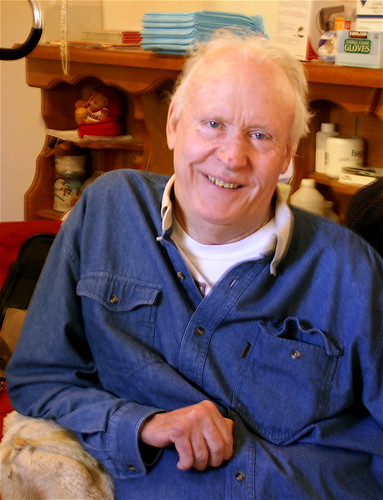
Peter

A Letter from Washington

Friday, November 7th, 2008

This message arrived the day after the election.

Friends,

Each of us has had their own window on the events of the past 24 hours, and their own story to tell. I want to take a moment to share with you what things look like through my window right now.

As the west coast results came rolling in at 10:00 pm last night,Susanna and I were riding with some friends through the geographic center of DC’s African American culture, and the epicenter of the riots that ensued here after Martin Luther King Jr. was assassinated in 1968, and the area in which we live. We knew the election had been decided when, as we dismounted our bikes, strangers ran up and hugged us. People poured out onto the streets chanting and singing and crying and dancing. As we approached the street corner, the rhythm found us. The sound of twenty drummers on djembes, bongos, snares, symbols, shakers. The sight of a growing mass of hundreds, then thousands, in a frenzy of hugs, tears, jumping, dancing, and chanting. People hailed the crowd from the tops of lamp poles,  tall trees, bus shelters. We were enveloped in a smiling sea of white, black, brown, red, yellow, young, old. A few elderly black men and women – those who had grown upforbidden to share a water fountain or attend the same school as their white peers – stood on the sidelines, just shaking their heads slowly, repeating the words “I don’t believe it. I don’t believe it.”

Understand that racial divides have remained strongly palpable here even in the absence of overt violence. This city is a prime example, and while there are many important exceptions, my experience here has been largely one of segregation – geographically, economically, culturally and socially. This majority African American city, for example, has one of the most abysmal education systems in the country and an HIV infection rate that is 10 times the national average and largely concentrated in the black community – a fact attributable in various ways to socio-economic conditions. This country has simply not dealt with its racial wounds, yet seems somehow shocked when then bleed and get infected. Here the relationships between blacks, whites and latinos is not a mosaic, not a melting pot, but mostly a guarded tolerance that is heavy on the streets. Lets just say that bear-hugs from random six-foot-six black men aren’t something I have come to expect. (more…)

Election Day 2008 (2)

Wednesday, November 5th, 2008

Andrew, our local Sierra Club Chapter director, sent out an email several days ago headed “All Hands on Deck,” urging members to attend the County Board of Supervisors meeting scheduled for Election Day.

It was considering a proposal for a vast and ill-planned subdivision on the Santa Margarita Ranch, the last intact old Spanish Rancho in California, a splendid tract of land just a few miles out of town.  The proposal, which required a 1200 page Environmental Impact Report including the revelation of 10 class one unmitigable negative impacts, had been presented before the Planning Commission a month ago, drawing spirited opposition from neighbors and environmentalists among others.

The Chair of the Commission had pulled a procedural ploy to force a vote after only a couple of hours of hearing, requiring the rest of the Commissioners to either approve or reject the application before considering the Environmental Impact Report in detail.  The majority rejected the plan, but either way, the developer won, since the project could immediately be appealed to the Supervisors.

The current Board majority was recently voted out of office because of their outrageous bias in favor of developers, but still could approve this project in the month before their terms ended and the new, more environmentally friendly board was seated.

The item was placed at the end of the agenda, close to the time that the Board would have to adjourn to allow for the ballots to be counted in the County Building.  Jan dropped me off there around 3:00, on the way to setting up her Election Night party at Linnea’s. I sat in the Chambers and wrote down what I wanted to say.  It turned out that the County Staff’s rebuttal of the Developer’s appeal was so lengthy that the meeting was adjourned before public comment even started, and the hearing was continued until November 18.  But at that point my remarks will have lost their timeliness, so I’m recording them here:

It’s an ironic coincidence that the Board of Supervisors is considering this proposal after many years of controversy on a day that marks the end of an era in our country.

It’s an era that’s been repudiated by most candidates for public office up for election, including both candidates for President.

The era that’s ending is one of private gain over public interest, an era of mortgaging the future assets of our children and grandchildren for the present benefit of the wealthy and well-connected few.

It’s an era of ignoring the consequences of untrammeled economic growth for our immediate environment and our global climate system.

Thankfully that era is coming to conclusion.

The strategy of the appeal in front of you is to get the present Board to act today to overrule the determinations of its own Planning Commission and staff in favor of land developers before the newly elected Board is seated in two months.

This strategy is a desperate effort to avoid the kind of change that the nation, the state and the county are now eager for. This strategy is an effort to allow the loosening hand of the past to retighten its grip on the future.

I ask the Board to reject this backward-looking appeal.  Doing so will allow time for the developers to create a new proposal that will not create ten class-one negative environmental impacts nor require an appeal of staff and Planning Commission findings.

Election Day 2008

Tuesday, November 4th, 2008

A time of waiting.

The email Jan sent this morning to all the people who aided in her campaign:

Thank you for all your hard work on my campaign.  All precincts have been walked, all signs posted, all letters to the editor published, all events beautifully hosted and productive, and all campaign materials distributed. We have all done our level best, and win or lose, deserve to take a bow. See you tonight at Linnea’s 8-11!

Gratefully yours,

Jan

Sunday morning I got a call from Megan, one of the students I’ve worked with on Focus the Nation at Cal Poly for the past year.  She was in Las Vegas walking precincts to get out the vote for Obama but wanted to let me know that she’d found a couple more volunteers to talk to residents and distribute flyers in student residences for Jan.  Cassidy biked over on Sunday and took a couple of hundred and spent three and a half hours canvassing Sunday night, and Tyler biked over yesterday and took 150 to pass out in Mustang Village before his 2pm class. (more…)

Parental Pride

Friday, October 17th, 2008

Hi Guys

The race in Nevada was great.  Desert.

here’s a link to the sustainability conference coming up in SV: http://www.sunvalleysustainability.org/sus_tour.php (scroll down to fifth item)
Our spec is on the tour.

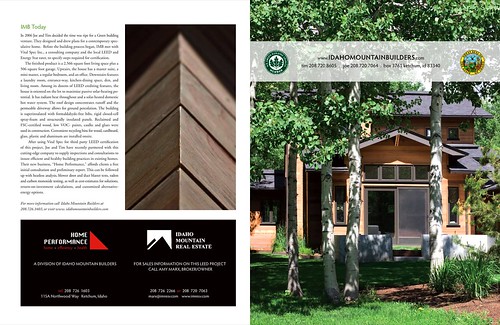
If you get a chance to go to Barnes and Noble see if they have a copy of Sun Valley Home.  Our house and family is in the latest issue.  Check the last page. http://www.sunvalleymag.com/Sun-Valley-Home-and-Design/Fall-2008/Urban-Urbane/index.php?cp=2&si=1#artanc

I hope the campaign will be followed by champagne.

Love,  JOE

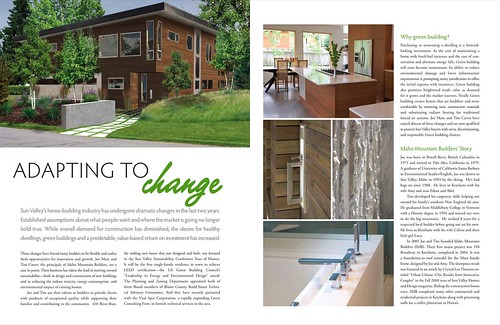
One email, two links.  Our son, age 37, has earned professional fame and recognition.  He’s become an architect without architecture school. The author of the article in Sun Valley Home and Design Magazine calls the staircase he created “an almost transparent work of art.”

Though still an off-road motorcyclist, he’s become a green builder. His blurb at the Sun Valley Sustainabiity Conference tour says, “We are treating LEED as a necessary component of responsible development, not an expensive additional feature.” He builds “relatively modest” homes in one of the world’s most exclusive locations.

Though still one of the boys, he’s a family man.  The magazine article brings honor to his wife and children.  And through a June article in the Idaho Statesman featuring him as outdoorsman on a backpacking trip, he brought honor to his son, his nephew and his dad.

God and Nature: The Poet’s Vision

Thursday, October 16th, 2008

An Address to the Estero Bay United Methodist Church
October 19 2008

Introduction

Thank you for inviting me here to speak today. I’m honored to be part of your series on Religion and the Environment.

I’ve taught courses at Cal Poly on Environmental Literature and on the Bible as Literature and in Literature. This is a place where those topics converge.

Two Books: Scripture and Nature

There’s a powerful idea set forth in the writings of St. Augustine and earlier, that God created the universe as two books: the book of Scripture and the book of Nature. Scripture and Nature are both expressions of God’s word; both are intelligible codes that decipher and reinforce one another. This idea of the two books has been propounded by thinkers who attempt to reconcile theology and science, from St. Thomas Aquinas in the twelfth century and Galileo in the seventeenth, to present day exponents of creationism and intelligent design.

But rather than as philosophy or theology, I’d like to explore the idea of the two books as a poetic metaphor”a figure of speech that stimulates the imagination. Here it is elaborated in Psalm 19:

The heavens declare the glory of God;
the skies proclaim the work of his hands.
Day after day they pour forth speech;
night after night they display knowledge.
There is no speech or language
where their voice is not heard.
Their voice goes out into all the earth,
their words to the ends of the world.
In the heavens he has pitched a tent for the sun,
which is like a bridegroom coming forth from his pavilion,
like a champion rejoicing to run his course.

The statement that the heavens express the greatness of God includes an enthusiastic outpouring of figurative descriptions of the sun: it’s a bridegroom before or after consummating his love, it’s a race horse in action. These go beyond just elaborating the point about God. With sound effects and imagery they awaken the experience of the sun’s brilliance and energy in the reader’s mind. Both nature and the author of scripture are exuberant poets. Both the world and the word are books of poetry.

A close look at its language as poetry illuminates the first chapter of the Bible, Genesis 1. It chronicles the process of the creation as an orderly, intelligible, symmetric, and progressively more complex sequence of steps, each building upon the previous one.

And it characterizes the process as the creative effort of a poet:

the earth was formless and empty, darkness was over the surface of the deep, and the Spirit of God was hovering over the waters. And God said, “Let there be light,” and there was light. God saw that the light was good, and He separated the light from the darkness. God called the light “day,” and the darkness he called “night.”

The creator starts with a dark confusion over which he hovers tentatively, gathering his wits, perhaps waiting for inspiration. Then he finds words, then he utters words, then he materializes the words, then he evaluates the outcome, then he names his first creation like the title, or a section of a larger structure.

Genesis dramatizes the work of the creator in carrying out this process: it is deeply satisfying. He regards each of his accomplishments separately as “good,” and at the conclusion of the whole process, “God saw all that he had made, and it was very good.” The effort is also depicted as tiring. “By the seventh day God had finished the work he had been doing; so on the seventh day he rested from all his work.”

The language of the narrative draws attention to itself, becoming more expansive and lyrical as the story proceeds from the 48 sparse words of the first day, which differentiate light and darkness, to the sixth day’s 260-word description of the ecological web of relationships among all living creatures. Yet it also retains a uniform pattern of meter and parallelism to emphasize the coherence between the parts and the whole.

(more…)

Yom Kippur 2008

Saturday, October 11th, 2008

The holiday began with Ian cutting chard leaves and eating them cooked, then playing the letter game with me on the floor after supper.  A return to the rapport we used to share when he spent more time here, not just intervals between school and home.

I’ve anticipated this holiday for weeks, though  I wasnt sure I’d be able to get away.  I didnt pack my gear until just before leaving last night. I’ve been longing for a respite from the campaigns–Jan’s and Obama’s–and from my own compulsive clicking on  the news of world economic collapse.  I’ve found surcease only while working in the garden and on my upcoming talk on “God and Nature” for the Methodist Church in Morro Bay.

After Dennis took Ian home last night, I pedaled across campus toward Poly Canyon.  Car, bike and pedestrian traffic bustled on the approaches to the new residential complex at its mouth.  The parking structure, swimming pool and athletic field lights cast a garish glow on the huge eucalypti and the mountainsides, but halfway up the canyon it was replaced by moonlight and the hooting of owls. Beyond the Peterson Ranch buildings, I crossed paths with two other bicyclists wearing headlamps as bright as an automobile’s.

I parked the bike by the dirt road near the junction of the south and middle forks of the creek at the base of Cuesta Ridge, a spot insulated from noise and open to a broad sky.  The cricket sounds were overtaken by the rising and falling roar of a crowd way back on campus, probably a soccer game.  By the time I’d finished unpacking and fiddling with my camera, the roar disappeared, and the chorus of crickets returned, now with its own throbbing pulse, like the sound of the stars. Through my binoculars I saw black shadows of mountains on the bright side of the half moon’s dividing line and white summits peeking through the dark side.  As I settled into my sleeping bag, a family of coyotes yodeled to one another across the valley.  Overhead, a shooting star stitched in and out of existence.

I awoke at 2:30. The moon had set and Orion stared down at me. I rested my camera on my shoe and took a fifteen second exposure with manual focus at 1600 ISO.

(more…)

Think Global, Write Local: Sustainability and English Composition

Thursday, July 24th, 2008

A Presentation to the UC/CSU/CCC Sustainability Conference
July 31-August 3 2008

Introduction

Ecocomposition is a new subfield in teaching English.*

I’m motivated to practise Ecocomposition by two principles, the first enunciated by David Orr in 1994: “All education is environmental education,” the second by George Orwell in 1946: “When I sit down to write ¦, I do not say to myself, ˜I am going to produce a work of art’. I write ¦ because there is some lie that I want to expose, some fact to which I want to draw attention, and my initial concern is to get a hearing.”

An essential element of Ecocomposition is local knowledge–engagement with one’s own particular place and time. Preparation for Ecocomposition requires teachers to be interested in their surroundings”the academic institution as not an ivory tower, but rather a physical, economic and political entity in history, situated on the land and in the community.

In keeping with these principles I’ll talk about Ecocomposition locally rather than abstractly: my experience of teaching it during the last three years here at Cal Poly.

In 2005, as the environmental crisis deepened and the Sustainability movement grew, I thought I could make an impact by reaching first year students and by framing the subject matter in the context of rhetoric”that is, the power of persuasion. So I designed a section of our first quarter required English composition course and called it Writing About Place

(more…)

Wedding Ceremony for Emma and Travis

Saturday, July 19th, 2008

Processional”Guitar music by Elijah

  • Groomsmen and Groom
  • Bridesmaids
  • Bride and father

Chant

Wedding is great Ischel’s crown:
O blessed bond of board and bed!
‘Tis marriage peoples every town;
High wedlock then be honoured!

(Shakespeare, As You Like It, Act 5 with slight modifications)

Greeting

Welcome to you all and thank you for attending this marriage ceremony. I’m Emma’s Uncle Steven, and I’ve been honored to be invited by her and Travis to conduct it.

The act we are about to perform together is universal. The words we repeat”some from the Bible, some from Shakespeare”have been uttered over and over for thousands of years. They lift us out of the flow of past, present and future into an interval of sacred time.

The space where we’ve assembled is sacred as well. Thousands of miles from home, we’ve all flown here through the air and endured an arduous jungle voyage to the edge of a foreign land and an unfamiliar sea, where ancient people erected fantastic cities devoted to ceremony and ritual.

It is this presence that the bride and groom will revisit whenever they remember their wedding in later life.

(more…)

RSVP

Friday, July 4th, 2008

Hi Verandah

Thank you for the invitation to the fortieth anniversary celebration at Packers Corners and for your handwritten note. Jan and I would love to attend, but regrettably that date coincides with our yearly pilgrimage to Lund British Columbia where we established our own total loss farm thirty eight years ago.

Your invitation has spurred me to delve into the collection of relics of our days in Vermont I’ve stashed in a file cabinet, and has brought our stays there both in the period 1968-70 and our visit with you and Marty in 1993 vividly back to mind, accompanied by great gasps and sighs.

Forty years seems a particularly powerful interval. Perhaps the the rounder number of 50 will be as strong, but I suspect by that time many more of us will have dropped out of sight and those who remain will be pretty unsightly. We attended the 68-08 Columbia Strike Reunion in May, getting together for wonderful times with Peter Behr and Linda (Grace) Leclair.

I’ve scanned and uploaded a few pictures from 1968 and 1993 on my Flickr site.

I imagine you’re overwhelmed with archived documents, but let me know if you’re lacking The Occasional Drop of 4 October 1968, 19 December 1968 and 21 December 1969. They are here in good condition.

Love,