Miscellaneous

wealth distribution

Monday, October 23rd, 2006

Who Rules America?  In the United States, wealth is highly concentrated in a relatively few hands. As of 2001, the top 1% of households (the upper class) owned 33.4% of all privately held wealth, and the next 19% (the managerial, professional, and small business stratum) had 51%, which means that just 20% of the people owned a remarkable 84%, leaving only 16% of the wealth for the bottom 80% (wage and salary workers).

google goes solar

Saturday, October 21st, 2006

Google goes Solar  This project will be the largest solar installation on any corporate campus in the U.S. … The amount of electricity that will be generated is equivalent to powering about 1,000 average California homes.

Proverb

Saturday, October 21st, 2006

It’s as hard
To control your children
As your parents,
But harder yet
To control yourself.

Jan Howell Marx

Territoriality

Wednesday, February 1st, 2006

Today’s ecolit class was a hike to Rockslide Ridge.


We’ve been reading John Muir’s The Mountains of California. Its first paragraph contains a fine description of our home territory.

The Coast Range, rising as a grand green barrier against the ocean, from 2000 to 8000 feet high, is composed of innumerable forest-crowned spurs, ridges, and rolling hill-waves which inclose a multitude of smaller valleys; some looking out through long, forest-lined vistas to the sea; others, with but few trees, to the Central Valley; while a thousand others yet smaller are embosomed and concealed in mild, round-browed hills, each with its own climate, soil, and productions.

I’d asked students to study the Geology chapter of Cal Poly Land: A Field Guide to connect the Muir text to our walk and to help them to decipher some of the language of the landscape.

The winter weather was clear and crisp. On my way up to our meeting place at the horse unit, I biked toward Drumm Reservoir and the site of “Poly Canyon Village,” a huge new student residential development I’d spent many hours haggling about in committee during the last five years. I’d just learned from reading Christy’s ecolit journal that groundbreaking started two days before with the destruction of ancient Eucalyptus trees:

Driving up to Peterson ranch this afternoon I was shocked to come across the mass arboreal murder taking place. The beautiful eucalyptus trees that have shaded the feed mill, the feedlot, and the bull test are being savagely mown down by hairy, overweight cretins in fluorescent vests. In the summer when it gets unbearably hot, there is some much needed comforting shade under these fragrant guardians. During wind-whipped storms, their branches sway and shed leaves in all directions. They hold the land stable; they act as nice bumpers for those whose breaking skills are not up to par. To me they stand watching over year after year of Cal Poly students. They have seen the succession of eager high school potential, to Poly student to teacher, teacher to department head, then to retirement. …Just five days ago, I walked to my car parked under those fated Eucalypts, listening to the eerie creaking and groaning of the trees, despite the dead stillness in the air. They knew, and they were broadcasting their goodbyes through the song of their branches.

I found only huge stumps, cut close to the ground. The rings werent visible enough to be counted.

While we waited for stragglers, I pointed out the borders of Cal Poly Land on the map. Our destination was just outside the property line. At exactly 10:15 by my watch, we started up the hill. Every minute counted if we were to be back in time for the next scheduled class at noon.

The horse corral above the stables provided a lesson in erosion and land misuse. As a flock of crows cawed in the twisted sycamore limbs, one student pointed out a foot-high gap between the ground and the concrete foundation of a watering trough, measuring the loss of topsoil.

At the top of the corral we came upon Indonesian reservoir, designed and built by a group of Indonesian students in the ’60’s to impound runoff from Horse canyon creek in front of us and water pumped uphill from the system of reservoirs, ditches, pipes and creeks that serve as plumbing to irrigate campus farm facilities. I pointed out Kestrel Crest, the serpentinite ridge above the reservoir. Kestrel was defined as a small raptor, a sparrow hawk. Kiell mentioned that it was also a verb that meant hovering in flight. As if on cue, two small birds with white spots on their wings–not kestrels–appeared below the crest and kestrelled for us. Another bird flashed grey-blue and light orange. I recognized it and three more that joined it, as female Western Bluebirds, Sialia mexicana. Not as impressive as the more brightly colored male I had photographed last year from my deck

they nevertheless gave me a thrill when their gray wings suddenly turned blue as they angled in the sun.

After a brief stop at bedrock mortars surrounding a grove of bay and hollyleaf cherries under the high voltage lines bringing power to the campus from the grid in Morro Bay, we huffed uphill on a deeply eroded dirt road past some recent slumpage in the Franciscan melange soils on the bank, passing through a shaded oak woodland along the creek. The woodland gave way to grassland and then to rock outcrop plant communities growing on the base of the steep upper slopes that constituted Rockslide Ridge. Despite an increase of wind, the temperature went up, and I had to remove my sweater and take a drink.

At the saddle dividing Horse Canyon from Poly Canyon, some people decided to ascend no further, while the rest of us left the road and found various paths through the unstable rock and gravel, avoiding the needle pointed tips of Spanish Dagger that thrived without much competition on the infertile serpentinite soil. Most of the group had never seen this backcountry before. Other people delighted in the escape during class hours. I watched the clock, knowing we had to reach the top by 11 in order to have fifteen minutes there before going back down.

I was one of the last near the summit to clamber over a barbed wire fence that ended in a vertical drop-off where half the mountain had shaken loose and slid down into the valley that was now the Architectural Area. Instructed by Professor Chipping’s explanations in the Field Guide, one could see where springs erupting from impermeable layers of rock covered by the slides secreted watercourses lined with green black clumps of trees–oaks, bays, sycamores and willows.

I collected papers due today and then people dispersed on the summit plateau, just outside the University property line to write in their journals.

(photo by Danielle O’Neill)

I found a natural rock bench, drank some water, munched on a chunk of olive bread and looked for a subject to describe. Just to my west, on a dried flower stalk of Yucca whipplei, perched another female bluebird. I approached her slowly to get a picture, and she let me come within 20 feet.


Then she disappeared and I went back to my seat. Looking to the south, over the campus toward the city in the distance, I saw her on another stalk, watching me.

I approached again. This time she flew directly toward me and fluttered in an arabesque a few feet from my eyes. At first I told myself she was rewarding my attentions. But then I realized this was threat behavior. I was doubly trespassing, my sit-spot in the middle of her territory, between her guard towers. I checked my watch. It was three minutes after the time to leave.

Love Among the Pinnipeds

Friday, January 20th, 2006

I’m sitting in an easy chair in an Oakland Starbucks, wireless blogging for the first time. We drove from San Luis Obispo this morning so Jan could meet a client in a retirement home across the street and go to an all-day workshop on estate planning in San Francisco tomorrow. By coincidence this place is also the residence of an old friend who’s had several strokes. We’ve planned dinner with her and her daughters tonight. When they were aged 2 and 4 in 1964, I was a graduate student and lonely lodger in their home. This is a familiar neighborhood. Half a block away is the apartment I inhabited for two months in 1989 while attending a National Endowment for the Humanities Summer Seminar at Berkeley, again as a lonely lodger.

Yesterday’s Nature Explorers took us to the Piedras Blancas Elephant Seal viewing area a few miles north of San Simeon and Hearst Castle. According to the Central Coast Friends of the Elephant Seals, this is the venue of “Mother Nature’s Big Show.” They dont exaggerate. Here one can witness the life force at work on a grand scale.

1.jpg

In a grayish-brown mass blending with the sand, thousands of bloated bodies lie packed on the mile-long beach, looking at first like the victims of a vast kill left behind by the tide. But the air is alive with shrieks, croaks and clicks emanating from what a closer look reveals as bubbling activity. With handlike flippers, fat loungers toss puffs of sand onto their backs. Glistening black babies cry for their mothers and jockey for space at teats on smooth ovoid bellies.

8.jpg

11.jpg
Mothers scream desperately to locate their offspring in the shuffling press. Young females arch skyward and howl, displaying bright pink mouths and sharp teeth. Pairs of juvenile males do push-ups with their foreflippers and face off with bobs and taunts. Mountainous old males erupt into motion, crash through the crowd, and scatter their junior rivals. Inamongst all this fierce and tender clatter gulls, jays and crows stand silently in attendance.

6.jpg
A couple of weeks ago in Ecolit class, I’d read aloud the creation poem from the opening chapter of Genesis. Here was day three:

And God said, Let the waters bring forth abundantly the moving creature that hath life, and fowl that may fly above the earth in the open firmament of heaven. And God created great whales, and every living creature that moveth, which the waters brought forth abundantly, after their kind, and every winged fowl after his kind. and God saw that it was good. And God blessed them, saying, Be fruitful, and multiply, and fill the waters in the seas, and let fowl multiply in the earth.

Despite the biblical blessing and my own reverence for biodiversity, I had second thoughts about the abundance and fertility of these creatures–their cacaphonous noise, the awful smell of their fish breath, their huge size, grotesque faces, clumsy movements, and the sheer numbers of their offspring. Not long ago, the Elephant Seal, Mirounga angustirostris was driven nearly to extinction by the market for its blubber, which supplied fuel oil from living rather than fossilized creatures. But now, as a result of the 1972 marine mammal protection act, their population has dramatically rebounded and they claim more central coast beaches amid complaints about their depleting local fishstocks.

Our group made its way to the end of the boardwalk and stopped at one place long enough to start distinguishing activities and individuals among the seething mass immediately in front of us. Near the edge of the water someone pointed out that a pup had just been born. There was the large male, the half-sized female, and in front of her the new baby still covered with remains of the amniotic sac.

14.jpg

We watched as, like a mother cat, she licked the prostrate infant into shape.

15.jpg

Suddenly a flurry of screaming seagulls surrounded the mother and child blocking them from view.
16.jpg

Could they be mobbing the baby, attempting to devour the new life? As they settled down, what was happening became clear. They were pulling and picking at slimey red strands of placenta that the mother had just delivered, cleaning up the beach, celebrating a birthday. Creatures of the sea and fowls of the air were brought forth on the same day.

17.jpg

A sign at the parking area noted that one month after giving birth on this beach, females were ready to conceive for a second time during the winter mating season.

10.jpg

Just below us on the boardwalk, a young silver-colored beauty with blue eye shadow posed and wiggled her tail, provoking a reaction from a nearby juvenile male.

19.jpg

He sidled on over, placed a companionable flipper on her hip, and with half-lidded eyes did something that caused her to laugh.

20.jpg

One thing led to another and soon they amiably hooked up.

21.jpg
Undeterred by lack of privacy, they lay together peacefully for a long time, occasionally trembling or shifting positions.

23.jpg

Suddenly, the male jumped off his mate as if shocked with an electric prod and shuffled speedily up the beach. From the opposite direction, a scar-chested warlord gallumpfed toward us, plowing a thick furrow in the sand. He landed heavily by an adjoining female, put his arm around her waist and pulled her close.

25.jpg

The new couple snuggled and quivered for several minutes before the male withdrew. Then they switched sides and blissfully embraced.

27.jpg

Earlier in the week, my co-instructor, Jimm Cushing, and I were lecturing on Plato’s Symposium during our class, “Love in the Ancient World.” This passage was in back of my mind:

See you not how all animals, birds, as well as beasts, in their desire of procreation, are in agony when they take the infection of love, which begins with the desire of union; whereto is added the care of offspring, on whose behalf the weakest are ready to battle against the strongest even to the uttermost, and to die for them, and will let themselves be tormented with hunger or suffer anything in order to maintain their young. ¦ why should animals have these passionate feelings? ¦ the mortal nature is seeking as far as is possible to be everlasting and immortal: and this is only to be attained by generation, because generation always leaves behind a new existence in the place of the old. …according to that law of succession by which all mortal things are preserved, not absolutely the same, but by substitution, the old worn-out mortality leaving another new and similar existence behind–unlike the divine, which is always the same and not another.

Watching the couplings of these animals affected me strongly. I saw in it a tenderness, grace, and immediacy that I had never witnessed outside of my own experience. A bond of intimacy had formed between me and the elephant seals, driven alike by the force that “through the green flower drives the fuse”–the power of Eros.

Vernal Pool

Monday, January 16th, 2006

My colleague Craig and I hadnt taken a hike since our search for the source of Stenner Creek last July. Ian was still on recess from Nursery School. So last Friday afternoon the three of us drove in Ruby RAV up TV Tower Road on West Cuesta Ridge to make our way back by foot down to Cal Poly and home.

From where we parked the unearned views of the Chorro Valley, the Morros, and the Pacific were splendid,

though marred by the foreground presence of broken glass and several glistening piles of offal that looked like recently dumped deer guts. We passed by them hastily and clambered down the steep lip of the ridge top. I told Craig about the time I’d taken this route with my previous hiking buddy, Doug, who died six years ago of lung cancer. People were shooting old television sets in this sacrosanct spot, and after we passed them and rounded a curve in the fireroad, a spent bullet came over the bluff behind us and hit the back of his leg, tearing his pants, but not breaking the skin.Passing from Los Padres National Forest Land through a gate onto Cal Poly Land, we took a trail I’d never been on heading from the ridgeline toward the watercourse containing the immense oak tree I’d slept under many times, which I wanted to show Ian. But Craig led the way and swerved south across a broad swath of grassland toward the top of Poly Canyon.

At the shoulder line of the hill, we saw the landscape below center itself around a small blue mirror set in a shallow green hollow. I recognized it as a vernal pool. I’d never seen one on Cal Poly land before, and from this vantage it looked mysterious and powerful–a place where you might find a magical sword or a frog prince.


The name of this geological feature had always appealed to me, and I had learned something about it in connection with struggles to preserve the small number that had remained in the Central Valley after 95% were destroyed by agriculture and development. The pools are formed, as are springs, where rainwater percolating downward meets an impermeable clay surface and finds no channel through which to run off. They provide habitat for rare species of plants, most of them native, endemic and endangered. Because the pools emerge during the wet season and dry up during summer and fall, introduced species that havent evolved locally to adapt to these conditions cant thrive here and outcompete the natives. Many of them produce dramatic displays of flowers during the spring, after the water disappears but before the area dries out.

Rare, ephemeral, and productive–we had come upon treasure. Ian was getting tired after a long day with no nap so Craig carried him on his shoulders while I lingered behind relishing the vision of the two of them crossing the gently curving greensward and closing in on that pure eye staring up at the firmament.

I wanted to slow my own approach to the snail’s pace at which I sometimes travel alone in this countryside, but the afternoon was getting on. The closer I came, the greener and thicker the pasture, the more intense the reflections of red basalt outcrops and sky in the low angling light.

The uphill margent of the pool had a hard edge. The lower side gradually merged with the spongy shore, recalling a descriptive passage I liked to read aloud in class from Shakespeare’s The Tempest:

Thy turfy mountains, where live nibbling sheep,
And flat meads thatch’d with stover, them to keep;
Thy banks with pioned and twilled brims,
Which spongy April at thy hest betrims,
To make cold nymphs chaste crowns.

I wanted to strip, leap in the water and drink my fill, but fear of a cold and of giardia held me back. I wanted to be here alone with a sleeping bag and stay the night.


The knifebladelike plants on the lower side of the pool grew half in and half out of the water. Were these some of those rare endemics? A few days later I emailed a colleague who teaches botany with this picture. He said, “There is no way to be sure, but I think it looks like one of the ‘iris-leaved’ rushes such as Juncus phaeocephalus…. a relatively common plant of periodically wet meadows.”

I tried today, MLK’s birthday, to get back and check the changes in this pool after a weeklong dry period and the more recent rain. I arranged a hike with Ian and another four year old, Francis, his two year old brother, and their two parents, Tom and Jennie. We started at Serrano ranch but only got as far as Serrano station, where we picnicked and turned back. Instead of the pool we saw the crane train repairing the tracks and climbed embankments and haystacks.

Georgics

Tuesday, January 10th, 2006

Vergil wrote this long poem about agriculture and rural life between 29 and 22 BCE and dedicated it to the Emperor Augustus. Its title derives from the Greek word for Earth–Ge or Gaia, and Ergon, or work: earth-work. I was prompted to reread it after spending time in the countryside of northern Italy last October. Its rich descriptions still apply to landscapes and methods of cultivation found there today, and its subject matter and style remind me of contemporary poets like Frost and Wendell Berry. A book called American Georgics by Timothy Sweet convinced me that it would be worthwhile to include early in the Ecolit course as a precursor of Walden.

I’d told students that our second class would include a hike of the horse canyon loop but I doubted we could fit that into the palty 85 minutes we’d have, given the need to schedule fifteen minutes at start and conclusion for leaving and returning to the central campus. I was also planning a discussion of the Georgics and its relation to pastoral traditions, some linkages between passages in the text and what we might encounter along the way, and a twenty minute interlude for quiet reflection and writing in journals. As much as possible I would use the peripatetic method of lecture, urging students to move fast in a tight knot, walking backwards and shouting. In the construction sites and parking lots along Via Carta we talked of heritage trees that were saved from the bulldozer by the intervention of enviromentalists, and threats to Brizzolara Creek, the central artery of the campus watershed. Students in Animal Science and Biology contributed much to the walkalong lesson.

At the Equine Unit, Kristy who had been there the day before caring for pregnant mares, led us past a mother and her one day old foal


to the enclosure where the mares were sequestered and given royal treatment, along the lines penned by Vergil:

To care of sire the mother’s care succeeds.
When great with young they wander nigh their time,
Let no man suffer them to drag the yoke
In heavy wains, nor leap across the way,
Nor scour the meads, nor swim the rushing flood.
In lonely lawns they feed them, by the course
Of brimming streams, where moss is, and the banks
With grass are greenest, where are sheltering caves,
And far outstretched the rock-flung shadow lies.

Kristy’s friend showed up with a bucket of grain she was bringing the ladies in her charge and filled us in on some of the niceties of breeding horses carried out on campus, largely through artificial insemination. This involves exciting a stallion with “teaser” mares, letting him mount a decoy, and then harvesting his sperm in a long tube known as an artificial vagina. She warned us to stay away from the dangerous rutting stallions, and I read Vergil’s sound painting of the stormy passion that drives both animals and humans:

Nay, every race on earth of men, and beasts,
And ocean-folk, and flocks, and painted birds,
Rush to the raging fire: love sways them all.
Never than then more fiercely o’er the plain

Mark you what shivering thrills the horse’s frame,
If but a waft the well-known gust conveys?
Nor curb can check them then, nor lash severe,
Nor rocks and caverned crags, nor barrier-floods,
That rend and whirl and wash the hills away.
Then speeds amain the great Sabellian boar,
His tushes whets, with forefoot tears the ground,
Rubs ‘gainst a tree his flanks, and to and fro
Hardens each wallowing shoulder to the wound.
What of the youth, when love’s relentless might
Stirs the fierce fire within his veins? Behold!
In blindest midnight how he swims the gulf
Convulsed with bursting storm-clouds! Over him
Heaven’s huge gate thunders; the rock-shattered main
Utters a warning cry; nor parents’ tears
Can backward call him, nor the maid he loves,
Too soon to die on his untimely pyre.

My watch battery had run down but I knew time was sliding by, so I decided to forgo the hike in favor of a tour of the Horticultural Unit and the Leaning Pine Arboretum. Alluding to what I learned from Animal Science Professor Rob Rutherford, I pointed out that the production of food and fibre was the original purpose of Agriculture and the School of Agriculture that Cal Poly started out as. But following the industry and the money, the fastest growing departments here now were Equine Science and Horticulture. These are dedicated to recreation and decoration, since that’s where the jobs and resources of our luxury-oriented economy are directed.

Walking through the greenhouses we spoke of alternative methods of pest management and outside near the experimental turf plots and formal gardens, we considered alternative directions for horticultural science: sustainable and unsustainable. As we entered the Arboretum’s California Gardens, I talked about how they inspired me to rip out my old lawns and shrubs and sprinkler systems and plant the California natives which require fews inputs and create no waste–with the guidance of ex Ecolit student and present day manager Chris who was working down the path.

Stopping by a beautiful white-limbed specimen of California buckeye–the genus of Aesculus mentioned several times by Vergil when he speaks of the Italian chestnut and horse chestnut– we noticed the winter-spring buds swelling at the growing tips of twigs and bursting from the middle of thick branches bare to the light stimulus of the southern sun. Passing through a damp grove of redwoods, we came upon the experimental Carex plot, after the recent rains greener and fuller than I’ve ever seen it, proof that the right native perennial bunch grass can replace the water and chemical dependent lawns that are depleting our naturally arid lands.

At the end of the garden we observed the great scar of the quarry-dump on Poly Mountain overlooking the future site of the 2700 resident Student Housing North development, while a redtail hawk circled overhead showing off his bright underwings. What was supposed to have been a hike turned out a brief stroll concluded with fifteen minutes of journaling and repose on a circle of stones in the shade of a cypress tree.

“A wild Santa Ana wind blew off a shingle last night, the first one since the roof was laid fifteen years ago. Now it’s a steady breeze from the east making ripples on Drumm reservoir that sparkle among silver clumps of deergrass.


A meadowlark yodels on a fencepost at the edge of the old Bull Test’s flourescent green pasture. Never again will it be manured and cropped down to dirt. At the foot of Caballo Peak the mares nibble in the lovely surroundings Vergil recommends.


The ground feels good under the base of my spine: serpentine gravel and sun-bleached chips of mulch.”

Snow

Friday, January 6th, 2006

I promised not to indulge the journaler’s vice, writing about writing. But I’ve lagged for two weeks now, and the longer delay the harder to start, so I drag myself to this window with a scolding. How can I expect students to fulfill this assignment if I can’t? How can I fail my own admired teachers, Thoreau, Wordsworth, Austin, Oliver?

My first seven months of retirement concluded with our Christmas trip to see grandson, Ethan, daughter-in-law Amy and son Joe, in the gorgeous new home he built in Sun Valley Idaho. Jan observed that his lifestyle blends his hippie childhood in British Columbia with his adolescence in Palo Alto, where we lived while I finished my doctorate and she attended law school.

The first couple of days there the temperature hovered around freezing. Cold rain alternated with falls of the largest thickest snowflakes I’d ever seen.


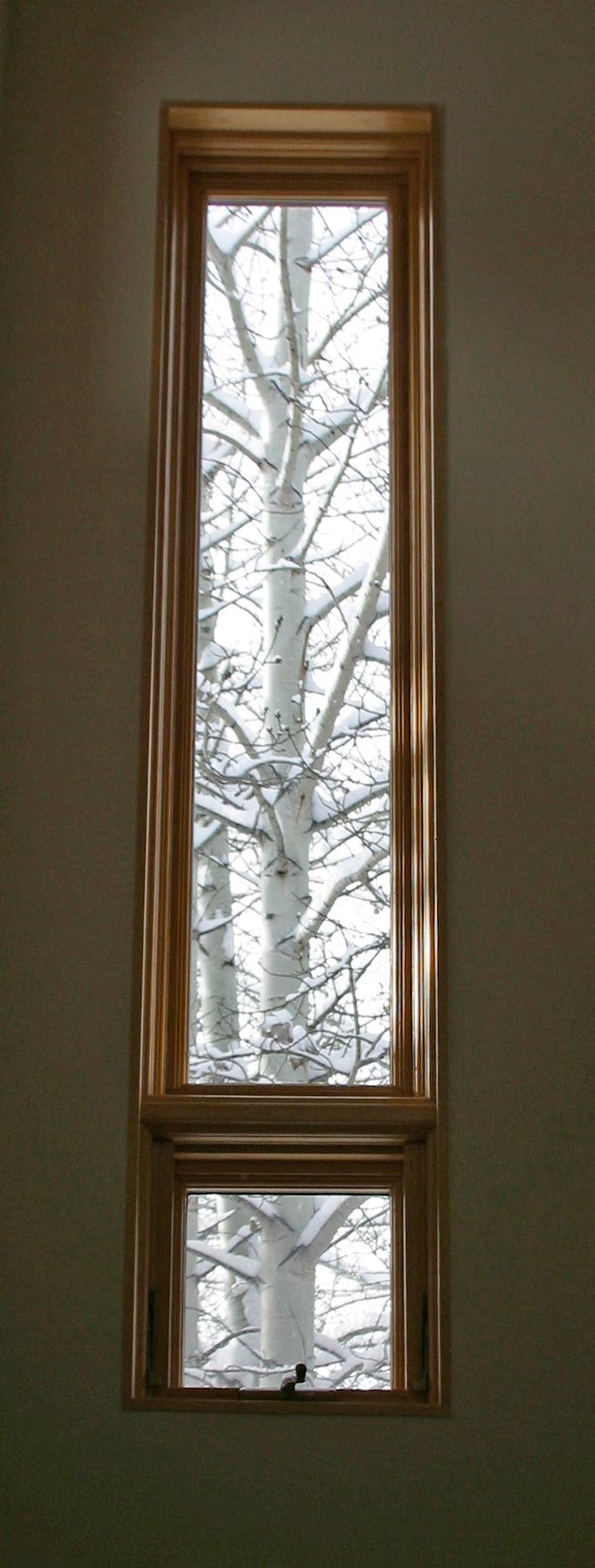
One late afternoon Ethan and I trudged through the foot-thick fresh cover to the creek and stared up as the grey flakes fell like cotton candy into our open mouths. They were so sticky they held to the surfaces they touched and to one another without compacting, sometimes leaving spaces that light passed through.

Next morning the temperature dropped and the sun came out. Joe was eager to ski the fresh powder at the top of the mountain. I stayed on the groomed slopes and watched the less adhesive crystals at high altitude blowing in the wind on the ridge top and the surrounding summits. They reminded me of the “snow banners” described lovingly by John Muir in chapter 3 of The Mountains of California.


Muir surmises that the powdery consistency that allows the snow crystals to be driven by the wind results from their crystalline hooks being ground off in the turbulence at high altitude. However, according to Snowcrystals.com, the reason why

…is still not known, believe it or not. The different ice facets grow at different rates in different temperatures, and to date we don’t really know why the growth rates depend so strongly on temperature. The growth depends on exactly how water vapor molecules are incorporated into the growing ice crystal, and the physics behind this is quite complex and not well understood. It is the subject of current research in my lab and elsewhere.

The celebrity resort of Sun Valley, with its $70 per day ski lifts and chandelier-bedecked mountaintop lodges is not where I’d have expected to spend holiday time. But the magnet of family and also the splendor of its outdoor recreation opportunities overcome my scruples about the conspicuous consumption of resources and the inequity of wealth distribution that the place represents.

The same weather system that was making life beautiful for skiers and resort owners in the Rockies lengthened our return trip home on the last day of 2005 to fourteen hours. We got back just in time for the ECOSLO bash in the Vets Hall that Jan had helped to organize, to celebrate a New Year’s Eve more hopeful than the last one.

Hazzardous Waste

Friday, January 6th, 2006

Yesterday morning I went to the Hazardous Waste Disposal Site in Cold Canyon Landfill that’s only open 11-3 on Fridays and Saturdays. The cardboard box of half-filled bottles and cans stashed in the garage–Diazanon, Malathion, ant-killer, Miracle-Grow–got soggy from the rain that seeped between the concrete wall and floor during last week’s storms. I had felt good about not using all these poisons since converting to native plants several years ago, but I never finished cleaning house because I didnt want to get near the toxic stuff any more.

I put on my gloves, transferred the frightening mess to a plastic carton and drove out Broad Street under a fresh sky brightened with puffy clouds. At Buckley Road a big pickup turned onto the highway in front of me stuffed with trash and sporting a huge confederate flag fluttering on a pole fastened to the tailgate. Concentrating the winter sunlight, its scintillating red field dominated the beautiful Edna Valley landscape and steadily increased my irritation. My head filled with challenges: “So you’re a big fan of slavery?” “You’re celebrating traffic in human beings.” “How about if you were the property rather than the owner?” When the driver moved into the left lane as if to turn on Corbett Canyon Road, I fantasized giving him the finger as I drove by but thought better of it as he moved back in front of me, clearly sharing the destination of the dump. I imagined the hostility and pain that might have been felt by an African-American staffing the landfill gate.

I followed the signs leading toward the shed where the poisons were to be left and watched the attendant dressed in white coveralls lifting a 48 inch television set on his forklift and dropping it with a crash onto a mountain of electronic detritus filling up an enormous dumpster. Five years ago somebody must have paid thousands of dollars for that half-ton item, giving it pride of place in the family home. Now it was just another piece of junk that needed to be processed at government expense. I remembered my earlier visit here with the old monitors and printers accumulated in my garage that no recycler could handle. The day before, at the Sierra Club office I discovered that installing the Quickbooks software necessary to handle our complicated non-profit financial statements required an upgrade to the operating system, which in turn required replacing the computer we had purchased only three years ago.

Ron Yamauchi’s Eulogy for Kenn Law

Thursday, December 22nd, 2005

I thought to do something different: bury Kenn not praise him. I think he would have liked that “ he liked things that annoyed most people, like that trancey music and spelling his name with 2 Ns. Being the world’s biggest expert. Forgetting things “ like 10 bucks. Being the vegetarian that can’t eat tofu.

But you could not stay angry at Kenn. I mean look at us – Here we are.

So I am just going to stick to my role.

Judy has spoken about Kenn’s professional life, Steve about Kenn as a friend and lover.

I’m here to talk about the Kenn that I knew, which was in some ways his most shockingly unexpected persona, that of the wholesome family man.

We three are not the complete experts on Kenn, but we’re giving briefing notes in the phases of his life. At the reception there will be more stories and hopefully lots of interaction. There’s so much I don’t know about Kenn as an artist, or art collector, just as some of you may want his recipe for broiled eggplant.

Kenn Law met Sharon Goddu (as she then was) in 1975. He’d have been about 21 years old. He’d returned to the Lower Mainland after some years as a hippie camp director and schoolteacher in Lund, BC, and was applying for a job as a child care worker. Sharon, one of the CCWs, objected to his hiring “ she said that there was something kind of intimidating about his charisma and energy “ she knew that he could change her life.

Well, he did get hired, so Kenn and Sharon became coworkers, then friends, best friends, roommates, and ultimately co-parents to her two young daughters, Rachel and Willow.

Ultimately, Sharon moved her family up to Desolation Sound, north of Powell River. Kenn told me he blamed himself for making the Sunshine Coast seem so alluring that he’s sent his precious daughters into a pre-technological world of cold water, oyster digging, and bear evasion.

Later, the girls came of age and started to attend Simon Fraser University. This is where I came into the picture.

Rachel and I worked on the student newspaper together, starting around 1987. She was very friendly and nice, and invited a bunch of us to a party at her place, an old house in Burnaby they called the Pender Palace. And Rachel introduced me to Kenn.

He made a striking impression: tall, broad shoulders, with the shaved head and a menacing expression. I also remember that he was incredibly curt with me. It could be that he was angry about the music “ there was this sloppy jam band playing, I believe they were called the Gonch Messiahs “ we know that he was particular about music.

But I also think he really didn’t like me. He was still reserved years later when I was dating Willow. Now that I am a dad, I really respect his frostiness towards whippersnappers who were hanging around his daughters. I don’t believe he really trusted my intentions until 1995, when we got married. And of course he did all these super-elaborate flower arrangements for the reception.

After that, he was a wonderful father in law and grandpa. He’d come over and cook us big meals, accompany us to shows, coo over the babies when they came, bring us coffee in the morning when we were up all night with a newborn, buy them clothes, volunteer at their school. I’m glad that Sophie and Flynn are almost 6 and 9. They will keep real memories of their Poppa Kenn.

As for Willow and myself, Kenn’s still a real presence in our lives.

This morning, I woke up, looked in the mirror upon which he’d written Go Beyond and Choose Happy in phosphorescent paint, see the tattoos he’d cajoled me into getting together, walk past the kids’ room he decorated, went to the kitchen he painted, ate bacon from the frying pan he left here, drank coffee from one of his mugs, put on the shirt and shoes he gave me, and walked to our car through the garden he planted, from the house he helped me paint.

I know what I’m supposed to feel about that. I ought to be taking consolation from the gifts he’d given us, to feel grateful that we got to know him for a considerable portion of his life. To acknowledge that his life was lived more intensely, passionately, dangerously, creatively than the theoretical average person for whom one day is much like another.

But that math doesn’t make sense to me. Heightened ability to give and to feel should have earned a reward. Those who don’t waste life, should get more years, not less.

I guess I am starting to come out of my shellshock over his quite horrible and protracted death, and into realizing that I am without my friend. He loved gossip, furor, huge emotional scenes. If anyone should be here, with us, it would be Kenn.

And if you’re a religious person, maybe you think he is here. If so, I envy your consolation. For myself, I say, Kenn “ forget the ten bucks. I’ll always owe you. Goodbye.