Topics

Sowing Peas

Monday, January 14th, 2008

It took more time than conceiving a baby, but planting a new crop of snow peas was finished in the half hour between our Sunday morning walk with the dog and taking great grandma out to lunch at the Sushi bar. Now there’s less than a half hour to write about it, between completing Monday morning’s preparation and leaving for class.

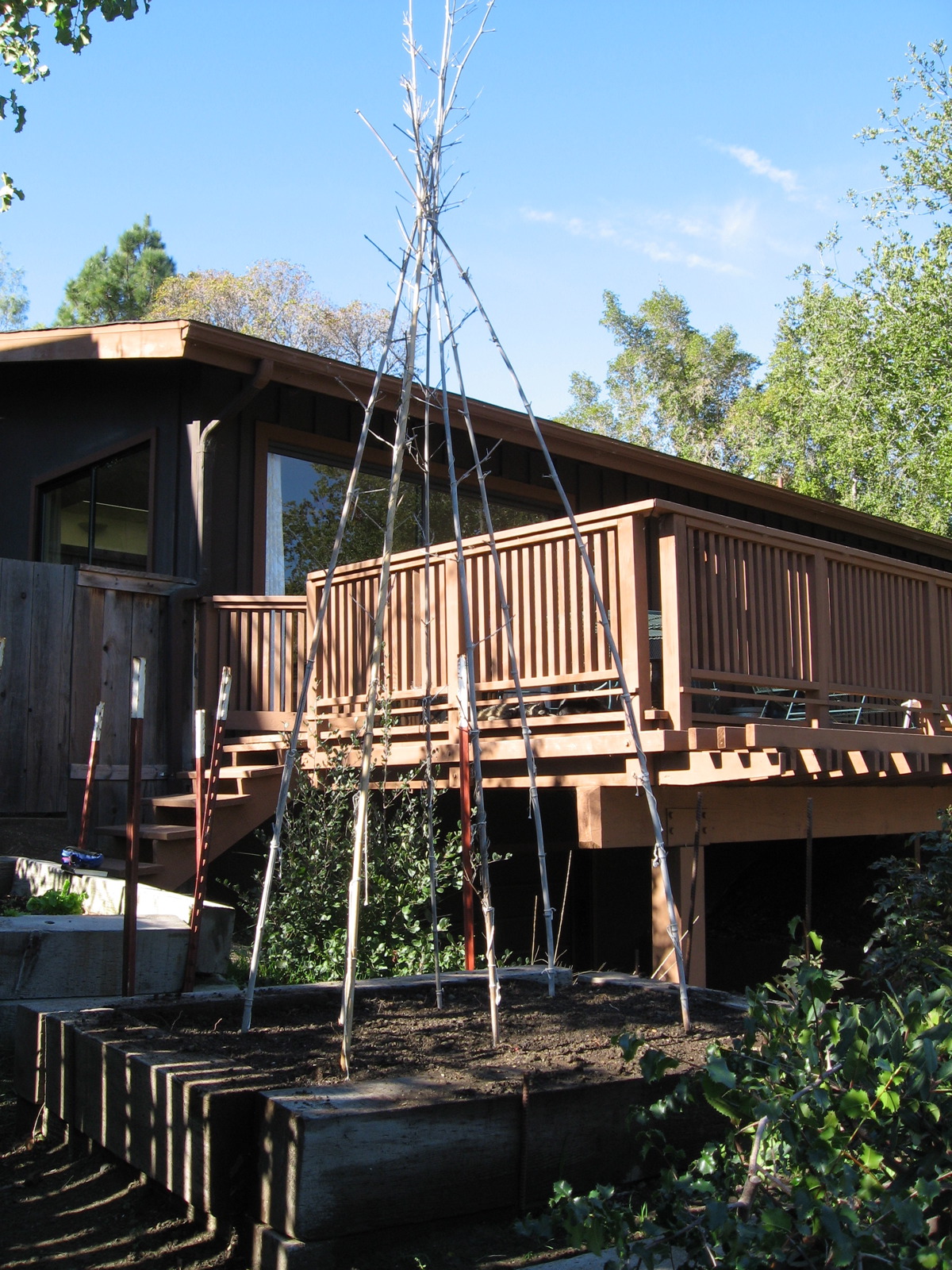
I yanked the decrepit old cherry tomato plants out of the raised bed and salvaged the remaining fruits to explode in my mouth while spading the damp compressed soil. I’d planned simply to insert the peas in the ground without disturbing the soil structure but it was too hard for my forefinger to penetrate. Digging revealed that roots, probably from the adjoining Toyon or Hollyleaf Cherry, had invaded the bed from below and were converting it into a dense fibrous tissue. With the shovel I was able to turn the soil and pull out most of them. I used a hand cultivator to smooth the surface and picked out several dozen stones that somehow had floated to the surface. Then in a corner of the bed, I poked a circle of ten holes and dropped one hard quarter inch sphere into each. I made six more such circles to fill the space of the bed. At the center of each I stuck one of the ten foot bamboo stalks I’d been reusing for years to grow peas and beans and tomatos. I pulled the tops of the bamboo stalks together like tipi poles and tied them up with a short length of soft cotton string that I’d cut off one of them with kitchen scissors. I patted the soil smooth over the seeds with the flat of my hands. Seventy seeds, sixty climbing vines, twenty sweet and crunchy pea pods each, by the end of March, when it will be time to replant tomatoes.

Under the Dome

Wednesday, January 9th, 2008

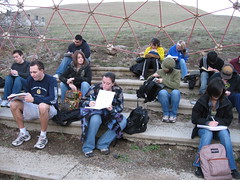
4:45 p.m. close to sunset, sound of hoofs galloping behind the dome where thirty people sit quiet, the light and warmth of a day between storms waning.

A single birdcall highlighted against the silence protected in this hollow between Caballo peak and Cuesta ridge. Poly Mountain rises to the south, Rockslide Ridge to the north. A wispy cloud above the summit of the peak begins to luminsce below higher dark gray clouds, then drops below the ridge line. A small stream meanders through the middle of the structure, separating the rickety stage from the new concrete amphitheatre seats. Poly Mountain’s north flank now burnished with dark gold light from the invisible sunset. Muscles tensed from a day of preparation, teaching and hiking up the slippery canyon trail slowly relax as the weight of the body settles on the cool cushion of stone.

Blowdown

Wednesday, December 12th, 2007

Jan, Steven,

About 8 trees blew down near your house in the last storm. The good news is that none of them damaged anything, & that they don’t need immediate attention. They don’t need Zenia or an expensive faller to clear them out. And the final good news is that there are now more poles for Joe.

We went up today and cleared the tree tops from the driveway. And I took the limbs off the downed tree near the shed but did not buck it up cause I don’t know the lengths Joe wants.

The house looks fine. Towagh, Kemi, & Aya plan to come up on Dec 20th.
In other news there was a great potluck at the Lund School yesterday.

Peter

blowdown pictures

The Presidents’ Climate Commitment: Pro and Con

Monday, November 19th, 2007

Hello Mike

Thanks for the thoughtful and detailed response to my question. I hope that it can serve to further some University-wide discussion of what I believe is the most consequential issue regarding Global Warming that Cal Poly faces right now.

That is, whether or not President Baker should the Presidents Climate Commitment:

http://www.presidentsclimatecommitment.org/html/commitment.php.

The primary author of that document, Anthony Cortese, visited the campus for several days this month, delivering a public lecture, meeting with several local Sustainability groups, and conferring privately with the President and Vice Presidents.

On several occasions Cortese stated that his mission was not so much to convince President Baker to join the 434 College and University Presidents nationwide in signing on as to promote public deliberation about this issue among all members of the University Community.

Whether or not we sign on to the specific terms of this Commitment, what Cortese asked was that the University move now, decisively and dramatically, to address the climate crisis and the need for leadership toward sustainability. Only the President of the University can direct such a move, but all the rest of us should be made aware of his options and reasons for action or inaction.

First of all, what is the actual commitment? It has three provisions:

1. Initiate the development of a comprehensive plan to achieve climate neutrality as soon as possible.
2. Initiate two or more of the following tangible actions to reduce greenhouse gases while the more comprehensive plan is being developed. [Cal Poly has already complied with this]
3. Make the action plan, inventory, and periodic progress reports publicly available.

One of Cortese’s main concerns was that objections to signing were not necessarily to the actual terms of the commitment.

The first objection you state is that true carbon neutrality cannot be achieved without our buying unaffordable and dubious carbon offsets.

There is considerable controversy in the environmental community as to whether buying offsets or sequestering carbon are meaningful ways of reducing GHG emissions. Thus, when the PCC requires us to set a schedule for reaching neutrality, when we don’t know if/how that can be achieved, the exercise is not entirely intellectually honest.

I think that was Yale’s position on the PCC: although they have set a goal to be “the greenest university in the world” (and have made some very noteworthy progress in this regard, including being on the forefront of GHG reductions), the president did not want to sign the actual PCC statement because he didn’t know how/if neutrality could really be achieved.

Thus, if the PCC is largely symbolic with regard to neutrality, then I’d prefer we were more upfront in saying that neutrality is a goal to be strived for, rather than saying we will set a schedule that hasn’t a realistic basis.

The commitment’s “Solutions” page states that “In general, buying carbon offsets to achieve climate neutrality should only be done as a last resort.”

The commitment is to achieving carbon neutrality “as soon as possible.” This gives the institution flexibility to set realistic targets and make adjustments as it tries to meet them. However this flexibility doesn’t mean that the commitment is mere lip-service, since it does require a plan, an inventory, and periodic reporting that demands an explanation for failure to make progress.

To me this is a sensible approach given the urgency of the situation. In the last few years, as documented in your well-crafted reports, Cal Poly has made what could be interpreted as impressive progress. However, that progress is not measured against any standard, and thereby gives no indication of how we really are doing compared either to other institutions or to targets defined by the demands of reducing emissions at a rate determined by scientific consensus to be necessary and feasible.

Yale’s objection may carry weight since they have instituted alternative targets and metrics for tracking progress toward an ambitious and clearly stated set of climate goals.

http://www.yale.edu/sustainability/YaleClimateInitiative.pdf

But no such initiative has materialized at Cal Poly. Our 2004 signing of the Talloires Declaration, positive though it has been in raising the profile and legitimacy of Education for Sustainability, has produced no measureable institutional targets and timetables for change, nor any discernible shifts in financing priorities to make such change possible.

Carbon neutrality may seem an unrealistic goal given many people’s present-day mindset, but as the consequences of global warming become more evident, that perception is changing. Our own governor, in signing a law passed by the state legislature stated:

“Using market-based incentives, we will reduce carbon emissions to 1990 levels by the year 2020. That’s a 25 percent reduction. And by 2050, we will reduce emissions to 80 percent below 1990 levels. We simply must do everything in our power to slow down global warming before it’s too late.”

By signing and fulfilling the Presidents Climate Commitment, Cal Poly would contribute its momentum to the initiatives of higher education nationwide as well as of the state of California.

Your next objection questions the appropriateness of Cal Poly’s taking the lead in moving our whole society toward climate neutrality:

My other concerns are secondary. First, as a public institution that will likely require public funding to achieve neutrality, the question should be raised: is this the most cost-effective use of public monies for reducing carbon emissions? Are we sure that bringing the public university sector to neutrality will achieve more benefits to the climate than using equal public monies in other sectors? Again, it’s the question of symbolism versus realistic solutions to a crisis. If we think we must act drastically now, we should direct our resources to those places that have the greatest results, fastest.

434 Presidents have agreed that Universities are appropriate institutions to lead the way, including the Chancellor of the University of California. Others, who haven’t signed the Presidents Climate Agreement like the President of Yale, also have taken steps in funding programs that are not merely symbolic but substantive. Universities house the next generation, which will be more affected by climate change than the present one and which will carry out the kinds of innovations and transformations that need to be developed now. In addition, Universities are also large institutions with correspondingly large environmental footprints.

Your next objection concerns possible abuses the Presidents Climate Commitment.

there is a potential problem with the need to earn a “gold star” versus really helping the environment. For example, at the UC/CSU/CCC sustainability conference last summer, a speaker suggested that the most important action UCI had taken to reduce GHG emissions was to build significant on-campus housing. More than one person remarked, however, that by bringing the housing on campus, the university would now have a bigger carbon “footprint” to “neutralize”…so wouldn’t it be better to not build the housing on campus so that campus neutrality would be easier? This goes back to my critique that by focusing on the university, we may lose sight of the truly global nature of the climate problem and that sometimes the best environmental answer may not be the one that gets a particular campus to neutrality.

This seems to be a problem of the accuracy of the metrics used in implementing the agreement. But as I understand it, each university that signs determines its own standards of measurement. Such technical problems are more likely to be solved if we become stakeholders in the process than if we use them as a reason to back off.

The example you mention illustrates some of the complexities involved in earning gold stars. In our biannual sustainability report, a good deal of credit is claimed for the construction of on-campus housing, despite the fact that Poly Canyon Village is adding two huge parking structures for the use of residents, which will encourage the increased use of automobile transportation on campus and in the local area.

Your last objection is based on a broader reason to discourage signing of the President’s Climate Agreement:

I am personally concerned by certain perspectives that suggest that the scientific inquiry regarding the causes and effects of climate change is “closed.” We always try to act on the best available science, but we should not close off intellectual/scientific debate or research. Scientists, academics and humans generally have certainly barked up wrong trees before. I have my father’s school text on environmental science from the late ’40’s. It notes that the greatest scientific breakthroughs to benefit humanity so far in the 20th century were 1) antibiotics (ok) and 2) DDT … because of how it eliminated malaria from many parts of the world. Hmmm. (I’ve read that limited use of DDT is again garnering favor in parts of the developing world for just that reason.)

I concede that skepticism about the reality of global warming or about humanity’s role in causing it or beliefs that there is nothing we can do about it undermine the immense resolve required to take responsibility for combating it. The science supporting the claim that we must act now to avoid future catastrophe is highly technical and the conclusion is not intuitively obvious. And in some cases, as you state, widely held scientific conclusions have been proven wrong.

But the risks of not acting on what has emerged as strong scientific consensus are today greater than those attendant upon waiting for more certainty. Two days ago, Science Daily reported

Secretary-General Ban Ki-moon has challenged the world’s policymakers to start devising a comprehensive deal for tackling climate change at next month’s summit in Bali, Indonesia, after a United Nations report released Nov. 17 found that global warming is unequivocal and could cause irreversible damage to the planet.

Finally then it comes down to whom to believe. At this point even the present administration in Washington acknowledges human causality for climate change, though it fails to do anything about it. This is why state and local governments, businesses, and other institutions of civil society are taking on the task. Education is at the forefront of these. The signatories of the Presidents’ Climate Agreement constitute a credible authority unreasonable for our President not to believe.

In addition to addressing the reservations you state, I’d like to mention a few of the positive benefits to be realized by our making the President’s Climate Commitment.

1. It provides a specific action program and timetable to guide the University in enacting provisions of the Talloires Declaration to which we already are signatory. Included is the creation of “institutional structures to guide the development and implementation of the plan.”

2. It provides an extensive “implementation guide” and a network of communication among other Universities participating in the program.

3. It provides access to funding sources”private, foundation and government”that can offset startup costs for implementing the plan

4. It provides a concrete statement of a shared mission that can

¢ engage all members of the university community
¢ heighten motivation of current students to succeed, especially in scientific and technical fields
¢ attract the most talented of prospective students who have realized that their future depends on dealing with the problem of climate change
¢ make graduates more competitive in a job market that demands the skills and inventiveness that arise out of accepting this challenge.

In conclusion, I’d like to reiterate what Anthony Cortese reported about the response on campuses at which Presidents signed the commitment. He said it has changed the level of conversation, it has raised the excitement, it has made it easier to discover ways to include sustainability in all curricular activities with incentives rather than requirements. As to why they made the decision to sign, the most frequent reply of the Presidents was “Because it’s the right thing to do.”

Jack Sparrow and the Devil’s Canyon

Tuesday, October 9th, 2007


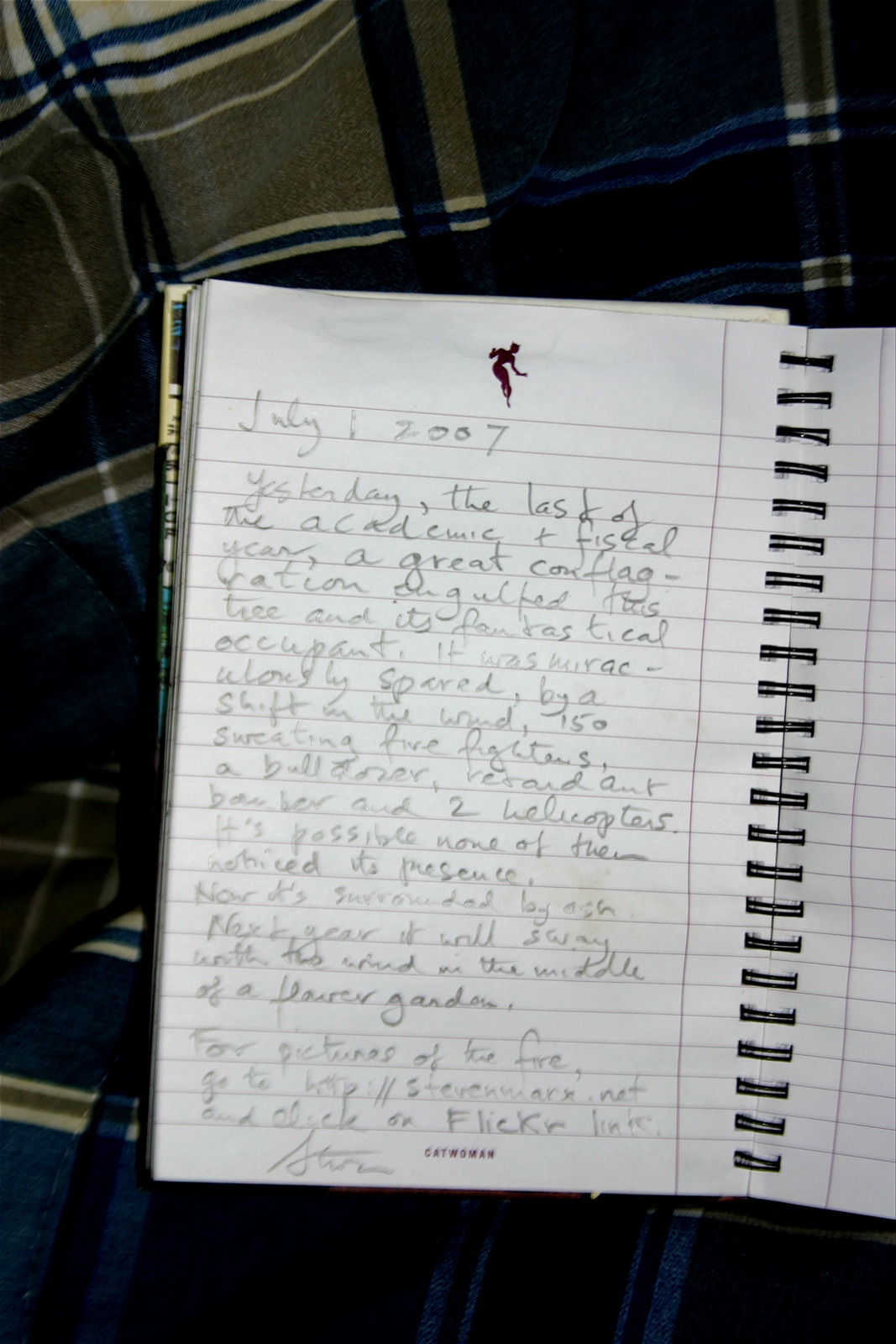
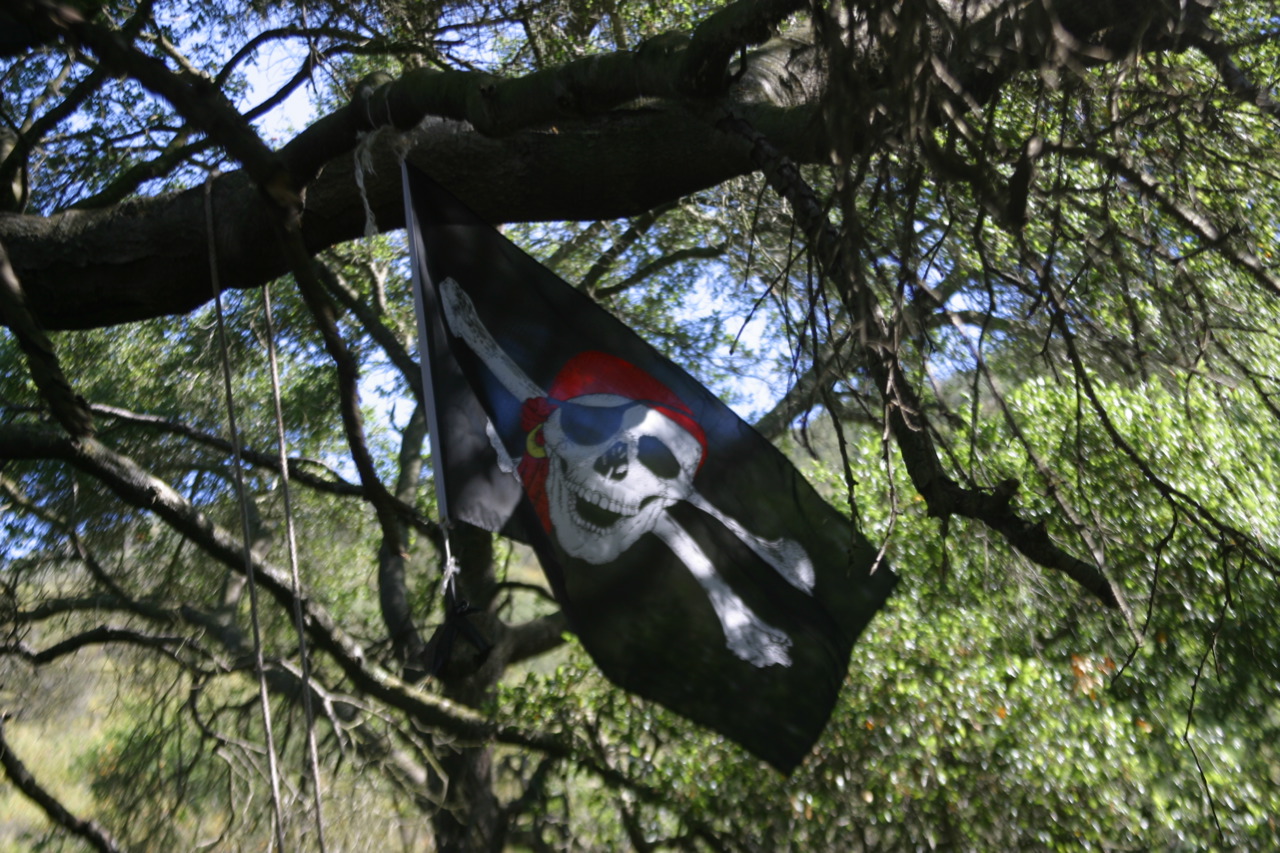
I’d been planning for several weeks to lead Ian’s school–24 kids from kindergarten to grade 6–on a hike up nearby Poly Mountain. I could begin in the classroom with a slide show of pictures I’d taken from my roof of last June’s fire on the mountain, and then we could make our way into the burn area to see the damage and the beginnings of regeneration. On the way it would be fun to check out the secret tree house on the hillside that was miraculously saved from the flames.


I’d noticed that the design on the large pirate flag hanging from a high branch next to the treehouse kept cropping up everywhere from pickup trucks to clothing.

Exploiting this new fad with a long story might distract the kids from the difficulty of negotiating the steep game trails leading up the slope. Maybe something about Captain Hook.

Then I remembered Ian’s talk of the Pirates of the Carribean movies and their hero, Jack Sparrow. That name was appealing enough to overcome my aversion to anything associated with Disneyland. I rented the movie of Part 1 and found myself enjoying its preposterous plot devices and prolific film and literary allusions. My pirate tale could bring Jack Sparrow to this improbable place.

Making up stories is as hard for me as remembering them, so I knew I had to do some preparation. A few days before the scheduled hike, I wrote it out in outline, and while swimming and doing housework worked on memorizing it. (more…)

Yom Kippur 2007

Monday, September 24th, 2007

(see Yom Kippur 2006, 2005, 2003)

My commitment to fasting and spiritual retreat shrank this year. I slept in my bed instead of camping out, drank coffee and practised connubial rites in the morning, and planned to go to Ian’s soccer game and then kayaking with a friend in the afternoon.

At 8:30 a.m. the delayed impulse struck and I decided not to eat or drink any more till dinner and to go on a hike by myself. There was also a pragmatic motive–to check out the route for the excursion I’d planned to take the Manzanita School kids up Poly Mountain to see the effects of last June’s wildfire.

The walk began with fanfare: a long predicted rainstorm arrived as a few morning sprinkles and grand skyscapes. There was enough moisture to make the rock hard clay soil congeal on my boots and to revive the strong smell of burnt vegetation.

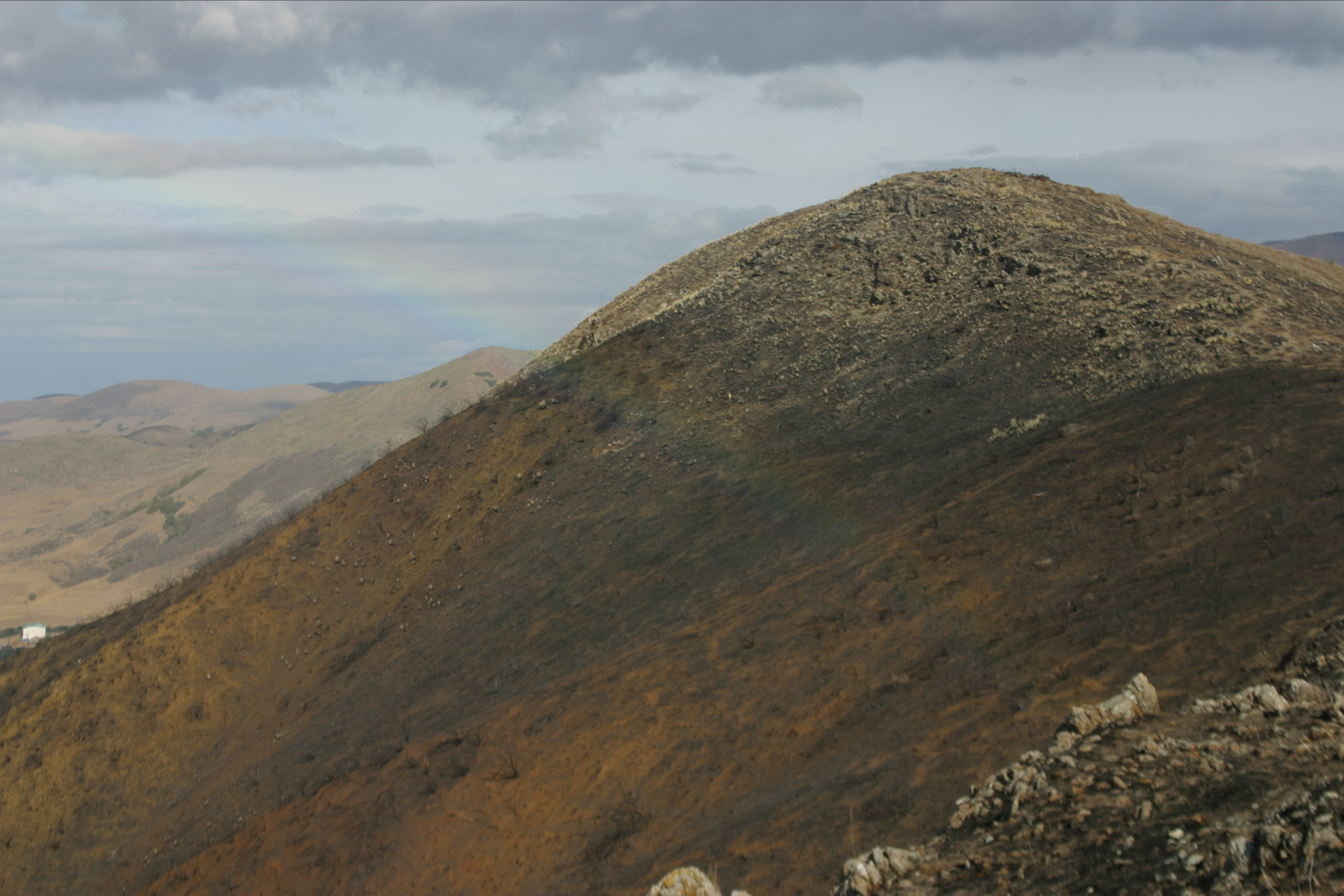
When I reached the top of the mountain, the sky was full of variety and motion.

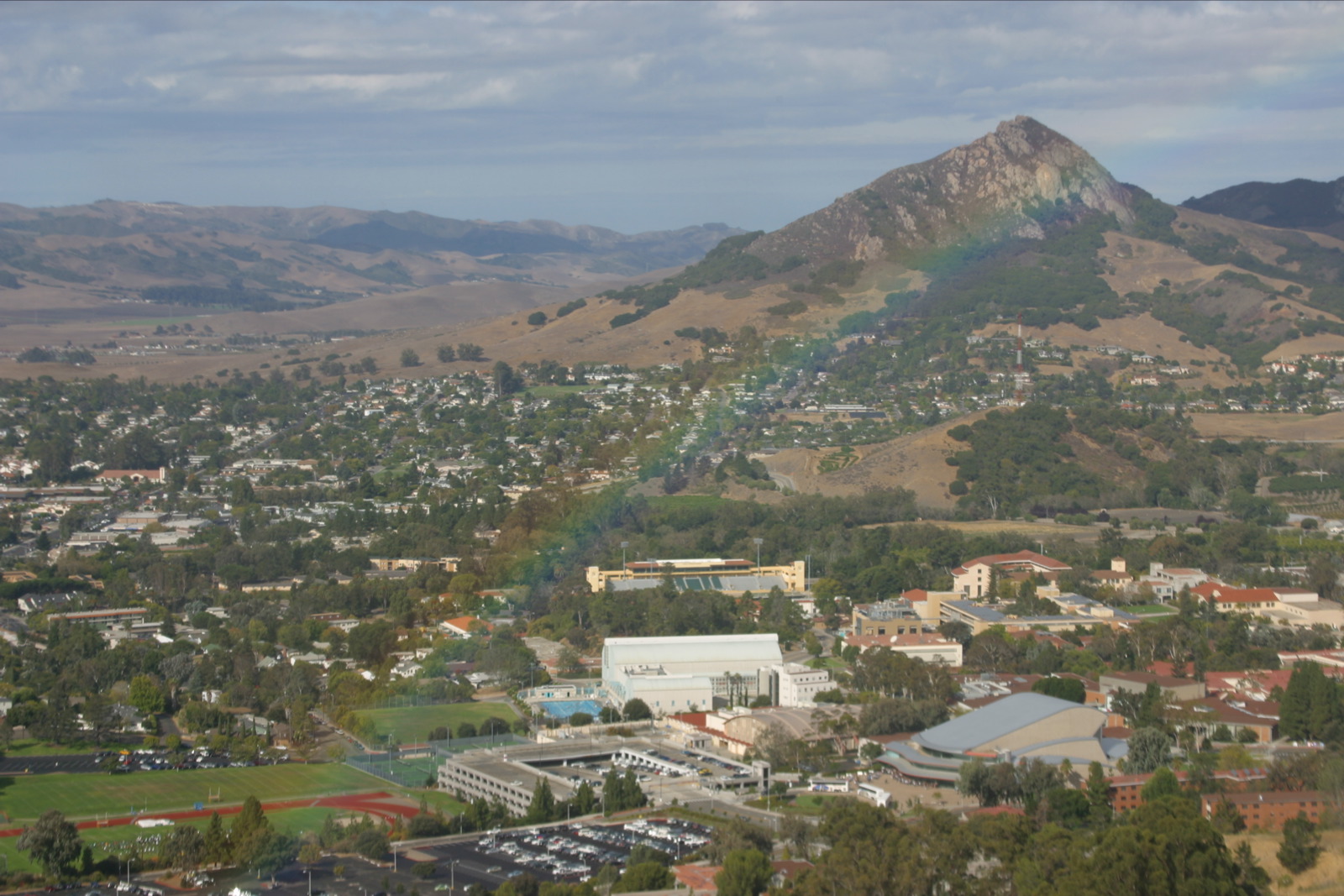
A subtle rainbow precipitated across the face of Bishop’s Peak below me, one end on the playing field where the marching band was striking up, the other on the bare soil exposed by the fire right beside me.

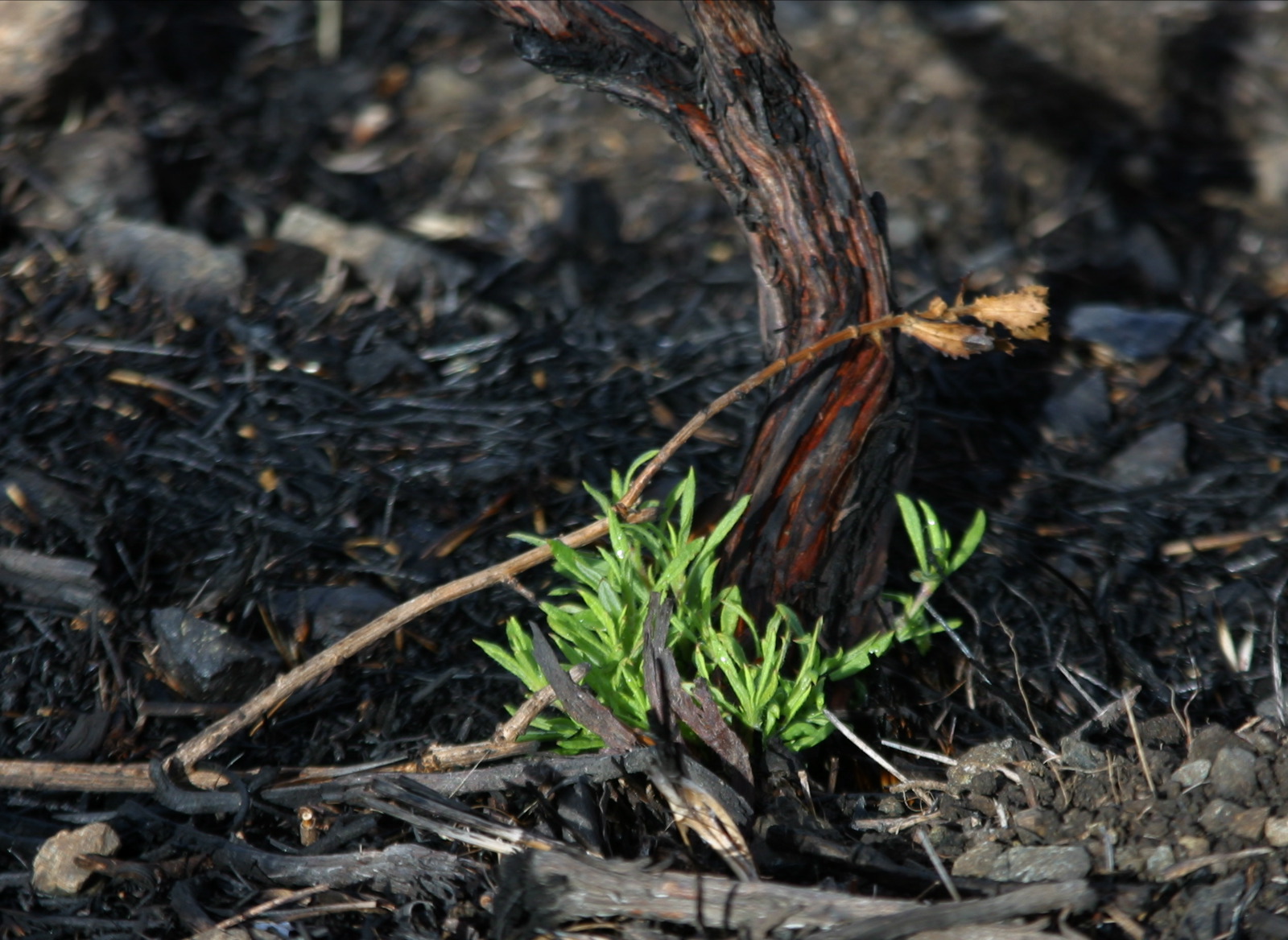
A few drops sparkled on the leaflets that sprouted from the base of a burnt manzanita stem hungry for moisture to maintain its precarious new growth.


The previous night, after the Coastal Cleanup party at Ecoslo organized by Jan, I watched Bill Moyers’ Journal. It was about Rachel Carson, devoted mostly to the performance of a play written and acted by Kaiulani Lee. She created the sense of glory and tragedy that Carson felt during her last years, when Silent Spring was published, villified by the chemical industry and generating the first environmental legislation in America. Carson hated to leave the peaceful Maine cottage where she spent the summers with her adopted son exploring forests and beaches. Now she had to return to the fray in Washington. And yet there she was drawn, by the excitement and by her sense of destiny. The moment of departure was framed by tragic knowledge: that even if her crusade against indiscriminate use of poisons succeeded, Earth’s natural systems remained imperiled. And she was dying of cancer.

The dramatization caught my mood. After four weeks in B.C., it was wrenching to leave Knoll House and the Zunoquad Kayak trip to the Broughton Archipelago and come back to the struggles here. All that time with no phone or email, a respite from continual reminders of global climate change and human persistence in suicidal folly. But return has drawn me into the heat of battle. I gave a talk on Thursday to the Student Services Conference urging them to demand that Cal Poly sign the Presidents’ Climate Agreement and get serious about its commitment to Sustainabiity. I picketed the Fall Conference of faculty and administrators with homemade signs:

Vice President, Provost and Dean
It’s time to make this campus Green

Students, staff and faculty
Want more Sustainability

Without more changes at the top
Sustainability will flop

President Baker,
Take the lead,
Green Cal Poly
With word and deed

President Baker
You’re the one
Green Cal Poly
Get it done

To be out front
The time has passed
We wont be first
Let’s not be last

Your Presidential legacy?
Green Poly University.

I distributed this leaflet:

From the funder of a major grant for a sustainability program at Cal Poly recently not renewed:

“However, the university’s decision to provide no university funding for the continued development of the program causes us to question the commitment of the university to sustainability ¦ .

In considering requests for financial support, ¦. Foundation (as well as most of our foundation partners) requires evidence that the university is willing to re-program its financial resources and commit its intellectual resources to sustainability. Thus the foundation is most interested in, and responsive to, inspired leadership and expertise when it is combined with the political will to dedicate the university to the development of sustainable systems.

¦ We make this decision to decline the current application with great regret.”

Yom Kippur is for reflection and atonement. This year I didnt even perform my morning meditation. I’ve ceased saying “I’m sorry for not doing enough” since rejoining the good fight. I can feel some guilt for neglecting my deceased parents, an obligation revived by having to explain the cremation remains we found last week on the Felsman Loop trail to Ian, and by the sermon of the Chumash elder, Mr. Cantu, that preceded my talk to Student Services. He said care for the future must stem from reverence for the past.

The sky cleared and the sun warmed my back.

I felt gnawing in my stomach and fast-fatigue. I lay back on the bed of dirt, and chanted and dozed. An hour later, I descended the mountain in time for the soccer game: sharks vs. sharks.

Dusty cancelled on the kayaking but Jan decided to come. We watched the sky together.

Dear President Baker

Tuesday, September 11th, 2007

I’m writing to express appreciation for your responsive reactions to my somewhat confrontational challenge at yesterday’s Fall Conference.   Your willingness to acknowledge the need for Cal Poly to do more to promote Sustainability gives me hope that this year will mark a significant step forward in that direction.

My gesture grew out of frustration with the pace of institutional engagement.  Over the past few years, growing numbers of students, faculty and staff have been increasing their commitment to greening the University.  But the magnitude and gravity of the task we face–one you clearly articulated in your remarks yesterday–requires more leadership and resources from the top of the University hierarchy.

I believe this can be accomplished by creating an Office of Sustainability coordinating the efforts of all the divisions that report to you. Sustainability is, among other things, about unifying the University.  I believe that this Office should be headed by a young and yet experienced Sustainability Manager with both academic and organizational credentials.   I believe that Cal Poly has the capacity to attract such an extraordinary individual.  I believe that funding sources outside of our existing ones can be found by our Advancement officers to finance such an office. I believe that this position will become self-supporting within a reasonable amount of time, following the precedent of Harvard and the University of British Columbia among others.

Ralph Wolff’s keynote presentation about the “inconvenient truth” of student performance nationwide and locally and about pressures we face to measure and improve it had no explicit connection with Sustainability, but I believe there is one.  I don’t think being “competitive in world markets” or making lots of money will produce the motivation to work hard and succeed in school that the statistics say is lacking.  I think rather that students need to feel effective in taking on the real threats that face them and their future families.  Primary among them are depletion of natural resources and degradation of natural systems, the climate being most urgent at the present moment.

I come to this conclusion from my own experience as a student many years ago and from my experience as a teacher since then.  For some evidence of the way that being engaged with the issues of Sustainability in the class can measureably improve student skill development and performance, I’d like to refer you to two collections of essays written for the basic writing freshman GE classes I’ve taught over the last couple of years while on FERP. Before the classes started, these randomly selected students had no idea of the course theme.

http://cla.calpoly.edu/~smarx/courses/145/paper6/index.htm
http://cla.calpoly.edu/~smarx/courses/134/webpapers/134papers05.html

Thank you for all that you have done for this wonderful institution in the past.  I look forward to continuing interaction.

Sincerely,

Steven Marx

The Wild Braid

Saturday, May 5th, 2007

At the Sierra Club ExCom meeting in March, Cal began with a reading, as is our custom. It was from a new book by and about Stanley Kunitz, The Wild Braid, A Poet Reflects on a Century in the Garden.

The garden is a domestication of the wild, taking what can be random, and, to a degree, ordering it so that it is not merely a transference from thewild, but still retains the elements that make each plant shine in its natural habitat.

In the beginning, a garden holds infinite possibilities. What sense of its nature, or its kingdom, is it going to convey? It represents a selection, not only of whatever individual plants we consider to be beautiful, but also a synthesis that creates a new kind of beauty, that of a complex and multiple world. What you plant in your garden reflects your own sensibility, your concept of beauty, your sense of form. Every true garden is an imaginative construct, after all.

I’m not sure if this is the actual passage he read, I was so struck both by the cover image of a bent-over hundred year old man gazing like a lover at his plants and by the recollection that Jan and I first set eyes on each other at a poetry seminar about Stanley Kunitz in 1966. Also distracted back then, I hadn’t paid attention to his writings since. But that book cover brought it together: the passage of time that we were planning to mark in our upcoming 40th anniversary celebration, not yet bent over, but transformed from children into grandparents. I mentioned the coincidence, there were appreciative murmurs, then on we went to discuss the budget.

While Jan made the guest list, mailed invitations, shopped for food, and spruced up the house, I prepared for the party by working in the garden, carving a new path in the adobe clay, trimming lower limbs of the pygmy oaks, transplanting bunch grasses. We were wedded in a garden in our backyard. Now this garden had turned into a setting I wanted to share for a while, just as I wanted to share the private space of marriage. When we arrived here nineteen years ago I knew this was a place I would transform and be transformed in. The change had come to pass.


The invitation to our celebration said “No gifts, but donations welcome to Santa Lucia Chapter of the Sierra Club or Environmental Center of San Luis Obispo (ECOSLO).” In the midst of the crowd at the drinks table, Cal handed me a package and said he was sorry to be violating the rule, but please would I open it. It was The Wild Braid.

Three days after the party I was missing classes, in bed with a sinus infection. Between naps, I wandered around in the book, finding poems about gardening and other outdoor experiences, memoirs about circumstances of their composition, prose reflections on their themes“bucolic retreat, cultivation, composting, decay, renewal, and the connections between horticulture and writing. They recalled my first scholarly article, “˜Fortunate Senex’: The Pastoral of Old Age.” Arranged like beds and terraces, I came upon photographs of the ancient sage among the trees and flowers and conversations that took place between him and Genine Lentine, his friend and caretaker during the time between partial recovery from a massive stroke and his death in 2004.
This morning I woke up at 5:15, still not healthy but eager to walk my trails at daybreak. Greeting the yucca, the hummingbird sage, the blue oak, seeing new blooms on the Columbine, I thought again of The Wild Braid. I’d only taken the first stroll through its garden. I’ll return to find paths I’ve missed and revisit familiar spots in changing seasons. Looking ahead, I knew I’d found a guide.

Post script–June 5

Last weekend, Jan made her pilgrimage to Tassajara, the Zen mountain retreat she’s visited every spring for the last 27 years. She was enrolled in a seminar which required her to bring along some poems. With my permission she took The Wild Braid. Upon her return she gave the book back and told me to look at the title page. On it was inscribed “For Jan and Steven–friends in the garden. With bright wishes, Genine.”

Native Plants in the Garden

Saturday, May 5th, 2007

  1. Bracken Fern, Pteridium aquilinum pubescens
  2. Toyon, Heteromeles arbutifolia
  3. Golden Current, Ribes aureum aureum
  4. Clustered Field Sedge, Carex praegracilis
  5. Lemonade berry, Rhus integrifolia
  6. Pink flowered currant, Ribes sanguineum glutinosum
  7. Fremontia, Flannel Bush, Fremontodendron California Glory
  8. Manzanita, Arctostophylus morroensis
  9. Bay Laurel, Umbellularia californica
  10. Fremontia, Flannel Bush, Fremontodendron California Glory
  11. Fuchsia flowered gooseberry, Ribes speciosum
  12. Holly Leaf Cherry, Prunus ilicifolia
  13. Western Redbud, Cercis occidentalis
  14. Point Reyes Bearberry, Arctostaphylos uva-ursi ‘Point Reyes’
  15. Fremontia, Flannel Bush, Fremontodendron California Glory
  16. Deergrass, Muhlenbergia rigens
  17. Manzanita, Arctostophylus morroensis
  18. Foothill Penstemon, Penstemon heterophyllus
  19. Calfiornia Fuchsia, Zeuschneria

22. Creeping Mountain Lilac, Ceanothus Joyce Coulter

  1. Holly Leaf Cherry, Prunus ilicifolia
  2. Coffeeberry, Rhamnus californica
  3. Shagbark Manzanita, Arctostophuylus rutis,
  4. Fremontia, Flannel Bush, Fremontodendron California Glory
  5. California Sagebrush, Artemesia californica
  6. Scarlet Bugler, Penstemon centranifolius
  7. Hoary leaf ceanothus, Ceanothus crassifolius
  8. Manzanita, Arctostaphylos densiflora ‘Howard McMinn’
  9. Black Sage, Salvia mellifera
  10. Black Sage, Salvia mellifera
  11. Holly leaved California Mountain Lilac, Ceanothus Mills Glory
  12. Calfornia Goldenrod, Solidago californica
  13. Leather Oak, Quercus durata
  14. Toyon, Heteromeles arbutifolia
  15. Manzanita, Arctostaphylos densiflora ‘Howard McMinn’
  16. California Buckwheat, Eriogonum fasciculatum foliolosum
  17. Coyote Mint, Monardella villosa obispoenis
  18. Clustered Field Sedge, Carex praegracilis
  19. Western Alpine Strawberry, Fragaria virginiana platypetala
  20. Douglas Iris, Iris douglasiana
  21. Western Columbine, Aquilegia formosa
  22. Holly Leaf Cherry, Prunus il15icifolia
  23. Deergrass, Muhlenbergia rigens
  24. Clustered Field Sedge, Carex praegracilis
  25. Purple Sage, Salvia leucophylla
  26. Coffeeberry, Rhamnus californica
  27. Foothill Penstemon, Penstemon heterophyllus
  28. Santa Susana Monkey flower, Diplacus rutilus
  29. Mountain Mahogony, Cercocarpus betuloides
  30. Big Leaf Maple, Acer macrophyllum
  31. Holly Leaf Cherry, Prunus ilicifolia
  32. Toyon, Heteromeles arbutifolia
  33. California Grape, Vitus californica
  34. Toyon, Heteromeles arbutifolia
  35. Holly Leaf Cherry, Prunus ilicifolia
  36. Bay Laurel, Umbellularia californica
  37. Coast Live Oak, Quercus agrifolia
  38. Oregon Grape, Mahonia aquifolium
  39. California Mountain Lilac Ceanothus Concha
  40. Toyon, Heteromeles arbutifolia
  41. California Strawberry, Fragaria californica
  42. Douglas Iris, Iris Douglasiana
  43. Snowberry, Symphoricarpos albus laevigatus
  44. Coast Redwood, Sequoia sempervirens
  45. Coast Live Oak, Quercus agrifolia
  46. Blueblossom Ceanothus, Ceanothus thyrsiflorus
  47. Black Sage, Salvia mellifera
  48. California Pitcher Plant, Lepechinia calycina
  49. Creeping Black Sage, Salvia mellifera ripens
  50. Hummingbird Sage, Salvia spathacea
  51. Coral Bells or Alum Root, Heuchera rubescens
  52. Western Columbine, Aquilegia formosa
  53. Purple Sage, Salvia leucophylla
  54. Purple Nightshade, Solanum xanti
  55. Yerba Buena, Satureja douglasii
  56. Yarrow, Achillea millefolium californica
  57. Coyote Brush, Baccharis pilularis
  58. Small leaf mountain Lilac, Ceanothus Julia Phelps
  59. Valley Oak, Quercus lobata
  60. Blue Oak, Quercus Douglasii
  61. Purple Needlegrass, Stipa pulchra
  62. California Mountain Lilac Ceanothus Concha
  63. Shagbark Manzanita, Arctostophuylus rutis
  64. Woolly Bluecurls, Trichostema lanatum
  65. Mugwort—Artemisia douglassiana
  66. Blue Elderberry, Sambucus Caerulea
  67. Catalina Ironwood, Leonusthamnus floribundus
  68. Small leaf mountain Lilac, Ceanothus Julia Phelps
  69. Spanish dagger/Our Lord’s Candle, Yucca whipplei
  70. Calfornia Buckeye, Aesculus californica


Fortieth Wedding Anniversary Celebration

Sunday, April 29th, 2007

p1010043.jpgmarriage.jpg

PROGRAM

Excerpt from “Mein Freund ist Mein,”
from Bach’s Cantata #140

Anniversary Pictures from 2007

Wedding pictures from 1967

S: Thank you all, friends and family, for joining us to honor our 40th wedding anniversary. The song you’ve just heard, a duet from Bach’s Cantata 140 based on the Biblical Song of Songs, was our wedding music. We want to take this moment to celebrate our blessings, especially our two children and four grandchildren. After 40 years of marriage, we want to celebrate that we are still in good health and still love each other.

J: We met just before the summer of love in 1966 and were married April 2, 1967 in our backyard in East Palo Alto . Rock and roll, tie dye and the war in Vietnam were raging. Those were the days of the generation gap. Both poor students, we had very little to spend on the wedding. It cost under $250, including the dress. Our parents arrived in Palo Alto to meet each other, and to meet the person their child was about to marry, for the first time, the day before the wedding.

S: We met several times with the minister, our friend Stuart McLean, to explore on the deepest inner level why we were founding a family with the world falling apart around us, to consider Christian and Jewish wedding ceremonies and, finally, to craft our own. We would like to share a few excerpts from that ceremony with you now:

S: We are assembled here in the presence of witnesses to join this man and this woman in marriage; to rejoice with them in the unity they have found; and to recognize that the vows between them made are a social as well as a private act. ¦

J: The act of marriage represents a change in relationship to the social order. It is the presentation of a new social unit to society and the founding of a family. As you who are gathered here symbolize this public world, Steven and Janet ask for and need your acceptance.

S: Nevertheless, while recognizing that community is the womb of life, and while affirming the importance of the social order, they are profoundly disturbed by the sickness of our society. In their higher commitment to our common humanity, they find that they must rebel against its dehumanization. Here they also, ask for your acceptance. Their commitment to one another is not just a private act, but a commitment to the concerns of all persons everywhere. Together they hope to give each other the comfort and courage both to affirm the social order and to change it…

J: The vision of our common humanity meets our past and embraces this present event of marriage. It is a public event, but more profoundly an act of two who hae decided in faith to become one. It is an act involving suffering as well as delight”conflict as well as love”despair as well as hope. Its form reveals the essence of true covenant. Within it two become one, but because of it, Steven’s and Janet’s unique individuality may grow.

S: Marriage is a moment of decision which is not just a moment in time, bujt one which transcends time, a moment in which Steven and Jan will always live. Its decision is a leap of faith. Its love takes the threat out of dying and growing old. Its promise changes the conditions of the future.

J: In the decision to live with and for one another, Steven and Janet have created a new relationship which involves all life. We all rejoice with you. ¦.

Wine ceremony”raise cups”these are words from our ceremony

S&J: This cup of wine is symbolic of the cup of life. As we share the one cup of wine, we undertake to share all that the future may bring. All the sweetness life’s cup may hold for you should be the sweeter because we drink it together. Whatever drops of bitterness it may contain should be less bitter because we share them.

S: And now in gratitude to all of you who’ve joined us today, some who were there with us 40 years ago, some who have traveled from as far away as Canada, we offer this toast. “May the close, loving bonds of each of us–to partners, family, friends, community and the earth itself–be strengthened and renewed today and every day.

___________

Some anniversary poems:

1979

1991

1992