Travel

Zunoquad 3“Canoeing the Teslin and Yukon Rivers (4)

Sunday, September 27th, 2009

Day 3

Jobwaddhi made two sensible proclamations at breakfast: we would switch paddling partners and we would begin the day with stretches, a morning ritual that had been observed for at least the last two years’ trips and that would have helped get us through yesterday had it not been abandoned.

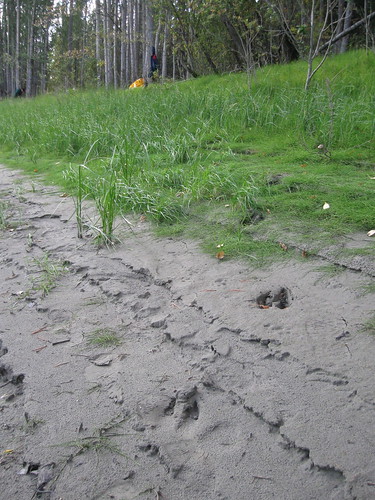
As we packed the gear, a large raven with a fat double chin perching on a snag in the middle of the campsite clicked and croaked with impatience to pick at our leavings   Daylight revealed fresh tracks of bear, wolf and moose in the mud, but we were disappointed that no large non-human mammals were sighted any time on the trip. Bald eagles, both mature and juveniles were in plentiful supply, along with the occasional dead salmon lying on the shore or floating in the water, after migrating up from the Bering Sea into which the river emptied 1900 miles downstream near Nome Alaska.
IMG_3419.JPG

Three days from our departure point and cut off from other human contact, toughened by yesterday’s ordeal, familiarized with the recurrent features of the landscape, spared from rain though still deprived of sunlight, we had gained our riverlegs.  The current varied from 3 to 6 km/hr with the exception of some faster water on hairpin turns and in reaches where the contour perceptibly dropped.  At times steersmen faced a tricky selection of which channel around an island was least likely to run their canoe aground and threaten to swamp it in the strong flow.  As they approached a junction trying to decide, they would often discover that the current had already chosen for them. On one occasion Steven and Ian found themselves making a 360 degree revolution while negotiating a swift section. On another Murray and John became marooned on a gravel bar off of which they had to walk their canoe, but this was as close to mishap that anyone came. Despite his worsening illness, John remained spirited and productive as ever.

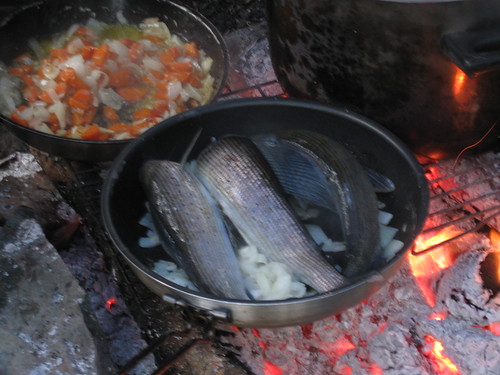
Several hours were spent passing through a burn where this summer’s forest fires rendered the tightly spaced black trunks into a dizzying moire pattern.  The destination selected for the day had the alluring name of O’Brien’s Bar, but rather than an Irish pub it referred to an old settlement on a flat section of bank surrounded by a 270 degree turn of the river.  With a surge of effort to fight a way out of the current, the canoes pulled up with a couple of hours left of daylight. People followed trails through the mossy forest which led to the ruins of a log cabin and heavy chunks of gold mining machinery manufactured in San Francisco, evidence of prospectors’ hopes and a long defunct paddle-wheeler trade. The catch of the day filled two large frying pans allowing each of us a generous portion.
IMG_3476.JPG

After dinner Ian and Steven did a tandem reading of Robert Service‘s poem, “The Cremation of Sam McGee,” which takes place “on the marge of Lake Labarge” nearby.  Each brought a copy, which wasn’t necessary, since this chestnut seemed to be printed in every tourist information pamphlet and engraved on many plaques on the streets of Whitehorse.

Day 4

To view a complete set of photos for this trip go here.
To view a slideshow of these photos go here.
Zunoquad 3“Canoeing the Teslin and Yukon Rivers (3)

Sunday, September 27th, 2009

Day 2

Andy got the fire going before yelling “Rise and shine” at the crack of dawn.  Murray’s clarion call of “Where’s the f…ing coffee,” preceded pouring the brew which he lovingly percolated to supplement Alan’s multigrain porridge.  Grunts and groans issued from several quarters, a result of stiff joints unaccustomed to sleeping on the ground or paddling and lifting. John was coming down with the flu, but insisted he’d tough it out. Murray recited the poem he had crafted about yesterday’s events, recalling forgotten incidents and giving the whole a memorable shape. Banter and storytelling delayed departure till 9:00 AM. The red sky at morning served as warning.

IMG_3382.JPG

On the river, the landscape grew more varied, at times opening to vistas of distant mountains pocketed with snow and carpeted with scarlet shrubs, at others unfolding high “cutbanks” of sediment carved by its meandering course into alluvial residues of sand and gravel left by receding glaciers. Distinguishing one from another and discovering the appropriate lunchstop and overnight campsite were officially delegated to the day’s navigator who carried the relevant pages of the guidebook in a ziplock bag.  But this thankless office lacked authority and its holder was subject to complaint and disobedience throughout the trip.

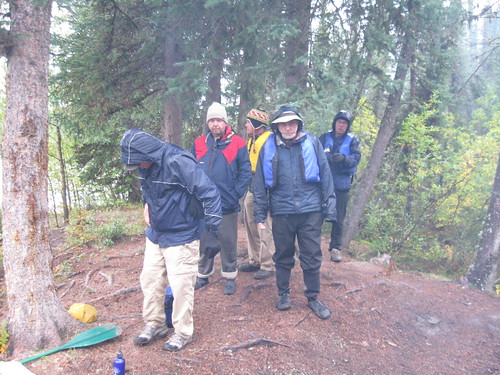
Within a couple of hours the temperature dropped close to freezing and it started to rain. Drybags were emptied of layers of waterproofing and insulation.  There was no choice but to paddle hard without pause–both to meet our distance quota and to keep warm–fueled by handfuls from the huge bags of gorp distributed by our food providers. Finally at 1:45, John allowed us to pull over at a small campsite for a lunchbreak. Gobbling rations of salami, cheese and cracker, men shivered around our small fire, and when it sputtered out in the increasing rain retreated under a tree.

IMG_3414.JPG

Back on the river, the rain lightened but we resigned ourselves to spending the rest of the day in wet clothes.  It was dark by the time we found the night’s campsite, but trolling from his canoe John had caught three arctic grayling trout to contribute to Allan’s piquant dish of riso pasta and curried canned chicken.  Inspired by the cuisine, Ian our leader-elect took on the title of “Jobwaddhi” and offered deep spiritual counsel to his devotees in the accents of a maharishi, occasionally slipping into Scottish brogue.  The dialogue was enriched in dialect mastered by several members of the group who had spent time in India or were in fact students of gurus.  Substantial inroads into the rum ration and a sense of challenge overcome ended the tough day with satisfaction.

Day 3

To view a complete set of photos for this trip go here.
To view a slideshow of these photos go here.
Zunoquad 3–Canoeing the Teslin and Yukon Rivers (2)

Sunday, September 27th, 2009

Day 1

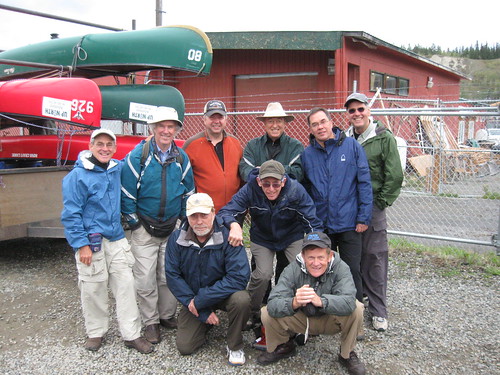
After arriving in town separately on a late-night flight, Andy joined us for breakfast.  Our outfitters, “Up-North Adventures,” ferried us around downtown Whitehorse in a van to shop for gas, groceries and liquor. On the way to the supermarket, the boyish driver told stories of kayaking down class-five rapids in the Andes but assured us that the Teslin-Yukon was quite tame. Back at the shop we posed for a group shot.

IMG_3352.JPG

Midway on the two hour van ride to our starting point at Johnson’s Crossing, the Alaska Highway bridge near the head of the Teslin river, “His Oiliness” Lionel, the day’s elected leader, realized we’d forgotten to pack the two propane stoves we’d rented and asked the driver if there was any way they could be delivered to us enroute. The rest of the crew displayed their manliness by pooh-poohing that notion and insisting we’d cook on open fires.

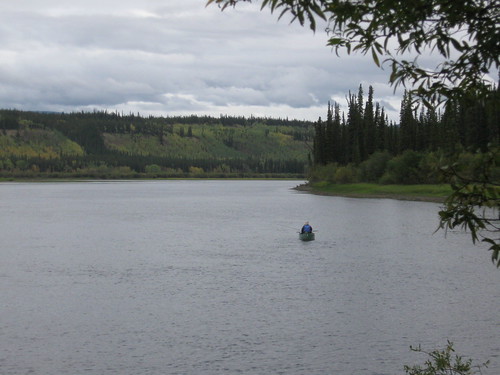
In a darkening drizzle we loaded the boats and headed off under the bridge and around a bend away from the highway into what seemed like uncharted territory.  I remembered that Andy had promised to bring a Satellite phone just in case. Even in the dead light, a margin of brilliant green grass lined the banks in front of a moving mosaic of dark spruce and luminous yellow aspen.  The river was wide and the current swept us luxuriously downstream.

IMG_3356.JPG

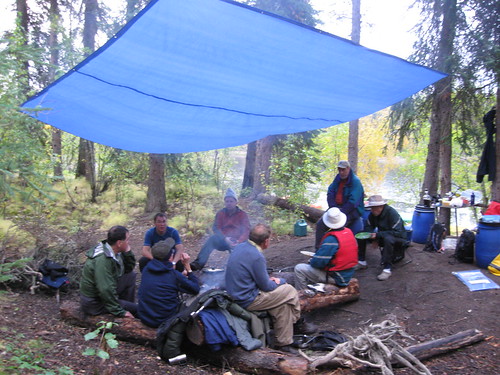
After two hours paddle, his oiliness bowed to pressure and called a halt at a fine campsite by the junction with Squanga Creek, only twelve kilometers from the start.  In a flurry of spontaneous activity, men scurried from the boats, hauled drybags and packs up the steep bank, pitched tents, constructed a makeshift table and benches, prepared food, gathered wood, built a cooking fire, and rigged a large tarp over it under the direction of Steve, our proficient tarpmeister. The first dinner consisted of steak, the last fresh meat for a week and quinoa enriched with garlic, onions and carrots. Rum toddies and chocolate around the fire were accompanied by a reading of Robert Service’s “The Spell of the Yukon”:

It’s the great, big, broad land ‘way up yonder,
It’s the forests where silence has lease;
It’s the beauty that thrills me with wonder,
It’s the stillness that fills me with peace.

As we packed all the food and anything attractive like toothpaste into the bear barrels, Andy offered a reality check after consulting the guidebook.  In order to meet the outfitter 300 kilometers down river as planned, we’d have to cover 75 clicks a day, eight hours of paddling at the rate we were going.  Taking into account an hour and a half each of set-up and take-down, there wasn’t much time for activities or exploration or fooling around.  John the next day’s leader who named himself “Gone Fishin” called for 6AM wakeup.

IMG_3363.JPG

Day 2

To view a complete set of photos for this trip go here.
To view a slideshow of these photos go here.
Zunoquad 3–Canoeing the Teslin and Yukon Rivers (1)

Sunday, September 27th, 2009

Prelude

At the end of last year’s excursion, Peter had suggested that we go on a river trip in “The North.”  Andy came through late in the game, on June 24 with a fully developed proposal:

My work schedule has blown me away for a good part of the year.  As unreasonable as it may seem I have only one window of opportunity for a wilderness trip. I can leave Edmonton on the afternoon of the 8th of September and I have to return to meetings in Vancouver that begin at 6:30 in the evening on the 17th September.

If the timing works then I think we can have a fine time (without the joy of any bugs of the biting variety) in the Yukon from Sept 9th to Sept 17th this year.

http://www.grc.k12.nf.ca/climatecanada/whitehorse.htm

At that time of year the length of day will change from about 13.5 hours to 12.5 hours during that period as the world plunges the North into twilight by November

http://www.timeanddate.com/worldclock/astronomy.html?n=679&month=9&year=2009&obj=sun&afl=-11&day=1

and the temperatures will not sustain black flies and mosquitoes

http://en.wikipedia.org/wiki/Whitehorse,_Yukon#Climate

I am heading up to Whitehorse again on business tomorrow and will try to scope out essentials and good advice from those well disposed to me J in those parts concerning the Teslin River and the Yukon River.

See link below to have confidence that a 7 day trip is possible “ we could likely easily make that distance on our own considering that the guided trip is 7 days on the Teslin¦.I have some friends on Lake Labarge ¦.not related to Sam McGee

http://www.spiritnorth.yk.ca/trips/trip3.html

Within four days ten men had signed up including first timer Allan, a friend of Lionel’s, who volunteered to be head cook.

Steven ordered a crudely produced but authoritative guidebook about the route by local guide Mike Rourke and posted several pages thick with detail. Its  handdrawn maps indicating every riffle and possible campsite proved essential to our daily navigation.

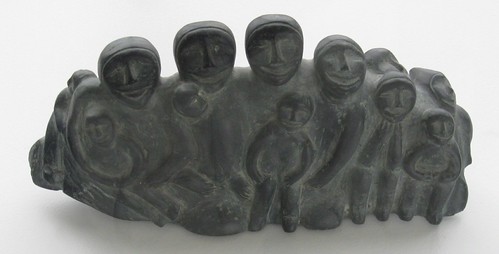
Converging from afar, our group assembled at Vancouver International at the check-in desk of Air North in the early evening, excited to meet again after a year and thrilled by anticipation, a cross between the Fellowship of the Ring and the Three Stooges. The hole left by the absence of Peter, who had bowed out because of a rib injury and family obligations, highlighted the sense of privilege shared by those who managed to get away. The wait in the terminal was enriched by a superb exhibit of Inuit sculpture.

IMG_3347.JPG

Landing in Whitehorse we were greeted by a welcoming face I hadn’t seen in decades: Noah C, whom I, Steve, Ian and Murray knew from Lund since birth, a friend of my son’s, whose parents had also come to live in the woods circa 1970.  He lives there with his family, a teacher of elementary school, handsome, healthy and happy in the place where they say “Down in B.C.”  He agreed to join us at our hotel for dinner.

When we debarked from the airport bus in front of the Best Western Hotel someone in a group of youngsters loitering at the door asked if we were from Whitehorse and when answered no said, “You’re lucky, this place is a hole.”  A few seconds later there was a crash of glass and the smell of gin, followed by a long series of howls as the kids lurched down the street leaving a broken bottle on the sidewalk.

At our long table in the bar, we were also joined by Jonah, a cousin of John’s who lives in Whitehorse, and his partner Monica, two young people employed in the business of recreation that makes this place seem youthful and prosperous –he as a sponsored mountain biker and shop manager and she as a designer.

Day 1

To view a complete set of photos for this trip go here.
To view a slideshow of these photos go here.
Hiking the Nootka Trail (6)

Friday, September 4th, 2009

September 1 Friendly Cove

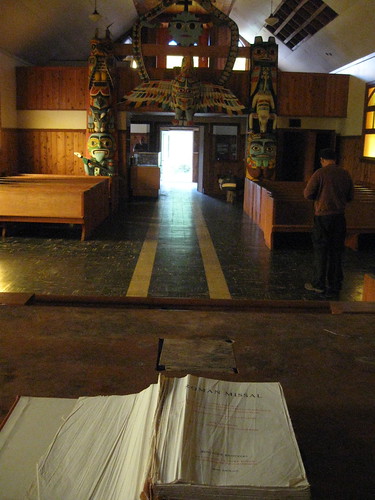
Tuesday morning, we loaded our lightened packs and followed the last part of the trail onto the Yuquot Reserve, passing a group of trim holiday cabins and a cemetery with early 20th century graves marked with stone crosses and a recent one for a seventeen year old girl marked with a carved bear totem. The large campsite adjoining the Church was well mowed but as deserted as the trail had been for the last five days.  We entered the store attached to the church at 10:00 A.M. and awakened the young caretaker, who bore a strong resemblance to the image of Chief Maquinna embroidered on the garments for sale, and who checked our receipts for the $45 we each paid at Gold River for permission to cross tribal land.  He said the boat on which we had confirmed reservations was not expected today and let us into the Church sanctuary, dimly lit by stained glass windows featuring chalices and crosses. On the stripped altar lay an opened Roman Missal, behind it stood two colorful totem poles and at the back of the sanctuary two more flanking a brilliant carved eagle. The incongruous mix of delapidation and restoration was also evident in the vestibule museum, where a ransacked display case and strewn framed historical photographs accompanied posters detailing a recent government plan for developing the whole settlement as a tourist attraction.  Ours were the first signatures in the guestbook for several days, but earlier entries indicated that several hundred hikers had passed through during the current season.

IMG_3264.JPG

IMG_3268.JPG

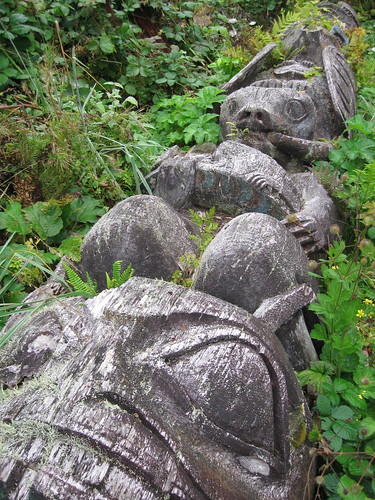
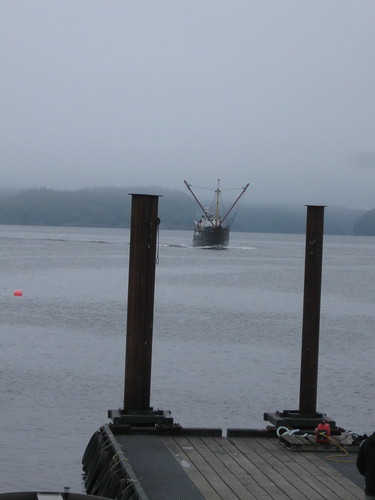
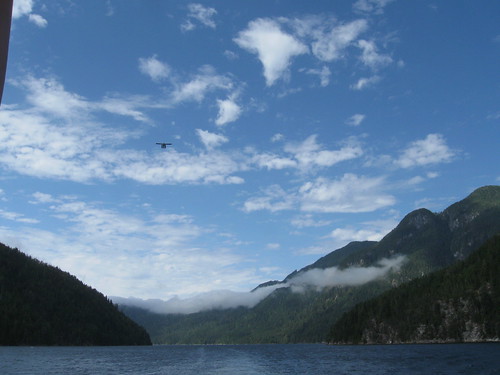
We roamed the paths cut through great mounds of blackberry brambles growing on the site of the old longhouses pictured in the museum and came upon a large fallen totem pole next to a pile of trash.  My book mentioned that this had been carved in 1929 as a gift to the Governor General of Canada who returned it to the Indians along with a chainsaw, which they’d expected in trade.  As we headed for the dock near the Coast Guard station, the caretaker hailed us and said that he’d called the MV UChuck office and confirmed that they were not coming to pick us up today, but that his grandfather could provide us a ride back to Gold River in his speedboat for $300, a discount from the $500 normally charged.  Somewhat perturbed, we thanked him and asked permission to phone ourselves.  The woman at the office said that the boat would be there within the hour as promised, and indeed the elegant old minesweeper turned freighter turned tourist boat soon appeared out of the fog.  In the galley we were amiably welcomed with coffee, home cooked soup and sandwiches. The sky cleared as we steamed up the inlet, escorted by the Air Nootka Cessna overhead.

IMG_3287.JPG

IMG_3291.JPG

IMG_3304.JPG

For a full photoset and slideshow of this day’s sights, go here

Hiking the Nootka Trail (5)

Friday, September 4th, 2009

August 31  Yuquot

nootkamap_2.jpg

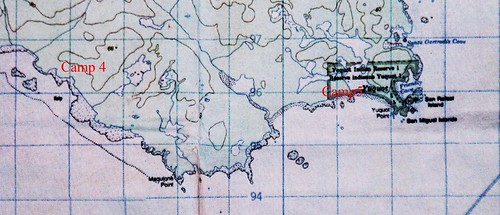
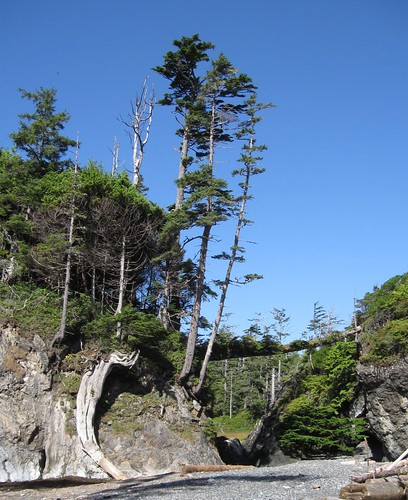
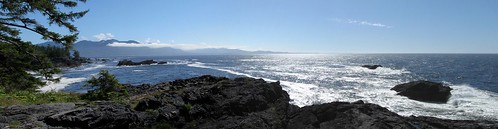
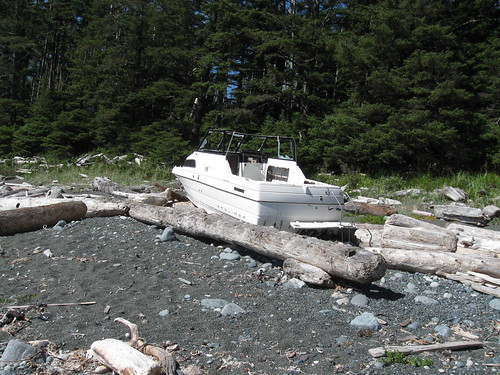
We broke camp early on a dazzling morning, reluctant to leave the cove for the long hike ahead. The trail required travel over headlands with beautiful forest and spectacular views and along small beaches passing a bead curtain waterfall, a thunder hole, ponds and meadows, and a log bridge.  The grandest of the headlands is Maquinna Point, where the coastline turns from facing the open Pacific to Nootka Inlet. We stopped there on a ledge of grass, wild onion and paintbrush to share our last lunch provisions, walk on the jagged abrasive rock and enjoy the 240-degree view. After that we started losing interest in spectacular prospects in preference for flatter ground. The last cove visited by the trail was dominated by a marooned pleasure boat, quite new with hull intact but windshield, cabin and motor smashed and cannibalized.

IMG_3210.JPG

maquinnapointpan.jpg

IMG_3226.JPG

The trail emerged onto the long beach that belonged to the settlement of Yuquot, or Friendly Cove, some of whose history I had read in White Slaves of Maquinna, John Jewitt’s early nineteenth-century account of being held captive by the Nootka chief for two years mostly in this location. (Heritage House Publishing, Surrey BC, 2000) It was the Spring and Summer residence of the Nuuchanulth tribes who resided along the protected beach in long houses that they disassembled every year and transported to their Winter residence up the inlet at Tahsis.  Friendly Cove was also the center of the otter trade during the late18th and early 19th centuries, at one time the most important port north of Mexico. During this time the otter population was virtually wiped out and the native population of the area declined from 200,000 to 40,000. The otters are now making a comeback.

P8290513.JPG

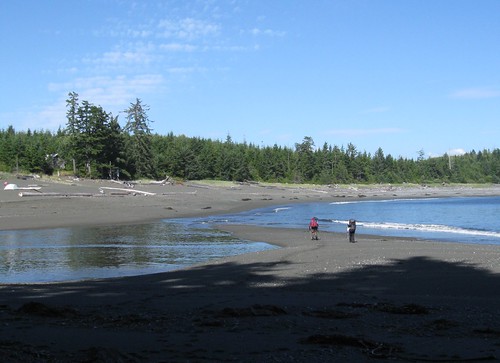
The beautiful views along this beach all seemed to center upon the church with its steep red roof and bright white walls. After Peter’s swim, my nap and Paul’s water gathering, we walked along soft sand and then through the outflow of a tidal lagoon where an older man sat between a small tent and a kayak.  He was waiting for the wind to die down so that he could paddle around Maquinna Point to Calvin Falls to meet a friend of his kayaking from the other direction.

IMG_3228.JPG

IMG_3230.JPG

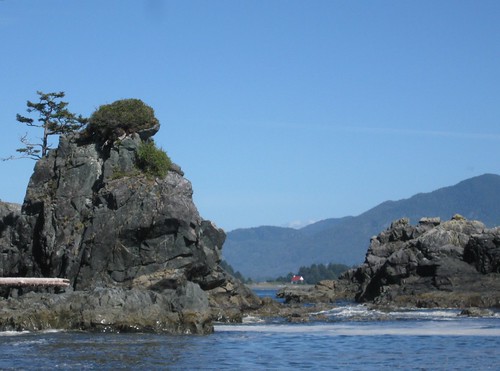
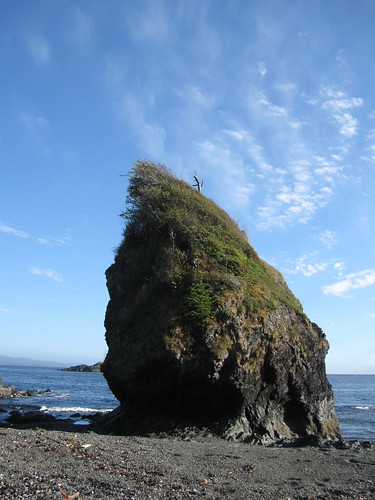
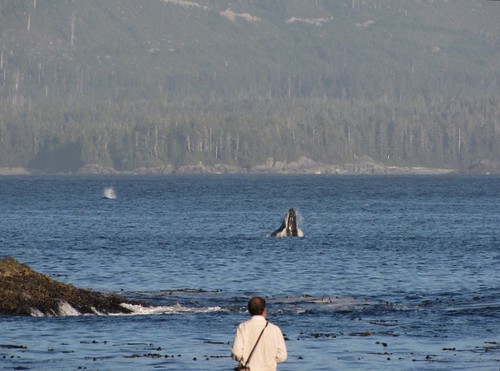
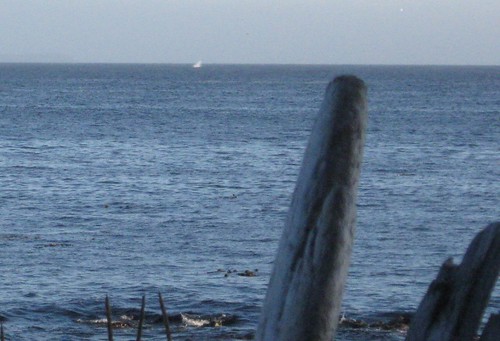
We continued along the beach to a campsite by a seastack, close enough to Friendly Cove to get us to the dock in time for our pickup the next morning. As we unloaded packs, Peter said, “A perfect trip. Cue the whales.”  Within a few minutes the action started out in Nootka Sound, not too surprisingly, since the Indians who lived here were famous as whalers.  First, two Orcas spouting way offshore and coming closer.  Then out near the horizon catching the late afternoon sun, continual explosions of a surfacing humpback, and finally an Orca coming in close enough for Paul to catch him on camera “skyleaping,” a wild behavior that seemed to have no purpose but to entertain us. Peter cooked dinner of beef rotini generously purchased from the Powell River outfitting store, enriched with chanterelles remaining from the earlier harvest.

IMG_3231.JPG

3882161365_731bbf9fca_o.jpg

IMG_3240.JPG

Hiking the Nootka Trail (6) »

For a full photoset and slideshow of this days sights, go here

Hiking the Nootka Trail (4)

Friday, September 4th, 2009

August 30   Marble Cove

nootkamap4.jpg

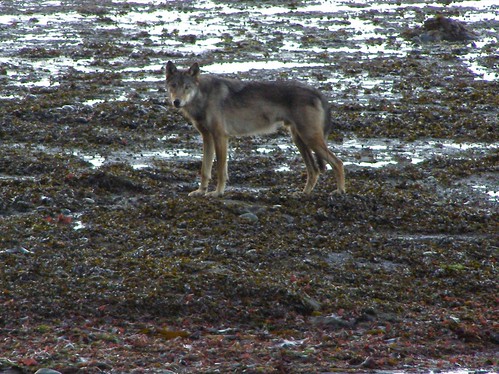
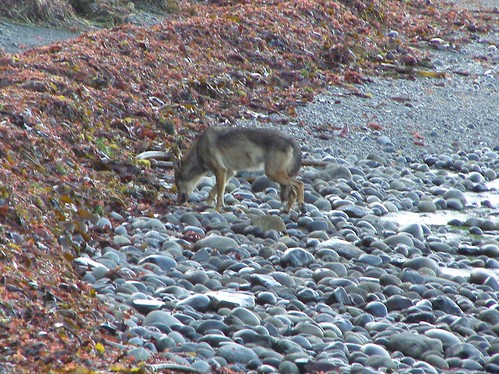
As we loaded our backpacks in the morning, Peter called out “the Wolf !” I looked up, and there it was, fifteen feet away on the other side of the log.  My camera, which I usually carry on my belt, wasn’t working because of a battery malfunction, and I yelled, “get the cameras.” As Peter and Paul scrambled for theirs, the creature stopped and I got my first look at a wolf in the wild.  Rather than the fierce and proud appearance I expected, it seemed hangdog and scrawny, but nevertheless surprisingly large. Its ribs protruded and its face, as it turned toward us, was flat and small-eyed, its legs long, its tail down.  As they snapped pictures, the wolf ambled over to a pile of bull kelp, nosed it disconsolately, stared up at us with an expression of hopeless hunger and moved on.  It recalled the wolf in illustrations of Little Red Riding Hood.

P8280477.JPG

P8280483.JPG

We hiked around the next point and passed a couple of cabins on the bluff above Beano Creek, which our both our trailguide and the pilot had mentioned were not to be disturbed and which were at the end of a logging road that could, before long, allow the trucks into this still unprotected section of the coast to destroy the forests we marveled at. We followed some flagging we thought indicated the trail around the impassable headland ahead up into the bush and ended up behind one of the cabins.  An elderly gentleman yelled across a logged-over patch that we were on the wrong trail and that we should take the bypass further down the beach.  Paul thanked him and then found a ripe red tomato unaccountably left in the middle of the trail. We welcomed it as compensation for our first unsavory reencounter with civilization. An added infusion of fresh produce materialized along one of the arduous bypass trails–a large colony of chanterelles, which Paul and Peter pounced on with expressions of glee.

P8280495.JPG

P8280502.JPG

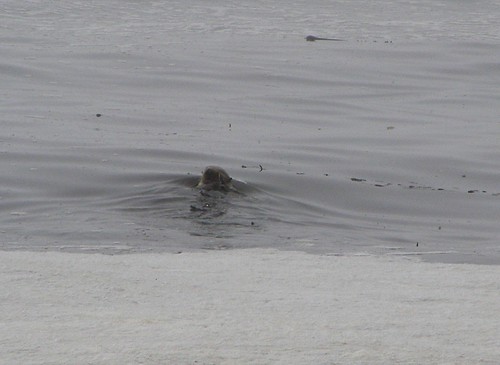
For several hours, the trail alternated between steep headland traverses through old-growth cedar groves and beautiful pocket beaches, including a sighting of a contented looking Pacific otter, the species rendered almost extinct by the fur trade between Indians and Englishmen during the 19th century.  We felt ready to stop at a small cove protected by limestone and marble walls and tall spruce-covered headlands. I climbed a tiny treed promontory that rose from the middle of the beach and Peter and I explored a sea cave at the north end. While Paul set up camp and gathered firewood, Peter took a swim in the rocky surf. I got wet and then lay down and buried myself in warm smooth beach pebbles. Then I cooked dinner of couscous and tuna while Paul sautéed the chanterelles with a garnish of tomato. Sunset and fire rounded off the evening.

P8290520.JPG

P8290541.JPG

IMG_3164.JPG

IMG_3180.JPG

IMG_3181.JPG

Hiking the Nootka Trail (5) »

For a full photoset and slideshow of this day’s sights, go here

Hiking the Nootka Trail (3)

Friday, September 4th, 2009

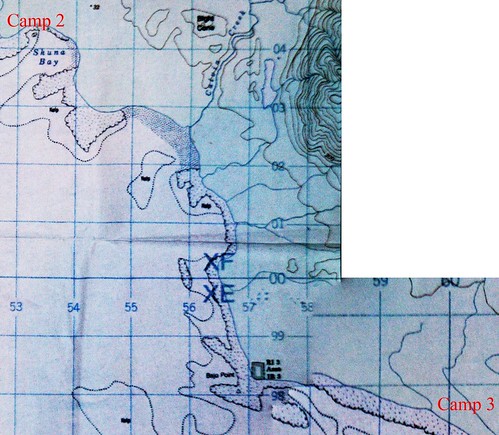
August 29  Midway between Bajo Point and Bajo Creek

nootkamap3.jpg

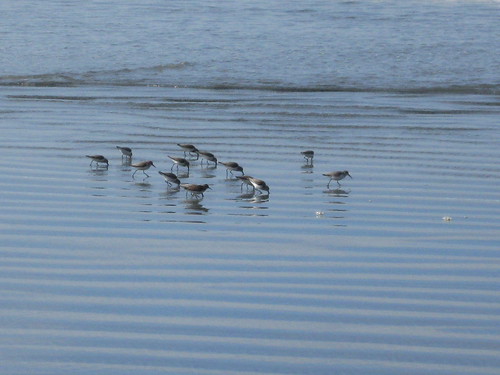
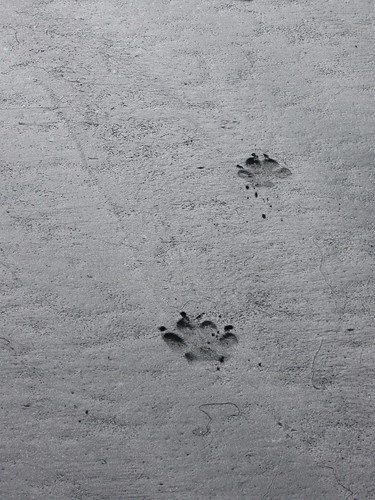
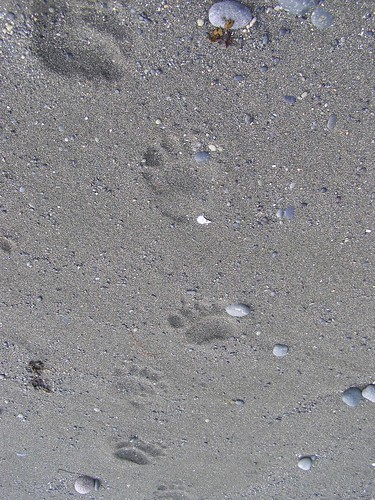
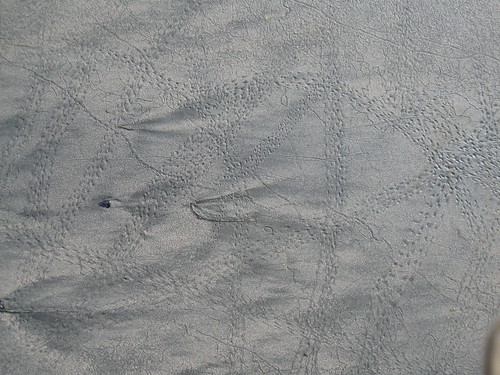
This morning dawned foggy.  Paul had coffee already brewed on his stove as I crawled out of the tent, less stiff and achy than on previous days. Walking on the hard grey sand along the smooth curve of Skuna Bay was fast and fluent.  We were greeted by a flock of killdeer at a little creek’s descent into the ocean.  A distinct track preceded us, which Paul identified as wolf.  For a while it was joined by bear prints and the delicate tracks of killdeer and sanderlings which follow the water’s moving edge, a double oscillation of waves within tides.

IMG_3069.JPG

IMG_3066.JPG

P8280489.JPG

IMG_3063.JPG

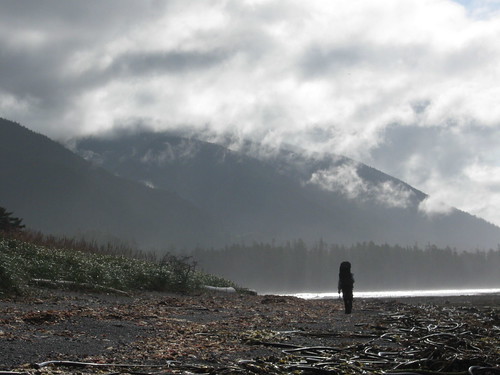
As we rounded the point at the south end of Skuna Bay under an awning of horizontal spruces, the sky disrobed, revealing its naked blue splendor and the sun’s brilliance. The top end of the bay where we’d camped remained in clear view, but continued shrinking into the expanding landscape.  Three days now with no trace of other humans”no logged stumps or springboard notches, no boats or planes or even contrails”except for a sprinkling of detritus on the beach: mostly water bottles and net floats.

IMG_3044.JPG

IMG_3062.JPG

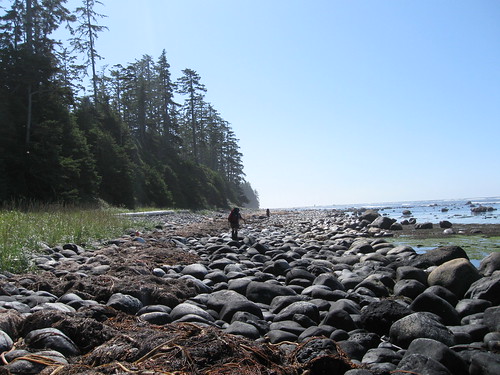
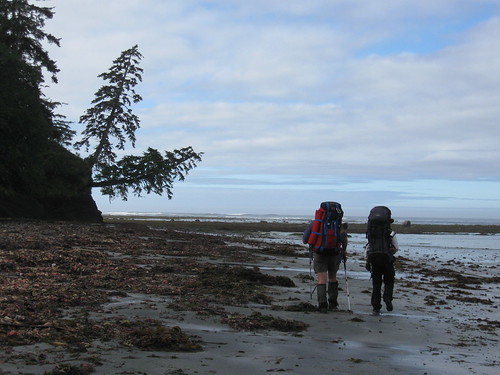
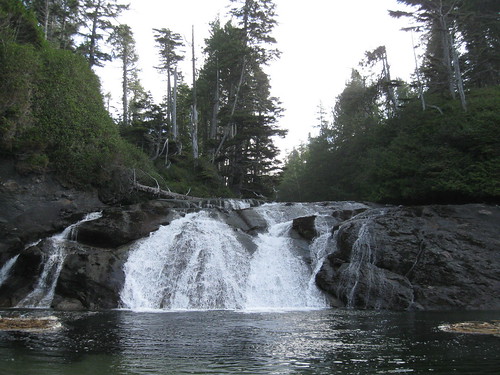
Calvin Falls came into view, a white cascade of fresh water pouring into a deep pool with a slow circular current that empties into an ocean-seeking stream flowing across the wide beach. I welcomed the chance to get out of my wet boots and take a cleansing swim before lunch.  As we continued on, the friendly packed sand was replaced by large polished boulders, at first difficult to negotiate but soon allowing light-footed progress guided by close attention to the steps immediately ahead, enhanced by the stones’ artful variety of texture and color.  Then the boulders got covered with thick deposits of seaweed and eelgrass ripped by storms from kelp beds offshore. We either had to slog through the soft wet piles or balance our way along the driftwood stacked at high tide line. At first the stench was overwhelming but after an hour or so, one got used to it.
IMG_3074.JPG

IMG_3095.JPG

We found a fresh water rivulet and nearby a tent site on a soft bed of rotten eelgrass behind a thin barrier of logs that separated us from mountains of broken bull kelp, giant kelp and other algae that would provide a fortune in sushi, fertilizer and xanthan gum to anyone who could harvest it. After a nap Peter and I headed up into the bush to reconnoiter, drawn by sky visible above the treetops. We tunneled through salal up to a bench where it thins to allow relatively easy walking among widely-spaced first-growth trees and windfalls. We made for a huge gnarled cedar and found around its back traces of removal of cedar planks by native inhabitants long ago. Such “Culturally Altered Trees” provide evidence in present-day land-claims negotiation. We wandered further back along the trunk of a windfall hung up in the crossing of a cedar and a spruce and ended up fifty feet above the forest floor in the middle of the clearing it created.  Peter’s foot dropped through a hole in the moss, but he didn’t fall.  We bushwhacked toward the little creek leading to our campsite on the beach and crossed on a windfall leading to another old-growth cedar with a bear’s lair in its hollow base.  When we returned to camp, we found Paul napping instead of cooking. After a rude awakening he cooked up a much-anticipated meal of jambalaya and sockeye salmon with chocolate pudding for dessert. The incoming tide nudged piles of seaweed into gracefully curved windrows along the shore.

IMG_3147.JPG

IMG_3127.JPG

IMG_3158.JPG

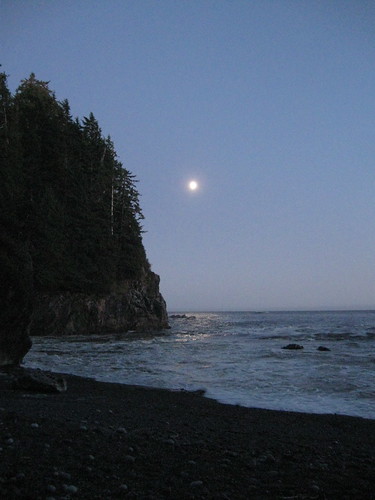
I got up to pee at 1:00 A.M. and was shocked by a bright orange moon sinking behind the shelf it exposed by pulling out the tide.

Hiking the Nootka Trail (4) »

For a full photoset and slideshow of this day’s sights, go here

Hiking the Nootka Trail (2)

Friday, September 4th, 2009

August 28 Skuna  Bay

nootkamap3.jpg

Yesterday’s blasting surf settled to a smooth rush from far offshore across the tidal shelf.  The quiet creek winds through first-growth spruce forest, clear enough for me to explore in my water shoes after the regular post-hike nap.  Many of the spruces are snapped off with a horizontal break at 50, 100 or 200 feet and surrounded by light coming through the hole their fallen tops leave in the canopy.

IMG_3016.JPG

IMG_3012.JPG

Contrasting to the noise and motion of sea and sky, the creek walk prompted reflection on the unpeopled landscape we’ve been immersed in now for more than 24 hours: the margin of land and ocean varying from forest and rock outcrop to beaches of sand, boulders, pebbles and vast sandstone shelves.

IMG_2987.JPG

IMG_2996.JPG

I wore parka, rainpants and poncho to stay dry through the swamps, fog and drizzle that succeeded the sunshine of our first day. My pants kept slipping down and my glasses kept fogging up from the heat of exertion, especially during the half hour we found ourselves bush-crashing to recover the lost trail.  The weight I’d added to my pack to reduce Peter’s tortured my shoulders until Paul showed me the proper strap adjustment to bring it closer to my back.

P8270416.JPG

The series of headlands requiring diversions through the bush ended and the beach turned into a flat tidal shelf of sandstone with good traction extending for a mile seaward and disappearing into the fog.

IMG_3026.JPG

Drifting off to nap after the day’s six-hour trek, I counted primal contraries revived by backpacking: wet-dry, hot-cool, cold-warm, hungry-full, thirsty-slaked, tired-rested, anxious-relieved. Now my boots, soaked in the last creek crossing, have dried and warmed by the fire.

Peter provided dinner of Annie’s organic Mac and Cheese, my grandsons’ favorite.

Hiking the Nootka Trail (3) »

For a full set of images and slideshow for this day, go here

Hiking the Nootka Trail (1)

Friday, September 4th, 2009

Prelude

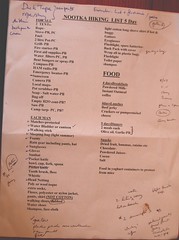
Peter B. had proposed a backpacking trip between the time Jan left B.C. for California and before our trip to the Yukon.  He invited his hiking buddy Paul C. to join us on the West Coast Trail from Tofino to Bamfield, but there were no reservations available for that heavily traveled route, so he suggested we do the Nootka Trail, a less known but comparably grand and remote wilderness experience. I agreed, as usual, to follow his lead, and he and Paul together did the research and made the necessary preparations, including getting plane and boat reservations, trailguides and maps.  After it took me almost a full day just to shop for my own provisions and pack for a six-day expedition, I felt grateful for all their legwork.

flightreserv.jpg

IMG_8193.JPG

August 27  South of Third Beach

nootkamap1.jpg

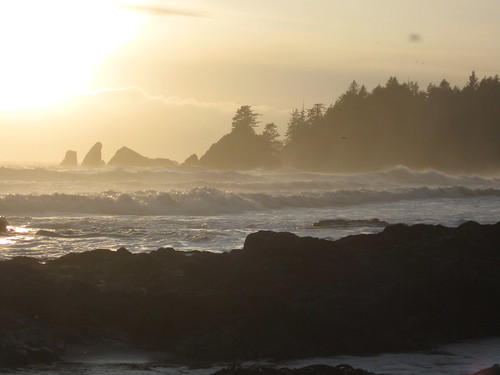
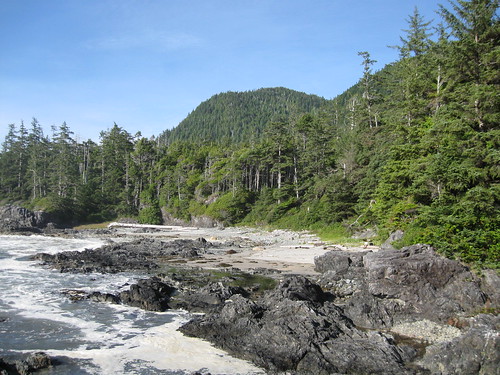
The sun drops into a rising fog bank above distinctive trapezoidal rocks and a tree-topped headland. The waves’ roar has been unabated since I first heard it deep in the forest on the trail from Louis Lagoon.  White tips are painted on the crests of broken rollers. The thunder of water colliding with stone vibrates in my gut. Thick foam left by turbulence and mashed red-tide algae accumulates on the beach. This is wilderness West Coast.  Nothing but the tiny settlement of Friendly Cove until Tofino, 75 miles to the south and only small towns fifty miles back up the inlets where the mills used to churn.  But before contact with Europeans in the late 18th century, this seacoast was home to hundreds of thousands of people for five thousand years.

IMG_2975.JPG

IMG_2957.JPG

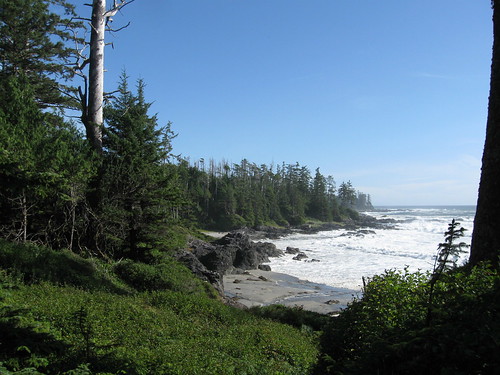
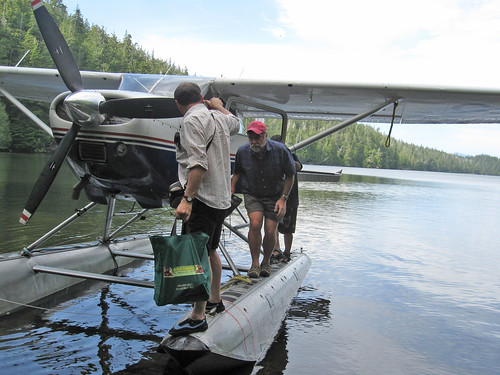
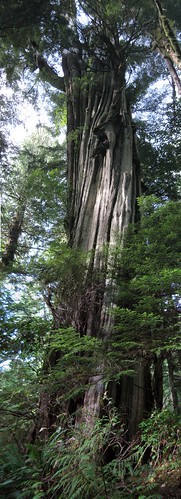
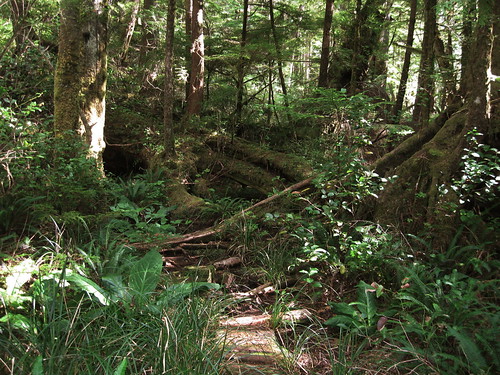
We were conveyed here by ferry across the Georgia Strait from Powell River, by Subaru to Gold River, by Nootka Air Seaplane to the Lagoon and by our feet across an isthmus of old growth cedar, hemlock and spruce on a rough trail cut and maintained by volunteers.  It winds through tangles of roots and windfalls obscuring the borders between ground and growth, living and dying. Immense trees, leaning and erect, sprout from fallen nurslings and grizzled snags to reach for sky.  Underfoot, ferns and bunchberry capture spots of sunlight that penetrate the dark canopy.

IMG_2921.JPG

tallcedartilt.jpg

I walked at a slug’s pace to balance the weight of the pack and spare my knees, and also to gaze at a living world hardly disturbed by humans.  It feeds, aspires, grows, strengthens, procreates, cooperates and competes, weakens and dies as we do, at a different temporal scale and speed.

IMG_2930.JPG

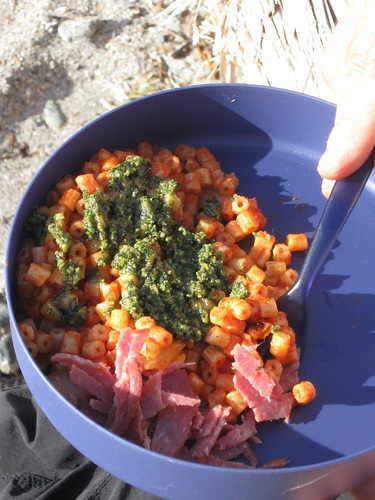
We found this campsite not indicated in the guidebook. It provides water to try out Peter’s fancy ozone generating purifier kit, which no one likes.  After an aperitif of whiskey from the plastic bottle, we were excited to share our first dinner: sautéed garlic and onion, tiny pasta rings, tomato sauce, fresh pesto I bought from Pat Hanson, and a little bit of sliced cervelatwurst, a guilty pleasure on my cholesterol-free diet.

IMG_2965.JPG

IMG_2972.JPG

For a full set of images and slideshow for this day, go here

Hiking the Nootka Trail (2) »