Author Archive

Covid in Ketchum

Thursday, April 16th, 2020

We follow the Idaho Mountain Express online to maintain indirect contact with Joe and his family who are sheltering at home in the middle of the highest per capita infection rate location in the country. The news there doesn’t tell us much about what’s really going on and neither do his reports but Jan came up with a long article in Buzzfeed, a national outlet, that gave us a fuller picture–both about the course of the spread and through a number of interviews with rich and poor victims, about the range of human impacts.  This quote stayed with me and dominated my morning quiet time in the bathtub and while meditating:

The infectious disease doc came in and said, “You have COVID, and I don’t think you’re going to survive, because you only have 61% of your lung capacity.” They asked him, “Do you still want to have this DNR [do-not-resuscitate order]?” He said yes. “Do you want to be put on a ventilator if needed?” He said yes.

Meanwhile, my dad was gradually improving. He said it was so hard to be alone, with the only people he came into contact with wearing full protective gear. He said it felt like they were scared of him. But he’s a tough cookie. He couldn’t get out of bed or go to the bathroom for nine days, but when they let him out, he took a shower, and came home — that was March 29 — and surprised everyone on the family Zoom call. It was my parents’ 51st anniversary. My mom was just totally taken aback and so happy.

https://www.buzzfeednews.com/article/annehelenpetersen/coronavirus-covid-19-idaho-blaine-county-sun-valley

My most persistent concern over the last several years has been the dual business of departure and legacy.  The “Better End” talk I wrote for the Sangha and the updating of our estate and advance directive documents last year addressed the first.  The effort I’ve put in to scanning photographs and retroactive updating of my blog with uncatalogued writings and documents address the second.  But both tasks are far from finished, the opposite of the kind of closure they intend. The ongoing Pandemic adds to my age and health status to make completing them more urgent, and the lockdown should provide the opportunity to get it higher on my list of priorities, but so far that urgency has issued only in procrastination pressure rather than action.

The questions, answers, and subsequent outcome of the old man in the Buzzfeed article captures my confusion about the  advance directive.  At the moment of actual decision he reaffirmed his DNR, but rather than abjuring any heroic artificial lifesaving efforts, as included in my directive, he asked for the ventilator, which then saved his life and brought happiness to his family. This goes against the news that I read lately indicating that those embattled ventilators have the desired effect only in a small  proportion of cases. When writing the directive, I didn’t envision Covid 19, but rather something like a stroke or heart attack after which any recovery would only prolong infirmity. But since then I’ve been diagnosed with coronary heart disease, suffered a (tiny) stroke and a syncope and agreed to the installation of a pacemaker.  And life is good. So if I become infected how will I answer those questions?
Death in the Afternoon

Sunday, April 5th, 2020

From Katie: “The fox just ran through my plot, coming from the direction of your plot. It came through the fence just behind the hoop house, headed southwest to the creek.”

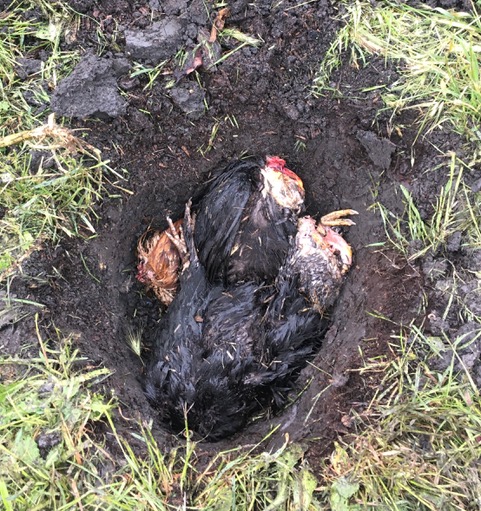
Reply: “Before we talked  yesterday, I gathered up the dead but unmutilated chickens and laid them in a tote inside the run for burial today.   When I arrived this morning they were strewn all over, all partially eaten.  My deduction, based on the fact that their feet were still warm yesterday:  I must  have scared  the fox off when I first came out, and he must have returned to finish the job after I left and before you sent the above text.”

NYC

Friday, April 3rd, 2020

My  daily news comes  from the world center of suffering:

  • New York Times
  • New York Review
  • New Yorker

My abandoned home

Shelter at Home

Thursday, April 2nd, 2020

[for our  53rd anniversary]

In the living room within these walls
Snug we sit on the softened sofa
And watch the dance of pixels on the screen
Replacing our extinguished hearth.

I recall the cozy chesterfield
Where we cuddled in front of the fire
While the storm roared in the hollow,
Our future but a threatening swirl.

Could we then have seen ahead
Our joy and comfort half a century hence,
Before the plague began to rage,
That moment might have lost its treasured worth

Like this perilous time’s, when every minute counts
When 25 million precious minutes since
Cannot be taken from us
By whatever now our future holds in store.


The New Routine

Monday, March 30th, 2020

30 March 7:23 A.M.

The big space in journaling accounted for by relative lack of change. Jan and I are still comfortable with social distancing, mitigated by her ongoing interactions on Facebook and my daily visits to the farm which include live interactions with co-workers Shane and Tree, fellow farmers Abimael, Javier and Katie, volunteers Claire,  and Anneke. Continuing harvest for the Food Bank, reorganizing the field map, planting the thousands of starts donated by Green Heart, feeling the ground softened by mini-miracle March drought busting rains makes time there more precious than ever, though often exhausting.  Daily routine includes nap, dinner prep with harvest or dutiful restaurant takeout, and entertaining screen time. With students gone and populace on lockdown, the streets and freeway are quiet, the downtown empty.  The absences are filled with birdsong and screaming headlines, the most recent being that the national lockdown will continue at least until April 30.

The vocabulary word reminder:

  • Social distance
  • Self quarantine
  • Isolation and self-isolation
  • Lockdown
  • Shelter at home

Art in a Time of Plague

Sunday, March 29th, 2020

29 March [to Kathleen Balgley]

After the lockdown started I began a journal to record thoughts of what seemed like unusual urgency in the face of unprecedented transformations. But within a couple of days I lost motivation, thinking that even if some new insight emerged, who cares, since both audience and author are likely to be eradicated in the approaching tsunami. Better to just keep working in the garden, prepare good dinners and drink hard while watching movies.

That sentiment was captured in this quote by an Oxford Shakespeare scholar in today’s NY Times:

René Girard, the French critic, wrote in a famous essay that “the distinctiveness of the plague is that it ultimately destroys all forms of distinctiveness.” Mass burial pits for plague victims were one visible symbol of the way the disease erased social, gender and personal difference.

But then she goes on:

Elaborate plots, motives, interactions and obscurities focus our attention on human beings. No one in Shakespeare’s plays dies quickly and obscurely, thrown into a communal grave. Rather, last words are given full hearing, epitaphs are soberly delivered, bodies taken offstage respectfully.

Lots to learn from writers and artists these days after all.

Covid 19

Monday, March 16th, 2020

March 16, 2020 7:25 AM

The greatest instability in my 78 years—maybe the Cuban Missile Crisis of 1962 or the Columbia strike of 1968 can compare—and it’s already become a routine. No mindblowing headlines this morning, no new directives for today—the schools all shut down, seniors supposed to stay indoors, stock market crashing again—Jan and I resolved to stay home without company, finding most stimulation in watching old TV shows.

I still go back and forth between fantasizing about how to pull the plug if I get really sick in compliance with my advance directive and thinking that the probability of being affected is less than dying of the seasonal flu.

St. Fratty’s Day

Sunday, March 15th, 2020

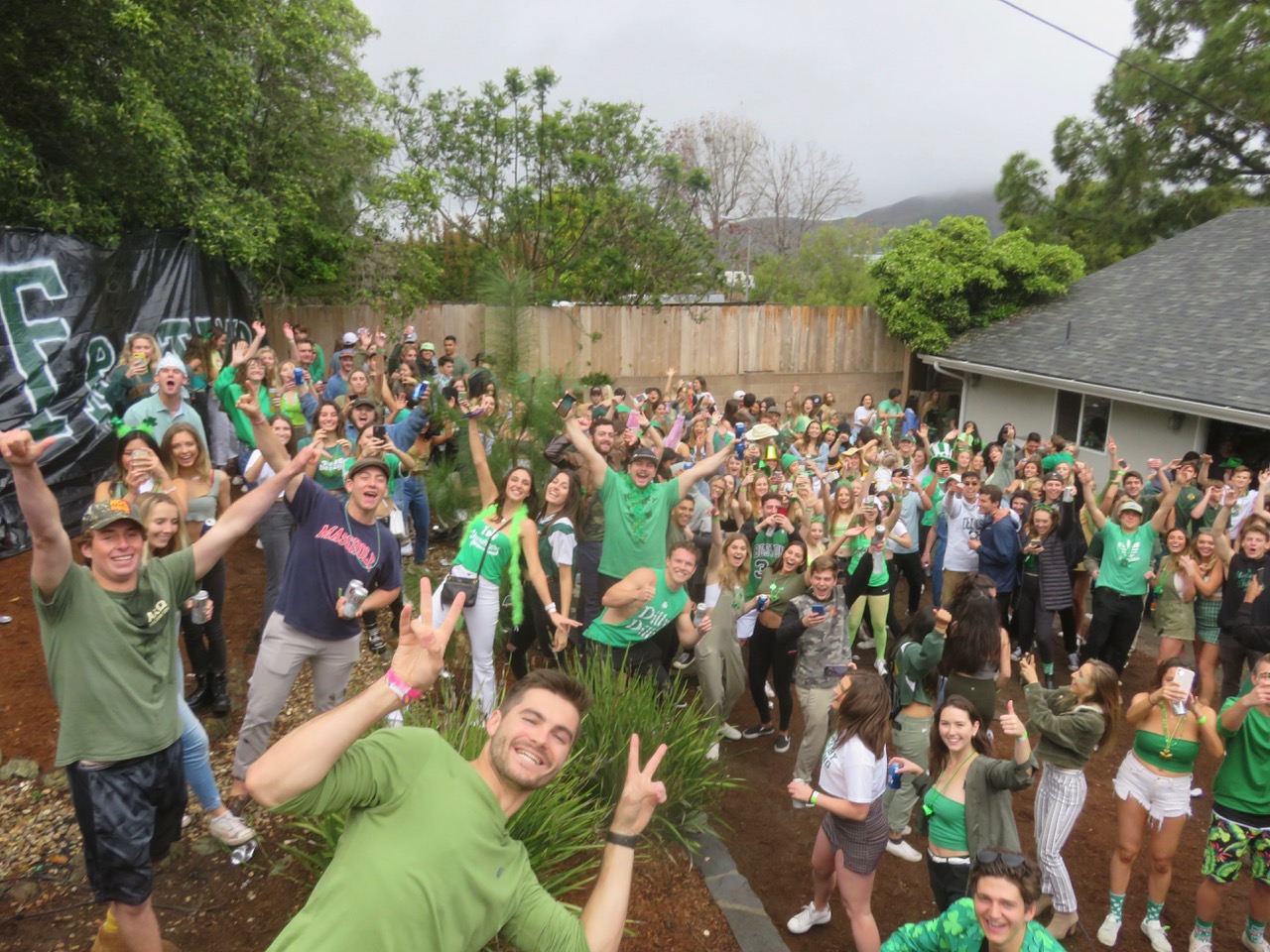
Our next door fraternity boy neighbors, who are careful not to have parties at night and are friendly and courteous, threw what in SLO is a traditional “St. Fratty’s Day” 8:00 AM bash the Saturday morning before St. Patricks Day.  They had told us of the plan the day before and neither of us were concerned, since we had planned a Saturday morning rendezvous for 6:30.  Once the festivities started I went up the hill in back and looked over the fence and gave a thumbs up, which produced this response:

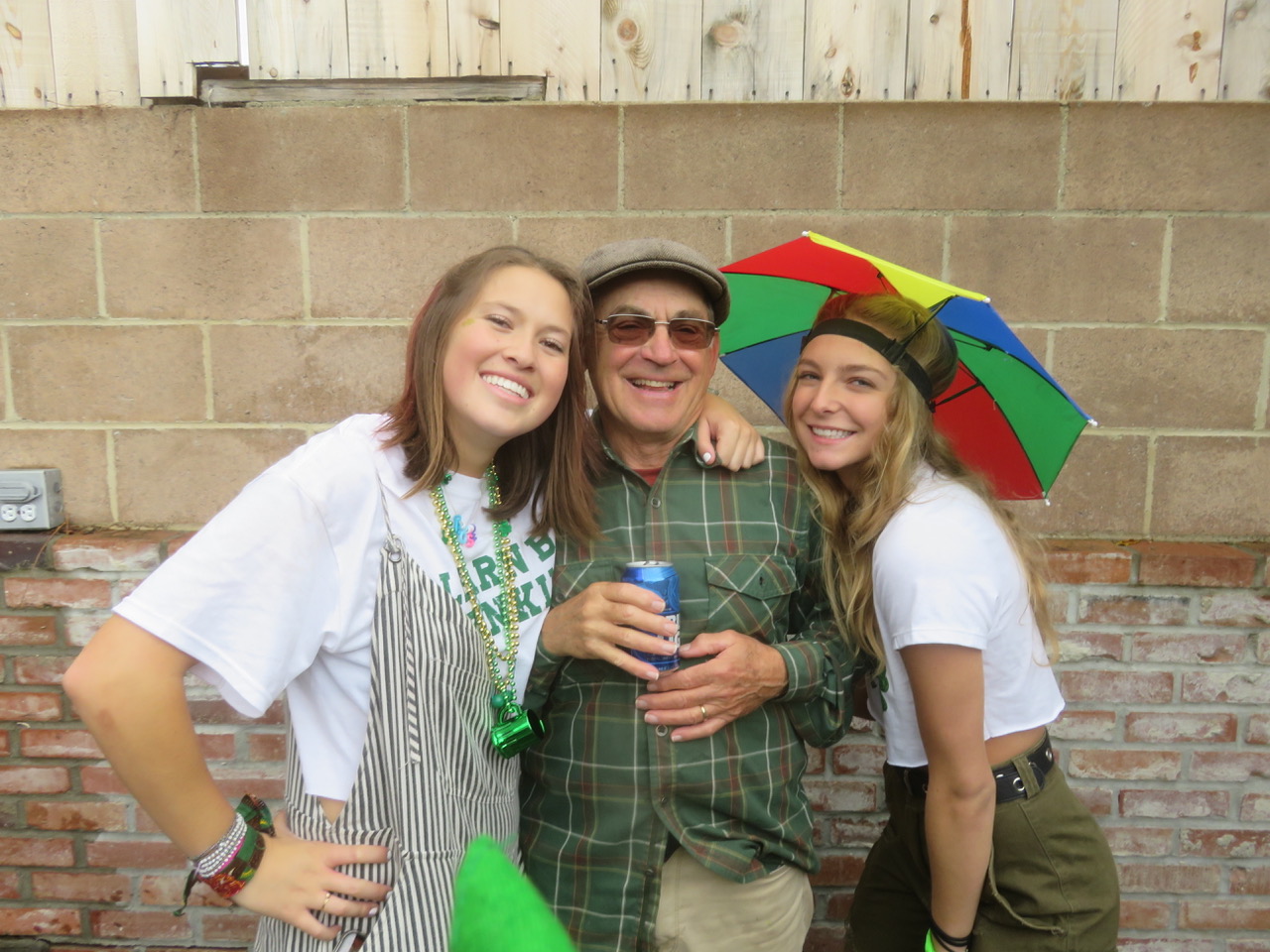
They urged me to join them, which I did, thinking I was being  discreet by elbow bumping instead of hand shaking.  Sky high on endorphins from the earlier activity, reinforced by avid attentions of the sorority girls, I did not resist many much closer contacts and couldnt help thinking if the end of the world was near, this was the way to go.

When I got back home Jan was not amused.  She’d been reading the morning’s news about the urgent necessity for “social distancing,” and told me immediately to take off all my clothes and put them in the washing machine and to shower thoroughly, soaping everywhere.  I did as she said, but still felt the glow of being a “celebrity””their word”among the neighbors, and so sent you the photos.  Fortunately I left it at that, though Jan put her picture from our yard up on Facebook.  But as the day went on and the news got steadily grimmer, she  got more and more pissed at me, and I felt stupider and guiltier, realizing that the party itself, and my succumbing to it was precisely what the Surgeon General and even the President now was cautioning against. We’ll only know in a couple of weeks whether that lapse will have led to serious   consequences.  But Jan did acknowledge this morning, that though she chose not to join me at the party, she didnt try to stop me going.

As of Friday all schools in the County are closed until April 15, and our burgeoning educational Farm programs are shut down.

Exchange with Richard Powers

Friday, February 28th, 2020

From: “Powers, Richard S” <[email protected]>

Subject: RE: ATTN: Richard Powers

Date: February 28, 2020 at 8:52:00 AM PST

To: “Steven R. Marx” <[email protected]>

Dear Steven Marx,

What pleasure it was to get your good and thoughtful letter.  Your words were very satisfying to hear, and I was delighted to hear of the connections between your personal journey and the journey I made while writing The Overstory.  It also moved me to learn of Eagle Waltz, whose productive response to a challenging situation would have made a wonderful addition to my fictional version of that challenge.  I look forward someday to hiking that trail he mapped and built.  Thanks for telling me about it, and for taking the time to write me with your generous words.

With gratitude,

Richard Powers

From: Steven R. Marx
Sent: Wednesday, February 26, 2020 3:31 PM
To: [email protected]; Powers, Richard S
Subject: ATTN: Richard Powers

Dear Richard Powers

I’ve been meaning to write to you since last September when I finished reading The Overstory.  I kept putting it off until now because I felt shy of requesting the attention of an author I so admired. The fact that the book affected me so deeply and personally was outweighed by reluctance to add to what must be a heavy load of fan mail from others in whom it’s created a need to share some of their stories.  But after all this time, and as I ready to tackle The Echo Maker, the resistance has crumbled.

I learned about The Overstory from Eagle Waltz, an old friend from back-to-the-land hippy days near the end of the road in Lund, British Columbia, where I moved from New York with my wife Jan in 1970, lived in the woods for nine years, and where we return annually with our children and grandchildren. Eagle was another exile at the time, from Germany, who was entranced by the wilderness and horrified, like all of of us, by the systematic destruction of old growth forests whose grave markers we lived among in the form of gargantuan springboard-nicked stumps.  Rather than merely learning to live with that grief, Eagle decided to try to save the few grand specimens still scattered through endless slash and second or third growth plantations by mapping and building a 150 mile-long hiking trail  connecting the old sages. He calculated that opening the back country to locals and eventually tourists would produce support for his lifelong efforts to negotiate with logging companies and the government to spare the last remnant, which it has done.

The book’s connection with Eagle and its portrayal of the pain of outsiders who moved to the woods and ended up in industrial logging zones created one bond.  But then there was Stanford/Palo Alto/East Palo Alto.  I had moved there first in 1963 to go graduate school in English in order to avoid the draft after being kicked out of the Peace Corps for being “too intellectual” and having “the wrong attitude toward authority.” Jan and I met at a poetry seminar In the Free University of Palo Alto, got into lots of trouble and fun as student activists, married in the backyard of a cottage we rented in EPA, moved to NYC  where I taught at Columbia for three years and then emigrated to Canada. Nine years later we returned to Palo Alto so I could complete the dissertation on pastoral ideals and the life cycle I’d started fourteen years earlier. My interest in trees was rekindled when, unable to secure decent academic employment, I became  a part-time arborist.  A couple of years later upon yet another return to Stanford as lecturer I also worked on the tree crew and wrote a piece for the Stanford Magazine about the combination. After four years, and having secured  a tenure track job at Cal Poly San Luis Obispo, I gave a  capstone talk for “Literature and  the  Arts in Western Culture” entitled “Everythihg’s Dead but the Tree.”

Its clear from descriptions of other books of yours I plan to read that trees are but one region of your exploration, and I look forward to discovering some of the others. But the striking intersections between the incidents, places and passions so compellingly narrrated in this novel and episodes in my life make me feel uniquely part of The Overstory.

Gratefully,

Steven Marx

Metta and Peta: Buddhist reflections on humans’ relations with other animals

Monday, September 16th, 2019

An address to the White Heron Sangha, September 15, 2019

A variety of encounters with non-human animals over the past year have opened new areas of experience for me and left me mulling some troubling questions. They’ve led to conversations with family members, friends and co-workers, to reflections on past experiences, to scientific research and to guidance from Buddhist authorities.

One area of experience is my relationship with our two year old family dog, Sophie. Another is a series of cardiovascular incidents which have motivated  me to refrain from eating animals for medical reasons. And another is my work at City Farm SLO, where the production of organic vegetables by small farmers and students is subject to the ravages of gophers and ground squirrels.

Sophie came into my life a year after the traumatic death of our previous family dog, a Yorkshire Terrier who had bonded closely with my wife Jan and our two live-in grandchildren but with whom my relationship was distant.  By the time that Jan acquired Sophie, we were empty nesters, and I was a goner.

1 sophie

(more…)