February 14 1985
Thursday, February 14th, 1985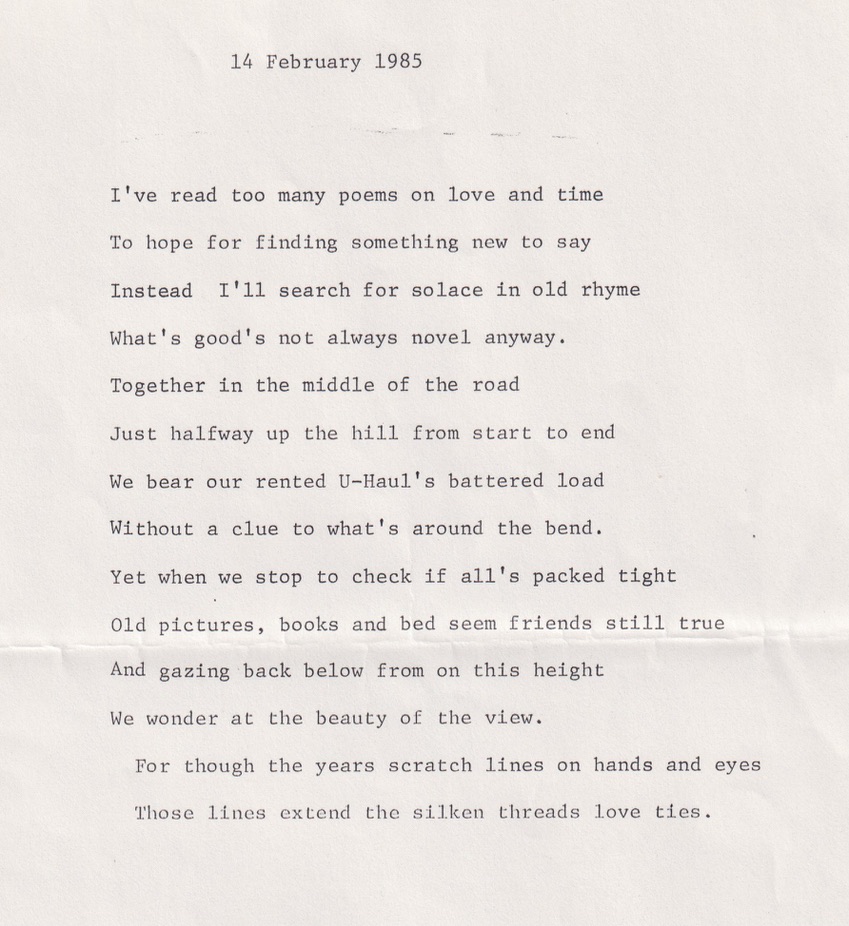

On American Airlines flight 510 to Kent Ohio
For two days I’ve been shopping and packing, provisioning for this expedition: 10 copies of a résumé, my article in progress, financial statement on Laurel tree care, family picture, three piece suit, hiking boots, dissertation, Index cards. My excitement has intensified since the Monday night phone message from the Davey Tree Company which said “we want you to come spend a week at corporate headquarters in Ohio as soon as possible.” Rescue and opportunity!
I sought out this company and this field of work both out of desperation and hope. The academic career I qualified for had dead ended again while working with trees is “a path with heart.” Since the termination of Jan’s job as Dean at Scripps College, the support of the family shifts to me. She needs the kind of space she has provided me, and someone must supply the family with peanut butter and running shoes. (more…)
[Published in the Western Chapter News of the International Society of Arboriculture, March 1983]
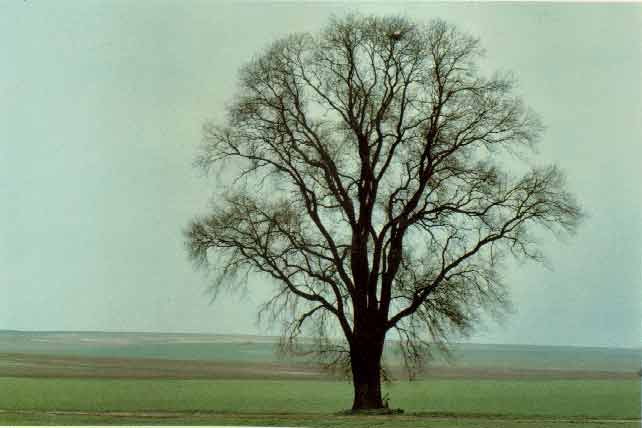
Readers of The Western Chapter News may be interested in two remarkable tree books published in recent years but not reviewed in the trade journals. They are Trees by Andreas Feininger (New York: Penguin, 1978, $9.94) and The Tree by John Fowles and Frank Horvat (New York: Little Brown, 1980, $24.95). Large formatted and lavishly produced, both books combine stunning photographs with informative, provocative and beautifully written texts. Their authors enjoy worldwide artistic reputations: Feininger exhibits in major museums and has published numerous other photographic studies; Fowles is a best-selling British novelist, author of The French Lieutenant’s Woman; Horvat is an eminent French landscape photographer.
Though none of these artists is a tree professional, their work displays extensive knowledge; more important, it expresses the kind of lifelong respect and affection for trees that lies at the heart of the arborist’s vocation. Like truly skilled tree work itself, these books represent a labor of love, an outpouring of praise, and and application of human art inspired by the art of nature. By deepening awareness of the value and meaning of trees, the authors hope ultimately not only to enrich human experience but also to save trees and forests from the wanton destruction to which they are still subjected.
In his introduction to Trees, Feininger states that he has created
…a new kind of book not a text nor a manual
nor a tree identification book, nor still another book proving
trees are beautiful, but a tree appreciation book.
In fact both these books promote tree appreciation in similar ways. First is through simple presentation. By selecting, composing and framing each tree portrait, the photographer brings forward aesthetic qualities–qualities of strength and fragility, of symmetry and variation, of balance and tension–that normally pass unobserved. Recalling Feininger’s shot of the massive central trunk of a twisted oak in a German park, I stop my morning run to admire the gnarly Quercus agrifolia in my neighbor’s yard. Or stuck in freeway traffic, I flash on Horvat’s portrait of the Wych Elm silouetted by a January mist, and suddenly I’m greeted with the sight of an Ulmus americana arching its limbs over an Arco station.
Appreciation of trees is also fostered by these books’ focus on detail. They slow and thereby enrich our perceptions of pattern, texture and light: Horvat’s row of pollarded sycamore crowns, Feininger’s mulberry leaves outlined black against the white sky, or his sweetgum leaves outlined against the dark background foliage. In such treatments of detail, the artist’s gift emerges. For while a lengthy series of photographs of bark in a tree identification book becomes schematic and dull, Feininger’s seventeen-shot sequence on trunks manages to build steadily to a dramatic visual climax. Each full-page portrait varies light, camera angle, distance, background and composition, delighting us with the variety contained in repetition. (more…)
*
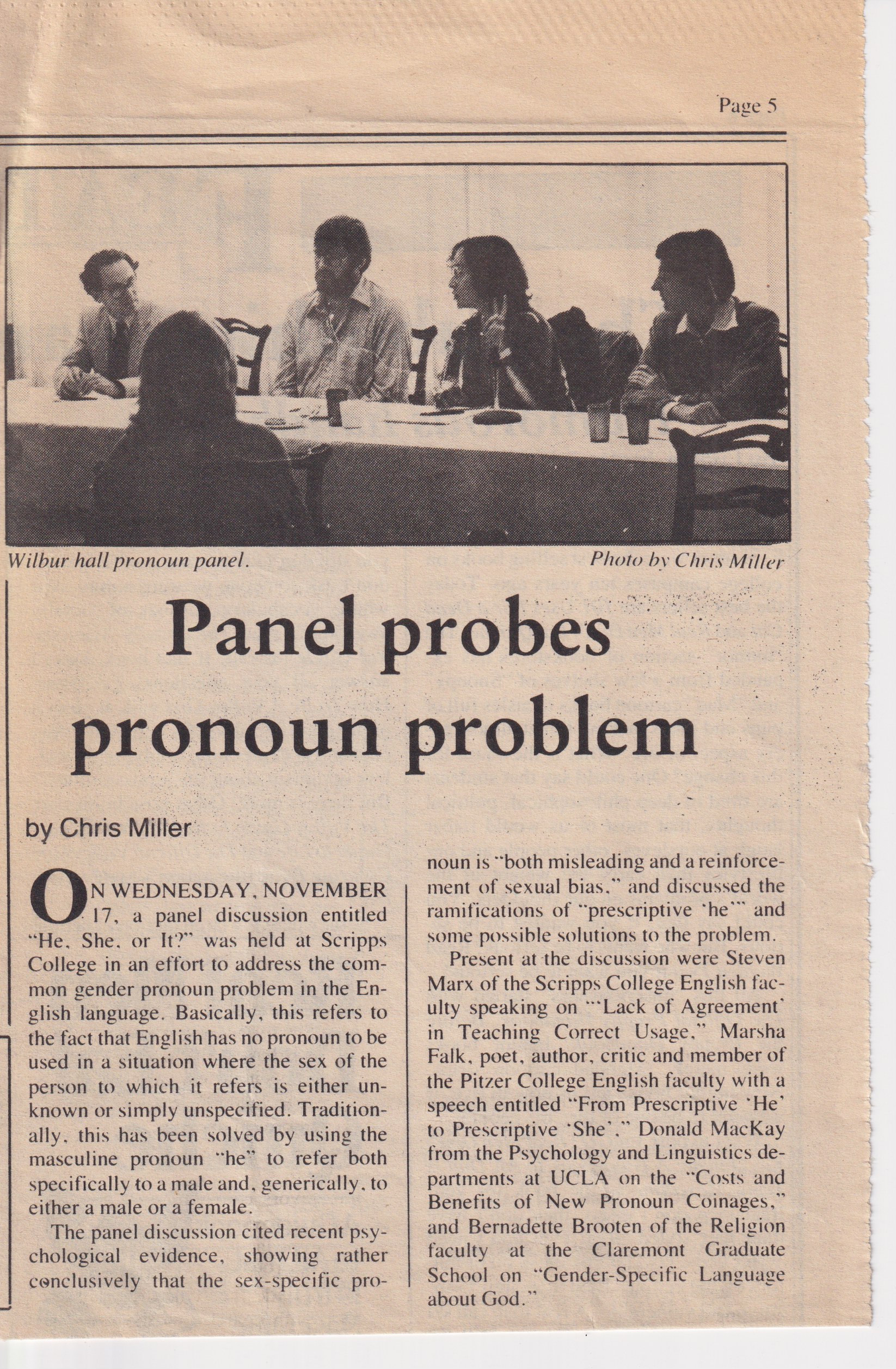
The trees are there
when talking stops.
They wait
for the runner.
*
At the track
before dawn
no sound
beyond breathing
but the freeway.
Exhaust
tires
and scares the runner; he stops
and notices the green-wattle tree
survives.
It softens the noise,
it freshens his blood.
*
Pursuing a youth
made lovelier yet by flight
through woods he runs
unloved,
imploring recognition.
Outdistanced and breathless
she prays for escape
then stands.
Her heart still beats against his touch
as bark encloses the soft breast,
arms twist into branches
hair flattens to leaves,
and swift feet root underground.
They are crowned
with laurel.
*
Last night’s storm
cleaned the branches
but left a mess
of yellow liquidambar leaves
on the wet, black pavement.
The runner’s eye arranges them
in passing.
*
The trees help the runner
reach his goal.
For his motion
they exchange stillness.
*
An Address to Philosophy 152: Theories of the Good Life
Claremont McKenna College
April 28 1983
I want to talk about this week’s topic–The Good Life as Living in the Country–by loosely braiding three strands of material into a single line of argument. These strands consist of your assigned readings by Carolyn Lewis and Scott and Helen Nearing, a discussion of the pastoral tradition in literature, and an account of some of my own experiences with living in the country for the better part of nine years.
The idea that the Good Life is to be found outside the limits of civilization in a rural, natural setting is as old and as widespread as civilization itself–a word whose root signifies the culture of cities. Urban people have often reacted to the conflicts and tensions of their existence with the wholescale rejection of their artificial environments and with affirmations of what they imagine to be the simple, happy lives of those who live in the country. This attitude has been dubbed “primitivism” by historians of philosophy, who have discovered its traces in some of the earliest Sumerian and Babylonian texts.
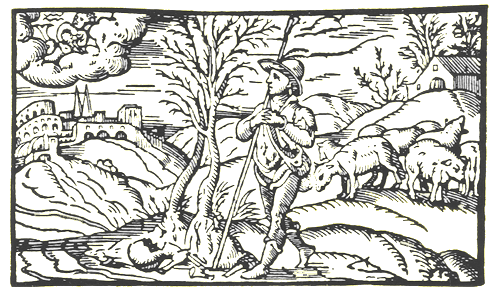
Primitivism has always been especially popular among writers–poets, dramatists, essayists, novelists. Their utterances of love of nature and hatred of the city have constituted a distinct literary genus called pastoral or bucolic–after the shepherd or cowherd whose occupations seem to embody the primitivist ideals of simplicity, unpossessiveness, rapport with nature, and the leisure for erotic, artistic and contemplative pursuits. Some pastoralists assert the theory of the Good Life in the country from the heart; others do so primarily to display their ability with words.
One can see evidence of the breadth and self-consciousness of this pastoral tradition in the way each chapter of the Nearings’ book begins with numerous epigraphs from sources ranging from ancient Chinese proverbs to Shakespeare and Thoreau. These epigraphs indicate that much of what follows has been said many times before and for that very reason bears repeating. The pastoral theory of the good life in nature and of the corruption of civilization dominates the Bible. We find it also in Homer and Hesiod–who project visions of the Golden Age before cities were founded; in the Phaedrus–where Plato paints an idyllic scene of erotic philosophizing outside the city walls; and in the Bucolics and Georgics of Vergil”which praise the quality of life far from the seat of Empire.
(more…)
5
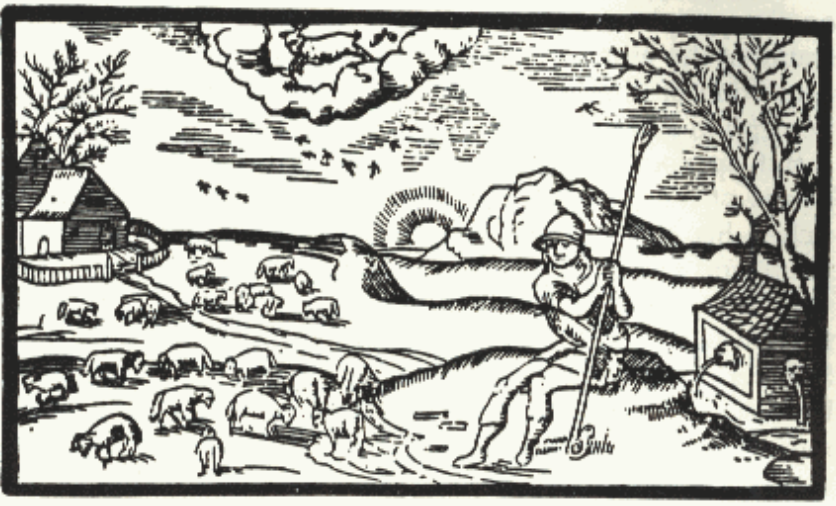
The Backstretched Connexion:
Youth and Age
in The Shepheardes Calender
This chapter proposes an interpretation of The Shepheardes Calender which places the debate of youth and age at the work’s core. Spenser used both the thematic content and the formal structure of this minor bucolic convention as the central shaping principle of his major pastoral work. Such emphasis was particularly appropriate, first because pastoral’s rural settings on the periphery of civilization correspond to the peripheral states of the human life cycle, and second, because pastoral’s projection of dual worlds inspires debate-like comparisons of perception and judgment.
But Spenser did not simply reprocess these essential elements of the pastoral tradition. Rather he modified and enriched his conventional models by disclosing the debate of youth and age through the viewpoint of a narrative persona, a viewpoint which shifts in the course of the poem from identification with youth to identification with age. That is to say, Spenser used the pastoral debate of youth and age as a means by which to externalize the inner conflicts of past and future, of regression and maturation, endemic to adolescence. By patterning his series of eclogues with a phased succession of such debates, Spenser allowed the reader to participate in the reversal of perspective that constitutes the subjective transformation of boy into man. Moving from premises about the psychology of pastoral and about the philosophy of debate laid down previously, this chapter arrives at the conclusion that The Shepheardes Calender–a product of its author’s youth and addressed to youthful readers-has as its deepest unifying subject the life stage of youth itself. (more…)