
Lund


End of the Road at the SLO Film Festival
Thursday, February 16th, 2017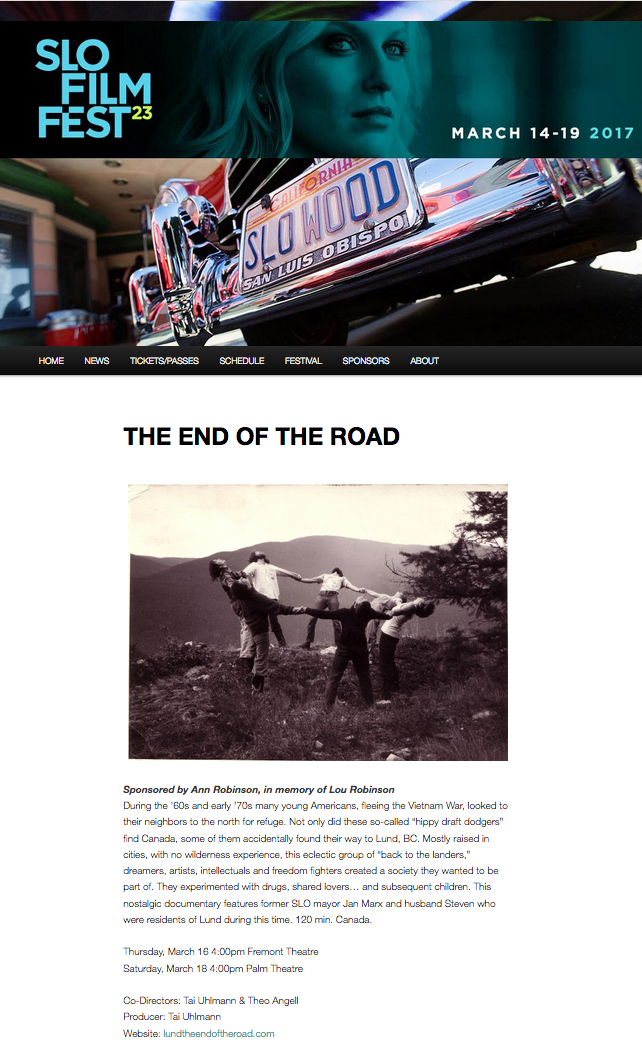
I’ll Remember April
Friday, October 21st, 2016(April Wells 1943-2016)
I loved you for your name–
the bloom of youth, the standing daffodil.
I loved you for your voice, in full Canadian lilt
Its high and low note chord.
I loved you for your strength,
To clear the brush and split the wood,
and raise those kids alone
in the dark house across the road.
I loved you for the gifts you brought”grace and song and dance
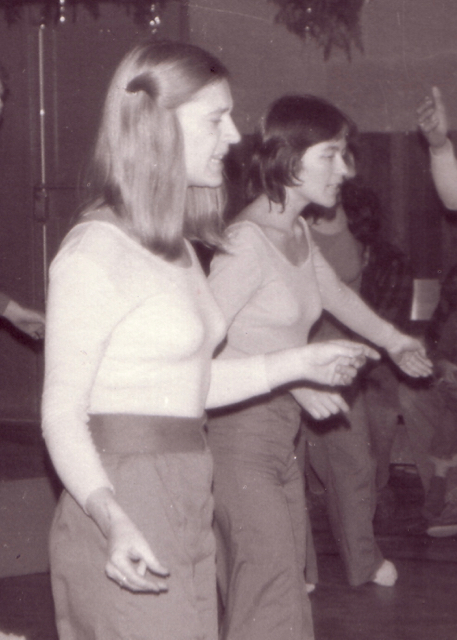
And for the gifts you gave–confidence and joy
I loved you for your laugh.
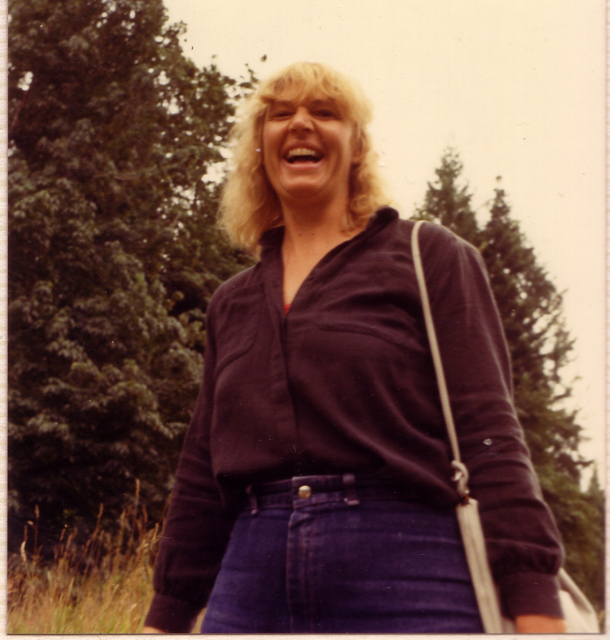
Introductory comments to 2015 Lund Reunion
Sunday, August 2nd, 2015
I procrastinated until early this morning to look closely at the speaking assignment in the program that Tai had given me:
Tell “Why this reunion and the community of Lund is so important to me.” You have three minutes.
She’s a born teacher and the project which she’s taken on”making a film about this community then and now”is an educational endeavor on a grand scale. Using the medium that’s most powerful and most accessible to the widest audience, she’s telling the story of young people desperate about the direction that the society they inherited was going and hopeful about creating alternatives for themselves. This is a largely forgotten story that the whole world can still learn from today. This is our story, and she’s brought us together here this weekend to participate in the project, and by so doing, to re-educate ourselves.
Like a good teacher, Tai designed her assignments to tap into the individual concerns of students. The topic that she’s given me, I realized as I thought about it, resonates with what I’d stated in the invitation we sent out last December:
For the last couple of years a number of present and past residents of Lund have tossed around the idea of organizing a reunion of people whose memories of the place go back to the late 1960’s and 1970’s, along with their descendants and friends.
We thought 2015 would be a good time for a couple of reasons. Sadly, the number of us who can share those memories is shrinking. Happily, Sandy Dunlop has been encouraging people to submit articles about their recollections for publication in The Lund Barnacle and Tai has been working on a documentary film about that time and place, including in-depth interviews, archival movies and photographs, and present-day footage.
A gathering of people who shared the adventure of coming to the End of the Road 35 to 45 years ago would allow us to pool interesting tales of the past, to catch up on what’s happened since then, and to reflect on the role of that place and time in the stories of our own lives.
As I did my homework this morning, the words of another teacher, Henry David Thoreau, came to mind–words which stirred me into undertaking that adventure in 1970 and which today close the great gap of time between then and now:
“I went to the woods because I wished to live deliberately, to front only the essential facts of life, and see if I could not learn what it had to teach, and not, when I came to die, discover that I had not lived.”
Lund Farm Day Camp: An Article in the Lund Barnacle
Wednesday, October 15th, 2014http://www.lundcommunity.ca/ESW/Files/Fall_2014-_online.pdf
Lund Farm Day Camp operated for three two-week sessions during the summers of 1973 and 1974. 25 to 35 kids in grades 1 through 8 from all over the district attended each session. The camp was headquartered at the old homestead on the Lund Highway owned today by Ed and Maggie Bereziak and at the time by Steven and Janet Marx, and previously by the Bleiler, Larson and Carlson families. Its original hand-adzed vertical cedar walls housed the cookshack for a logging camp in the 1890’s.
The camp’s activities included caring for a herd of goats, 35 chickens, a pair of ducks, two sheep, six rabbits, and a pig named Snorky Porker. Children also tended, harvested and preserved vegetables from a large garden and fruit from the ancient orchard, baked pies in the outdoor woodstove, built cedar-stave fences, sheared, washed, carded, spun and crocheted sheep’s wool, and dammed up the stream for a swimming hole. Recreational activities included a morning singsong, capture-the-flag in the pasture, writing and performing plays, swinging on a huge zunga and in a gillnet hammock, along with hiking and swimming.
Each day concluded with a gathering at which the children contributed reports recorded in a daily log. A sample: “We played on the big Zunga. Worked on the dam. Found a frog and three water snakes. Peter came and cut hay. Fred came to take pictures. One chicken got away and we caught it again. Chased Laurie and Steven with hoops. Mulched lettuce and corn. Cleaned up cubbies. Fed ducks. Baby goats nursed off Mama. Michael and Val clipped chicken wing. Flag making. Played drama games. Made birthday cake in Joanne’s loft. Waded in pool. Joanne drove Kent to hospital. Went to beach. Drank out of stream. Ken and Pauline learned to swim. Steven took a group to climb mountain.”
The camp’s emphasis was on teaching some of the skills required to live in the bush in an earlier era. According to an article in the Powell River News of July 16, 1973, “The first batch of children at the camp have almost completed a scale-model of nearby Craig farm. They were taken on a tour of the farm by its owner, learned its history and are now reconstructing the site¦”
Families paid $10 per child per session. During the first year students were brought to camp by carpool. The second year’s budget included a bus and driver for daily pickup and delivery. Each week included a one-night sleep-over, either on the farm or on Savary Island, transportation provided by local tugs and fishboats.
The original idea for the Camp was dreamed up by Janet and Steven in early January 1973, when their unemployment insurance ran out. It started to materialize as a result of brainstorming and collaboration with Kenneth Law, who settled on the farm in mid-February. It was funded by Opportunities For Youth, a federal program encouraging local community development.
In addition to the organizers, the Camp offered ten weeks of gainful employment to Gerry Karagianis, Laurie Derton, Joanne Power, Elaine Sorenson, Anne Wheeler, Pam Huber, Randy Mann, Mike Nelson, Rob Dramer, David Creek, Gae Holtby and Janet McGuinty. It was supported by the Powell River School District, the Sliammon Band and many community volunteers.
Invitation to Flickr photo pool for End of the Road–2006
Tuesday, August 15th, 2006The Family
Wednesday, December 7th, 2005[click pictures for full size images]
Early Tuesday I got a ride with Keith, Sharon’s husband and Pat to attend the memorial in Vancouver. Kenneth’s first visit to Lund in many years came last summer to attend a memorial for the death of Mike, one of Pat’s sons, who had also worked at our camp. Soon thereafter Pat had lost another son. She bore the weight of these tragedies with great strength.
We arrived at the spare but stately old Vancouver frame house, the home of Willow, Ron and their children, with some time to spare. Ron had corresponded with me about the old pictures and journal excerpts they had read on this weblog, so I felt immediately drawn into the family. Ron and Willow disappeared, and I met Ron’s father Henry, his sister-in-law Rachel, her 15 month old son Dash, and her husband Cameron. She has a Ph.D. in English and he’s finishing one. For two and a half minutes we discussed her dissertation topic, the Semiotics of Multicultural Rhetoric.
In the midst of the hubbub, Sharon, whom I’d first met two days earlier, prepared me a grilled cheese sandwich with pickled green beans and a cup of coffee, and poured me a shot of her 25 year old prized Canadian Whiskey.
The Unitarian Church at 49th and Oak was packed with 250 people attending the memorial. We were greeted by a shrine outside and four kids handing out programs, two of them Kenneth’s adopted grandchildren, Sophia and Flynn.
The service began with a quotation from Mary Oliver:
you must be able
to do three things:
to love what is mortal;
to hold it
against your bones knowing
your own life depends on it;
and, when the time comes to let it go,
to let it go.
The lay minister didn’t know Kenneth but was awed by the intensity and range of his legacy. The program included a harp introduction, recorded music, an operatic rendition of “Ave Maria,” and a beautiful piano and voice performance of Leonard Cohen’s “Hallelujah,” by Ron.

 There were three speeches, one by his professional mentor, one by a former lover, and one by his son-in-law. From these I learned that he worked with child protective services and in an alternative school for severely disturbed kids; that he founded and managed “After Hours,” a drop in center and hotline which became a Province-wide institution; that he organized teams and competed as a runner, a hurdler and a softball player in the Gay Olympics; that he was a textile designer; that he earned an M.A. from Pratt Institute of Art in New York; that he was a famous D.J.–“Poppalizard”– in young people’s clubs. Ron spoke of the way he remained as part of the family after Willow married: Poppa to the grandchildren, cook, party organizer, gardener and house painter. It struck me how many of these life accomplishments were there in germ during the time we knew him in his early twenties.

Following the three speeches and a candlelighting and quenching ceremony, Ron presented a DVD with musical accompaniment including a dozens of pictures and film clips of Kenneth from infancy to grandfatherhood.

 At the huge reception afterward, I ran into Mara, Janet and Rhea, Lund people who now live elsewhere. I would have loved to stay for the roasts and tributes, but I had a plane to catch.

Knoll House
Friday, August 21st, 1998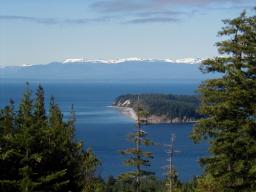
Gently wafting Knoll House breeze
Stirs the firs and arbutus trees
That frame the watery passage I see
Between the mainland and Savary
From the deck six hundred feet up
Where a fritillary flits by my coffee cup.
Speedboats enter from each side
Gash parallel lines before they hide
Behind green curtains lost from view
Their white paths fading back to blue.
Horizon clouds disperse to show
The glacial glare off Forbidden Plateau.
A loud leaf scrapes the greying shakes
Above soft sounds that birdsong makes.
The sun radiates my soles with heat
And puffs of wind aircool my feet.
Whiffs of fragrance richly vary
Shalal, peat, and huckleberry.
Writing makes my observation
Slow motion, line’s permutation.
Dancing fingers lead the pen
Across the empty pages, then
Leave a snail-paced slimey trail
Wormy castings endless tale.
Broken off by–of all things–
Yellow belly-throat, black wings
Crimson crown–an Oriole
Visiting this blessed Knoll.
August 1998
Desolation Sound
Friday, December 20th, 1985Elegy for Eric (1962-1985)
Now closer creep the shadows of the trees
The pasture’s morning mist makes squash leaves freeze.
The house without a fire’s a chilling place
Forsaken of the summer’s hot embrace.
A dullness weights the limbs, fatigues the mind
Acts fail, words trail, thoughts snap, ears seal, eyes blind
Alone sleep offers rest from fear and pain
But nightmares waken torments once again.
Bottomless and void, bereft of light
The sea has robbed us of a spirit bright
A man-child at the verge of fatherhood
Innocently searching for the good.
He dove below his depth alone for love
And left alone his loved ones here above
His friends, parents, lady and child-to-be
His boats, barn, his plans to farm the sea.
Without him we grow old before our time
But in our hearts he stays in youthful prime.
So let us gather now in deepening night
And sharing sorrow, kindle warmth and light.