Adventures with Ethan
Saturday, November 18th, 2006A Walk to the Confluence of Warm Springs Creek and Big Wood River
What do you call a guy who does the Luge? Click mvi_7408.AVI for the answer. Then run the Quicktime movie backward.

A Walk to the Confluence of Warm Springs Creek and Big Wood River
What do you call a guy who does the Luge? Click mvi_7408.AVI for the answer. Then run the Quicktime movie backward.
Monday November 13, 2006 12:30 P.M.
Abel sleeps, second nap this morning. I fed, changed, carried, played with him since 9:00 when Amy and Joe left with Ethan for school. He got tired in my arms, turning to jelly, eyes closing. While I worked at the computer he sat in his rocker and talked, and when he complained, I just tapped the moon and star rattles.
Friday November 10, 2006
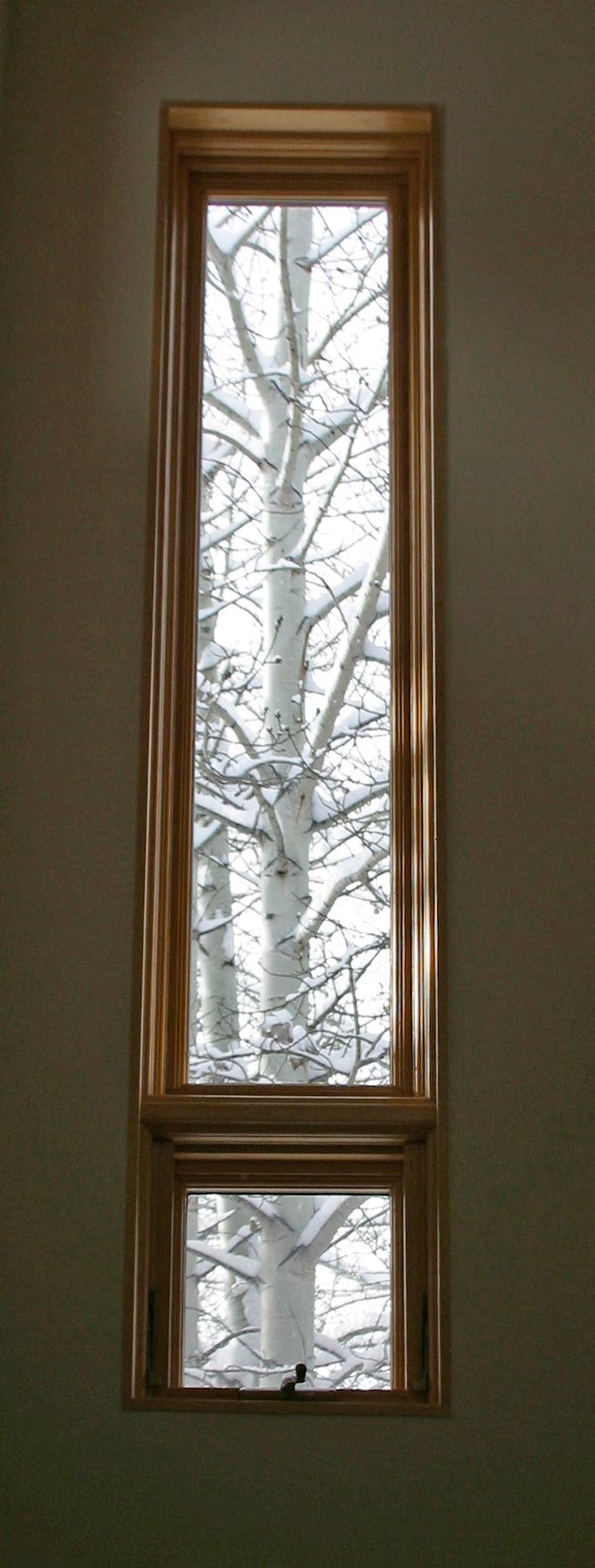 Isabel is in the third hour of her weekly cleaning Joe and Amy’s house as I sit on the couch in the slant sun illuminating the back sides of the bare aspens in the front yard and creating complicated patterns on the walls through the many windows in sight. North November light.
Inga swearingen croons through the sound system. Four year old Ethan is in nursery school and ten week old Abel is deep asleep. I held, rocked, played with, sang to, fed and changed him for two and a half hours until he drifted off in my arms. As he relaxed, his body got heavier while his consciousness thinned and floated away–along with my own. Now he’s awake again. Only a forty minute nap.
12:10 Abel sits in his bouncy seat listening to the Bruch violin concerto. He’s waving his hands and feet, fascinated with the soft moon, star and blue dog on his toy bar. He stares at them, his own movements rocking him, occasionally furrowing his brow, swatting and talking, and I talk back. Now the sounds intensify. They could lead to crying or just be self-expression, cheering at the ball game.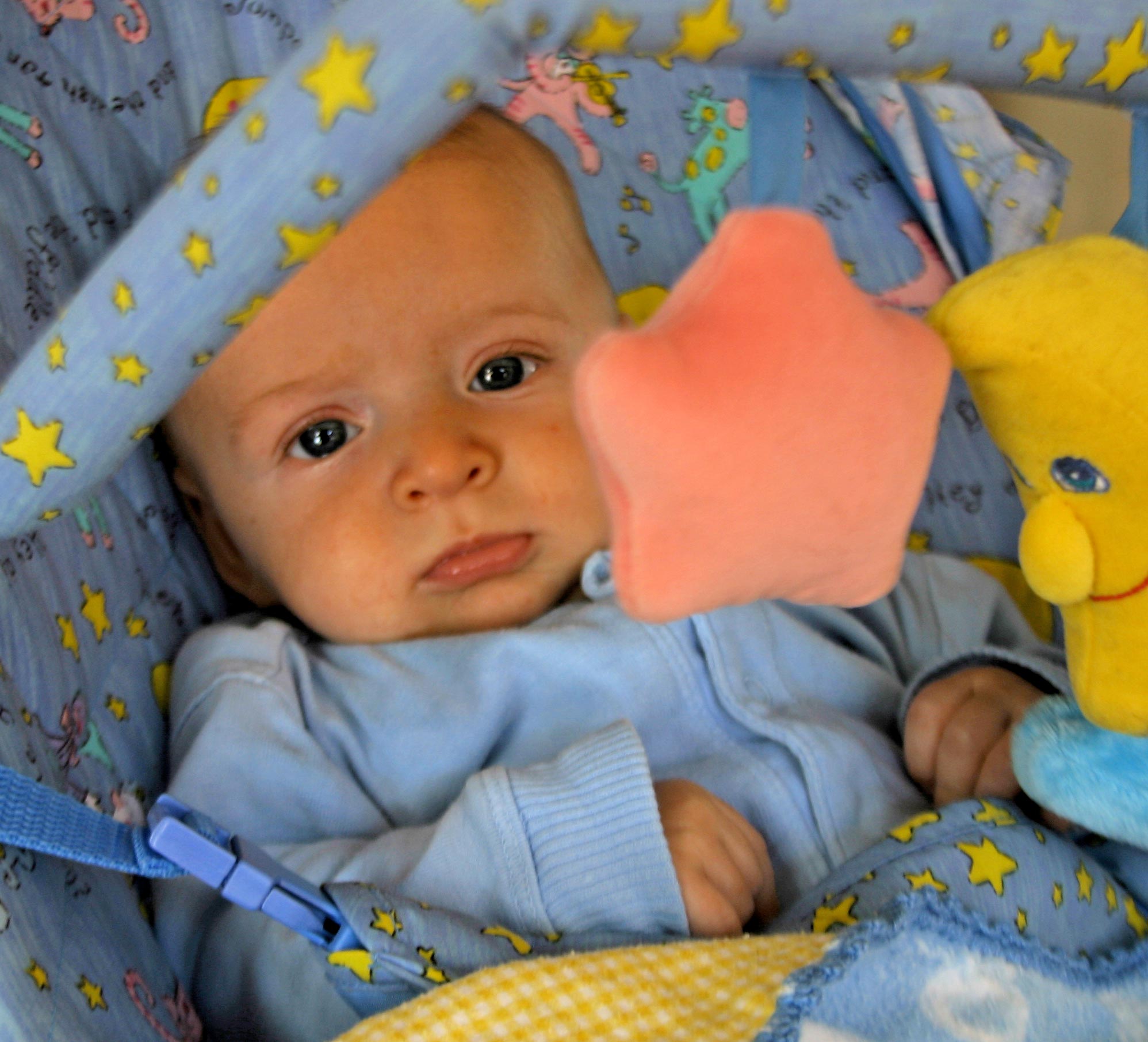
I have nothing to do but attend him. Behind the music, the sounds of the Spanish soap opera from the tv in the kitchen as Isabella cleans. We conversed a bit in Spanglish: she has five children, aged 22 to 7. She looks youthful and moves fast.
It’s three days after the election, after the national headlong plunge into darkness has been arrested, after the citizens of San Luis County voted overwhelmingly to approve a huge shopping center on prime ag land with no environmental review. I flew here for a week to provide some support for Joe and Amy as she returns to work.
LA Community Colleges go solar. Los Angeles community college officials have announced a plan to take campuses “off the grid” by having each school generate its own electricity.
Monday night, on a whim I decided to make a campfire in the backyard to burn pieces of a broken lawn chair and barbecue chicken and vegetables. We’d picked up our grandson at preschool as usual and kept him till his dad came by to take him home after a long day at work installing fire sprinklers. I invited him to stay for dinner.
We chattered while cooking the meal on hand grills in the warm light of one of the last evenings of daylight-saving time. After hearing about how he almost came to blows with a fellow worker who had punctured his 64 oz bottle of Mountain Dew, Jan asked how his aunt was doing now that she’d moved down south.
“Not too well,” he said. “She’s not getting along with her relatives.”
“She wasn’t happy here either,” said Jan.
“Life’s what you make of it,” replied my ex-son-in law.
Spoken by him, that tired old proverb took on depth. Our fractured and happily reconstituted family was testimony. It struck me that this was a more direct way of saying what seemed terminally hip during my adolescent days in Greenwich Village: “existence precedes essence.”
How Close to Catastrophe? An upcoming piece in the New York Review by Bill McKibben. Cutting edge on Global Warming.
Who Rules America? In the United States, wealth is highly concentrated in a relatively few hands. As of 2001, the top 1% of households (the upper class) owned 33.4% of all privately held wealth, and the next 19% (the managerial, professional, and small business stratum) had 51%, which means that just 20% of the people owned a remarkable 84%, leaving only 16% of the wealth for the bottom 80% (wage and salary workers).
Google goes Solar This project will be the largest solar installation on any corporate campus in the U.S. … The amount of electricity that will be generated is equivalent to powering about 1,000 average California homes.
It’s as hard
To control your children
As your parents,
But harder yet
To control yourself.
Jan Howell Marx
Today’s ecolit class was a hike to Rockslide Ridge.

We’ve been reading John Muir’s The Mountains of California. Its first paragraph contains a fine description of our home territory.
The Coast Range, rising as a grand green barrier against the ocean, from 2000 to 8000 feet high, is composed of innumerable forest-crowned spurs, ridges, and rolling hill-waves which inclose a multitude of smaller valleys; some looking out through long, forest-lined vistas to the sea; others, with but few trees, to the Central Valley; while a thousand others yet smaller are embosomed and concealed in mild, round-browed hills, each with its own climate, soil, and productions.
I’d asked students to study the Geology chapter of Cal Poly Land: A Field Guide to connect the Muir text to our walk and to help them to decipher some of the language of the landscape.
The winter weather was clear and crisp. On my way up to our meeting place at the horse unit, I biked toward Drumm Reservoir and the site of “Poly Canyon Village,” a huge new student residential development I’d spent many hours haggling about in committee during the last five years. I’d just learned from reading Christy’s ecolit journal that groundbreaking started two days before with the destruction of ancient Eucalyptus trees:
Driving up to Peterson ranch this afternoon I was shocked to come across the mass arboreal murder taking place. The beautiful eucalyptus trees that have shaded the feed mill, the feedlot, and the bull test are being savagely mown down by hairy, overweight cretins in fluorescent vests. In the summer when it gets unbearably hot, there is some much needed comforting shade under these fragrant guardians. During wind-whipped storms, their branches sway and shed leaves in all directions. They hold the land stable; they act as nice bumpers for those whose breaking skills are not up to par. To me they stand watching over year after year of Cal Poly students. They have seen the succession of eager high school potential, to Poly student to teacher, teacher to department head, then to retirement. …Just five days ago, I walked to my car parked under those fated Eucalypts, listening to the eerie creaking and groaning of the trees, despite the dead stillness in the air. They knew, and they were broadcasting their goodbyes through the song of their branches.
I found only huge stumps, cut close to the ground. The rings werent visible enough to be counted.
While we waited for stragglers, I pointed out the borders of Cal Poly Land on the map. Our destination was just outside the property line. At exactly 10:15 by my watch, we started up the hill. Every minute counted if we were to be back in time for the next scheduled class at noon.
The horse corral above the stables provided a lesson in erosion and land misuse. As a flock of crows cawed in the twisted sycamore limbs, one student pointed out a foot-high gap between the ground and the concrete foundation of a watering trough, measuring the loss of topsoil.
At the top of the corral we came upon Indonesian reservoir, designed and built by a group of Indonesian students in the ’60’s to impound runoff from Horse canyon creek in front of us and water pumped uphill from the system of reservoirs, ditches, pipes and creeks that serve as plumbing to irrigate campus farm facilities. I pointed out Kestrel Crest, the serpentinite ridge above the reservoir. Kestrel was defined as a small raptor, a sparrow hawk. Kiell mentioned that it was also a verb that meant hovering in flight. As if on cue, two small birds with white spots on their wings–not kestrels–appeared below the crest and kestrelled for us. Another bird flashed grey-blue and light orange. I recognized it and three more that joined it, as female Western Bluebirds, Sialia mexicana. Not as impressive as the more brightly colored male I had photographed last year from my deck

 they nevertheless gave me a thrill when their gray wings suddenly turned blue as they angled in the sun.
After a brief stop at bedrock mortars surrounding a grove of bay and hollyleaf cherries under the high voltage lines bringing power to the campus from the grid in Morro Bay, we huffed uphill on a deeply eroded dirt road past some recent slumpage in the Franciscan melange soils on the bank, passing through a shaded oak woodland along the creek. The woodland gave way to grassland and then to rock outcrop plant communities growing on the base of the steep upper slopes that constituted Rockslide Ridge. Despite an increase of wind, the temperature went up, and I had to remove my sweater and take a drink.
At the saddle dividing Horse Canyon from Poly Canyon, some people decided to ascend no further, while the rest of us left the road and found various paths through the unstable rock and gravel, avoiding the needle pointed tips of Spanish Dagger that thrived without much competition on the infertile serpentinite soil. Most of the group had never seen this backcountry before. Other people delighted in the escape during class hours. I watched the clock, knowing we had to reach the top by 11 in order to have fifteen minutes there before going back down.
I was one of the last near the summit to clamber over a barbed wire fence that ended in a vertical drop-off where half the mountain had shaken loose and slid down into the valley that was now the Architectural Area. Instructed by Professor Chipping’s explanations in the Field Guide, one could see where springs erupting from impermeable layers of rock covered by the slides secreted watercourses lined with green black clumps of trees–oaks, bays, sycamores and willows.
I collected papers due today and then people dispersed on the summit plateau, just outside the University property line to write in their journals.
 (photo by Danielle O’Neill)
I found a natural rock bench, drank some water, munched on a chunk of olive bread and looked for a subject to describe. Just to my west, on a dried flower stalk of Yucca whipplei, perched another female bluebird. I approached her slowly to get a picture, and she let me come within 20 feet.

Then she disappeared and I went back to my seat. Looking to the south, over the campus toward the city in the distance, I saw her on another stalk, watching me.
 I approached again. This time she flew directly toward me and fluttered in an arabesque a few feet from my eyes. At first I told myself she was rewarding my attentions. But then I realized this was threat behavior. I was doubly trespassing, my sit-spot in the middle of her territory, between her guard towers. I checked my watch. It was three minutes after the time to leave.