Topics

Bonding with Beethoven (5)

Thursday, October 28th, 2010

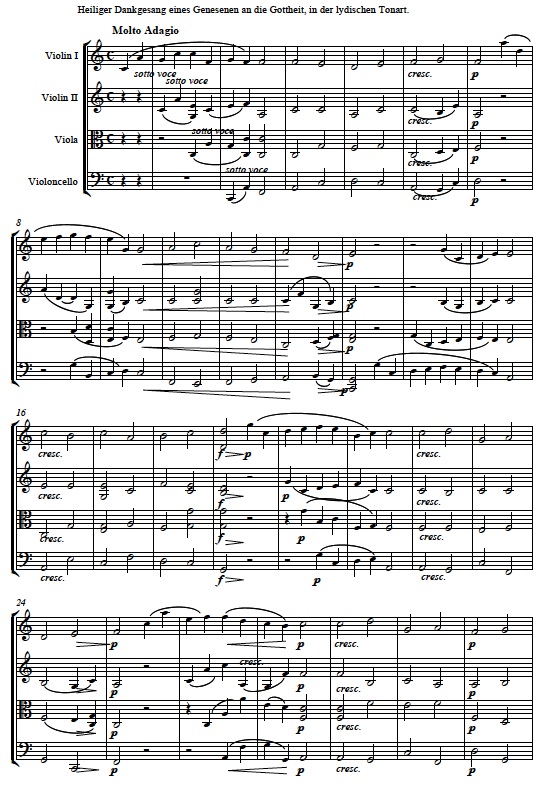
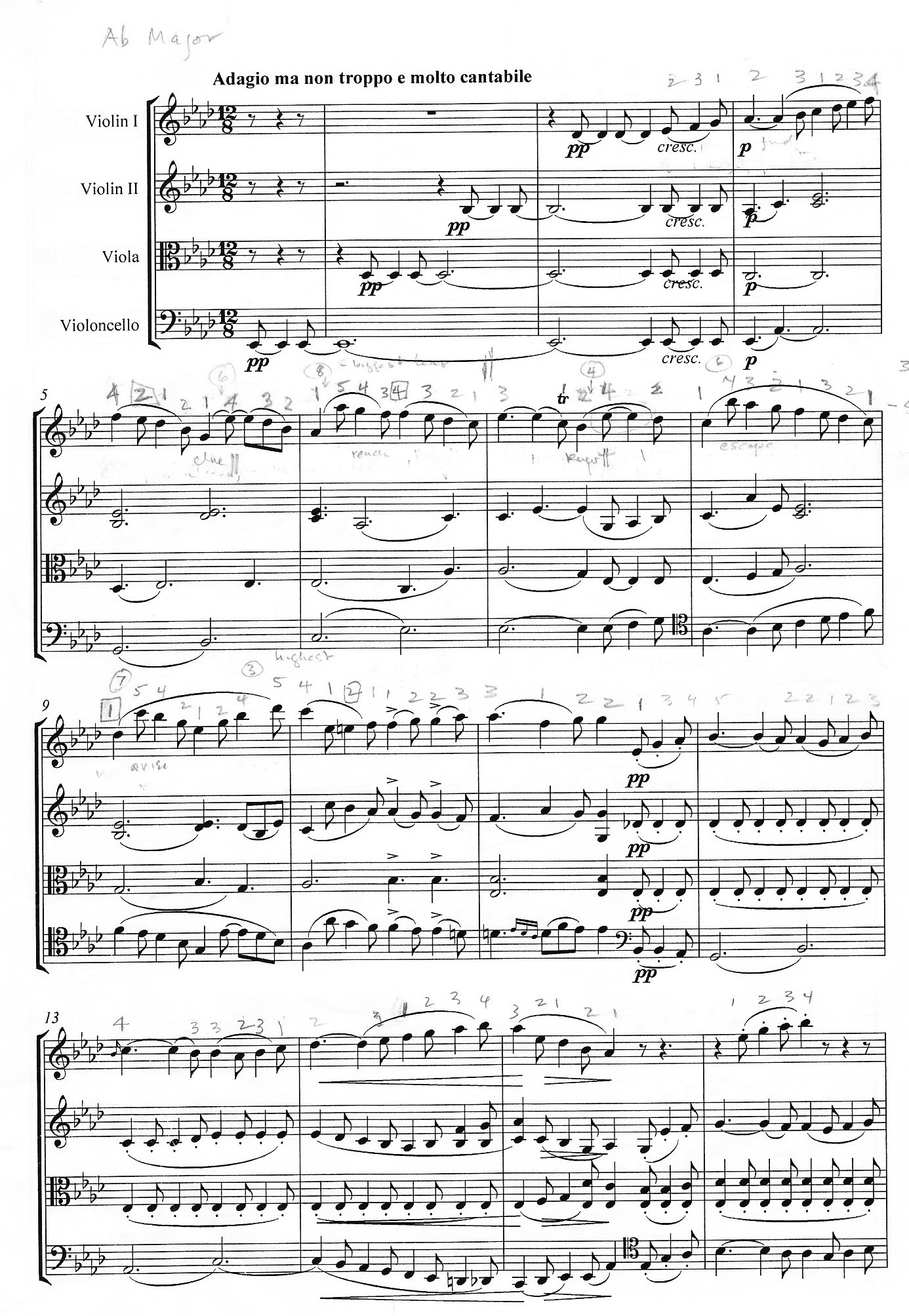
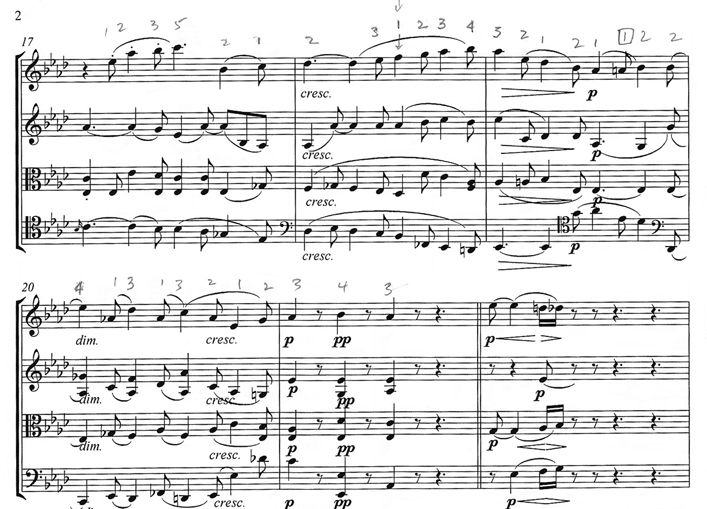
At the Mayoral Candidates Forum, I run into Craig R. the composer. I ask him about the fingering of the Opus 127 Adagio.  He says everyone has to figure it out for themselves.  Depends on your hands.  One “rule of thumb”: keep thumbs off the black keys.  When Chad drops by to pick up a precinct, I ask him to look at the fingering I’m working on.  He’s a good pianist but he’s stumped.  After two more days of trial and error, I arrive at a sequence my fingers can follow. I see where the strains within the melody begin and end, where they repeat and vary, where they accelerate and retard, rise and fall, build up and trail off.  The words click into place.


Audio [new window]

If we could find¦
The key to unlock beauty’s hidden clue
Then¦we might learn to reach
The love of life we sometime knew.
Then we might escape
Our lonely shell
We might arise out of our hell
Grow wings to fly into the air
And float free from care

But there’s no chance
That such release will ever
Be felt while we are here
Unless we can recall
From whence we came

Yet I am hopeful
(And so are we)
I’m truly hopeful
(And we are too)
I hope our lives
Can be the way
We want
The way we want
The way they truly should have been
Once more
Once more
Once more

Bonding with Beethoven (4)

Sunday, October 24th, 2010

In order to really understand the 127 Adagio, I’ve got to come up with some lyrics. But I cant do that in my head. The melodic curve is too long. It must be hammered out on an instrument. The four-flats key signature and the full two-octave pitch range rule out my playing it on the recorder.  I need a keyboard.  I search Craigslist and find one for sale by a student in Laguna for $35.  It takes a week to track down the missing power supply. Now I will enter the dark world of the black keys that scared me away from piano lessons in grade 5.

How to finger those notes scored for the first violin?  I google “four flat scale” and find it’s A Flat major and come up with several different recommendations for fingering it.  I try them all, writing and erasing numbers above the first few measures.  None tells me which finger to use when the melody skips successive notes or makes its breathtaking leaps.


Bonding with Beethoven (3)

Thursday, October 14th, 2010

Health is returning.

Piano Concerto #4 now playing”the last movement’s opening theme:

Bump ba da bump ba ba bump/bump bump bump/
bump bad a bump bump bump/
bump bad a bump bump bump/.

Audio [opens in new window]

I search for words that could correlate with the notes, lyrics to enable my weak memory to recall the tune.

While Ian was at Karate yesterday, I walked around the parking lot listening to the Waldstein sonata. As the wind swept through the tops of the eucalyptus trees by the creek, I imagined hearing it in the opening of the third movement.

Audio [opens in a new window]

Wikipedia calls it “a sweet and consoling tune.”

Today driving around putting up “Elect Jan Marx” signs, words for the first phrase pop into my head: “Sing sing the wind is blowing.” At home I play with rhymes.

Sing, sing, the wind is blowing
Dance dance the fluttering leaves
Ring ring the bells are tolling
Earth now new life conceives

I check the performance and the score:


My last line ignores the shift from a simple repeat to an extended variation in the third and fourth lines of the stanza.

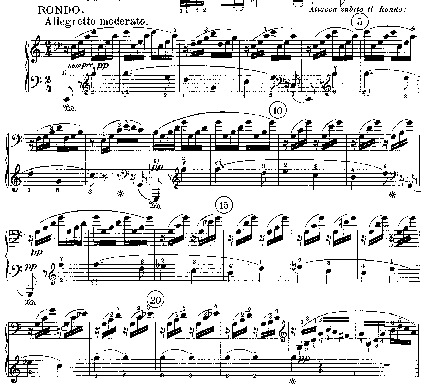
I look in the top line of the score for the theme and cant locate it.  Then I notice that the treble and bass clef have been deviously reversed to indicate right and left hands being crossed.  I correct the lyrics:

Sing, sing, the wind is blowing
Dance dance the fluttering leaves
Ring ring the bells are tolling
With news that earth receives, conceives, believes
And having heard no longer sighs and grieves

I don’t care that they don’t make much verbal sense; they help me remember the strain that shapes the later wild variations.

Bonding with Beethoven (2)

Sunday, October 10th, 2010

I’m sick in bed with a recurrent sinus infection. I listen to the quartet, watch movies– “Eternal Beloved” and  “In Search of Beethoven””and study the criticism.  I’m frustrated by the incomprehensible music theory but the scholars’ descriptive language helps me grasp the elusive central theme of the Adagio.  Lewis Lockwood calls it a “long and winding melody,” Michael Steinberg “a rapt and expansive melody,” Joseph Kerman “a famous miracle of beauty.”  Awakened last night by a violent cough, I sat up on the couch and for the first time recognized bits of the core theme in the six subsequent variations. I thought of Beethoven’s struggle with disease, deafness, isolation, and self-loathing.  His creativity transformed his suffering into beauty. It saved him from suicide.

Bonding with Beethoven (1)

Monday, October 4th, 2010

I’m not scheduled to teach this quarter or next, and I hope renewing an engagement with classical music will complement my service to grandchildren and to Jan’s mayoral campaign. Larry and I have agreed to lecture on The Kreutzer Sonata“both the violin-piano sonata by Beethoven and the novella by Tolstoy–next Spring in the course we’re collaborating on.* We arrange to meet with Jim C., mutual friend, colleague and musical savant to discuss the piece, since Larry and I are hardly literate in this area.

Tolstoy’s unreliable narrator says this about the first movement:

How can that first presto be played in a drawing-room among ladies in low-necked dresses? To hear that played, to clap a little, and then to eat ices and talk of the latest scandal? Such things should only be played on certain important significant occasions, and then only when certain actions answering to such music are wanted.

As I listen to the sonata in preparation for our meeting I think I hear what evokes that reaction: a sensuous and violent mating dance between violin and piano: courtship, chase, capture, resistance, yielding and consummation.

Spurred on by this encounter, I venture into more challenging musical territory. I  purchase the 3 CD set of the Emerson Quartet’s performances of Beethoven’s “late quartets.”  Since adolescence I’ve heard them referred to as one of humanity’s supreme artistic achievements, but I’ve been intimidated by their reputation for inaccessability. I copy the first of them, Opus 127, to my ipod nano, along with the Kreutzer and some more familiar pieces in my itunes collection: the Archduke Trio, Waldstein Sonata, and Piano Concerto #4 and listen to them during my daily hours of precinct walking. I’m intrigued by the billowing, elongated melody of the quartet’s slow second movement. I download the score and order books of music criticism through interlibrary loan.

When the three of us get together in our living room, Jim moves the furniture to place the speakers in optimum positions. We compare his different recordings of the Kreutzer and Opus 127. The music and talk are loud, and at 1:00 A.M. Jan asks us to end the party because she cant sleep.

*Materials for that class

Eaarth by Bill McKibben

Sunday, September 26th, 2010

The title of Bill McKibben’s latest book, Eaarth, sounds like the cry of someone falling off a cliff. McKibben has been writing about climate change since he published The End of Nature twenty years ago, always mixing a prophetic pessimism about the magnitude of the danger with an activist’s optimism about how disaster could be avoided. In the two years since the publication of his last book, Deep Economy, the option of avoidance has disappeared. Eaarth is McKibben’s name for the less friendly and predictable planet humans now inhabit. Two years ago, people were still quaintly worried about the effect of climate change on their grandchildren. Today its consequences are already upon us. “Eaarth,” he concludes starkly, “represents the deepest of human failures.”

This book is worth reading now because it fully takes into account three recent catastrophes: the acceleration of geophysical climate changes, the near collapse of the global economic system, and the failure of the U.N. Copenhagen Climate conference to arrive at any meaningful international agreement. McKibben’s prescriptions for dealing with our predicament are consistent with what he and many others have been advocating since 1970: recognizing limits to growth, promoting localism and decentralization, and affirming that conservation and satisfaction of basic needs must replace our excesses of consumerism and greed.

During the years he was working on this book McKibben was remarkably successful in organizing two grassroots worldwide movements largely driven by young people, Step-It-Up and 350.org. Despite their inability to produce the kind of changes needed, his recommendations for adaptation to our reduced circumstances could allow us to face them “lightly, carefully, gracefully.”

my notes and comments on Deep Economy (Word doc)

Protected: Yom Kippur 2010 Morning

Monday, September 20th, 2010

This content is password-protected. To view it, please enter the password below.

Protected: Yom Kippur 2010 Evening

Monday, September 20th, 2010

This content is password-protected. To view it, please enter the password below.

Botanical Surprises

Monday, September 13th, 2010

A doleful awakening on a foggy Sunday morning,  joints aching from the strain of lifting boxes of steel wires and forcing them into hard ground to hold Elect Jan Marx Mayor signs.  Looking forward to meditation for escape from the nattering in my head, then impatient for it to be over.  Not swimming enough because I wont use the Poly Rec Center in protest against that revolting expansion.

I wont let my alienation from the University–latest outrage disbanding the CSA– alienate me from Poly Land.  I’ve been wondering about the red blanket of vegetation on Poly Mountain since June.  Is it dried monkeyflower or buckwheat?

As soon as I slip into my West Coast Trail boots, my mood lightens and my legs urge me to get started, like the dog when he sees Jan lace her runners. I stride through the silent foggy streets, climb over the fence, and feel the spring of my footfalls through the grass.  The sensation of freedom in the question, which way to go? Feet find a trail of cracked soil showing through trampled grass pointing straight uphill.  Breathing muscles mobilized.  The absence of the forty-pound pack makes the steepening ascent effortless, and the mixture of tarweed and horsemanure pleasures my nostrils. The trail continues beyond the fence.  Two strands of barbed wire slack enough to allow me through.  The sun is a faint disk penetrating the fog, recalling its appearance at Klanawa River.

Perhaps I’ll go to the tree house and sit there and write.  I’ve done it before. The trail winds through the chapparal right to it.  A new resident?  Entering the secluded clearing under the great  oak, I see a  spade and a rake leaning against the twenty foot ladder that reaches the lowest branch.  Ten feet above the tree house a large improvised hammock hangs atop another ladder. As I stare I hear a sleepy “hello?” Not wanting to trespass, I say “Hi, my name’s Steven. I come here every few months.  Do you know E.C. the guy who built this house?”  “Yes, met him once,” answers a voice whose origin seems to be a pile of blankets in the hammock.  I ask if it’s OK to come up, and then mount the lower ladder. At the treehouse platform I see a mop of hair at the edge of the blankets above and try to build more trust.  Yes they know M, they’re his students.  I wrote in the guest ledger here on previous visits.  I climb the next ladder into the bedroom.  Two people snuggle under the blankets, K. and T.  They work with the same environmental organization I do.  I  built a hammock like that forty years ago for kids on our farm in B.C.

After fifteen minutes chat I descend the ladders and continue up the mountain,  serpentine boulders providing foot and handholds.  The fog  now just a ribbon draping Bishop Peak. The dark red scrub I’d been wondering about from the house and while approaching SLO on the freeway is neither monkeyflower nor buckwheat, but deerweed stalks, all the leaves and flowers gone. A huge exclusive patch, easy to walk through. Three years after the fire, it’s choked out all the poison oak.

IMG_0960.JPG

IMG_0965.JPG

IMG_0967.JPG

Snuffing the CSA

Friday, September 10th, 2010

Letter to Editor New Times

The Cal Poly Crop Science Department’s decision to kill the Community Supported Agriculture (CSA) Program may have been cruel and ill advised, but it did provide an effective display of raw power (“Harvest of disappointment,” Aug. 25). Its execution with blitzkrieg haste at a time of year when the university is deserted was well timed to maximize the shock and bewilderment of the many students, faculty, employees, and customers who held a stake in this real community institution.

One wonders if any of the decision- makers has ever shared my experience as a 10-year CSA member”being personally connected to the elemental process of planting, cultivating, harvesting, and cooking food grown by people they knew, in soil they loved. One wonders if these agriculturalists were aware of the decades of dedication invested in this program by visionary volunteers as a tiny offset to the servitude of most of the College of Agriculture to corporate industrial-chemical interests. One wonders if these crop scientists had considered the impact of being left in the lurch mid-season on several local small farmers who had partnered with the CSA.

One also wonders if their bumbling explanations, insulting to any person of intelligence, convinced their own authors or were just a smokescreen for a show of force. The only statement that made any sense in the letter sent to the press and to CSA members was that the program has been running a deficit. Apart from the fact that innovative, educational, and community service projects should not be judged simply by the bottom line of short-term profitability, a reasonable approach to the CSA’s financing problems would be for Cal Poly to activate some of its educational resources and opportunities”for instance in agricultural marketing and distribution”to help it thrive.