Topics

Nocturia and Poophoria

Thursday, November 27th, 2025

Nocturia is defined by the International Continence Society (ICS) as “the complaint that the individual has to wake at night one or more times for voiding (i.e., to urinate)”.[1] The term is derived from Latin nox – “night”, and Greek – “urine”…Nocturia becomes more common with age. –Wikipedia

I dont remember when I started experiencing this, probably in my early seventies.  The urologist prescribed Flomax, first once then later twice a day.  That reduced waking up to pee to once a night.  A year or so ago, when it got more often she prescribed Myrbetrick and told me to do the onerous job of keeping a urination diary which I refused.  About four months ago I started waking up even more frequently and she told me to stop drinking liquids after 6 p.m. and to cut back coffee and cut out alcohol.  Even more onerous but I did that. It didnt help much.  Then I went to the acupuncturist who applied needles around my bladder every two weeks and told me to gradually stop taking the drugs, which helped more than taking them.  Then I went for physical therapy for knees and shoulders which were preventing me from walking and chainsawing. Doing the exercises, which included 30 squeezes of the glutes, helped more than anything else.  Sometimes now I’m able to go only once, but the average is twice, which I consider tolerable, sometimes it’s still up to three or four.  This makes the formerly unnoticeable activity of an organ, which in another function has taken disproportionate attention, the focus of nightly concern.

Poophoria: The pleasant, full-body sensation after a large bowel movement is a physiological response primarily driven by the vagus and pudendal nerves, along with the release of endorphins and the relief of physical and psychological discomfort” –Google AI

I became fully aware of this around the same time that I started experiencing Nocturia, and over time the intensity of the sensation and my appreciation of it has steadily increased, offsetting the tribulation of the other excretory process. Once more the body has its own agenda, most prominent now with age.

Peter Uhlmann Turns 85.

Thursday, November 20th, 2025

Hello family and friends! I am reaching out because my dad is turning 85 on November 20! I would love it if you would send me a message for him or you could text me a short video that we can share with him on his birthday. 85 is a big milestone and I really want to celebrate him!Hi Tai

Here’s my video:

Yes and it’s wonderful! What fun! I love it with the music in the photos. Sorry for the late response was travelling and busy with work, but finally got to take a look. Xo

Interpreting Academic Acknowledgements

Saturday, November 15th, 2025

This scholarly article from 1999 quotes and analyses the personal acknowledgements in the Preface of Youth Against Age, the 1985 book version of my dissertation, which was completed 1981, fifteen years after it was started. The relevant passage is found on page 265 of the article.

Interpreting Academic Acknowledgement

Shakespearean Encryptions: Image, Injoke, and Allusion in Ben Elton’s Upstart Crow and All is True

Saturday, November 8th, 2025

Abstract

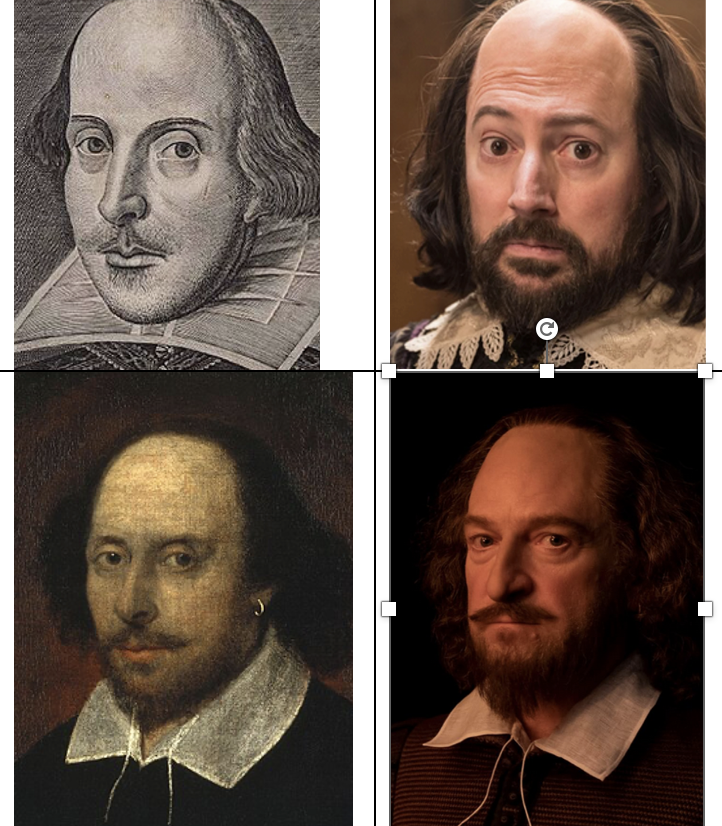
The Droeshut and Chandos portraits, two familiar images, embody two contrasting representations of Shakespeare in Ben Elton’s  biofictions, Upstart Crow and  All is True.

The Droeshut engraving evokes the comic TV sitcom character played by David Mitchell.

The resemblance is short of literal, belied by the presence of a beard absent in the engraving, but richly suggested by the bulbous forehead and receding hairline, topic of a running gag throughout the series.  The actor’s typically bewildered expression conveys what some authorities have found to be a clownish cast in the image.  John Dover Wilson called it “a pudding faced effigy.” Northrop Frye said it makes Shakespeare “look like an idiot.”

The Chandos image renders the melancholy film character played by Kenneth Branagh. The resemblance of images here is unmistakable, confirmed by facial hair and costume, by inclusion of the portrait at the opening of the film, and by Branagh’s statements in interviews that this was his intent and inspiration. Nevertheless, the large prosthetic nose and angry eyes convey a much harder expression than the serene watchfulness of the oil painting. The discrepancy prompts the film viewer to collaborate with its producers in fleshing out a dark view of what Shakespeare’s late years in Stratford might have been like.

This essay explores these correspondences in light of encryption theory, an analytical framework derived from computer science, semantics and evolutionary psychology. (more…)

Stockholm 4

Wednesday, August 13th, 2025

We breakfasted in the basement of Hotel Gama Stan whose walls and vaults formed part of the ancient City walls.

IMG_7843

Further under ground on the way to City Hall, we rode an escalator 100 feet down to the Kungstradgarten Subway station

IMG_7848

and were astounded by what we found down there:

IMG_7850

IMG_7856

We got the requisite portrait at City Hall.

IMG_7867

While Jan stayed at the cafe, I roamed the grounds that I recognized from the Hendrik Willem Van Loon alphabet book I’d treasured as a five year old.

IMG_7868

Scan
Scan 1

As an inscription in it shows, my parents rescued the battered volume and gifted it to our daughter Claire when she was 9.

I rented one of the ubiquitous Lime electric scooters, planning to ride to a beach along the shore a couple of miles away for a swim. But I soon lost heart because of the traffic and confusing road alignments and walked over to check out one of the Culturfest events:

IMG_7874

Jan and I reconnected in the mid afternoon and agreed to visit the National Museum. We wound our way through the ever more crowded streets filled with young Swedes whose beauty appealed to my art conoisseur’s eye.

IMG_7872

IMG_7900

We arrived with just enough time to catch some highlights before it closed for the day.

IMG_7938

Over the entrance we both found the PreRaphaelite mural by Carl Larsson visually appealing  but  bizarre in subject. “Midwinter Sacrifice” portrays a legendary naked king being willingly beheaded for his subjects by a red-cloaked priest in the effort to end a famine. Inspiring ongoing controversy, it was removed and then returned over a period of several decades.

IMG_7903

Only briefly distracted, we hunted down the less controversial, but no less affecting Rembrandt portraits of youth and age.

IMG_7908

IMG_7906

IMG_7907

With only a half hour or so left, we came upon the featured exhibit entitled “Hannah Hirsch Pauli, The Art of Being Free.” We both loved the work and the life story of this relatively unknown Swedish painter (1864-1940) who came from an assimilated Jewish family, spent several years in Paris with the Impressionists, married an artist and bore children, lived a sane and productive life and died before being exiled or murdered by the Nazis. Like Rembrandt’s, I particularly liked her portraits of Youth and Age.

IMG_7926

IMG_7920


IMG_7919

This image of fulfilled exhaustion befitted our mood as we left the museum and hiked back to Kungsradgarden for dinner in a cafe neatly tucked in a tight grove of linden trees.

IMG_7881

Somewhat refreshed, we braved exuberant crowds gathered before the Opera House to hear a concert by a big star we didnt know, but whose lyrical enthusiasm I greatly enjoyed.

IMG_7930

Jan and I again parted ways in front of the Royal Palace, she on her way back to the hotel and I in search of one last taste of mainstream Culture that I wished the one I was returning to in the morning was more like:

IMG_7945

As I stood with the crowd, my phone dinged notice of a text from Jan.  It was a picture and the caption, “Best dessert I’ve ever eaten.”

IMG_4847

Stockholm 3

Tuesday, August 12th, 2025

It felt liberating to be on our own for the last two days in this City we had come to love.  To reach the coffee shop arranged to meet Ruth, Jan’s undergrad roommate, we took a pleasant busride through neighborhoods inhabited by locals, all of which gave evidence of an extensive and prosperous middle class.

IMG_7788

Ruth was late so I left Jan waiting and walked up the hill in a nearby public park which offered wide views

IMG_7794

and the preserved structure of the Stockholm astronomical observatory, built in the mid 1700’s at the behest of the Swedish Academy of Sciences which included major researchers whose names are still familiar like Celsius and Linnaeus.

IMG_7799

Back at the coffee shop, Jan and Ruth were deep in reminiscence and catch-up.

IMG_7821

After graduating Stanford in 1967, she had opted to move to Sweden, gone to medical school there, became a specialist in oncology, married a fellow physician and pharmaceutical executive, and recently retired.

Her husband, who had come along to the coffeeshop, invited me to visit their nearby apartment, in the middle of major renovation but still notably comfortable.

IMG_7817

IMG_7809

Jan and I returned downtown to retrieve our suitcases and walk through the steadily increasing crowds assembling for “Culturfest,” a weeklong festival of free concerts at multiple outdoor venues. We arrived at Hotel Gamla Stan, relieved to check in to the modest room overlooking an ancient alley.

IMG_7842

IMG_7899

Refreshed by a siesta, we crossed the street, found a restaurant and sat at a table again overlooking the water. Before we had a chance to order, a shabby-looking fellow and two sidekicks entered the terrace and set up instruments. Then he started to sing

IMG_7832

At that point we stopped thinking about food, captivated by his voice and personality. The large respectable looking party sitting nearby sang along with him.

IMG_7834

And people along the quay outside the restaurant gathered to listen and shoot video.

During a brief set break we ordered from the waitress and I asked who is this guy.  “Tommy Nilsson,” she said, “Look him up.”

That I did, and on the iphone popped this:

Screenshot 2025-08-13 at 06.16.38

and this

6A751596-A076-4602-9E47-2C0BC5DA7DBC_1_102_o

Stockholm 2

Monday, August 11th, 2025

Next morning, after loading up on the Scandinavian staple of pickled herring and lox, our small group assembled to meet the local guide, Gaby, a former high school history teacher, who spoke with knowledge and enthusiasm.

IMG_7716

After passing a synagogue built in 1870 and apparantly not destroyed by the Nazis, she stopped at at a memorial honoring slain Jews and the gentile Swedish diplomat Raoul Wallenberg, who risked his life to provide safe passage to people fleeing the murderers throughout Europe. After the Allied victory in Europe, he was imprisoned by the Soviets and never heard from again.

IMG_7719

The prostrated figures reminded me of the memorial in Vienna I saw last year.

Next, with no waiting necessary, we boarded a comfortable electric bus headed toward the Vasa Museum.  It houses a huge sailing ship that sank in Stockholm harbor in 1628 and was salvaged almost fully intact 333 years later.

IMG_7732

It was commissioned by King Gustavus Adolfus, who at the time was fighting wars with Denmark, Russia, and Poland-Lithuania,  a nation  ruled by his cousin and Sweden’s former king who’d been exiled during wars of religion because he was Catholic. “Richly decorated as a symbol of the king’s ambitions for Sweden and himself, upon completion she was one of the most powerfully armed vessels in the world. However, Vasa was dangerously unstable, with too much weight in the upper structure of the hull. Despite this lack of stability, she was ordered to sea and sank only a few minutes after encountering a wind stronger than a breeze.”*

IMG_7752

Just as memorable as that story was the one of the sunken ship’s discovery in Stockholm harbor and its recovery and restoration between 1961 and 1990 presented in the museum’s film theatre.

A tiring walk through the crowded streets of Gamla Stan, the well preserved old section of the City

IMG_7772

ended with a short ferry ride back to the harbor

IMG_7766

and dinner in a cafe served by cheerful young waitstaff,

IMG_7778

and return to our opulent hotel room.

Stockholm 1

Monday, August 11th, 2025

Arriving in sunny Stockholm, I was energized by the luxury of the room we were assigned at the Hotel Kungstradgarden, complete with a large chandelier reflecting moving lights on the walls and 12 foot ceiling.  Originally an adjunct to a royal palace, it was renovated recently to retain its 18th century decor.

IMG_7698

Its location on a little sloped plaza allowed us to reach the King’s park in minutes and stroll  down  a treed alley to the harbor.

IMG_7783

IMG_7847

We scanned the waterfront in search of an optimally situated restaurant to take in the spectacular views. Across a graceful stone bridge and surrounded by palatial buildings we saw a treed terrace with tables and umbrellas jutting into the water. Wary of long flights of steps, we found a cylindrical outdoor elevator accommodating those with knee issues.

IMG_7673

At a table by swiftly flowing tidal currents we realized that this City, like Venice, was an archipelago equally composed of land and water.

A panorama of majestic buildings adjoining the King’s Park spread across the opposite bank, the  most imposing being the Royal Opera House, perhaps, I surmised, in competition with those of Copenhagen and Oslo.

IMG_7661

Behind us and beyond the bridge stood the austere but elegant royal palace.

IMG_7690

And across the road from the elevator rose the less fortress-like parliament building.

IMG_7667

On the way back to the King’s Park, we noticed a young man fishing.  As in Oslo, we were told, all the waters here were clean enough for angling and swimming.

IMG_7679

Fabled Scandinavian design was evident everywhere, from a brightly colored local church

IMG_7683

to the sculpture of lamposts and lions

IMG_7689

IMG_7709


Bergen

Saturday, August 9th, 2025

From Jan: 

Sick in bed, poor Steven completely missed seeing Bergen.

So, I set off bravely on my own. First I went to the Bryggens Museum.  I was blown away by the unique tapestry series “Åsmund Frægdagjeva” by Ragna Breivik.

These ten magnificent tapestries created by Norwegian textile artist Ragna Breivik were woven over a period of more than 25 years. She dyed the wool with natural dyes, spun it and wove the tapestries on a loom of her own design, on display at the museum.

IMG_4796 - Copy

The tapestries are based on the medieval ballad of Åsmund Frægdagjeva, who rescues Princess Ermelin from trolls in Trollebotn where the sun never shines.

These visually stunning woven images reawakened my long ago love of  Viking and Icelandic sagas–as retold in medieval poetry and storytelling traditions–when I studied them in my Comparative Medieval Literature MA program at Columbia.

The story begins as many fairytales do: the fair princess has been captured and imprisoned in a faraway castle, and the King commissions a hero, in this case Åsmund, to rescue her.

He and his brothers take the King’s flagship vessel to the castle of the ogre, where the princess is imprisoned.

IMG_4788

He finds the princess walking through the castle, and immediately falls in love with her. But she, under a spell of the ogre to believe that he is her mother, will not leave with Åsmund.

IMG_4791

He then takes her by force. On his way out, the ogre appears. They fight a long battle both physically and with curses and spells, but Åsmund eventually kills him.

IMG_4792

The princess being free from the spell, they plunder the castle and return home with all the ogre’s treasure.
IMG_4793


Next I headed to the Hanseatic Museum.  I was excited to see the well preserved historic Bergen headquarters of the Hanseatic League. A whole block of wooden buildings dating back to the Hanseatic era, comprising no less than 62 buildings, has been preserved.

IMG_4802

IMG_4811

IMG_4816

This was a thrill for me because as a student I had studied and explored several of the ports dominated and operated by these 13th Century merchants from Northern Germany. They sailed into Bergen to exchange grain for stockfish from Northern Norway. Their trading activities made Bryggen and Bergen one of Northern Europe’s most important trading hubs for the next 400 years.
IMG_4808

The Hanseatic League, using the power of the purse, supplanted the kingdoms and governments of Germany and Norway. The Bergen seal symbolizes this shared governance, half German heraldic eagle and half “King Codfish.”

IMG_4813

The Hanseatic trade routes went as far West as Greenland and as far East as the Holy Land.

IMG_4799

Flam

Friday, August 8th, 2025

The tour’s itinerary included a railway trip to Flam, an outpost at the head of a fjord on the super-rugged west side of Norway.

Screenshot 2025-08-08 at 12.11.10

IMG_7568

The route followed a steady ascent from sea level through farmland up to 2800 feet at Myrdal, a mountaineering, hiking and cross country skiing area where glaciers are visible nearby in midaugust.

IMG_7439

There one changes trains to the Flamsbana, a railroad enthusiast’s classic operation that descends along a hair-raising right of way down to the fjord

IMG_7467

At one point the train stops briefly at a tiny curved bridge crossing  over a wild cascade

IMG_7471

IMG_7481

Through the windows one sees the rushing river and numerous waterfalls

IMG_7516

interspersed with isolated farms and homesteads, many inhabited for centuries

IMG_7509

At the terminus, after walking through a riot of tourist shops, we arrived at a rustic-styled hotel fronting on a cruise ship wharf thankfully unoccupied during our overnight stay

IMG_7592

IMG_7599

I felt a cold coming on and stayed in through through dinner, but next morning took a walk on one of many trails surrounding the village.

IMG_7590

I had to cut it short to board another ferry that  carried us for the rest of the day through inland waterways

IMG_7626

IMG_7636

and for a short while in the open ocean to the historic port of Bergen. Again under the weather — now gray skies and intermittent rain–I went back to bed and slept until the next afternoon’s flight to Stockholm, while Jan explored the City’s preserved heritage of the Hanseatic League, established there by Germans in 1350.