Topics

Copenhagen to Oslo

Thursday, August 7th, 2025

A morning boatride around the harbor along with the tourist hordes we joined


IMG_7250

preceded departure on the overnight ferry, including sleeping cabin, for Oslo.

IMG_7283

Another literary association brought the significance of this passage in view. It was the location of The Surgeon’s Mate, the seventh in the Aubrey-Maturin series of 21 novels by Patrick O’Brian I’ve become addicted to.  Set during the Age of Sail and the  Napoleonic Wars of the early 1800’s, these blockbuster books have been called “the greatest historical novels of all time.”

The often narrow passage between Denmark, Sweden and Norway, control of which has been contested since the Viking age, provides the only sea access from the Atlantic and beyond to Germany, Eastern Europe and Russia.

IMG_7281

At at a table in the congenial bar on the rear deck I noticed a man writing notes on a pad next to a thick book stuffed with multicolored stickies.  Aha,  I thought, an academic! Despite fifteen years since retirement from the profession, I felt no reluctance in striking up a conversation.  It turned out he was a professor of African-American studies, working on his third book.  His wife was heading a Social Work program, and they were riding up to Oslo and returning to Copenhagen the day after arrival.

IMG_4735

Jan joined us for a heated happy conversation, and next morning we exchanged hugs and contacts. But I’ve lost the information.  It was another of those travellers’ meetings, sufficient in itself, reminding me of the phrase I had learned from our tea ceremony host in Japan in 2010: “One life, one encounter.”

Upon arrival in Oslo, we were greeted by the local guide, a moonlighting building contractor who hailed from a village north of the Arctic Circle, hired to lead a City tour. Regaling us with sordid gossip about the Royal Family, he drove us in a van to the out of town hilltop location of an Olympic ski-jump training facility–not a place of pressing interest for me–and then to  a reputedly world reknowned sculpture park exclusively featuring the work of Gustav Vigeland. It was impressive to be sure, but left both of us cold. The last stop was the Fram Museum, containing the preserved ship built and led for the first successful expedition to the South Pole in 1911 by Roald Admundsen. Wandering upon and below decks vaguely recalled the account of that trip and the brilliant heroics of its leader that enthralled me in the 1952 Landmark book and affirmed that positive aspects of the Viking spirit have remained.

IMG_7335

IMG_7337

After checking in at the portside Radisson Hotel reserved by the tour, we searched for a place to eat in another jam packed and very expensive tourist district. We ate  falafel pita at a dirty sidewalk table and ended up crashing early.

Again the selected luxury hotel offered a lavish breakfast leaving behind mountains of food waste. However, it did offer advice on how to behave sustainably.
IMG_7339

Before departure to the train station, I explored some of the new monumental buildings at the waterfront, including another Opera House, financed by Norway’s vast North Sea oil production.

IMG_7358

IMG_7383

IMG_7390

Copenhagen 5

Tuesday, August 5th, 2025

After a lavish breakfast included in the tour’s hotel accommodation, our group of nine assembled in the lobby under the leadership of a local guide.  Its membership fluctuated throughout the ten days allotted, probably as a result of low enrollment. This was reflected in the decision to use public transportation rather a van to take us to appointed attractions. At first I liked that option, but it turned out that the initial destination–the statue of The Little Mermaid in a remote section of the harbor– demanded a long, fast paced and uninteresting trudge from the subway that was onerous for the heavy-set limping Australian housepainter and us two octogenarians. That little landmark, widely forewarned on the web as a disappointing trap, was packed with tour buses and crowds of people elbowing their way to a railing to snap selfies with it.  The rest of the three hour directed excursion offered little improvement, and we were relieved to be released to our own recognisance to return to the hotel, rest and explore further.

Sharing our early interests in Viking age culture–reinforced for me by the recent audiobook, Embers of the Hands by Eleanor Barraclough I’d heard on the flight from San Luis Obispo–we returned to the National Museum to an exhibit emphasizing the neglected female perspectives of the fearsome Nordic conquerors.

IMG_7210

One entered through an “immersive” multimedia show dramatizing occult roles and rituals of Scandinavian wise women.

IMG_7191

That led to galleries displaying real artifacts and captions detailing new discoveries and research. One was a gold pin similar to a replica that Jan often wore

IMG_7197

It depicted a favorite Scandinavian theme of furious sea monsters like the ones Beowulf battled in his long sea-swim.

IMG_7206

This item is supposed to represent either a Valkyrie or the Goddess Freya.

A sidewalk cafe nearby provided a welcome glass of wine and early dinner

IMG_7209

Afterwards Jan went back to the hotel and I walked to the Arts Academy where we’d been the day before and roamed through its courtyard featuring posters promoting avant-garde political/cultural themes that recalled our own visions during the 1960’s

IMG_7220

at the age of its present day students.

IMG_7159

This was probably the same age as the Israeli pianist who again thrilled the small audience

IMG_7225

IMG_7235

Back at the Royal SAS, I grudgingly enjoyed the 12th floor panoramic view looking down into Tivoli Gardens and the Central Railroad station.

IMG_7230

Copenhagen 4

Monday, August 4th, 2025

It was raining the third morning of our stay, and we agreed to go off the beaten path negotiating our way by two buses  to the six million brick cathedral.  Located in a district of affordable housing and from the outside less pleasing looking  than the photo of the interior in BLOX, we found it was locked up, nobody around.

IMG_7113

Knocking on the door produced no response, so I crept around to a back cellar door and kept banging.  The person who opened it explained that the Church was reserved for a later morning baptism ceremony but yielded to my badgering and led me through a side aisle  to the front door where she let Jan in.

As we entered the nave together,  our senses were engulfed by sound and sight:

IMG_7116

After the sound ceased, the front doors opened pouring in a crowd of dressed-up families many with small children.  Jan lit a candle and then we departed.

IMG_7148

Looking for the bus stop in the rain,  a sign in Danish and English stated  that the line in that direction had been cancelled to accommodate street construction. A young man passing by led us a couple of blocks to a stop on a different route that could take us back to Hotel Savoy to retrieve our baggage and relocate to the  hotel booked by the tour.

IMG_7244

This was the SAS Royal Hotel, featured in the BLOX museum, built in 1960 and famously designed by architect Arne Jacobsen. As have many others, I found the exterior blocky and ungraceful, especially compared to the variety of Copenhagen buildings I’d already seen or the Lever House on New York’s Park Ave. I’d admired growing up during the 1950’s.

It was the sole subject of a large book found in the building’s museum to itself in the lobby

IMG_7187

and the of the memorial room containing all its original furnishings, including Jacobsen’s ubiquitous swan and cloud chairs.

IMG_7239

After the requisite nap, we took a tram to the Art Academy housed in another palace to attend a late afternoon concert we’d preordered tickets for presented by two young Ukranian virtuousi.  It featured pieces by Beethoven, Ravel and two Ukranian composers.  That made it one of many political/cultural events staged throughout Europe

IMG_7155

Another gratifying architectural experience was offered by the escalator to the subway back to the hotel

IMG_7162

Tired and hungry in search of dinner, Jan led us to the  appealing Bodega cafe around the corner

IMG_7180

across the street from the Tivoli Gardens, the 19th century progenitor of Disneyland, which we never entered.

IMG_7179

At the end of a long day, we preferred to enjoy the local food, music, and company of this great discovery.

Copenhagen 3

Sunday, August 3rd, 2025

I was eager to ride a bike around this City, even more bicycle oriented than Amsterdam, where two wheelers take precedence over cars and pedestrians.  I rented a clunker from the hotel, its weight and size making me regret I hadnt looked for a smoother ride, and took off along a dedicated path by the lagoon/canal toward a large section of greenspace, museums and historical monuments to the north. Parking at the stone gate of an immense formal garden surrounding the Rosenborg Castle I wandered in and felt enfolded by the beauty of the building and landscape architecture, completed 1633.

IMG_7041

IMG_7037

Spurred on by a cappucino in the outdoor cafe, I pedalled east toward the harbor, and across the water saw Copenhill,  the incinerator/power plant and snowless skislope, the highest point in Denmark which I’d been told about by my contact at the San Luis Obispo Waste Management Authority.

IMG_7058

Nearby stood the  Copenhagen Opera House, financed by the founder of Maersk shipping corporation, whose conflicts over design with the architect, Henning Larsen, were chronicled in his book.  Both from this vantage and a couple of days later from a boatride, the building looked good to me.

A couple of minutes away I came upon the Christianborg Palace, home of the Danish Government, an equally symmetrical and pleasing design in contrasting neo-Baroque style last rebuilt in 1928.
IMG_7062

Further along the quai, perched BLOX, a museum devoted to the Danish architecture which I’d become a fan of.

IMG_7269

I paid the entry fee and found numerous engaging displays, glad I selected this among the embarrassment of riches where to spend some time.  One was a picture of a cathedral in a remoter part of the City built between 1920 and 1940 called Grundvig’s Church or “six million bricks.” I’d never seen anything like its combination of medieval vault and modernist austerity.

IMG_7077

An extensive display featured the work of Arne Jacobsen, in particular the hotel in which our tour had reserved rooms for the last two nights of our Copenhagen stay

IMG_7080

A large area was devoted to what we used to call Green Building, in particular a fancy kitchen built entirely out of construction waste

IMG_7092

which would have fit nicely into the high-end second homes our son builds in Ketchum Idaho.

On the way back to meet Jan at the Hotel Savoy I took pleasure in the variety of less grandiose urban beauty:

IMG_7098

IMG_7096

IMG_7101

Copenhagen 2

Saturday, August 2nd, 2025

The morning light illuminated a building on the corner with a tower also designed by Rosen

IMG_6950

the whole streetscape an assemblage of distinctive masterpieces

IMG_6957

After a light breakfast, a short tram ride took us to the downtown central square encircled by towered Victorian period buildings,

IMG_6971

before one of which Jan posed to add to our collection of City Hall portraits.

IMG_6972

The Radhuspladsen was still  free of the crowds, noise and litter that packed it later in the day, adding impact to its central fountain depicting the ferocious  and beautiful battle between a bull and a dragon.

IMG_6980

Entering City Hall we were dwarfed by a grand rectangular space

IMG_6994

adjoining a more modest chamber available at low cost for private weddings. In a corner near the entry, we noticed a cluster people preparing balloons, bags filled with food and bottles of champagne.

IMG_6999

A couple of blocks away we found the National Museum and started in on the medieval collection, both of us having studied Anglo Saxon what seemed as far in the past as the material itself.  (Jan earned an M.A. in medieval comparative literature at Columbia in 1969).

IMG_7004

Next to another fierce battle with a dragon, this one carved in wood, we were intrigued by the display of one of the earliest printed artifacts, an actual indulgence signed by the Pope’s representative in 1517 guaranteeing that the purchase by the living would shorten the term of torture in Purgatory of their dead friend or relative.

IMG_7005

The massive promotion and sale of these early Crypto items was a major source of funds for the Catholic Church, and objection to the scam was a major energizer of the Protestant Reformation in Northern Europe. As we chortled knowingly over the case, we heard a loud voice from behind call out “Janet and Steven,” which I recognized immediately as belonging to Diana W., a fellow medieval literature student with Jan with whom we’ve had widely spaced connections since then in Canada and California.

IMG_4697

Turns out she was in Copenhagen with her daughter who was attending an international conference. That brought the excursion in medieval history to an end with a lengthy catch-up session in the coffee shop.

After a late siesta in the hotel we took the tram to Krogers Familiehave a garden restaurant recommended by the driver from the airport the day before as a genuine Copenhagen hangout. The service was slow and the food forgettable, but the setting was lovely and we sat next to a large multigenerational multiracial family with whom we shared excited conversation.

IMG_7013


Copenhagen 1

Friday, August 1st, 2025

Our decision to schedule travel during the summer rush was necessitated by Jan’s City Council meeting schedule. We made the conservative choice of Europe again because of our ages and shared youthful  reverence for its high culture: literature, philosophy, music, art, architecture. We picked  Scandinavia to avoid the heatwaves and fires feared for the south and because I’d never been there, though Jan had visited briefly during her sophomore year abroad. Our one personal connection was a long lost college roommate of hers whom she managed to arrange meeting for coffee one afternoon in Stockholm. We selected a tour format at the late date we reserved that would choose destinations, handle transport arrangements, book accommodations, and provide only a single half-day local tour in each country. And we arranged for two days before and after the tour to make our own way.

The trip began on a disastrous note.  The day before departure, when I tried to check-in to our flight purchased in May on Expedia for Copenhagen on United from SLO via San Francisco to Munich and then via United’s “partner” Lufthansa,  I was informed by a United agent that Lufthansa rejected the reservation because my first and last names had been reversed and could not be corrected at this late date. In order to carry through, we would have to lose our seats on the second leg and purchase new tickets from Munich from Baltic Air at last minute prices plus a bunch of penalties–for the additional cost of $7,000.  Knowing that delay would mean missing the tour and assuming this could be eventually resolved (it never was), we accepted the extortionate deal.

The approach to Copenhagen on a calm sunny day highlighted the flatness of Denmark’s topography and  vulnerability to sea-level rise.

IMG_6928

We’d booked a room in the boutique Hotel Savoy for two nights preceding the Firebird Company Tour and upon arrival delighted in the art-nouveau style of its facade designed by Anton Rosen (1859-1928),

IMG_6947

whose eminent status among Danish architects was confirmed by a big book in the lobby.

IMG_6945

Excited by the new destination, I went exploring the neighborhood and found a park that surrounded a large lagoon full of people enjoying the sunset

IMG_6937

Google Maps led me back to the hotel via a street passing right through a fanciful theatre building

IMG_6941

On the other end of the passage a restaurant window sported the image of an exuberant waiter

IMG_6942

Its adjoining window opened to living chefs gesturing with equal exuberance

IMG_6944


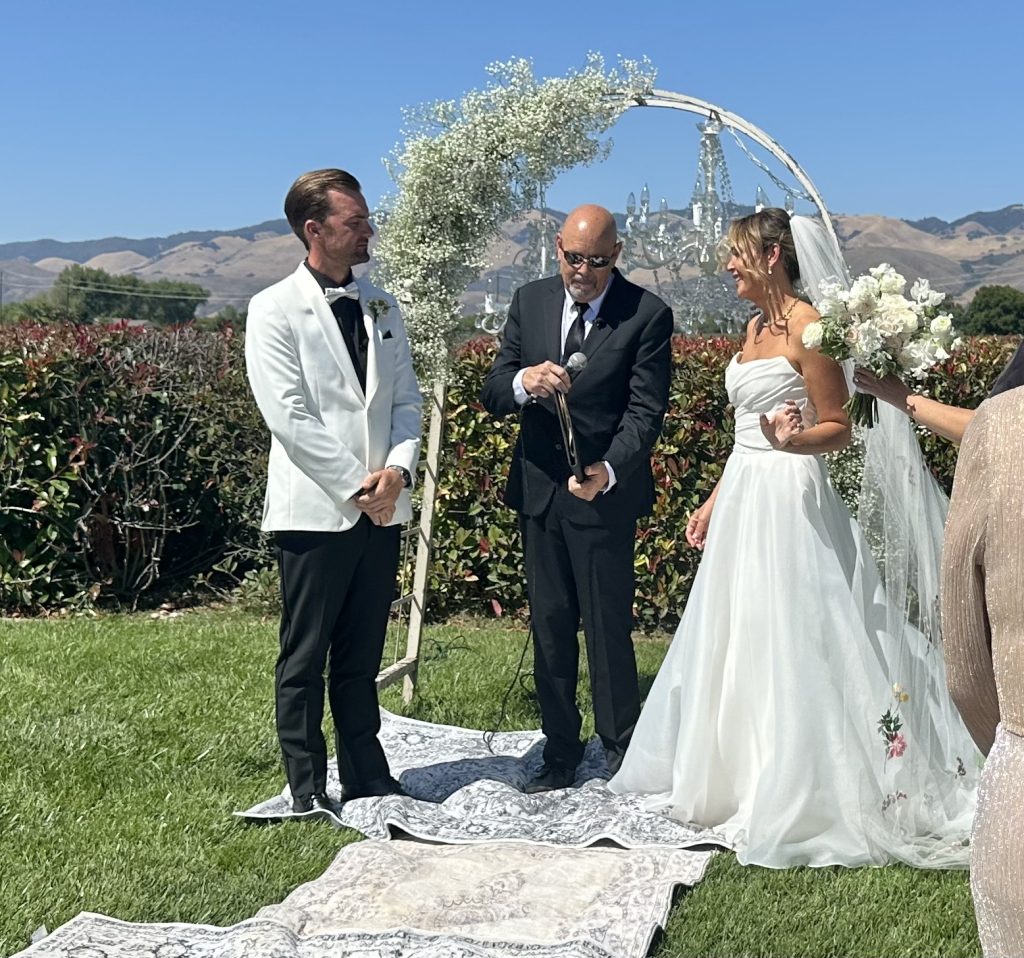
Shane and Candice Wedding

Sunday, July 20th, 2025

Love and Marriage, love and marriage
Go together like a horse and carriage

That’s the old song from the play*
We used to sing back in the day,

Remembering an earlier time
When little farms and towns were prime,

Where couples met at church or dance
Familiar spots to find romance.

Since then, we switched our sense of place
The global village became the space

Where modern people first entwine
In the world-wide web, on screen, online.

But some old things remain the same
For our young Candice and her Shane

A community farm, a tie to the land
Co-workers and friends joined in a band,

And in this antique barn just now
The ancient rite of speaking their vow,

The words we witnessed that bind to last
Their lives, their families, their future and past.

A timeless moment, a rock to resist
Amidst the floods of change, to persist.

So, with love in marriage for 58 years
Sustained by that vow, I say, “Cheers!”

*

iphone, eyephone, earphone

Monday, June 2nd, 2025

Out at the river this morning, I found a purple flowering plant I’d not seen before. I took out the phone, clicked Google Lens, placed it near the blooms and tapped. A mosaic of pictorial links popped up identifying it as dog’s tongue.

During her Friday Nature Journaling, Ann Marie demonstrated Merlin, the Cornell Ornithology Lab app I’ve had on my phone for over a year but never used.  Identifying real time bird calls with the tap of a finger, it confers powers of an experienced birder upon a complete neophyte.  Hear a bird call, even if faint or mixed with other ambient sounds, touch the button, the source with a name and a picture and a link to Wikipedia appears on the screen.

Yesterday morning, walking back from the river, my attention was arrested by a loud cheep originating in a blue spruce tree in the neighbor’s yard. I took the phone from my right pocket, opened Merlin, and tapped. When the next cheep came, there was American Robin. I showed it to the woman there watering her new sod, who’d never heard of the app. Out from the branches scampered the real robin, and cheeped again, both seen and heard. Next day the woman told me she’d downloaded Merlin and already shared it with several friends.

AI has been a topic of conversation among three generations during our visit. An essay in today’s NY Times by one of AI’s creators, acknowledging the ignorance about how it actually works and where it’s going, claims that AI will soon absorb most jobs in computer science. The author says that instead of learning coding and programming as has been recommended to young people for a generation, all students should return to an emphasis on liberal arts and math, since those fields develop capabilities that still are not available to this exploding new technology.

Counter to that, and also to my imagined literary conversations with Robert MacFarlane celebrating “The Old Ways,” I realized that the extension of senses created by Lens and Merlin heightening my physical and mental experience of nature demonstrates how far Artificial Intelligence has fused with its predecessor and taken up residence in my fingers and brain.

Signs

Saturday, May 31st, 2025

My lead guide in this difficult transition has been Ann Marie. We met as fellow members of the White Heron Sangha, a meditation group I’d belonged to for ten years where I’d regularly given “dharma talks” requiring reading and writing preparation that provided some continuity with my previous professional activity.  A fellow Cal Poly faculty retiree and environmental educator, she’d served as Secretary for the Board at City Farm SLO and then stepped down to free time for her growing responsibilities in a national organization devoted to Nature Journaling around the time I shifted involvement with the Farm to the Creek Project.

One day she came as a guest presenter to the twice-weekly Pacific Beach Continuation High School Ecology class I was co-teaching at the Creek with Deannie, the official science instructor.  Anne-Marie brought along little pen, paper and water color kits for each student:

and within the 40 minutes available, got most of them to produce a creditable page recording their observations at the site–to their own and their teachers’ amazement.

Greater amazement was elicited by examples from her journals she laid out on the picnic table.

I was entranced with the lushly colored sketches, the calligraphy, the varying page layouts, the scientific precision of their visual and verbal descriptions, and even more by the immediacy of the moment captured in their quick strokes, complementing their recording of location, time, date, season and weather.  Hesitantly I asked if I could photograph some of those pages for more time to absorb their rich feast of information. When the class ended I invited her to walk the trails I’d constructed over the last year with the help of College Corps student volunteers.

A few weeks later she returned for another workshop with students. She was carrying binoculars and said she’d like to do some of her own journaling along the creek. I was thrilled to find another person intrigued enough by my pet spot hidden in a canyon just below the shopping center and car dealerships on the opposite bank to want to linger there.  An hour later she emerged from the bush and said she was thinking of returning periodically on Friday mornings for more.

On one of those Fridays she showed me the pages she’d created so far. They included new names for familiar places, drawings of birds and plants I’d seen and not seen, stories of fleeting animal dramas and slow vegetational changes revealed through fresh eyes.

These were signs I’d been waiting for.  The original grant proposal for the Creek Project included installation of informational guideposts to engage visitors with natural and historical features of the site. But the institutional formality of earlier samples to me had the opposite effect. These journal pages’ combination of artistry, information and immediacy could open hidden treasures of the place to newcomers.

Once again, I hesitantly asked if she would consent to such a use and received a wary affirmative response.  The originals would have to be scanned professionally, reproduced on weather-resistant boards, and mounted on t-posts. With the help of our supportive printer at UPS, the hardware expert at Miner’s and my grandson apprentice, they took their place.


Willow, willow

Friday, May 30th, 2025

song

This is the initial entry here about the Prefumo Creek Restoration and Enhancement Project, my main activity for the past three years.

As the second and largely solitary portion of the project nears completion, my attention is turning from weed-whacking, chainsawing and mulch-moving to making it accessible to more people, rebuilding lapsed institutional support for its further expansion, telling its story and studying its lessons.

That study led me yesterday to a Google search about the bizarre growth habits of its dominant occupant, the Arroyo Willow. Buried deep in the list of uninformative links, I discovered a marvellous scientific paper published in September 2024: THE ROLE OF PARTIAL LIMB BREAKS IN THE GROWTH AND PERSISTENCE OF ARROYO WILLOW (SALIX LASIOLEPIS),

Its subject has intrigued me ever since I started cutting a pathway through the thicket of willows along the creek bank to open views of the incised channel 15 feet below.  The heavy trunks of the oldest trees crawl up from the stream bed and grow horizontally along the ground conveniently providing trail borders and benches before pivoting upward into leafy crowns.

The paper author’s onomatopoeic term for such trees seemed perfect: “decumbent sprawlers.” It captured the combination of weighted immobility and reptilian motion that I sensed passing them on my daily walks.  He provided an ecological explanation for their animated shape as the final stage of the tree’s growth. Young willows spring up single and erect to compete for light as do other pioneer species. Those which are shaded die out, while the survivors sprout multiple trunks from their bases, turning from trees into shrubs. Their rapid accumulation of biomass leads to breakage of limbs and trunks that cant be supported under the stress of weight and wind.  Such breaks would leave other species liable to infection, weakening and mortality. But willows can tolerate open wounds indefinitely, and their broken limbs continue to grow and heal even if thinly attached. They re-root when touching the ground, where they continue growing horizontally and mature as sprawlers that sprout decumbent vertical shoots which thrive in the light opened by the breaks.

Upon returning to the creek the next morning, I came upon a large branch that must have broken the night before, while I was reading the article.  Instead of an ugly marker of weakness and injury that needed to be cleared, I saw it now as the tree’s extension of territory and length of life.

I’d been led to the paper listening to the first chapter of Landmarks, a 2017 book written and narrated by Robert MacFarlane, mountaineer, naturalist, Cambridge English professor, and splendid stylist, while while walking with the dog at Pismo Beach. His thesis about the interrelation of language, literature and appreciation of nature is a variant of the one guiding the Cal Poly class I taught from 1998 until retirement in 2014, “Ecolit, Reading and Writing the Landscape,” its syllabus headed by a quote from Thoreau

Where is the literature which gives expression to Nature? He would be a poet who could impress the winds and streams into his service, to speak for him …whose words were so true, and fresh, and natural that they would appear to expand like the buds at the approach of spring, though they lay half smothered between two musty leaves in a library.

Grieving for the new Oxford Junior Dictionary’s culling of words like acorn, fern, otter and pasture, which named particulars of the natural world, and their replacement with terms like attachment, chatroom, and voicemail– supposedly of more relevance to modern children–MacFarlane includes glossaries of traditional local words for landscape features, plants, and animals whose loss accompanies the loss of the features they name under the pressure of industrial/commercial development. Naming, he observes, is the prerequisite for knowing, a point confirmed by my subsequent discovery of “sprawler.”

In addition to preserving dying vocabulary, MacFarlane practices literary criticism in appreciation of obscure books of nature writing, like The Living Mountain, a volume of essays by Nan Shepherd produced in the course of her wanderings through the Cangorns, a range on the island of Lewis in the Outer Hebrides of Scotland, which he has explored since early childhood visiting his grandfather there.

Facing an abyss of unstructured time at this interval of the Prefumo project, MacFarlane encourages me to relate to the Creek in a different way, to make the difficult transition from physical activity back to my earlier academic engagement with reading and writing the landscape.