Ecolit Hikes Rockslide Ridge

May 1st, 2009

In the equine unit where we assemble, a filly born at 12:15 a.m. that morning.
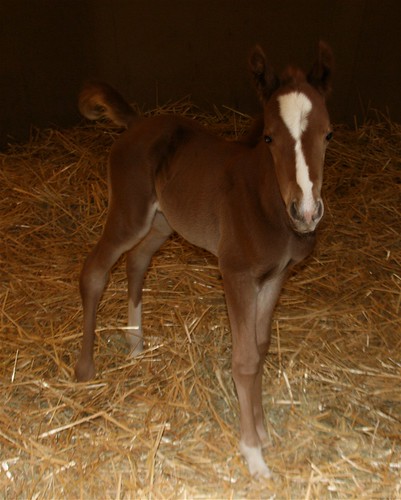
IMG_7464.JPG

The arboretum in full flower.  This morning I biked up here with Lucas in the backpack and we ate wild strawberries under the redwoods.

Out through the back gate, up the little creek still flowing from a single spring at the junction of the serpentine and the lodo soil.

Through the gate at Indonesian Reservoir, where ducks take off and thoroughbreds run over hoping for a treat.
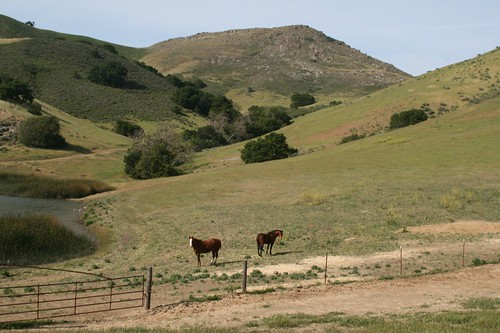
IMG_7469.JPG

Dylan shows me a picture on his phone of the fat bass he caught here.  I asked if it tasted good.  He threw it back, he says.

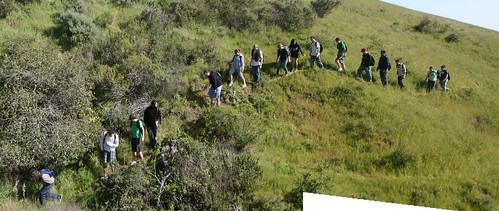
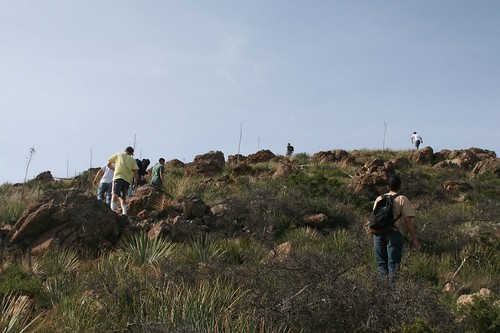
Bedrock mortars under the hollyleaf cherries. Volunteer artichokes spreading in the meadow.  At the divide between Horse Canyon and Brizzolara watersheds,  half the group remains and the rest head upward.
IMG_7471.JPG

We have 40 minutes to get to the top and back.

Dylan finds his own stopping place and calls out that he’s spotted a bald eagle.
IMG_7474.JPG

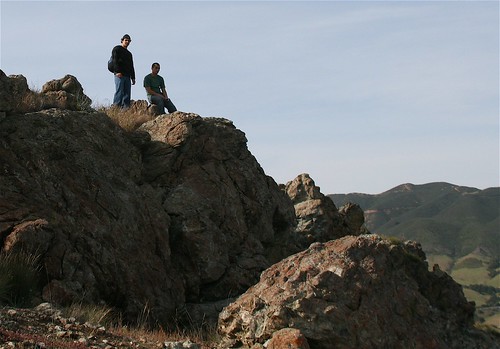
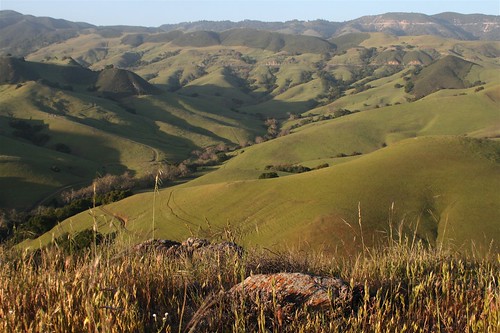
At the summit, we take in the big view.
IMG_7479.JPG

I read out the first paragraph of John Muir’s The Mountains of California:

The Coast Range, rising as a grand green barrier against the ocean, from 2000 to 8000 feet high, is composed of innumerable forest-crowned spurs, ridges, and rolling hill-waves which inclose a multitude of smaller valleys; some looking out through long, forest-lined vistas to the sea; others, with but few trees, to the Central Valley; while a thousand others yet smaller are embosomed and concealed in mild, round-browed hills, each with its own climate, soil, and productions.

Five minutes to write in  journals.

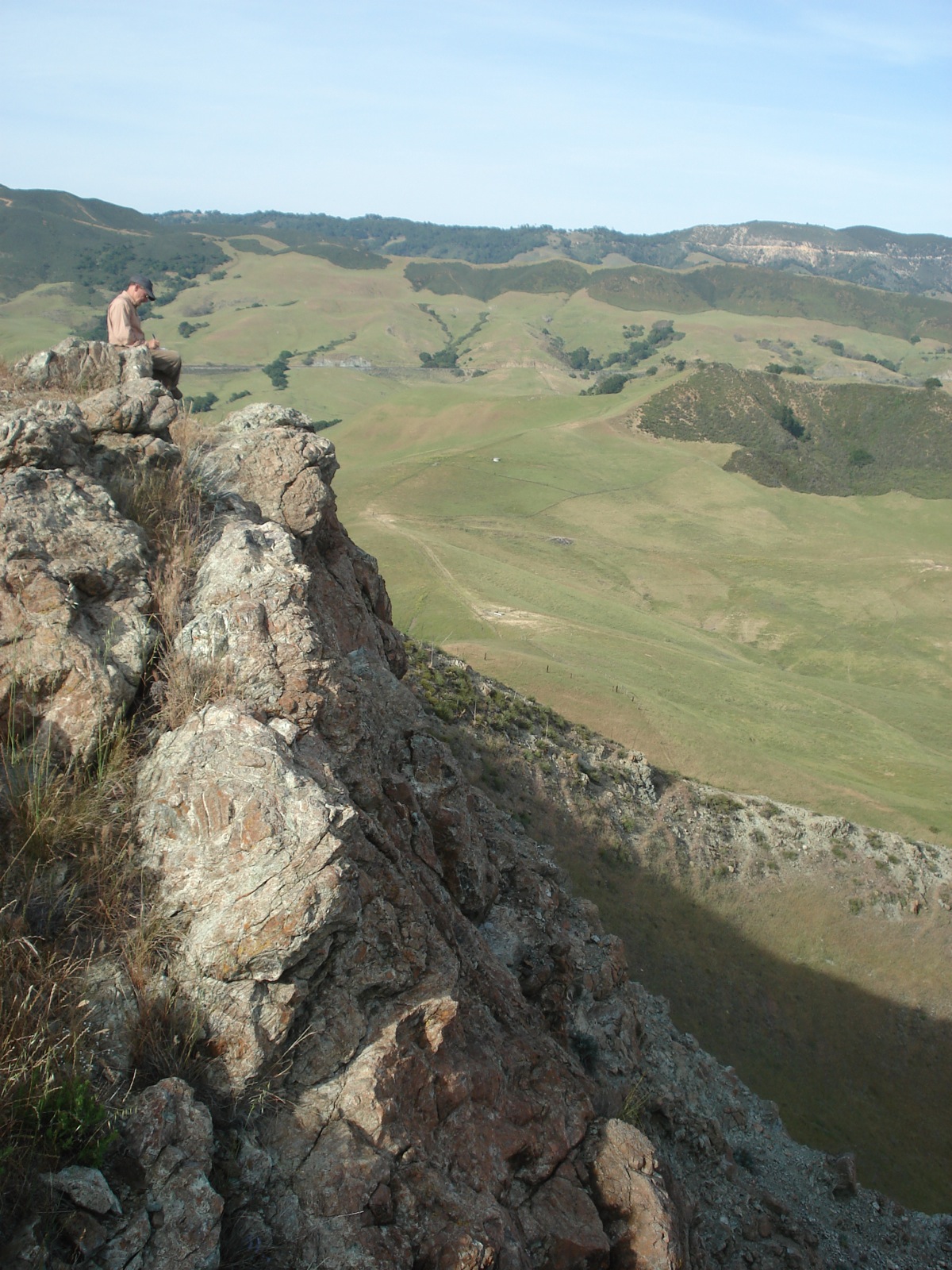
Edge of escarpment–feels like looking into a volcano, but it’s just rotten serpentine slumped down into the melange through which it floated to the surface 100 million years ago.  The blinding green of the grasses three weeks ago has paled, fitfully retaining some chloroplasts, the drier areas now tan yellow after releasing seeds to the wind.  Soon all the grassland will be white against the black of riparian corridors.

The call of a meadowlark fills the big valley:  key-ho-trillabittle.

Endorphins released by the scramble up the mountain tingle through veins in my chest and flow toward my heart.  Sweat drying in the warm breeze cools my brow.
DSC02878.JPG

Photo by Ben Taylor (click for large size)
Cedar Waxwings

April 26th, 2009

On the way to class on a gray chill Thursday afternoon overloaded with the lesson plan in my head and the computer:

  • to complete discussion of last paragraphs of Thoreau’s “Sounds”– the negative formula divesting the saunterer of worldly encumbrances: “No yard but unfenced nature reaching up to your very sills, A young forest growing up under your meadows.”  The irony of 600,000 people a year visiting Walden today, the edge of the  pond “restored” with rebar grid and imported rocks, sand and tree plantings. My afternoon there in the rain, in 2003, swimming in my underpants.
  • moving on to “Solitude””its insistence on the refusal to grieve”for the lost younger brother and the lost beloved, the only two people Thoreau was really close to”and the insistence on the cockerel’s joyful exuberance felt even by the “misanthrope and most melancholy man,” except for the one hour of “a slight insanity in my mood,”  after which “every little pine needle expanded and swelled with sympathy and befriended me.”  The desire to dwell not in a neighborhood but rather “most near to the perennial source of our life, whence in all our experience we have found that to issue, as the willow stands near the water and sends out its roots in that direction.”  The conclusion of that most transcendent chapter, the cry for a drug to repair the rent that tears us from our essence: “What is the pill which will keep us well, serene, contented?” And the answer””a draught of undiluted morning air.”

As I approached the English building I was distracted by a gaggle of bird calls overhead. In the flat backlight I couldn’t make out their shape”were they starlings or grackles?  One bunch was rustling in the top leaves of the holly trees alongside the door, while another was spinning cartwheels just above it, and several individuals dashed toward Eucalyptus trees back by the Plant Conservatory.  Then the group overhead descended to the hollies, the group in the trees blasted together to the Eucs and different individuals shot up and down over the building.  I noticed the birds in the tree were gobbling the red holly berries. Now it registered: a migrating flock of Cedar Waxwings  drunk on fermented fruit.  I had seen such a flock seven or eight years ago on the sycamores where Via Carta crosses Brizzolara Creek, but they were sitting at rest, illuminated by the morning sun, their chamois-smooth bodies glowing, their graceful crests  and eye masks on stately display.

I begged them to stay  for another ten minutes.  As the students assembled in the classroom, I googled “Cedar Waxwing Drunk” and put up this webpage on the screen.

After the’d all arrived, I led them through the long corridor of building 10 and out the door on a sixty second hike. The party was still in full swing.

“Walking” Poly Mountain

April 18th, 2009

IMG_7345.JPG

The sun sets on some retired meadow, where no house is visible, with all the glory and splendor that it lavishes on cities, and perchance, as it has never set before…where there is but a solitary marsh hawk to have his wings gilded by it

IMG_7336.JPG

¦ and there is some little black-veined brook in the midst ¦ We walked in so pure and bright a light,

380polymtpan.jpg

gilding the ¦ grass and leaves, so softly and serenely bright–

IMG_7347.JPG

I thought I had never bathed in such a golden flood, without a ripple or a murmur to it. The west side of every wood and rising ground gleamed like the boundary of elysium,

IMG_7353.JPG

and the sun on our backs seemed like a gentle herdsman, driving us home at evening.

April 16 7:15 pm

IMG_7359.JPG

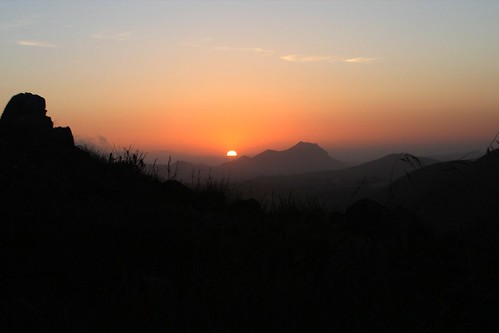
Sun dropping toward mist on the horizon.  Temperature dropping as the sleeping bag warms. Bits of remaining light in the needlegrass awns. An hour and a half since I departed from the class down in the oak grove and its words still echo”the words of Thoreau’s essay  “Walking” and his chapter, “Sounds,” along with our improvisations upon them.

The longing for the wild and the new, the demand for fresh and expansive experience, the unfamiliar, the virgin. The westward march and its ultimate demise with humanity’s dark dominion”the “End of Nature” in anthropogenic climate disruption. The sound of silence in the snap of sumac twigs too heavy to support their own growth.

Sounds now of the invisible traffic on Cuesta Pass and my stomach growling. A meadow lark.  A cow’s moo. A haunting ullulation across the valley. What is that familiar call”like a loon’s, but no loons here. Perhaps not a bird?  I struggle to find the memory, fail,  surrender to another diminution of capacity.  Shifting my gear to support my shoulder recalls previous sleepouts and the line “My pillow is my boot,” which I put on Tuesday’s reading quiz.  And the preceding stanza:

The silence of the valley
Breaks with a coyote’s sound
That’s followed by responses
From all the hills around.

Hello! it’s coyotes.

The sun dips under the cloud bank behind Hollister Peak.

IMG_7365.JPG

I told students I hadnt planned on camping tonight, but rereading “Walking” seduced me again with its invitation to saunter, to wander a creek or scramble up a mountain with no plan or destination, to sleep where I felt tired. The sensation of freedom at 6:00 p.m. Thursday, the end of my week’s classes compounded with such a walk enabled “a fair return to my senses.”

Ironically, so does the camera and computer. The viewfinder provides concentration, the monitor focus, the harddrive memory. The pictures of sunset I just took recall those I took six years ago from a spot close by after another April class on Thoreau and just last week placed in a slideshow to accompany the first movement of Beethoven’s pastoral symphony.

Would William or Henry David or Ralph Waldo allow for technology to be the agent of this return to the senses? Not if Nature is the Wild or the “not-human.”  But also, yes,

the meadows and the woods,
And mountains; and … all that we behold
From this green earth;… all the mighty world
Of eye, and ear,–both what they half create,
And what perceive

Thoreau exults, “Man and his affairs¦I am pleased to see how little  space they occupy in the landscape.”  But as Dylan observed as we sat in the deep  grass above campus, yes if you look north, but not if you look south, at the city and the freeway extending to L.A.

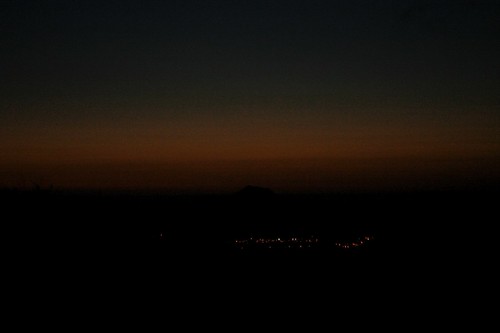
Now against the background of  darkened peaks and glowing sky emerges a panoply of orange lights: the state prison.

IMG_7373.JPG

The History of Peas

April 13th, 2009

It started with the financial meltdown last September. I hired Chris to help me take down the ziggurat I’d constructed 7 years ago at the top of the hill and use the railroad ties to enlarge the vegetable beds. They were soon filled with spinach, chard, kale and lettuce and I began hankering  for more territory to plant.

In early November I went up Stenner Creek Road with Lucas and loaded our Subaru, Jade, with serpentinite boulders I found abandoned at a turnout.  I dug up a dozen heavy carex clumps in front of the house and transplanted them to make a little retaining wall, spaded and levelled the adobe clay in an irregular eight by five foot patch that might catch a little winter sun, laid out a new path around part of it connecting the brick walk to the top trail, surrounded it with the boulders, and worked in leftover compost.

I decided to plant sugar snap peas since, like the leaf crops, peas would grow in winter on our north-facing, shaded slope.  Peas also enrich the soil  and grow large plants in small patches of ground.  Like tomatos, their expansive vines provide something to watch and fiddle with, and they yield an ongoing harvest of food that’s good raw or cooked, both the pods and the little treasures inside.

I couldn’t find organic sugar snap pea seeds anywhere in town in November, but New Frontiers put in a special order.  The packet was embellished with an an enticing illustration and invitation:

peapacket.jpg
Once torn open it also offered information about the history and culture of the fruit.

peapacketreverse.jpg

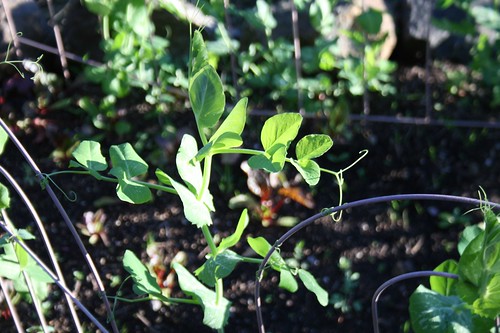
I’ve always been a little intimidated by gardening, partly because I could never compete with my neighbors, Stan and Peter, back in the seventies, but also because of the patience required by its slow rhythm and its uncertainty of outcome.  With both anticipation and fear, I patted the little off-white marbles into the holes I’d punched with my fingers every two inches into the dampened soil.  After just a week of watering  the seedlings came up juicy and vigorous and curled their tendrils around the fence marking the row.  I’d gotten the thumbs up from the Great Outdoors, confirmed every morning as I watched their progress in the golden light of sunrise.

IMG_6523.JPG

Read the rest of this entry »

Easter Week 2009

April 12th, 2009

My assigned twenty minutes of Ecolog is overdue.  I sit behind the pea patch in front of the house, the breeze riffling newly transplanted tomatos and cooling the back of my neck damp with sweat from digging and mixing soil.  Lots of that’s been going on this weekend, starting with buying three-foot seedlings at Cal Poly’s “Tomato Mania” Friday morning and putting them into the ground while Chris restored one section of the drip irrigation system I ripped out when the native shrubs no longer needed water five years ago. Now its required for the vegetables.

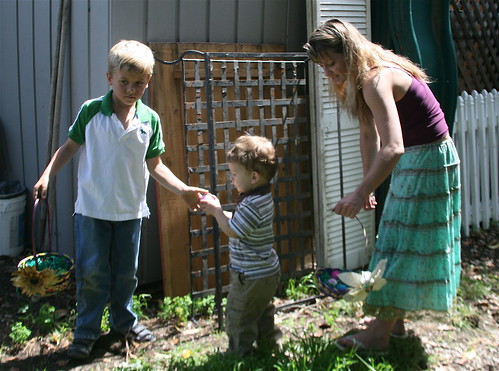
Saturday I bought three varieties of basil seedlings at the farmer’s market and sweet pepper, cucumber and summer squash seedlings at Home Depot. Jan transplanted flowers at Claire’s mobile home this morning during the Easter Egg Hunt,

IMG_7322.JPG

and for the last two hours I dug in yesterday’s purchases.

Then there were the hikes: Tuesday with the Ecolit class into Poly Canyon, Wednesday with the Cal Poly Land class, guided by geologist Scott Johnson

petersonpan.jpg

the light and the green overwhelming after Tuesday’s rain.  Up to Felsman Loop on Bishops Peak with Lucas before his nap on Thursday, and up on the ridge between Los Osos Valley and Clark valley on Good Friday afternoon, botanizing with Matt, Hunter, Jen and Bridey,

lososvalleypan.jpg

And yesterday into Froom Canyon with Jan.

IMG_7303.JPG

The force of April, that pierces “the draught of March… to the roote”and “through the green fuse drives the flower”  drives me like lust to dig in the dirt and wander the earth.  Writing down this  desire is as old as poetry, which I rediscover like Spring with students as we read Solomon and Vergil and Marlow and Shakespeare, and as we listen to the raunchy flute and entwining voices of sixteenth century airs.

Under the Dome 2009

April 8th, 2009

Ecolit class hike number one.

Today’s rain, the first in weeks during this dry wet season, regreens the yellowing vegetation.  The air is damp, ready to unload again from scudding clouds overhead. Intermittent sounds of breeze: a vibrating groan from the sycamore overhanging the dome, a light rustle from the pepper tree to the side, a delicate breath from the oaks on the hillside.  The soil, which had become hard  and crusted yesterday is gooey or bouncy.

Over the ridgeline to the east, the grey veils part, displaying two blue patches and then quickly cover up, recalling the momentary revelation of sunshine, deep azure and billowing cumulus on the slippery trail up the canyon which lighted up a fresh carpet of wildflowers on the serpentine slope.

Birds twitter in the oaks near the bridge, goading us to leave this Golden Age and head back down to the world of work.

Palm Sunday

April 5th, 2009

Short bright streak moving above the black mass of East Cuesta Ridge,  another one overhead.  The mountain wall turning dark dark green.  Deep blue sky fading to white at the wavy border with the ridge. Bird song from all directions no match for the roar of freeway traffic in the still clear air. Homer the cat meows for breakfast. A little color washes the hills to the north behind Poly where the skyline is smoky gray. To the east a line of tiny trees serrate the ridge. A trace of pink in the glow. Steam rises from what’s left in my  cup as the caffeine rises and clears my sinuses.

I stare at the bright spot that marks the entry point, the grand portal, tabernacle’s curtain, door of the tent.  That point has travelled ninety degrees north since December. No trace left of darkness.  The wait is impatient. Has the temperature dropped or have I lost all bed-warmth?  A small flock of birds scoots by. The newspaper sits waiting in the driveway. Bunchgrasses I transplanted yesterday to make room for tomato plants grow rootlets to take up water in their new home.

A bird in the topmost branch across the street silouetted against sky. A new vapor trail in the same spot above the ridge now hardly visible against the bright background. Maple leaves have grown from one inch maroon to five inches olive-green in two weeks. No more pink above the ridge. The volunteer oak on the lot corner below glistening light green, almost doubled in size.  Pea tendrils quiver. The windmill starts turning.  A quick look at the horizon leaves a mark on the retina and warmth on my forehead, but fingers stiffen with cold.

Can I sense the earth revolving eastward? Vapor seems to condense above the ridgeline or is it my tightening eyelashes? Two crows overhead.  A car alarm goes off. Its infuriating pulse persists.  But perhaps this is a chorus of welcome”horns of a procession entering the city gate.

Then it stops, leaving a moment of pure silence.

Flame tops the horizon in slow motion, frees itself from the land, and ascends, throbbing heat, needling eyes.  I put my hand up and squint through the slit of fingers glowing orange-pink at the full circle in the center of a luminescent web. The pea blossoms turn translucent. I cast a shadow behind me and the sharp shadow of the pen dances with the line across the page.  I don’t dare look longer at the naked body in the sky. From the bedroom I hear stirring.

In Memoriam: Steve Caldwell 1941-2009

March 21st, 2009

steve.JPG

click on picture for full-size image

more pictures from 2008 and 2000

quotes from a correspondance:

July 15 2002

I’m in the process of preparing to sell my rather nice
first-edition collection, regretfully but to the immense relief of my
heirs, I think.  It sits today in the dining room here, in 100 cardboard
boxes, each numbered, so I can’t even see the books, but it wouldn’t
surprise me if we’re in a bit of a bubble in firsts, which the popping
of the stock-market bubble could in turn pop.  I plan to sell to offset
my considerable marketing losses and hope it will assure I can stay on
here indefinitely without counting on an inheritance–a good idea, since
my mother may indeed be immortal, unlikely as that seems.  As may I.
But neither’s a very good bet.

December 24 2002

We’re a mess, but life is, and fortunately not just a mess.

March 8 2003

The war does seem all but inevitable.  Bush may have been right about its
necessity, but his lead-up has been a travesty.  It would arguably be
necessary (if you accept any rationale for war) if the war was to serve the
purposes of the U.N., which likely needs teeth to work well, but Bush from
the start has seemed to be intent on undermining the U.N., now seems likely
to go to war when the U.N. attempts to forbid him.  The NYT columnists have
been excellent from the start, Krugman best and Friedman, except that he
obviously would applaud an attempt at a just war to establish a moderate
Iraqi democracy (as though that was doable and as though a democracy has any
way of forcing its electorate to be moderate), very good.   But whether X
might wage a wise war, Bush seems very unlikely to, seems to be bent on
isolating the U.S. and assuring us a semi-permanent terroristic opposition.
He can win the war but the peace we’ve reason to think he’ll butcher.

…Mom uses my experience a lot, my early radical dependence on others in
effect pioneer work for her and you of my generation.  There are just more
and more things she can’t do, and she’s very good, or seems to be, at
focusing on what she can.  Also, at 91, she can’t help but wonder now and
then, as she did one day all day this week, whether a temporary aberration
won’t prove permanent, a wonder I’ve known myself now and again.

Read the rest of this entry »

The Culture of Sustainability (2)

February 5th, 2009

An Address to Focus the Nation II Cal Poly
February 5 2009

The words of Bob Dylan’s 1964 anthem, “The Times They Are A Changin'” have never rung truer than during the last few years of apocalyptic uncertainty, threat, and promise. It’s been a period of sudden collapse–from the Twin Towers and the Global financial system to species diversity and climate stability–and of miraculous growth”from the Internet and biological research to community organizations and acceptance of diversity.

Change, when you’re in the middle of it, is mysterious, lacking adequate name or narrative. The package isn’t labeled, the story is still unfolding. In the sixties, before the words “hippy,” and “counterculture” were coined, we referred to our transformations of consciousness simply as “the Movement.” The positive change going on today remains unnamed. In his latest book, Blessed Unrest, Paul Hawken calls it “the largest social movement in all of human history.” He claims “noone saw it coming.”

But Hawken is one of the visionaries who have seen what’s coming and have provided it with various names and stories. His earlier books, The Ecology of Commerce, and Natural Capitalism, envisioned the present as one of “Restorative Economy” and “A Second Industrial Revolution.” E. J. Dionne calls it “The Revival of Civil Society,” Thomas Berry, “The Great Work,” David Korten, “The Great Turning.” I’m calling it the Sustainability movement.

One way to make sense of this movement is to place it in historical context.  As I look back at my own story, I remember childhood in the nineteen forties and fifties governed by postwar, coldwar, economic expansion, consumerism, suburbanization, homogenizing TV, and patriarchy. The sixties and seventies rejected all that in favor of peace, community living, spirituality and ecology. The eighties and nineties reacted again, privileging individualism, greed, branding and technology over nature. The new millennium took those tendencies to an extreme and then reversed direction toward where we are now.

Such a pattern of oscillations was characterized by Friedrich Hegel as thesis-antithesis-synthesis. He believed history was driven by the progress of the collective spirit of humanity expressed in science, art, and philosophy. Changes in ideas were then manifested as material progress in technology, economics and politics. Karl Marx famously turned the pattern on its head, claiming that economic arrangements, particularly the flow of financial capital, provided the base that determined the rest, which he called superstructure.

This dialectical pattern can apply today. The movement we call Sustainability seems to synthesize the sometimes unrealistic idealism of the sixties and seventies with the shrewd yet often short-sighted materialism that followed. Sustainability is grounded in science and deals with resources, technology and business, but it’s also grounded in consciousness and deals with morality, aesthetics, and religion. Its trinity of values”Environment, Equity, Economy”can be emblematized not as base and superstructure, but rather as a triangular recycling moebius.

Read the rest of this entry »

Singalong with Lucas

January 28th, 2009

Back in December Claire got a job in a phone center marketing upgrades to web orders.  To support her efforts at achieving independence and paying rent, we have taken on babysitting for Lucas while she works.  He takes a two to three hour midday nap and otherwise is easy to look after and fun to be with.

We’ve been going to the Singalong at Boo Boo records, a fifteen year institution I happened to hear about last month from a lady in the City Hall Parking Structure elevator. It’s not publicized.

The woman who leads it is named Heidi.  She wears funny glasses and shoes and passes the hat afterward. I dont think BooBoo’s charges for the space.   An underground club scene Wednesdays  10:15 to 10:45 A.M.