Sowing Peas

January 14th, 2008

It took more time than conceiving a baby, but planting a new crop of snow peas was finished in the half hour between our Sunday morning walk with the dog and taking great grandma out to lunch at the Sushi bar. Now there’s less than a half hour to write about it, between completing Monday morning’s preparation and leaving for class.

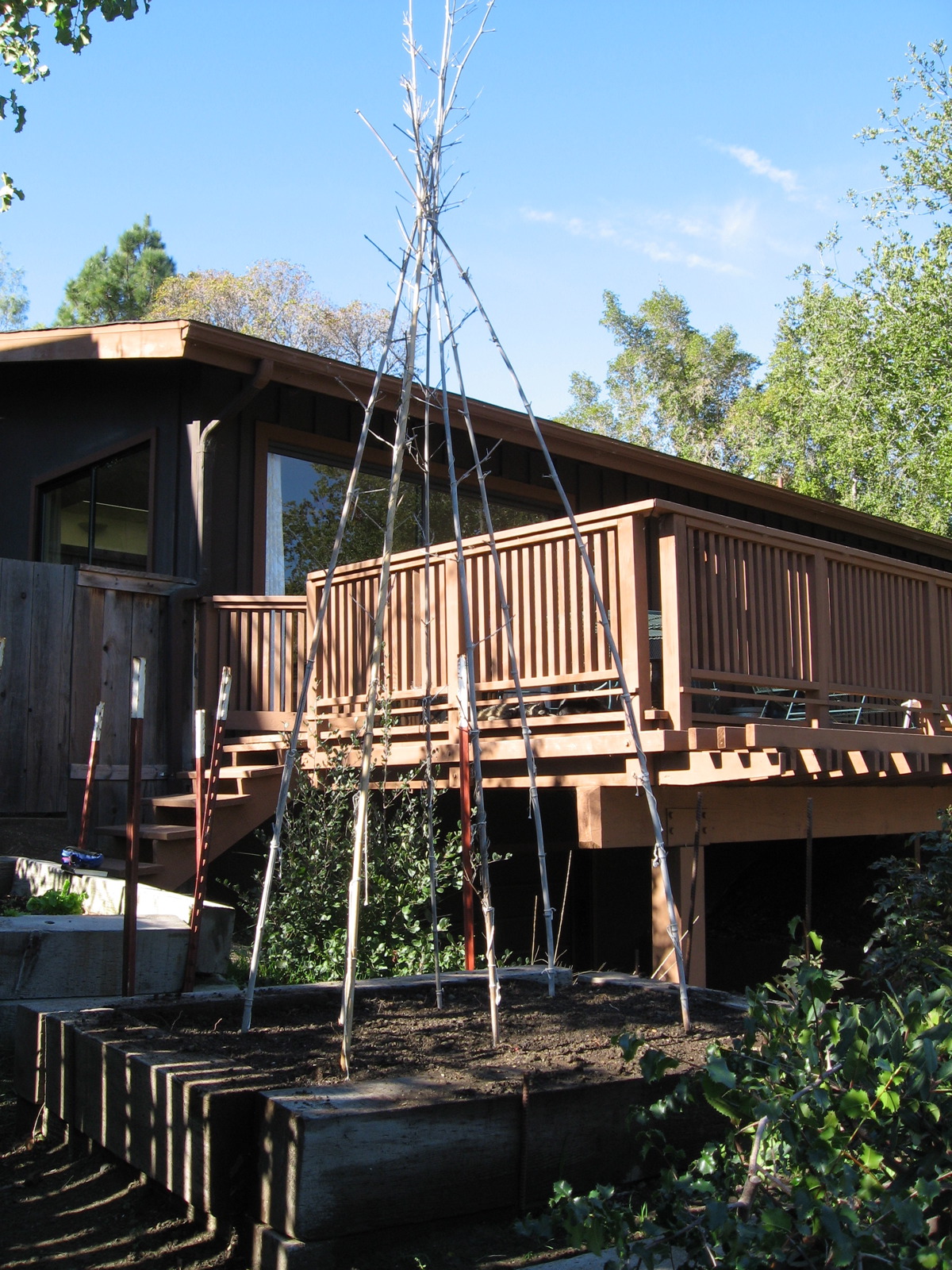
I yanked the decrepit old cherry tomato plants out of the raised bed and salvaged the remaining fruits to explode in my mouth while spading the damp compressed soil. I’d planned simply to insert the peas in the ground without disturbing the soil structure but it was too hard for my forefinger to penetrate. Digging revealed that roots, probably from the adjoining Toyon or Hollyleaf Cherry, had invaded the bed from below and were converting it into a dense fibrous tissue. With the shovel I was able to turn the soil and pull out most of them. I used a hand cultivator to smooth the surface and picked out several dozen stones that somehow had floated to the surface. Then in a corner of the bed, I poked a circle of ten holes and dropped one hard quarter inch sphere into each. I made six more such circles to fill the space of the bed. At the center of each I stuck one of the ten foot bamboo stalks I’d been reusing for years to grow peas and beans and tomatos. I pulled the tops of the bamboo stalks together like tipi poles and tied them up with a short length of soft cotton string that I’d cut off one of them with kitchen scissors. I patted the soil smooth over the seeds with the flat of my hands. Seventy seeds, sixty climbing vines, twenty sweet and crunchy pea pods each, by the end of March, when it will be time to replant tomatoes.

Under the Dome

January 9th, 2008

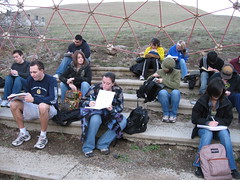
4:45 p.m. close to sunset, sound of hoofs galloping behind the dome where thirty people sit quiet, the light and warmth of a day between storms waning.

A single birdcall highlighted against the silence protected in this hollow between Caballo peak and Cuesta ridge. Poly Mountain rises to the south, Rockslide Ridge to the north. A wispy cloud above the summit of the peak begins to luminsce below higher dark gray clouds, then drops below the ridge line. A small stream meanders through the middle of the structure, separating the rickety stage from the new concrete amphitheatre seats. Poly Mountain’s north flank now burnished with dark gold light from the invisible sunset. Muscles tensed from a day of preparation, teaching and hiking up the slippery canyon trail slowly relax as the weight of the body settles on the cool cushion of stone.

Blowdown

December 12th, 2007

Jan, Steven,

About 8 trees blew down near your house in the last storm. The good news is that none of them damaged anything, & that they don’t need immediate attention. They don’t need Zenia or an expensive faller to clear them out. And the final good news is that there are now more poles for Joe.

We went up today and cleared the tree tops from the driveway. And I took the limbs off the downed tree near the shed but did not buck it up cause I don’t know the lengths Joe wants.

The house looks fine. Towagh, Kemi, & Aya plan to come up on Dec 20th.
In other news there was a great potluck at the Lund School yesterday.

Peter

blowdown pictures

Kestrel Crest December

December 11th, 2007

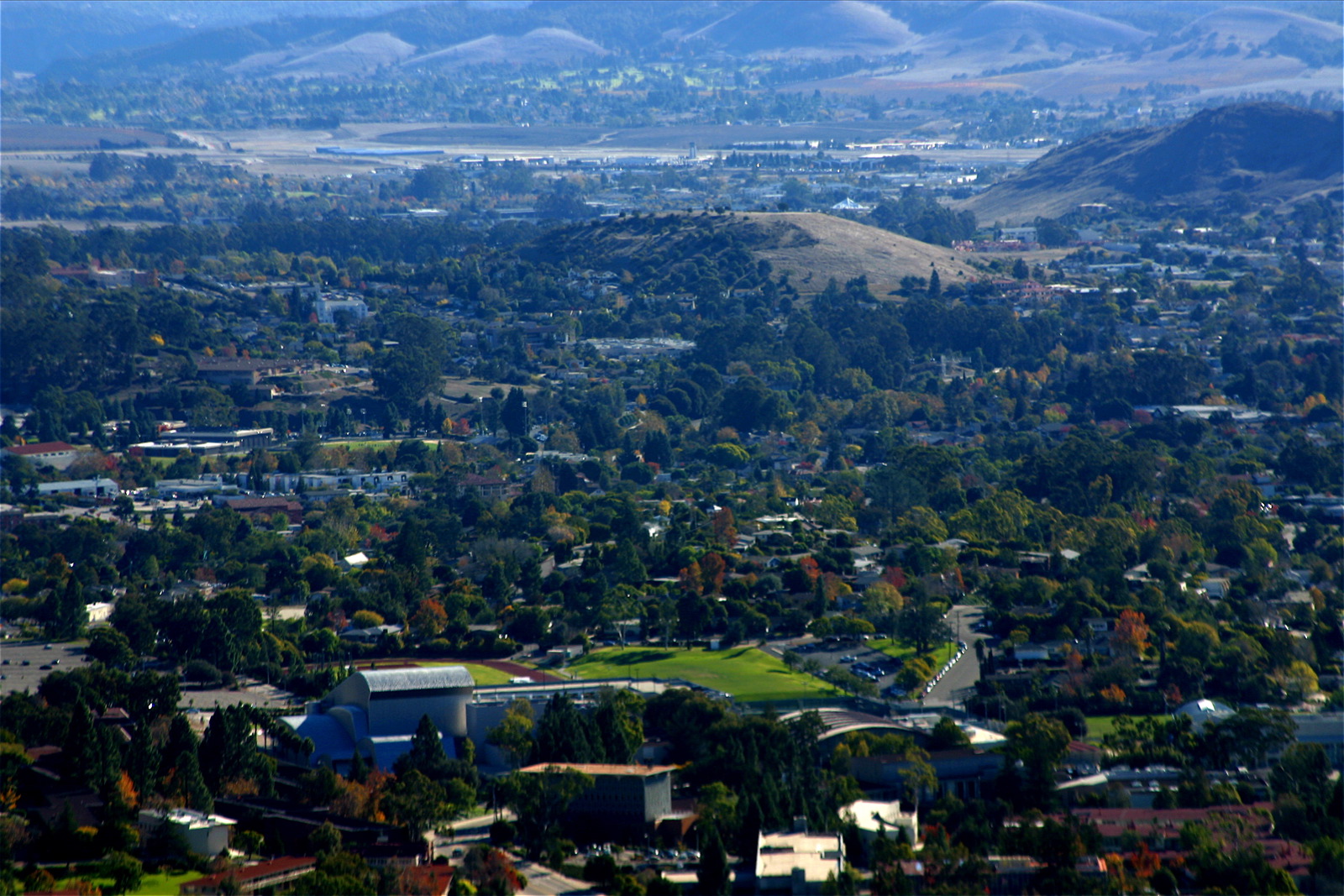
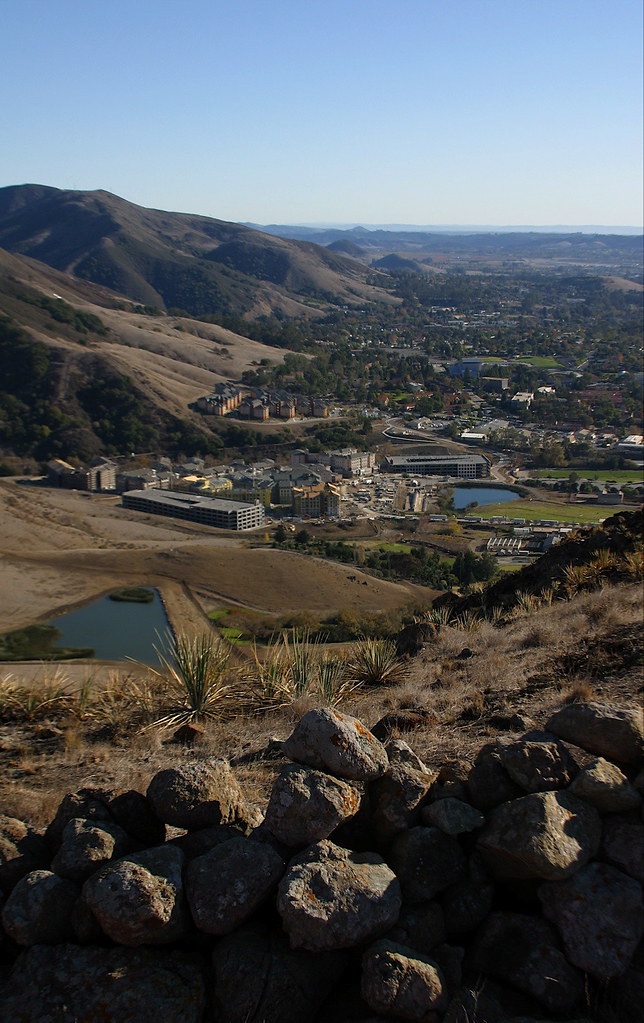
Despite the sound of hammers and traffic, the world seems emptied out. It’s two days after winter graduation, three weeks to the end of the year. The sun so low it makes windows glitter all over the valley before me.

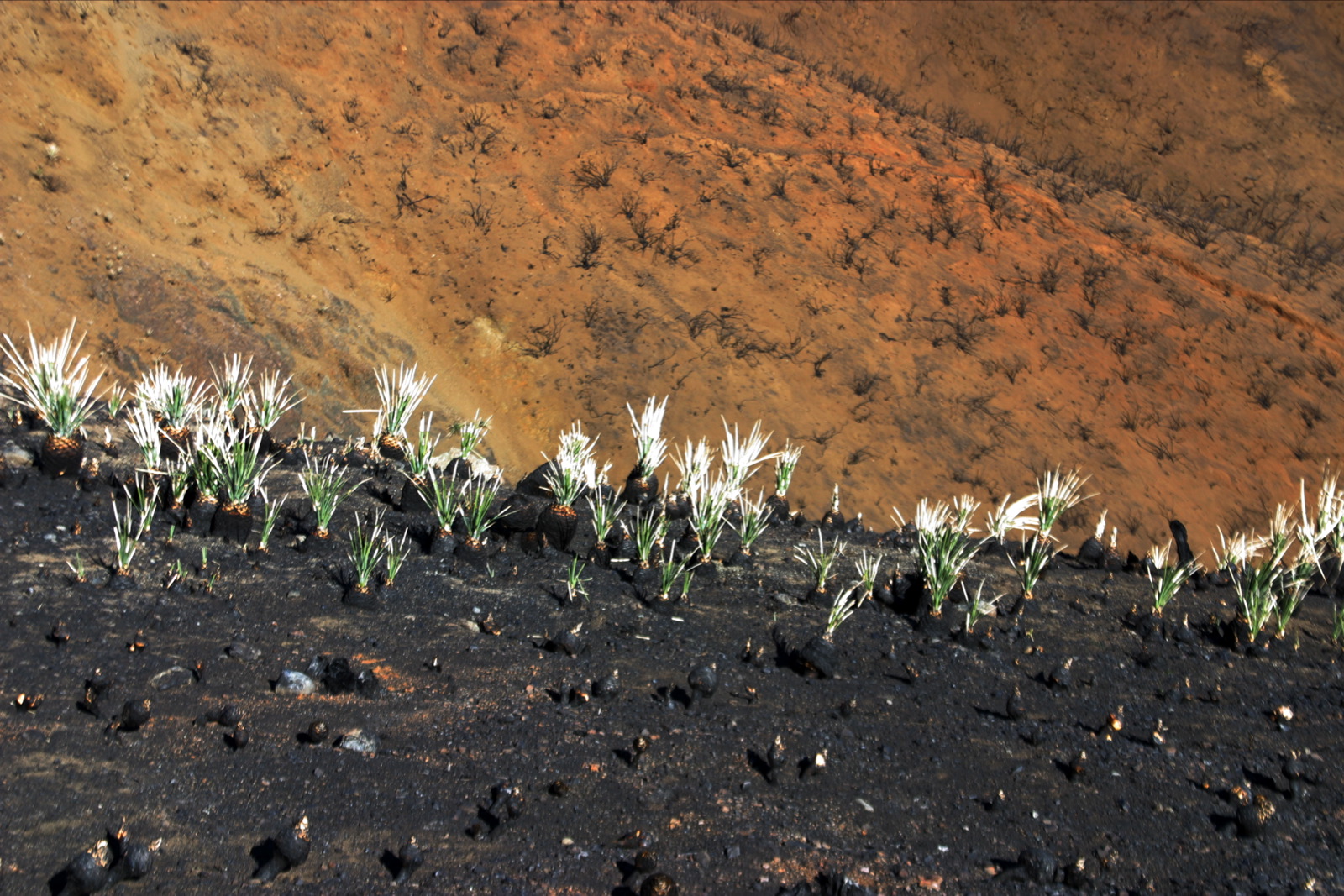
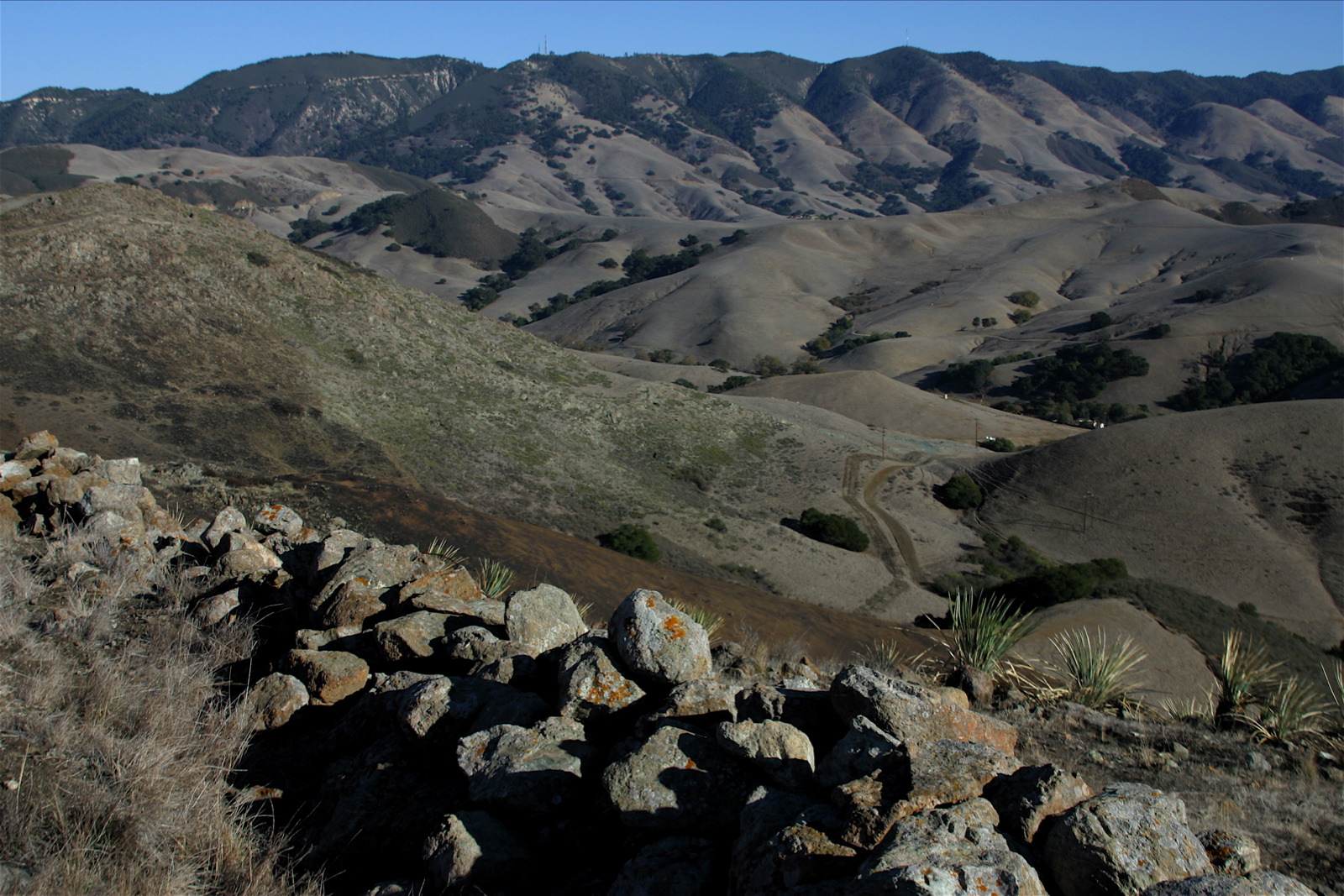
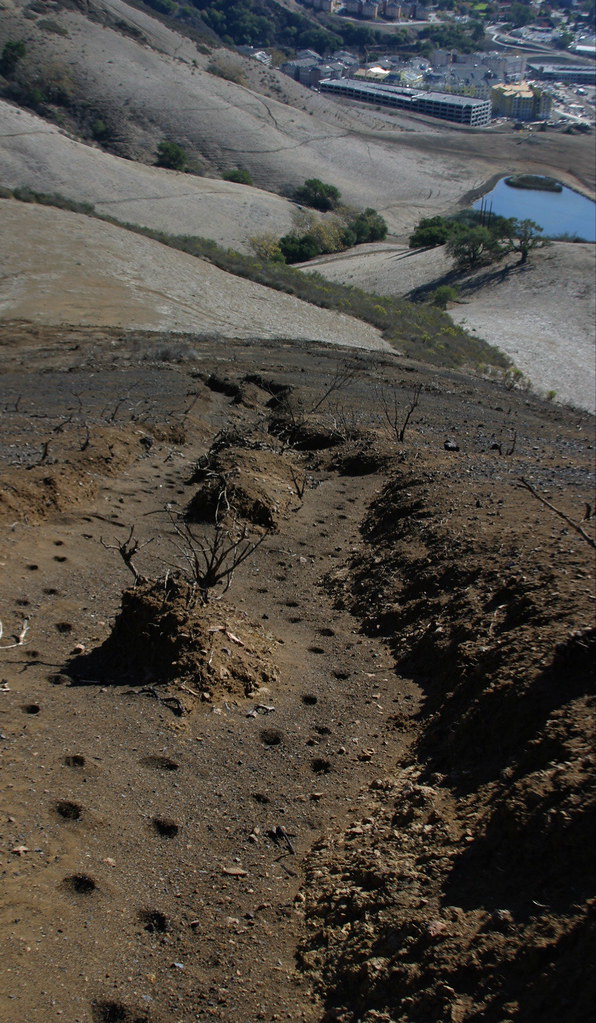
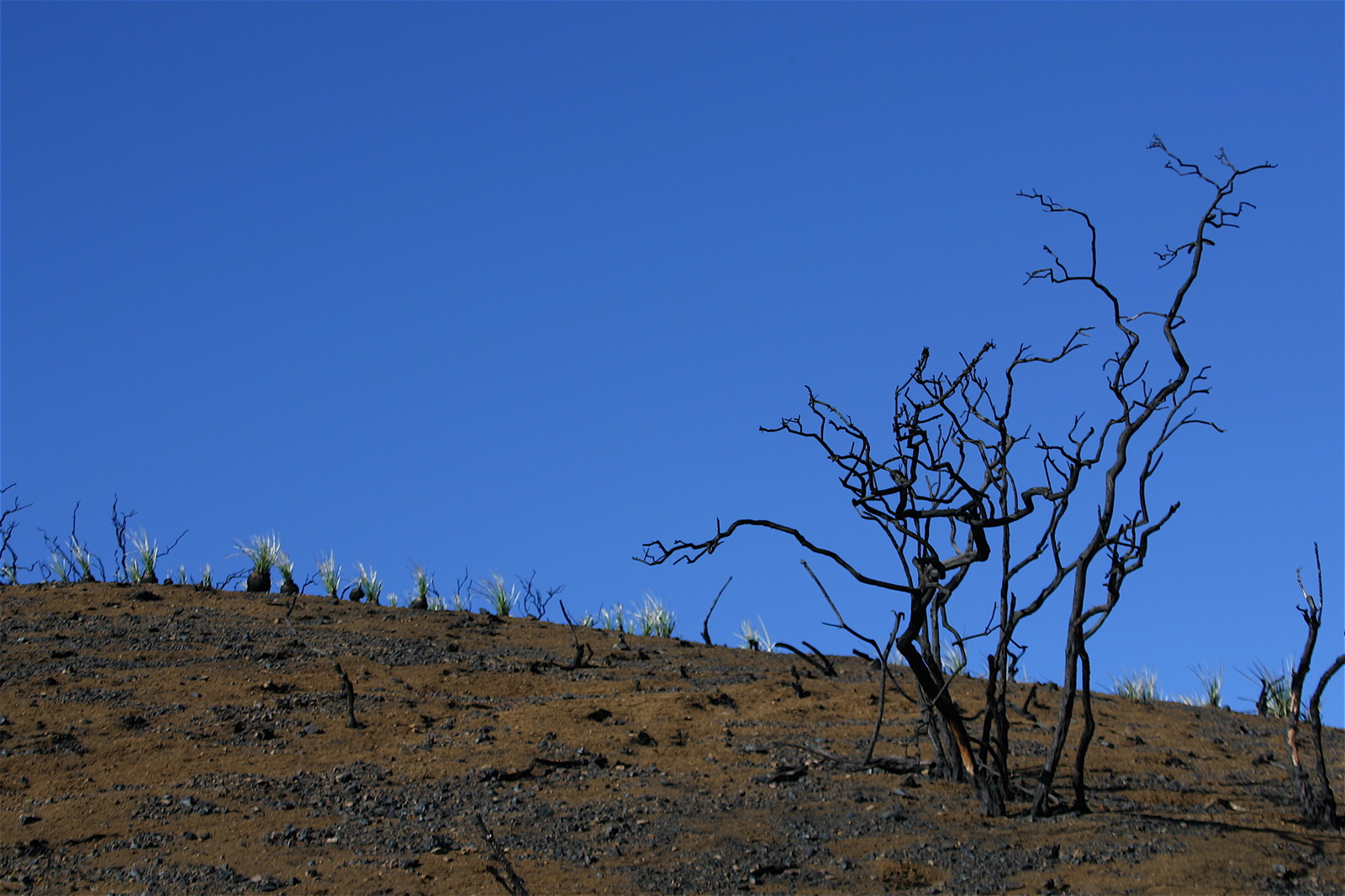
Why do I face the city and leave my back to the back country? Its not a friendly season, despite the quiet, the warming sun and cooling breeze. The ground I sit on is bare dirt. A scattering of small hard berries: deer pellets annealed by the fire that’s burned off the grass, blackened the rocks, trimmed the yuccas into globular bulbs topped with brown quills surrounding a few spared green ones. Their needled tips curve south clawing for light.

A few days ago I wandered through the restored ruins of Poly Canyon. Now I look down into it, shadowed by a warren of rising buildings flanked front and back by massive rectangular parking structures.

Only a half inch of rain was left by last week’s much heralded storm. The grassland has turned from green to gold to tan to a corpselike gray.

Much of the way up here, I followed a deer trail along the blank margin of the scrub. Ecotone. “Why do they choose this route,” I’ll ask the class on our hike in January after we read Mary Austin’s “Water Trails of the Ceriso.” They’ll answer, “to stay close to the cover.” Just like the birds and rodents who harvest the grass and seeds close to the edge. Below me a rustle breaks the silence and two rear ends bounce three times downward and out of sight.

Fire and drought.
A land dry, silent, withdrawn,
aching to soak up moisture,
to shine and swell,
to burst into flower and song.

The Presidents’ Climate Commitment: Pro and Con

November 19th, 2007

Hello Mike

Thanks for the thoughtful and detailed response to my question. I hope that it can serve to further some University-wide discussion of what I believe is the most consequential issue regarding Global Warming that Cal Poly faces right now.

That is, whether or not President Baker should the Presidents Climate Commitment:

http://www.presidentsclimatecommitment.org/html/commitment.php.

The primary author of that document, Anthony Cortese, visited the campus for several days this month, delivering a public lecture, meeting with several local Sustainability groups, and conferring privately with the President and Vice Presidents.

On several occasions Cortese stated that his mission was not so much to convince President Baker to join the 434 College and University Presidents nationwide in signing on as to promote public deliberation about this issue among all members of the University Community.

Whether or not we sign on to the specific terms of this Commitment, what Cortese asked was that the University move now, decisively and dramatically, to address the climate crisis and the need for leadership toward sustainability. Only the President of the University can direct such a move, but all the rest of us should be made aware of his options and reasons for action or inaction.

First of all, what is the actual commitment? It has three provisions:

1. Initiate the development of a comprehensive plan to achieve climate neutrality as soon as possible.
2. Initiate two or more of the following tangible actions to reduce greenhouse gases while the more comprehensive plan is being developed. [Cal Poly has already complied with this]
3. Make the action plan, inventory, and periodic progress reports publicly available.

One of Cortese’s main concerns was that objections to signing were not necessarily to the actual terms of the commitment.

The first objection you state is that true carbon neutrality cannot be achieved without our buying unaffordable and dubious carbon offsets.

There is considerable controversy in the environmental community as to whether buying offsets or sequestering carbon are meaningful ways of reducing GHG emissions. Thus, when the PCC requires us to set a schedule for reaching neutrality, when we don’t know if/how that can be achieved, the exercise is not entirely intellectually honest.

I think that was Yale’s position on the PCC: although they have set a goal to be “the greenest university in the world” (and have made some very noteworthy progress in this regard, including being on the forefront of GHG reductions), the president did not want to sign the actual PCC statement because he didn’t know how/if neutrality could really be achieved.

Thus, if the PCC is largely symbolic with regard to neutrality, then I’d prefer we were more upfront in saying that neutrality is a goal to be strived for, rather than saying we will set a schedule that hasn’t a realistic basis.

The commitment’s “Solutions” page states that “In general, buying carbon offsets to achieve climate neutrality should only be done as a last resort.”

The commitment is to achieving carbon neutrality “as soon as possible.” This gives the institution flexibility to set realistic targets and make adjustments as it tries to meet them. However this flexibility doesn’t mean that the commitment is mere lip-service, since it does require a plan, an inventory, and periodic reporting that demands an explanation for failure to make progress.

To me this is a sensible approach given the urgency of the situation. In the last few years, as documented in your well-crafted reports, Cal Poly has made what could be interpreted as impressive progress. However, that progress is not measured against any standard, and thereby gives no indication of how we really are doing compared either to other institutions or to targets defined by the demands of reducing emissions at a rate determined by scientific consensus to be necessary and feasible.

Yale’s objection may carry weight since they have instituted alternative targets and metrics for tracking progress toward an ambitious and clearly stated set of climate goals.

http://www.yale.edu/sustainability/YaleClimateInitiative.pdf

But no such initiative has materialized at Cal Poly. Our 2004 signing of the Talloires Declaration, positive though it has been in raising the profile and legitimacy of Education for Sustainability, has produced no measureable institutional targets and timetables for change, nor any discernible shifts in financing priorities to make such change possible.

Carbon neutrality may seem an unrealistic goal given many people’s present-day mindset, but as the consequences of global warming become more evident, that perception is changing. Our own governor, in signing a law passed by the state legislature stated:

“Using market-based incentives, we will reduce carbon emissions to 1990 levels by the year 2020. That’s a 25 percent reduction. And by 2050, we will reduce emissions to 80 percent below 1990 levels. We simply must do everything in our power to slow down global warming before it’s too late.”

By signing and fulfilling the Presidents Climate Commitment, Cal Poly would contribute its momentum to the initiatives of higher education nationwide as well as of the state of California.

Your next objection questions the appropriateness of Cal Poly’s taking the lead in moving our whole society toward climate neutrality:

My other concerns are secondary. First, as a public institution that will likely require public funding to achieve neutrality, the question should be raised: is this the most cost-effective use of public monies for reducing carbon emissions? Are we sure that bringing the public university sector to neutrality will achieve more benefits to the climate than using equal public monies in other sectors? Again, it’s the question of symbolism versus realistic solutions to a crisis. If we think we must act drastically now, we should direct our resources to those places that have the greatest results, fastest.

434 Presidents have agreed that Universities are appropriate institutions to lead the way, including the Chancellor of the University of California. Others, who haven’t signed the Presidents Climate Agreement like the President of Yale, also have taken steps in funding programs that are not merely symbolic but substantive. Universities house the next generation, which will be more affected by climate change than the present one and which will carry out the kinds of innovations and transformations that need to be developed now. In addition, Universities are also large institutions with correspondingly large environmental footprints.

Your next objection concerns possible abuses the Presidents Climate Commitment.

there is a potential problem with the need to earn a “gold star” versus really helping the environment. For example, at the UC/CSU/CCC sustainability conference last summer, a speaker suggested that the most important action UCI had taken to reduce GHG emissions was to build significant on-campus housing. More than one person remarked, however, that by bringing the housing on campus, the university would now have a bigger carbon “footprint” to “neutralize”…so wouldn’t it be better to not build the housing on campus so that campus neutrality would be easier? This goes back to my critique that by focusing on the university, we may lose sight of the truly global nature of the climate problem and that sometimes the best environmental answer may not be the one that gets a particular campus to neutrality.

This seems to be a problem of the accuracy of the metrics used in implementing the agreement. But as I understand it, each university that signs determines its own standards of measurement. Such technical problems are more likely to be solved if we become stakeholders in the process than if we use them as a reason to back off.

The example you mention illustrates some of the complexities involved in earning gold stars. In our biannual sustainability report, a good deal of credit is claimed for the construction of on-campus housing, despite the fact that Poly Canyon Village is adding two huge parking structures for the use of residents, which will encourage the increased use of automobile transportation on campus and in the local area.

Your last objection is based on a broader reason to discourage signing of the President’s Climate Agreement:

I am personally concerned by certain perspectives that suggest that the scientific inquiry regarding the causes and effects of climate change is “closed.” We always try to act on the best available science, but we should not close off intellectual/scientific debate or research. Scientists, academics and humans generally have certainly barked up wrong trees before. I have my father’s school text on environmental science from the late ’40’s. It notes that the greatest scientific breakthroughs to benefit humanity so far in the 20th century were 1) antibiotics (ok) and 2) DDT … because of how it eliminated malaria from many parts of the world. Hmmm. (I’ve read that limited use of DDT is again garnering favor in parts of the developing world for just that reason.)

I concede that skepticism about the reality of global warming or about humanity’s role in causing it or beliefs that there is nothing we can do about it undermine the immense resolve required to take responsibility for combating it. The science supporting the claim that we must act now to avoid future catastrophe is highly technical and the conclusion is not intuitively obvious. And in some cases, as you state, widely held scientific conclusions have been proven wrong.

But the risks of not acting on what has emerged as strong scientific consensus are today greater than those attendant upon waiting for more certainty. Two days ago, Science Daily reported

Secretary-General Ban Ki-moon has challenged the world’s policymakers to start devising a comprehensive deal for tackling climate change at next month’s summit in Bali, Indonesia, after a United Nations report released Nov. 17 found that global warming is unequivocal and could cause irreversible damage to the planet.

Finally then it comes down to whom to believe. At this point even the present administration in Washington acknowledges human causality for climate change, though it fails to do anything about it. This is why state and local governments, businesses, and other institutions of civil society are taking on the task. Education is at the forefront of these. The signatories of the Presidents’ Climate Agreement constitute a credible authority unreasonable for our President not to believe.

In addition to addressing the reservations you state, I’d like to mention a few of the positive benefits to be realized by our making the President’s Climate Commitment.

1. It provides a specific action program and timetable to guide the University in enacting provisions of the Talloires Declaration to which we already are signatory. Included is the creation of “institutional structures to guide the development and implementation of the plan.”

2. It provides an extensive “implementation guide” and a network of communication among other Universities participating in the program.

3. It provides access to funding sources”private, foundation and government”that can offset startup costs for implementing the plan

4. It provides a concrete statement of a shared mission that can

¢ engage all members of the university community
¢ heighten motivation of current students to succeed, especially in scientific and technical fields
¢ attract the most talented of prospective students who have realized that their future depends on dealing with the problem of climate change
¢ make graduates more competitive in a job market that demands the skills and inventiveness that arise out of accepting this challenge.

In conclusion, I’d like to reiterate what Anthony Cortese reported about the response on campuses at which Presidents signed the commitment. He said it has changed the level of conversation, it has raised the excitement, it has made it easier to discover ways to include sustainability in all curricular activities with incentives rather than requirements. As to why they made the decision to sign, the most frequent reply of the Presidents was “Because it’s the right thing to do.”

Lund Retreat Autumn 2007 (9)

November 10th, 2007

7:15 Chet Baker singing and playing as I drink my coffee, thinking of return to Jan.

Time after Time
I tell myself that Im
so lucky to be loving you
so lucky to be
the one you run to see
in the evening
when the day is through

I only know what I know
the passing years will show
you’ve kept my love so young so new
and time after time
you’ll hear me say that Im
so lucky to be loving you.

Woke with a start at midnight from the sound of three sharp knocks on the door. No lights, no follow up. I sneaked around in the dark and locked all doors. Wake up at 5, achy as usual, take hot bath, go back to bed to feel the pleasure of warmed, relaxed muscles, meditate and sleep. Get up again at 7:00.

4:20 p.m. What’s happened to this day? After oatmeal breakfast, I write a guide to keeping warm and disposing of trash for visitors at Knoll House. Then split kindling to leave behind. Again enjoy feeling the aim improve as I tilt the axehead back over my head, bring it down on the quarter round, hear the crack of the fibres and the pop of the pieces shooting out in opposite directions. Pack the garbage to take to Lund, where I buy lamp oil, candles and matches for future power outages. An easy glide down, but a tough slog back up to Malaspina Road and then down to U. to give back one bike and pick up another. I make it all the way home on Peter B’s bike. Get back at 12:15, read for fifteen minutes and then start a cleanup that lasts four hours. After the morning’s splitting and bikeride, it’s hard work. The rain gets stronger and steadier, Savaryview fogged in.

Sad songs play on the computer. Now its time to pack my bag, lock up, and catch the little bus to Powell River.

Lund Retreat Autumn 2007 (8)

November 5th, 2007

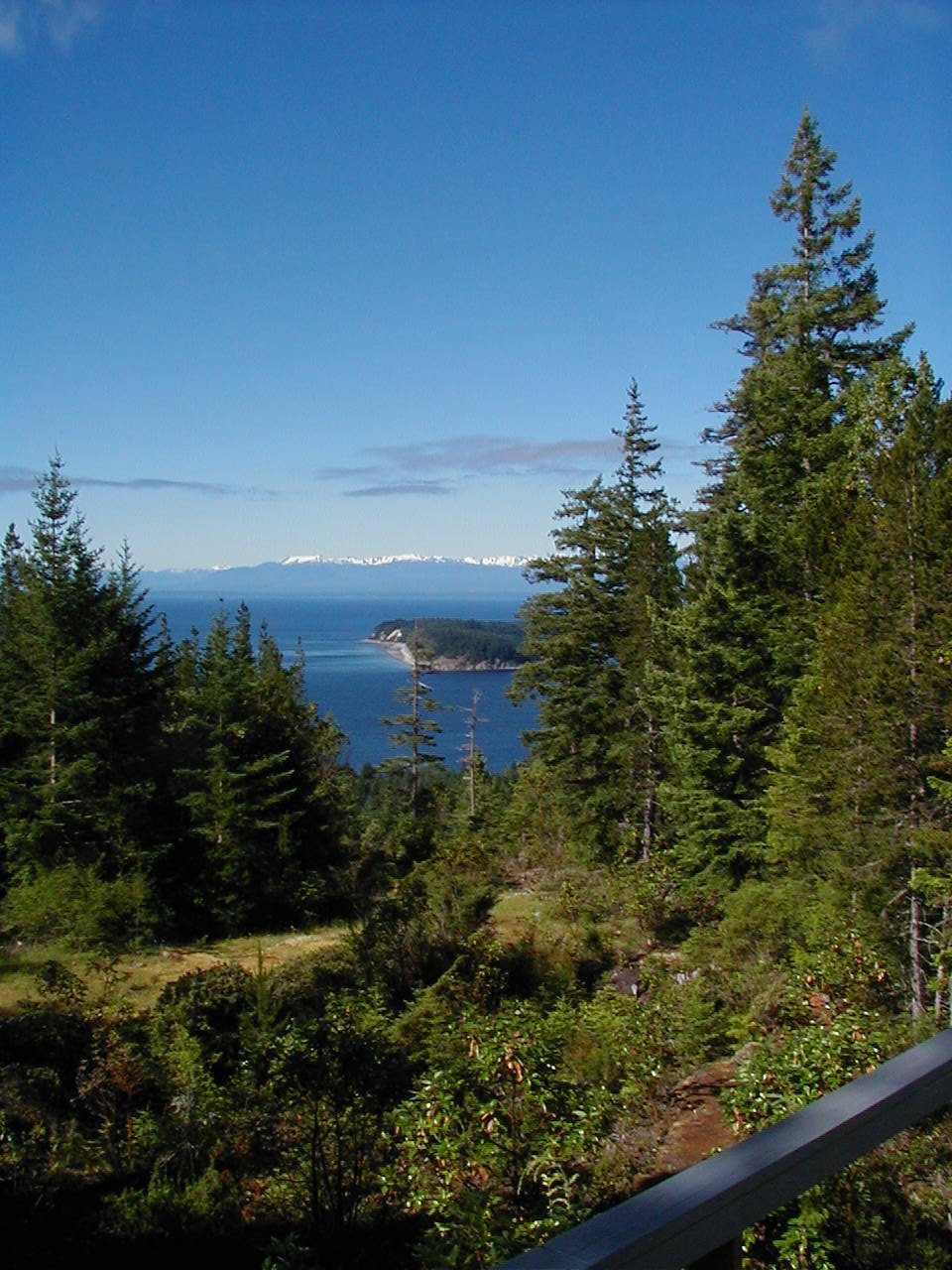
How many vertical layers in Savaryview?

1. Deck surface
2. Railing
3. Close clearing with rocks
4. Path to bluff
5. Proscenium of trees
6. Lower fringe of trees in front of water
7. The passage between Mace and Hurtado points
8. Mace point
9. South beach and Savary trees
10. Georgia Strait
11. Comox peninsula
12. Comox Valley
13. Lower cloud layer
14. Front Range
15. Skyline Range
16. Distant sky
17. Overhead sky

What are the movements?

1. Sun, moon, star light: the time of day or night, the seasonal angle, the cloud covers
2. Skyscape: cloud density, color, shape, texture on horizontal and vertical axes
3. Wind: intensity, steadiness, direction, in sound, smells, effect on land, sky and seascapes
4. Tidal ebb and flow, shrinking and expanding the beach
5. Current in the channel
6. Snow cover on the mountains, expanding and receding
7. Wildlife: bugs, birds, mammals

The temperature drops a degree or two. Does the stove need a log? It’s been an hour. I go downstairs to check, feel warmth as I reach the bottom steps, hear the rippling flow of combustion, see the flicker in the window. Not at all. Instead of raising, I lower the damper. There’s a living being at work for my comfort down there that requires close tending. When I came home last night and the stove was cold, I worried that the jack pine was poor fuel, that Dick may have tricked me, that I’d have to order a load of fir for any visitors. But the fire lit easily, and when I woke up this morning, it was still going.

What are the planes of consciousness?

1. right now: the temperature, the stove, the view, the list, appetite
2. observing and recording right now
3. reading and revising right now’s entries
4. reading and revising yesterday’s entries
5. reflecting and commenting on yesterday’s entries right now
6. recalling: old stuff in the computer. Old stuff remembering earlier stuff¦

A phone call. The College Dean wants to know if I’d be willing to moderate a round table discussion on Sustainability and the Liberal Arts with a distinguished visitor the day after I get back. Suddenly there’s homework.

I walk down to the bluff listening to the glocks of three ravens flying formation.

I encounter a squirrel cheeping loudly and take his picture and a film and sound recording.

Douglas squirrel Tamiasciurus douglasi ¦skull olive brown on the back and buff underneath, the two colours being separated by a black line. The bushy tail is also darker above¦coniferous seeds from the mai pat of the squirrel’s food, supplemented by berries and mushrooms. ¦does not hibernate¦stores large quantities of cones for winter use¦.active during the day, scolding and chattering as it tries to chase other animals from its home territory. Nature West Coast 205

Follow the trail to below the summit. See Cortes and Twin Island.

Walk back and hear chipping and see a little wren on the path back to the house. Winter Wren, Troglodytes, troglodytes

Repair gasket on woodstove.

Eat the last leftovers of Michael’s Snow White Chicken. The water chestnuts and baby bok choy and diagonally sliced asparagus and the local grown chicken, stewed in its own broth, whitened with the corn starch”along with the remains of a bottle of Okanagan Semillon Chardonnay.

Finish reading Prodigal Summer. Its happy ending makes me feel happy. A vulgar enjoyment. I will enjoy sharing it with students.

This is my last night here until April or May. I love this house, this land, this neighborhood, this province, this country.

Lund Retreat Autumn 2007 (7)

November 4th, 2007

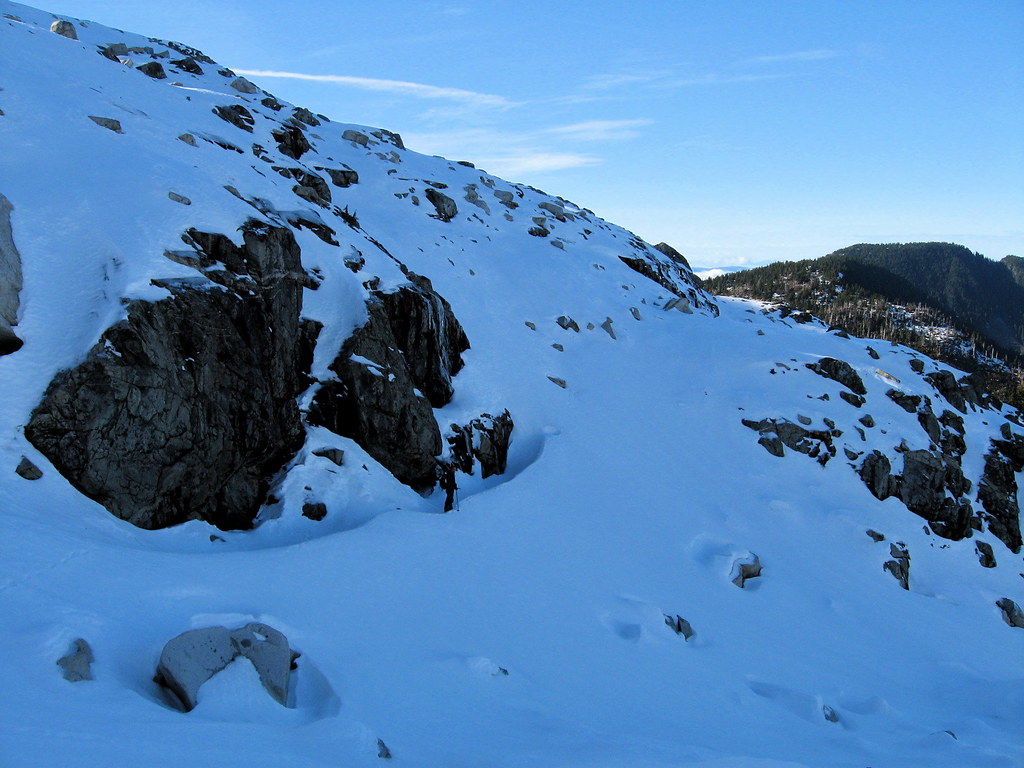
Peter B. is back here at 6:30 in morning to pick me up for a hike up into the Coast Range. I have some difficulty getting going and packing what I need for the day. We drive two hours to the trailhead on logging roads where no old growth remains and the second growth is harvested with the haste of looters. But this grandiose landscape would be inaccessible without those roads.

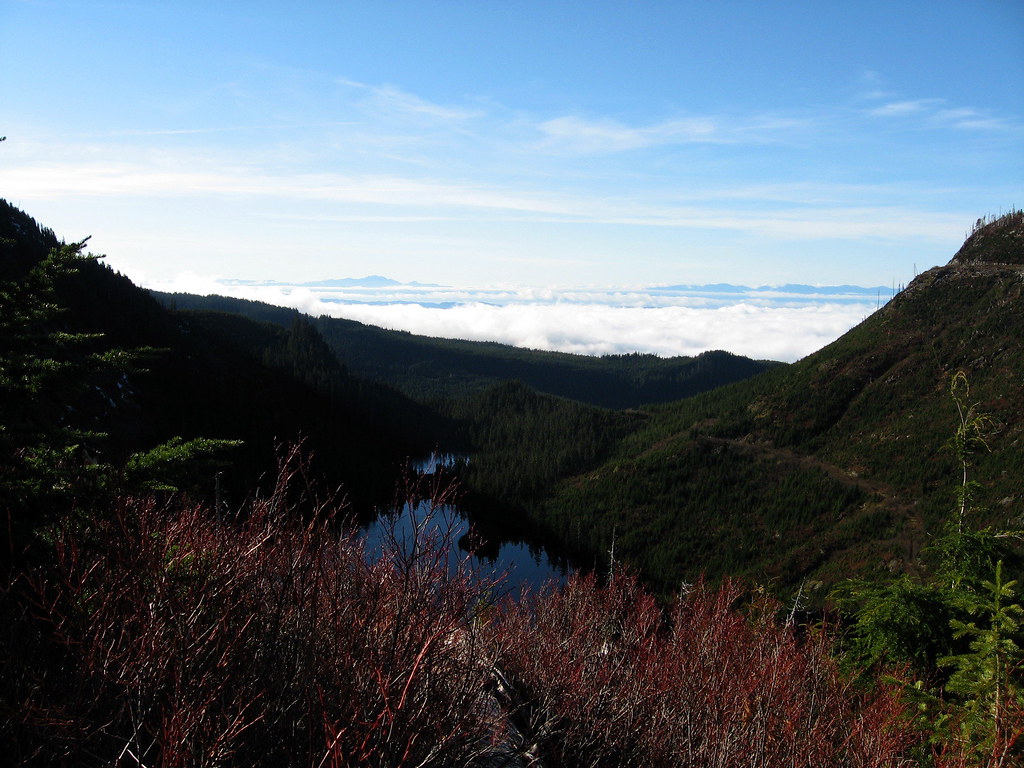
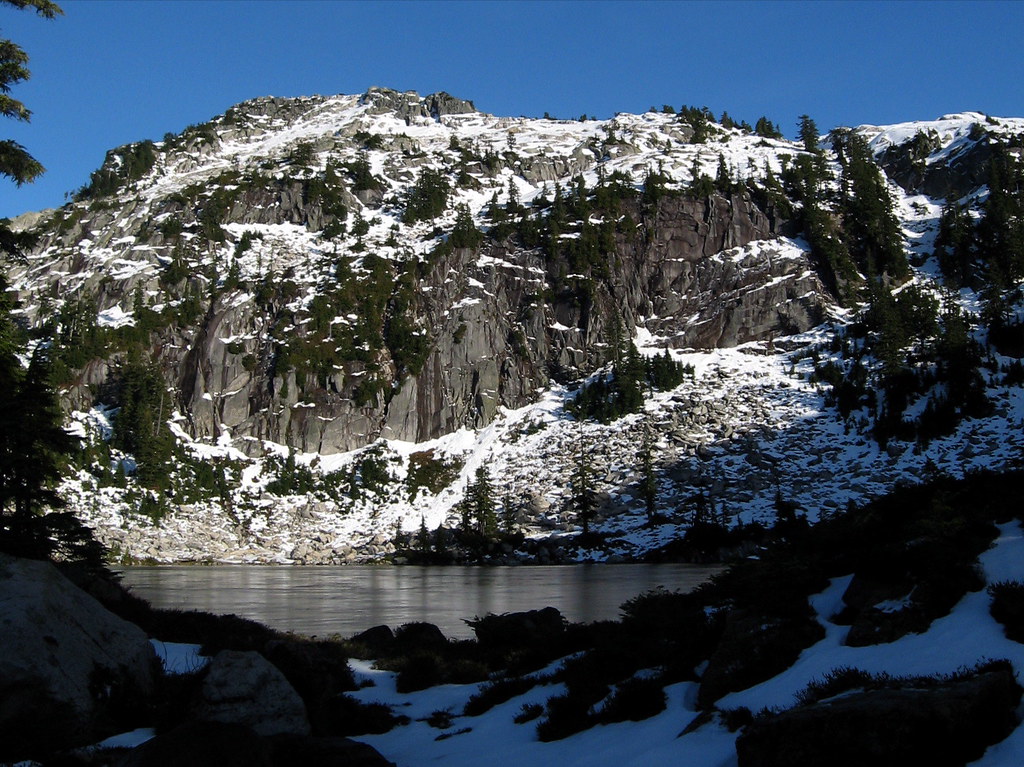
We ascend through juvenile yellow cedars and wine-red blueberry twigs above Gamma and Alpha lakes till we come to the half-iced over Beta lake, at the base of the two Knucklehead peaks.


This is the easiest ascent of any of the high mountains in the area, and Peter’s plan is to make a loop between the two peaks and around the lake. But as we pull ourselves up by gripping the heather protruding through the iced-over snow, it becomes evident that the going will be rougher than expected. At times the snow is soft enough or the crust is thin enough for us to break through and gain traction. But in most places the surface is slick with hard ice.

At a little plateau where the vegetation gives way to pure rock and snow, Peter unpacks his single pair of crampons.

One goes on his left foot the other on my right. If you put any weight on the foot without the crampon, you are sure to fall, not something you want to do, given the slope and dropoffs. With the cramponed foot, you carve a rough, flat resting place for the useless foot but dont move it until you’ve stepped sideways and a little forward with the cramponed foot. Then you move the useless foot into its prepared spot and repeat the sequence. This is a lesson on the complexity of normal walking. It takes half an hour to make what would be a five minute traverse without the ice.

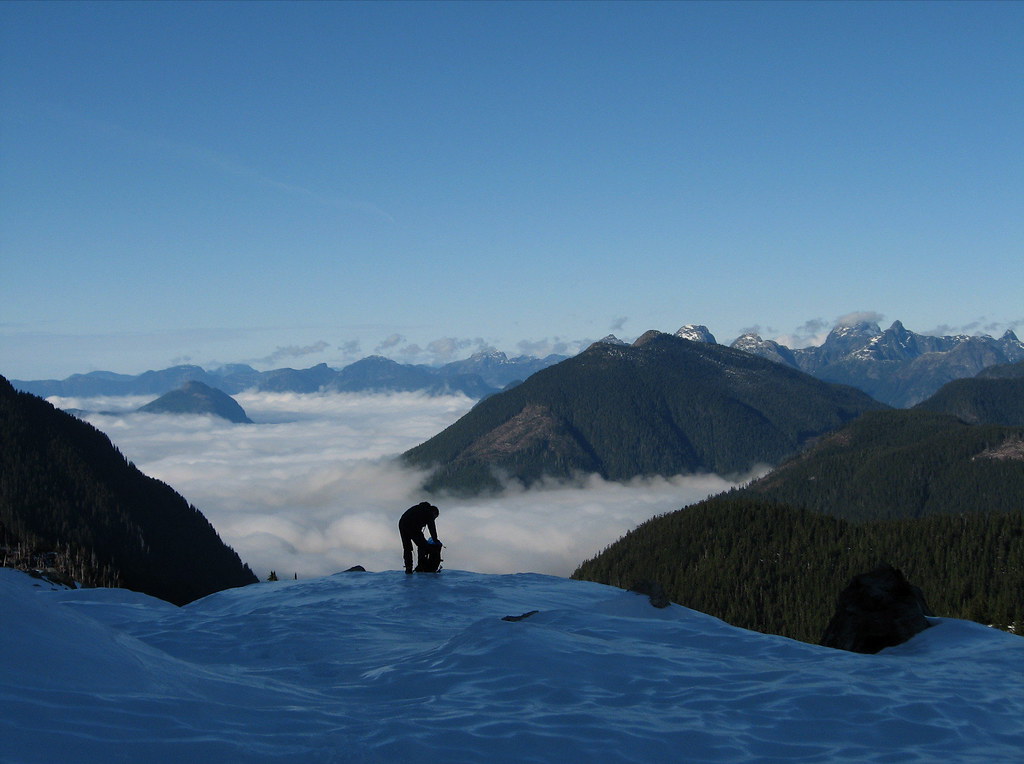
The weather is clear, the views spectacular and proceeding is not too strenuous or frightening if you slow down and pay very close attention.

We decide to stop for lunch at the saddle between the peaks, forgo both summits and head back the way we came.

The way down is easier because we have tracks to follow and the snow has softened a little. What a substance: hard, soft, appearing and disappearing–a solid almost as mercurial as liquid or gas.

Once returned to the lake, we split up to meditate, sitting on cushions of heather in the early lowering sun. Back by nightfall at Peter’s house, we’re served a salmon dinner by Margaret. A girl at the reserve sold her the fish, which, it turned out, was stolen from her grandmother’s freezer.

Lund Retreat Autumn 2007 (6)

November 3rd, 2007

Woke up at 5:30 this morning, eager to start the day probably from anticipation: dinner party tonight, Lucien coming to cut firewood”company. But also solitude: the sensation of the warm bath, reading, meditating, and returning to this journal. Researching granite and moss, liverworts and lichen. Photoshopping pictures of the rocks with the sequence I came upon yesterday: filter>artistic>cutout>4.4.1 and 4.10.1.

And searching for Knoll House journals in the computer.

Back to the day of the dead: excerpts from Court Evidence transcribed in the blog of two years ago: Glimpses of Kenneth.

A 1998 poem and reflection about Ellen’s coming death.

June 21 1998

Amazingly you’re back
And still “with no deficits.”
Each message feels like my last,
And yet there comes an answer.
This is what war was like:
Someone at home writing
To a soldier on the front.

Why is it that death interests me so? The only thing worth writing about. The only relationship really worth pursuing–with a woman who’s got one foot in the grave. “This is it,” she wrote in an email a year ago. This is it.

And a sonnet to her dated May 10 1964, my first year in grad school.

Indifference has only one cure that I know
The solution is obvious but hard to apply
Cold shoulders and hearts must be warmed up with snow
Not answering in kind will produce a reply.

The icier my silence, the sooner you thaw
But you freeze when my temperature rises.
“Nothing from nothing,” declares the old saw
Yet here nothing claims all of the prizes.

Passionate pleadings and drunk declarations,
Whatever displays my feelings, my fire
The overwrought products of late lucubrations
Won’t further but frustrate my ardent desire.

Though I realize restraint would be much more effective
Still I’ll send you these lines and forsake my objective.

The song playing in the morning darkness: Eric Clapton’s “Drowning in a River of Tears.”

A poem to Jan written a month after we met, preserved in a 1992 Journal:

May 10, 1966

Reveille

This morning I awoke from sleep
And smiled although you weren’ there.
Exuberant with gratitude
That I’d returned from solitude
Back to a world we share.

The bed I lay in still was warm
With the languid memory of your breast
And sense with fancy subtly blent
The sweet trace of our mingled scent
The room itself was blessed.

A dumb indifferent world transformed
Into a friendly welcome place
Reminding me of last night’s kiss
And promising the next night’s bliss
Denying time and space.

The taking of the vitamin
Acquired a sacramental drift
My imitative ritual
That answers to the purple pill
Which served to pledge your gift.

And later in the day I found
The promise of the early hour
Fulfilled again when sight unseen
My ugly, lonely brown machine
Was changed into a flower.

Morning meditation: noisy but with a buzz. Sounds of rain hitting roof, hard to distinguish from sounds of fire and stovepipe. The inside temperature always changing. The outside world without color.

Shore pine, Pinus contorta. Bundles of two needles. There’s lots around. Someone once told me it was worthless for firewood. I cut a stick out of a windfall with the handsaw and put it in the stove to find out. Seems to burn nicely. Check with Dick. He says, “Jack Pine, its great firewood.”

“Short to 20 m. bark moderately thick, scaly or deeply furrowed into plates, dark brown to blackish¦ Restricted to dry rocky areas with shallow soil, not because this habitat represents optimum growing conditions for it, but because it is intolerant of shade and connote compete with other conifer species in the more favorable habitats.”

The sun is lighting up half the sky and droplets in the wire mesh on the deck railing.

After two hours of cutting, splitting and loading wood into the shed with Lucien, it’s close to half full. We took down two trees. The top of one came within two feet of the house. The other bent his chain bar, but he was able to unbend most of the curve. Both mishaps resulted from following my advice.

Michael comes over at four and completes the dinner preparation he’s been working on since yesterday afternoon.

Company arrives soon after 5. Lucien brings a huge bag of Chanterelles he picked in a favorite spot after this afternoon’s woodcutting. Sophia loves Ethan’s toys and the slideshow on the computer. Don comes with Paula, the one person here who wasn’t yet family. Peter B. brings a packet from Margaret who’s on Savary with her woman’s group: a new signed copy of Sheila Munro’s biography of her mother”cost $19.50, not the $450 asked for by Amazon. Mara’s birthday adds festivity. She looks little changed from the Mushy who lived on the Funny Farm in 1971. While everyone delights in his dinner, Michael recites Robert W. Service poems with a professional actor’s presence and range.

Lund Retreat Autumn 2007 (5)

November 2nd, 2007

7:20 A.M.

Forgot to meditate last night, an opportunity missed. I remembered as I dropped off to sleep. Instead I read Prodigal Summer till 10:30, the book absorbing, enjoyable but too long. Kingsolver’s characters are stagnating, but factual material about small homesteading and predation and insects is informative. I’ll have to space out this winter’s Ecolit class’s reading assignments over two weeks, while we do the short poems.

The theme of predation in Thoreau, Oliver, Austen. Other themes to pursue from the start of the class: evolution, meditation and Solitude, observation, primitivism, ecological harmony, ecological disaster, rural life, progress, natural patterns, the seasons, fertility, stages of the life cycle, the erotic.

10:58 My worry: the excitement I feel at returning here after absence, the delight in the house and the view, the thrill of seeing people like Lucien and Peter U. and Michael and Don, all are transitory and contingent. A few more hours or days and all will get stale and then the memory of the excitement will summon disgust.

I go out to the two rocks whose pictures I collected from the archive last night and take more photographs”of the moss and the lichens and the granite, of the spaces between them and the lines of their convergence, of the juxtaposition of large and small, parent and offspring. “Land Art.” But the shapes don’t please me as much as they did this summer while I cleared them.

The downloaded pictures don’t help. I try cropping. Name them them Adam and Eve? Play with the spaces between them, and their adjoining borders, remembering couples by Brancusi and Henry Moore. The only images that aren’t terrible are several of the large rock alone, massive and weighty, but with a readiness to pounce: rhinoceros.

Should I get rid of the smaller rock? I could sledge it to pieces. “Two paradises twere in one/ to live in paradise alone.” If the small rock broke off the big one, the one became two. Is two more or less? Can the two again become one? Questions for couples.

Moving the pictures around into a sequence: from the two discreet weighty masses to the negative spaces between them to their direct juxtaposition, like a yin-yang, to their combining as a single image. I’ll need a better camera with manual focus and tripod to carry it out.

Moss show”mosses on the rock. Story of the rocks. A legend of the rocks. Father and Daughter, mother and daughter, father and son, married couple.

4:30 p.m.

Back from shopping trip for tomorrow’s dinner with Michael. We looked at the dying salmon making their way up Sliammon creek, went to the Hatch-a-Bird and bought a chicken and veggies, shopped at Overwaitea. He’ll do all the work. I paid. Downloaded email at River City Coffee Shop to read at home.

Notice sent to everybody in the department with links for student newspaper profiles of Larry and Todd but not mine. I’m relieved, but saddened by that. My colleagues’ cordiality covers disdain. Also a note from JW whom I’ve had no contact with since he went right wing in 1967. He found my website and sent me a link to something of his, which I cant check out till I’m back online. Also a note about Columbia 1968 strike 40th reunion coming up. Not sure I want to celebrate that failed revolution.

After reading the email, I feel like I’m standing at the edge of a large hole, about to fall in. Novemberness. Wet, cold and dark now, wetter, colder, darker ahead. Even in the sunshine yesterday, when Lund was almost empty of people, I sensed the quiet like a cloud of nothingness surrounding whatever was there.

I talk to Jan. She’s at an art opening and tipsy on wine, people and politics. We share news of the last 24 hours. My mood lightens.

I walk over to the neighbor’s place. D. pours rum-cokes and talks about hunting. B. cooks and watches TV and says nothing. I return, defrost Renee’s soup and eat it with toasted bread and broccoli salad. I load and run the dishwasher and come back to the computer to play with images of the rocks in Photoshop. My work is desultory.

It’s close to nine. I meditate fifteen minutes. More quiet than this morning. I continue for another fifteen minutes, more quiet than before.

The story of digging out the rocks last August? Clearing the fir stump and red dirt and arbutus tree and salal around the base, the roots tearing at them, exfoliated pieces broken off by the concerted action of vegetation. Moss and lichen exude acid which breaks granite down to soil which they can grow in. The shrubs and trees thicken their roots to wedge in the cracks for stability, but the rocks split and no longer provide it so the roots spread further to regain it. The cabled fibrous texture of root is harder for me to break with pick and shovel than the rock, but yields to saw and axe. When the vegetation, soil and broken rock created by the vegetation is cleared away, the boulder’s real shape is revealed, seated not on bedrock but floating on its own detritus.

I read Michael’s crumpled menu and shopping list with affection. I ask myself to enjoy the piece of dark chocolate I break off and not just let it go by. I ask myself to look at this room and enjoy it now, as well as when arriving and leaving and away. It’s not only a room but a living space, a globe. Let me love what and whom I love while present. All moments have value, those of sadness, loss and self-hate are as fine as those of triumph and pride.

Or am I looking too hard? And cloying again? The trees intruding on the view of Savary were bothering me. Was the view of Savary bothering me too? Is being here now both enjoyment and loathing? Is all this oscillation the product of too much time on my hands? Or is time on my hands what I need to find what I seek? And what would prove it found? Written work worth publishing? I peruse my archives and come up with a downloaded pdf of last year’s Presidential Address to the American Studies Association that cites my 1989 essay on Diablo Canyon. I reread the essay with pleasure.