

March, 2010 Archive

Ruth Howell (1916-2010) The Family Reunion

Monday, March 8th, 2010

February 27 2010

IMG_1030.JPG

February 28 2010

IMG_1095.JPG

Ruth’s 90th Birthday

famport3.jpg

More pictures

Down to the Wire: Confronting Climate Collapse

Friday, March 5th, 2010

Notes in preparation for a discussion of the book by David Orr, published 2009, at the Sustainability Book Club at Cal Poly.

David Orr is one of my gurus, but the first time I read this book I was disappointed by its repetitiousness, vagueness, lack of sequential structure or sustained, fully supported and defended claims, and its preaching to the choir, who have already heard most of this many times.  The central points were hardly controversial or new for us, but still unacceptable to the great majority of citizens who are looking more than ever at short term rescues or pleasures. For that reason the urgency and insistence of the tone seemed irritating and disrespectful of the audience. Compared to his last book, Design on the Edge, which contained a fascinating autobiographical narrative and a detailed account of the remarkable history of the building he was responsible for planning, designing and financing at Oberlin College, this book felt vague, uninspired, and sentimental. What does it mean after all to insist that what we should do is “deepen our humanity.” (202)

I also found it sadly dated.  Though filled with topical references to the impending Obama adminstration, the events of the fifteen months since his inauguration made many of the proposals about transforming governance and launching a revolution in Washington seem painfully overoptimistic.

Nevertheless I decided to give it another try, either to be able to articulate specifically what I found wrong with the book or to give it a more sympathetic and engaged reading.

First, I confirmed what I suspected about the book’s process of composition.  Most of the material here was previously published in the form of essays that Orr writes for the journal Conservation Biology and others.  Many of these can be found at the website, http://www.davidworr.com/index.html.  That accounted for and in a way justified the sense that each chapter recovered much of the same territory and started from scratch rather than building on what preceded.  Viewed from this perspective, each chapter had the coherence and scope of his remarkable speeches, such as the one I heard at the organizing conference for Focus the Nation in Las Vegas.  And even when general points were repeated, Orr seemed in each essay to summon up different examples and sources.

A second reading also revealed an overall structure of chapters that moved forward from beginning to middle and end despite the backtracking.  Preface and Introduction both state the predicament and his solutions. We are facing what has been called a long emergency or a bottleneck, a worldwide period of crisis brought on by the environmental degradation and climate change that misguided human impacts have produced over the last 200 years. The way out will be long and arduous, and only possible with strong, transformative leadership, primarily in the presidency but also at all levels of government and society.  Leaders have three leading tasks: move the citizenry out of a state of denial to a recognition of the dangers, develop energy policies that reverse our dependence on carbon and promote renewables, and foster a deepening of public morality emphasizing fairness, compassion, nonviolence and a sense of purpose and reverence for nature grounded in appreciation and gratitude. These three mandates are reaffirmed throughout the book.

The three chapters of section I, Politics and Governance, assert that Government is the only agency strong enough to effectively address the emergency but that government needs to be transformed. Chapter 1, Governance, asserts that the challenges of mitigating and adapting to climate change and its associated catastrophes can be faced by reversing the trend toward unregulated corporate power, trivialized and ineffective journalism, excessive consumerism and rule by lobbyists.  This can be done by redistributing wealth and privilege, publicly funding elections, smartening land use and agricultural policy, guaranteeing universal access to communication media and promoting small community autonomy.  But first government itself must be transformed from its present corrupt and dysfunctional state to a just, effective and elevating one. This will have to be accomplished through a mechanism like a new Constitutional Convention and the establishment of a new consensus.

Chapter 2 is a meditation on democracy, the form of government most likely to succeed despite its faults, the failures of its alternatives, like natural capitalism, and unregulated free-market capitalism, and the proposal of a legal, constitutional framework for instituting the kinds of social transformation needed to address climate change based on the new idea of the legal standing of future generations. Chapter 3, Leadership in the Long Emergency, compares today’s crisis with those faced by Lincoln and Roosevelt, and concludes that Obama can learn leadership lessons from both his great predecessors, which include the necessity of understanding and framing those crises both as legal-constitutional issues requiring preservation of law and tradition and as moral issues requiring deep personal insight and unshaken commitment. Orr repeats the laundry list of reforms mentioned earlier that Obama needs to accomplish.  Chapter 4, Leadership, defines true leadership, like that of those predecessors, as the capacity to energize and give direction to the populace.

Part II, Connections, is transitional in the overall structure of the book, but provides a sample of some of Orr’s strongest qualities as a writer, manifested when he lets a more imaginative, associative principle guide his design.  Chapter 5, The Carbon Connection, juxtaposes two powerful narrative descriptions: nature’s devastation of humans in New Orleans by Katrina, presumably caused by climate change, and humans’ devastation of nature in Coal Companies’ mountaintop removal, causing climate change. This is connected to Chapter 6, The Spirit of Connection, which explores spiritual and religious perspectives on Climate Change, differentiating the apocalyptic fundamentalism that both affirms and brings it on with the subjective experiences of wonder, reverence and gratitude for the gift of life that provide meaning and hope for those struggling to protect it.

Part III, Farther Horizons, contains three chapters overlapping earlier chapters and one another in content.  Chapter 7, Milennial Hope, lists factors blocking us from taking the steps necessary to confront and deal with the coming crisis and solutions, psychological, political, and spiritual, concluding with a story of Gandhian non-violence displayed by Amish toward a mass murderer who shot a number of their children. Chapter 8, Hope at the End of our Tether, expands the emphasis on anti-militarism, Gandhian Satyagraha and other Gandhian principles like anti-materialism—shift from wealth to happiness—social justice, and localism.

The final chapter, The Upshot: What is to be Done? echoes both Aldo Leopold and Lenin, verbally in the titles of two of their well known works, and thematically in calling for the creation of a community that includes natural beings and systems and in calling for a total revolution to be initiated by a vanguard of leaders, giving direction and energy to an awakened populace. The first section covers the same ground as the preceding chapters, but the chapter and section ends with a powerful vision of a desireable outcome from the long emergency only ten years in the future, imagined in his home town of Oberlin Ohio, where the  programs he has set in motion as an activist and educator have run their course.  The vision is startlingly similar to the kinds of programs and visions activists at Cal Poly and in San Luis Obispo County have dedicated themselves. More than anything in this book, these few pages (212-215) provide some of the grounds for hope that present conditions don’t encourage in regard to most of the books larger recommendations.

“Postscript: A Disclosure” is vintage Orr.  It’s a recollection of the  extraordinarily hot summer of 1980 when he and his brother worked like slaves on a farm in Arkansas, as the temperature reached 111 degrees and stayed there. It was then that he became interested in climate change.  He says he felt it viscerally, the memory recorded in his body.  That’s why it’s presented as a disclosure.  But the impact of that memory, I’m afraid is unlikely to be felt until the rest of us consistently experience such nasty conditions, and by then it’s likely to be too late.

Taking issue:

  • “leadership”—is Obama like Lincoln and Roosevelt, sticking to the moral vision, keeping legal and constitutional integrity at the fore, reaching the people?
  • Seemed so at inauguration, but less so now, largely because of loss of confidence resultant from bailouts and compromises, failure to seize the opportunity with courage—e.g. Copenhagen
  • The long emergency—less perceivable now than in 2006, when much of this was written and when Katrina and An Inconvenient Truth and IPCC and oil spike converged to shake people up.
  • Non-violence, Satyagraha—true, and a manifestation of deeper humanity, but turmoil is less likely to bring it to the fore, especially when the rulers and perpetrators are becoming more brazen
  • Coupling peace, justice and sustainability has advantages but also makes any progress seem hopeless, because it will leave so much undone.

(more…)

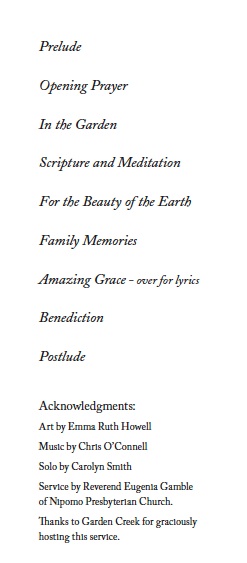
Ruth Howell (1916-2010) Memorial Program

Wednesday, March 3rd, 2010

program1

program2

Ruth Howell (1916-2010) Obituary

Wednesday, March 3rd, 2010
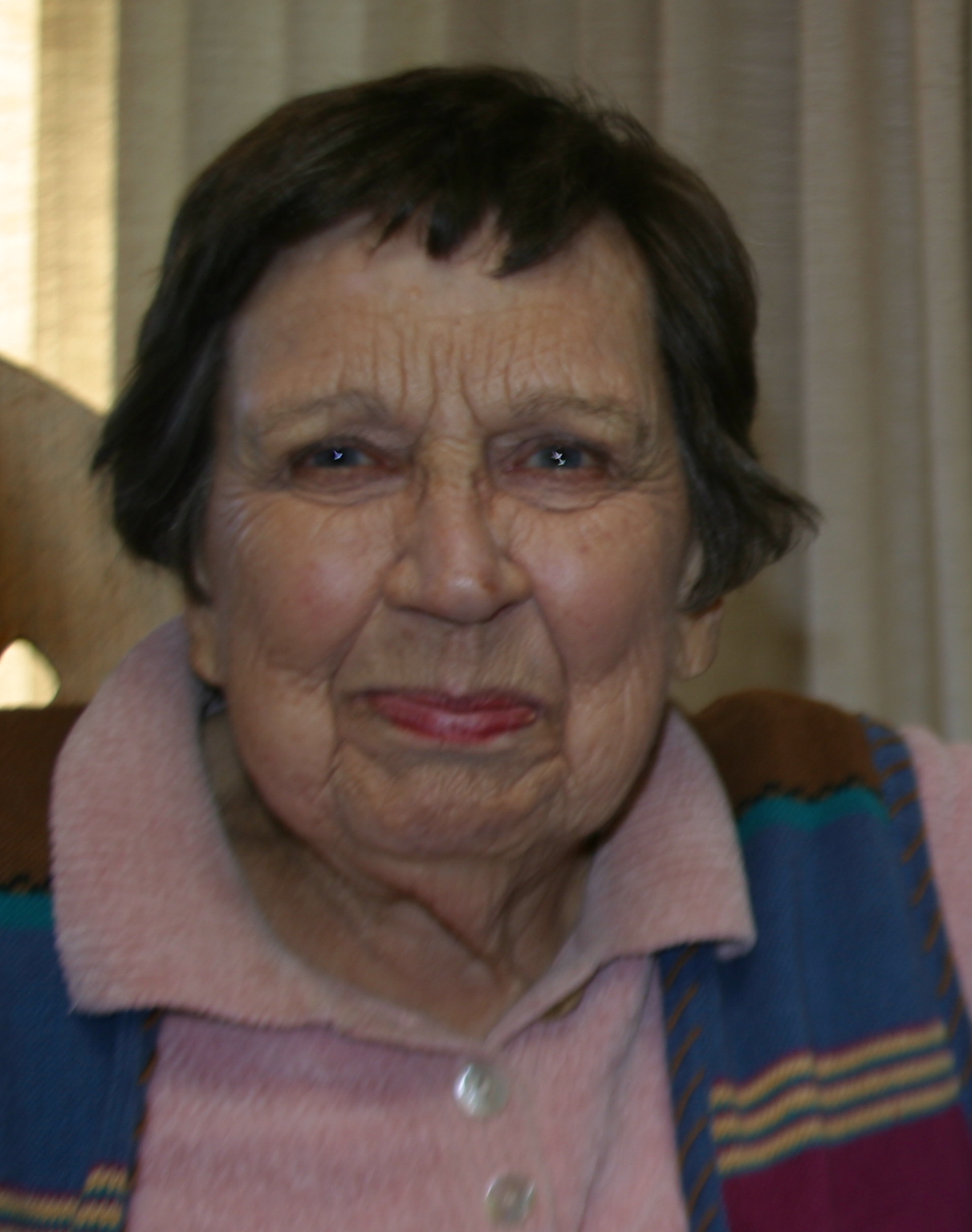
IMG_6602_2Ruth Howell was born in November 1916 in Houstonia, Mo., to Grace (Montgomery) and John Herring, and died peacefully of natural causes Saturday, Feb. 13, 2010, in San Luis Obispo. After attending secretarial school in Sedalia, Mo., she worked for the US Department of Agriculture in Nevada, Mo., and then the Department of War. She was stationed in Midland, Texas, as a secretary in a hospital for “shell shocked” soldiers. There, she and William Robert “Bill” Howell, Army Air Corps Lieutenant from Nevada, Mo., became engaged. They married in Long Beach, Calif., February 6, 1944, and their daughter, Janet was born in 1945. They moved to Lakewood, Calif., and their son, Mark was born in 1950. Ruth and Bill helped found Lakewood First Presbyterian Church, where she taught Sunday school. She volunteered for the Community Hospital of Long Beach for over 40 years and helped run the gift shop. In 2002, Ruth moved to San Luis Obispo and enjoyed living at the Palms, then Garden Creek Assisted Living. Ruth loved family, children, music, art, traveling, sewing and gardening. She was an active, involved and beloved mother and grandmother. Her engaging sense of humor earned her many friendships over her long lifetime, and her youthful spirit was reflected by the fact that her hair never turned gray. Ruth is survived by her daughter, Jan Howell (Steven) Marx of San Luis Obispo; son, William Mark (Sonia) Howell of Lakewood; grandchildren Joe (Amy) Marx of Ketchum Idaho, Claire Fisher of San Luis Obispo, Emma (Travis) Smith of Long Beach and Marie Howell of Santa Barbara; step-grandson, Mitchell Benjamin; great-grandchildren Ian Fisher, Ethan Marx, Abel Marx and Lucas Green; sister, Mary Helen French of San Diego; as well as numerous nieces and nephews. She was predeceased by her husband of 40 years, Bill; brother, John Herring; sister, Louise Butts; and cousin, Dorothy Cronk. A memorial will be held at 2 p.m. Saturday, Feb. 27, 2010, at Garden Creek Assisted Living, 73 Broad St. in San Luis Obispo. In lieu of flowers, please send donations to Hospice Partners of the Central Coast, 277 South St. Ste. R, San Luis Obispo, CA 93401, or Central Coast Memorial Society, P.O. Box 679, San Luis Obispo, CA 93406.

Ruth Howell (1916-2010) Jan’s Eulogy

Tuesday, March 2nd, 2010

Thank you all for coming.  My mother had three happy years in Garden Creek Assisted Living, and many of her friends still live here. We decided to hold the service here so they could attend.  I would like to thank Garden Creek for allowing us to be here today.

Emma Ruth Howell was born in Houstonia, Missouri 1916, four years before women got the right to vote.  She told me that her earliest memories were of horses, buggies and carts.  Her great grandfather Reverend John Montgomery was a pioneering Presbyterian minister and her great grandmother Katherine Lee Rennick was descended from Mayflower and Jamestown Lee families.  Her 93 years saw the Depression, WW II, and the advent of computers and cell phones. Just imagine the changes during her lifetime.

She told me that 16 was her lucky number because she was born in 1916 and she was 16 in her heart.  I remember her at her happiest as an energetic, fun loving, creative young mother in Long Beach California.  She helped found Lakewood Presbyterian Church, taught Sunday school and volunteered tirelessly for the local hospital, the PTA and the community. We had all kinds of pets and she turned our backyard into a garden. She always wanted to be “modern.” She enjoyed living in a brand new town, having a shiny Formica kitchen table, a new Chevy with tail fins, and her very own washing machine. She was proud our family was the first on our block to have a television.

She loved her children, grandchildren and great grandchildren.  She took excellent care of us children, her husband Bill, her grandchildren and of herself. She worked out with Jack LaLanne when he was on TV and later at his gym in person. After Bill, our Dad and her husband of 43 years died, Ruth carried on and enjoyed her independence.  She traveled to Japan, Israel, Egypt and Africa.

Even in her old age, she had an active and curious mind and wanted to know all about the news and the latest technology.  She loved the Bible and was fascinated with its history and archeology. She taught us habits of punctuality, honesty, responsibility, thrift, hard work and the importance of walking on “the sunny side of the street.” She valued relationships above all else. She made friends even during the last days of her life, as shown by the presence of her Hospice nurse and her last caregivers here at this service.

It was a rare privilege for me to have spent the last seven years living close to my mother.  We got to know each other as adults and had lots of “sister fun” together. Ever since she died, so many people have been telling me how much she meant to them, how she reached out and lifted their spirits.  I miss her and I know I will miss her every day of my life, but I am thankful that she no longer has to contend with the aches and pains of her last year. I do not believe that her love has died, because we all still feel it in our hearts.  As Emily Dickinson wrote:  “Unable are the loved to die. For love is immortality.”

Ruth Howell (1916-2010) Steven’s Eulogy

Monday, March 1st, 2010

IMG_1795_2_2.JPG

When we first met, the Son-in-law//mother in law relationship was material for every cheap stand up comic and cartoonist, and mine with Ruth fit many of the negative stereotypes.

She thought this New York radical Jewish Phd candidate had dishonorable intentions toward her chaste church going daughter. I thought of Ruth as a Missouri rube, content to keep house in her Southern California tract. At their first meeting at our wedding a year later, she and my mother had little to agree upon but their disapproval of their child’s choice of spouse.

42 years later that son-in-law//mother-in-law relationship had grown into its opposite.  The last fully coherent words she said to me were “Thank you for coming, you cant know how much it means to me.”  But when I think of what she means to me, I believe I can know that.

Though her decline in powers of sight and hearing and ability to walk was tragic, it allowed for a growing physical intimacy. Like a baby, I could put my arms around her, hold her hands, stroke her hair.  Until just before the end, she had the bright eyes, the warm smile, the easy laugh, the chiseled features, the lustrous hair and the sonorous voice of a pretty and vivacious lady.  And six months earlier, during a dark mood, when she’d said to me, “Don’t come back, I don’t want you to visit,” I felt crushed like a spurned suitor.

During the seven years she lived in San Luis Obispo, I visited Ruth almost weekly, at that familiar succession of  homes  at the Palms, at Garden Creek at Sidney Creek, and at Cabrillo Care Center—often in the company of one of her great grandsons, Ian or Lucas. Her critical attentiveness, her vivid memories of her youth and mine, her sharp humor and verbal brilliance provided entertainment and challenge.  We would take walks around the block, and later around the corridors, we would sit and drink tea, we would work a crossword puzzle together and talk politics. I loved bragging to her about her daughter while marveling at their similarities of appearance and their differences of temperament.  Ruth was someone I could gossip and share my problems with, someone understanding, sympathetic but also detached.  While her sight lasted, I would bring my computer and show her pictures of the family in Idaho, of our annual trips to British Columbia, of other travels far and wide.  She always acted interested and made me feel I was doing her a favor, but I was having the fun.

Her personality remained vital and inventive until the last.  She’d be embarrassed about moving slowly or losing her train of thought, as if this was something neither she nor others might expect. But as she apologized, she’d find a smart alecky way to express herself that would crack me up, and turn the awkwardness of the situation into a moment of delight.  When I try to recall the actual words they elude me, not only because my wits are too foggy, but because that’s a sign of what we’ve lost.