Author Archive

2006 Yom Kippur Fast at Sycamore Glen

Tuesday, October 17th, 2006

October 1 2006 7:30 p.m.

Inside tent after a clumsy pitch in the early dark, flashlight hanging from a loop in the roof. The first time in dozens of overnights on Cal Poly Land I’ve brought a tent. Only a light rain, but enough to warrant it.

Left home on my bike at 5:30 to get settled by the sunset start of the holiday. Headed for the high ground and a view. But the overcast created a sense of quiet that made me want to stop and listen rather than look.

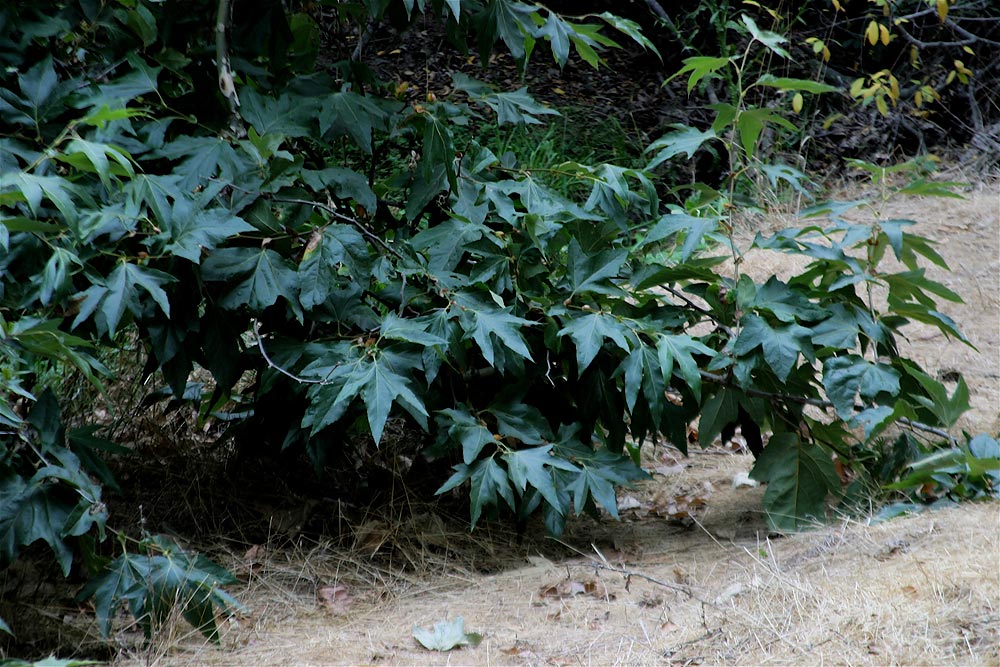
sycamoreleaves.jpgI parked the bike at the trail leading to Sycamore Glen. Normally dry this time of year, the creekbed was full of watercress and yellow monkeyflower, so wet I couldnt cross without getting muddy boots. My usual trail was overgrown this time, but I found a new one made by horses higher on the bank. The sycamore leaves were black green, thick, a foot across.

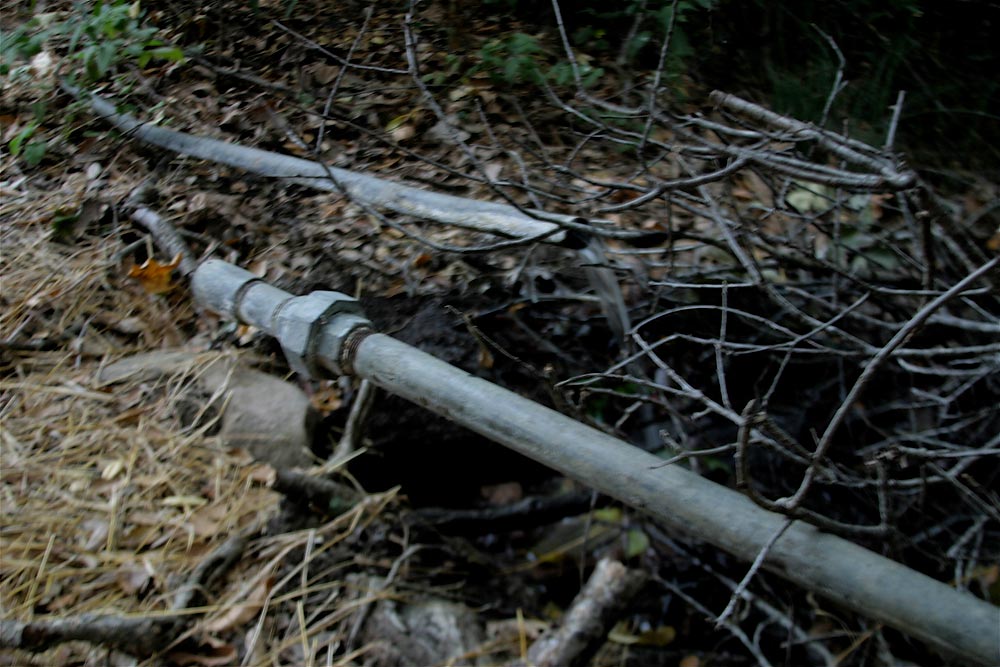
waterpipe.jpgI walked slow and wide-eyed, ready for surprises. At the end of the little canyon leading to the Glen, I heard the plash of flowing water. There was the source: a broken steel pipe. On another visit I’d found a slump in the hillside grown over with rushes, and above it a break in this pipe where a plastic coupling had come undone. I’d repaired that and wondered how the landscape might change as a result. In the waning light of this afternoon I sauntered up the Glen and saw that the former little wetland had turned to dry grass.

I decided to return to the broken pipe and camp near the old oak where I’d stayed during my Yom Kippur fast three years ago.

darkoak.jpg

The temperature is dropping. My eyes are drooping. Its only 8:00.

(more…)

Words on a Page

Saturday, October 14th, 2006

Fossils in rock
Footprints in sand
Paths in a chamber of cloud.

Phoenix Rising

Tuesday, October 10th, 2006

A Report on the Conference of the Association for the Advancement of Sustainability in Higher Education (AASHE), October 4-6 2006

My only previous experience with Phoenix Arizona was a couple of years ago changing planes on a flight from San Luis Obispo to New York. On the descent to the airport I was arrested by the sight of an L.A. scale megalopolis in the middle of a vast desert patched with hundreds of golf courses, thousands of swimming pools and dozens of artificial lakes bordered by marinas and mansions. It struck me at the time that this must be the most ecologically unsound, resource-wasteful place on earth.

That impression was reinforced earlier this week, when I walked out of the air-conditioned “Sky Harbor” terminal into a 95 degree atmosphere which burned my eyes and clenched my chest. I had arrived to attend a conference of AASHE: The Association for the Advancement of Sustainability in Higher Education. The choice of location seemed bitterly ironic.

Three days later, by the end of the conference, I understood that choice differently. The mistakes of development causing the present environmental crisis can only be rectified by massive transformations of places like Phoenix Arizona. And right there such transformations are beginning.

(more…)

Invitation to Flickr photo pool for End of the Road–2006

Tuesday, August 15th, 2006

This website grows out of a long-envisioned plan to pool pictures and words recalling experiences of people whose paths converged in Lund B.C. during an ever more remote period of history. It’s brought into being, however, by a very current development in digital technology: the invention of photo-sharing applications like Flickr.

It happens that one of the two creators of Flickr, Stewart Butterfield, was born in that place at that time. The cover story in Newsweek Magazine of April 6 2006 features Stewart and his wife Caterina’s invention under the headline, “Putting the We in Web.” www.msnbc.msn.com/id/12015774/ An underlying purpose of this invention is to promote human community in a fragmented and depersonalized culture. This also was an underlying purpose of many people who converged at the end of the road thirty or so years ago.

Whether they stayed permanently or departed, the memories of those days in that place seem to have a special value for those who lived through them, their descedants and friends, and even strangers who hear the stories and see the pictures. Though a couple of books about life around Lund were published at the time, an adequate history of the inspiration and madness of this experiment remains to done. In the spirit of community collaboration, perhaps this is a way to start.

The first picture posted in this collection records the moment I learned a little about Flickr from David and Norma Butterfield, Stewart’s parents. The succeeding fifteen or so are some of the earliest pictures I have of Jan and my first adventures there in 1970 and 1971, while she was pregnant with Jonah. I will add more old photographs as I continue scanning and processing them. Uploading to this site is easy and fluid, though I’ve found it does take a couple of hours to first learn your way around the whole Flickr operation. I also hope, during this second year of my partial retirement, to add comments to the pictures, some based on memories and others on old journals. My fervent hope is that you and people you pass this invitation on to will add their contributions and before long make this the true group project it’s intended to be.

Yours,

Steven Marx

hodgeman1066 4 years ago
our 3 children went to your Daycamp on the farm early 70′,the they still talk about it to tthis day, they are now in their mid 50’s ,wish there was something similar for the youngest Grandkids 9and 11 today. I used to drive them in from Westview daily for two weeks. It was such a magic time in our lives, we are now seniors and it was the best times of times. ps pauline + michelle’s picture made it
into THE POWELL RIVER NEWS.
Love,
Sheila Hodgson,
David Hodgson.

An Excursion Near Home

Sunday, February 19th, 2006

Low-grade illness and a heavy schedule has kept me from fulfilling my own assignment to students: get outdoors, pay attention, write. Yesterday morning’s cool weather and dramatic light got me going. The Sierra Club’s outings web page promised a kayak trip up the Morro Bay Estuary to spot birds, but when I phoned the leader he said it had been cancelled because of uncertainty about wind and rain. The Morro Bay Natural History Association offered a talk about “Living on tectonic plate borders” which sounded appealing since I’ll have to lecture on Cal Poly Land’s geology next quarter. I took my down vest, windbreaker and packsack loaded with camera, binoculars, bird book, a loaf of sunflower seed bread and an avocado, and told Jan I’d be back in the late afternoon.

I arrived at the Marina early and walked to the point to gaze at birds, clouds and the distant dunes.

Rounding the lion rock, I came across two white egrets. I was transfixed by their yellow eyes and graceful head plumes but they werent interested in my company. They slowly flapped their huge wings, lifted their legs and flew across the flat water.


(more…)

February Garden 2

Sunday, February 19th, 2006

It gets light now soon after the alarm goes off and its not dark until suppertime, but the plants in the gardens have remained at the same stage of development where I left them two weeks ago, when I broke off writing the last entry and abandoned my postings. So I’m going back to where we were.

Here is the growing tip of Heuchera maxima

This plant is as hardy as a weed, tolerating deep shade in front of the house and direct sun in back, no water or plenty of water, as when it grows under redwoods. One of its common names is Alum root. And yet it’s delicate as these velvety hairs on its leaf tips and stems, and therefore it’s also called, Coral Bells, for the lily-0f-the-valley-like blossoms that will spring from these buds.


The flowering time of Umbellularia californica has passed since this picture was taken; some of the tiny blossoms in the inflorescence were already dry then. That lilting scientific appelation is almost as melodious as “Bay Laurel,” its vernacular name, linked with the myth of Apollo and Daphne, which recalls something I wrote twenty three years ago:

Pursuing a youth
made lovelier yet by flight
through woods he runs
unloved,
imploring recognition.
Outdistanced and breathless
she prays for escape
then stands.
Her heart still beats against his touch
as bark encloses the soft breast,
arms twist into branches
hair flattens to leaves,
and swift feet root underground.
They are crowned
With laurel.

Three bay laurels have been growing in the front for four or five years. They prefer sun and water–you can see them as the lighter-colored foliage in riparian corridors on the hillsides–but here on the north slope they are dry and shaded. One grows under a large liquidambar tree. It’s intended to replace that beautiful non-native if ever it gets tall enough, but that wont happen in my lifetime.

The old Fremontodendron grows dense and low on the steep bank above the wall in front. It turns into a burning bush of gold flowers from April to July. The one I planted recently with the early orange bud needs continuous pruning to keep the path clear.

The one with the large heart shaped yellow bud grows at the top of the hill in back.


These Flannelbush are showy and indestructible, perfect California natives for the garden. I like looking across the valley to Poly Mountain and seeing the clumps of Flannelbush growing there wild. But Flannel is a misnomer. Rather than stroked, their leaves, flowers and stems should be handled with gloves to protect you from their tiny hairs which want to embed themselves in skin.

Creeping mountain lilac or Ceonothus Joyce Coulter is another prolific bloomer, here just about to burst into a rich purple quilt. After the blossoms drop, the leaves remain almost as deep green and shiny all year round as they do here at first emergence.


The same is true for the other five or six other Ceonothuses that thrive in the yard, each different in leaf and growth.


Only one Red twigged Dogwood, Cornus sericea, grows here, cramped between the path and the wall in front. It seems to be capable of putting out new leaves all year long, whenever it rains. When it’s dry, the leaves, which are neither waxy, leathery nor hairy, go papery and fall off, exposing deep wine-colored stems.


The flowers remain packed in tight white bud-buttons during December and January and then burst into bloom lasting only a week or two.

Just uphill from the Dogwood stands a Western Redbud, Cercis occidentalis. Unusual for California plants, this one is winter deciduous, losing its leaves in early fall, blooming and regaining them in Spring. The dying leaves, slightly rubbery in texture, take on a touch of
Autumn coloring that reveals a veined and capillaried web on their circular surfaces.

Two weeks ago, when this picture was taken, I hadnt seen traces of regeneration on this tree for months, but since then tiny leaf and bright pink flower buds have started to pop all over the gray bark.

More dramatic suspense was created by the grapevine in the backyard, now about 12 years old and the centerpiece of the arbor on the mid-hill terrace that creates an elegant shady bower in summer and a rich harvest of grapes and raisins. I cut the canes back to old wood to promote new growth and fruiting in November, hesitantly following some website instructions. But when no buds appeared, well after the native California grape along the eastern wall in front had started to leaf, I thought I’d have to pull out the whole venerable stock. I checked and poked everyday for a month, and then the day of the last entry, February 2, I found, two tiny sprouts.

Now two weeks later, I still wait for more.

There’s no new growth yet on the old oaks, the ones I planted seventeen years ago. But several recent volunteer Quercus agrifolia have come into leaf. I marvel at the fragility and tenderness of these infants, knowing that within the next four months they will expand and curl into thick, hard, thorny surfaces. These are the only volunteer natives that have cropped up since I started cultivating natives, testimony I think, to the fact that this north facing slope wants only to be an oak woodland.


Hummingbird sage, Salvia spathecea, has been blooming here since January, almost as early as the Red Currant. I love the delicious pink, magenta and purple colors of its flowers springing modestly, just a few at a time, from teardrop shaped sheaths of its bud clusters.

I love the sticky clear residue it leaves on the fingers when touched, smelling tart and sweet as grape soda. I love its velvety green foliage that returns every year and spreads by rhizomes, overwhelming the dark brittle remaining stalks of last year’s growth. And I love the way it draws the hummingbirds low to the ground under the oaks, where it hides in the shade.


February Garden

Saturday, February 4th, 2006

It was supposed to rain today, but we got wind and clouds instead. While grading papers, I’ve been taking vitamin C and Echinicea pills every couple of hours, humbly hoping to hold at bay the headache, cough and scratching in my lungs. I visited my mother in law at Assisted Living for a break, and seeing her and her companions in the rec room 20 minutes early for Bingo reinforced the winter mood.

But the overcast skies provided some good light for pictures of developments in the garden last week. After Spring in December, not much changed during January. The longer days of February have brought the early bloom of the volunteer almond tree, remnant of what must have been a local orchard before the 1950’s subdivision of this neighborhood.

On Friday I got a copy of his brand new book, Plants of San Luis Obispo: Their Lives and Stories from Matt Ritter who teaches in the Biology Department and is curator of the Cal Poly Plant Conservatory. In addition to running the conservatory, teaching full time, and writing scholarly articles for tenure, he wrote the text, shot all the pictures, and did the layout for the book himself with Photoshop and Indesign.

His descriptions of the species in my garden help me see them up close: “Fuschia-flowered gooseberry is a bristly, evergren shrub with leathery, dark green, irrgularly toothed leaves. The beautiful, bright red, tubular flowers, which are pollinated by hummingbirds, hang from the stems. The stamens, which are twice as long as the rest of the flower, hang down with bright yellow tips. To ward off herbivores, there are three stout spines emanating from each node.” (p. 57)
This Ribes speciosum is another early bloomer. I’d describe the leaves as waxy rather than leathery, since they’re thin and they dry up in late spring, unlike the thick leaves of the holly-leafed cherry for example. Once flowers and leaves are gone the plants have a forbidding allure, like that of a cactus, but now they are all slender and delicate. At the Brizzolara Creek Committee we’ve talked about planting them as hedge to keep people out of the watercourse.

At the side of the house, by the compost and redwoods, the wild strawberries are back. Soft, matt, and pertly serrated, the leaves make a fresh bed for occasional yellow-centered white blossoms.

Territoriality

Wednesday, February 1st, 2006

Today’s ecolit class was a hike to Rockslide Ridge.


We’ve been reading John Muir’s The Mountains of California. Its first paragraph contains a fine description of our home territory.

The Coast Range, rising as a grand green barrier against the ocean, from 2000 to 8000 feet high, is composed of innumerable forest-crowned spurs, ridges, and rolling hill-waves which inclose a multitude of smaller valleys; some looking out through long, forest-lined vistas to the sea; others, with but few trees, to the Central Valley; while a thousand others yet smaller are embosomed and concealed in mild, round-browed hills, each with its own climate, soil, and productions.

I’d asked students to study the Geology chapter of Cal Poly Land: A Field Guide to connect the Muir text to our walk and to help them to decipher some of the language of the landscape.

The winter weather was clear and crisp. On my way up to our meeting place at the horse unit, I biked toward Drumm Reservoir and the site of “Poly Canyon Village,” a huge new student residential development I’d spent many hours haggling about in committee during the last five years. I’d just learned from reading Christy’s ecolit journal that groundbreaking started two days before with the destruction of ancient Eucalyptus trees:

Driving up to Peterson ranch this afternoon I was shocked to come across the mass arboreal murder taking place. The beautiful eucalyptus trees that have shaded the feed mill, the feedlot, and the bull test are being savagely mown down by hairy, overweight cretins in fluorescent vests. In the summer when it gets unbearably hot, there is some much needed comforting shade under these fragrant guardians. During wind-whipped storms, their branches sway and shed leaves in all directions. They hold the land stable; they act as nice bumpers for those whose breaking skills are not up to par. To me they stand watching over year after year of Cal Poly students. They have seen the succession of eager high school potential, to Poly student to teacher, teacher to department head, then to retirement. …Just five days ago, I walked to my car parked under those fated Eucalypts, listening to the eerie creaking and groaning of the trees, despite the dead stillness in the air. They knew, and they were broadcasting their goodbyes through the song of their branches.

I found only huge stumps, cut close to the ground. The rings werent visible enough to be counted.

While we waited for stragglers, I pointed out the borders of Cal Poly Land on the map. Our destination was just outside the property line. At exactly 10:15 by my watch, we started up the hill. Every minute counted if we were to be back in time for the next scheduled class at noon.

The horse corral above the stables provided a lesson in erosion and land misuse. As a flock of crows cawed in the twisted sycamore limbs, one student pointed out a foot-high gap between the ground and the concrete foundation of a watering trough, measuring the loss of topsoil.

At the top of the corral we came upon Indonesian reservoir, designed and built by a group of Indonesian students in the ’60’s to impound runoff from Horse canyon creek in front of us and water pumped uphill from the system of reservoirs, ditches, pipes and creeks that serve as plumbing to irrigate campus farm facilities. I pointed out Kestrel Crest, the serpentinite ridge above the reservoir. Kestrel was defined as a small raptor, a sparrow hawk. Kiell mentioned that it was also a verb that meant hovering in flight. As if on cue, two small birds with white spots on their wings–not kestrels–appeared below the crest and kestrelled for us. Another bird flashed grey-blue and light orange. I recognized it and three more that joined it, as female Western Bluebirds, Sialia mexicana. Not as impressive as the more brightly colored male I had photographed last year from my deck

they nevertheless gave me a thrill when their gray wings suddenly turned blue as they angled in the sun.

After a brief stop at bedrock mortars surrounding a grove of bay and hollyleaf cherries under the high voltage lines bringing power to the campus from the grid in Morro Bay, we huffed uphill on a deeply eroded dirt road past some recent slumpage in the Franciscan melange soils on the bank, passing through a shaded oak woodland along the creek. The woodland gave way to grassland and then to rock outcrop plant communities growing on the base of the steep upper slopes that constituted Rockslide Ridge. Despite an increase of wind, the temperature went up, and I had to remove my sweater and take a drink.

At the saddle dividing Horse Canyon from Poly Canyon, some people decided to ascend no further, while the rest of us left the road and found various paths through the unstable rock and gravel, avoiding the needle pointed tips of Spanish Dagger that thrived without much competition on the infertile serpentinite soil. Most of the group had never seen this backcountry before. Other people delighted in the escape during class hours. I watched the clock, knowing we had to reach the top by 11 in order to have fifteen minutes there before going back down.

I was one of the last near the summit to clamber over a barbed wire fence that ended in a vertical drop-off where half the mountain had shaken loose and slid down into the valley that was now the Architectural Area. Instructed by Professor Chipping’s explanations in the Field Guide, one could see where springs erupting from impermeable layers of rock covered by the slides secreted watercourses lined with green black clumps of trees–oaks, bays, sycamores and willows.

I collected papers due today and then people dispersed on the summit plateau, just outside the University property line to write in their journals.

(photo by Danielle O’Neill)

I found a natural rock bench, drank some water, munched on a chunk of olive bread and looked for a subject to describe. Just to my west, on a dried flower stalk of Yucca whipplei, perched another female bluebird. I approached her slowly to get a picture, and she let me come within 20 feet.


Then she disappeared and I went back to my seat. Looking to the south, over the campus toward the city in the distance, I saw her on another stalk, watching me.

I approached again. This time she flew directly toward me and fluttered in an arabesque a few feet from my eyes. At first I told myself she was rewarding my attentions. But then I realized this was threat behavior. I was doubly trespassing, my sit-spot in the middle of her territory, between her guard towers. I checked my watch. It was three minutes after the time to leave.

Rinconada Trail–Big Falls

Saturday, January 28th, 2006

I’d been looking forward to today’s Sierra Club hike throughout a challenging week filled with classes, student conferences, 90 minutes of testimony at a deposition and lots of meetings. Big Falls is a famous local attraction and I’d never been there.

I carpooled with Chris on the way to Santa Margarita. Dense fog met us at Cuesta Pass, and at our meeting place, people shivered in the cold. There were 35 of us eager to tackle the nine miles and 1700 foot elevation gain announced on the Outings page of the monthly Chapter newsletter. I asked if anyone was interested in having a copy with articles about the many activities going on during the month and a membership application. Fifteen people asked for it.

Ruby RAV filled with two more passengers for the last ten miles of car travel to the trailhead through Santa Margarita Ranch and out toward Pozo. Huge valley oaks, bare of leaves during the winter, loomed in the fog, their limbs arching over the road and dividing into gnarled branches looking like arthritic witch fingers.

At the trailhead the fog broke up and we took off at a breathless pace up the first long ascent through blue oaks and coastal scrub. The small trees were still bare, but black sage, California sagebrush and chamise were in fresh new leaf. People spoke about how hot and dry this hike was during summer. At the top of the first ridge, we took a break and looked out over the Santa Lucia range to Cuesta Ridge on the horizon hiding Edna Valley on the other side.


Heading downhill toward Lopez Canyon, one could see a series of parallel valleys to the south filled with fog. Other than a couple of water tanks and fireroads, nowhere on the whole hike were there signs of human habitation, not even a fence.


Occasionally the scrub and serpentine outcrops alternated with meadows, mostly gray with last years dead grasses, but showing the green of new growth hesitantly emerging. I saw hardly any of the annual grasses that filled the hills in the lower elevations; instead these were native perennial bunch grasses. Clearly this area had not been cultivated by the early settlers. The remains of the highway 41 fire of twelve years ago were still in evidence, but I thought that this area would soon welcome more fire, since in some places the scrub was getting thick and clotted with dead growth.

The group was large enough to spread for half a mile along the trail, and it was fun to watch people far below on the steep slopes crisscrossed by switchbacks. They moved in shifting groups, pairs and singles and conversation flowed easily.

It was not too early in the season for dramatic displays of red current


and Chris noticed one large shooting star growing right alongside the trail.

Soon we descended into a shady oak woodland of non-deciduous California live oaks. Then I noticed a series of pools beside the path that gave way to a trickle. For the next mile it dropped away out of sight but within earshot of its increasing babble. Suddenly we came out of the woodland to a crossing where the water flowed over smooth rocks and formed lovely pools surrounded by wooded canyon walls.

This was the most pleasing part of the trail, and all too soon we we arrived at the top of the falls, where some folks decided to sit and rest while others explored the lip of the falls.


The trail spiralled through woods down the fifty foot drop and returned to the base of the falls where most folks chose to eat lunch. There was a festive sense of arrival at a worthwhile destination.

I really wanted to swim in the pool at the base of the fall–in my underpants. I took off my boots and crawled out on a log hanging over the clear inviting water. I knew it would be chilly, but I expected to be able to immerse my legs up to the knees until the pain went away and the rest of my body acclimated. This method had worked to allow me to swim for an indefinite time in the cold water of local beaches. But I couldnt leave my feet in for more than a minute or two at a time, and after a quarter of an hour I realized that my plan wouldnt work. So I stared at the tumbling spray and listened to its sounds and resigned myself to a chaste encounter.

Love Among the Pinnipeds

Friday, January 20th, 2006

I’m sitting in an easy chair in an Oakland Starbucks, wireless blogging for the first time. We drove from San Luis Obispo this morning so Jan could meet a client in a retirement home across the street and go to an all-day workshop on estate planning in San Francisco tomorrow. By coincidence this place is also the residence of an old friend who’s had several strokes. We’ve planned dinner with her and her daughters tonight. When they were aged 2 and 4 in 1964, I was a graduate student and lonely lodger in their home. This is a familiar neighborhood. Half a block away is the apartment I inhabited for two months in 1989 while attending a National Endowment for the Humanities Summer Seminar at Berkeley, again as a lonely lodger.

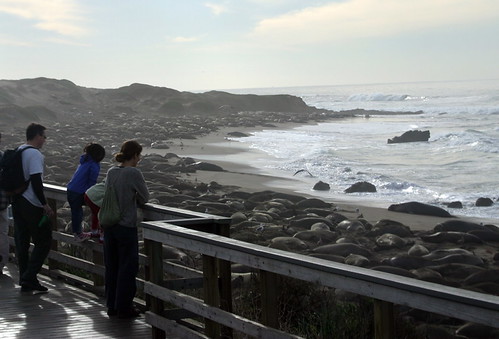
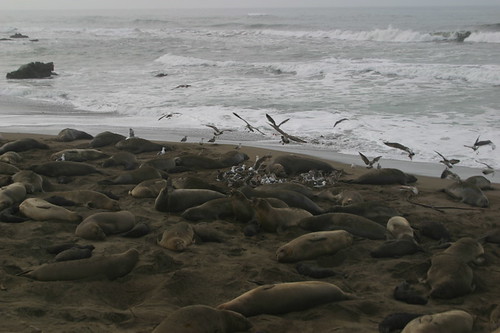
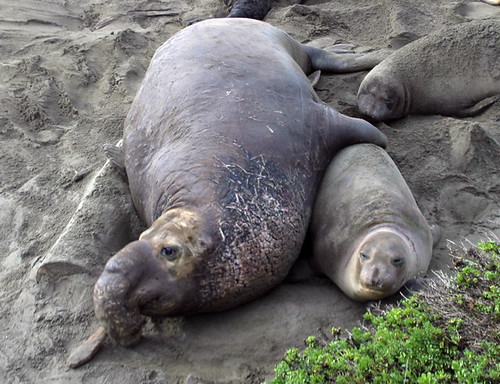
Yesterday’s Nature Explorers took us to the Piedras Blancas Elephant Seal viewing area a few miles north of San Simeon and Hearst Castle. According to the Central Coast Friends of the Elephant Seals, this is the venue of “Mother Nature’s Big Show.” They dont exaggerate. Here one can witness the life force at work on a grand scale.

1.jpg

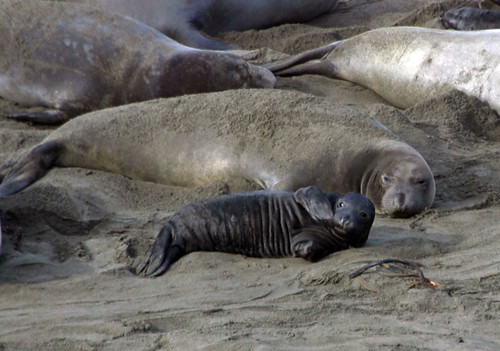
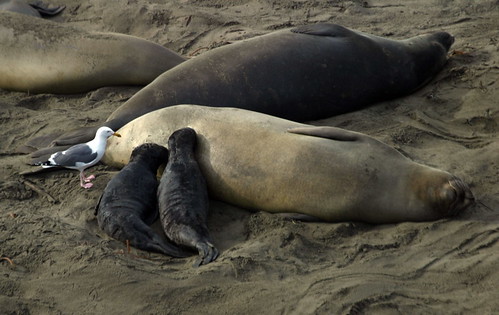
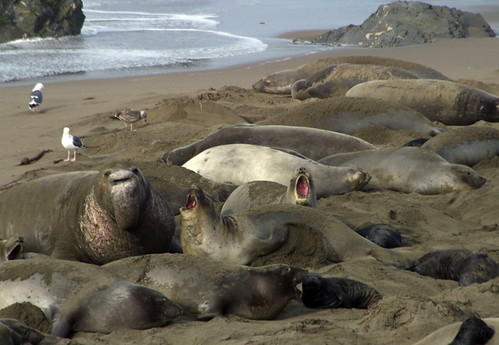
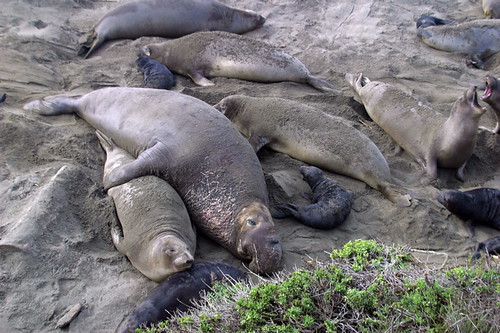
In a grayish-brown mass blending with the sand, thousands of bloated bodies lie packed on the mile-long beach, looking at first like the victims of a vast kill left behind by the tide. But the air is alive with shrieks, croaks and clicks emanating from what a closer look reveals as bubbling activity. With handlike flippers, fat loungers toss puffs of sand onto their backs. Glistening black babies cry for their mothers and jockey for space at teats on smooth ovoid bellies.

8.jpg

11.jpg
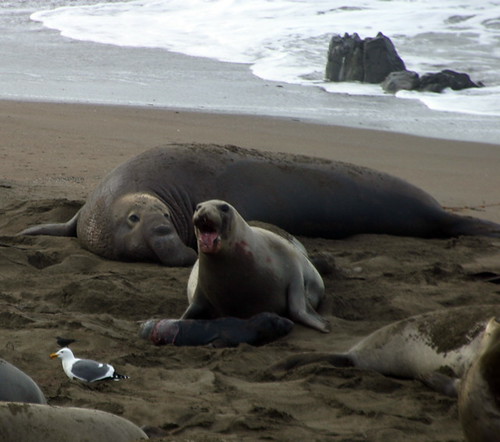
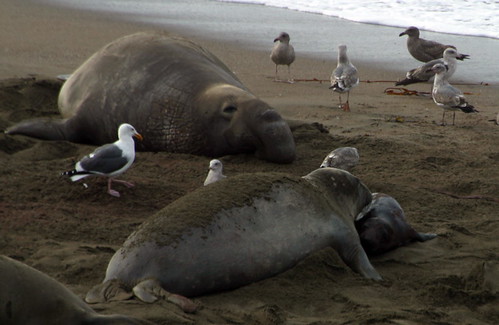
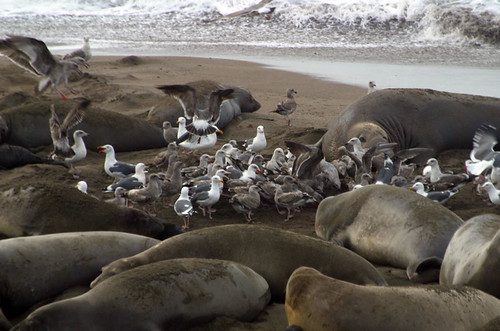
Mothers scream desperately to locate their offspring in the shuffling press. Young females arch skyward and howl, displaying bright pink mouths and sharp teeth. Pairs of juvenile males do push-ups with their foreflippers and face off with bobs and taunts. Mountainous old males erupt into motion, crash through the crowd, and scatter their junior rivals. Inamongst all this fierce and tender clatter gulls, jays and crows stand silently in attendance.

6.jpg
A couple of weeks ago in Ecolit class, I’d read aloud the creation poem from the opening chapter of Genesis. Here was day three:

And God said, Let the waters bring forth abundantly the moving creature that hath life, and fowl that may fly above the earth in the open firmament of heaven. And God created great whales, and every living creature that moveth, which the waters brought forth abundantly, after their kind, and every winged fowl after his kind. and God saw that it was good. And God blessed them, saying, Be fruitful, and multiply, and fill the waters in the seas, and let fowl multiply in the earth.

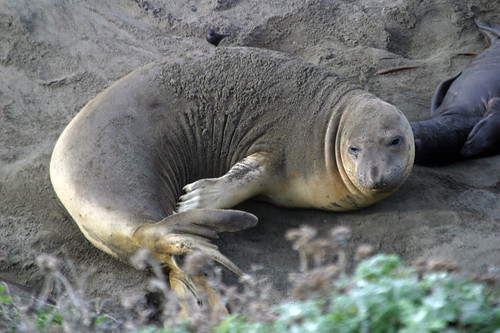
Despite the biblical blessing and my own reverence for biodiversity, I had second thoughts about the abundance and fertility of these creatures–their cacaphonous noise, the awful smell of their fish breath, their huge size, grotesque faces, clumsy movements, and the sheer numbers of their offspring. Not long ago, the Elephant Seal, Mirounga angustirostris was driven nearly to extinction by the market for its blubber, which supplied fuel oil from living rather than fossilized creatures. But now, as a result of the 1972 marine mammal protection act, their population has dramatically rebounded and they claim more central coast beaches amid complaints about their depleting local fishstocks.

Our group made its way to the end of the boardwalk and stopped at one place long enough to start distinguishing activities and individuals among the seething mass immediately in front of us. Near the edge of the water someone pointed out that a pup had just been born. There was the large male, the half-sized female, and in front of her the new baby still covered with remains of the amniotic sac.

14.jpg

We watched as, like a mother cat, she licked the prostrate infant into shape.

15.jpg

Suddenly a flurry of screaming seagulls surrounded the mother and child blocking them from view.
16.jpg

Could they be mobbing the baby, attempting to devour the new life? As they settled down, what was happening became clear. They were pulling and picking at slimey red strands of placenta that the mother had just delivered, cleaning up the beach, celebrating a birthday. Creatures of the sea and fowls of the air were brought forth on the same day.

17.jpg

A sign at the parking area noted that one month after giving birth on this beach, females were ready to conceive for a second time during the winter mating season.

10.jpg

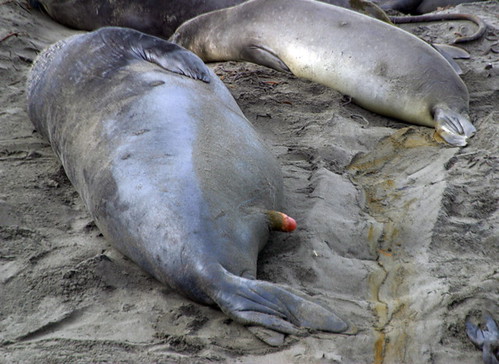
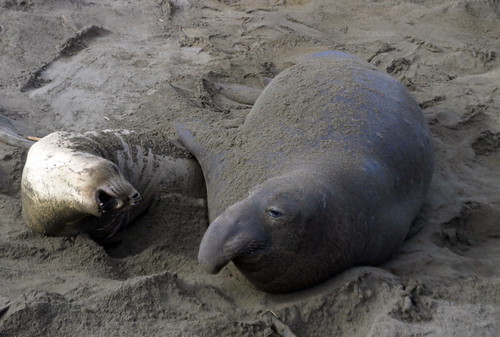
Just below us on the boardwalk, a young silver-colored beauty with blue eye shadow posed and wiggled her tail, provoking a reaction from a nearby juvenile male.

19.jpg

He sidled on over, placed a companionable flipper on her hip, and with half-lidded eyes did something that caused her to laugh.

20.jpg

One thing led to another and soon they amiably hooked up.

21.jpg
Undeterred by lack of privacy, they lay together peacefully for a long time, occasionally trembling or shifting positions.

23.jpg

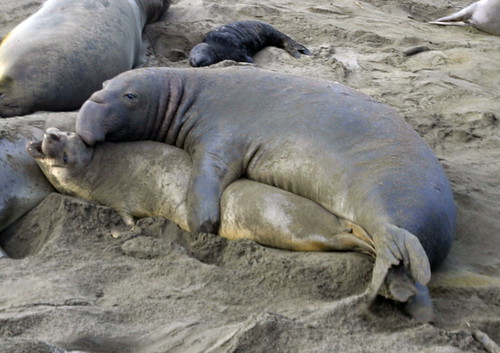
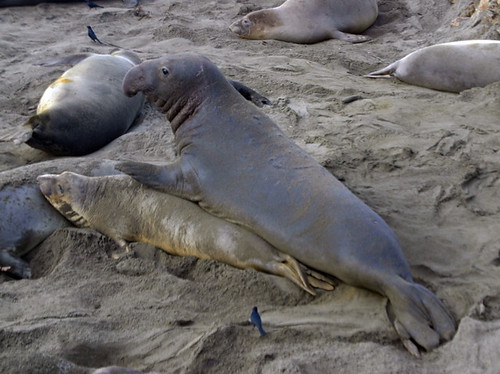
Suddenly, the male jumped off his mate as if shocked with an electric prod and shuffled speedily up the beach. From the opposite direction, a scar-chested warlord gallumpfed toward us, plowing a thick furrow in the sand. He landed heavily by an adjoining female, put his arm around her waist and pulled her close.

25.jpg

The new couple snuggled and quivered for several minutes before the male withdrew. Then they switched sides and blissfully embraced.

27.jpg

Earlier in the week, my co-instructor, Jimm Cushing, and I were lecturing on Plato’s Symposium during our class, “Love in the Ancient World.” This passage was in back of my mind:

See you not how all animals, birds, as well as beasts, in their desire of procreation, are in agony when they take the infection of love, which begins with the desire of union; whereto is added the care of offspring, on whose behalf the weakest are ready to battle against the strongest even to the uttermost, and to die for them, and will let themselves be tormented with hunger or suffer anything in order to maintain their young. ¦ why should animals have these passionate feelings? ¦ the mortal nature is seeking as far as is possible to be everlasting and immortal: and this is only to be attained by generation, because generation always leaves behind a new existence in the place of the old. …according to that law of succession by which all mortal things are preserved, not absolutely the same, but by substitution, the old worn-out mortality leaving another new and similar existence behind–unlike the divine, which is always the same and not another.

Watching the couplings of these animals affected me strongly. I saw in it a tenderness, grace, and immediacy that I had never witnessed outside of my own experience. A bond of intimacy had formed between me and the elephant seals, driven alike by the force that “through the green flower drives the fuse”–the power of Eros.