Author Archive

Vernal Pool

Monday, January 16th, 2006

My colleague Craig and I hadnt taken a hike since our search for the source of Stenner Creek last July. Ian was still on recess from Nursery School. So last Friday afternoon the three of us drove in Ruby RAV up TV Tower Road on West Cuesta Ridge to make our way back by foot down to Cal Poly and home.

From where we parked the unearned views of the Chorro Valley, the Morros, and the Pacific were splendid,
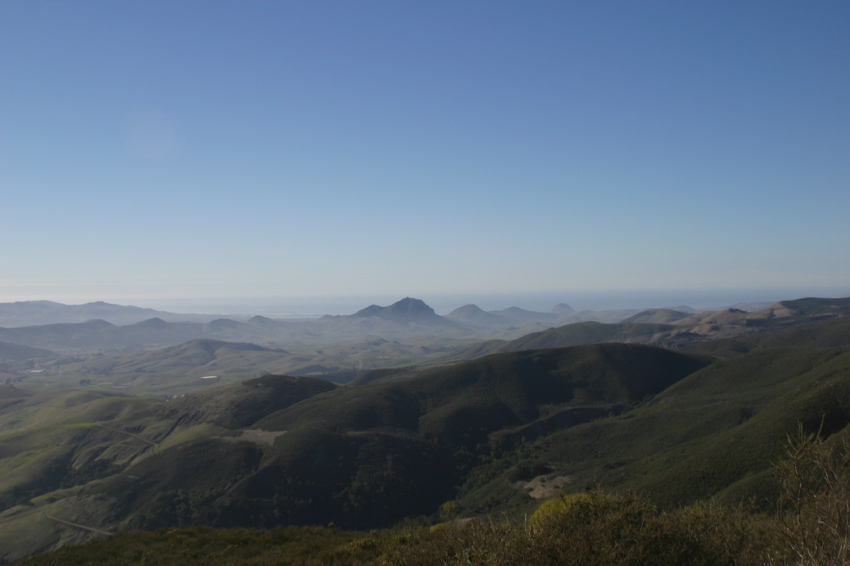
though marred by the foreground presence of broken glass and several glistening piles of offal that looked like recently dumped deer guts. We passed by them hastily and clambered down the steep lip of the ridge top. I told Craig about the time I’d taken this route with my previous hiking buddy, Doug, who died six years ago of lung cancer. People were shooting old television sets in this sacrosanct spot, and after we passed them and rounded a curve in the fireroad, a spent bullet came over the bluff behind us and hit the back of his leg, tearing his pants, but not breaking the skin.Passing from Los Padres National Forest Land through a gate onto Cal Poly Land, we took a trail I’d never been on heading from the ridgeline toward the watercourse containing the immense oak tree I’d slept under many times, which I wanted to show Ian. But Craig led the way and swerved south across a broad swath of grassland toward the top of Poly Canyon.

At the shoulder line of the hill, we saw the landscape below center itself around a small blue mirror set in a shallow green hollow. I recognized it as a vernal pool. I’d never seen one on Cal Poly land before, and from this vantage it looked mysterious and powerful–a place where you might find a magical sword or a frog prince.
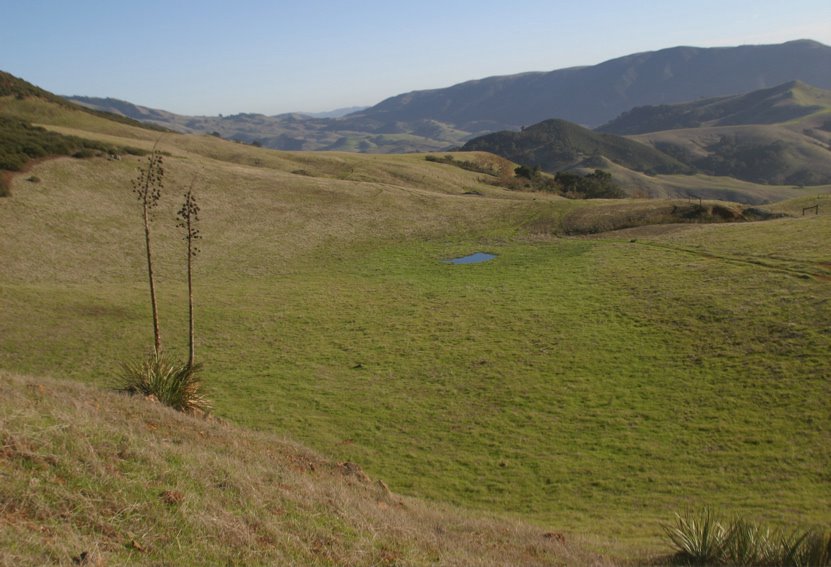

The name of this geological feature had always appealed to me, and I had learned something about it in connection with struggles to preserve the small number that had remained in the Central Valley after 95% were destroyed by agriculture and development. The pools are formed, as are springs, where rainwater percolating downward meets an impermeable clay surface and finds no channel through which to run off. They provide habitat for rare species of plants, most of them native, endemic and endangered. Because the pools emerge during the wet season and dry up during summer and fall, introduced species that havent evolved locally to adapt to these conditions cant thrive here and outcompete the natives. Many of them produce dramatic displays of flowers during the spring, after the water disappears but before the area dries out.

Rare, ephemeral, and productive–we had come upon treasure. Ian was getting tired after a long day with no nap so Craig carried him on his shoulders while I lingered behind relishing the vision of the two of them crossing the gently curving greensward and closing in on that pure eye staring up at the firmament.

I wanted to slow my own approach to the snail’s pace at which I sometimes travel alone in this countryside, but the afternoon was getting on. The closer I came, the greener and thicker the pasture, the more intense the reflections of red basalt outcrops and sky in the low angling light.
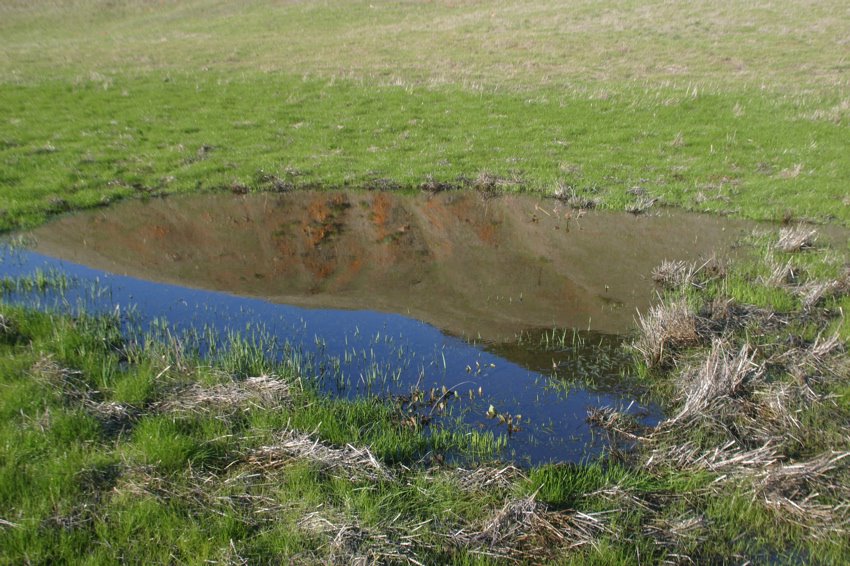
The uphill margent of the pool had a hard edge. The lower side gradually merged with the spongy shore, recalling a descriptive passage I liked to read aloud in class from Shakespeare’s The Tempest:

Thy turfy mountains, where live nibbling sheep,
And flat meads thatch’d with stover, them to keep;
Thy banks with pioned and twilled brims,
Which spongy April at thy hest betrims,
To make cold nymphs chaste crowns.

I wanted to strip, leap in the water and drink my fill, but fear of a cold and of giardia held me back. I wanted to be here alone with a sleeping bag and stay the night.


The knifebladelike plants on the lower side of the pool grew half in and half out of the water. Were these some of those rare endemics? A few days later I emailed a colleague who teaches botany with this picture. He said, “There is no way to be sure, but I think it looks like one of the ‘iris-leaved’ rushes such as Juncus phaeocephalus…. a relatively common plant of periodically wet meadows.”

I tried today, MLK’s birthday, to get back and check the changes in this pool after a weeklong dry period and the more recent rain. I arranged a hike with Ian and another four year old, Francis, his two year old brother, and their two parents, Tom and Jennie. We started at Serrano ranch but only got as far as Serrano station, where we picnicked and turned back. Instead of the pool we saw the crane train repairing the tracks and climbed embankments and haystacks.
Georgics

Tuesday, January 10th, 2006

Vergil wrote this long poem about agriculture and rural life between 29 and 22 BCE and dedicated it to the Emperor Augustus. Its title derives from the Greek word for Earth–Ge or Gaia, and Ergon, or work: earth-work. I was prompted to reread it after spending time in the countryside of northern Italy last October. Its rich descriptions still apply to landscapes and methods of cultivation found there today, and its subject matter and style remind me of contemporary poets like Frost and Wendell Berry. A book called American Georgics by Timothy Sweet convinced me that it would be worthwhile to include early in the Ecolit course as a precursor of Walden.

I’d told students that our second class would include a hike of the horse canyon loop but I doubted we could fit that into the palty 85 minutes we’d have, given the need to schedule fifteen minutes at start and conclusion for leaving and returning to the central campus. I was also planning a discussion of the Georgics and its relation to pastoral traditions, some linkages between passages in the text and what we might encounter along the way, and a twenty minute interlude for quiet reflection and writing in journals. As much as possible I would use the peripatetic method of lecture, urging students to move fast in a tight knot, walking backwards and shouting. In the construction sites and parking lots along Via Carta we talked of heritage trees that were saved from the bulldozer by the intervention of enviromentalists, and threats to Brizzolara Creek, the central artery of the campus watershed. Students in Animal Science and Biology contributed much to the walkalong lesson.

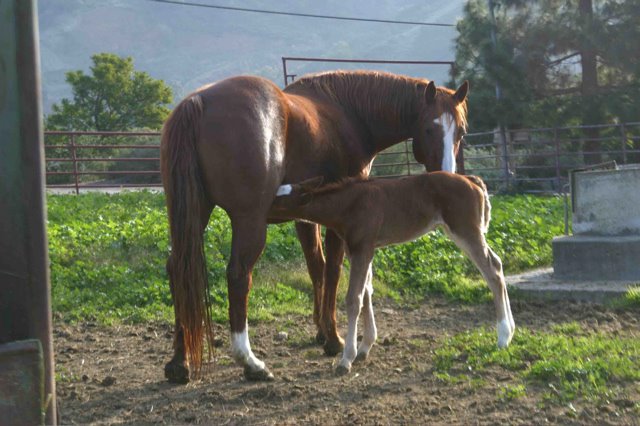
At the Equine Unit, Kristy who had been there the day before caring for pregnant mares, led us past a mother and her one day old foal


to the enclosure where the mares were sequestered and given royal treatment, along the lines penned by Vergil:

To care of sire the mother’s care succeeds.
When great with young they wander nigh their time,
Let no man suffer them to drag the yoke
In heavy wains, nor leap across the way,
Nor scour the meads, nor swim the rushing flood.
In lonely lawns they feed them, by the course
Of brimming streams, where moss is, and the banks
With grass are greenest, where are sheltering caves,
And far outstretched the rock-flung shadow lies.

Kristy’s friend showed up with a bucket of grain she was bringing the ladies in her charge and filled us in on some of the niceties of breeding horses carried out on campus, largely through artificial insemination. This involves exciting a stallion with “teaser” mares, letting him mount a decoy, and then harvesting his sperm in a long tube known as an artificial vagina. She warned us to stay away from the dangerous rutting stallions, and I read Vergil’s sound painting of the stormy passion that drives both animals and humans:

Nay, every race on earth of men, and beasts,
And ocean-folk, and flocks, and painted birds,
Rush to the raging fire: love sways them all.
Never than then more fiercely o’er the plain

Mark you what shivering thrills the horse’s frame,
If but a waft the well-known gust conveys?
Nor curb can check them then, nor lash severe,
Nor rocks and caverned crags, nor barrier-floods,
That rend and whirl and wash the hills away.
Then speeds amain the great Sabellian boar,
His tushes whets, with forefoot tears the ground,
Rubs ‘gainst a tree his flanks, and to and fro
Hardens each wallowing shoulder to the wound.
What of the youth, when love’s relentless might
Stirs the fierce fire within his veins? Behold!
In blindest midnight how he swims the gulf
Convulsed with bursting storm-clouds! Over him
Heaven’s huge gate thunders; the rock-shattered main
Utters a warning cry; nor parents’ tears
Can backward call him, nor the maid he loves,
Too soon to die on his untimely pyre.

My watch battery had run down but I knew time was sliding by, so I decided to forgo the hike in favor of a tour of the Horticultural Unit and the Leaning Pine Arboretum. Alluding to what I learned from Animal Science Professor Rob Rutherford, I pointed out that the production of food and fibre was the original purpose of Agriculture and the School of Agriculture that Cal Poly started out as. But following the industry and the money, the fastest growing departments here now were Equine Science and Horticulture. These are dedicated to recreation and decoration, since that’s where the jobs and resources of our luxury-oriented economy are directed.

Walking through the greenhouses we spoke of alternative methods of pest management and outside near the experimental turf plots and formal gardens, we considered alternative directions for horticultural science: sustainable and unsustainable. As we entered the Arboretum’s California Gardens, I talked about how they inspired me to rip out my old lawns and shrubs and sprinkler systems and plant the California natives which require fews inputs and create no waste–with the guidance of ex Ecolit student and present day manager Chris who was working down the path.

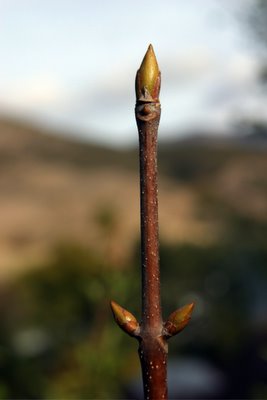
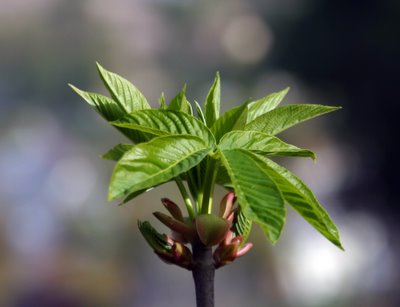
Stopping by a beautiful white-limbed specimen of California buckeye–the genus of Aesculus mentioned several times by Vergil when he speaks of the Italian chestnut and horse chestnut– we noticed the winter-spring buds swelling at the growing tips of twigs and bursting from the middle of thick branches bare to the light stimulus of the southern sun. Passing through a damp grove of redwoods, we came upon the experimental Carex plot, after the recent rains greener and fuller than I’ve ever seen it, proof that the right native perennial bunch grass can replace the water and chemical dependent lawns that are depleting our naturally arid lands.

At the end of the garden we observed the great scar of the quarry-dump on Poly Mountain overlooking the future site of the 2700 resident Student Housing North development, while a redtail hawk circled overhead showing off his bright underwings. What was supposed to have been a hike turned out a brief stroll concluded with fifteen minutes of journaling and repose on a circle of stones in the shade of a cypress tree.

“A wild Santa Ana wind blew off a shingle last night, the first one since the roof was laid fifteen years ago. Now it’s a steady breeze from the east making ripples on Drumm reservoir that sparkle among silver clumps of deergrass.


A meadowlark yodels on a fencepost at the edge of the old Bull Test’s flourescent green pasture. Never again will it be manured and cropped down to dirt. At the foot of Caballo Peak the mares nibble in the lovely surroundings Vergil recommends.


The ground feels good under the base of my spine: serpentine gravel and sun-bleached chips of mulch.”

Snow

Friday, January 6th, 2006

I promised not to indulge the journaler’s vice, writing about writing. But I’ve lagged for two weeks now, and the longer delay the harder to start, so I drag myself to this window with a scolding. How can I expect students to fulfill this assignment if I can’t? How can I fail my own admired teachers, Thoreau, Wordsworth, Austin, Oliver?

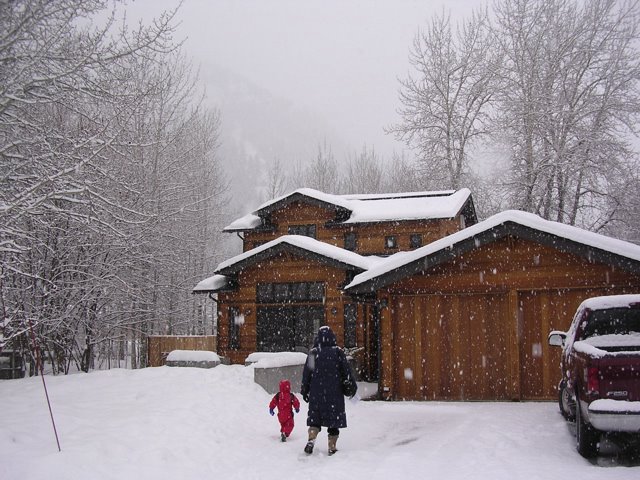
My first seven months of retirement concluded with our Christmas trip to see grandson, Ethan, daughter-in-law Amy and son Joe, in the gorgeous new home he built in Sun Valley Idaho. Jan observed that his lifestyle blends his hippie childhood in British Columbia with his adolescence in Palo Alto, where we lived while I finished my doctorate and she attended law school.

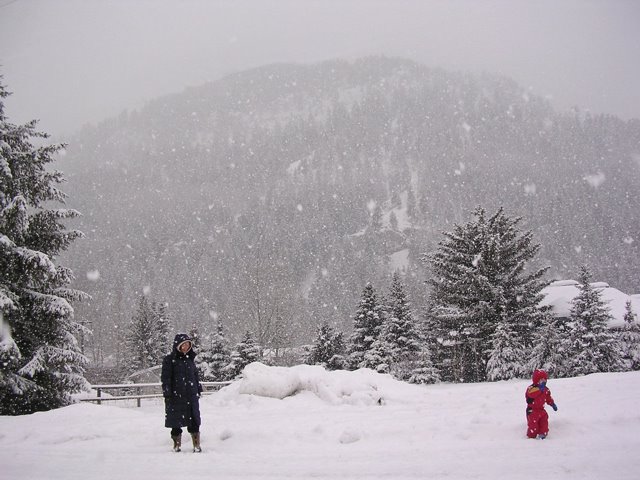
The first couple of days there the temperature hovered around freezing. Cold rain alternated with falls of the largest thickest snowflakes I’d ever seen.


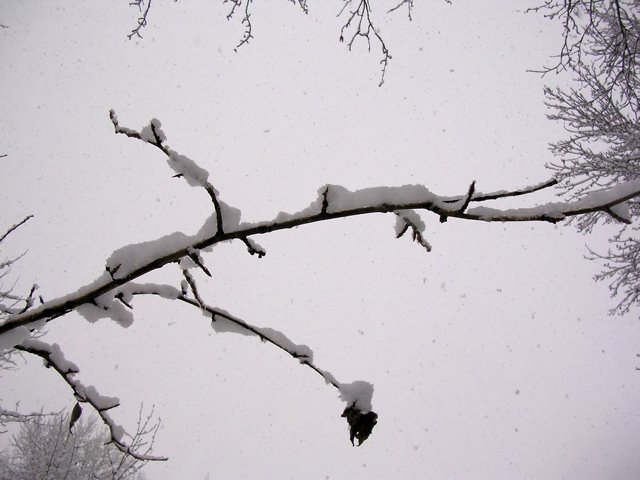
One late afternoon Ethan and I trudged through the foot-thick fresh cover to the creek and stared up as the grey flakes fell like cotton candy into our open mouths. They were so sticky they held to the surfaces they touched and to one another without compacting, sometimes leaving spaces that light passed through.

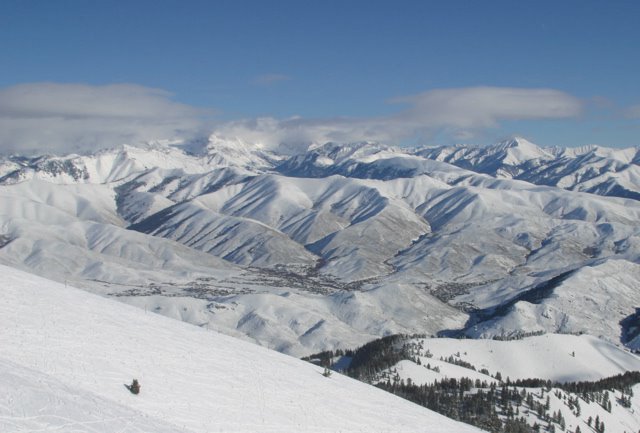
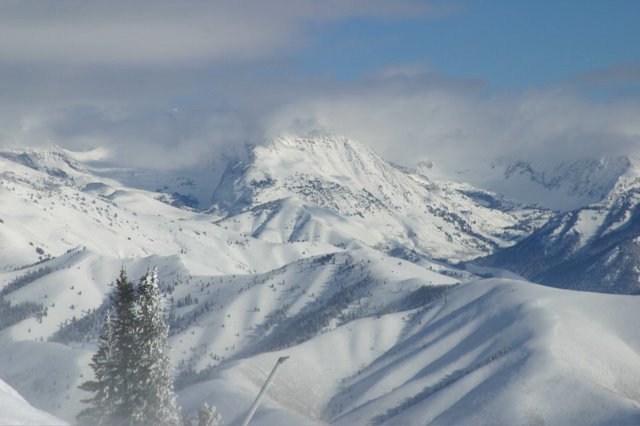
Next morning the temperature dropped and the sun came out. Joe was eager to ski the fresh powder at the top of the mountain. I stayed on the groomed slopes and watched the less adhesive crystals at high altitude blowing in the wind on the ridge top and the surrounding summits. They reminded me of the “snow banners” described lovingly by John Muir in chapter 3 of The Mountains of California.


Muir surmises that the powdery consistency that allows the snow crystals to be driven by the wind results from their crystalline hooks being ground off in the turbulence at high altitude. However, according to Snowcrystals.com, the reason why

…is still not known, believe it or not. The different ice facets grow at different rates in different temperatures, and to date we don’t really know why the growth rates depend so strongly on temperature. The growth depends on exactly how water vapor molecules are incorporated into the growing ice crystal, and the physics behind this is quite complex and not well understood. It is the subject of current research in my lab and elsewhere.

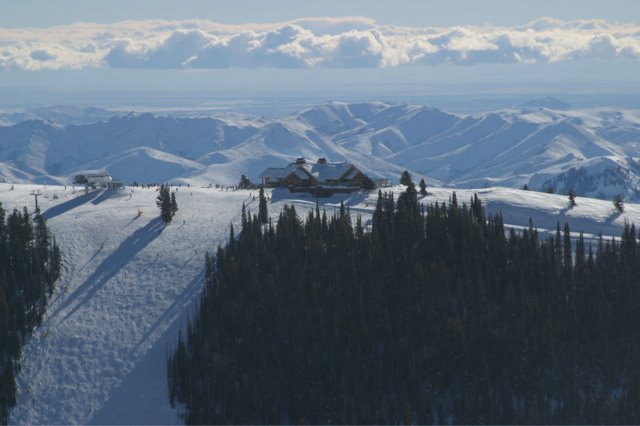
The celebrity resort of Sun Valley, with its $70 per day ski lifts and chandelier-bedecked mountaintop lodges is not where I’d have expected to spend holiday time. But the magnet of family and also the splendor of its outdoor recreation opportunities overcome my scruples about the conspicuous consumption of resources and the inequity of wealth distribution that the place represents.

The same weather system that was making life beautiful for skiers and resort owners in the Rockies lengthened our return trip home on the last day of 2005 to fourteen hours. We got back just in time for the ECOSLO bash in the Vets Hall that Jan had helped to organize, to celebrate a New Year’s Eve more hopeful than the last one.

Hazzardous Waste

Friday, January 6th, 2006

Yesterday morning I went to the Hazardous Waste Disposal Site in Cold Canyon Landfill that’s only open 11-3 on Fridays and Saturdays. The cardboard box of half-filled bottles and cans stashed in the garage–Diazanon, Malathion, ant-killer, Miracle-Grow–got soggy from the rain that seeped between the concrete wall and floor during last week’s storms. I had felt good about not using all these poisons since converting to native plants several years ago, but I never finished cleaning house because I didnt want to get near the toxic stuff any more.

I put on my gloves, transferred the frightening mess to a plastic carton and drove out Broad Street under a fresh sky brightened with puffy clouds. At Buckley Road a big pickup turned onto the highway in front of me stuffed with trash and sporting a huge confederate flag fluttering on a pole fastened to the tailgate. Concentrating the winter sunlight, its scintillating red field dominated the beautiful Edna Valley landscape and steadily increased my irritation. My head filled with challenges: “So you’re a big fan of slavery?” “You’re celebrating traffic in human beings.” “How about if you were the property rather than the owner?” When the driver moved into the left lane as if to turn on Corbett Canyon Road, I fantasized giving him the finger as I drove by but thought better of it as he moved back in front of me, clearly sharing the destination of the dump. I imagined the hostility and pain that might have been felt by an African-American staffing the landfill gate.

I followed the signs leading toward the shed where the poisons were to be left and watched the attendant dressed in white coveralls lifting a 48 inch television set on his forklift and dropping it with a crash onto a mountain of electronic detritus filling up an enormous dumpster. Five years ago somebody must have paid thousands of dollars for that half-ton item, giving it pride of place in the family home. Now it was just another piece of junk that needed to be processed at government expense. I remembered my earlier visit here with the old monitors and printers accumulated in my garage that no recycler could handle. The day before, at the Sierra Club office I discovered that installing the Quickbooks software necessary to handle our complicated non-profit financial statements required an upgrade to the operating system, which in turn required replacing the computer we had purchased only three years ago.

Another Look

Friday, December 23rd, 2005

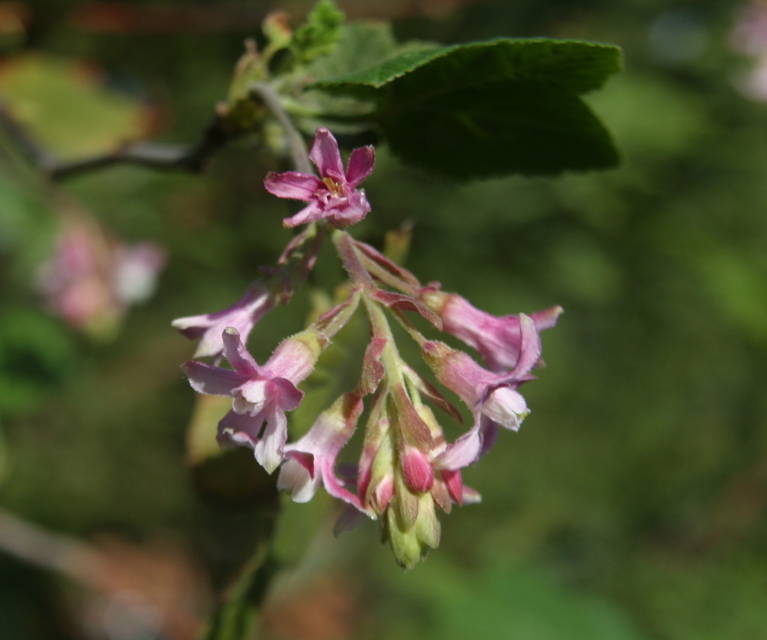
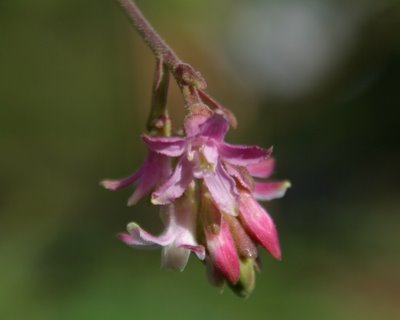
“What is a course of history or philosophy or poetry no matter how well selected…compared to the discipline of looking always at what is to be seen,” says Thoreau. (Walden p. 105) I tried to exercise some of that discipline this morning. Instead of going Christmas shopping I returned to the raceme of pink-flowered currant that I had looked at earlier in the week, now again illuminated by a horizon-hugging sun.


I noticed that the five petals of each blossom split into two layers, a longer outside one arching back and curling at its edges, and a shorter inside one that remained erect. The splaying outside layers gave the blossom its star shape. The inside layers combined into an open tube surrounding its golden pistil and stamens. I also noticed some changes since the last look:

seven of the blossoms were open instead of four. Five pink closed blossoms cupped a cluster of immature green buds at the raceme’s tip. As each blossom opened, it diverged from the central axis on its own outward stretching stem. The higher on the raceme, the more mature the blossom and the the more shrunken and curled the sepal which had enclosed it as a bud.

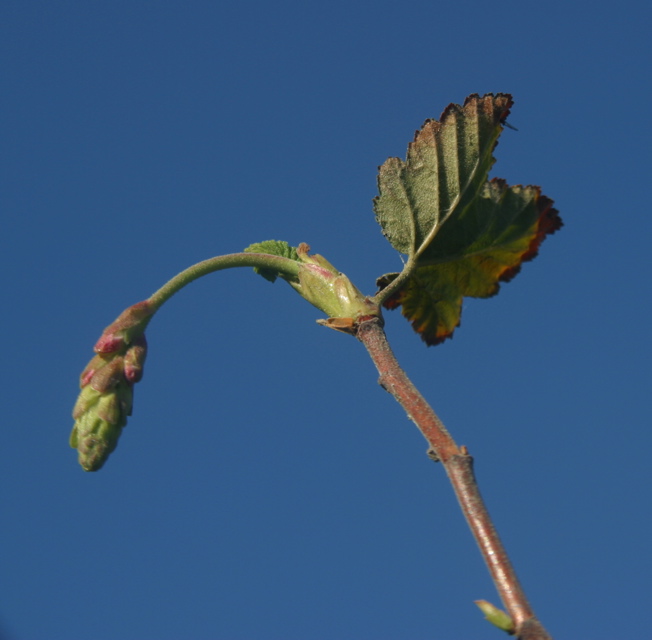
My revisited raceme seemed to be the oldest one on the shrub, its location best placed to gather the sparse sunlight and attract me with my camera. On other twigs I found younger growing tips. They revealed that flowers and leaves are originally enclosed in a single germinal container springing from the battered remnants of last year’s growth.

The subtle fragrance of Ribes sanguineum glutinosum, more leathery than sweet, occasionally wafted past but dissipated before I could satisfy my hungry nostrils. I wanted to be smaller, faster and more sensitive–like the bug that buzzed by me and dove into one of the blossoms. Then I understood that they had evolved to entice it into spreading their red and sticky seed.

I’ve often discussed with students the lines of Wordsworth’s “The Tables Turned” that inspired Thoreau’s preference of Nature over Culture:

Come forth into the light of things
Let Nature be your teacher.

Enough of Science and of Art
Close up those barren leaves
Come forth and bring with you a heart
That watches and receives.

I’m still trying to figure out how to do that. Returning to the same flower after a few days and noticing some changes, spending enough time to really look at it and allow the bugs to show up, taking as long as I need to find the right words–that’s a start.

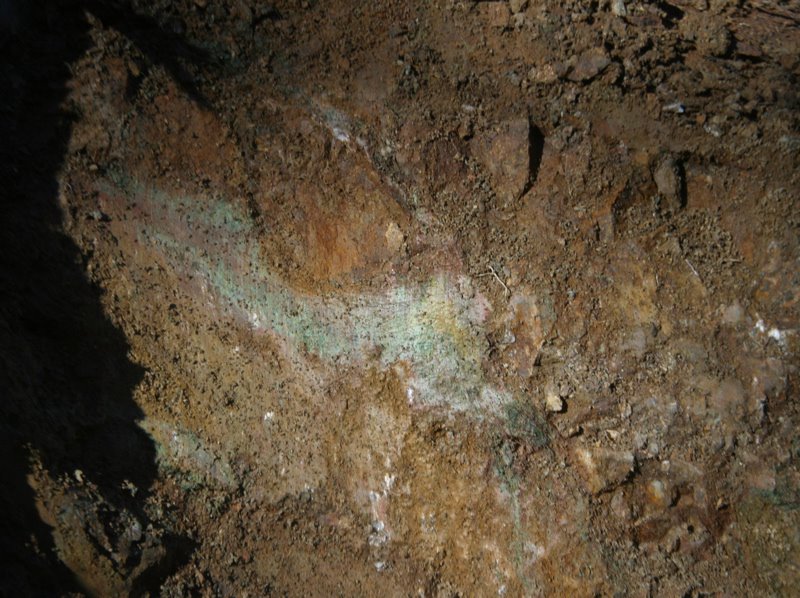
On the way to the back door to clean the mud off my shoes, I noticed a patch of sunlight on the wall of my excavation.


While digging I find the life of the seasons in the mineral as well as in the vegetable and animal. A few weeks ago, this same ground broke the tip off the steel pickaxe. Now my spade sinks into the damp earth like a scoop into ice cream.

Ron Yamauchi’s Eulogy for Kenn Law

Thursday, December 22nd, 2005

I thought to do something different: bury Kenn not praise him. I think he would have liked that “ he liked things that annoyed most people, like that trancey music and spelling his name with 2 Ns. Being the world’s biggest expert. Forgetting things “ like 10 bucks. Being the vegetarian that can’t eat tofu.

But you could not stay angry at Kenn. I mean look at us – Here we are.

So I am just going to stick to my role.

Judy has spoken about Kenn’s professional life, Steve about Kenn as a friend and lover.

I’m here to talk about the Kenn that I knew, which was in some ways his most shockingly unexpected persona, that of the wholesome family man.

We three are not the complete experts on Kenn, but we’re giving briefing notes in the phases of his life. At the reception there will be more stories and hopefully lots of interaction. There’s so much I don’t know about Kenn as an artist, or art collector, just as some of you may want his recipe for broiled eggplant.

Kenn Law met Sharon Goddu (as she then was) in 1975. He’d have been about 21 years old. He’d returned to the Lower Mainland after some years as a hippie camp director and schoolteacher in Lund, BC, and was applying for a job as a child care worker. Sharon, one of the CCWs, objected to his hiring “ she said that there was something kind of intimidating about his charisma and energy “ she knew that he could change her life.

Well, he did get hired, so Kenn and Sharon became coworkers, then friends, best friends, roommates, and ultimately co-parents to her two young daughters, Rachel and Willow.

Ultimately, Sharon moved her family up to Desolation Sound, north of Powell River. Kenn told me he blamed himself for making the Sunshine Coast seem so alluring that he’s sent his precious daughters into a pre-technological world of cold water, oyster digging, and bear evasion.

Later, the girls came of age and started to attend Simon Fraser University. This is where I came into the picture.

Rachel and I worked on the student newspaper together, starting around 1987. She was very friendly and nice, and invited a bunch of us to a party at her place, an old house in Burnaby they called the Pender Palace. And Rachel introduced me to Kenn.

He made a striking impression: tall, broad shoulders, with the shaved head and a menacing expression. I also remember that he was incredibly curt with me. It could be that he was angry about the music “ there was this sloppy jam band playing, I believe they were called the Gonch Messiahs “ we know that he was particular about music.

But I also think he really didn’t like me. He was still reserved years later when I was dating Willow. Now that I am a dad, I really respect his frostiness towards whippersnappers who were hanging around his daughters. I don’t believe he really trusted my intentions until 1995, when we got married. And of course he did all these super-elaborate flower arrangements for the reception.

After that, he was a wonderful father in law and grandpa. He’d come over and cook us big meals, accompany us to shows, coo over the babies when they came, bring us coffee in the morning when we were up all night with a newborn, buy them clothes, volunteer at their school. I’m glad that Sophie and Flynn are almost 6 and 9. They will keep real memories of their Poppa Kenn.

As for Willow and myself, Kenn’s still a real presence in our lives.

This morning, I woke up, looked in the mirror upon which he’d written Go Beyond and Choose Happy in phosphorescent paint, see the tattoos he’d cajoled me into getting together, walk past the kids’ room he decorated, went to the kitchen he painted, ate bacon from the frying pan he left here, drank coffee from one of his mugs, put on the shirt and shoes he gave me, and walked to our car through the garden he planted, from the house he helped me paint.

I know what I’m supposed to feel about that. I ought to be taking consolation from the gifts he’d given us, to feel grateful that we got to know him for a considerable portion of his life. To acknowledge that his life was lived more intensely, passionately, dangerously, creatively than the theoretical average person for whom one day is much like another.

But that math doesn’t make sense to me. Heightened ability to give and to feel should have earned a reward. Those who don’t waste life, should get more years, not less.

I guess I am starting to come out of my shellshock over his quite horrible and protracted death, and into realizing that I am without my friend. He loved gossip, furor, huge emotional scenes. If anyone should be here, with us, it would be Kenn.

And if you’re a religious person, maybe you think he is here. If so, I envy your consolation. For myself, I say, Kenn “ forget the ten bucks. I’ll always owe you. Goodbye.

Waves

Wednesday, December 21st, 2005

I read this yesterday in the SLO Tribune

“The ingredients are now in place to produce a huge wave event,” said John Lindsey, Diablo Canyon weather forecaster.

…Wednesday’s waves are generated by a storm 1,100 miles to the west and will hit the coast more directly.

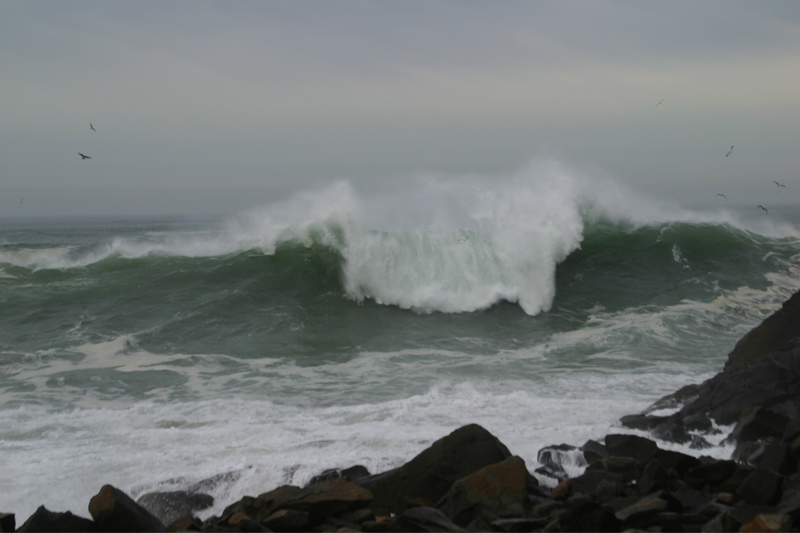
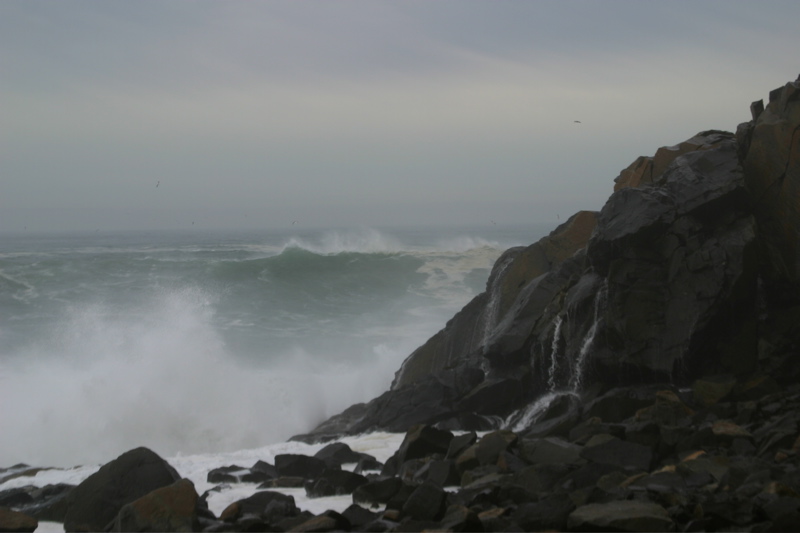
After attending the Christmas pajama parade at Ian’s nursery school with Claire this morning, I celebrated the winter solstice by driving to Morro Bay to look at the waves.

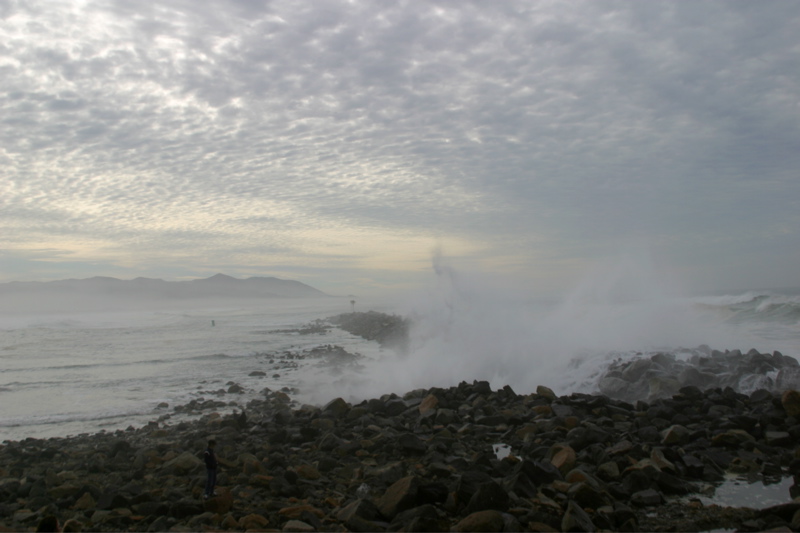
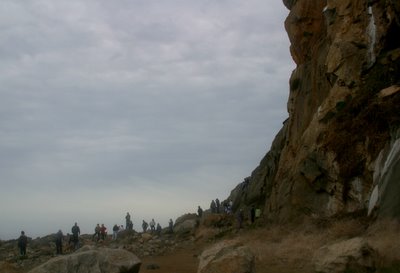
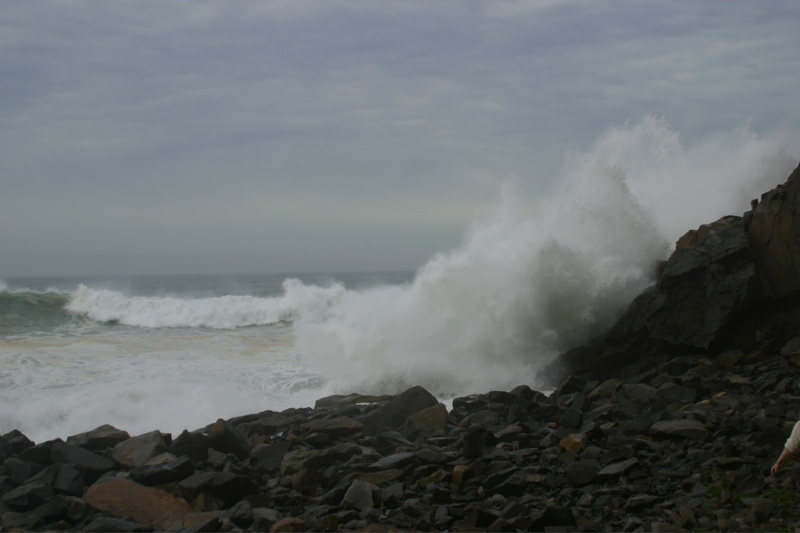
During a stop in town I took in a deep breath of sea-smell–much further ashore than usual. Driving down the hill, I saw a crowd of cars at the foot of the Rock. I wondered if people were there for the Salinen Indian Winter Solstice ceremony announced in this morning’s paper or like me, to welcome the waves at the end of their long journey. Then I saw the blasts of spray above the breakwater.


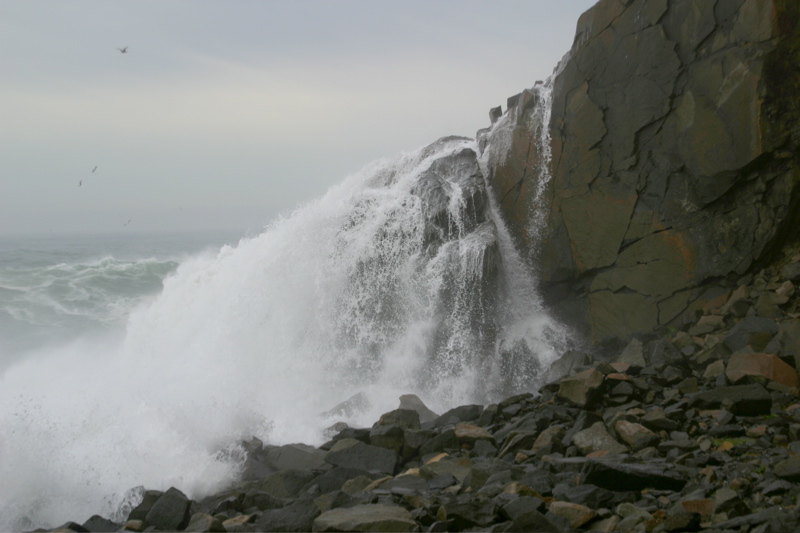
The heavy camera and tripod made me self-conscious among the dozens of people there with palm-sized digitals, but they added to my sense of purpose. As I rounded the corner toward the open ocean, I heard the crashes echoing from the hollow stone bowl overhead and felt the ground shake. I was reminded of those disaster movies, when the thunk of a landslide or a mortar round makes your pelvic bones rather than your ear drums vibrate. The atmosphere was a mixture of church and amusement park, reverence and sensation-seeking. It may be like this for the solstice ceremony too, as it might have been during the parting of the Red Sea.


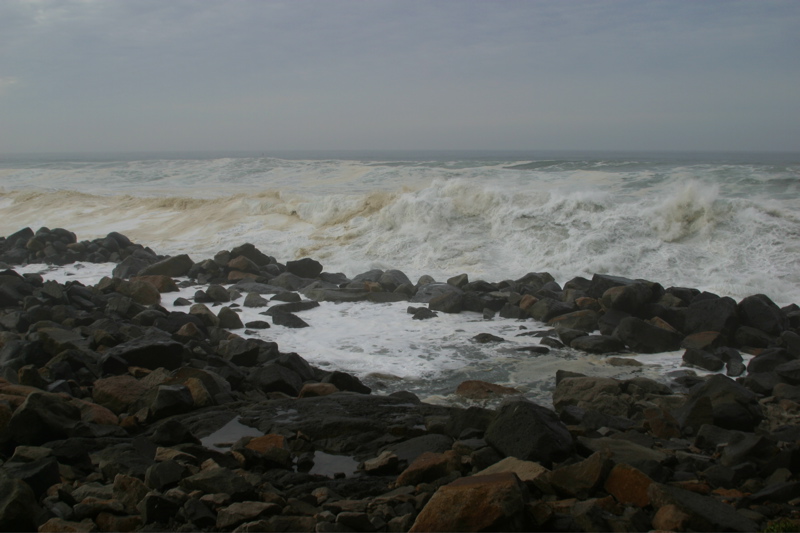
I couldnt tell how much of the water’s angry turbulence was natural surf and how much was due to meeting the artificial impediment of piled boulders.


The slight offshore breeze lifted scarves of spray from the tops of the breakers, and the wild air they pushed before them made a playground for the gulls.


I could feel it blow as the explosions of water on rock grew more intense.


After one of them brought a shower down over the camera, I packed up and left.

Spring in December

Saturday, December 17th, 2005

The rains have been slow this year, only two since June. But the native garden I’ve been cultivating since 2001 has matured. Last spring I removed the drip irrigation system I’d used to get it established, and except for one ground soak, I refrained from watering during summer and fall. All 68 varieties survived and most have remained green, proving their adaptation to arid conditions, subsisting on fog, dew, and bits of moisture their roots capture deep in the parched clay soil. Buds were fattening on a buckeye I’d planted a couple of years ago and another had started to leaf.


But this made me nervous. With so little water in the ground, would they deplete their energy with premature growth? I checked my authority on California Natives, the website of Bert Wilson, proprietor of Las Pilitas nursery, and found that Aesculus californica is “tolerant to drought but needs regular water for the first few years.” Remembering Bert’s general abhorrence of watering, this warning seemed urgent. I hooked up the hose and gave the two little saplings a normal season’s worth of precipitation.

The next morning, Sunday, I was gently awakened by the gurgle of rain in the downspout on the wall by my bed. I put on a wool sweater and hat and went out to enjoy it. I climbed the ladder to the roof and cleared the gutters of curled Eugenia leaves and spikey liquidambar seedpods. I rooted up dandelions that had sprouted in the front yard. I transplanted ten bunches of Idaho fescue stored in pots after I’d cleared them off the hillside I’ve been excavating with pick and shovel to make room for an extension of Jan’s office. I cut huge clumps of deergrass straw and spread the leaves and seed stalks on the muddy paths. I filled the wheelbarrow with raked leaves and sprinkled the crackling residue on the spoil I’d been dumping alongside the house to raise the ground level. The porous mixture absorbed the water puddled on the dense clay, protected my shoes, and made a deep-textured carpet of autumnal tweed.

I knew that the thirsty plants would respond quickly to the rain, and next morning I went out to look at the new growth.

This is ribes sanguineum glutinosum, or pink flowered currant. The specimen between the neighbors’ towering second story and our roof has grown 10 feet, as fast and as tall as the Redwood next to it. Another in total shade under the fence, which I planted to replace a vigorous non-native tree I cut down, has only reached two feet, but is also showing new leaves. The two in back, on the steep north facing slope where there’s very little soil, have reached about four feet. Bert says “This Ribes is more drought tolerant than most of the drought resistant plants of the trade, but in a native garden plant towards the wettest section… .”

Plants for a Future, a British permaculture site reminds me that sanguineum and glutinosum stem from the latin words for “bloody,” and “sticky,” and informs me that its fruits are edible though not tasty. From Native Plants of Montara Mountain I learn that this Ribes belongs to the Grossulariceae family, which contains currants and gooseberries. The vivid language invites a bit of rearrangement

Leaves: alternate, palmately-lobed, hand-like, soft, veined, with edges curving under.
Flowers: pink, five-petaled and stamened, funnel and star shaped, racemes in hanging cascades at ends of branches. Calyx fused to the pistil.
Fruit: Fleshy, red berries ripening to dark blue; developing below the calyx lobes in clusters, with tan seeds inside.

It includes two beautiful words I pursue in the Dictionary

Raceme: An inflorescence having stalked flowers arranged singly along an elongated unbranched axis, as in the lily of the valley…from Latin racemus, a bunch of grapes.

Calyx: the whorl of sepals…collectively forming the outer floral envelope…enclosing…the developing bud

Compared to these technical descriptions, how little of this plant have I described or perceived, even with the assistance of the camera. I need another look.

The Family

Wednesday, December 7th, 2005

[click pictures for full size images]

Early Tuesday I got a ride with Keith, Sharon’s husband and Pat to attend the memorial in Vancouver. Kenneth’s first visit to Lund in many years came last summer to attend a memorial for the death of Mike, one of Pat’s sons, who had also worked at our camp. Soon thereafter Pat had lost another son. She bore the weight of these tragedies with great strength.

We arrived at the spare but stately old Vancouver frame house, the home of Willow, Ron and their children, with some time to spare. Ron had corresponded with me about the old pictures and journal excerpts they had read on this weblog, so I felt immediately drawn into the family. Ron and Willow disappeared, and I met Ron’s father Henry, his sister-in-law Rachel, her 15 month old son Dash, and her husband Cameron. She has a Ph.D. in English and he’s finishing one. For two and a half minutes we discussed her dissertation topic, the Semiotics of Multicultural Rhetoric.

In the midst of the hubbub, Sharon, whom I’d first met two days earlier, prepared me a grilled cheese sandwich with pickled green beans and a cup of coffee, and poured me a shot of her 25 year old prized Canadian Whiskey.

The Unitarian Church at 49th and Oak was packed with 250 people attending the memorial. We were greeted by a shrine outside and four kids handing out programs, two of them Kenneth’s adopted grandchildren, Sophia and Flynn.

The service began with a quotation from Mary Oliver:

you must be able
to do three things:
to love what is mortal;
to hold it
against your bones knowing
your own life depends on it;
and, when the time comes to let it go,
to let it go.

The lay minister didn’t know Kenneth but was awed by the intensity and range of his legacy. The program included a harp introduction, recorded music, an operatic rendition of “Ave Maria,” and a beautiful piano and voice performance of Leonard Cohen’s “Hallelujah,” by Ron.

There were three speeches, one by his professional mentor, one by a former lover, and one by his son-in-law. From these I learned that he worked with child protective services and in an alternative school for severely disturbed kids; that he founded and managed “After Hours,” a drop in center and hotline which became a Province-wide institution; that he organized teams and competed as a runner, a hurdler and a softball player in the Gay Olympics; that he was a textile designer; that he earned an M.A. from Pratt Institute of Art in New York; that he was a famous D.J.–“Poppalizard”– in young people’s clubs. Ron spoke of the way he remained as part of the family after Willow married: Poppa to the grandchildren, cook, party organizer, gardener and house painter. It struck me how many of these life accomplishments were there in germ during the time we knew him in his early twenties.

Following the three speeches and a candlelighting and quenching ceremony, Ron presented a DVD with musical accompaniment including a dozens of pictures and film clips of Kenneth from infancy to grandfatherhood.

At the huge reception afterward, I ran into Mara, Janet and Rhea, Lund people who now live elsewhere. I would have loved to stay for the roasts and tributes, but I had a plane to catch.

Winter Journey

Wednesday, December 7th, 2005

The impulse that started this weblog gained strength over the past week and propelled me back to British Columbia for a rare Winter visit–only one other since leaving in 1979. Encouraged by welcomes from Rosemary who was organizing the Lund memorial and by Lou Stevenson, whom I hadnt met, but who told me that Kenneth had spoken fondly of his time with us to his later family, I flew from San Luis Obispo to Powell River on Friday. Peter and Margaret took me home to their beautiful cabin on the beach, and we stayed up late laughing at CBC political comedy on TV.

Next morning, Peter and I roamed the trails of our summer home at Knoll House, breakfasted at Nancy’s Bakery and explored the old Marx farm with permission of Ed and Maggie, who’ve owned and lived on the place for many years. During the time we lived there it was called the Bleiler farm, for the residents prior to us. Brambles and alders had grown in close to the house, you could hardly see the stream, and alot of stuff had been collected and strewn about. But the place was in working order; there were chickens, a horse, more light on the pasture since the logging after we left, and the pear, apple and cherry trees, ancient and decrepit in 1970, were still standing and producing.

I recognized the staircase to the loft in the abandoned shack Kenneth had decorated and inhabited during 1973, but the old gate with the heart-shaped hole–the entrance to our homestead that kept the goats out and welcomed the people–was gone.

We walked out of the woods and drove to Rosemary’s bright new home overlooking the water on Ralph Road, the location for the Lund memorial. Rosemary worked with Kenneth at the Lund School as instructional assistant. Also in attendance were Darrel, his partner for the last year, who had come up from Vancouver for the celebration; Vicky, whose cousin Joanne Kenneth had almost married while living on our farm; Debby whom Kenneth had married to allow her to emigrate to Canada as an eighteen year-old; Lou, who had met Kenneth in Vancouver and came to Powell River at his instigation; Sharon, who also came to the area as a result of Kenneth’s influence and whose two daughters were adopted by him in Vancouver; Pat, Rudy, Sherry, Steve and Juliet, who were friends with Kenneth when he lived in Lund during the seventies.

After enjoying the sunny vistas and the food and drink, we sat in a circle and shared old photos and stories of Kenneth: grateful stories of his generous involvements in families, of his inspiring creative community activity, of his way with children, and hilarious stories of his outrageous sexuality and gender-bending, his falling in and out of love, his tendency to appear and disappear without warning.


While this memorial took place another historic event was unfolding in Lund: a meeting of 75 people to try to halt the logging of old growth trees on the Malaspina Peninsula. Steve, Juliet and I attended the last hour, retired to the pub with two organizers, Eagle and Pam, and then went back to Malaspina Farm for dinner and conversation which mixed talk of Kenneth and the political future of this area. Next day, Sunday, Peter, Steve and I went cross country skiing for seven hours on the Elk Lake loop. I spent Monday recovering from that and reading and writing at the Behrs while they were at work.