Topics

from The Magic Flute

Sunday, September 1st, 2013

Mann und Weib
Und Weib und Mann
Reichen an
die Gottheit an.

(Wife and husband
husband wife
together reach
for godly life.)


Thoreau’s Buddhism

Monday, June 24th, 2013

A presentation to the White Heron Sangha June 23 2013

Henry David Thoreau was born July 12, 1817 and died at 45 years of age on May 6, 1862. His name is a household word, especially among those of us who grew up during the 1960’s, when his two most famous works, Walden and “Civil Disobedience” offered compelling guides to non-conformity, self-reliance, appreciation of nature, reduction of one’s environmental footprint, opposition to war and injustice and spiritual quest.

Although not widely appreciated during his life, since the late 19th century Thoreau’s works have become classics, admired by later writers, assigned in schools, and the subject of a burgeoning scholarly industry. He produced more than 20 volumes in a dense and quirky literary style, at times pompous and bombastic, at others intimate and funny. (more…)

Reminders of the “Good Old Days”

Tuesday, April 9th, 2013

[Updated June 30 2013]

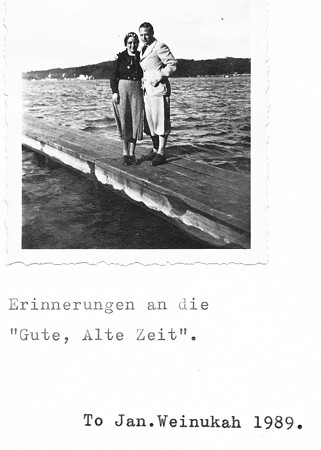
gute alte zeit_2.jpg

Soon after their move to San Luis Obispo in 1989, my parents, Lise and Henry Marx, presented Jan and me with a gift they’d been working on for several years: a collection of German proverbs they had learned from their parents and grandparents.

I remember continually hearing these sayings from my earliest childhood until their final days. Each time one was uttered there was a moment of satisfaction”the speaker pleased to have found a way to make familiar sense out of some new experience and the hearer gratified to grasp the connection.  Growing up as a first generation American, I reacted to these old-world pieties with boredom and embarrassment.

(more…)

Genes in Genesis: Evolutionary Psychology and the Bible as Literature

Monday, April 8th, 2013

Introductory Note:  This essay was completed in March 2011.  The interpretation of Genesis it proposes first occurred to me in 1996 in the course of writing a book commissioned by Oxford University Press,  Shakespeare and the Bible.  I first learned about Evolutionary Psychology and the field of Darwinian Literary Criticism in 2006.

Introduction

“The Old and New Testaments are the Great Code of Art,” proclaimed William Blake in one of the captions of his etching, “Laocoon” (755). In The Great Code: The Bible and Literature, Northrop Frye replicated part of that proclamation and elaborated some of its implied claims. If indeed the Bible can be said to encode a substantial portion of Western culture’s imaginative, historical and legal heritage, then its first book, Genesis, can be regarded as the Code for the Great Code, since so much of what appears in the subsequent 65 books seems to grow out of it. Genesis’ title is amplified in the names of some of its recurrent themes and images: generation, generations, genealogy, gender, genitalia. The common root of all these words suggests yet another code: that which is carried by genes.[1]

Frye observed that Genesis’ “primary concern is expressed in the Biblical phrase “life more abundant,” and J.P. Fokkelman showed coherence in the book’s motley mosaic of stories with the discovery that its “overriding concern [is] life-survival-offspring-fertility-continuity,” (41) but neither critic associated these concerns with the evolutionary perspective they suggest. Until recently it’s been left to contemporary novelists versed in biology and literature to explore some of the rich meanings that flow from the convergence of Genesis and evolutionary principles, for instance Ruth Ozeki in All Over Creation and Barbara Kingsolver in Prodigal Summer.[2]

Genesis rewards literary analysis because of its complex structure and plot, its concentrated characterization, its vibrant language and its rich but submerged themes, accompanied by what Robert Alter calls “the high fun of the act of literary communication¦ the lively inventiveness …[which] repeatedly exceeds the needs of the message, though it often also deepens and complicates the message”(40-45).  Such analysis can be enriched by combining the relatively rigorous scientific methods of evolutionary psychology with some of the inventive and fanciful tactics of traditional Midrashic interpretation to make sense of the book.[3] That combination seems appropriate to a work which is itself a product of literary evolution–the outcome of a thousand-year history of competition among oral traditions, written documents, individual and group authors and editors assembled in the palimpsest of the received text (Friedman).

Genesis prompts Darwinian analysis because it traces human history back to its beginnings, where it locates the origin of what came later. It chronicles a period of prehistory that figuratively parallels the one and a half million year Pleistocene period that Darwinists refer to as the Environment of Evolutionary Adaptation (EEA), the span of time long enough to allow most human traits to evolve (Cosmides 1997).

Darwinian interpretation explores the operation of the principle of evolution in literary works, depicting what Jonathan Gottschall calls

the fascinating multiplicity of ways characters react to and manipulate their environment (the setting and the other characters) to accomplish the prime directive of all life: to live long enough to reproduce and, in species where parental care is necessary (like ours), rear young to reproduce again.¦” (260)

Genesis personifies that principle in its characterization of the Creator. Its God designs both animal and human life during their common emergence on days five and six by pronouncing the two parts of evolution’s “prime directive”: “I have given you every seed bearing plant ¦for food¦and to all which has the breath of life within it.” (1.29) “¦be fruitful and multiply and fill the earth¦”(1.28)[4]

Genesis’ God repeatedly affirms evolution’s positive outcome of reproductive success as the reward of those whom He has chosen and trained–from Adam at the beginning of the book to the sons of Israel at the end: “I will greatly bless you and will greatly multiply your seed, as the stars in the heavens and as the sand on the shore of the sea, and your seed shall take hold of its enemies’gate.”(22:17)

Genesis’ word for “seed” –zera in the original Hebrew”has several meanings that converge with those of “gene” (Alter 1996 xiii-xiv). It signifies the originating kernels as well as the foodstuff of fruit and grain–the source of sustenance for animals and humans. It signifies semen, half of the material agency of reproduction. It signifies individual progenitors and progeny connected by inheritance–the generations of genetic relatives who extend personal existence beyond the bounds of individual mortality. It signifies lineage, the mark of kinship drawing individuals together into a survival unit, a community, and eventually, a nation.[5]

Joseph, the culminating hero of Genesis, epitomizes all of these meanings of “seed.”  He distributes seed during famine; he preserves enough grain to feed the world; he procreates two sons, one of whom is named Ephraim, meaning “he has made me fruitful”; at his death, he joins his father and mother in their tomb; and he paves the way for his wise descendant Solomon “whose people, Judah and Israel, were as many as the sands of the sea.”[6]

Genesis establishes literary coherence among narrative units with genealogies that catalogue the succession of seed through numerous generations, binding its many discrete stories into the history of a single genetic strain. Later uses of the text call attention to the importance of this genetic continuity. The first edition of the King James Bible begins with thirty-four folio pages of genealogical charts tracing lineage from Adam to Christ, while the succession of deaths and births of relatives is still recorded on pages inserted in family Bibles.

The operation of the principle of evolution is determined by the “algorithm” of Natural Selection formulated by Darwin in Origin of Species:

Through the preservation of favoured individuals and races, during the constantly-recurrent Struggle for Existence, we see the most powerful and ever-acting means of selection. The struggle for existence inevitably follows from the high geometrical ratio of increase which is common to all organic beings. ¦

These laws, taken in the largest sense, being Growth with Reproduction; inheritance which is almost implied by reproduction; Variability from the indirect and direct action of the external conditions of life, and from use and disuse; a Ratio of Increase so high as to lead to a Struggle for Life, and as a consequence to Natural Selection, entailing Divergence of Character and the Extinction of less-improved forms (406).

Genesis begins at “Growth with Reproduction; inheritance” and proceeds to the more complex and turbulent aspects of natural selection: “the struggle for Life,” “Variability,”  “Extinction of less improved forms,” and consequent adaptation.

Natural selection arises from three conditions: 1) individuals compete for the resources to stay alive and procreate, 2) they compete for reproductive success through sexual selection–finding mates and raising offspring that preserve and proliferate their genes, and 3) over long periods of time, species adapt, that is, they change in ways that increase their likelihood of survival and reproduction. Such adaptive changes are carried out through improved design of the physical organism and through the adoption of adaptive behaviors.

Adaptive behaviors are patterns of response to recurrent environmental challenges. The brain circuits, or programs that enable adaptive behaviors, become “incorporated into a species’ neural design.”[7] Assemblages of such software circuits evolved as “cognitive domains,” just as the eye and ear, for example, evolved as hardware. Their blueprints were replicated and transmitted by genes in “the seed,” just as were the blueprints for organs.[8]

Adaptive behaviors produced by natural selection include tool use, kinship selection, status competition, territoriality, coalition building, reciprocity, indirect reciprocity and in-group/outgroup discrimination. These adaptations are observed in primates as well as in remnants of hunter-gatherer societies. This essay argues that evolutionary psychology’s account of the development of cognitive and behavioral adaptations offers a key to decode many of Genesis’ particular incidents as well as its overall design.

(more…)

Backpacking with Ian

Tuesday, February 19th, 2013

President’s Day Weekend was the date chosen for the big demonstration in Washington D.C. planned by the Sierra Club and 350.org. to urge Obama to block the construction of the XL Pipeline. It was the first massive public action on Climate Change, and I wanted to join it, but no group transportation arrangements were available from California and I didn’t have enough miles on my frequent flyer account to make it feasible to go.

Nevertheless, after the satisfactions of the Peru trip and the recent hike to Sykes Hotsprings, the urge to travel again outweighed both inertia and the motivation to work on other projects. “Seize the Day” was accumulating authority as a watchword for my seventies and full retirement.

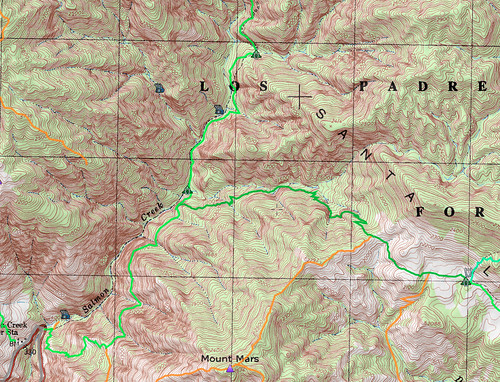
Reading Robert Macfarlane’s The Old Ways: A Journey on Foot strengthened my desire to return to the trail.  Ian’s five-day Winter recess from Grade 4 was coming up and he was excited by the slideshow about backpacking presented at his last Cub Scout meeting, so I decided to return to Big Sur with him on an overnight camping trip.  I’d been up the Salmon Creek Trail a few years ago with a former student and remembered a remote campsite by the creek only two miles in but requiring a thousand foot ascent.

salmoncreekmap.jpg

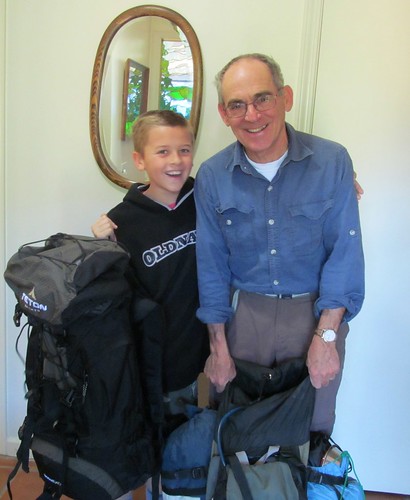
We sat at the computer together and ordered a packsack for him, a butane stove, and a water purification bottle from Amazon, which were delivered within two days. The weather forecast was mild and the Ranger said no fee or fire permit was required till May.

We departed at 10 AM and stopped at Spencer’s Market in Morro Bay for baguettes and Hershey Bars to complete the food selection plucked from the cupboards at home.

IMG_4380.JPG

As we drove north on Highway 1 along the open Pacific, the radio reported that a 300 foot wide asteroid was about to pass within 17,000 miles of the earth”only two diameters away”and that a large meteorite just landed with the blast of 25 Hiroshima atom bombs somewhere in Russia.  This was the first I heard about either of these apocalyptic cosmic invasions, and the news only confirmed my motto.  I couldn’t think of a better place to meet the end.

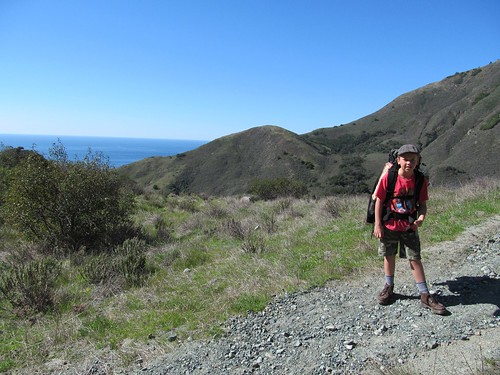
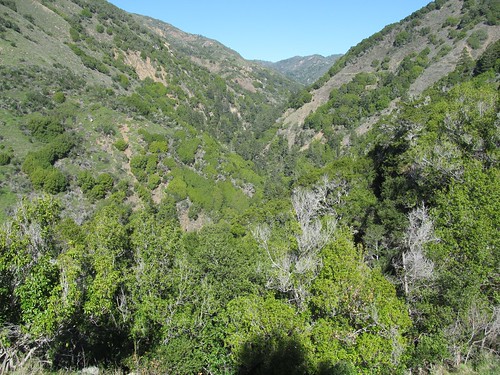
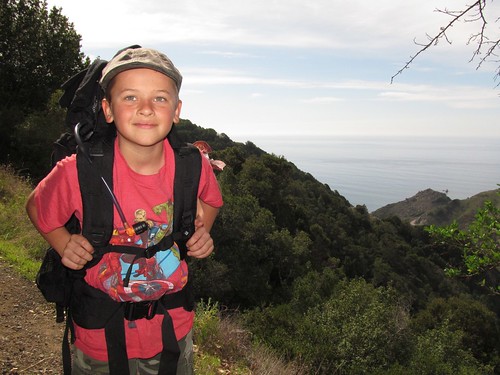
We shared a Hearst Ranch hamburger at Sebastian’s in San Simeon and parked near the trailhead at noon.  Ian’s pack weighed about 20 pounds, mine about 35.  The first section of the well-traveled path was a trudge, relieved by dramatic views of the ocean below and the steep canyon above.

IMG_4387.JPG

IMG_4394.JPG

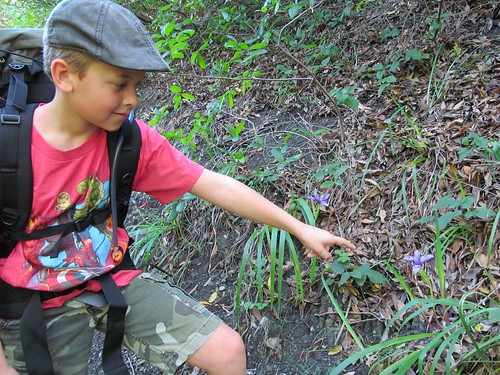
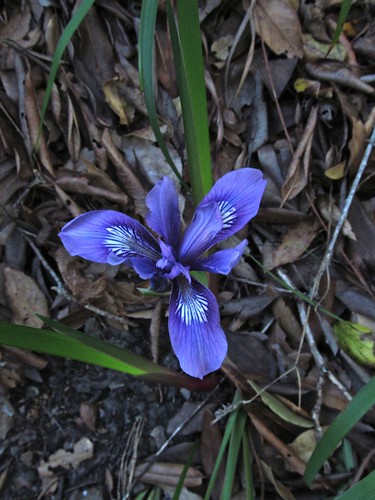
The ecology of this valley was  similar to that of the Big Sur River I’d I’d traveled through two weeks earlier, but also different.  A hundred miles to the south, here there were no Redwoods, but occasional large Douglas Firs and a full canopy of California Bay Laurel, whose new winter leaves glowed fluorescent light green.  Lush Fremont Iris bloomed in the shade,

IMG_4381.JPG

IMG_4382.JPG

and the sunny patches of exposed Serpentine soil where no trees grew sported rich displays of Poppies, Paintbrush and Shooting Stars. Ian distracted both of us from muscle pain and fatigue by recounting the plot of Shadowmage, the novel he’d recently  finished reading on his Kindle for a book report.

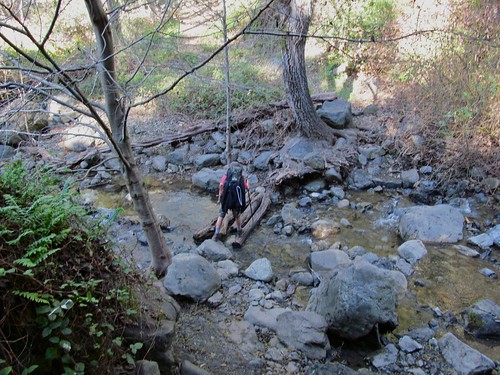
It took us an hour and a half to reach the high point almost directly above the road and our tiny Prius, Reddy. There the trail headed inland on a level contour cut into the mountainside, zigzagging toward and away from tributary creeks grooving the main canyon. After the shakedown climb, the last mile and a half of the hike went fast and smooth.  At the first trail junction we descended toward the main creek, whose rush and roar we’d heard the whole way, down to the dark and somewhat dismal campsite I remembered.  But further exploration led to a crossing of  Spruce Creek just above its convergence with Salmon Creek and a promontory bathed in Winter afternoon sun.

IMG_4402.JPG

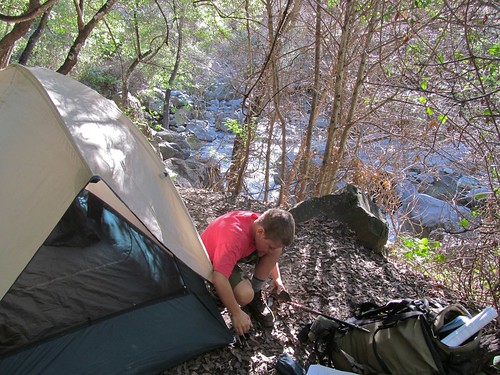
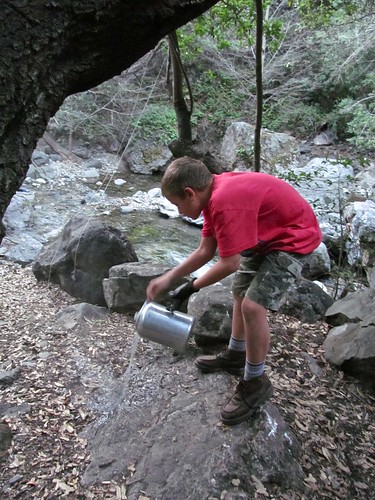
We pitched the old tent, gathered firewood and relaxed a little while.

IMG_4408.JPG

IMG_4412.JPG

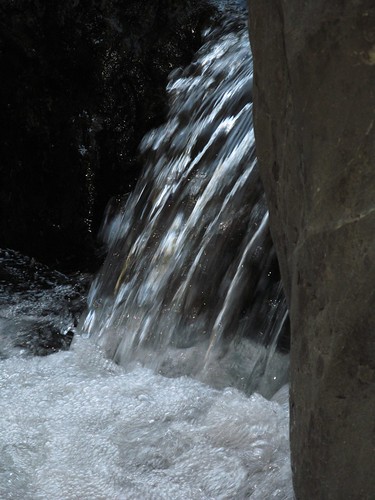
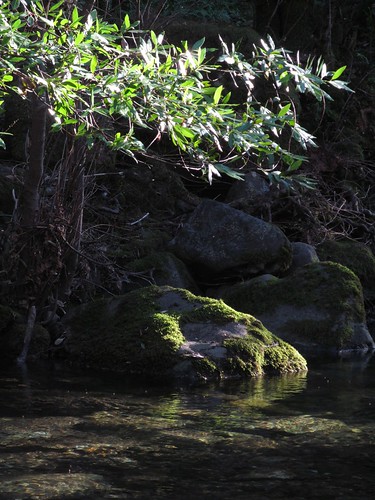
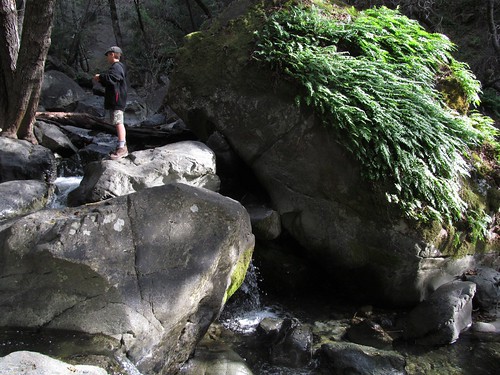
Then it was time to enjoy the pleasure garden: the play of light and water over rocks,

IMG_4417.jpg

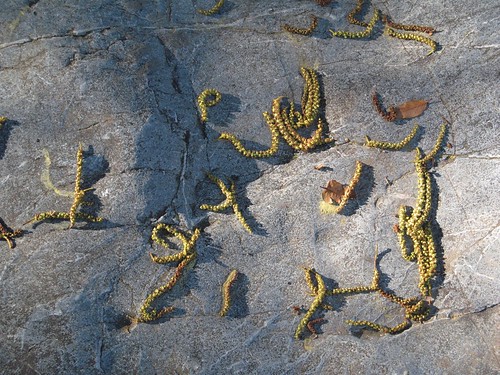
the bloom of  pollen-spilling alder catkins,

IMG_4435.JPG

the extremes of color and shadow on leaf, moss, stone, and liquid,

IMG_4441.jpg

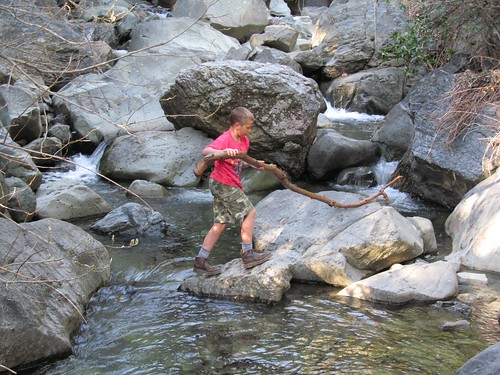
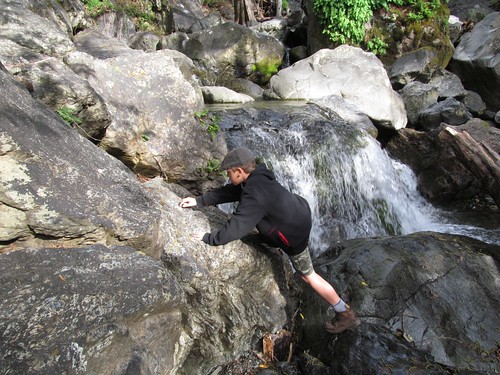
the thrill of hopping, climbing and jumping,

IMG_4423.JPG

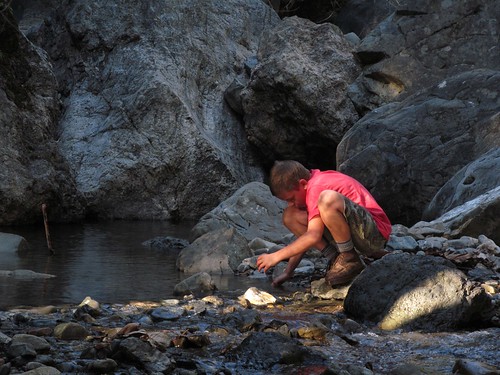
the satisfaction of building dams and taking pictures.

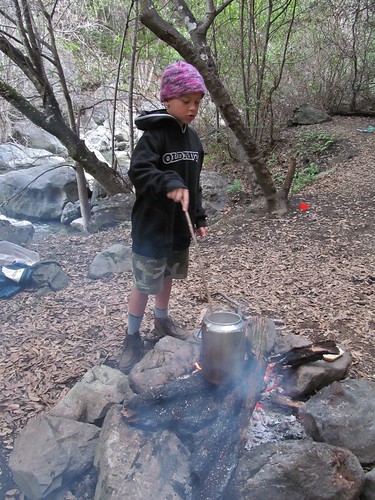
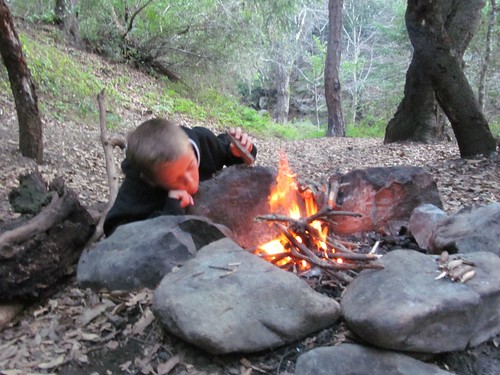
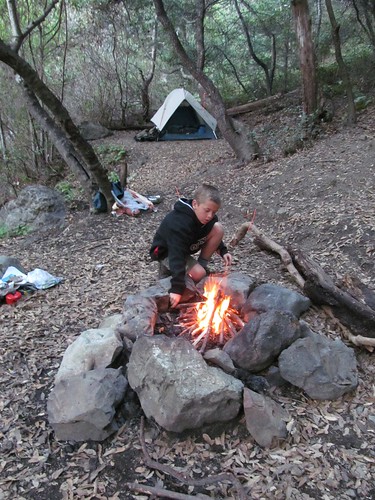
IMG_4454.JPG After the sun passed below the canyon’s wall and our little island of light was engulfed in shadow, Ian built a layered pyramid around a sheet of crumpled newspaper–tinder first, then pencil sized twigs, then thicker sticks”and lit the fire with a single match.  He nursed it with bellows breath and fed it with fuel wood until the sparks crackled and the bed of coals was hot enough to ignite the thick wet logs we’d dragged from a distance out of the forest.
IMG_4458.JPG

IMG_4460.jpg

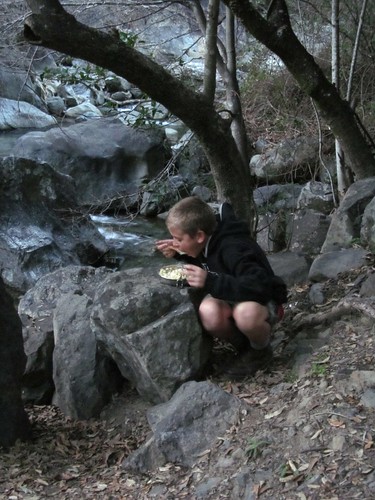
He cooked a box of mac and cheese in the coffeepot on the camp stove, drained it and gobbled it down as I munched bread, cheese and salami.

IMG_4461.jpg

IMG_4463.jpg

Afterwards we toasted marshmallows and made s’mores, stashed all the food in a bag, and hung it with a cord from a thin branch above the stream to keep it away from the bear.

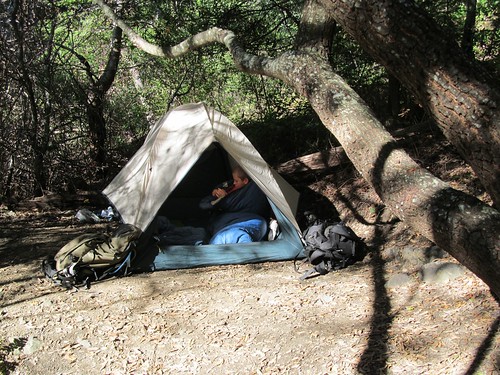
Snug in sleeping bags by 7:00, we saw the moon rise above the canyon walls through the branches overhanging the tent. By 7:30 we’d stopped talking.  Though I woke up every hour or so, feeling my leaky thermarest mattress gradually deflating and listening to the rich music of the creek, I slept eleven hours and awakened refreshed.  Ian slept another hour while I cooked cowboy coffee and restarted the fire.  He got up and made another pot of mac and cheese for his breakfast.

IMG_4468.jpg

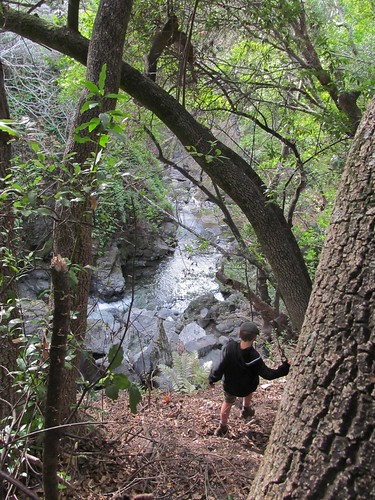
We set off through the creek in search of a large waterfall about a mile upstream, him leading the way over big rocks, across logs, and up steep banks, as the going got rougher and more spectacular.

IMG_4479.JPG

IMG_4482.JPG

We turned back before finding the waterfall, hoping to avoid exposure to poison oak stems that hadn’t yet leafed out and therefore remained hard to recognize

IMG_4483.jpg

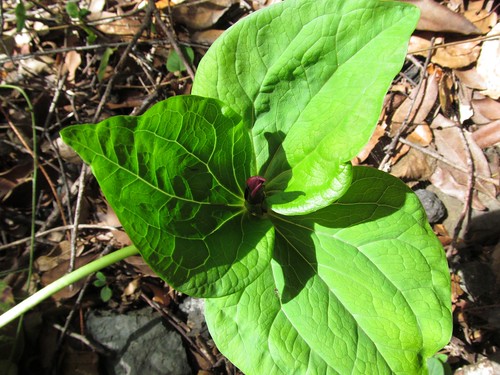
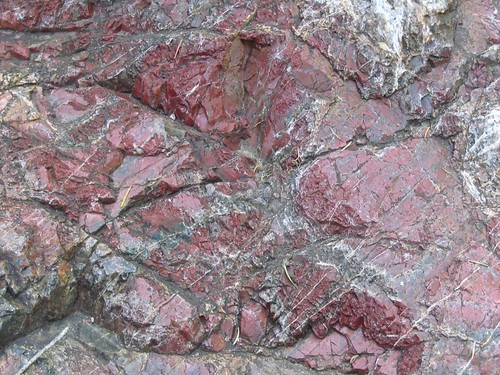
We sighted budding triliums and boulders of jasper

IMG_4485.JPG

IMG_4489.JPG

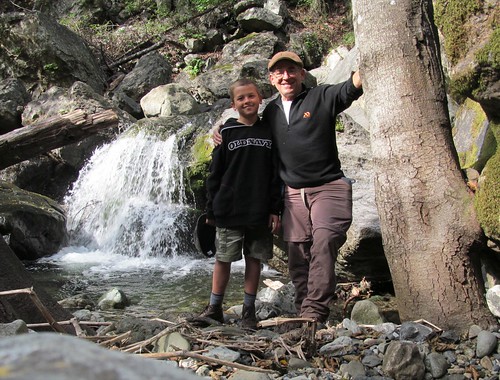
and posed together for a self-timed photo before drenching our feet and boots in an awkward stream crossing.

IMG_4487.JPG

Back in camp we packed our gear, doused the fire, and at noon, as planned, hit the trail back.  The return hike was less arduous than the way in.

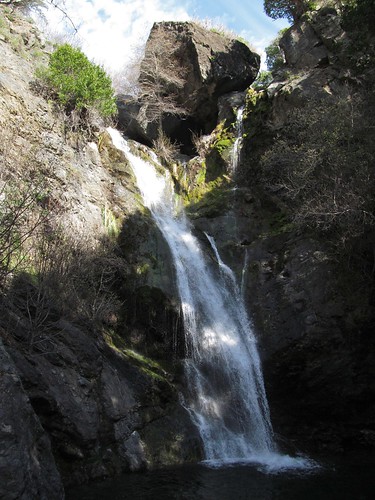
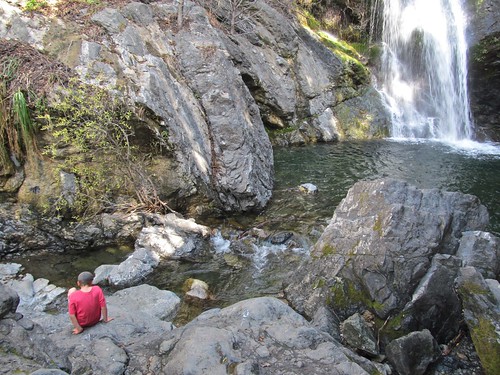
IMG_4496.JPG Just before reaching the car, we followed a spur leading to an impressive waterfall  that compensated for the failure to reach the one upstream. It was topped by a loose boulder that looked like a teetering meteorite.
IMG_4504.jpg

It was no great challenge for us seasoned backpackers to clamber over the rockfall that hid the pool  and cavern at its base.

IMG_4503.JPG

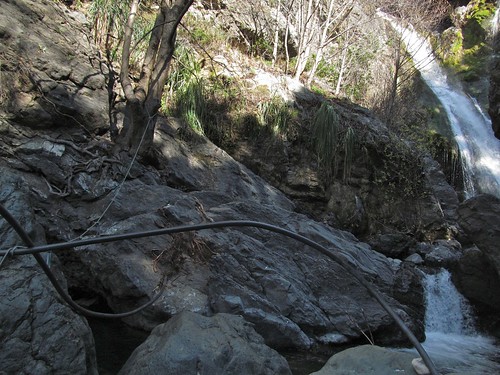
The way back down required crossing the creek along a twisted steel pipe while hanging on to a stretchy  mountaineering rope”a nice adrenaline rush to conclude our short, satisfying adventure.

IMG_4513.JPG

IMG_4512.jpg

Slideshow of full-sized pictures


Peru Day 7

Wednesday, January 16th, 2013

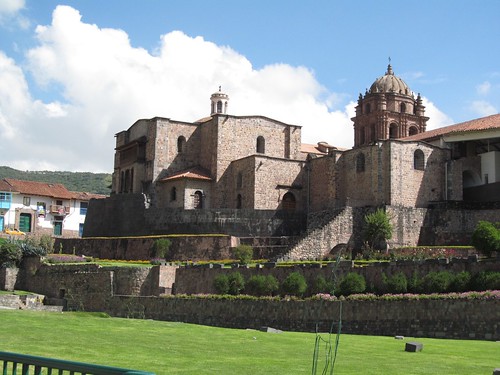
Next morning Alvaro leads us in brilliant sunshine on a walking tour of the downtown. First, directly across the street from our hotel, the Koricancha or Temple of the Sun, the religious center of the Inca temple, on top of and around which the Spanish built the Convent of San Lorenzo.

IMG_3682.JPG

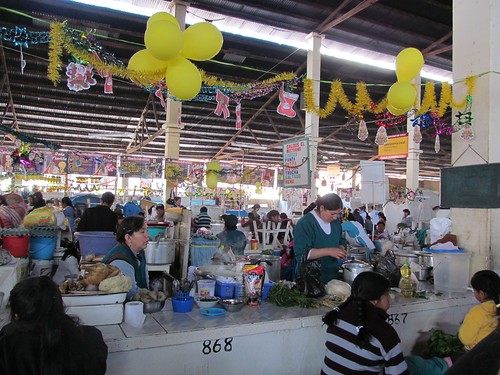
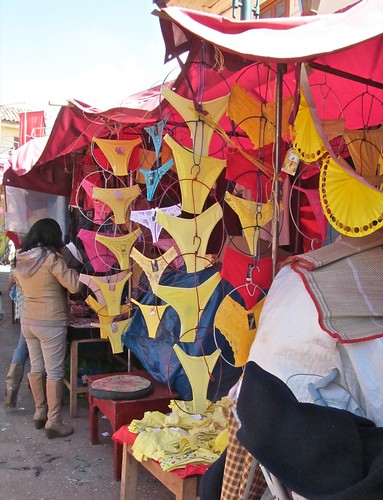
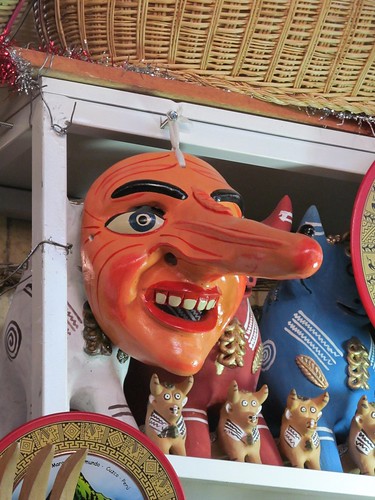
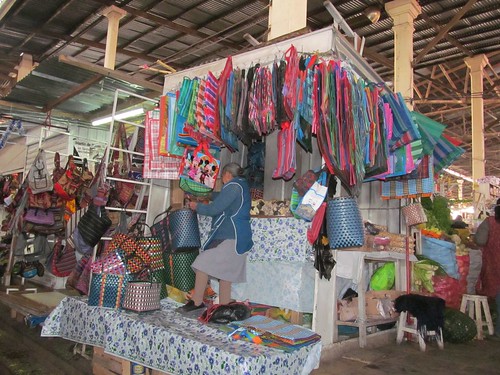
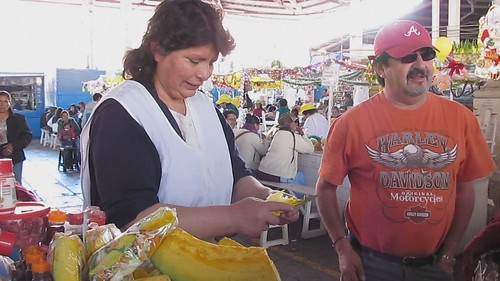
Then, the city’s central market, which all this week in celebration of New Year’s is festooned with yellow balloons, streamers, confetti and underwear.

IMG_3684.JPG

IMG_3710.jpg

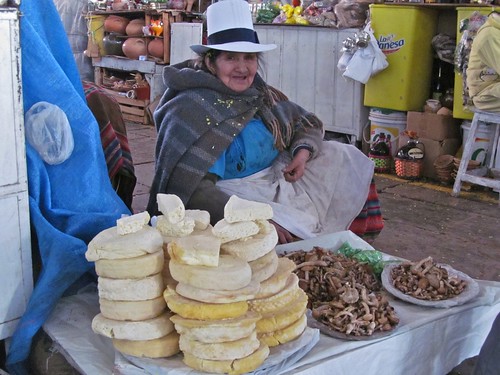
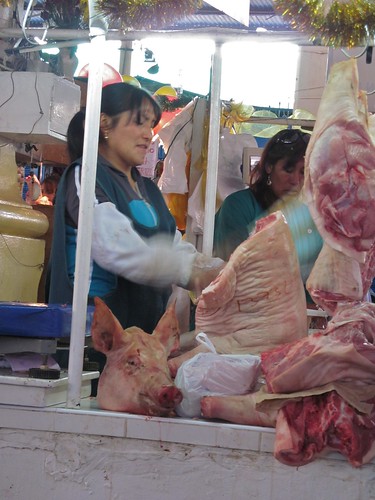
Inside is a riot of colors, sounds and smells and of merchandise, costumes and activity.

IMG_3694.jpg

IMG_3696.JPG

IMG_3700.JPG

IMG_3707.jpg

MVI_3699

[Click image for movie]

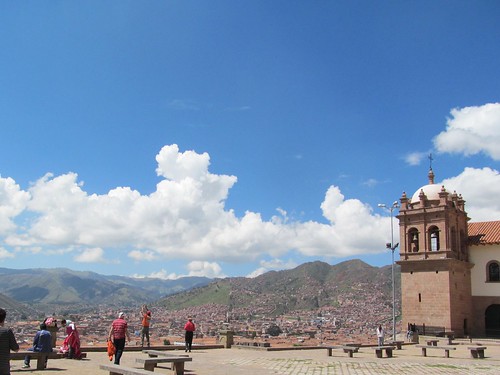
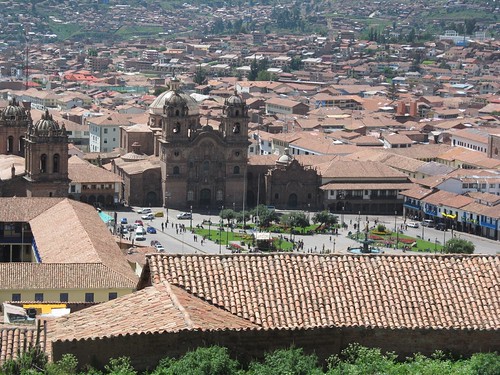
We pass through packed streets to the bus and drive by another new community on the hillside to a 17th century church overlooking the city

IMG_3713.JPG

IMG_3718.JPG

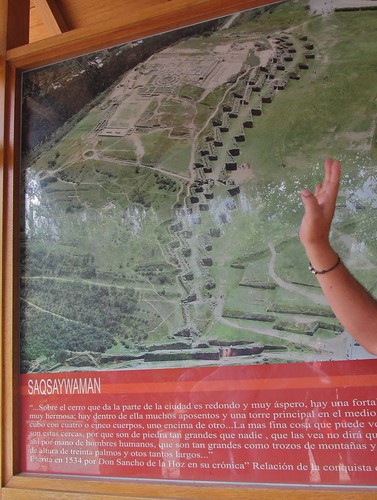
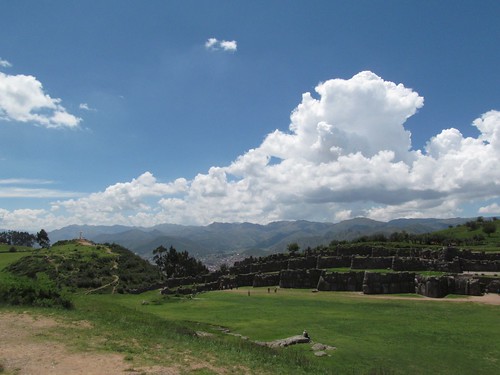
and then a little higher to Sacsaywaman, an immense Inka temple fortress laid out in the shape of a bolt of lightning. It was the scene of a famous battle between Pizarro and the rebel Emperor Manco Inka, and still competes for prominence with the large statue of Christ on an adjoining hilltop.

IMG_3720.jpg

IMG_3739.JPG

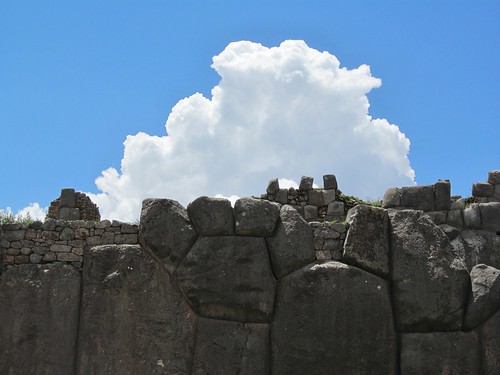
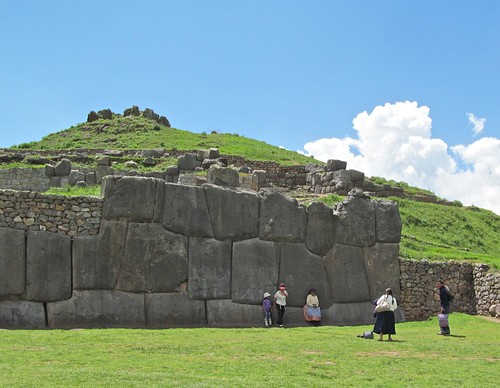
Much of the temple was dismantled by the Spanish to build the cathedrals that were intended to replace it, but the megalithic foundation stones, perfectly fitted and exquisitely shaped–here like a puma’s paw–have withstood Qosqo’s earthquakes and provide a site for locals to enjoy holiday picnics.

IMG_3737.JPG

IMG_3725.JPG

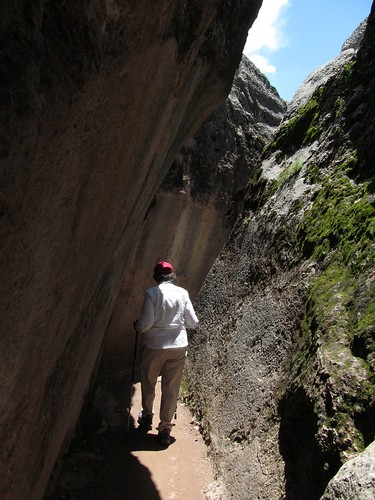
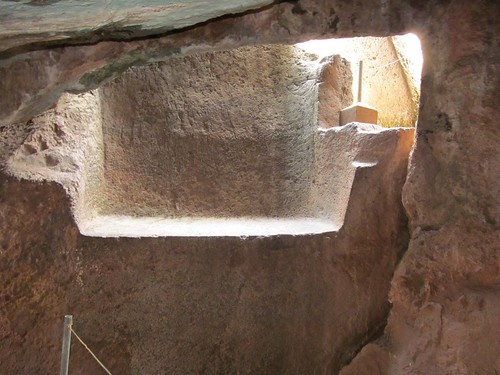
Another stop brings us to Q’engo, an underground labyrinth carved out of a natural rock formation where Inkan royalty were mummified.

IMG_3745.jpg

IMG_3749.JPG

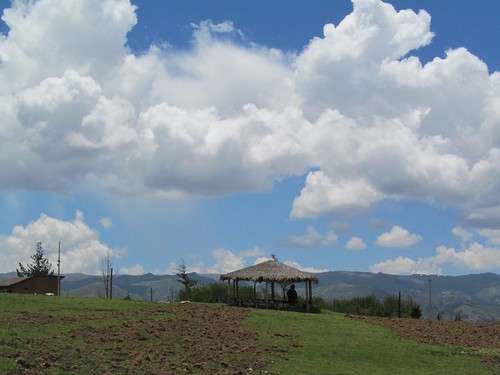
Two minutes down the road we get off the bus at the edge of a field overlooking the city. A shadowy figure appears in the distance sitting under a thatched pavilion.

IMG_3750.JPG

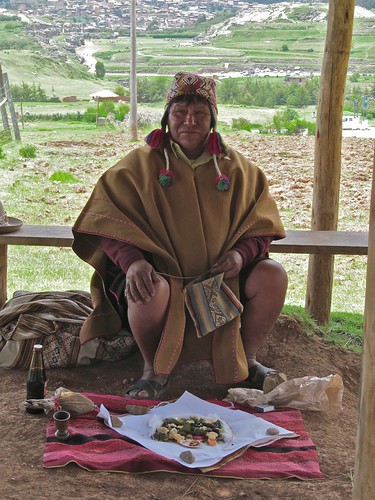
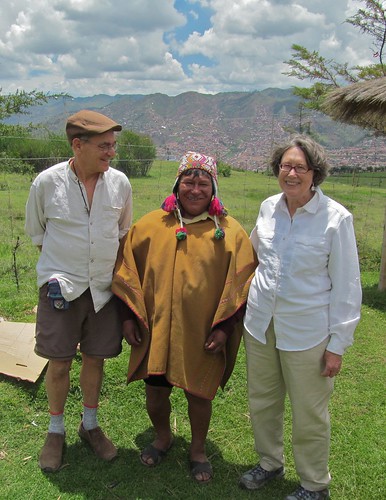
As we take seats, Alvaro introduces him as a curandero or shaman, a healer who has traveled here a long way from the highlands to conduct a ceremony for us. We agree to refrain from picture taking while the ritual proceeds. The curandero unfolds a blanket and covers it with a large white sheet of paper. He pours libations of beer on the ground and unfolds small packets containing corn, rice, sugar, candies, flowers, potatoes, alpaca jerky and other substances and arranges them in a mandala-like pattern surrounded by cotton for clouds and multicolored strings for Inka roads. He rocks and chants to himself like a davener in synagogue. All of this is meant as an expression of gratitude to the earth goddess, Pachamama.

IMG_3751.jpg

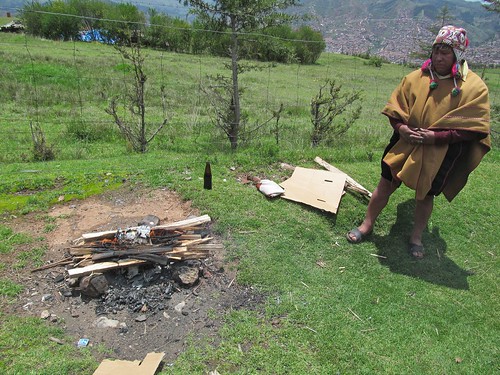
He folds the loaded paper into a compact bundle, tucks coca leaves into the top and blows on them,  laying hands on each person in the group. To dispose of any illness or ill-feeling, Alvaro says we should exhale it onto the packet. When everyone has done so, the curandero places the bundle on a wood fire Alvaro has kindled outside. As it burns, he poses for more photos and accepts gratuities.

IMG_3756.JPG

IMG_3757.JPG

Though logically contradictory, it doesn’t seem inappropriate that we offer up both our goods and our evils to the goddess. And given the prevalence of coughs and swollen eyes at this stage in the trip, the promise of a purge of poisons adds immediacy to the exotic ritual.

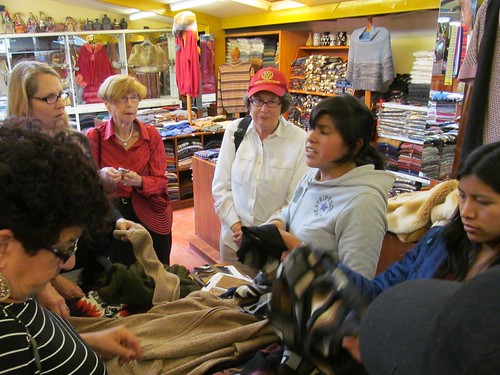
We cross the road to an unobtrusive storefront and inside find a large showroom full of alpaca woolens of varying grades. Alvaro encourages us to buy here rather than on the street or in the markets for the best prices and quality. Jan and I comply, purchasing gifts for friends and relatives back home and for ourselves.

IMG_3759.JPG

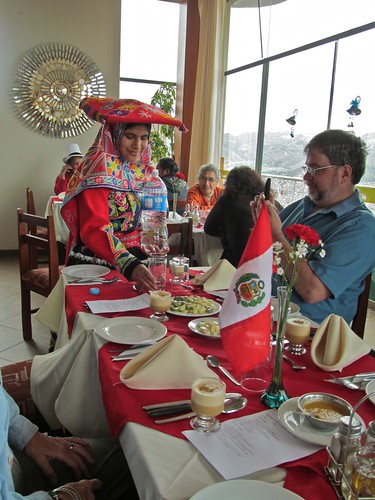
The day’s planned activities conclude at a hillside restaurant with panoramic views of the city where  luncheon is served by a woman in spectacular traditional garb.

IMG_3761.jpg

On the way back to the bus after the meal, we’re serenaded by passing holiday celebrants.

MVI_3768

[Click image for movie]

While Jan stays at the hotel, adding rest, antihistamine and more ibuprofen to the curandero’s cure, I explore the walled streets of the central downtown for an hour or so, but then join her, satiated with stimulation and grateful for the chance to read more in Mann’s 1491 about the historical background of what we’ve seen .

Slideshow of these and more full-sized photos

Linnk to Day 8


Peru Day 6

Wednesday, January 16th, 2013

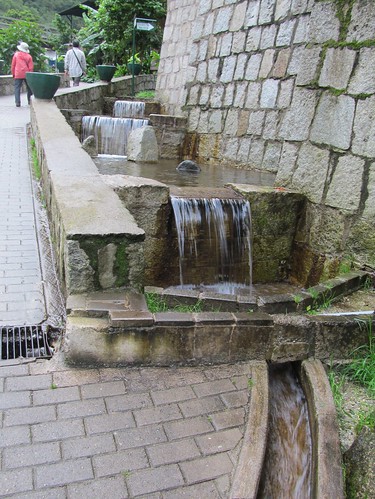
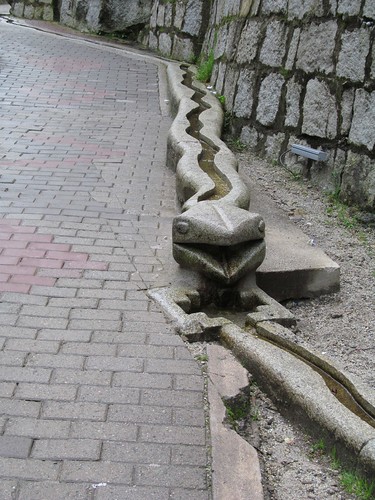
Next morning we walk back to the bus stop along the tributary rushing through the middle of Aguas Calientes. The street is flanked by fountains inspired by the spring-fed watercourses in the city above, one simulating cascades, another the undulating body of a snake.

IMG_3590.jpg

IMG_3594.jpg

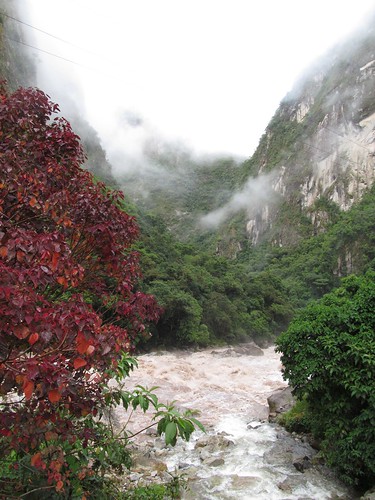
The sound of the rapids echoing between the high walls of the canyon roars through the town and adds excitement to our departure for the heights.

IMG_3597.jpg

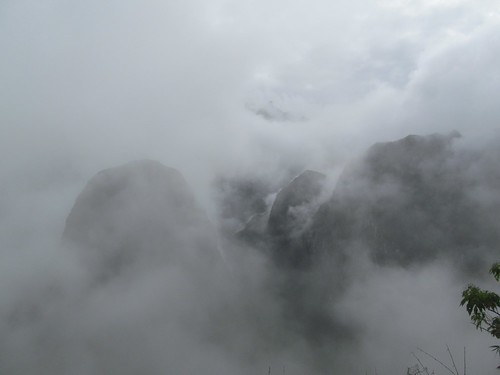
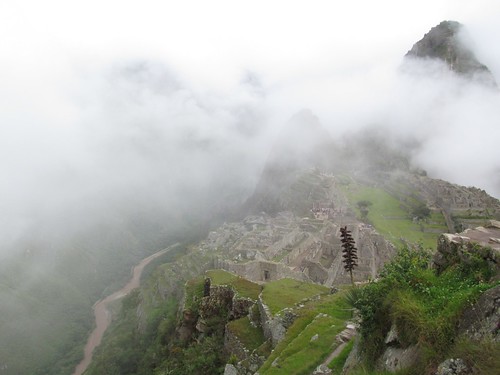
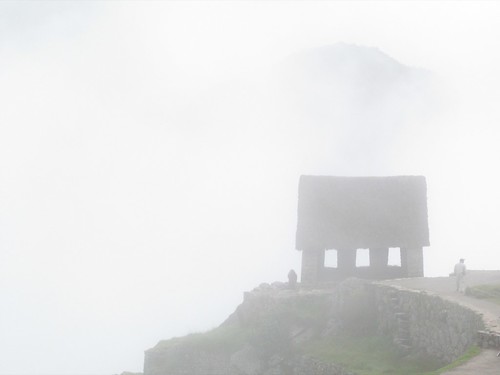
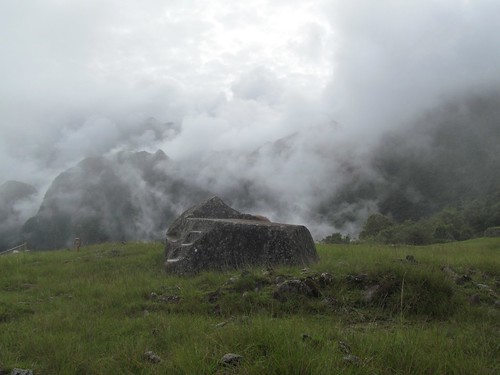
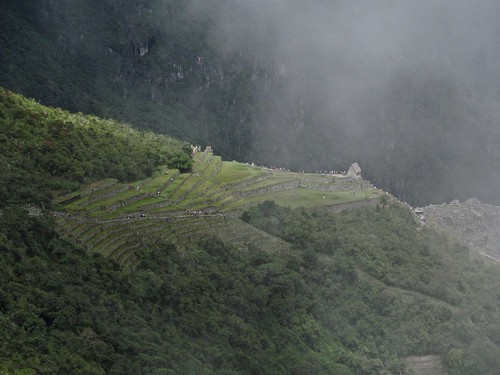
When we arrive, the site and surroundings are predictably obsured by fog.

IMG_3601.JPG

Alvaro leads the group in a prayer at the edge

IMG_3605.JPG

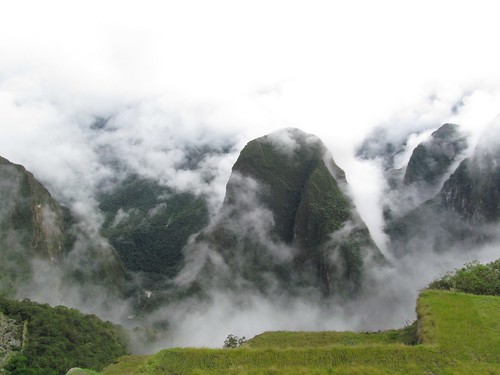
The clouds begin to lift. Yesterday’s amazing sights take on a living presence, mysterious and intimate.

IMG_3607.JPG

IMG_3633.JPG

IMG_3617.JPG It seems like the renting of a veil, the parting of a curtain, the revelation of divine nature, Pachamama’s gift.
IMG_3609.JPG

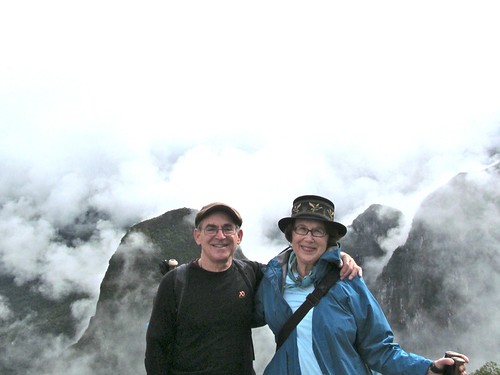
This is a moment together Jan and I are supremely privileged to share and preserve.

IMG_3612 - Version 2.jpg

Our group leaves the confines of the city and is led slowly by our guides toward a viewpoint looking down on it from above.

IMG_3650.JPG

Anyone who wishes to go on ahead has permission to hike to the Sun Gate, the high pass through which Machu Picchu first appears to those traveling by foot along the Inka Trail, the 500 year old original approach.

IMG_3642.jpg

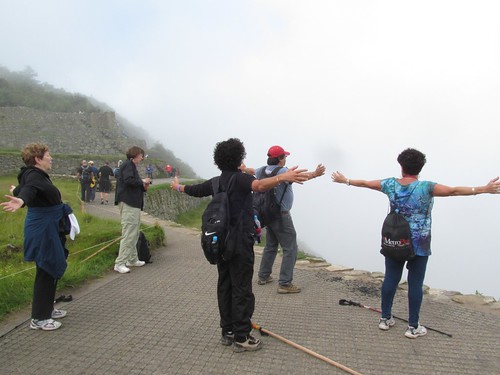
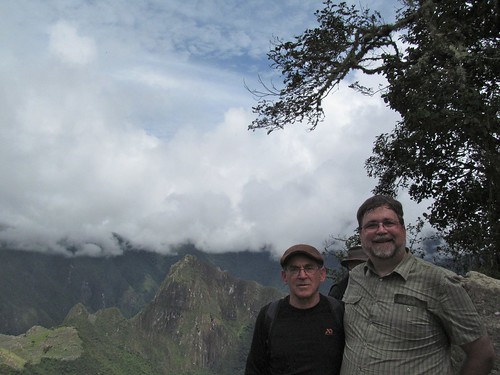
I welcome the chance for more exercise and a little solitude.  Half an hour later I encounter another member of our party. He accepts my assistance in climbing the rock wall below a small opening in the jungle that provides the only possible opportunity within miles to go to the bathroom. On the way out, he slips and falls on the stone path. He’s in great pain but refuses offers to call for help or accompany him back to the bus.  He will reach the Sun Gate!  With the assistance of four Ibuprofen and my spring-loaded trekking pole heroically he reaches his goal.

IMG_3658.JPG

Meanwhile, despite her injured knee and with the help of her two trekking poles and more Ibuprofen, Jan mounts hundreds of stone steps to the lower viewpoint. Little Al calls her the lady on four legs.

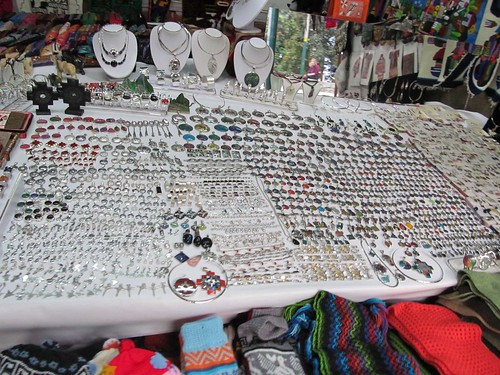
On the way back to the train she bargains in the market for silver earrings decorated with an Andean cross and symbols of the months and for a table cloth woven in the rainbow colors of the Qosqo flag.

IMG_3583.JPG

IMG_3585.JPG

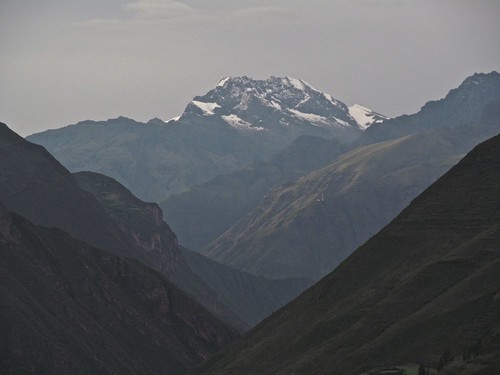
The bus trip back to Qosqo offers our first view of the snow-covered mountains of the Cordillera Blanca.

IMG_3677.JPG

Jan too is coming down with the cold that’s hit most members of the group. Having landed in a comfortable hotel room, we both decline to join the late night New Year’s Eve festivities in the central plaza and fall asleep well before the end of 2012.

Slideshow of these and more  full-size photos

Linnk to Day 7


Peru Day 5

Wednesday, January 16th, 2013

At breakfast, Jan begins a conversation with a young couple in the Villa Urumbamba dining room and asks where they are from.  “Lima,” says the man in accent-free English, “we’re here to celebrate New Year’s Eve.”

IMG_3330.JPG

She says we’re from San Luis Obispo California. He says he’s been there to visit his aunt who was a physician with Doctors Without Borders recently killed in a plane crash. Jan says she’d met her once and we both attended the funeral of her volunteer pilot, whom we knew as an environmental activist.

Like our son Joe, Pacifico is a mountain bike and offroad motorcycle enthusiast, and head of the Lima Mountain Bike Association, which is now big enough to afford him employment.  His partner, Maria, is a fashion designer.  He shows me his bike and points out the trail on a distant hillside that he’s built by himself.

IMG_3333.JPG

IMG_3334.JPG

Ruefully we leave this beautiful enclave and head back to Ollantaytambo to catch the train for Machu Picchu. On the way we stop at a house marked by a red plastic bag on a stick, the sign for a chicha bar, one of the several found in all rural villages.

IMG_3342.JPG

The doorway is painted with a design copied from an ancient inscription.  Long before the Inkas, this form of corn liquor has been a staple of the Andean pharmacopeia and diet, just like the coca leaves on the figure’s headress.

In the courtyard, Alvaro shows us the bar game of Sapo, which involves tossing heavy bronze disks into the mouth of the frog and various other orifices.  I enjoy playing, even though my aim has always been terrible.

IMG_3344.jpg

IMG_3353.JPG

Inside another kitchen that seems like a museum display, we are introduced to the brewer-hostess.

IMG_3358.JPG

IMG_3366.JPG

IMG_3359.jpg

She demonstrates the process of making chicha: sprouting corn kernels, fermenting them, filtering and stirring the brew in large clay pots and ending up with the either the cheap plain or the more expensive variety flavored with strawberries.

IMG_3363.JPG

IMG_3367.JPG

IMG_3372.JPG

IMG_3371.JPG

Peruvians are known to drink it by the half gallon, but we each only take a sip, reluctant to imbibe anything that might weaken tolerance for the altitude.

Near the bathroom at the back of the bar, we discover another little guinea pig barn, a lovingly arranged tool-storage wall, and a quinoa plant, which I’ve never seen, even though I eat a lot of this Peruvian staple.

IMG_3379.JPG

IMG_3381.jpg

Alvaro stops the bus again to grab some beetles infesting a prickly pear cactus by the side of the road.  He crunches them on a sheet of paper to reveal the source of cochineal, the red pigment used as a fabric dye, cosmetic, and wall paint.

IMG_3384.JPG

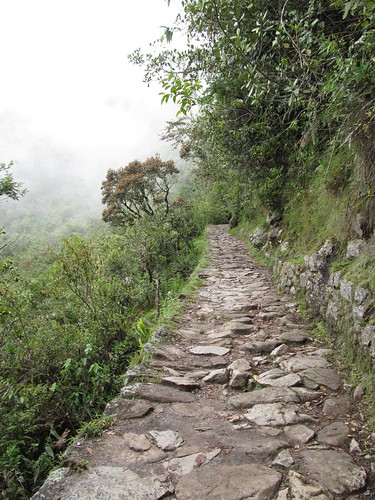
At Ollantaytambo, we board the train that travels beyond the end of the road down the narrowed Urumbamba valley, now a canyon. We pass a footbridge at the start of the Inca Trail, the beginning of a four-day trek to Machu Picchu on the old stone road which now requires advance registration, a guide and porters.

IMG_3404.JPG

Another footbridge rests on original Inka piers. As we descend in altitude the surrounding vegetation turns to thick tropical jungle.

IMG_3407.JPG

The railroad terminus is Aguas Caliente, a bustling tourist town on either side of the tributary that dashes down from fog-enshrouded peaks to converge with the Urumbamba.

IMG_3434.JPG

There we meet “little Alvaro,” another licensed guide who assists our Alvaro, and we board one of a steady stream of buses carrying visitors up the “Hiram Bingham highway,” named after the Yale explorer who claimed to discover the ruins of the lost city in 1911. In fact, they were shown to him by local farmers who lived on the site, but Bingham must share credit with Pachacuti the original builder for creating an economic bonanza for later generations.

As the river shrinks to a narrow ribbon below, surrounding mountains break through the clouds.

IMG_3443.JPG

Then we’re off the bus, through the mass scene at the entrance kiosk where passports must be shown and the $60 entrance fee paid, and out on a terrace for the first view of the place.  Though I’ve seen it on countless brochures and billboards, nevertheless here in person, it shuts the mouth, quiets the brain, and fills the eyes with wonder. Walls, terraces, houses, temples, the jungle, the clouds above, the adjacent summit of Huayna Picchu, the peaks rising from the river below, the myriad miniscule people–all that variety in a unified three dimensional panorama.

IMG_3470.JPG

After the initial impression of the whole, I take in more of the specifics: steep agricultural terraces and drainage corridors,

IMG_3474.JPG

waterfalls tumbling out of the cloud forest,

IMG_3461.JPG

structures hewn out of and bedrock and grafted onto it,

IMG_3463.JPG

IMG_3481.JPG

Huayna Picchu peak chiseled with staircases and topped with temples,

IMG_3459.jpg

IMG_3469.jpg

animals domestic and wild.

IMG_3477.JPG

IMG_3567.JPG

Despite the rainy season, the weather is dry and the clouds are clearing.  Alvaro’s prayers have worked!  He leads the group to the Temple of the Condor, a dazzling statue of one of the three sacred beasts of the Inka, representing the realm of the sky, and also a site for sacrificial offerings.

MACHU PICCHU 4-0515.JPG

photo credit

IMG_3492.JPG

He says his prayer, offers some coca leaves, and distributes mouthfuls to the rest of us. The sun comes out, revealing the primary deity the Inka worshipped.

IMG_3504.jpg

IMG_3507.jpg

IMG_3519.jpg

He impresses upon us their aesthetic appreciation, their scientific observation, and their spiritual responsiveness to the natural environment.  Here a stellar observatory in protected reflecting ponds

IMG_3508.jpg

Here a carved imitation of the peak behind it

IMG_3535.JPG

Here, at the zenith of the site, a sundial.

IMG_3560.JPG

IMG_3563.JPG

In front of Mount Machu Picchu, we stop for a group portrait–travellers from Vermont, Massachusetts, New York, Pennsylvania, Illinois, Arizona, and California.

IMG_3536.JPG

At the base of the southwest side of the ridge, the river twists downstream.

IMG_3547.JPG

To the northwest, peaks of the Cordillera momentarily  appear thousands of feet above us.

IMG_3564.jpg

IMG_3565.JPG

The most polished masonry of Machu Picchu is reserved for the Temple of the Sun, a structure twinned by Korikancha, a temple in the middle of the city of Qosqo and aligned with it along a mysterious network of meridians.

IMG_3577.jpg

The temple perches on a rough rock face above a cave used for the preparation of mummies which represents the underworld realm of the dead, presided over by the snake god.

templepan.jpg

As we head back to the entrance late in the day, the contrast deepens between shadow and light.  Color, shape and texture take on intoxicating intensity.

IMG_3556.JPG

IMG_3573.jpg

Down in the valley, we walk to dinner at a gaudy restaurant where we’re serenaded by a lively group of traditional musicians. The we check in for the night at a friendly little hotel.

IMG_3586.JPG

Slideshow of these and more full size photos

Link to Day 6


Peru Day 3

Tuesday, January 15th, 2013

A 5:30 wake-up call marshalls us back to Lima airport under Alvaro’s direction for the flight to Qosqo, the center of the Inca empire and of present day Peruvian tourism.  On the way he regales us with stories from the Inka history that he identifies as his own heritage, occasionally speaking in the Quechua language that they imposed on its diverse communities during the less than hundred year duration of their rule in the 15th and 16th centuries.

After a three-hour delay and two gate changes, we fly for ninety minutes and land at the Qosquo airport situated in the center of the city. Signs proudly exclaim that it is soon to be replaced by a much larger international airport on the outskirts. I fear that the expansion of industrial tourism this brings will eradicate whatever is left of the native cultures and archaic way of life we’ve come here to appreciate. That at least is what happened at Cancun in the Yucatan, which we travelled through three years ago to attend the wedding of our niece in Playa del Carmen.

To help us adapt to the altitude change, we will descend to the 6000 foot level in the Sacred Valley of the Urumbamba River for several days before returning to this 11,000 foot city.

Cusco-MachuPicchumap.jpg

As we exit the terminal, there’s a clap of thunder and sudden mountain downpour.  Alvaro reminds us that summer in Peru is the rainy season and that abrupt weather changes are to be expected. However he will be praying to the Apus”the Inca spirits of the mountains”to provide us with sunshine at Machu Picchu.

In the still pouring rain”the snowline in this near equatorial latitude is 14000 feet–the bus winds above the City nestled in the valley below.

IMG_2911.JPG

Alvaro points out rock formations and walls that mark the Inca holy places (Wasi) and agricultural terraces that cover the countryside.

IMG_2909.JPG

We stop at a settlement on the pass above Qosqo to view new peasant structures that incorporate traditional ceramic bas-reliefs, thatch roofs and shrines that meld pagan and Christian images.  We encounter campesinos herding sheep and pigs and selling native crafts to tourists.

IMG_2928.JPG

IMG_2931.JPG

IMG_2933.JPG

It’s hard to believe that this is not all part of an Andean theme park, but as we start downhill following the course of a mud-swollen stream, it’s clear that we’re in a real archaic landscape where homebuilt houses and subsistence farming still prevail.

IMG_2965.JPG

IMG_2966.JPG

The streambed deepens into a canyon with steep rock walls rising on the opposite side.

IMG_2983.JPG

The road turns and we stop for a new view. The canyon we’re in converges 1500 feet below with a wide valley flanked by mountain ranges on both sides whose tops disappear into the clouds. Through it runs the Urumbamba river flowing westward toward our destination, Machu Picchu, and downward toward the Amazon.  Directions are confusing; I expect the Amazon to be across the Andes to the east, but the map shows the range in this region angling from a north south to an east west axis before resuming its general orientation further north. At this overlook, I imagine the route taken by the rebel emperor Manco Inka and his retinue as they fled Qosqo pursued by the Spanish over the mountains and into the jungle.

IMG_2992.JPG

This is the Sacred Valley, known for its fertility and beauty and the magnificence of its archaeological resources. Alvaro prays to the Apus while the rest of us take pictures.

IMG_2994.JPG

IMG_2996.JPG

At the convergence of another river on the opposite side of the Urumbamba the town of Pisac comes into view below precisely spaced and angled walls that terrace the nearly vertical rock faces. How could they have been constructed in the first place and how could they have lasted in earthquake country another 500 years?

IMG_3013.JPG

IMG_3006.JPG

IMG_3011.JPG

We cross the river and stop to wander through the narrow streets of the ancient market town. I’m drawn in by two little girls in Andean costume cradling a bleating lamb and a puppy.

IMG_3055.JPG

In return for the picture I put a sole (about 40 cents) into one of their outstretched hands.

IMG_3057.JPG

The bus ascends through a gully behind the town, providing a closer view of the terraces, many still cultivated with corn and potatoes by local farmers whose chickens and cows share the road with us.

IMG_3039.jpg

IMG_3033.JPG

As we get higher, the terraces take the shape of an amphitheatre and are no longer farmed but part of an archaeological preserve.  We walk on a stone path toward a temple fortress overlooking the valleys below and a stone village above.

IMG_3042.JPG

IMG_3047.JPG

A woman in traditional garb insistently offers handicraft merchandise laid out on colorful blanket.  No one is buying so she folds up her wares and walks toward the village.

IMG_3048.JPG

IMG_3052.jpg

The bus heads back down to the river and drives through tiny villages strung along the road.  We pass a supply yard storing great piles of 24 inch pipe that will bring natural gas from the Peruvian Amazon through the Sacred Valley to Qosqo and Lima.  “This will be tremendous for us”cheap energy to fuel economic development.” Says Alvaro.  I think about the melting glaciers above us and the protests in the U.S. against natural gas fracking and the construction of the XL pipeline from Canada to Louisiana.

In the town of Urubamba, the bus turns off the main road down a bumpy little lane and comes to a halt at a mud puddle. To reach our lodgings we walk over a stone wall, through a wet potato field, and past a new adobe gateway, accompanied by the sound of the rushing river below.

IMG_3341.jpg

IMG_3340.jpg

Just past a tree full of ripe papayas, the Urubamba Villa sign comes into view.

IMG_3339.JPG

A massive portal opens on a beautiful prospect: immaculate lawns, flowery rock gardens buzzing with hummingbirds and butterflies, fountains and ponds surrounded by a portico supported by peeled timbers secured to beams with braided rawhide lashings.

IMG_3075.jpg

IMG_3073.JPG

IMG_3325.JPG

IMG_3313.JPG

At the center of the garden stands a circular sanctuary topped by a high dome.

IMG_3320.jpg

IMG_3321.JPG

For two nights, this is to be the base camp for our approach to Machu Picchu.

Slideshow of these and more full-size photos

Link to Day 4


A Visit to EldrBill

Sunday, August 28th, 2011

There’s alot for an environmentalist to feel hopeless about these days, from calls for the militarization of the Arctic Ocean as a response to the melting polar icecap to the prospect of our local chapter of the Sierra Club running out of money. So I decided to take a little trip to Nipomo to express a treasurer’s appreciation to a donor whose generosity has allowed us to keep going for one more year, and also to get my spirits raised.

“Bill’s Farm” looked no worse for the wear since the last time I stopped by three years ago. I noticed an ancient carriage almost hidden by the gaggle of bicycles kept here for the use of his hostel visitors from all over the world and the array of solar panels on the roof setting off the “No Diablo” sign by the corner of the house.

IMG_0075.JPG

I was welcomed by a high ringing voice, and once inside surrounded by walls and tables completely covered with pictures and clippings. On the counter was a half-empty quart bottle of beer next to another one full of milk.

IMG_0080.jpg

“Just did the goats,” giggled the man with flowing white hair, cascading beard, cabled arms and frighteningly tough legs revealed by his short-shorts.

“I love goat’s milk,” I said, “reminds me of my days on an old homestead in British Columbia.”

“Take it,” he answered, “and that dozen eggs from my chickens.”

“Bill, I came to say thanks,” I replied, “and here you keep giving me more.”

The phone rang and he spoke briefly to someone about the Santa Maria Times article on the table that reported his $500 environmental award to the graduating High School Senior who’d volunteered in the Nipomo Native Garden and was now heading for UCSB.

IMG_0079.JPG

“These young people inspire me,” he said. They’re our only hope. I’m 86 and starting to lose it, but they carry the torch. Here’s another one of my heros,” he declared, pointing to a picture of Jordan Hasay: “While I was doing a triathlon a couple of years ago and just ready to throw in the towel, she came up behind me. ˜You can make it,’ she said, ˜just keep going.’ And she was right.

Then here’s Virginia Souza, she’s the President of the Natural History Museum in Santa Maria. It’s tiny, but she just hosted an event there for the Chamber of Commerce which brought out forty people. In Santa Maria! She was a biology student of mine way back when. I introduced her to the idea of ecology. Here’s an award for the 40th anniversary of Earth Day she gave me last year.”

IMG_0085.JPG

“And this is my woman’s wall. Next to the fridge, pictures and articles about Barbara Boxer, Lois Capps, Hilda Zacarias, Lisa Jackson, Dixie Chicks, Sonia Sotomayor, Ruth Coleman, Marion Jones, Steph Brown, Kathy Goddard Jones. “I remember your Dad, Henry,” Bill chuckled. “He used to tell me how the dunes were ˜so sensual.'”

That must have been 20 years ago, when my father was just about Bill’s age now. “How old are you?” he asked.

“Sixty nine,” I answered, “just retired.”

“My sixties were my best decade,” said Bill. “Learning how to appreciate things because the end was in sight, but still capable.”

He brought over a stack of postcards and said, “here, take a few.” The top one was a photo of a sand dune gracefully curved against the sky. Running up it was a black lab next to a perfectly formed naked young woman. “I’ve worked to save those Dunes and Point Sal for 50 years–from a Nuclear Power Plant, from a Coal Fired power plant, from a housing development, from developers. And now they’re safe in perpetuity, since the SLO Land Conservancy just purchased the last developable property. Lets go out back.”

We passed his desktop computer surrounded by magazines and books, where Bill composes his “Nipomo Free Press,” an email newsletter that includes commentaries on the latest news and on long term issues as well as responses from his readers”precursor of the blog. We talked of another hero, writer and 350.org organizer Bill McKibben, who was sitting in a Washington jail after leading a protest against Obama’s approval of the XL Pipeline. We passed the chickens scratching in the sand, the empty pigpen”the pig was in the freezer”and the goat corral. He climbed nimbly over a high gate into an overgrown orchard of apple and tangello trees heavy with fruit that I sampled and picked. “I just cant keep these up any more,” he said with a twinkle. Don’t get old.”

IMG_0089.jpg

On my way back to the car weighted down with eggs, milk and fruit, I felt lightened. Instead of dreading yet another meeting to discuss grant applications, budgets, and liability insurance, I was eager to share Eldr Bill’s harvest with the volunteers at the potluck that night.