Topics

Shelter from the Storm

Wednesday, January 20th, 2010

Luscious sounds of rumbling thunder and rain tapping on skylights.  Still dark at 6:30.

After preparing a solo dinner last night with rappacini from the farmers market and a glass of wine, I lay down on the bed for a nap, which lasted until this morning. Tensing with the pains in my back and joints all day left me exhausted.  Settling under the old feather comforter felt wonderful, as if I had been up all night or spent hours at hard labor in the cold, even though it hadnt been a strenuous day, especially by comparison to Jan’s, who was at a Council meeting that would probably go till midnight.  I’d accompanied Lucas and Claire to the dentist in Arroyo Grande, driven home for lunch, driven back to A.G. at Dennis’ request to take Ian out of school and get his cast removed, gone with him to the beach to look at  storm waves and topple little sand cliffs, and then stopped at the nursing home to see Ruth.  It was a shock to find her no longer dressed in her wheelchair, but sprawled in bed in a flimsy hospital gown without glasses or hearing aids or false teeth, her mouth shriveled and gaping, her hair lusterless, her skin gray, her brow  furrowed.  I announced my presence and took her hand.  She squeezed it once, then pushed it away,  shuffled on the mattress, and resumed fingering the edge of her gown. One word escaped her: “help.”  Then she quieted, apparently off to morphine-induced sleep, though her brow never relaxed.

The night before, Jan prepared an elegant dinner for Patricia whom we hadn’t seen in two years, since before her cancer diagnosis, radiation, chemo, and surgery.  She was as vital, busy and considerate as ever, full of lighthearted stories of her ordeal and triumph, of recollections of experiences we’ve shared, of questions about us and the family, and of her own burgeoning plans for this year”directing six productions at PCPA while teaching full time.

On the topic of feeling pain during her new exercise-physical therapy routine I was especially engaged”trying to distinguish between the benefits of pushing limits of  endurance and recognizing signals to pull back, use drugs, seek medical help.  The knee surgeon had told me two weeks ago to take four Aleve per day to see if that reduced swelling, but after reading of the long-term side effects of such regular use, I was experimenting with doing without it and working in the yard.  The results were not encouraging.

All this wintry local experience takes place within the darker framework painted by the news flooding in on radio, internet, and newspaper.  The failure of Obama’s promise, confirmed by the fizzling of the Copenhagen talks on climate change,  the widening of war in Afganistan,  the increase of debt and reduction of government services, and by yesterday’s Republican victory in Massachusetts.  And behind this political gloom lurks the metaphysical horror of the earthquake in Haiti.

I’m in the habit of preceding my morning meditation with prayers to a god whose existence I don’t believe in. I make three silent utterances beginning, “Thank you,” “Please,” and “I’m sorry.”  The Please is most often for cure of disease or alleviation of suffering by friends and family members: “let the chemo work for T¦, let the tumor  be benign for P, let R rest in peace.”  These requests affirm my concerns, discharge obligations and create the illusion of sending  positive influence their way through my obeisance to a higher power.  But when I think of the suffering in Haiti, the Please bounces back at me.  Even suspending disbelief and regressing to the innocence of the first graders in Ian’s  school who a dozen times a day hear of God’s benevolent intentions, I cant imagine a personality who would unrelentingly torment so many people while allowing me to listen to their story on the radio as I cook myself supper.
Letter to the Chancellor

Wednesday, December 23rd, 2009

Dear Chancellor Reed:

At the advice of your office, I am submitting some input on the search for the successor of Warren Baker as President of Cal Poly University San Luis Obispo.

I have taught here since 1988 and am recipient of the University’s Distinguished Teaching Award, the College of Liberal Arts Outstanding Scholarship Award and the CSU Systemwide Quality Improvement Award.

During his tenure President Baker has led Cal Poly to become one of the country’s preeminent Polytechnic Universities. I believe the primary mandate of his successor should be to transform Cal Poly into one of the country’s leaders in Education for Sustainability”the long-term approach to integrated solutions of economic, social and environmental problems.

It is crucial that the Trustees Committee for the Selection of the President incorporate terms in the job description and advertisement that call for successful experience in leading such institutional transformation and that they make promise in advancing sustainability an important criterion for final selection.

Doing so would serve the interests of Cal Poly’s students, who seek employment in emerging fields, of the institution, which needs more cross-disciplinary collaboration in teaching and research, and of the larger community, whose health and welfare depend upon the next generations’ commitment to addressing these problems effectively. (see  http://presidentsclimatecommitment.org/documents/Leading_Profound_Change_ExecSum_final7-28-09.pdf)

In support of this opinion, I refer you to the University Sustainability Learning Objectives recently adopted by Cal Poly’s Academic Senate and ratified by President Baker:

Cal Poly defines sustainability as the ability of the natural and social systems to survive and thrive together to meet current and future needs. In order to consider sustainability when making reasoned decisions, all graduating students should be able to:
¢    Define and apply sustainability principles within their academic programs
¢    Explain how natural, economic, and social systems interact to foster or prevent sustainability
¢    Analyze and explain local, national, and global sustainability using a multidisciplinary approach
¢    Consider sustainability principles while developing personal and professional values

It also bears mention that the “Top Ten Best College Presidents” selected by Time Magazine in November 2009 are all Sustainability Champions. (http://www.aashe.org/blog/top-ten-college-presidents-also-sustainability-champions)

In recent years Cal Poly faculty and students have collaboratively demonstrated initiative and talent in developing major sustainability projects in and out of class”e.g. the Solar Decathlon (http://www.solardecathlon.calpoly.edu/mainpage.html),
Focus the Nation (http://focusthenationslo.wordpress.com/about-focus-the-nation/), the Sustainable Agriculture Resource Consortium (http://www.sarc.calpoly.edu/), the Business of Green Media Conference (http://www.californiagreensolutions.com/cgi-bin/gt/tpl.h,content=2983) ”and Facilities Departments have moved forward in conserving money and resources, thereby teaching by example (http://www.afd.calpoly.edu/facilities/sustainability.asp). What is now urgently needed is creative, daring and seasoned leadership at the top to articulate the vision and summon the resources to strengthen this focus.

Book Review: English Mercuries

Wednesday, December 23rd, 2009

Dear Professor S Marx

RQ has received a review copy of English Mercuries: Soldier Poets in the Age of Shakespeare by Adam McKeown (Vanderbilt University Press). Would you agree to write a 700 word review due no later than February 10th?

Renaissance Society of America
365 Fifth Avenue, 5400
New York, NY 10016

*******

This book’s scholarly subject is literary works about war produced between 1551 and 1632 by English writers who fashioned themselves both soldiers and poets. Three introductory chapters frame that subject: an account of the author’s experience as an English professor and Marine Lieutenant Colonel deployed in Djibouti during 2006, where questions raised in a class he taught on Shakespeare’s Henry V generated the project, a discussion of an 18th-century pamphlet pretending to collect eyewitness accounts of 16th century warfare, and a description of similarities between the conditions of expeditionary forces under the command of Elizabeth 1 and George Bush 2. The whole book addresses what the author calls a “glaring omission”(11) by voicing perspectives of veterans then and now about war and militarism.

McKeown analyzes texts dealing with military activity during  Elizabeth’s regime. “Age of Shakespeare” in the subtitle alludes to a sentimental characterization of Early Modern England he challenges and to responses to Henry V that begin and end the book.  His readings undermine the hawkish propaganda usually associated with military writings and critique policies leading to the “calamity” of expeditionary war.  Instead, they emphasize the paradoxical, nuanced and invariably tormented experience of soldiers in battle, on deployment or returning home.

In Thomas Churchyard’s 1575 account of  The Siege of Leith, McKeown finds both a critique of the military strategy that fruitlessly sacrificed many lives and disdain for the diplomacy that eventually brought peace yet discredited the sacrifices of those who fought.

Contrasting George Gascoigne’s 1576 The Spoil of Antwerp with Alarum for London,  an anonymous 1602 play based upon it,  McKeown finds the earlier soldier’s account of the English mission in the Netherlands better informed and more judicious than the later adaptation, which converts it into anti-Spanish propaganda.

John Donne’s utterances on the subject “ask their readers to see war as both a testing ground for personal and national valor and a destructive force that ravages human pride and renders whole countries bare, peace both an Eden on earth and a state of gnawing restlessness and internal anxiety.”(19) McKeown states that the purpose of these emblematic paradoxes is to stimulate spiritual awakening, but he finds their source in Donne’s harrowing military experiences in the Cadiz and Azores expeditions.

McKeown juxtaposes John Harington’s popular translation of Ariosto’s war-glorifying Orlando Furioso with his reports on the disastrous Irish campaign for which he volunteered and with his complaints of ingratitude by “the country that scorned him when he came home.”(20)

The book concludes with an affirmation of martial virtue in Ben Jonson’s The New Inn and The Magnetic Lady, where the playwright presents exemplary veteran soldiers who, during the revival of English militarism after the death of King James, warn “Caroline England of its moral and physical unfitness to get involved in foreign war.”(20)

McKeown’s third chapter, “English Mercuries,” begins by presenting a document about heroic soldiers that lionizes Elizabethan military achievements. At the end of a long paragraph he reveals that it is an 18th century hoax often quoted to support 19th century English militarist propaganda.  “Mercury” signifies reporter, as in the names of newspapers, and “English Mercuries” is used by the chorus in HenryV (2.0.7) to describe the king’s recruits. The term appears in emblems and a familiar motto signifying the Renaissance ideal of soldier-scholar: Tam Marti quam Mercurio. But Mercury also represents a liar and thief, alluding to the unreliability of both Chorus and King, as witnessed by the play’s cynical other voices. McKeown restores the term’s honorific meaning in reference to his real soldier-poets.

McKeown’s paradoxical method is prominent in the introductory chapter, entitled “Ecole Lemonier” after the “forward antiterrorism base” in Djibouti U.S. forces shared with the French Foreign Legion.  Here, McKeown tells us, he taught Henry V to fellow marines who wanted to know if Shakespeare ever served. He describes this class to reporters and to NPR listeners he addressed in a commentary as neither “the story of one sensitive intellectual’s attempt to create a meaningful experience in a war otherwise without meaning” nor that of “a patriot who risked the censure of an elitist and hypocritical academy to serve his country and give Shakespeare back to the regulars guys fighting the war.”(12) Rather he claims, “it was a real war story by real soldier about other real soldiers fighting in a real war.”

The book concludes by repudiating the perennial use of Henry V to promote military adventurism. In the self-portrait on the back cover, the author wears no uniform, but his black t-shirt, shaved head and fierce smile convey the message, “Semper Fi.” Speaking both for and as one of the English Mercuries, he characterizes soldiers as “morally strong people¦who are not stooges of the state or servants of its whims¦They are above all products of political violence and witnesses to how people come to terms with political violence not as an idea but as an action they must commit or endure.” McKeown provides valuable insight to outsiders about what military people for five hundred years have thought about their profession.  But in this age of a volunteer army, I still fail to understand his meaning of  “must.”

Urban Farm

Wednesday, December 16th, 2009

A few ideas for the future of San Luis Obispo City Agricultural Development at Calle Joaquin

A.    This project has many potential benefits

  1. It can produce healthy nourishing food for local consumption with minimal energy and water consumption.  The soil is excellent, the water is on site, the market is nearby.
  2. It can provide both a learning experience and employment for farmers, a valuable profession in decline for 50 years but now beginning to revive.
  3. It can serve as site for education about local history and sustainable food systems and for recreation.
  4. It can serve as a wildlife preserve for butterflies, birds and beneficial soil organisms.
  5. It can contribute to the worldwide movement for sustainable agriculture, healthy eating, and stronger local communities.
  6. It can bring fame, fortune and foundation support to the City of San Luis Obispo.
  7. It can provide retraining and employment for people who need it as agricultural and hospitality service workers.

B.    The site has many advantages:

  1. Proximity to commercial and residential areas and a huge volume of freeway traffic that will allow for easy publicity of successful development, assuming that poisons are not used.
  2. Proximity to Laguna Lake Park, which already attracts recreational uses which could be linked”e.g. hiking and equestrian trails, wildlife habitat, views of mountains and valley
  3. A varied set of present uses and resources that fit well together for potential development, e.g.
  4. Historic barn and farmhouse”for education center and livestock facilities to be used by public and 4H, Cal Poly Ag Education program, local schools
  5. Creek and tributary riparian areas”for pleasant landscape and riparian uses
  6. Heritage Eucalpytus grove for wildlife habitat and park
  7. Enough class one soil for a variety of sustainable agriculture uses, including leasing to local farmers or coops, e.g. New Frontiers, Cal Poly Organic Farm, Central Coast Ag Coop, community allotment gardens, Non-profits like Growing Grounds

C.    Priorities

  1. I believe making a significant portion of this land financially viable as source of local food production is highest priority. Potential for longer term leasing, easy access to water and distribution outlets and a history of successful cultivation could allow for both profitability and a pricing structure making access to organic produce, including perhaps poultry, dairy and eggs, available to lower income customers.  Linkage with local Food Stamp and Food Bank and School Lunch programs could be encouraged.
  2. Education is a second priority.  The present existence of Ag Education programs in County schools and at Cal Poly promises extensive use of this potential.
  3. Recreation and tourism.  Places like Fairview Farms, Avila Barn, the original Knott’s Berry Farm, demonstrate the potential in this area.

Bit Rot and Digital Remastering

Saturday, October 31st, 2009

This website is the beginning of my endgame.

My aim is to do this kind of sifting of grain from chaff with the motley collection of journals and letters that fill my file cabinet. I’m content with the belief that this life is all I get. Rather than a mess to clean up, I’d like to leave behind an ordered recollection of what I’ve learned and enjoyed.

I wrote that three years ago on the  “about” page  of this weblog.

I knew then I was starting a big project.  The more I work on it, the larger it gets. Not really then an endgame.

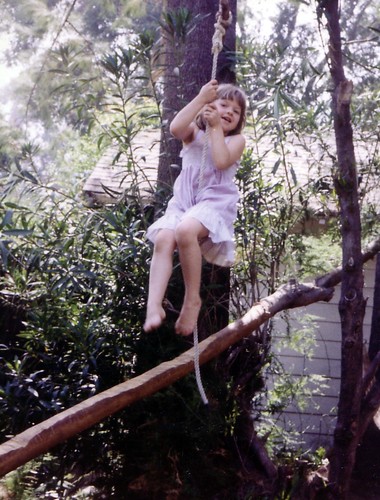
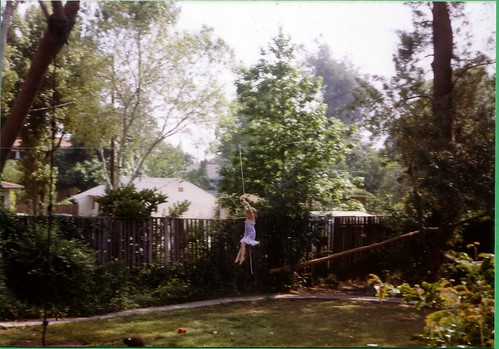
Next week mother-in-law Ruth will be 93. This morning I visited her in Sydney Creek, the Dementia Facility.  As usual when I arrive, she is asleep in her chair, but she perks up immediately, light streaming from her almost blind eyes, her voice clear and joyful.  She tells me her dreams and hallucinations and memories.  She picks up our last conversation where it left off.  I report on Claire and the two great-grandkids, she listens and laughs and says, “I remember those playground toys you built for her in your backyard in Claremont.”

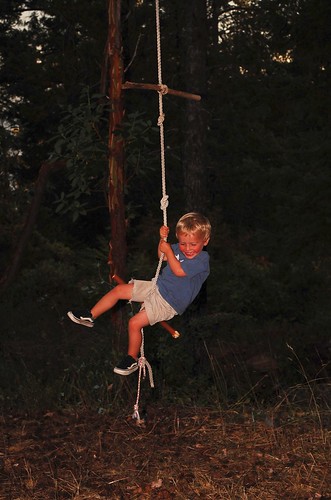
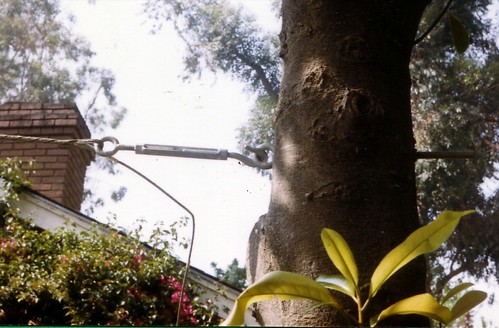
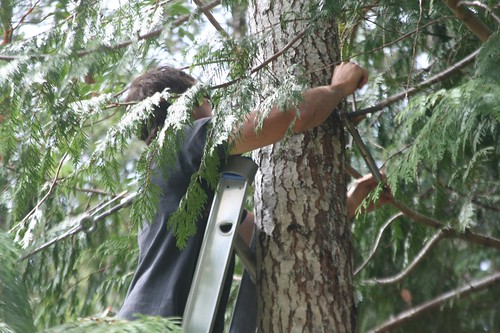
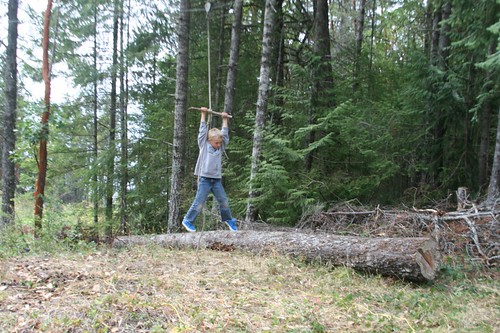
That was 1983.  I tell her that just this summer the cable and hardware for that tree trolley, which I’d stowed  in an old carpenter’s chest salvaged from the farm, returned to Canada, where Joe rigged it up at Knoll House for the use of his kids, their friends, parents and grandparents.

Back home I dig old pictures out of a huge lateral file drawer  and scan a few to match with this summer’s.

1983trolley2.jpg

IMG_7988.JPG

1983trolley1.jpg

DSC_4205.jpg

1983trolley4.jpg

IMG_7974.JPG

The galvanized steel of the cables and eyebolts and the polyethelyne of the rope are more durable than other artifacts I’ve been excavating.  Week before last I spent many hours in the Cal Poly Art Resource Library using its expensive equipment to scan 250 35mm slides that had been boxed in cassette trays in my garage. They record moments from our wedding, from early days on the farm, from our family trips to Europe in 1978, to Hawaii in 1984, from our time in Claremont and Palo Alto. The slides were covered with dust and grease and their colors were faded and distorted. The scanner software and adjustments in Photoshop brought them back to life, some almost as good as new, many better.  I gasped as our images of thirty years ago revived on the monitor.

Slide_Scans_063.jpg

Slide_Scans_037.jpg

scan126.jpg

I  spent much of the previous week in the CLA computer lab converting old VHS videotapes of English 510 Players productions of Twelfth Night (1990) and The Winter’s Tale (1994) to binary files.  Like the slides, they needed to be restored to a more accessible and permanent medium.  I’d discovered that the dozens of short segments I’d digitized nine years ago and placed on the University Media Server to provide material for my Triangulating Shakespeare website had decomposed over time into a kind of pixel jelly. Now I could replace them in larger, clearer format and at full length.  But the new digital files will probably be no less fragile than the previous ones I’d assumed would last forever.  The problem is called “bit-rot.” See the entry called “Data decay: even computers forget” on the Australian blog,  Time, etc.; Humans in the big scheme of things.

This echoes the title of the work that Shakespeare rewrote as The Winters Tale, Thomas Greene’s The Triumph of Time. As I played and rewound and spliced the recitation of the character named “TIME”  in Act 4, Scene 1 (performed fifteen years ago by the daughter of my wife’s best friend in elementary school) I slipped into the allegorical role myself:

I, that please some, try all, both joy and terror
Of good and bad, that makes and unfolds error,
Now take upon me, in the name of Time,
To use my wings. Impute it not a crime
To me or my swift passage, that I slide
O’er sixteen years and leave the growth untried
Of that wide gap, since it is in my power
To o’erthrow law and in one self-born hour
To plant and o’erwhelm custom. Let me pass
The same I am, ere ancient’st order was
Or what is now received: I witness to
The times that brought them in; so shall I do
To the freshest things now reigning and make stale
The glistering of this present, as my tale
Now seems to it.

When I watched the final scene, where a memorial statue comes to life after its subject was thought to have been dead for sixteen years scripted  as a theatrical resurrection in a chapel, I felt that moment  of performance on the altar of San Luis Obispo’s  1762 Mission Church quickening again, wrinkled now but still warm.

POSTSCRIPTS:

January 20 2010: Wow! Just watched the old Measure for Measure video. Really amazing that you managed to get such solid performance out of non-acting students. I found the play charming and — most importantly — the language really came alive. You should do some directing for community theater. — Elizabeth

November 30 2009: It was wonderful to hear from you. I just got started on Facebook. Wishing you happy holidays, Don

November 28 2009: How wonderful to hear from you! Unfortunately I can’t seem to open this link – which might be a good thing as I think I was a pretty shockingly bad actress–Ann

November 24 2009: Thanks Steven–it’s amazing!  Tom

November 24 2009: Hi Steven! Wow. Thanks for this treasure trove! I remember lending my VHS copy of”Twelfth Night” to a friend soon after I received it. Never got it back. Almost twenty years later, my kids are saying “Daddy, you look weird. And why are talking so funny?” Congrats on leaving lasting wonderful impressions on your old students!–Greg

November 23 2009: What fun! Good to hear from you. Patty

November 23 2009: Participating in the English 510 Players Production of “Measure for Measure” was one of the highlights from my Cal Poly years. I’m sure I’ll cringe as I watch my performance but what an awesome experience it was. Thank you, Dr. Marx! –Candice

November 21 2009: This is great! Thanks for doing this Steven.  We’ll give you a call for lunch next time we’re down–we had a really good time with you guys last time. Take care. –Craig

Protected: A Visit to Social Services

Monday, October 26th, 2009

This content is password-protected. To view it, please enter the password below.

Zunoquad 3“Canoeing the Teslin and Yukon Rivers (9)

Sunday, September 27th, 2009

Day 8

Cameron and the Brits headed downstream while we washed the canoes and obeyed Steve’s strict instructions for cleaning up the campground.  He struck it rich by finding a pair of provocative ladies’ panties.  Horst showed up with the trailer.  He came here 40 years ago from Germany to hunt moose and never went back.  On the road to Whitehorse we got out to look at a roadkilled porcupine, slight compensation for the absence of bear, wolf and moose along the river. We stopped in Braeburn, a coffee shop on the Alaska highway to share some impressive Cinnamon Rolls and arrived in Whitehorse, where we found the previous day’s newspaper’s official version of Russell’s story.

IMG_3802.JPG

We were joined at dinner in the Hotel Restaurant by Andy’s friends and associates–Chad, an environmental consultant and Mary Ann, professor and researcher in paleolimnology, the study of lake bottom sediments and fossils that encode the north’s environmental history.  Jonah and Monica also returned to hear about our adventures and share more of theirs.  Some of the men stayed in the bar till closing learning local lore from a reliable informant with some regrets in the morning.  Others retired early to enjoy clean sheets, good books and prospects of returning home.

whitehorsescribe.jpg

Zunoquad 3“Canoeing the Teslin and Yukon Rivers (8)

Sunday, September 27th, 2009

Day 7

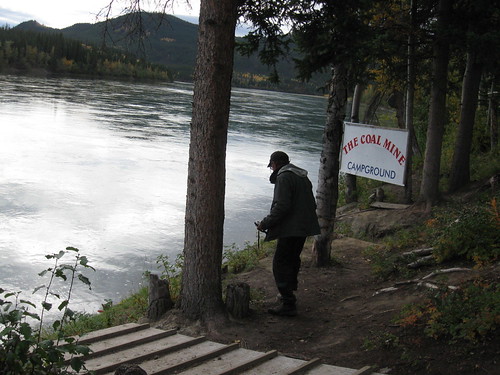
The fog was thick during breakfast at the Little Salmon campsite. The roar of trucks on the Campbell Highway that converged here with opposite bank of the river gave notice of our excursion’s approaching end. Our original plan to spend one more night in the wild was abandoned in favor of staying over at the Coal Mine Campground in Carmacks, our planned pickup point the next day. We couldn’t travel the river in fog and it was lifting later today than yesterday. It could strand us tomorrow.

IMG_3769.JPG

A second shot of Murray’s coffee and his pome cleared the air for the last lazy cruise.  The aspens were turning from yellow to gold.  Fish were biting.  On a gravel bar at lunch, the men aimed rocks at a figurine erected by Steve. Early arrivals at the Coal Mine campground got to clean up and ride into town for beer to bring back, and heard the news that Russell’s associate had been found dead in the bush after an extensive search involving boats, land parties and helicopters.  Andy and Murray brought more fish caught in eddies and at beaverdams.  Cameron and the two Brits showed up and joined our campfire for more Robert Service readings.  Ian presented them with the collection he’d bought second hand.

IMG_3772.JPG

Day 8

To view a complete set of photos for this trip go here.
To view a slideshow of these photos go here.

Zunoquad 3“Canoeing the Teslin and Yukon Rivers (7)

Sunday, September 27th, 2009

Day 6

A quarter moon and Venus lit the dawn, which arrived 45 minutes later this morning than the day we started. Allan, a.k.a. “Soaring Eagle,” was the day’s leader. We crawled out of the tents greeted by a heavy frost, another sign that the northern winter was on its way. A ribbon of fog spread from the cold river over the warming land and then burned off revealing a cloudless sky. The powers above were smiling on our soon-to-be-terminated voyage. The current had reached a steady 10 km/hr making paddling optional, except where multiple channels around gravel bars and islands required selection and vigorous effort.  Reflecting on the ability of the river to move us as it wanted while we struggled to find the right direction and on yesterday’s experience of choice and circumstance, Steve and I debated determinism and free will. In other canoes Andy theorized about neurological analogies between gambling and angling addictions while John and Murray caught more fish.

IMG_3709.JPG

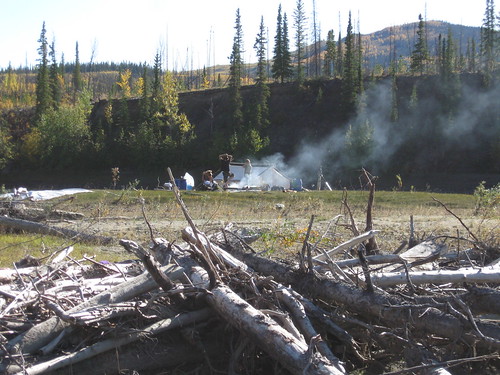
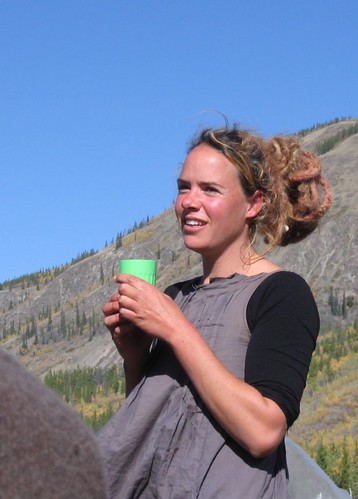
On the lookout for a suitable spot to stop for lunch, we rounded a turn and spotted a curious sight on a distant low island: what looked like an old-fashioned wall tent standing off kilter on the shore and people at a campfire.  Steve said, “Looks like hunters, lets not go there,” but then we saw Allan and John’s canoes pulled up on the beach.  As soon as we landed, our old friend Cameron came over and introduced a young fellow with long curly hair and a leather hat as “a film maker.”  We walked with them toward the fire and discovered that the tent was pitched on fresh cut spruce poles and mounted on a large raft also completely constructed of poles. Alan and Rob were conversing with a striking young woman wearing dreadlocks gathered in a loose bun who offered us tea and muffins with a radiant smile.  I could only smile back and stare goggle-eyed as she explained that she was with a group who had built the raft several days before out of 130 poles they cut at the northern end of Lake LaBarge where they too were delayed by the storm. Afterward they’d floated it down the river, having spent a whole night on the water trying to find a place to land where they could maneuver out of the current.

IMG_3746.JPG

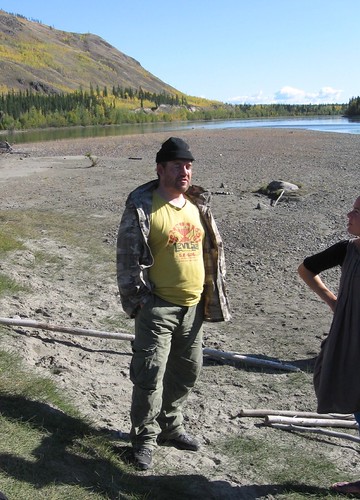
Two other men stood at the fire drinking tea, neither looking much like a voyageur, and when they spoke, out came the broadest Cockney accents I’ve heard since watching a Mike Leigh movie.  They had seen a story about going down this river in a book about 20 Great Things To Do Before You Die and had taken a couple of weeks off from their business in London ferrying drunk teenagers from pub to pub in a minibus.  They’d never canoed or kayaked before and were having the time of their lives.

IMG_3729.JPG

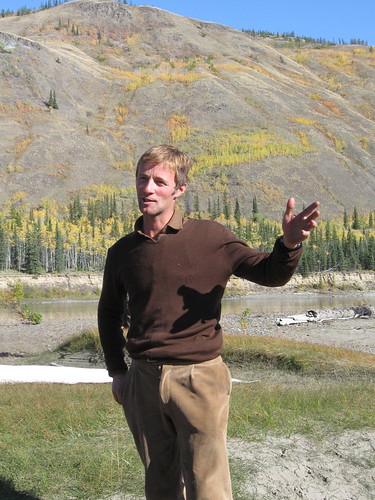
It was hard for me to take my eyes off the woman with the tea, but my attention was drawn by the sound of Ian flopping in the water off the gangplank leading to the raft.  I wandered over and went aboard to overhear a man who looked like a model exquisitely garbed in wool and corduroy explaining to John with a thick French accent that he and his partner, professional guides, were making a promotional film about a new sport of recreating the old prospector’s experience of building rafts and floating them down the river, the project financed by a Swiss bank. They had rented two canoes from “Up North Adventures,” carried their baggage and towed two large logs and six plastic barrels up the lake, and then used hand tools to build the raft.

IMG_3739.JPG

Against the pile of baggage on the large deck leaned expensive cases for a rifle and a guitar. Too shy to address questions in the presence of all this competence, youth and beauty, I asked John how the girl got here and he said the guides had put an invitation in the Whitehorse newspaper classifieds and that she responded. Her name was Victoria.  She’d left New Zealand on her post-highschool travel sabbatical twelve years ago and was still on the road.

IMG_3734.JPG

Back at the fire, Victoria was joined by another lovely woman from the south of France.  She was talking to Lionel and Allan about having encountered Russell a couple of days before and not knowing what to make of him. We shared our story and I flashed on my adventure in the south of France 47 years ago, centered in a tiny village called Grimaud.  She said she knew the place.

Our group reassembled at our landing spot for lunch as the last canoe arrived with Murray and Andy, triumphant about having caught four grayling and also puzzled by the spectacle on the beach.  I urged Murray to give the ladies an offering of fish, but hearing our giggles at his approach, he returned too embarrassed to proceed and instead targeted me with a Monte Python fish slap.

IMG_3742.JPG

After lunch Murray, Andy and I went skinny dipping in the cold Yukon river a discrete enough distance from the young folk to limit our exposure and still show off. Once we were dressed again and about to get  back into our canoes, the two women wished us farewell as they walked down the beach carrying machetes, presumably to cut more poles in the bush.

Our intended campsite for the night was already occupied by a couple with a dog so we decided to spare them our company and take the next one downstream indicated in the guide, but it couldnt be found. While Murray and Andy stayed behind to catch more fish, the rest decided to carve out a new campsite on a small muddy spit at the end of an island since night was approaching. When the fishermen arrived and saw it, they convinced us to keep going another hour to the Little Salmon River where we found an established spot that all agreed was a better choice. Three speedboats passed close to the canoes just before dusk–other than the RCMP’s the first motors we heard in a week. “Don’t F—With Me” Steve was appointed next day’s leader.

Day 7

To view a complete set of photos for this trip go here.

To view a slideshow of these photos go here.

Zunoquad 3“Canoeing the Teslin and Yukon Rivers (6)

Sunday, September 27th, 2009

Day 5

I woke up clear in my mind that leaving Russell behind was not an option.  His alien presence might spoil our holiday mood, but it was possible he could enter and extend the scope of the group.  More important, guilt for abandoning him in the woods would dampen our high spirits even more than his presence, and if he met harm, the story would eventually come out to our shame.  Before I had a chance to express this view, Steve approached me with the question, should we leave or take him, and I answered without hesitation.  He said that he and Andy had agreed he should poll people individually rather than enter a lengthy group deliberation, and that my sentiment was shared by everyone. Russell seemed happy with our decision and brought his backpack with rifle down to the shore to be loaded into the reconfigured canoes, and asked if we could spare a cup of rum.

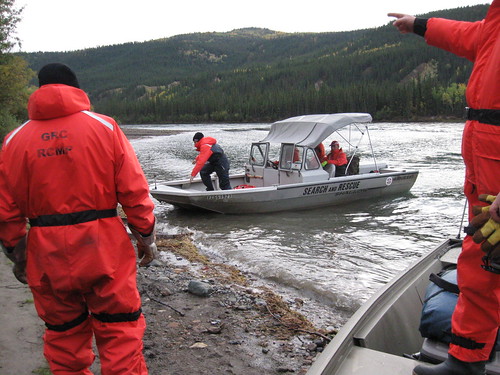
Minutes before our scheduled 9:00 AM departure the unaccustomed sound of engines was heard from upstream, and as it increased to a roar, two stainless steel jet boats with several red-suited occupants sped toward us across the bay. It was the Royal Canadian Mounted Police!  They came onshore announcing that a couple of hunters had been reported missing and then saying quietly to John that this kind of thing happens often; the “crazy” guy was probably in detox.  Russell didn’t appear eager to go with them, but had little choice and gave us a friendly goodbye. After reporting what little we knew of the situation, we repacked the boats again and shoved off downstream without him.

IMG_3625.JPG

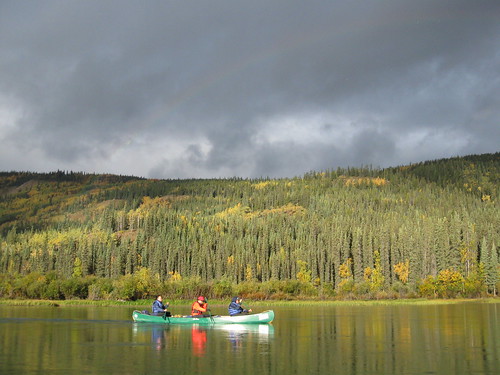
Now we were riding the Yukon river, larger and faster than the Teslin.  Windows of sunshine opened in the overcast occasionally flooding canoes and shore with oblique morning light. Reflection upon our being spared the consequences of our morally preferable choice about Russell eased the mood, and Lionel and I spun alternative Hollywood plotlines for a sequel: a hijacking involving the guy who went crazy a la “The River Wild” or “Deliverance,” or our rescue from drowning in rapids by Russell and his family living along the shore.

IMG_3636.JPG

At a late afternoon lunch break we were joined at a pullout by Imo, a shy greybearded German mountaineer, who had just gotten into kayaking after making a film about rock climbing along the coast of Majorca. Rob joined the exclusive club of successful fishermen but got so carried away by the sport that he busted Lionel’s fancy rod.

IMG_3665.JPG

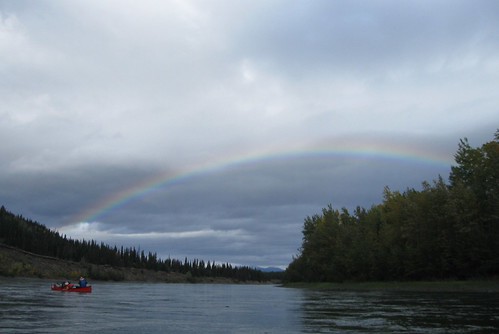
As we coasted downstream the lightshow continued all afternoon, highlighting the canoes between water and sky, casting a rainbow between the river banks and making the autumn foliage glisten at our day’s destination, the old trading post at the confluence of the Big Salmon with the Yukon.  Cameron had reached this spot before us and found shelter far enough away to avoid being disturbed by our unrestrained language and laughter.  This expansive site included several log cabins, one of which contained a bookcase full of liquor bottles left by recent campers as well as an old gold pan.  Originally a First Nations fishing camp, it had served as steamboat landing, telegraph station and mission.  Before the Klondike Gold Rush in 1903, it was headquarters for many prospectors who took out moderate amounts of gold from the immediate area.  According to the guide, “By the mid 1930’s the community was still a riverboat landing with a trading post.” On a rock outcrop above the site, we found a cemetery, with manufactured fencing and small structures protecting shallow or surface graves.

IMG_3675.JPG

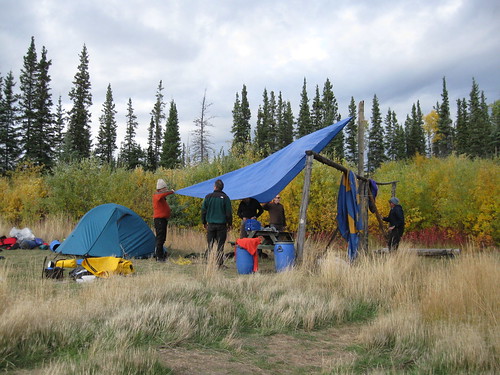
Erecting the tarp without trees to rope to was an ambitious task but not beyond the abilities of the tarpmeister and assistants.  Cocktail hour consumed all the remaining rum under the auspices of the day’s leader, Andy, aka “Captain Blowhard.” Entertainment was provided by the whole crew playing roles of ragged, rambunctuous, raunchy pirates.  Another dinner with a generous fish course followed by Nutella for dessert was enjoyed under a lyrical pastel sunset.

IMG_3694.JPG

Day 6

To view a complete set of photos for this trip go here.
To view a slideshow of these photos go here.