Topics

Japan Trip–Day 1

Tuesday, March 23rd, 2010

Slideshow

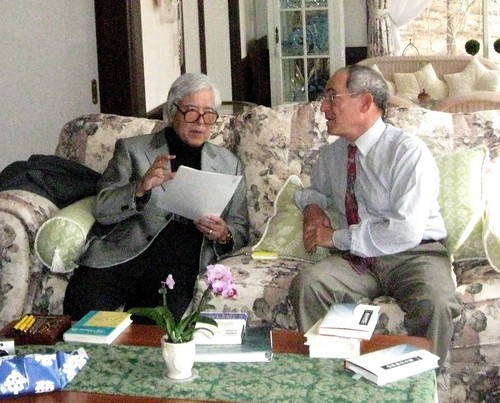
It’s been five years since Jan and I traveled abroad, my retirement began, and I started writing this blog.  Japan was the next destination on our list because we were attracted by what we knew of its culture–haiku, sashimi, kabuki, Toyota–and because we hoped to spend some time there with our nieces, Emma and Marie, whose mother is Japanese-Korean.  The nieces had gotten married and engaged within the last year and wanted to introduce their partners to the family, so the time had arrived to coordinate plans.  Jan and I would go on a ten-day guided tour of “Japan’s Cultural Treasures” and meet them afterward for a few days together in Osaka, where it happened a friend of ours from San Luis Obispo had been living for three years.  Once we decided our schedule, I contacted Kazumi Yamagata, an eminent scholar of English Literature who’d translated my book on Shakespeare and the Bible into Japanese, and he invited us to visit him and his family at home outside of Tokyo the day before the tour  started.

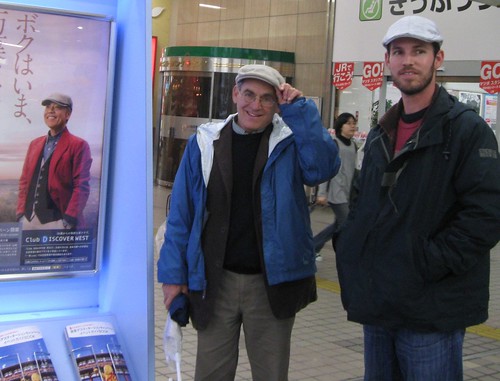
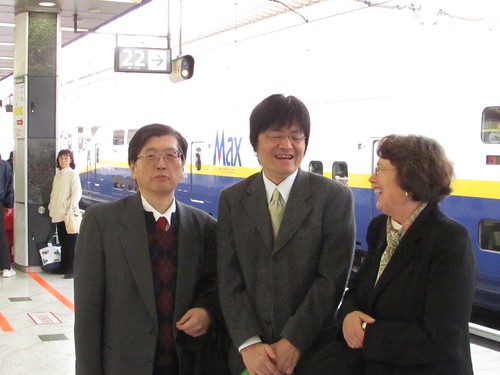
After 24 hours of travel and a good night’s sleep we were met at our hotel by a disciple of Dr. Yamagata who conducted us through the maze of downtown Tokyo to Central station where we met one of his disciples and boarded the bullet train for an hour’s trip north to the Professor’s home.

IMG_1198.JPG

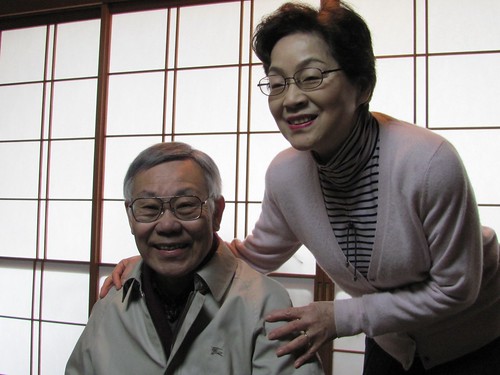
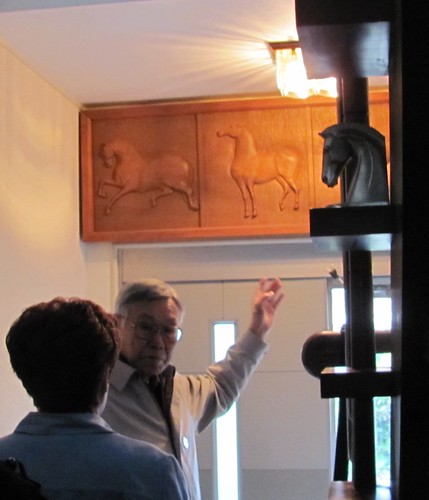
These men all teach English literature and were relatively easy for us to communicate with.  Kazumi’s wife, Satchiko, met us at the station in their daughter’s Jaguar and drove us to their  country home, where were we received warmly by the mentor, who’d turned 76 the day before.  We spent time gossiping about English literary critics, I signed their copies of his translation, and Kazumi brought out fourteen volumes of his collected works recently published–a minor portion of the 50 books that he’s written.

IMG_0545_2.JPG

He was pleased when Jan mentioned that she’d written her M.A. thesis on Dante, who he’s now translating into Japanese.

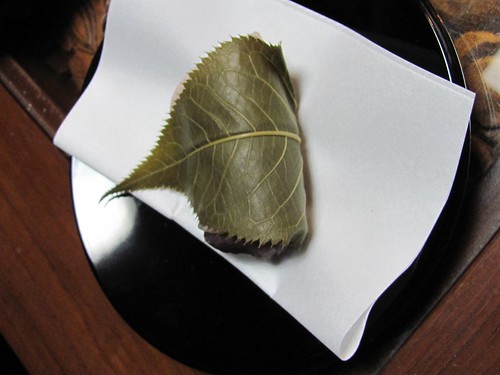
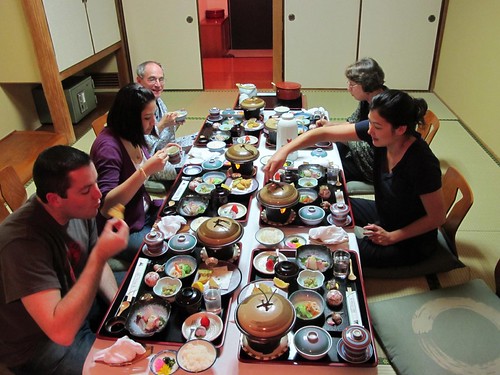
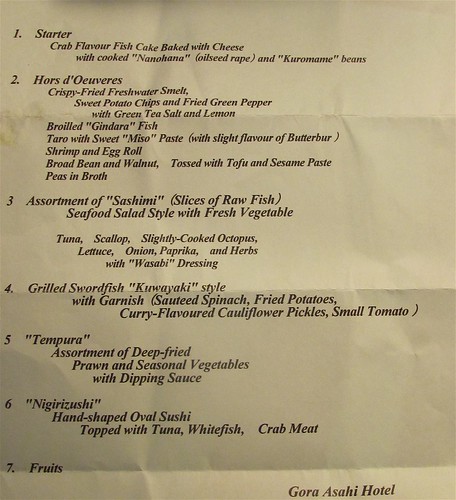
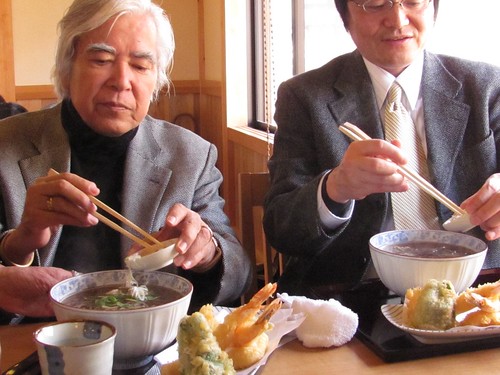
After a couple of hours, they took us to a traditional restaurant in their neighborhood where we ate large quantities of melt-in-your-mouth and melt-you-away sashimi and tempura.
IMG_1205.JPG

IMG_1207.JPG

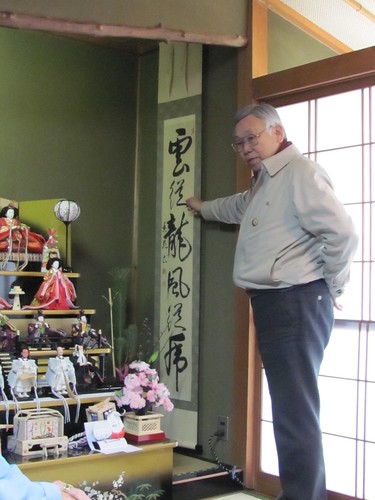
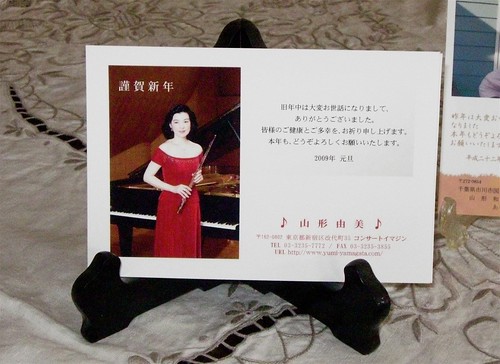
Then back to their house for tea and a tour of his study, and a visit with their daughter, Yumi, who’d just arrived from a concert she’d performed at in southern Japan.  Jan got to know her better than I did, but as her flute played quietly on the stereo in the background, they brought out gifts for us including a new CD of her work.

IMG_0548.JPG

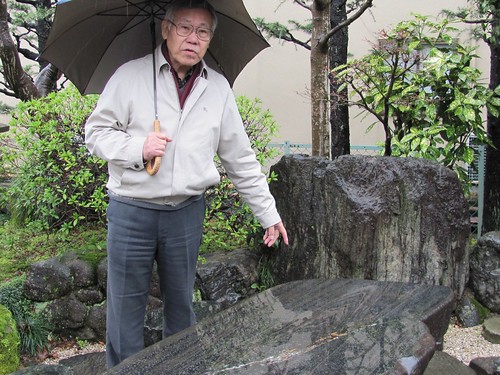
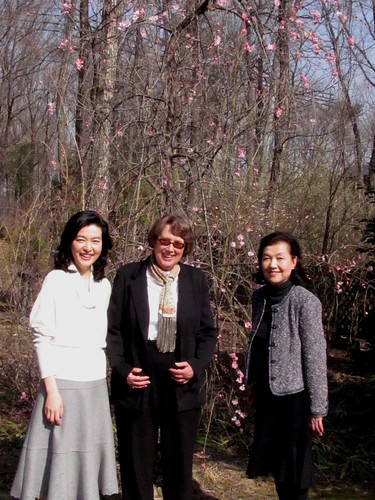
We toured their garden, where the same plants that we’d eaten in the tempura were springing up, plum blossoms in the background.

IMG_1215.JPG

We returned to Tokyo in time to meet up with our tour group led by Maya, our striking and gracious guide. We marched together to a little dive for yakitori dinner and then home to this “modest” hotel, one of the best I’ve ever stayed in, that has a toilet with two different kinds of sprays for one’s undercarriage, along with a really deep bathtub.

IMG_1231.JPG

Doris Haddock (Granny D) 1910-2010

Thursday, March 11th, 2010

DSCN1586.JPG

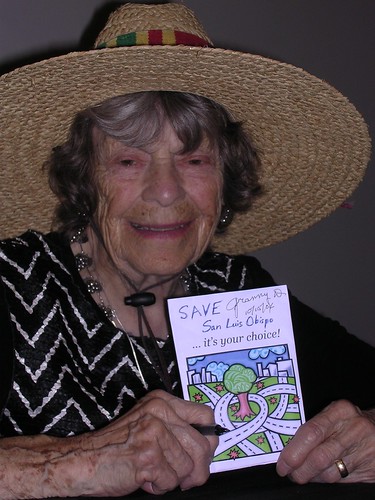
Doris “Granny D” Haddock died peacefully today in her Dublin, New Hampshire family home at 7:18 p.m. Tuesday, March 9, 2010. She was 100 years old. Born in 1910 in Laconia, New Hampshire, she attended Emerson College and lived through two world wars and the Great Depression. She was an activist for her community and for her country, remaining active until the return of chronic respiratory problems four days ago.

I only met Doris once briefly when she visited San Luis Obispo in connection with the Cal Poly Preface Reading Program but she touched me permanently.  As I seek ways to adapt to growing old in a world that feels easy to abandon, her love of life, her pride in her past, her urgent concern with the future, her fighting spirit, and her refusal to give up in spite of disappointment, provide me with guidance and inspiration.  What a sad irony it is that during her last few months, the Supreme Court handed down a decision that, for the time being at least, reverses so much of what she worked for. Finally now she gets a break from that relentless struggle.  Or perhaps, somewhere, her spirit still is on the march.

Two freshman student responses to Granny D’s visit to Cal Poly in 2004

Go Granny Go!

When I got to Cal Poly this fall, I soon learned that not too many people actually read the shared reading book, Granny D., You’re Never Too Old to Raise a Little Hell.  Furthermore, those who did read it did not really like it.  I was surprised because I loved reading the book!  I love to travel and have been to most of the states of our country, so I loved hearing about her adventures in the different states.  In addition, I have gotten really into politics over the summer, and I have loved forming my political identity and views.  Doris “Granny D” Haddock is very inspirational, and she demonstrates what a difference one person can make.

I have looked forward to hearing Granny D. speak since I read just a few pages of the book.  I was very excited to finally have the opportunity last Friday night when Granny D. gave her speech entitled “I am in the Example Business.”  She is an engaging speaker, and it was delightful to hear her.  I liked how her speech started regarding writing a cheaper and shorter book, although I was not one of the students with an “independence streak” (at least as far as this book goes).  I liked how she drew us in with her stories of New England autumns, which I remember vividly from the year I lived in Massachusetts.  Additionally, I loved all the “political stuff” and her stories of life in New Hampshire.  My favorite part of her speech was when she said, “We cannot move the world toward our wisdom and love so long as we permit political systems that run on greed and fear instead of love and ideas.”  At the end of the speaking, I enjoyed the question and answer time.  For example, her sticker that said “Vote Dammit!” and when Dennis Burke told her that a question was “regarding Iraq.”  Throughout her speech, I loved to applaud her and give her standing ovations.

Attending Granny D’s speech was one of the most enjoyable things I have done at Cal Poly.  It was motivational, and I felt “the hero inside my heart.”  Granny D. is one of my heroes, and she is what this country is all about!

Granny D

When I found out Granny D was coming to speak at Cal Poly, I was excited but did not think it would be worth my time. Looking back to the event and reflecting on what she said, I am extremely glad that I decided to attend! As in her book, her speech was filled with inspiration, politics, life lessons, biographical anecdotes, and of course humor. Her opening statement “Had I known that 3,000 of you would be forced to buy and read my book instead of enjoying your summer, I certainly would have written a cheaper and shorter book” had the crowd roaring with laughter. That statement was a perfect example to explain her personality. She is a person who loves life and has made her mark in the world and will continue to do so in the United States Senate if she gets elected.

I enjoyed learning about life in her small hometown of Peterborough, New
Hampshire. Her description of autumn made me want to become a “Leaf Peeper”! Peterborough seems to have a lot in common with San Luis Obispo and through the examples she gave, it made me want to get involved here in my new hometown and find out about local issues since I am a citizen. The fact that a play was written about the town struggles showed what a tight- knit community Peterborough is and how it is good that people don’t take things too seriously in the end. There has to be a sense of humor to get through life and not let differences divide one another. That message was strong throughout her talk.

It was nice that the forum was opened for questions. It was good to hear about local issues and hear what Granny D had to say. She is a person who knows her stuff and is not afraid to tell you. She has and will continue to fight for what she believes in until she gets what she knows is right. The United States Senate is a good move for Granny. She will be a strong influence and I believe a good influence to the senators. She will make changes for the better. Granny D will make America better and keep its ideals alive and on track.

My notes in preparation for the discussion of Granny D, during the 2004 Preface Program at Cal Poly
(more…)

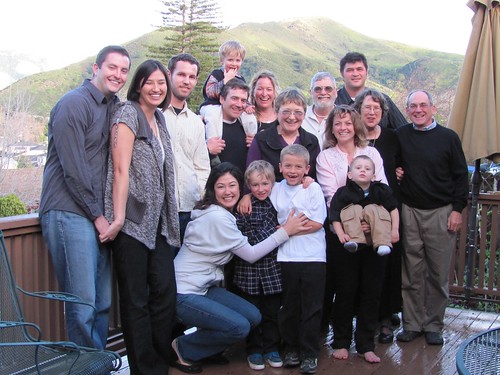
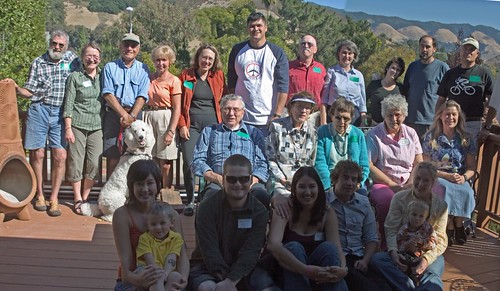
Ruth Howell (1916-2010) The Family Reunion

Monday, March 8th, 2010

February 27 2010

IMG_1030.JPG

February 28 2010

IMG_1095.JPG

Ruth’s 90th Birthday

famport3.jpg

More pictures

Down to the Wire: Confronting Climate Collapse

Friday, March 5th, 2010

Notes in preparation for a discussion of the book by David Orr, published 2009, at the Sustainability Book Club at Cal Poly.

David Orr is one of my gurus, but the first time I read this book I was disappointed by its repetitiousness, vagueness, lack of sequential structure or sustained, fully supported and defended claims, and its preaching to the choir, who have already heard most of this many times.  The central points were hardly controversial or new for us, but still unacceptable to the great majority of citizens who are looking more than ever at short term rescues or pleasures. For that reason the urgency and insistence of the tone seemed irritating and disrespectful of the audience. Compared to his last book, Design on the Edge, which contained a fascinating autobiographical narrative and a detailed account of the remarkable history of the building he was responsible for planning, designing and financing at Oberlin College, this book felt vague, uninspired, and sentimental. What does it mean after all to insist that what we should do is “deepen our humanity.” (202)

I also found it sadly dated.  Though filled with topical references to the impending Obama adminstration, the events of the fifteen months since his inauguration made many of the proposals about transforming governance and launching a revolution in Washington seem painfully overoptimistic.

Nevertheless I decided to give it another try, either to be able to articulate specifically what I found wrong with the book or to give it a more sympathetic and engaged reading.

First, I confirmed what I suspected about the book’s process of composition.  Most of the material here was previously published in the form of essays that Orr writes for the journal Conservation Biology and others.  Many of these can be found at the website, http://www.davidworr.com/index.html.  That accounted for and in a way justified the sense that each chapter recovered much of the same territory and started from scratch rather than building on what preceded.  Viewed from this perspective, each chapter had the coherence and scope of his remarkable speeches, such as the one I heard at the organizing conference for Focus the Nation in Las Vegas.  And even when general points were repeated, Orr seemed in each essay to summon up different examples and sources.

A second reading also revealed an overall structure of chapters that moved forward from beginning to middle and end despite the backtracking.  Preface and Introduction both state the predicament and his solutions. We are facing what has been called a long emergency or a bottleneck, a worldwide period of crisis brought on by the environmental degradation and climate change that misguided human impacts have produced over the last 200 years. The way out will be long and arduous, and only possible with strong, transformative leadership, primarily in the presidency but also at all levels of government and society.  Leaders have three leading tasks: move the citizenry out of a state of denial to a recognition of the dangers, develop energy policies that reverse our dependence on carbon and promote renewables, and foster a deepening of public morality emphasizing fairness, compassion, nonviolence and a sense of purpose and reverence for nature grounded in appreciation and gratitude. These three mandates are reaffirmed throughout the book.

The three chapters of section I, Politics and Governance, assert that Government is the only agency strong enough to effectively address the emergency but that government needs to be transformed. Chapter 1, Governance, asserts that the challenges of mitigating and adapting to climate change and its associated catastrophes can be faced by reversing the trend toward unregulated corporate power, trivialized and ineffective journalism, excessive consumerism and rule by lobbyists.  This can be done by redistributing wealth and privilege, publicly funding elections, smartening land use and agricultural policy, guaranteeing universal access to communication media and promoting small community autonomy.  But first government itself must be transformed from its present corrupt and dysfunctional state to a just, effective and elevating one. This will have to be accomplished through a mechanism like a new Constitutional Convention and the establishment of a new consensus.

Chapter 2 is a meditation on democracy, the form of government most likely to succeed despite its faults, the failures of its alternatives, like natural capitalism, and unregulated free-market capitalism, and the proposal of a legal, constitutional framework for instituting the kinds of social transformation needed to address climate change based on the new idea of the legal standing of future generations. Chapter 3, Leadership in the Long Emergency, compares today’s crisis with those faced by Lincoln and Roosevelt, and concludes that Obama can learn leadership lessons from both his great predecessors, which include the necessity of understanding and framing those crises both as legal-constitutional issues requiring preservation of law and tradition and as moral issues requiring deep personal insight and unshaken commitment. Orr repeats the laundry list of reforms mentioned earlier that Obama needs to accomplish.  Chapter 4, Leadership, defines true leadership, like that of those predecessors, as the capacity to energize and give direction to the populace.

Part II, Connections, is transitional in the overall structure of the book, but provides a sample of some of Orr’s strongest qualities as a writer, manifested when he lets a more imaginative, associative principle guide his design.  Chapter 5, The Carbon Connection, juxtaposes two powerful narrative descriptions: nature’s devastation of humans in New Orleans by Katrina, presumably caused by climate change, and humans’ devastation of nature in Coal Companies’ mountaintop removal, causing climate change. This is connected to Chapter 6, The Spirit of Connection, which explores spiritual and religious perspectives on Climate Change, differentiating the apocalyptic fundamentalism that both affirms and brings it on with the subjective experiences of wonder, reverence and gratitude for the gift of life that provide meaning and hope for those struggling to protect it.

Part III, Farther Horizons, contains three chapters overlapping earlier chapters and one another in content.  Chapter 7, Milennial Hope, lists factors blocking us from taking the steps necessary to confront and deal with the coming crisis and solutions, psychological, political, and spiritual, concluding with a story of Gandhian non-violence displayed by Amish toward a mass murderer who shot a number of their children. Chapter 8, Hope at the End of our Tether, expands the emphasis on anti-militarism, Gandhian Satyagraha and other Gandhian principles like anti-materialism”shift from wealth to happiness”social justice, and localism.

The final chapter, The Upshot: What is to be Done? echoes both Aldo Leopold and Lenin, verbally in the titles of two of their well known works, and thematically in calling for the creation of a community that includes natural beings and systems and in calling for a total revolution to be initiated by a vanguard of leaders, giving direction and energy to an awakened populace. The first section covers the same ground as the preceding chapters, but the chapter and section ends with a powerful vision of a desireable outcome from the long emergency only ten years in the future, imagined in his home town of Oberlin Ohio, where the  programs he has set in motion as an activist and educator have run their course.  The vision is startlingly similar to the kinds of programs and visions activists at Cal Poly and in San Luis Obispo County have dedicated themselves. More than anything in this book, these few pages (212-215) provide some of the grounds for hope that present conditions don’t encourage in regard to most of the books larger recommendations.

“Postscript: A Disclosure” is vintage Orr.  It’s a recollection of the  extraordinarily hot summer of 1980 when he and his brother worked like slaves on a farm in Arkansas, as the temperature reached 111 degrees and stayed there. It was then that he became interested in climate change.  He says he felt it viscerally, the memory recorded in his body.  That’s why it’s presented as a disclosure.  But the impact of that memory, I’m afraid is unlikely to be felt until the rest of us consistently experience such nasty conditions, and by then it’s likely to be too late.

Taking issue:

  • “leadership””is Obama like Lincoln and Roosevelt, sticking to the moral vision, keeping legal and constitutional integrity at the fore, reaching the people?
  • Seemed so at inauguration, but less so now, largely because of loss of confidence resultant from bailouts and compromises, failure to seize the opportunity with courage”e.g. Copenhagen
  • The long emergency”less perceivable now than in 2006, when much of this was written and when Katrina and An Inconvenient Truth and IPCC and oil spike converged to shake people up.
  • Non-violence, Satyagraha”true, and a manifestation of deeper humanity, but turmoil is less likely to bring it to the fore, especially when the rulers and perpetrators are becoming more brazen
  • Coupling peace, justice and sustainability has advantages but also makes any progress seem hopeless, because it will leave so much undone.

(more…)

Ruth Howell (1916-2010) Obituary

Wednesday, March 3rd, 2010

IMG_6602_2Ruth Howell was born in November 1916 in Houstonia, Mo., to Grace (Montgomery) and John Herring, and died peacefully of natural causes Saturday, Feb. 13, 2010, in San Luis Obispo. After attending secretarial school in Sedalia, Mo., she worked for the US Department of Agriculture in Nevada, Mo., and then the Department of War. She was stationed in Midland, Texas, as a secretary in a hospital for “shell shocked” soldiers. There, she and William Robert “Bill” Howell, Army Air Corps Lieutenant from Nevada, Mo., became engaged. They married in Long Beach, Calif., February 6, 1944, and their daughter, Janet was born in 1945. They moved to Lakewood, Calif., and their son, Mark was born in 1950. Ruth and Bill helped found Lakewood First Presbyterian Church, where she taught Sunday school. She volunteered for the Community Hospital of Long Beach for over 40 years and helped run the gift shop. In 2002, Ruth moved to San Luis Obispo and enjoyed living at the Palms, then Garden Creek Assisted Living. Ruth loved family, children, music, art, traveling, sewing and gardening. She was an active, involved and beloved mother and grandmother. Her engaging sense of humor earned her many friendships over her long lifetime, and her youthful spirit was reflected by the fact that her hair never turned gray. Ruth is survived by her daughter, Jan Howell (Steven) Marx of San Luis Obispo; son, William Mark (Sonia) Howell of Lakewood; grandchildren Joe (Amy) Marx of Ketchum Idaho, Claire Fisher of San Luis Obispo, Emma (Travis) Smith of Long Beach and Marie Howell of Santa Barbara; step-grandson, Mitchell Benjamin; great-grandchildren Ian Fisher, Ethan Marx, Abel Marx and Lucas Green; sister, Mary Helen French of San Diego; as well as numerous nieces and nephews. She was predeceased by her husband of 40 years, Bill; brother, John Herring; sister, Louise Butts; and cousin, Dorothy Cronk. A memorial will be held at 2 p.m. Saturday, Feb. 27, 2010, at Garden Creek Assisted Living, 73 Broad St. in San Luis Obispo. In lieu of flowers, please send donations to Hospice Partners of the Central Coast, 277 South St. Ste. R, San Luis Obispo, CA 93401, or Central Coast Memorial Society, P.O. Box 679, San Luis Obispo, CA 93406.

Ruth Howell (1916-2010) Jan’s Eulogy

Tuesday, March 2nd, 2010

Thank you all for coming.  My mother had three happy years in Garden Creek Assisted Living, and many of her friends still live here. We decided to hold the service here so they could attend.  I would like to thank Garden Creek for allowing us to be here today.

Emma Ruth Howell was born in Houstonia, Missouri 1916, four years before women got the right to vote.  She told me that her earliest memories were of horses, buggies and carts.  Her great grandfather Reverend John Montgomery was a pioneering Presbyterian minister and her great grandmother Katherine Lee Rennick was descended from Mayflower and Jamestown Lee families.  Her 93 years saw the Depression, WW II, and the advent of computers and cell phones. Just imagine the changes during her lifetime.

She told me that 16 was her lucky number because she was born in 1916 and she was 16 in her heart.  I remember her at her happiest as an energetic, fun loving, creative young mother in Long Beach California.  She helped found Lakewood Presbyterian Church, taught Sunday school and volunteered tirelessly for the local hospital, the PTA and the community. We had all kinds of pets and she turned our backyard into a garden. She always wanted to be “modern.” She enjoyed living in a brand new town, having a shiny Formica kitchen table, a new Chevy with tail fins, and her very own washing machine. She was proud our family was the first on our block to have a television.

She loved her children, grandchildren and great grandchildren.  She took excellent care of us children, her husband Bill, her grandchildren and of herself. She worked out with Jack LaLanne when he was on TV and later at his gym in person. After Bill, our Dad and her husband of 43 years died, Ruth carried on and enjoyed her independence.  She traveled to Japan, Israel, Egypt and Africa.

Even in her old age, she had an active and curious mind and wanted to know all about the news and the latest technology.  She loved the Bible and was fascinated with its history and archeology. She taught us habits of punctuality, honesty, responsibility, thrift, hard work and the importance of walking on “the sunny side of the street.” She valued relationships above all else. She made friends even during the last days of her life, as shown by the presence of her Hospice nurse and her last caregivers here at this service.

It was a rare privilege for me to have spent the last seven years living close to my mother.  We got to know each other as adults and had lots of “sister fun” together. Ever since she died, so many people have been telling me how much she meant to them, how she reached out and lifted their spirits.  I miss her and I know I will miss her every day of my life, but I am thankful that she no longer has to contend with the aches and pains of her last year. I do not believe that her love has died, because we all still feel it in our hearts.  As Emily Dickinson wrote:  “Unable are the loved to die. For love is immortality.”

Traitor Joe’s

Thursday, February 4th, 2010

I’m concerned about your continuing purchase and sale of fish on the Monterey Aquarium’s Red List.

The comment on your bulletin board responding to customer concerns about this is so vague it sounds like a brushoff: “When we do offer seafood species on the Monterey Bay Aquarium’s Seafood Watch “red” or “avoid” list, we undertake additional steps to fully understand the ways in which those items come to market to be sure they fit with our customers’ needs and concerns. We’re also evaluating alternatives to those red list species.”

I appreciate being able to shop regularly for most of my groceries at Trader Joes, partly because I have confidence your products come from healthy and sustainable sources. A response like this undermines that confidence.

I believe that many of your customers share a concern for saving what’s left of fragile ocean fisheries. Abiding by the Red List recommendations now is the only way to allay those concerns. However if you find it inconvenient to do that, I believe you owe it to your customers to at least label the fish that are on that list accordingly.

I would appreciate a response to this inquiry. I tend to be sceptical of the Greenpeace campaigns like “Traitor Joe’s,” so I am asking you to please provide information that will prove them wrong.

Shelter from the Storm

Wednesday, January 20th, 2010

Luscious sounds of rumbling thunder and rain tapping on skylights.  Still dark at 6:30.

After preparing a solo dinner last night with rappacini from the farmers market and a glass of wine, I lay down on the bed for a nap, which lasted until this morning. Tensing with the pains in my back and joints all day left me exhausted.  Settling under the old feather comforter felt wonderful, as if I had been up all night or spent hours at hard labor in the cold, even though it hadnt been a strenuous day, especially by comparison to Jan’s, who was at a Council meeting that would probably go till midnight.  I’d accompanied Lucas and Claire to the dentist in Arroyo Grande, driven home for lunch, driven back to A.G. at Dennis’ request to take Ian out of school and get his cast removed, gone with him to the beach to look at  storm waves and topple little sand cliffs, and then stopped at the nursing home to see Ruth.  It was a shock to find her no longer dressed in her wheelchair, but sprawled in bed in a flimsy hospital gown without glasses or hearing aids or false teeth, her mouth shriveled and gaping, her hair lusterless, her skin gray, her brow  furrowed.  I announced my presence and took her hand.  She squeezed it once, then pushed it away,  shuffled on the mattress, and resumed fingering the edge of her gown. One word escaped her: “help.”  Then she quieted, apparently off to morphine-induced sleep, though her brow never relaxed.

The night before, Jan prepared an elegant dinner for Patricia whom we hadn’t seen in two years, since before her cancer diagnosis, radiation, chemo, and surgery.  She was as vital, busy and considerate as ever, full of lighthearted stories of her ordeal and triumph, of recollections of experiences we’ve shared, of questions about us and the family, and of her own burgeoning plans for this year”directing six productions at PCPA while teaching full time.

On the topic of feeling pain during her new exercise-physical therapy routine I was especially engaged”trying to distinguish between the benefits of pushing limits of  endurance and recognizing signals to pull back, use drugs, seek medical help.  The knee surgeon had told me two weeks ago to take four Aleve per day to see if that reduced swelling, but after reading of the long-term side effects of such regular use, I was experimenting with doing without it and working in the yard.  The results were not encouraging.

All this wintry local experience takes place within the darker framework painted by the news flooding in on radio, internet, and newspaper.  The failure of Obama’s promise, confirmed by the fizzling of the Copenhagen talks on climate change,  the widening of war in Afganistan,  the increase of debt and reduction of government services, and by yesterday’s Republican victory in Massachusetts.  And behind this political gloom lurks the metaphysical horror of the earthquake in Haiti.

I’m in the habit of preceding my morning meditation with prayers to a god whose existence I don’t believe in. I make three silent utterances beginning, “Thank you,” “Please,” and “I’m sorry.”  The Please is most often for cure of disease or alleviation of suffering by friends and family members: “let the chemo work for T¦, let the tumor  be benign for P, let R rest in peace.”  These requests affirm my concerns, discharge obligations and create the illusion of sending  positive influence their way through my obeisance to a higher power.  But when I think of the suffering in Haiti, the Please bounces back at me.  Even suspending disbelief and regressing to the innocence of the first graders in Ian’s  school who a dozen times a day hear of God’s benevolent intentions, I cant imagine a personality who would unrelentingly torment so many people while allowing me to listen to their story on the radio as I cook myself supper.

Letter to the Chancellor

Wednesday, December 23rd, 2009

Dear Chancellor Reed:

At the advice of your office, I am submitting some input on the search for the successor of Warren Baker as President of Cal Poly University San Luis Obispo.

I have taught here since 1988 and am recipient of the University’s Distinguished Teaching Award, the College of Liberal Arts Outstanding Scholarship Award and the CSU Systemwide Quality Improvement Award.

During his tenure President Baker has led Cal Poly to become one of the country’s preeminent Polytechnic Universities. I believe the primary mandate of his successor should be to transform Cal Poly into one of the country’s leaders in Education for Sustainability”the long-term approach to integrated solutions of economic, social and environmental problems.

It is crucial that the Trustees Committee for the Selection of the President incorporate terms in the job description and advertisement that call for successful experience in leading such institutional transformation and that they make promise in advancing sustainability an important criterion for final selection.

Doing so would serve the interests of Cal Poly’s students, who seek employment in emerging fields, of the institution, which needs more cross-disciplinary collaboration in teaching and research, and of the larger community, whose health and welfare depend upon the next generations’ commitment to addressing these problems effectively. (see  http://presidentsclimatecommitment.org/documents/Leading_Profound_Change_ExecSum_final7-28-09.pdf)

In support of this opinion, I refer you to the University Sustainability Learning Objectives recently adopted by Cal Poly’s Academic Senate and ratified by President Baker:

Cal Poly defines sustainability as the ability of the natural and social systems to survive and thrive together to meet current and future needs. In order to consider sustainability when making reasoned decisions, all graduating students should be able to:
¢    Define and apply sustainability principles within their academic programs
¢    Explain how natural, economic, and social systems interact to foster or prevent sustainability
¢    Analyze and explain local, national, and global sustainability using a multidisciplinary approach
¢    Consider sustainability principles while developing personal and professional values

It also bears mention that the “Top Ten Best College Presidents” selected by Time Magazine in November 2009 are all Sustainability Champions. (http://www.aashe.org/blog/top-ten-college-presidents-also-sustainability-champions)

In recent years Cal Poly faculty and students have collaboratively demonstrated initiative and talent in developing major sustainability projects in and out of class”e.g. the Solar Decathlon (http://www.solardecathlon.calpoly.edu/mainpage.html),
Focus the Nation (http://focusthenationslo.wordpress.com/about-focus-the-nation/), the Sustainable Agriculture Resource Consortium (http://www.sarc.calpoly.edu/), the Business of Green Media Conference (http://www.californiagreensolutions.com/cgi-bin/gt/tpl.h,content=2983) ”and Facilities Departments have moved forward in conserving money and resources, thereby teaching by example (http://www.afd.calpoly.edu/facilities/sustainability.asp). What is now urgently needed is creative, daring and seasoned leadership at the top to articulate the vision and summon the resources to strengthen this focus.

Book Review: English Mercuries

Wednesday, December 23rd, 2009

Dear Professor S Marx

RQ has received a review copy of English Mercuries: Soldier Poets in the Age of Shakespeare by Adam McKeown (Vanderbilt University Press). Would you agree to write a 700 word review due no later than February 10th?

Renaissance Society of America
365 Fifth Avenue, 5400
New York, NY 10016

*******

This book’s scholarly subject is literary works about war produced between 1551 and 1632 by English writers who fashioned themselves both soldiers and poets. Three introductory chapters frame that subject: an account of the author’s experience as an English professor and Marine Lieutenant Colonel deployed in Djibouti during 2006, where questions raised in a class he taught on Shakespeare’s Henry V generated the project, a discussion of an 18th-century pamphlet pretending to collect eyewitness accounts of 16th century warfare, and a description of similarities between the conditions of expeditionary forces under the command of Elizabeth 1 and George Bush 2. The whole book addresses what the author calls a “glaring omission”(11) by voicing perspectives of veterans then and now about war and militarism.

McKeown analyzes texts dealing with military activity during  Elizabeth’s regime. “Age of Shakespeare” in the subtitle alludes to a sentimental characterization of Early Modern England he challenges and to responses to Henry V that begin and end the book.  His readings undermine the hawkish propaganda usually associated with military writings and critique policies leading to the “calamity” of expeditionary war.  Instead, they emphasize the paradoxical, nuanced and invariably tormented experience of soldiers in battle, on deployment or returning home.

In Thomas Churchyard’s 1575 account of  The Siege of Leith, McKeown finds both a critique of the military strategy that fruitlessly sacrificed many lives and disdain for the diplomacy that eventually brought peace yet discredited the sacrifices of those who fought.

Contrasting George Gascoigne’s 1576 The Spoil of Antwerp with Alarum for London,  an anonymous 1602 play based upon it,  McKeown finds the earlier soldier’s account of the English mission in the Netherlands better informed and more judicious than the later adaptation, which converts it into anti-Spanish propaganda.

John Donne’s utterances on the subject “ask their readers to see war as both a testing ground for personal and national valor and a destructive force that ravages human pride and renders whole countries bare, peace both an Eden on earth and a state of gnawing restlessness and internal anxiety.”(19) McKeown states that the purpose of these emblematic paradoxes is to stimulate spiritual awakening, but he finds their source in Donne’s harrowing military experiences in the Cadiz and Azores expeditions.

McKeown juxtaposes John Harington’s popular translation of Ariosto’s war-glorifying Orlando Furioso with his reports on the disastrous Irish campaign for which he volunteered and with his complaints of ingratitude by “the country that scorned him when he came home.”(20)

The book concludes with an affirmation of martial virtue in Ben Jonson’s The New Inn and The Magnetic Lady, where the playwright presents exemplary veteran soldiers who, during the revival of English militarism after the death of King James, warn “Caroline England of its moral and physical unfitness to get involved in foreign war.”(20)

McKeown’s third chapter, “English Mercuries,” begins by presenting a document about heroic soldiers that lionizes Elizabethan military achievements. At the end of a long paragraph he reveals that it is an 18th century hoax often quoted to support 19th century English militarist propaganda.  “Mercury” signifies reporter, as in the names of newspapers, and “English Mercuries” is used by the chorus in HenryV (2.0.7) to describe the king’s recruits. The term appears in emblems and a familiar motto signifying the Renaissance ideal of soldier-scholar: Tam Marti quam Mercurio. But Mercury also represents a liar and thief, alluding to the unreliability of both Chorus and King, as witnessed by the play’s cynical other voices. McKeown restores the term’s honorific meaning in reference to his real soldier-poets.

McKeown’s paradoxical method is prominent in the introductory chapter, entitled “Ecole Lemonier” after the “forward antiterrorism base” in Djibouti U.S. forces shared with the French Foreign Legion.  Here, McKeown tells us, he taught Henry V to fellow marines who wanted to know if Shakespeare ever served. He describes this class to reporters and to NPR listeners he addressed in a commentary as neither “the story of one sensitive intellectual’s attempt to create a meaningful experience in a war otherwise without meaning” nor that of “a patriot who risked the censure of an elitist and hypocritical academy to serve his country and give Shakespeare back to the regulars guys fighting the war.”(12) Rather he claims, “it was a real war story by real soldier about other real soldiers fighting in a real war.”

The book concludes by repudiating the perennial use of Henry V to promote military adventurism. In the self-portrait on the back cover, the author wears no uniform, but his black t-shirt, shaved head and fierce smile convey the message, “Semper Fi.” Speaking both for and as one of the English Mercuries, he characterizes soldiers as “morally strong people¦who are not stooges of the state or servants of its whims¦They are above all products of political violence and witnesses to how people come to terms with political violence not as an idea but as an action they must commit or endure.” McKeown provides valuable insight to outsiders about what military people for five hundred years have thought about their profession.  But in this age of a volunteer army, I still fail to understand his meaning of  “must.”