Topics

Spring in December

Saturday, December 17th, 2005

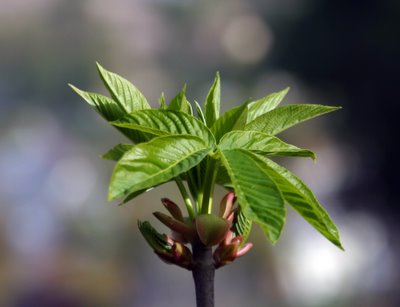
The rains have been slow this year, only two since June. But the native garden I’ve been cultivating since 2001 has matured. Last spring I removed the drip irrigation system I’d used to get it established, and except for one ground soak, I refrained from watering during summer and fall. All 68 varieties survived and most have remained green, proving their adaptation to arid conditions, subsisting on fog, dew, and bits of moisture their roots capture deep in the parched clay soil. Buds were fattening on a buckeye I’d planted a couple of years ago and another had started to leaf.


But this made me nervous. With so little water in the ground, would they deplete their energy with premature growth? I checked my authority on California Natives, the website of Bert Wilson, proprietor of Las Pilitas nursery, and found that Aesculus californica is “tolerant to drought but needs regular water for the first few years.” Remembering Bert’s general abhorrence of watering, this warning seemed urgent. I hooked up the hose and gave the two little saplings a normal season’s worth of precipitation.

The next morning, Sunday, I was gently awakened by the gurgle of rain in the downspout on the wall by my bed. I put on a wool sweater and hat and went out to enjoy it. I climbed the ladder to the roof and cleared the gutters of curled Eugenia leaves and spikey liquidambar seedpods. I rooted up dandelions that had sprouted in the front yard. I transplanted ten bunches of Idaho fescue stored in pots after I’d cleared them off the hillside I’ve been excavating with pick and shovel to make room for an extension of Jan’s office. I cut huge clumps of deergrass straw and spread the leaves and seed stalks on the muddy paths. I filled the wheelbarrow with raked leaves and sprinkled the crackling residue on the spoil I’d been dumping alongside the house to raise the ground level. The porous mixture absorbed the water puddled on the dense clay, protected my shoes, and made a deep-textured carpet of autumnal tweed.

I knew that the thirsty plants would respond quickly to the rain, and next morning I went out to look at the new growth.

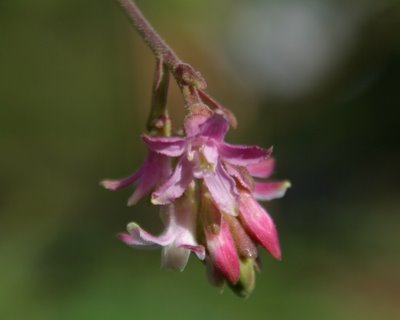
This is ribes sanguineum glutinosum, or pink flowered currant. The specimen between the neighbors’ towering second story and our roof has grown 10 feet, as fast and as tall as the Redwood next to it. Another in total shade under the fence, which I planted to replace a vigorous non-native tree I cut down, has only reached two feet, but is also showing new leaves. The two in back, on the steep north facing slope where there’s very little soil, have reached about four feet. Bert says “This Ribes is more drought tolerant than most of the drought resistant plants of the trade, but in a native garden plant towards the wettest section… .”

Plants for a Future, a British permaculture site reminds me that sanguineum and glutinosum stem from the latin words for “bloody,” and “sticky,” and informs me that its fruits are edible though not tasty. From Native Plants of Montara Mountain I learn that this Ribes belongs to the Grossulariceae family, which contains currants and gooseberries. The vivid language invites a bit of rearrangement

Leaves: alternate, palmately-lobed, hand-like, soft, veined, with edges curving under.
Flowers: pink, five-petaled and stamened, funnel and star shaped, racemes in hanging cascades at ends of branches. Calyx fused to the pistil.
Fruit: Fleshy, red berries ripening to dark blue; developing below the calyx lobes in clusters, with tan seeds inside.

It includes two beautiful words I pursue in the Dictionary

Raceme: An inflorescence having stalked flowers arranged singly along an elongated unbranched axis, as in the lily of the valley…from Latin racemus, a bunch of grapes.

Calyx: the whorl of sepals…collectively forming the outer floral envelope…enclosing…the developing bud

Compared to these technical descriptions, how little of this plant have I described or perceived, even with the assistance of the camera. I need another look.

The Family

Wednesday, December 7th, 2005

[click pictures for full size images]

Early Tuesday I got a ride with Keith, Sharon’s husband and Pat to attend the memorial in Vancouver. Kenneth’s first visit to Lund in many years came last summer to attend a memorial for the death of Mike, one of Pat’s sons, who had also worked at our camp. Soon thereafter Pat had lost another son. She bore the weight of these tragedies with great strength.

We arrived at the spare but stately old Vancouver frame house, the home of Willow, Ron and their children, with some time to spare. Ron had corresponded with me about the old pictures and journal excerpts they had read on this weblog, so I felt immediately drawn into the family. Ron and Willow disappeared, and I met Ron’s father Henry, his sister-in-law Rachel, her 15 month old son Dash, and her husband Cameron. She has a Ph.D. in English and he’s finishing one. For two and a half minutes we discussed her dissertation topic, the Semiotics of Multicultural Rhetoric.

In the midst of the hubbub, Sharon, whom I’d first met two days earlier, prepared me a grilled cheese sandwich with pickled green beans and a cup of coffee, and poured me a shot of her 25 year old prized Canadian Whiskey.

The Unitarian Church at 49th and Oak was packed with 250 people attending the memorial. We were greeted by a shrine outside and four kids handing out programs, two of them Kenneth’s adopted grandchildren, Sophia and Flynn.

The service began with a quotation from Mary Oliver:

you must be able
to do three things:
to love what is mortal;
to hold it
against your bones knowing
your own life depends on it;
and, when the time comes to let it go,
to let it go.

The lay minister didn’t know Kenneth but was awed by the intensity and range of his legacy. The program included a harp introduction, recorded music, an operatic rendition of “Ave Maria,” and a beautiful piano and voice performance of Leonard Cohen’s “Hallelujah,” by Ron.

There were three speeches, one by his professional mentor, one by a former lover, and one by his son-in-law. From these I learned that he worked with child protective services and in an alternative school for severely disturbed kids; that he founded and managed “After Hours,” a drop in center and hotline which became a Province-wide institution; that he organized teams and competed as a runner, a hurdler and a softball player in the Gay Olympics; that he was a textile designer; that he earned an M.A. from Pratt Institute of Art in New York; that he was a famous D.J.–“Poppalizard”– in young people’s clubs. Ron spoke of the way he remained as part of the family after Willow married: Poppa to the grandchildren, cook, party organizer, gardener and house painter. It struck me how many of these life accomplishments were there in germ during the time we knew him in his early twenties.

Following the three speeches and a candlelighting and quenching ceremony, Ron presented a DVD with musical accompaniment including a dozens of pictures and film clips of Kenneth from infancy to grandfatherhood.

At the huge reception afterward, I ran into Mara, Janet and Rhea, Lund people who now live elsewhere. I would have loved to stay for the roasts and tributes, but I had a plane to catch.

Winter Journey

Wednesday, December 7th, 2005

The impulse that started this weblog gained strength over the past week and propelled me back to British Columbia for a rare Winter visit–only one other since leaving in 1979. Encouraged by welcomes from Rosemary who was organizing the Lund memorial and by Lou Stevenson, whom I hadnt met, but who told me that Kenneth had spoken fondly of his time with us to his later family, I flew from San Luis Obispo to Powell River on Friday. Peter and Margaret took me home to their beautiful cabin on the beach, and we stayed up late laughing at CBC political comedy on TV.

Next morning, Peter and I roamed the trails of our summer home at Knoll House, breakfasted at Nancy’s Bakery and explored the old Marx farm with permission of Ed and Maggie, who’ve owned and lived on the place for many years. During the time we lived there it was called the Bleiler farm, for the residents prior to us. Brambles and alders had grown in close to the house, you could hardly see the stream, and alot of stuff had been collected and strewn about. But the place was in working order; there were chickens, a horse, more light on the pasture since the logging after we left, and the pear, apple and cherry trees, ancient and decrepit in 1970, were still standing and producing.

I recognized the staircase to the loft in the abandoned shack Kenneth had decorated and inhabited during 1973, but the old gate with the heart-shaped hole–the entrance to our homestead that kept the goats out and welcomed the people–was gone.

We walked out of the woods and drove to Rosemary’s bright new home overlooking the water on Ralph Road, the location for the Lund memorial. Rosemary worked with Kenneth at the Lund School as instructional assistant. Also in attendance were Darrel, his partner for the last year, who had come up from Vancouver for the celebration; Vicky, whose cousin Joanne Kenneth had almost married while living on our farm; Debby whom Kenneth had married to allow her to emigrate to Canada as an eighteen year-old; Lou, who had met Kenneth in Vancouver and came to Powell River at his instigation; Sharon, who also came to the area as a result of Kenneth’s influence and whose two daughters were adopted by him in Vancouver; Pat, Rudy, Sherry, Steve and Juliet, who were friends with Kenneth when he lived in Lund during the seventies.

After enjoying the sunny vistas and the food and drink, we sat in a circle and shared old photos and stories of Kenneth: grateful stories of his generous involvements in families, of his inspiring creative community activity, of his way with children, and hilarious stories of his outrageous sexuality and gender-bending, his falling in and out of love, his tendency to appear and disappear without warning.


While this memorial took place another historic event was unfolding in Lund: a meeting of 75 people to try to halt the logging of old growth trees on the Malaspina Peninsula. Steve, Juliet and I attended the last hour, retired to the pub with two organizers, Eagle and Pam, and then went back to Malaspina Farm for dinner and conversation which mixed talk of Kenneth and the political future of this area. Next day, Sunday, Peter, Steve and I went cross country skiing for seven hours on the Elk Lake loop. I spent Monday recovering from that and reading and writing at the Behrs while they were at work.

Introduction

Monday, November 28th, 2005

https://www.flickr.com/photos/smarx/55490651440/in/album-72177720335328098/I learned this morning of Kenneth Law’s death. Though we were close friends for only a year long ago and though I had no contact with him at all for the last twenty five years, the news made me realize how much I regret losing touch. I’ve tried to find some of that lost connection in old pictures and journals that I’ve scanned or transcribed here. I hope to find more by sharing with others who knew him, perhaps by attending memorial gatherings in Lund and Vancouver and perhaps through this website. If anyone reading this would like to contribute material, please email me words and pictures and I will post them.

[email protected]

Thanksgivings

Sunday, November 27th, 2005

Jan suggested a hike this Sunday morning, since she no longer has to go to church with her mother. We agreed to catch the sunrise on San Luis Mountain. There were already three cars in the parking lot when we got there and started up the hill in the chill wind. The sun crested the southern horizon as we passed below a great boulder surmounted by two large coast live oaks, and slowly lit up the red, yellow and purple rock. Behind it you could see the sky turn from gray to lapis lazuli blue. As we descended from the summit after enjoying the view of the city surrounded by agricultural fields mountains and ocean and drinking coffee from a thermos, I said that the older I get the more I think its unlikely we’ll move away from this place. On the way home we stopped at Home Depot for a new pickaxe. The one I’d been using broke off at the tip after hitting one too many rocks.

Now I sit at the top of the hill in the backyard on the “60th Anniversary Bench” we gave to my parents, inscribed with the old proverb about love. Its the only spot at our place that gets sun this time of year and the warm rays feel good in the chilly air. The light at midday is better than early morning or late afternoon at this time of year–both low and strong, intensifying shadows and highlights.

I’m reminded of November on our old homestead in British Columbia in the ’70’s. Only on the bank above the driveway, high on the south facing slope could you get out of the shadow of the cliffs and tall trees surrounding the pasture. Here the goats and the cat would lounge all afternoon whenever it was clear.

I’ve been scanning and restoring old pictures of that time from mouldering photo albums.

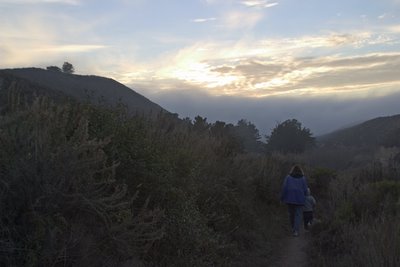
Its been a long Thanksgiving holiday whose approaching end is marked by the sound of students’ cars returning to campus. On Tuesday morning Ian and I packed provisions and headed for Montana de Oro. We found a site near the trailhead at the end of the campground. As we were setting up the tent, a midsized healthy looking coyote sauntered by and stood scratching itself and watching us as we watched it, for about ten minutes. I was too enthralled to take out my camera. At first I thought it was a dog belonging to another camper.

At the Spooner’s Cove beach we climbed a tilted sandstone outcrop and came to spot on top where the waves roared through a crack below us. I foraged eucalyptus branches for firewood and as we returned to the camp, Jan drove up after seeing her afternoon clients. The three of us took a hike up the Islay creek trail and watched fingers of fog creeping down into the canyon over Reservoir Flats. On the way back to camp Jan told the story of the three little pigs in great detail to keep Ian from thinking about being tired, and we watched the sun dip into the marine layer as we came back to the camp. As the sky turned florescent pink, then purple then black, we grilled dinner with only three candle stubs sheltered by the apple juice container for light.

Inside the little backpacking tent we hung a small flashlight from the ceiling and played Chutes and Ladders till Ian threw the spinner away in rage and then immediately fell asleep. When Jan went out to pee in the middle of the night she heard cellophane crackling and in the morning we discovered that the cookies we had forgotten to put away were missing.

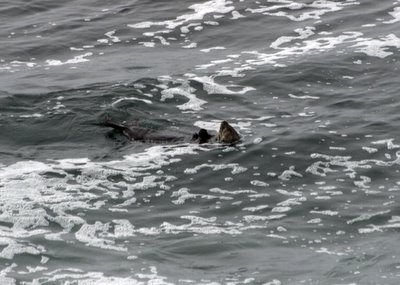
Claire drove up in a big truck in time to join us for breakfast and more games. After Jan left to go back to work, Ian Claire and I struck camp and hiked the bluff trail along the ocean, sighting quail, sparrows, herons, cormorants, herons, and male and female brown pelicans which Ian identified with the bird book. We also spotted an otter relaxing in the surf between protruding outcrops.

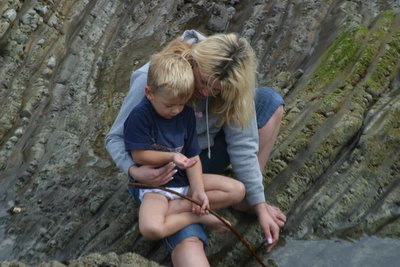
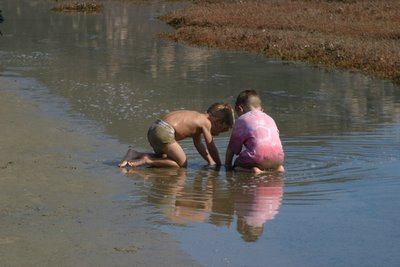
The sun hid in the mist and then appeared briefly intensifying colors and shapes. We stayed for two hours in Corallitos Cove, throwing rocks, chasing waves, poking anemones, investigating crabs and observing the comings and goings of the pelicans. In the late afternoon we drove to Los Osos for ice cream cones.

Backyard afternoon

Monday, November 21st, 2005

The furious bluster of this morning’s Santa Ana wind gave way to a whisper of breeze perceptible only in the flutter of mimosa leaves on the silk tree and the shimmer in the tall palms across the street. I suck in deep breaths of the soft dry air, shaded by the hillside from the hot November sun which lights up Poly Mountain across the valley and the treetops around me. The quiet is broken by a loud, scolding, mechanical noise, like a ratchet on a gearwheel. I get up for the binoculars and then remember: hummingbird.

Since no machinery can get in here, I hired a landscape architecture student and his crew to hand-excavate a 13 by 17 foot hole in the steep bank to make room for an addition to Jan’s home office. The day they were supposed to start, he emailed me to say it was too big a job. Our contractor friend said, “that’s alot of digging, it’ll be expensive to have my guys do it.” A couple of days later I realized that it would make a good project for me in the last few weeks of my early retirement recess. I could go at my own pace and enjoy a sense of steady progress, benefit from the exercise, test my newly strengthened back, and get acquainted with the dirt and rock I live on. Last Thursday I went to Home Depot with Ian and found a plastic cart with a scoop nose perfect for hauling spoil and a small spade with a handle we sawed to a length that would reach from the ground to his nose.

After ten minutes he decided he didnt like the work, but it suits me fine, especially during this week of dealing with the vagaries of my 89 year-old mother-in-law’s move into an assisted living facility as a result of a fall.

The top ten inches of ground are composed of adobe clay soil that breaks up into light chocolate brown pea gravel that turns to dark sticky mud when wet. I uncover buried irrigation pipe and roots to cut with loppers. Then comes the yellowish-tan hardpan, a dense but penetrable layer that grabs the point of the pickaxe and doesnt want to let go. Then blue-green or wine-brown chert, in some places yielding, like the hardpan, in others brittle and shattering into rock gravel when hit, and in others hard enough to clank, send a shock up my arm and knock the tip off the pick. When I hit this stuff, I look for fracture lines and feel triumph when it breaks.

I just got off the phone with a student who asked me to supervise a senior thesis in Natural Resource Management on the restoration project planned for a steep bank in Poly Canyon. Along with the preparation I’m doing occasionally for upcoming winter classes, this reminds me of the world I’ve been away from since June and makes me glad to return. Early retirement for more than one quarter would be too much, despite the luxury of free time. No part-time project is as compelling as teaching, whose steady stresss I retreat from and desire.

The light has changed, departed from the treetops here and weaker on the mountain, where the lengthening shadows increase contrast but reduce brightness. The large black one creeping over the Buena Vista neighborhood–could it be Bishop’s Peak?

Sierra Summit

Friday, November 18th, 2005

[This report was published in the October 2005 Issue of The Santa Lucian]

I just returned from the Sierra Summit that took place in San Francisco September 8 to 11. My wife Jan and I had decided to attend privately to strengthen our connection to the national organization in this dark time and to learn from a luminary lineup of scheduled speakers. When some of our chapter representatives couldn’t go, I became a delegate in return for half price on the registration fee. The delegates’ job was to bridge a gap between leadership and grassroots and to democratically select goals guiding action and budget decisions over the next five years.

We drove up on Thursday morning with Chris, who’d agreed to become a much in-demand under-30 delegate, checked into a cheap hotel in Chinatown, walked to the Moscone Convention center, and fell in with thousands of well-dressed members of the California Dental Association. Finally we found our way to “Moscone North” and what was billed as “Sierra Club’s First Ever National Environmental Convention and Expo.” http://www.sierraclub.org/sierrasummit

The prospect of a four hour priority setting session after a long drive and no lunch in a cavernous banquet hall was not enhanced by lengthy “motivational” harangues by two professional facilitators with deep southern accents. Though the leader admitted that he had no environmental involvement of his own, he assured me that he did not normally work for energy companies like Exxon, but only churches and financial institutions. Sitting at tables in groups of ten, the seven hundred delegates were put through a series of ill conceived icebreaking exercises and endless questionnaires, and asked to prioritize vague, confusing and overlappingly phrased goals.

Midway through the session, delegates started speaking up, expressing bewilderment and resentment. Carl Pope, Sierra Club Executive Director, convinced the audience not to give up and the facilitators to talk less and listen more. By the end of the session a general consensus among delegates was reached: the first two priorities for future national action and budgeting were 1)build a clean and safe energy future with improved efficiency and renewable resources and 2)build vibrant communities assuring environmental justice and reducing sprawl.

This selection makes significant changes in sequence and wording to conclusions drawn from pre-summit surveys. It signals a shift from primary emphasis on recreation and wilderness preservation and clearly reflects the impact of Hurricane Katrina. That impact was reinforced by the surprise announcement that the Convention would be addressed at 8:30 next morning by Al Gore. He had turned down our invitation because of a previous commitment on the same day to talk about global warming to an insurance industry convention in New Orleans.

The onslaught of Katrina is an apt metaphor for the Bush administration’s onslaught on the world environment. The speeches I heard at Sierra Summit on Friday and Saturday gave evidence of an energy that might be able to resist and protect from these storms.

Gavin Newsome, the radiant mayor of SF, welcomed the Sierra Club to his “49 square miles surrounded by reality” by asserting that cities can act when federal and state governments fail to address environmental issues. San Francisco has required all retired city vehicles to be replaced by hybrids, has embarked upon an aggressive green building program, and has been the first city to adopt the Precautionary Principle as a guiding policy. http://www.sfenvironment.com/aboutus/innovative/pp/

In his introduction of Al Gore to a packed hall of about 2500 people, Carl Pope told us he had just returned from India where a hardly reported storm dropped 37 inches of rain on Bombay the day that Katrina hit New Orleans. Carl witnessed that within seven hours 15,000 Indian troops were on the streets helping survivors, within 15 hours all buses in the neighboring states were mobilizeed for rescue and evacuation, within 8 hours, everyone in Bombay had food and water, and within two days plastic packaging was banned because it was discovered that plastic waste had blocked sewers and storm drains. The contrasting fate of the Gulf Coast, said Pope, was sealed on a November day in 2000, when the Supreme Court decided the case of Bush vs. Gore.

The gravity and eloquence of Gore’s speech are impossible to convey. I urge you to read or listen to it at http://www.sierraclub.org/pressroom/gorespeech/. He put Katrina into the context of the gathering storm preceding World War II prophecied by Winston Churchill. We have tasted the first sip of the bitter cup that awaits us, he prophesied. Four years ago it was vacation time when dire warnings about the prospect of an attack by Al quaeda and identification of students at flight schools with no interest in learning to land were provided to the President. This summer there were warnings about what could happen if a large hurricane hit New Orleans. Three years ago, there were dire warnings that FEMA was being rendered helpless. He asked us to draw the line connecting the emotions we felt when we saw the images of Abu Graib and the emotionswe felt when seeing the people in the Superdome and then to draw the line connecting those responsible for both tragedies.

Gore compared the warnings about Hitler wilfully ignored by the British government and the West and the warnings about global warning wilfully denied by the American government, quoting Upton Sinclair: “It is difficult to get a man to understand something when his salary depends on his not understanding it.” He insisted that we have the vision and know-how and technology we need to address global warming, but we lack the political will. “But political will is a renewable resource,” he concluded, and the audience came to its feet and roared.

The glimmer of hope kindled by Gore’s conclusion exploded into sunshine during the next presentation I attended, a talk by Bill McDonough, the author of Cradle to Cradle and prophet of the Second Industrial Revolution. His maxim is “how do we love all the children of all species for all time?” McDonough often works with people the Sierra Club is aligned against, such as the Ford Motor Company, for which he designed a green assembly plant in Dearborn Michigan. McDonough and his company devise products, buildings, industrial processes and cities according to standards that require zero waste and zero pollution. He showed us some of his ecotopian plans for the construction of seven new cities commissioned by the government of China which he said has adopted Cradle to Cradle as their industrial policy. Less optimistically, he alerted us to the fact that the world’s oceans are rapidly lowering in Ph, and that if the present trend continues, by the year 2100, calcium carbonate will dissolve, destroying all coral and molluscs”the bottom of the food chain. If you want to know more about McDonough, a seminal thinker on Sustainability, try http://www.mcdonough.com

While McDonough spoke to an audience of 800, six other presentations were taking place simultaneously. For the late afternoon session, I attended a small one on “engaging youth” mounted by the Sierra Student Coalition. These young people organize projects like “Victoria’s Dirty Secret” exposing the practises of the catalog industry which is destroying boreal and appalachian forests to produce the junk mail. SSC may be able to help us start a local group bringing together high school, college and university student allies.

Delegates convened again Saturday morning from 7:30 to 11:30 to prioritize means to achieve goals prioritized the day before. First place went to organizing people locally to take action. Second was creating new allies and coalitions. Others included supplying environmental expertise, getting people outdoors, public education, bringing legal action and creating media visibility. Delegates were then treated to a lengthy study by Harvard Professor Marshall Ganz on how the club could increase general effectiveness (NPLA). He concluded we need motivated well trained leaders and lots of attention to engaging new members in club activities. If interested, see http://www.clubhouse.sierraclub.org/committees/oegc/workplan/index.html

Saturday’s highlight for me was the plenary session featuring Robert F. Kennedy Jr. Security was extensive and the great hall was even more packed than for Gore. Hoarse with laryngitis, at times desperate with anger at others ecstatic with ardor, Kennedy repeatedly brought me to tears. This is a person you could follow to the barricades. Presented with the Sierra Club’s William O. Douglas award, he spoke at length about his childhood relation with Douglas and then went on to indict the present administration”headed by the worst environmental president in history who has corrupted all agencies by heading them with the bought dogs of the corporations who finance his campaigns. A former NY state assistant attorney general who spearheaded the salvation of New York’s Hudson River, Bobby’s son spoke about his three sons who suffer from asthma brought on by the unprosecuted criminal activities of corporate polluters. He talked about the subversion of the free market by the corporations that now control government. He talked about the ignorance of what’s going on caused by the corporate media’s refusal to report it. He talked about his own success at awakening and converting Red-state audiences. And finally he rhapsodized at length about Saint Francis, the Bible, religion and nature. You can find an early version of this speech at http://www.commondreams.org/views03/1120-01.htm

A quiet and lyrical coda to this Riverkeeper’s jeremiad came in a presentation by Robert Hass entitled “River of Words.” Another local as well as national hero, Hass used his position as former US poet laureate to create an organization promoting environmental education for children. As he does with his students at UC Berkeley he encourages teachers to take their students outdoors, to cultivate their senses and encourage their observations of nature, to get them to follow Aldo Leopold’s advice to “think like a mountain,” and then to have them write poems and draw pictures about their experiences. This traditional but nowadays rare approach has generated thousands of submissions from around the world which his organization makes available online and in published collections, and which in turn generate more rivers of words. Rather than reading his own lovely nature poems, Hass spent the hour showing and commenting upon exquisite examples of the childrens’ work. For more information on this project see, http://www.riverofwords.org/index.html

There was much more at this amazing conference than can fit here. The impact of what I heard and saw is still not absorbed. And though I have doubts about the effectiveness of a very abstract exercise in deliberative process, the sensation of simply being together with so many people of like mind, common loss and shared aspiration–people for whom I immediately felt affection and respect–will nourish me for a long time.

Assignment

Friday, November 18th, 2005

Preparing for my next quarter’s class, Ecolit: Reading and Writing the Landscape, I modified the Journal writing requirement to include a weblog option. At least twice a week students must write an entry. I must follow suit.

I’ve been going to Nature Explorers with my grandson Ian every Thursday morning. Its a program for kids up to age 8 and their parents and grandparents, part of the Coyote Road School in San Luis Obispo. The school focuses on outdoor education and nature study with an emphasis on tracking that derives from the educational philosophy of Tom Brown’s Tracker School.

We’ve been to Bishop’s Peak, Reservoir Canyon, Cuesta Park, Laguna Lake, the Sand Spit and Morro Bay Estuary, a few of the hundred wonderful natural preserves within 20 minutes of home. All the kids are enthralled with these sessions, especially Ian, and the adults seem to enjoy them with just as much enthusiasm. There’s alot of philosophy and expertise that goes into the program, but each excursion feels casual and slow paced and leaves plenty of time for adventure and pure fooling around.

Alot of what goes on is similar to what happens in my University classes, although less information is conveyed. As a student rather than a teacher, however, I find myself marvelling at the knowledge of wildlife, vegetation, and Indian lore drawn upon by Dave and Evan, the leaders, especially the kind of reading of the landscape they do with the kids by studying the inscriptions left by animals in tracks, scats, and bones.

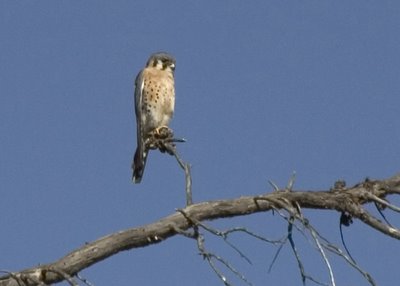
Each session has ended with some unscripted but dramatic sighting–yesterday, the last of the quarter, it was a peregrine falcon mobbed by a merlin–the two raptors noisily squabbling overhead at the Morro Bay Marina in the estuary. The week before it was discovery of the skeletal remains of a seal or a sea lion on the Sandspit. The week before, a kestrel sitting in the sun for his portrait at Laguna Lake.

Most of the students and parents attending Coyote Road classes are being home-schooled. I remember that one of the most well informed and talented writers in my ecolit class two years ago was home-schooled in North County. A full generation below me, the Coyote Road parents and instructors seem to have resurrected or retained the spirit of the sixties and seventies whose demise I’ve mourned since returning from exile in Canada in 1979. But at Tuesday night’s general meeting of the Sierra Club, I saw more traces in the presentation about his Environmental Studies curriculum by a Paso Robles High School Teacher, Mark DeMaggio.

My Ascent of Mount Maggiore

Thursday, October 27th, 2005

photo gallery

During our visit to Fornello, Brenda reminded me twice that the final day of our trip was Yom Kippur, the highest holiday in the Jewish Calendar. I wished she hadn’t mentioned it so I could have let it pass unnoticed. I woke up Thursday morning feeling guilty”in part for the privilege of enjoying Italy during the time of year I would normally be staggering under my Fall quarter workload, and more specifically at the prospect of going on our scheduled gastronomic and wine tour of the Chianti region on this fast day. I hadnt attended a synagogue service in decades, but refraining from food for 24 hours and going into the woods alone on this holiday was one religious duty I had regularly observed. I decided to skip breakfast, excuse myself from the tour, and head for countryside. It took me a cranky uncaffeinated hour to negotiate buying a ticket from the Tabak shop and find the right bus stop, but by 11 a.m. I had reached Monteriggioni, where my Italian Alpine Club map indicated the beginning of an excursion leading to the top of Monte Maggiore.

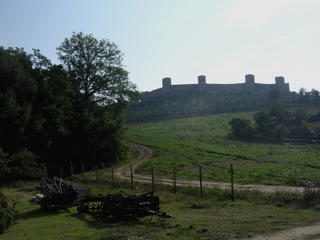
I got off the bus and bounded up the steep pedestrian approach to the castle famously described by Dante

As, when the fog is vanishing away,
Little by little doth the sight refigure
Whate’er the mist that crowds the air conceals,

So, piercing through the dense and darksome air,
More and more near approaching tow’rd the verge,
My error fled, and fear came over me;

Because as on its circular parapets
Montereggione crowns itself with towers, 41
E’en thus the margin which surrounds the well

With one half of their bodies turreted
The horrible giants, whom Jove menaces
E’en now from out the heavens when he thunders. (Inferno Canto 31)

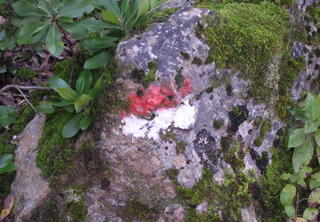
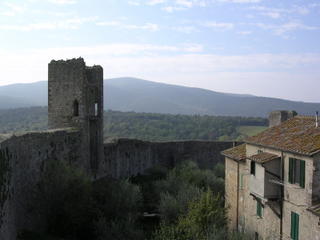
I wandered through the tiny village inside the fortress, sat for a moment in the empty chapel, and left 50 cents in the offering box. I paid a Euro to the lonely young man guarding the stairway that led to the top of the wall from which I could see the mountain towering in the mist. In the car park on the south side of the wall, I found a large sign with a maps and historical information about the trail ahead. Like the piazza between the Siena Duomo and the Ospedale, this too was part of the Via Francigena, the pilgrim itinerary from Compostela to Rome that put me on a venerable path of discomfort, wanderlust and spiritual aspiration. My route through the wilderness of “Montagnola” would take me to the summit and then on what a sign called “La Grande Traversata,” down to the villages of Fungaia and Santa Columba on the other side, where I could catch another bus back to the city.

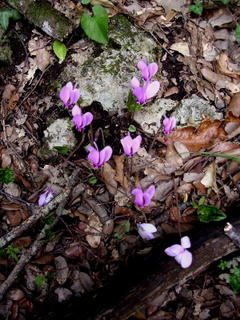
A dirt road led me into thick woods which occasionally opened up to fields, olive groves, and old villas and ended at an organic farm and meditation center named Ebbio, where several guests stood in the courtyard looking nervous and smoking cigarettes. Here the road gave way to a steep trail that tunnelled through forests of small trees, some thick with brush, others recently thinned and coppiced. I was serenaded by unfamiliar melodies that sounded as if they could only have been sung by birds called “larks.” Exertion and solitude and the growing distance from the valley occasionaly visible through a break in the trees contributed to the pleasant buzz in my head created by the emptiness in my stomach. A small trail branched to the left which I thought might lead to the summit. I noticed a cluster of delicate pink cyclamen growing in the deep shade at my feet, fresh blooms in mid-autumn.

I followed the side trail uphill for several minutes, but rather than reaching a summit, it headed back downhill. Conscious that it was well past noon and that I hadnt seen any signs or trail markers for the last hour, I no longer could locate myself on the map with certainty. I returned to the patch of cyclamen and continued heading toward the westering sun, hoping soon to find a junction that would lead to the south and then east. The bird song had ceased and now in the distance I heard the whine of one, then two chainsaws. The trail came to a clearing at a junction of several tracks filled with deep mud, sign of the recent passage of skidders, the huge insect-like machines which drag timber out of the forest. Across a plateau miles ahead of me I could see land that had recently been cleared but no evidence of civilization or indications of where I could make my way out of this endless Montagnola. I walked faster and then half ran toward the ugly sounds of the chainsaws but seemed to get no closer and found new paths heading off in all directions. I felt stirrings of fear and confusion. I checked my watch and told myself that if I found no landmark within ten minutes I would have to admit defeat, turn around and retrace my steps. Twenty minutes later, with an unmistakeable taste of panic in my mouth, I did just that.

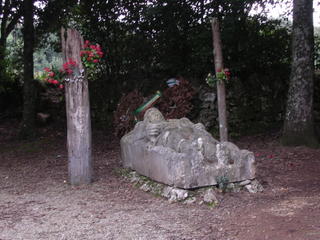
The walk back was long and boring. Having neither reached the summit nor accomplished “La Grande Traversata,” once I knew my way, I took an alternative dirt road down to the valley that passed by a memorial to WW II partisans who hid in this wilderness but finally were captured and executed by the Nazis. I passed several men with guns and dogs who were out hunting, probably for larks. The road was steep, viewless and littered with trash. It emerged at Abbadia de Isola, which the historical signs told me was the site of an Abbey and military outpost for Siena that was rendered obsolete with the construction of Monteriggione back in the eleventh century. The buildings were standing, but restoration had not proceeded. Inside, on rutted dirt streets, I saw decrepit old people coming and going from apartments built into the decaying ruin.

A sign on the road through the village indicated that the last bus to Siena had departed hours ago. By now footsore and fatigued as well as hungry, I trudged toward a junction with the main highway. The prosperous American Elderhosteler had no choice but to hitchhike. I stuck out my thumb”probably not even the right gesture”and for fifteen minutes got nothing but puzzled stares from occasionally passing cars. Then in the distance I saw it”the Blue Bus. As it approached I could read “Siena Direct” in little yellow lights above the windshield. I don’t think I was at a real bus stop, but in my pocket I carried the return ticket I’d purchased for 90 cents that morning at the Tabak shop, so I stood in the road, and it stopped and opened its door. Back in the city and feeling triumphant, I stepped off at the Piazza Diavoli near our hotel. I was greeted by Tom, a member of our group, who was eager to fill me in on their day’s excursion and to give me a slide show on the back of his little camera until the local bus he was waiting for pulled up and took him downtown.

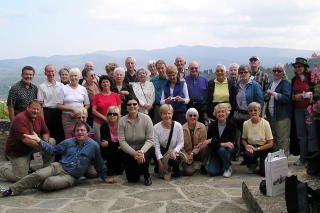
I walked through the Hotel’s entry arch and up the tree-lined promenade, a genial variation of the trail through the dark wood on Monte Maggiore. At the top, I enjoyed my last view of the towers of Siena in the waning light. Jan welcomed me with some bread and wine to break my fast. At our final meal together in the brightly lit dining room, I joined 35 Elderhostlers in toasting our caring hosts and bidding each other farewell.

Expatriates

Monday, October 24th, 2005

photo gallery

A member of our group asked Louise, our graceful guide in Cortona, whether she knew Frances Mayes, the author of Under the Tuscan Sun, the bestseller book and film story of an American woman who falls in love with Italy, buys an abandoned farmhouse and olive grove near that town and settles in for good. Louise answered, “Sort of¦that is I hear about her from my plumber. He also works for her.” Until Wednesday, the next to last day of the Elder Hostel program, this was as close as we’d come to a real local resident. So Jan and I were excited to use our only day off to accept our old friend Brenda’s repeated invitation to visit her and her partner Don at their country home at Fornello in the hills above Florence.

We knew Brenda in the late sixties when I was a probationary instructor and she and Jan were graduate students at Columbia University. The two of them were in the same Dante seminar, and we crossed paths as visitors to Florence the summer of 1969, our last time in Italy. One hot evening the three of us attended a concert in the courtyard of the Pitti Palace, and during intermission, Brenda struck up a conversation with a clarinet player in the orchestra, later married him, moved to Florence and has lived there ever since. The following year Jan and I emigrated to live at the end of the road in coastal British Columbia, where we remained for nine years. In the intervening time, we had heard a bit about Brenda through a mutual friend in California, and before this trip we reestablished contact by email.

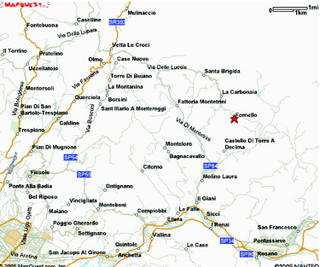
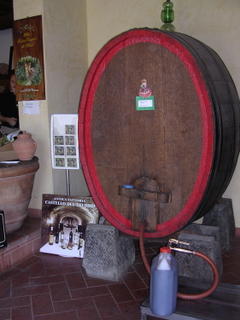
The train ride from Siena to Florence on the Eurostar was brief and cushy. There we boarded a local branch line which passed through the less glamorous districts of the city, full of grafitti, litter, and drab apartment blocks but brightened by ever-present backyard and trackside vegetable gardens. The flat suburbs soon gave way to hills, small towns and picturesque views of the Arno, which we followed upstream. Brenda greeted us at the station in Sieci, near where the river took a sharp turn and descended over a small waterfall. She drove us up a narrow, winding road into the foothills of the Appenines, a green rural landscape dotted with farmhouses, fortresses, churches and tiny villages. First stop was a crenellated stone castle on a narrow ridgetop, Castello del Trebbio, which served as the headquarters for a winery and agritourismo. Brenda got a cannister normally used for gasoline out of the trunk, greeted a demented looking feather-hatted old man in the parking lot, and took us into the building where she filled her plastic five-liter container from a hose connected to a huge barrel. “Don bottles it at home,” she told us, as she paid the proprietor what looked to be the cost of an equivalent amount of my home-town favorite, “Two-buck Chuck.”

As we continued up the mountain, the views longer and more pristine, it was hard to believe that she could commute several times a week to teaching jobs in Florence and Bologna. Santa Brigida was just a few houses and a church hanging onto the mountainside along the roadway, and there we stopped in her little local market for bread, cheese, prosciutto and salad vegetables. It took a good twenty minutes before she and Jan emerged from what looked like a Romanesque stone balconied façade with some of the makings for lunch.

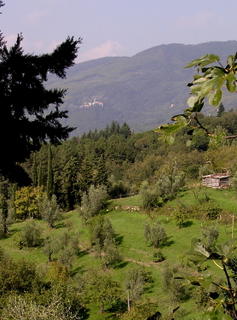
Another couple of miles, past a large villa that used to house the noble that owned all the land in this valley, and we turned up an impossibly steep driveway, passed an assemblage of plastic playground equipment belonging to the people who owned the main house, and stopped alongside a converted brick barn set on a terrace above a sloping olive orchard. This was the landscape described in Vergil’s Eclogues. It was a familiar two thousand year old dream: the subject of my doctoral dissertation on Renaissance pastoral.

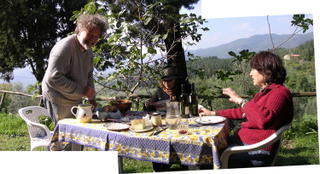
A transplanted Scotsman from near Edinburgh, Don came out from his study where he works as a translator from Italian to English”everything from marketing materials to fine books, one of which he showed me about the cultural history of the Vespa, and another a photo essay about the Tuscan landscape. He decanted some of the new wine into a pitcher, Brenda laid a colorful tablecloth over the plastic patio furniture, dressed up the antipasto and we sat down to begin a three hour midday meal. Don went into the kitchen and cooked up a fine pasta while the rest of us tried to reconstruct some colorful common experiences of the sixties . After lunch he returned to his work, and Brenda led us on a hike down the lane by a small country church, through a thick forest, past a sign about a newly discovered early medieval monastery, and out to an isolated house with a view of another great valley to the east that opened before us for the first time in the golden evening light

Yet here¦you might repose with me,
On green leaves pillowed: apples ripe have I,
Soft chestnuts, and of curdled milk enough.
And, see, the farm-roof chimneys smoke afar,
And from the hills the shadows lengthening fall! (Eclog 1)

Like it was for Vergil’s shepherds however, so this perfection was imperilled. As age creeps up, wages and pensions are frozen and the cost of living rises–especially gas for commuters and rents for possible recreational property now on the global real estate market. In the dark, on the way back down to the train station at Sieci, Brenda mentioned that they may soon be forced to move.