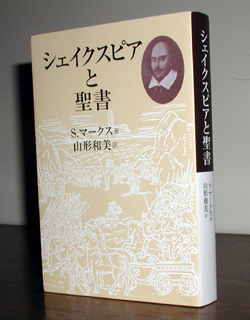
This book is a complete translation into Japanese of Steven Marx, Shakespeare and the Bible (Oxford University Press, 2000). The original book is a title of the Oxford Shakespeare Topics series with Peter Holland and Stanley Wells as General Editors
Steven Marx is a literary scholar and critic. He was born in 1942. He is currently professor in English literature, English Department of Cal Poly University, California. He graduated from Columbia University, Phi Beta Kappa, magna cum laude in 1963, and acquired his Ph.D. in English from Stanford University in 1981. Steven Marx, after graduation from Stanford University, became assistant Professor of English, Columbia University (1967-1970). From 1970 to 1984 he taught English and English literature at various colleges, and in 1984 he was appointed as a lecturer in English and Western Culture in Stanford University. Up to 1988 he also held seminar in Shakespeare. From 1988 to the present Marx has been acting as assistant professor, associate professor, and full professor, teaching both at literary department level and at graduate school level Shakespeare, Classical, Medieval, and Renaissance Literatures, the Bible as Literature, Blake, Ethnic Literature.
Among his works are the following: Youth Against Age: Generational Strife in Renaissance Poetry (1985)(2) “Teaching in the School of Donne: Metaphysical Poetry and English Composition” (1990)(3) “Shakespeare’s Pacifism” (1992)(4) “The Prophet Disarmed: Milton and the Quakers” (1992)(5) “A Problem in Rhetoric: Teaching Writing with Western Culture” (1993)(6) “Northrop Frye’s Bible” (1994)(7) “Holy War in Henry V” (1995) (8) “Progeny: Prospero’s Books, Genesis, and The Tempest” (1996)(9) “Moses and Machiavellism” (1997) In book form he has published (1), and of course, to it Shakespeare and the Bible should be now added. It may be evident that the articles (8)and (9)have much to do with his recent book. And article (6) presents serious explication and interpretation of Northrop Frye’s last major work Words with Power (the Japanese translation of this work was done by the present writer, published by Hosei University Press in 2001).
I have found intense interest in “Literature and Christianity” as one of my research subjects. When I came to know of Marx’s new book, curiousity was instantly aroused. Soon I acquired it and read through it. And I thought that my translation would attract not only those who are interested in Shakespeare, but also Christian readers. As for the relation of Shakespeare and the Bible, I was already familiar with the critical comments by Harold Bloom of Yale University. He says that “There are only three significant literary influences upon Shakespeare: Marlowe, Chaucer, and the English Bible” (Ruin the Sacred Truths: Poetry and Belieffrom the Bible to the Present, Harvard University Press, 1989, p. 53). Milton of the next age was fully influenced by the Bible, and created a really great epic poem on the subject of “The Fall of Man”, the most important item of the Bible.
But the effect Shakespeare had from the English Bible was “ambiguous”, Bloom says. Shakespeare has been the only rival of the English Bible in “forming the rhetoric and vision” of the coming world of English. But this does not necessarily mean that by this Shakespeare intended at the same time to return to belief. Let us quote from Bloom: “Shakespeare’s use of the Geneva and Bishops’ Bibles, and of biblical portions of the Book of Common Prayer, is a resort not to belief but to poetry. We have learned much more from Shakespeare than we generally realize. One of the many truths he goes on teaching us is that belief is a weak misreading of literature, even as poetry depends upon a strong or creative misreading of prior poetic strength. (Ibid., p.53)
The point these sentences involve is that as Bloom himself has always distinctly separated literature from belief, so Shakespeare excluded every element of belief from his own art. We must not forget that as the reason for this artistic attitude Bloom was thinking of his own now famous poetics: unless a poet can’strongly’ exclude preceding poetry by misreading it, he cannot create his own poetry. What we feel uneasy about is that Bloom here makes us feel as if his own poetics was Shakespeare’s own poetics. According to Bloom, what induces a weak attitude on the side of a poet is belief, and Shakespeare, only by eliminating such belief, succeeded in creating his own world nobody else could have created.
When we have gone over Bloom like this, we have already brought within our shot the problem of “Shakespeare and Christianity” or, and, “Shakespeare and the Bible”, that is, we have already caught the core of the problem which Marx has proposed to clarify. Can we deal with Shakespeare as curtly as Bloom? Of course, not. I do not think that Shakespeare was completely free from all the problems Christianity or, and, the Bible imposed, and I do strongly propose that all the elements or traces of the encounters between Shakespeare and the Bible are hidden somewhere within the world of Shakespearean canon in such forms as are extremely indiscenible especially to the novices. Thus, we cant point to the direction Marx has propounded and the mode of the discernment he has shown in the treatment of his proposed subject.
Readers may feel that the construction of this book is well-balanced, too much well-balanced. That is, the mode of writing of the book gives us a strong feeling that the canon of Shakespeare and the text structure of the Bible are very conveniently matched with each other.
First, the four genres of Shakespeare’s work are taken into account. From the genre of Romance The Tempest, from the genre of History Henry V, from the genre of Tragedy King Lear, from the genre of Comedy Measurefor Measure and The Merchant of Venice are respectively chosen, and finally, to conclude the vision, again The Tempest is taken up (needless to say, not only these chosen plays are good plays of Shakespeare). Each of these plays is associated with a particular book, a particular topic, or particular places of the Bible. It is not clear whether these Shakespearean plays have come first, and then these particular items of the Bible are drawn out, or the opposite. Anyway, we have the impression that this is deliberately not made clear, which shows something of the author’s adroit technique.
The Tempest which comes first is connected with Genesis, the second Henry V is discussed as a historical type in connection with Moses and David, King Lear is squarely compared with The Book of Job, Measure for Measure is discussed in parellel with the Gospels, and The Merchant of Venice is read on the basis of The Epistle to the Romans. But just as the Bible begins with Genesis and end with Revelation, so in Marx’s book The Tempest, which is put in parallel with Genesis, is at the final stage accreted as ‘apocalypse’ with Revelation for further explication.
Thus,- Marx’s Shakespearean exposition is structured as if the whole canon of Shakespeare had its own beginning and end just as the whole canon of the Bible has. Not only that. Readers are even induced to feel as if the Shakespearean plays taken up here had been created on the basis of the Bible. This is, of course, an illusion the exquisite working by Marx has produced. Needless to say, Shakespeare did not create his plays just in the way as the author here has laboriously developed. This kind of work was not done from the illusion on the side of the author; it is indeed a fact that there is something in Shakespearean texts which permit, or induce, such readings in connection with the text of the Bible.
The fact we can point out with perfect certainty is that, as has been so far clearly shown by the research scholars, Shakespeare has alluded in his whole canon of plays to about one thousand and two hundred places of the Bible including Apocryphal documents (cf. 1. D. E. Thomas, William Shakespeare and His Bible, Hearthstone Publishings, 2000, p. 58). This fact inevitably invites us to an attracting work which should promise a rich result in the problem of Shakespeare and the Bible. But if this kind of work merely continues to enumerate only related items, phrases and words, and compare them like a form of catalogue, it would produce nothing valuable or illuminating
In order to make both Shakespeare and the Bible alive, as circumspectly and opulently done by this author, it will be essential, by making ‘close readings’ in concrete contexts, not only to speculate carefully both Shakespeare and the Bible, but to fuse ‘dialectically’ both of them into each other, to re-unite them, and finally to create, as it were, a third vision out of them. And I am quite sure that Marx’s circumspect procedure has attained this stage of result.
It is because Marx has cultivated an exceedingly rich knowledge and penetrating vision of both the world of Shakespeare and the world of the Bible that he has
succeeded in accomplishing such a work, and moreover we must not forget that in order to do such a work properly at the end of the 20th century (and looking into the 21st century) significantly Marx found such critics as Northrop Frye, Robert Alter, Frank Kermode, and Harold Bloom very encouraging: in their respective study they distinctly have shown the core of the literary criticism which analyses the structures of biblical texts. But what he has learned from them may be merely courage and sophistication of a critic, but I can say with conviction that Marx has learned much from Northrop Frye as a genuine leader, or a guide, in this field of criticism, particularly from Frye of Words with Power (re. Marx’s paper “Northrop Frye’s Bible” mentioned above).
There are two principles which Marx has set up as facilitating the research of the relation of Shakespeare and the Bible. They are Typology and Midrash, which are traditional principles for the Biblical interpretation. Of course, these principles are not what the author learns from Alter, Kermode, and Bloom. But Marx was already well aware these principles were effective ones in Frye Typology deals with the fateful relation between the Hebrew Bible and the Christian Bible. Let me quote from Marx “Typology is a method of noting similarities and correspondences between texts. On the basis of those similarities, one thing or event is claimed to stand for or represent another …. typology … was used by later biblical writers commentators to point out how an early event or passage … the type … prefigured and thereby explained and validated a later one … the antitype. (Shakespeare and the Bible, pp. 14-15
The author mentions as an example of typology in his context the relation between the underdog victory of the Israelite forces over Pharaoh’s at the Red Sea (Exodus) and the underdog victory of the English forces against the French at the battle of Agincourt (Henry V). In this way, typology shows the influence of the Bible on Shakespeare.
On the other hand, Shakespeare’s commentary on the Bible can be called midrash. According to Marx’s explanation, “generically, midrash refers to a technique of interpretation that expands and elaborates the biblical narrative”(p. 15). ‘Midrash’ comes from the verb ‘to study’ or ‘to search out.’ It means ” a way of delving more deeply than the literal meaning … an instrument for imparting contemporary relevance to biblical events.” “Midrash unfolds symbolic meanings latent in the scriptural texts with analytical techniques ‘linking the various part of the Bible together by the discovery of typological patterns, verbal echoes, and rhythms of repetition” (ibid). As is understood by the event in Henry V to which we referred above, if we try either by typology or midrash to surface on a big base the latent meanings of the two texts concerned, a certain degree of arbitrariness cannot be evaded, but it would be quite irrelevant to argue thereby that such an armament with theory should be from the beginning unnecessary.
It will be no more necessary to expound in many words that the theme of “Shakespeare and the Bible” by any means needed such a frame of principle. Without typological vantage-point and midrashic vantage-point, Marx could not have involved such a big perspective (extending from Genesis to Revelation), have fitted Shakespeare in there, and have tried a “new” reading of Shakespeare in the relation with the Bible.
A natural problem which becomes concrete after having affirmed the above is what is the working procedure which the theme of “Shakespeare and the Bible” actually means. Like Bloom we have already seen, if we think the influence Shakespeare received from the Bible is negative, we have a relation between the two items, which is not “The Bible in Shakespeare”. But if we can make “The Bible in Shakespeare” our problem, we must answer the two questions. First, How consciously Shakespeare has incorporated the Bible into his work, making the Bible the beginning and, or, end of the work’s vision. Second, with what degree of confidence readers can make the presence of the Bible in Shakespeare the ultimate positivity of his work.
Perhaps on this Marx writes: “Two inferences follow from the hypothesis that Shakespeare was influenced by the Bible and that he interpreted it freely. One is that understanding the play’s references requires a thorough familiarity with the Scriptures. A second is that these references generate what Bloom calls ‘strong’ readings that is, they illuminate fresh and surprising meanings in the biblical texts” (p. 13). And then he definitely states like this: “By writing new stories that elaborate and comment playfully on the Bible’s, Shakespeare himself took up the invitation to ‘kiss the book’ (p. 16). As everybody knows by this time, Bloom’s ‘strong’ readings are recommended in order to exclude preceding poetry for maintaining one’s own territory of poetry making. If my understanding is correct, I might say that here for Shakespeare Marx proposes a different way of ‘strong’ readings from Bloom’s. Of course, by saying this I will not negate Marx’s way of statement: rather he is thinking of a very positive way of ‘strong’ readings in Shakespeare.
But we must not fail to remember Shakespeare’s influence from the Bible and his free interpretation of the Bible is presented as a’hypothesis’by Marx. By the way, Leland Ryken, in his rather sharp review of Marx’s book in Literature and Christianity, when he quotes the same passage, purposely (so it seems) omits the word ‘hypothesis’. Did Ryken think that Marx actually regards Shakespeare’s influence from the Bible and his free interpretation of the Bible as a Fact’? Reading through Marx, we are apt to be convinced that Marx has believed this as a Fact’. As the situation of the relation of Shakespeare to the Bible are understood just like that, the principle on which Marx is to stand should be a ‘hypothesis’, but the actual procedure of dealing with this problem Marx has accomplished is so splendid and so superb that this ‘hypothesis’ has almost changed into a ‘fact’, or has completely disappeared, and what remains is a solid ‘fact’.
It seems that surely the mind of Marx was swinging around this very important basis of his whole argument. We might say as a fact that Shakespeare was greatly influenced by the Bible and was driven by the Bible to create some of his plays, but traces of this influence and drive by the Bible do not appear in the surface so clearly as we, or in that matter Marx, hope to see. Therefore, it seems that Marx must have staked his procedure on surfacing the biblical images and visions Shakespeare’s plays so tactfully conceal. We might say that thus Marx has succeeded in getting to the limit possible in the problem of the relation of Shakespeare and the Bible.
What has always driven Marx is not the ‘evidence’ of the textual surface, but the vision he caught in the depth of the work. Even if this working goes on the ‘hypothesis’, the results of the working have strangely proven to be indestructible by the ‘hypothesis’. This is indeed strange; eventually, this may have been owing to the discrimination and adroit handling of Marx.
In so far as this is concerned, Marx’s understandings both of Shakespeare and of the Bible are outstanding. His vision, working, and superb understanding have come to shed a new light of the Bible on Shakespeare, and at the same time the Bible is given a new, rare illumination by the context of this new Shakespeare. “The twisting path among meanings that the Bible points to in Shakespeare and that Shakespeare points to in the bible is marked by allusion,” the author says (p. 13). This sentence seems to sum up ingeniously what I have been saying so far. It is most important to be reminded here that the main working motif of Fryes ‘s Words with Power is ‘allusion’ and’metaphor’ which connect literature and the Bible.
But, is Shakespeare, who permits of such treatment, a pious, practicing Christian? As a citizen, he may have been a pious, practicing Christian, but the problem is that however true it may be that the work of Shakespeare has taken much of rich life from the Bible, the work cannot be in any sense a Christian apologetics. “Late twentieth-century critics surmise that Shakespeare, along with his contemporaries, was involved in an overall cultural movement that funnelled the energy of religious forms and expressions into various temporal replacements” (p. 7), Marx refers to the situation of the historical transitions in which Shakespeare was embedded. As a reason why the phenomena of these transitions, which are called’mythic transformations’, were possible, Marx cites Debra Shuger who observes “in Renaissance practice the Bible narratives retained a certain … flexibility … a sort of extra-dogmatic surplus of undermined meaning or meaning capable of being determined in various ways” (pp. 7-8).
But the most attractive thing which accounts for Shakespeare having willingly embedded himself in these situations of transformation is not the fact that Shakespeare cut off himself entirely from the old regime, but that he kept watching both backward and forward. As a result, Shakespeare embedded his imagination in indeterminacy in the true sense of the word, indeterminacy of belief, innate indeterminacy of metaphor, and did wish for the richness and fecundity of language, art, faith, and politics. There surely exists the context in which indeterminacy means richness. Or it might be more proper to say that nobody has understood the danger of displaying one’s true colour more instinctively than Shakespeare. To those who are ready to die for their own faith, this way of life seems to be the “via negativa”. But the “art” which Shakespeare left us is nothing but the “via positiva”.
In spite of so much knowledge about the Bible, Shakespeare refused to ‘Christianize’ his works. Is is because, Shakespeare, as Bloom claims, thought that belief weakens the power of literary imagination? If so, though he believed in the power of all languages including the language of the Bible, he must have thought it would be the defeat of the artist if he in his work gives priority to one particular image of life. At this point I am reminded of Milton. Milton was a great poet who took the initiative to choose the way which Shakespeare had refused.
This book by Marx could be put in the category of “Literature and Christianity”. I think, if I may repeat, that in writing this the author was strongly conscious of Northrop Frye’s Words with Power; Frye exerted a strong influence on Marx. Among other related worksl I may mention Frank Kermode’s Genesis of Secrecy, Robert Alter’s Pleasures ofReading, Harold Bloom’s Ruin the Sacred Truth: Poetry and Belieffrom the Bible to the Present (all of these are translated into Japanese by the present writer).
For the Japanese translations of the quotations from Shakespearean texts in this
book, I have made use of the following, for which I express thanks: The Tempest
by Yudii Odasima(Hakushisha Publishing Co.) Henry V by Shun’ichi
Ooyama(Chikumashobo Publishing Co.) King Lear by Takeshi
Saitou(Chikumashobo Publishing Co.) Measure for Measure by Maso
Hirai(Chikumashobo Publishing Co.) The Merchant of Venice by Tuneari
Fukuda(Shinchousha Publishing Co.) Except for working for the periodicals, this is
the second time for me to do work with Japan Christian Publishers. In both cases
Mr. Shouji Iseki took charge, for which many thanks. Praying for a greater
activity and prosperity of the Publishers. July 2001