My Story by Louise Marx

December 15th, 1994

My earliest recollection seems to be when I was three years old sitting on my potty on the floor and the earth shook. It was a Sunday morning and there were several members of our family in our apartment in Stuttgart, Seestrasse 65.  It increased my vocabulary by the word, “Erdbeben,” earthquake.  That late in life, at age 80, I would live in earthquake country, California, nobody could foresee.

My48A0DF1E-A848-476E-9715-D8EC4C6628AD_1_105_c next memory is of when my father returned from the office with a bulletin distributed on the streets.  It was August 2, 1914, the beginning of World War I.  There existed no other news media, except for the newspapers delivered a few hours later, going into detail of the assassination of Franz Ferdinand, Archduke of Austria in Sarajevo.  Many of my friends’ fathers were conscripted for military service at the front.  My father was in uniform but not recruited to serve in the trenches, as his health was not good enough.  He suffered from asthma and bronchial conditions. He was employed by a large company which manufactured “Schiesbaumwolle,” used in shooting the cannons on the front.

As the war continued, we had to prepare for aircraft attacks every night by putting warm clothing on a chair next to our beds and toys to take down to the cellar where we spent many evenings.  Anti-aircraft was close to our section in Stuttgart.  As soon as one heard the siren one was supposed to enter the nearest house for shelter.  At home we went to the cellar.  Father had a wine cabinet down there and took the key along to open a bottle for the grownups.  Children got apples which were also stored downstairs.  For us kids it was lots of fun.
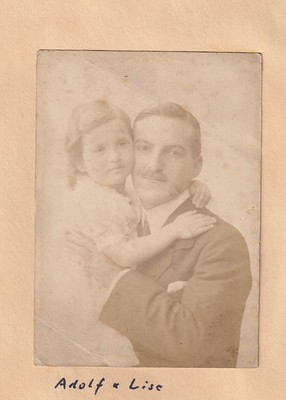
8A9831B6-DEAF-4E28-BA4D-BF9D35CB32F0_1_105_cAdolf went toboganning with me, we took long walks, and sang together.  The Stuttgart zoo was not far from where we lived.  On one of our visits, I came close to the monkey cage.  I had two pigtails with rust-colored satin bows, and before I knew it, a monkey had grabbed a bow and disappeared with it.  Another day my father asked me what I would prefer, either ride a donkey in the zoo or attend a concert in town.  My answer was, “on the donkey to the concert.”
Read the rest of this entry »

Northrop Frye’s Bible

September 18th, 1994

Journal of the American Academy of Religion 1994

Mark Antony’s Valentine

February 14th, 1994

“You cannot call it love, for at your age,
The heyday of the blood is tame,” said he–
An ignorant child who never could presage
What nature’s secret of love’s growth would be.
No less than air or food or sun’s warm ray
Your sound, your smell, your taste, your touch, your sight
Still animate, sustain and calm the clay
That sinks into my mattress every night.
No less the rose of dawn, the bloom of spring
For being welcomed yet another time.
Appreciation of a precious thing
Accumulates before it turns sublime;
Even in depletion, more entire
And poignant, knowing soon it must expire.

Published in A Fine Frenzy:Poets Respond to Shakespeare p.98

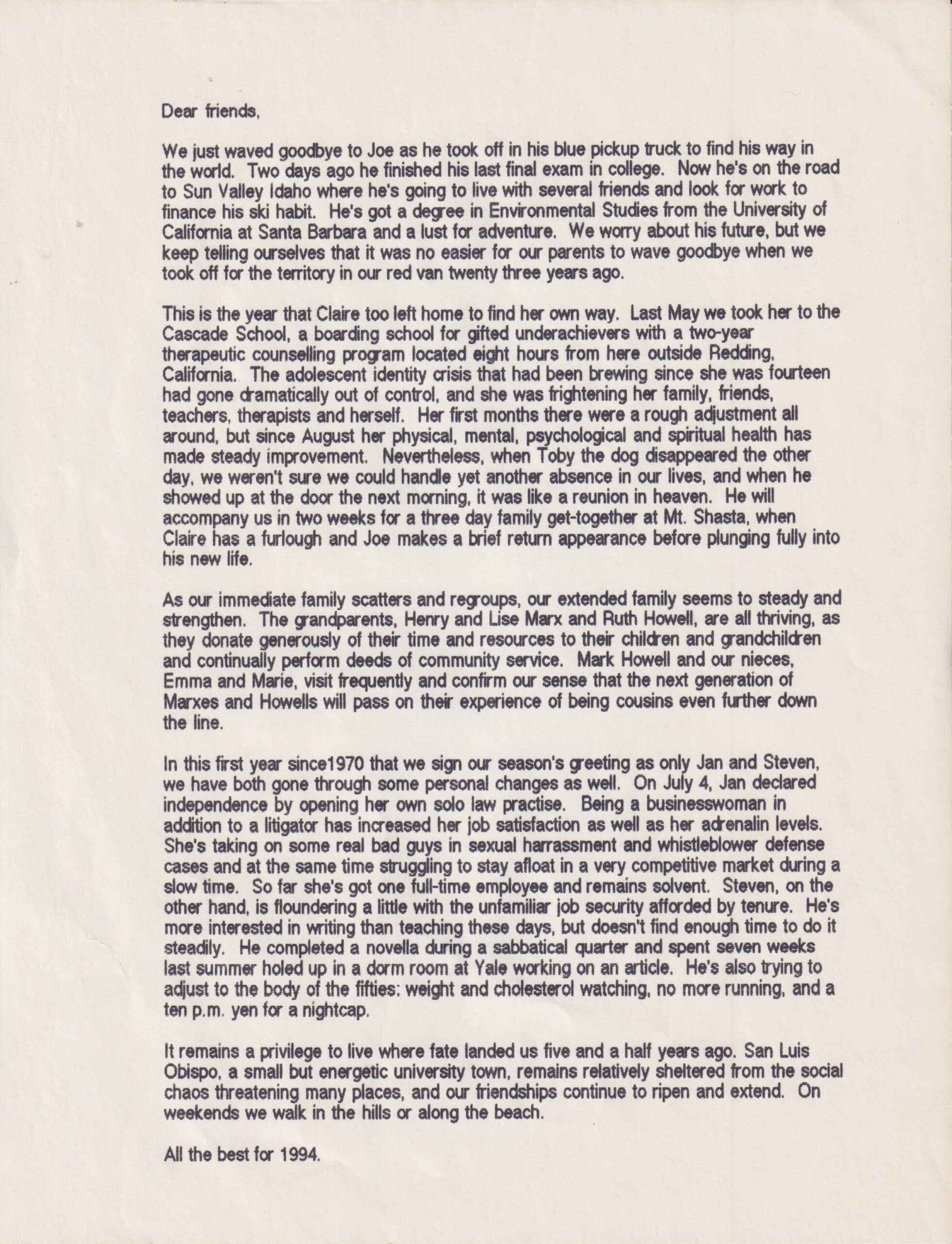
Holiday Letter 1993

December 8th, 1993

The American Scholar: An address to Sigma Tau Delta and the English Club

October 21st, 1993

“Mr. President, Ladies and Gentlemen: I greet you on the recommencement of our literary year….We do not meet for games of strength or skill, for the recitation of histories, tragedies and odes,…for parliaments of love and poesy…nor for the advancement of science…Our occasion is simply a “friendly sign of the survival of the love of letters amongst a people too busy to give to letters any more. As such it is precious as the sign of an indestructible instinct. [In the hope that this love will thrive and persist,] I accept the topic which not only custom but the nature of our association seem to prescribe to this day–the American Scholar. Year by year we come together to read one more chapter in his biography. Let us inquire what light new days and events have thrown on her character and her hopes.”

Those, roughly, are the opening words of Ralph Waldo Emerson’s “Oration delivered before the Phi Beta Kappa Society at Harvard on August 31, 1837,” thereafter published under the title of “The American Scholar,” and venerated ever since as a classic document in both the realms of literature and of education. What am I doing getting up here in an academic robe and mouthing them as if they were my own?

Well, just as it was to Emerson, the title of this talk was given to me as one appropriate for the occasion. Thomas Patchell, your new president, invited me to speak on this topic at two oclock in the morning at McCarthy’s bar last June 4, after the cleanup of the English Department’s Year End Bash. I was too exhilirated or too tired or too drunk to say no. But from a more sober perspective there is a certain appropriateness. Though this is not Harvard, but Cal Poly, and though our meeting is sponsored not by Phi Beta Kappa but by Sigma Tau Delta, the Cal Poly English Honor Society, we too are celebrating the recommencement of the literary year and the survival of the love of letters in a less than congenial environment. And though the audience facing me tonight may not include the likes of Henry David Thoreau, Margaret Fuller, and William Henry Dana, just back to Cambridge after his famous sea voyage to the Central Coast of California, it couldn’t be any more challenging to me than the one Emerson faced 156 years ago. He tells us that the custom of his audience prescribed that the speaker read a chapter in the biography of THE American Scholar. But since I’m a little short of Ralph Waldo’s measureless confidence, I’ll scale back the assignment and limit my scope to a chapter in the biography of the one American Scholar I feel qualified to talk about, myself. That will require about as much transcendental ego as I can summon up.

Read the rest of this entry »

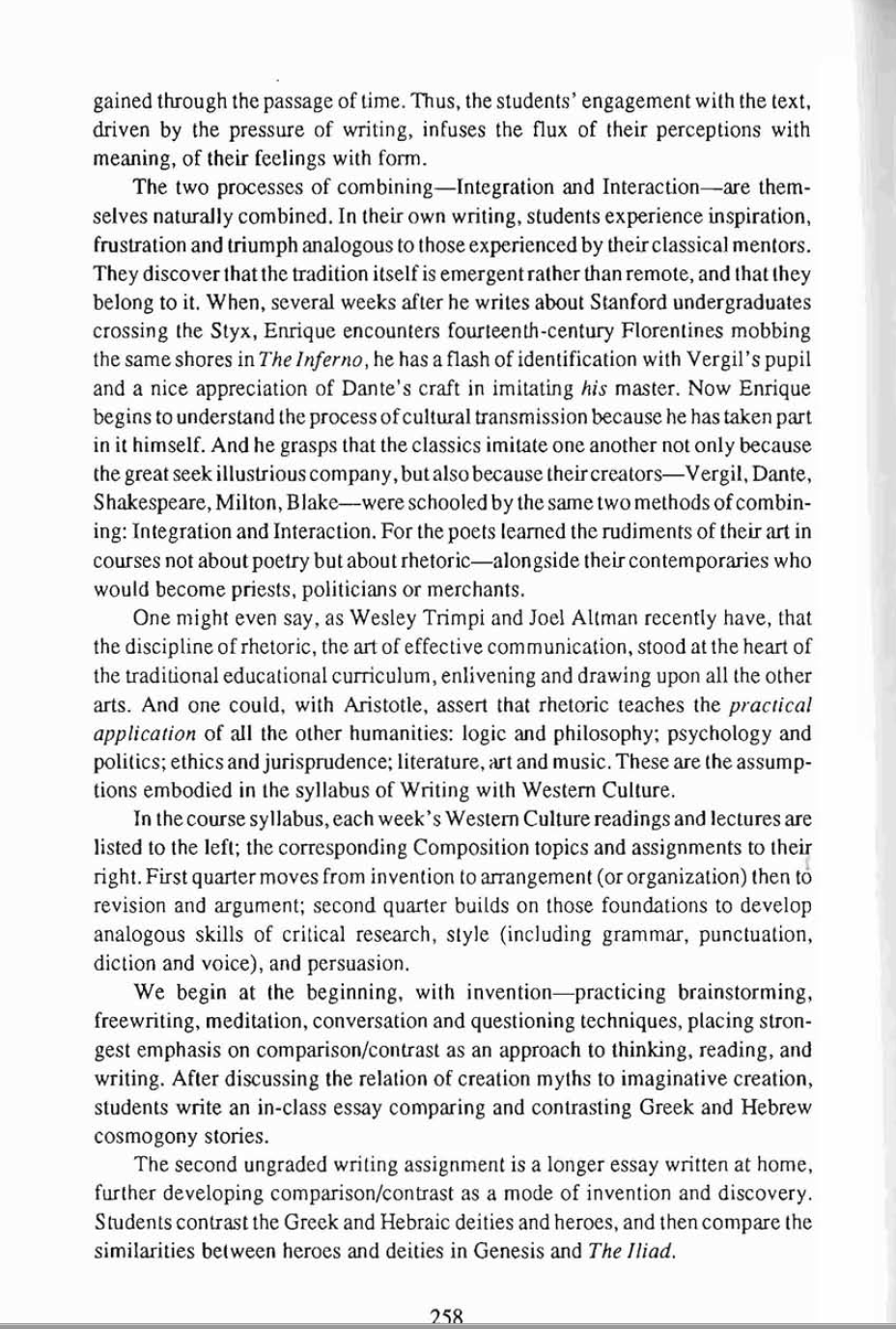
A Problem in Rhetoric: Teaching Writing with Western Culture

September 1st, 1993

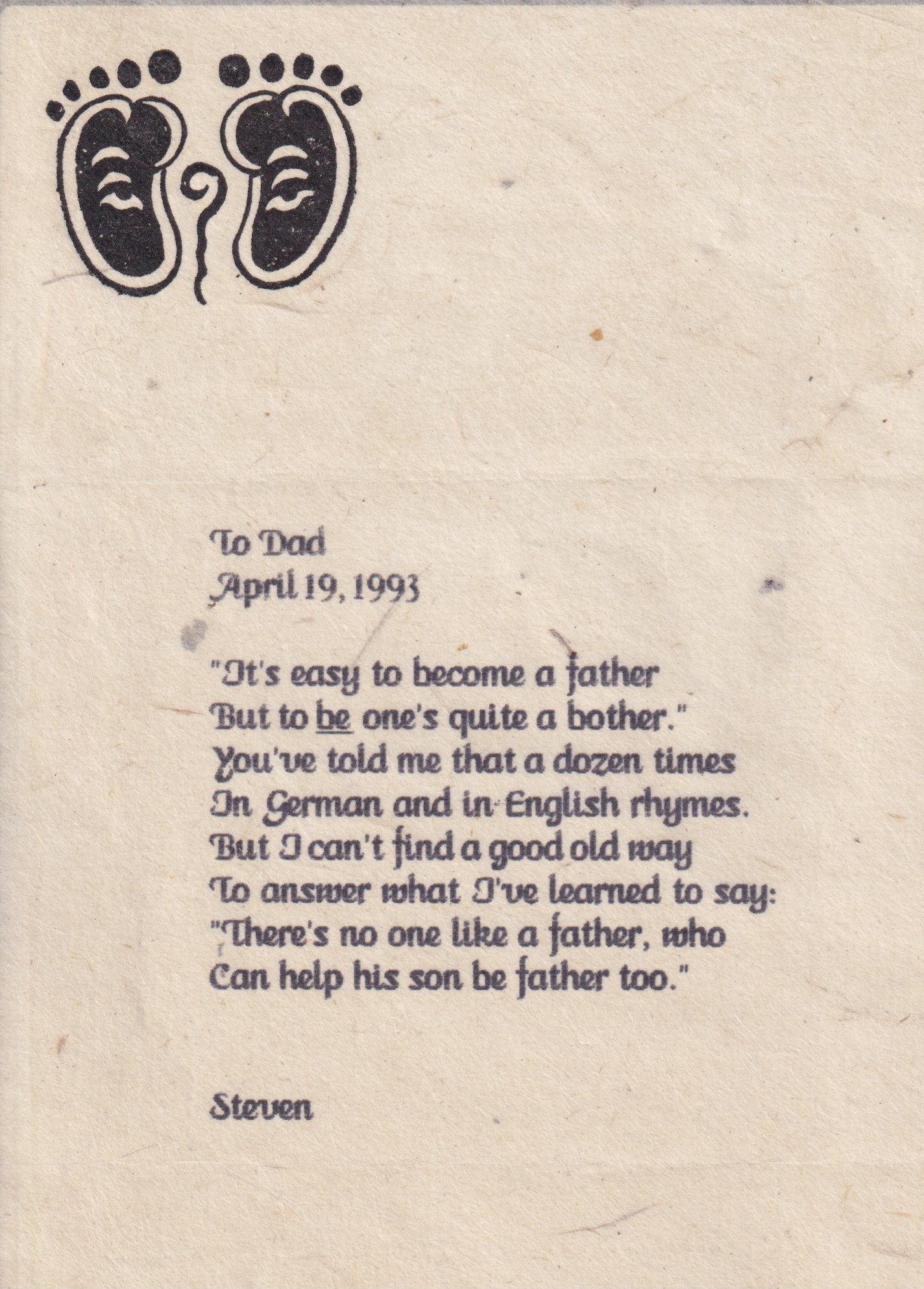
To Dad

April 19th, 1993

The Path of Totality

November 6th, 1992

Leave your stepping stones behind, something calls for you
Forget the dead you’ve left, they will not follow you
The vagabond who’s rapping at your door
Is standing in the clothes that you once wore…
The carpet now is moving under you
And its all over now Baby Blue.

Twelve people sat on the floor around a rectangular Oriental rug. The supper of brown rice and steamed vegetables was finished, and they were passing wooden bowls, chopsticks and teacups to the corner nearest the kitchen. The host, Peter Klein, straightened his back, crossed his legs, and took charge: “I’ve been reading about carpet designs. They’re all symbolic. The harder you look, the more meaning you find.” He felt warmed by the regard of his guests, mostly ex-students.

“For instance?” asked Ginnie, a thin young girl wearing a homemade beaded vest and strong wire rim glasses.

“See that outer border that looks like a row of crooked fingers?” said Peter. Those are waves. The sea surrounds everything. Now look at the next border with those jagged things alternating with those Y-shaped dealies. What do you see there?” As he used to in class, he waited out the silence.

“They look like pine cones and katchina dolls to me,” said Beth in a low, cultivated voice. Her mouth retained the suggestion of a slight smile, and she kept her eyes on Peter as if there were no one else in the room.

“Interesting idea,” he replied, but I think they’re actually heads of wheat and goblets, signifying harvest. Food and drink, the bread and the wine, communion.”

“I thought this was an Oriental carpet,” said Ramon, the art student whom Ariel had introduced for the first time tonight. There was a touch of irony in his voice.

Peter replied, “The rug is a Sumac. It comes from the Caucasus, on the border of Europe and Asia, where ancient trade routes and Christian, Moslem and Eastern cultures intersect. See these large cruciform shapes? They’re like the floor plan of a cathedral. And these feathery flames inside the crosses? They represent the Phoenix, the Arabian bird that dies every thousand years in a burst of flame and then is resurrected, like Christ.”

Peter stopped lecturing as he felt attention shifting toward the phallus-shaped pipe being lit by one of the guests. As the sweet fragrance filled the room, he centered himself between two diagonal axes of the Sumac pattern and waited his turn. The carpet was left to him by Tante Clara, his mother’s aunt. His wife Leona and he had recently agreed that apart from the bed, it was the only furniture they really needed. To simplify their lives and prepare for their eventual departure, they had sold or given away the rest, making most of their rent-controlled university apartment into a storage facility and crash pad. Read the rest of this entry »

Shakespeare’s Pacifism

April 18th, 1992

Renaissance Quarterly Spring 1992

The Prophet Disarmed: Milton and the Quakers

April 18th, 1992