Scholarship

Interpreting Academic Acknowledgements

Saturday, November 15th, 2025

This scholarly article from 1999 quotes and analyses the personal acknowledgements in the Preface of Youth Against Age, the 1985 book version of my dissertation, which was completed 1981, fifteen years after it was started. The relevant passage is found on page 265 of the article.

Interpreting Academic Acknowledgement

Shakespearean Encryptions: Image, Injoke, and Allusion in Ben Elton’s Upstart Crow and All is True

Saturday, November 8th, 2025

Abstract

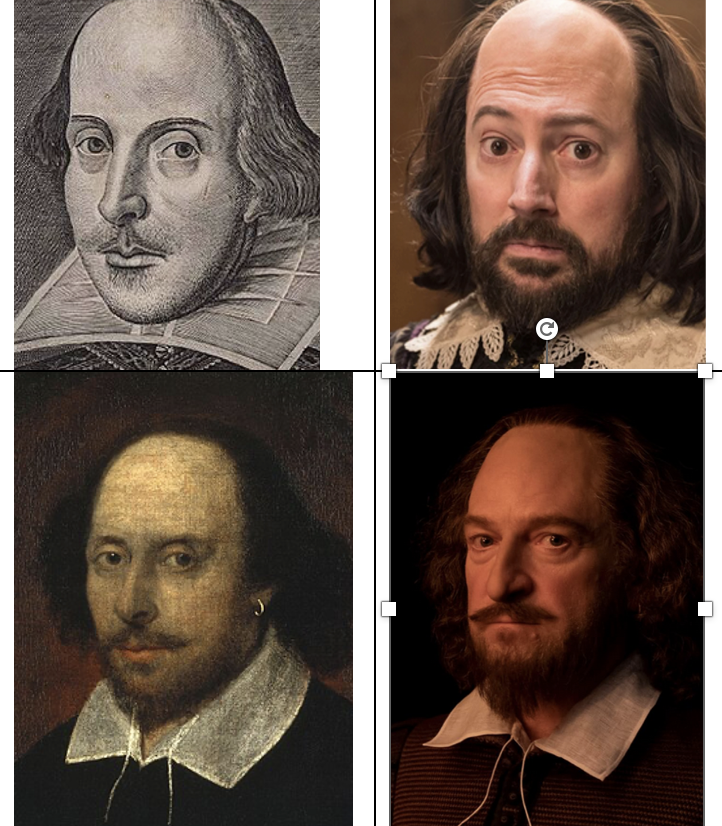
The Droeshut and Chandos portraits, two familiar images, embody two contrasting representations of Shakespeare in Ben Elton’s  biofictions, Upstart Crow and  All is True.

The Droeshut engraving evokes the comic TV sitcom character played by David Mitchell.

The resemblance is short of literal, belied by the presence of a beard absent in the engraving, but richly suggested by the bulbous forehead and receding hairline, topic of a running gag throughout the series.  The actor’s typically bewildered expression conveys what some authorities have found to be a clownish cast in the image.  John Dover Wilson called it “a pudding faced effigy.” Northrop Frye said it makes Shakespeare “look like an idiot.”

The Chandos image renders the melancholy film character played by Kenneth Branagh. The resemblance of images here is unmistakable, confirmed by facial hair and costume, by inclusion of the portrait at the opening of the film, and by Branagh’s statements in interviews that this was his intent and inspiration. Nevertheless, the large prosthetic nose and angry eyes convey a much harder expression than the serene watchfulness of the oil painting. The discrepancy prompts the film viewer to collaborate with its producers in fleshing out a dark view of what Shakespeare’s late years in Stratford might have been like.

This essay explores these correspondences in light of encryption theory, an analytical framework derived from computer science, semantics and evolutionary psychology.

Encryption involves “an oblique method of communication” that entails a relationship between the surface content of an utterance and an unstated “implicature,” or key, which is known by both the sender and the receiver, and without which the intended meaning of the message cannot be understood.

In formal encryption, the key resides in a secret code that translates the surface message to the intended one. Formal encryption functions to restrict access to the meaning of messages requiring confidentiality and validate their truthfulness.

Rhetorical encryption encompasses injokes and allusions. The key resides in unstated information shared by members of an in-group and unknown by others. Rhetorical encryption functions to create intimacy and trust among sender and receivers and sensations of pleasure, self-esteem and bonding attendant upon privileged access to information.

In Upstart Crow, the encryption consists of injokes and allusions with distinct but overlapping keys for lowbrow and highbrow audiences of the show. Elton has appealed to both in a genre-crossing-career as standup comedian, actor, director, lyricist, and novelist, employing both crudeness and sophistication.

Upstart Crow often portrays Elton’s fictional writers and actors encrypting injokes and allusions and his fictional audiences enjoying or disdaining them. On this level, it references Shakespeare’s own habit of metatheatrical representation, including staging plays within a play, role-playing, and disguise.

In All is True, the encryption consists of allusions informed by literary and historical scholarship, sympathetic responsiveness to Shakespeare’s texts and subtexts, and an intention to elicit sympathy and tears rather than ridicule and laughter. Consistent with its focus on the poet’s later life, it employs the tragic-comic narrative arc of the last plays and the ironic demand for suspension of disbelief conveyed in its title.


On Oct 31, 2025, at 6:36?AM, Shormishtha Panja <[email protected]> wrote:

Dear Steven

How are you?  I hope this finds you well.  I heard from Arden Shakespeare (Bloomsbury Publishing) yesterday about  the volume Shakespeare/Image for the Arden Shakespeare Intersections Series to which you so generously agreed to contribute an essay.  Unfortunately the editors regret that they cannot go forward with the project.  I quote from the excerpt of the reviewers’ comments sent by Arden: “It does not engage with recent and current debates… about how cognitive diversity, identity politics or digital technologies are changing how Shakespeare signifies, or is re-presented, as ‘image’ and across visual media….”

The reviewers do appreciate the fact that the volume brings together young scholars and senior ones from all across the globe but that is clearly not enough.  I thought that that was the volume’s greatest strength, bringing together academics not just from Spain, Germany, Italy, France, UK and USA but also from China, Japan, Korea, Malaysia, Singapore, Turkey and India.  I have not come across such a truly global range of academics and theatre practitioners in any other Arden volume.

I know that you share my disappointment at this outcome.  I do hope that you will go ahead and write that fine essay Ben Elton’s Upstart Crow and All is True of which you sent an abstract.  I am sure that it will find a home in a journal and an anthology of repute.  I learned so much about Shakespeare traditions across the world just by reading your abstract and those of other scholars. It has been a pleasure to interact with you as always, and I am sure that our paths will cross again in the future.

Thank you again for your patience, co-operation and friendship.

Warmly,

Shormi

Shormishtha Panja

Former Professor of English

Department of English

University of Delhi

India


Buddhist Shakespeare

Monday, February 6th, 2023

An Address to the White Heron Sangha
February 5, 2023

Good evening fellow White Heron Sangha members and visitors. Thank you for once again inviting me to give a Sunday night Dharma Talk.In some previous ones I’ve explored ways that American literary writers I admire, specifically, Henry David Thoreau, Jack Kerouac and Leonard Cohen, were influenced by Buddhist texts and incorporated them into their own unorthodox experiences and writings.

Tonight, I want to examine ways that the works of William Shakespeare connect with my understanding of Buddhist principles. There’s no evidence that this sixteenth and seventeenth century British writer had any exposure to Buddhist teachings. Nevertheless, I find in his works many ideas in common with what’s called “the Dharma,” identifiable with what Joseph Campbell called The Perennial Philosophy.

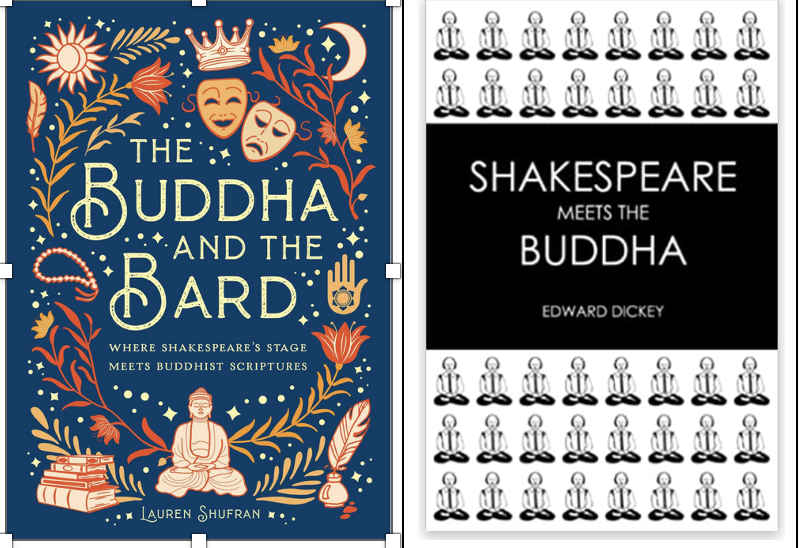
In the immense body of Shakespeare literary criticism since 1948, I’ve found only two items, both quite recent, that treat this subject: The Buddha and the Bard by Lauren Shufran (May 2022) and Shakespeare Meets the Buddha by Edward Dickey (October 2021).

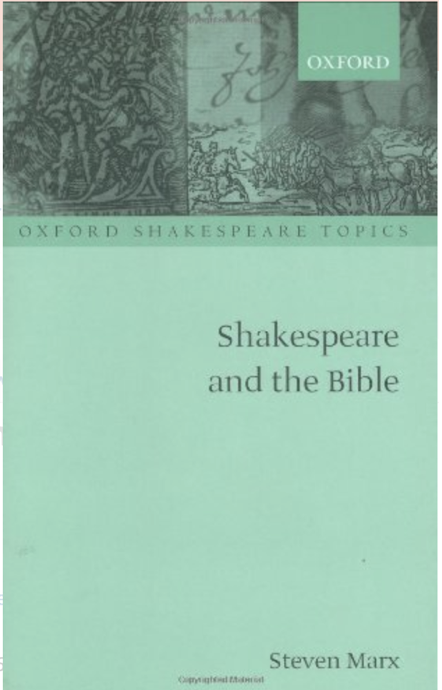
My own interest in the subject arises from an academic career that included teaching, directing and writing about Shakespeare—including a book which argued that Shakespeare read the Bible as literature and construed its varied depictions of God as personifications of the theatrical roles of author, director and actor.

In this talk I will align six Buddhist doctrines with recurrent Shakespearean themes

1 Emptiness and Form, Prajnaparamita –The World as Stage
2 The First Noble Truth, Dukkha–Tragic Suffering
3 Dependent Co-arising, Ptratityasamutpada–Motivation and Causality
4 Impermanence, Anicca–Time
5 Delusion, Avidya–Error
6 No-self, Anatta–The Person as Actor

Separating, labelling and numbering these ideas is somewhat misleading, since they often overlap or blend. However, this kind of schematic analysis is typical both in Buddhist texts and in literary criticism because it opens new ways of understanding. (more…)

Lost and Found

Friday, August 19th, 2022

Hi Alexander

I came across your film as accidentally as you came across my Shakespeare at Swanton website.

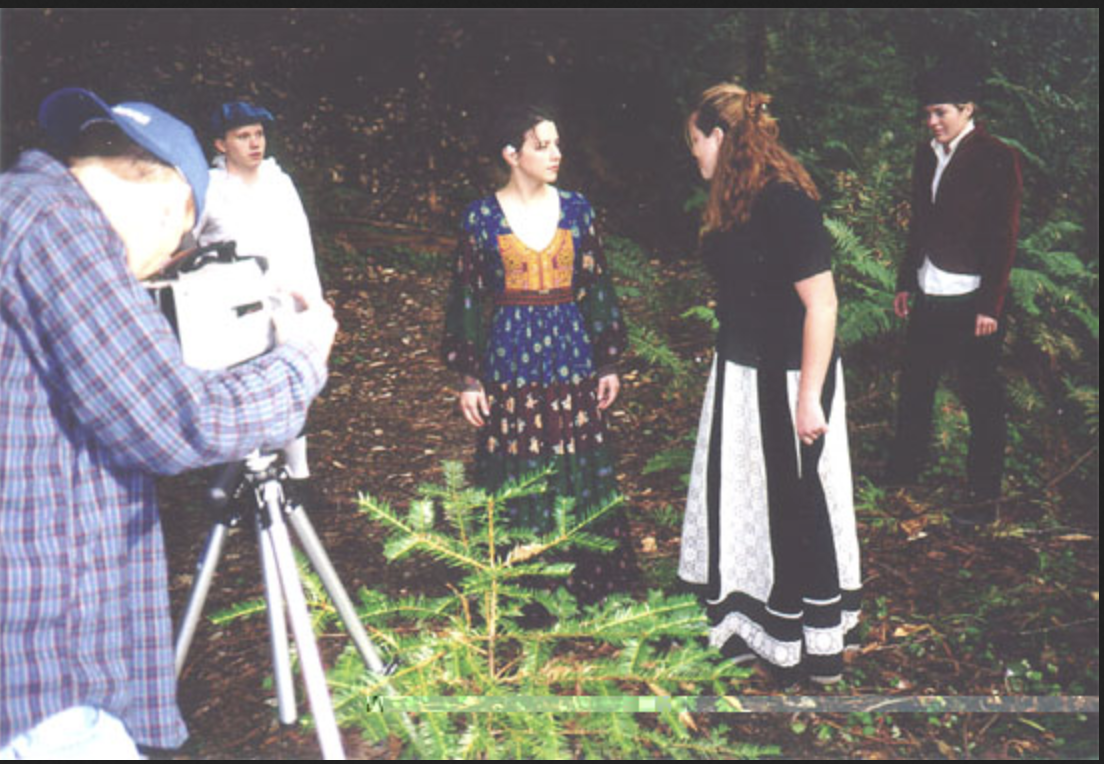
As part of general downsizing efforts, a couple of weeks ago my wife, Jan, sent a beautiful Afghan dress she acquired in 1972, when we homesteaded in the woods of British Columbia, to a friend born and still living there, who took a photo of it, worn by her daughter riding a ropeswing on the property their family leases from us.

Seeing it reminded me of another woodland use of the dress in 1999 at Swanton Ranch. So I googled the old website to download a picture of it worn by  a student playing Hermia in scenes from A Midsummernight’s Dream that the class filmed there.

I was amazed to find the link to your “Shakespeare at Swanton” video and astounded to watch it.

I’m still pulsing with the world wide web of connections it activated. Parallel surprises of happening upon a relic in the course of searching for lost treasure—lost through fire and aging and through the digital loss of “bitrot” and software updates.

And parallel grief for the losses of Time: 1960’s back-to-the-land hippies turning 80, ’90’s English majors now in their ’40’s, a 2021 forestry student graduated and out in the world.

And the transformation of it all, through memory and art, via the alchemy of Shakespeare.
___________________

March 2024 Postscript: A further variation on the theme of Alex’ video and this post.  Shortly after this entry was written, Cal Poly University erased the whole website which included “Shakespeare at Swanton” from its server. Almost two years later, the site was resurrected from its 404 grave on a different server with a new URL–smarxpoly.net–which allowed for the link here to be reactivated. Thank you, Ty Griffin, for all the work you did to make this happen.

Loss

Monday, February 8th, 2021


Art in a Time of Plague

Sunday, March 29th, 2020

29 March [to Kathleen Balgley]

After the lockdown started I began a journal to record thoughts of what seemed like unusual urgency in the face of unprecedented transformations. But within a couple of days I lost motivation, thinking that even if some new insight emerged, who cares, since both audience and author are likely to be eradicated in the approaching tsunami. Better to just keep working in the garden, prepare good dinners and drink hard while watching movies.

That sentiment was captured in this quote by an Oxford Shakespeare scholar in today’s NY Times:

René Girard, the French critic, wrote in a famous essay that “the distinctiveness of the plague is that it ultimately destroys all forms of distinctiveness.” Mass burial pits for plague victims were one visible symbol of the way the disease erased social, gender and personal difference.

But then she goes on:

Elaborate plots, motives, interactions and obscurities focus our attention on human beings. No one in Shakespeare’s plays dies quickly and obscurely, thrown into a communal grave. Rather, last words are given full hearing, epitaphs are soberly delivered, bodies taken offstage respectfully.

Lots to learn from writers and artists these days after all.

All Is True

Monday, May 27th, 2019

Last night I went to see All Is True, the new Kenneth Branagh movie written by Ben Elton.  I was motivated by curiosity more than expectation, wondering where the creator of the hilarious and erudite “Upstart Crow”  BBC sitcom series would go in revisiting the life and works of Shakespeare.

During the first fifteen minutes I found the somber lighting, lugubrious pace and bleak expressions of the familiar sprightly characters alienating, but at a certain point I got oriented to the genre and recognized Elton’s earlier constructions of Will, Anne, Judith and Hamnet presented behind tragic instead of comic masks.

By the scene of the encounter between Ian McKellen’s Southhampton and Branagh’s Shakespeare that concludes with the double recitation of sonnet 29, “When in Disgrace with Fortune and Men’s Eyes,” my tears flowed along with theirs. I was stirred by its enactment of a “marriage of true minds” for whom the approach to immortality brought human limitations into highest relief.

By the end of the film this seemed its central tone and idea, brought home by the titles that followed the happy ending insisted upon by the Ben Jonson character–titles stating that the three sons of Judith, who seemed to fulfill Will’s obsessive wish for a male heir, all died as children, and by the song from Cymbeline behind the final credits:

Fear no more the heat o’ the sun,
Nor the furious winter’s rages;
Thou thy worldly task hast done,
Home art gone, and ta’en thy wages:
Golden lads and girls all must,
As chimney-sweepers, come to dust.

Fear no more the frown o’ the great;
Thou art past the tyrant’s stroke;
Care no more to clothe and eat;
To thee the reed is as the oak:
The scepter, learning, physic, must
All follow this, and come to dust.
¦
Quiet consummation have;
And renownèd be thy grave!

As I left the theatre I felt that “All is True” achieved the aspiration uttered by its protagonist: with a patent fiction to express reality–in this case the notoriously elusive reality of the author’s personality. It did that by combining the few known facts with astute readings of his work to imagine the inner and outer life of his last silent years. In the words of Jonson’s tribute, it made “My Shakespeare rise!”

Shakespeare Reading Paul: Heavenly Fraud in The Winter’s Tale

Saturday, May 27th, 2017

A couple of days before the conference in Jerusalem for which this paper was written, I woke up before dawn to avoid the crowds and went down to the Old City to visit the Church of the Holy Sepulchre. Under a dark and cavernous rotunda, before the shrine covering the tomb from which Jesus is said to have been resurrected, priests in splendid vestments swung censers, sang prayers and placed communion wafers in the mouths of the few worshippers in attendance. During the performance of that ceremony I sensed the tangible power of their faith. Though I didn’t share it, I was alerted to the gravity of the subject of my upcoming talk. (more…)

Dharma and Darwin

Saturday, November 5th, 2016

Introduction

My talk today follows in the tracks of fellow sangha members who’ve given us presentations on the convergence of scientific inquiry and the insights of traditional Buddhist precepts in the area of neurobiology and brain science. I want to explore the ways the theory of evolution that has provided a framework for all biological research during the last 150 years illuminates and is illuminated by my experience of meditation and my rudimentary understanding of Buddhist doctrine. (more…)

Book review: The Bible in Shakespeare by Hannibal Hamlin

Wednesday, October 8th, 2014

[published in Renaisssance Quarterly, Fall 2014]

This book begins with the assertion that “no one has yet published a full-length critical study of Shakespeare’s practice of biblical allusion and the implications of biblical allusion for our understanding of the plays.” Its author is eminently qualified to remedy what he calls this “deficiency,” having published several books on aspects of biblical culture in Early Modern England and co-curated an exhibition celebrating the 400th anniversary of the King James Bible at the Folger Shakespeare Library.

Impressive in its learning and packed with original discoveries of biblical and extra-biblical Shakespearean references, the book is written in concise, lucid and lively prose. Its “argument” is incontrovertible: the Bible is a pervasive source and object of reference in Shakespeare’s plays. The recognition and contextual reframing of hundreds of biblical allusions was part of the experience of earlier audiences, whose familiarity with the Bible was guaranteed by their cultural environment. The book’s task is to restore such experience to the modern reader lacking this familiarity.

Part I, titled ” Shakespeare’s Allusive Practice and its Cultural and Historical Background” opens with a vast array of evidence for the saturation of Shakespeare’s culture with Biblical narratives, characters and language. Chapter 2 traces discourse about the Bible and Shakespeare from early editorial glosses through 19th century elevation as paired pillars of British Civilization to recent debates about Shakespeare’s religious beliefs. (more…)