Travel

Peru Day 1

Tuesday, January 15th, 2013

Preface

Back in September 2011 Jan and I purchased a three week tour of Israel and Jordan scheduled for February 2012 from Overseas Adventure Travel (OAT), the company that had provided us with a remarkable experience in Japan two years earlier. In early December we were forced to cancel the trip to deal with a family crisis. The insurance policy we’d bought to cover such situations would only refund a fraction of the cost and the balance could be credited to another trip only if taken before February 2013.

Our disappointment was kept alive by the diminishing possibility of redeeming the credit. In the meantime we had been assigned court-appointed custody for our eleven-year old grandson. In September 2012, we found out that he’d be visiting his father in Georgia for the winter school holiday and therefore we might have a two- week interval around Christmas to travel.

Ready to go anywhere in the world on an excursion already paid for, we searched the OAT catalog and came up with “Real Affordable Peru.” It fell within the allotted time and offered an appealing itinerary, including Lima, Cuzco, the Sacred Valley and Machu Picchu, which had intrigued me ever since I learned about it at age 10 in Richard Halliburton’s Book of Marvels. Throughout Jan’s hectic fall re-election campaign for Mayor, our bedtime reading consisted of Kim Macrorie’s The Last Days of the Incas, Mario Vargas Llosa’s The Storyteller, Mark Adams’ Turn Right at Machu Picchu, and Charles Mann’s 1491: New Revelations of the Americas before Columbus. But as the departure date approached, another problem loomed.  The  surgery that Jan had undergone in October destabilized rather than repaired her left knee, and she now needed a brace and continual icing just to walk city streets.  How would she fare clambering in the heights of the Andes?

Day 1

We land in Lima 12:30 A.M. December 26 and are greeted at the gate by Jonathan, the OAT representative, along with a couple of intrepid fellow travellers from Chicago a few years our seniors. In the downtown, every building is protected by high walls or fences, and some of them have guard towers at the corners.  The minivan drives along the Pacific shore toward Miraflores, the affluent tourist-friendly section of this city of 10 million.  Jonathan assures us that the district has three levels of protection: municipal police, semi-official companies that contract with the police, and private security. We’re welcomed to Hotel Jose Antonio by a large African-Peruvian doorman in a suit and tails.  It’s an upscale facility typical of those chosen by OAT and several notches above the motel 6 level I usually patronize.
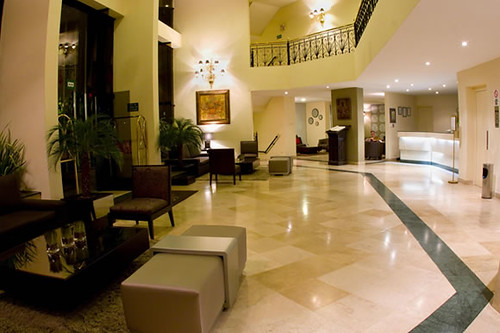
joseantoniohotel

In the bathroom we encounter the trip’s first culture shock: a sign tells us to dispose of all paper in the adjacent wastebasket, not in the toilet.
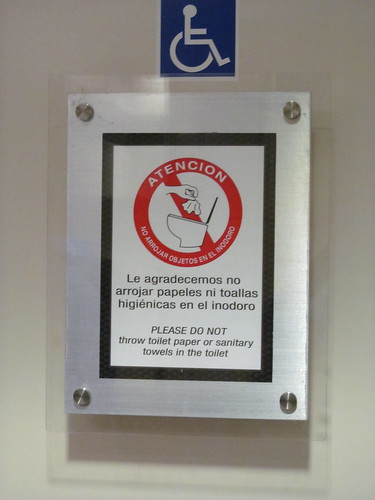
IMG_4127

Our guide affirms that this means all paper, in order not to overtax the capacity of municipal sewage systems. It’s a contrast to the equally foreign peculiarities of Japanese toilets, which provided a warm water rinse of one’s undercarriage after every use. But it’s no more an adjustment than having to remember to always use bottled water for toothbrushing and sinus rinsing, as well as drinking.

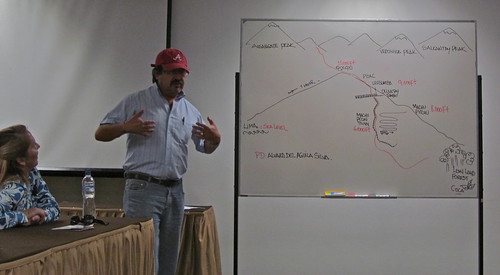
The morning’s generous breakfast buffet includes a thick, sour distillation of coffee one renders palatable by diluting with hot milk and water and a variety of delicious fresh fruit. Afterwards our group of 12 travelers assemble in a conference room for an introductory lecture by our trip guide Alvaro, illustrated with a timeline and map of the upcoming journey and including a strong recommendation that we ignore medical prescriptions for altitude sickness and instead drink coca tea and chew coca leaves, the time-honored cure.
IMG_2648

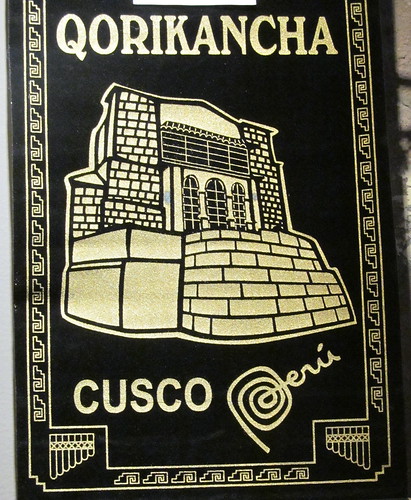
Alvaro is a native of Cuzco”to be pronounced correctly as Qosco (just like Costco) in Quechua, the native language still spoken by the Andeans. He espouses a nationalism hostile to the Spanish conquistadores, ambivalent toward the short-lived Inca empire that they conquered, and partisan toward the decentralized pre-Incan native cultures whose histories extend back ten to twenty thousand years.  He points out that modern Peru has recently rebranded itself with a new logo containing a spiral that’s found on inscriptions and also represents the concentric ancient terraces we will discover throughout the mountainous countryside.
IMG_4076

We learn that his father’s family comes from the Amazon”most likely from Spanish ranchers–his mother’s from Andean Qosqo, making him a mestizo  like most other Peruvians since the Conquest. There’s a familiar anti colonial, anti-imperial bias in his views, but they are mixed with great enthusiasm for his longtime employer, OAT, which is dedicated to educating Americans about foreign cultures and environments, promotes international understanding, underwrites local social service programs and has provided his family with the resources to send his three children to University.

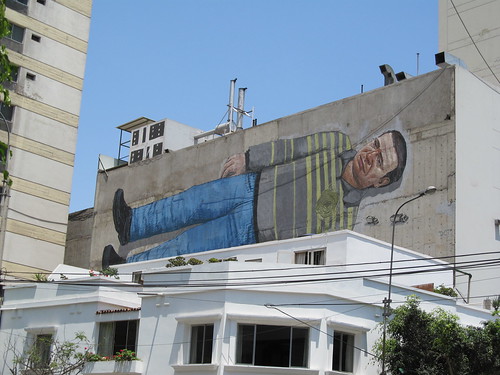
We depart for a group promenade down the busy main boulevard of Miramontes. There are no beggars or street sellers and a prominent presence of kevlar-vested gun-toting police and private security patrols. A building across the street sports a huge mural depicting a prostrate Gulliver-like figure with tiny trucks driving away from a hole near his heart.  Alvaro interprets: this is the heart of Peru being eviscerated by the mining industry.
IMG_2649

We amble through Kennedy square and down another boulevard to a restaurant for our first meal of legendary Peruvian cuisine, passing a long line of respectable but unhappy-looking people lined up at one of the many prominent banks. These, says Alvaro, are civil servants lining up to cash (or receive?) their paychecks.  Jan and I both order ceviche, and the raw fish marinated in lime juice and a light cream sauce with sliced onions reminds me of the sashimi which introduced our culinary adventures in Japan.

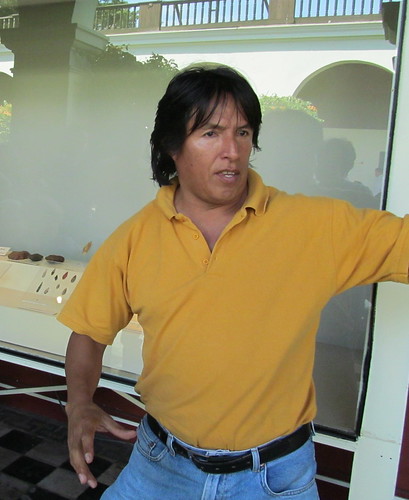
Back at the hotel we are introduced to Dante, our local guide, a compact man with glossy black hair, shiny eyes, a mime’s expressive gestures, a shaman’s intensity and a distinctive profile like those on Aztec and Mayan reliefs.  He was born in a small village north of Lima into a family of subsistence farmers and moved with his parents and brothers to the city when he was nine years old.  He hated to leave his beautiful rural village but since then has learned why it was the right choice for his parents.
IMG_2661

We arrive at the National Museum of Archaeology and Anthropology, an attractive ochre and white colored building with a central courtyard graced by brightly flowering trees and loudly chirping birds. First stop for the group is under an arch bearing the ubiquitous “S” for Sismo sign”a supposedly safe sanctuary in case of Seismic disturbances.  Peru’s history and culture is dominated by earthquakes; the last big one in 1970 rocked Lima for two full minutes and caused a hundred thousand deaths.  The damage to this museum has still not been fully repaired due to the government’s according higher priority to developing the infrastructure–roads and bridges facilitating commerce across the extraordinarily difficult terrain separating the three primary areas of the country: coastal desert, mountains, and Amazonian jungle. Peru’s immense archaeological riches have only been properly excavated and preserved with foreign financing.

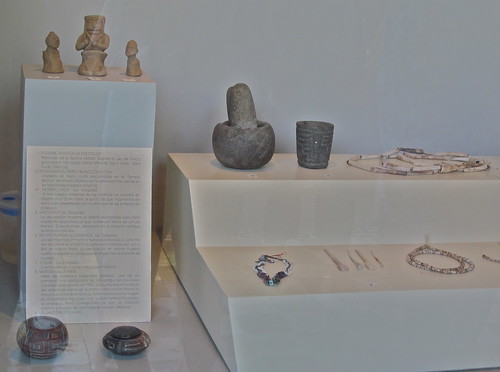
The Museum’s exhibits are displayed in chronological sequence and Dante emphasizes the ingenious technology for resource use of the earliest strata”stone age tools similar to those of the early California Chumash I saw on a recent school visit with my grandson to the Rancho El Chorro Education center.
IMG_2665

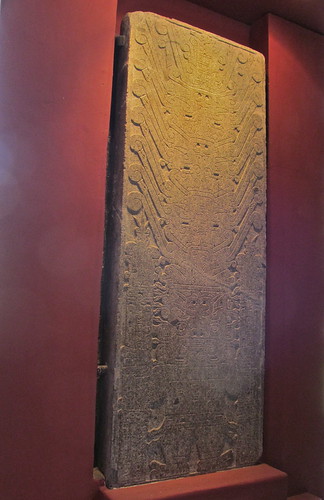
As we move to the display of a stela depicting the puma god holding staffs of peyote cactus, he points out that the physical evidence here suggests the existence of an agriculturally based civilization even older than Egyptian, Sumerian or Hindu”the Chavin culture. This new view of the age, size and complexity of New World cultures is amplified in the book that Jan and I are continuing to read as we travel, Charles Mann’s 1491.
IMG_2666

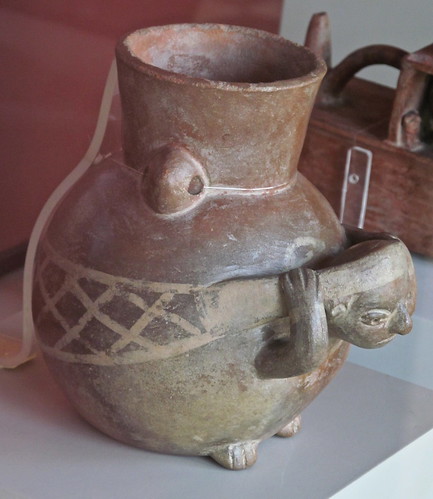
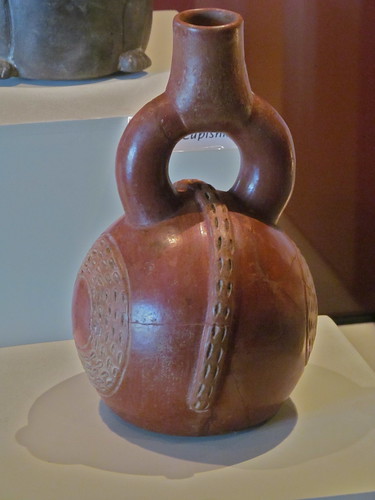
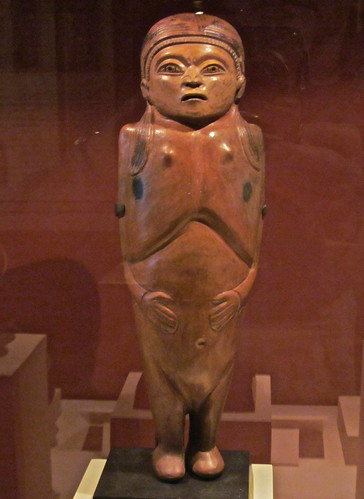
Though none of the New World cultures seem to have invented the wheel or the metallurgy that could produce powerful weapons, their hand-formed pottery glazed with characteristic red ochre looks as if it was thrown, and both human and animal figures are elegant and expressive.
IMG_2671

IMG_2677

IMG_2684

From early times onward music has been ubiquitous in religious ritual as well as daily life, and the instruments displayed are themselves beautifully sculpted artifacts.
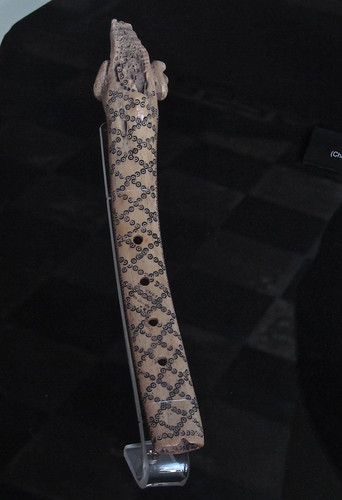
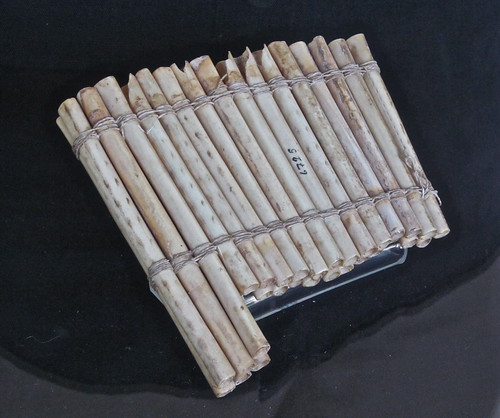
IMG_2690 

IMG_2691

A darkened room displays Inka treasures, some of the few remaining examples of the vast trove of gold and silver architectural features, sculptures, ritual instruments and costumes that Pizarro and his tiny band of invaders pillaged, melted into ingots, and sent back to Spain during the sixteenth century.
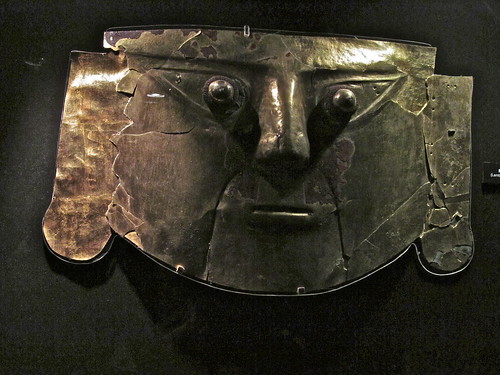
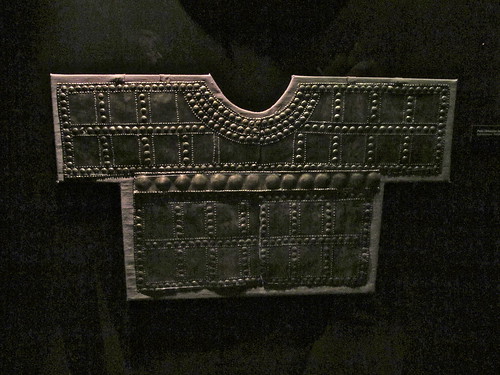
IMG_2700

IMG_2701

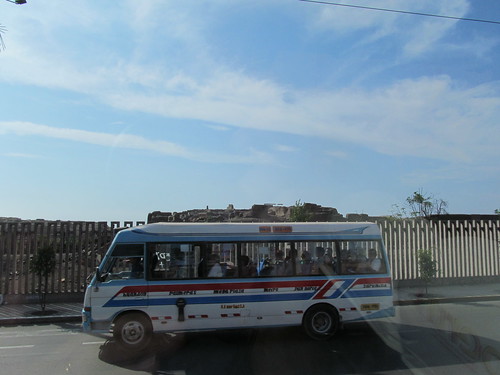
On the bus trip to the City Center, Dante points out a fortress-like structure rising behind a large fenced area, one of more than 40 major excavations now being carried out within the city limits, an indication of the nation’s hidden reserves of archeological resources.
IMG_2718

We pass a heavily fortified complex of buildings suggesting an Inca temple that he identifies as the Japanese Embassy–the scene of the 1996 drama initiated by the Shining Path guerillas who took over the complex, held  people hostage for 126 days and finally were defeated by police and military commandos under the direction of then president Alberto Fujimori.  Dante says he voted for Fujimori and found him an effective leader whose strong-arm tactics were necessary to combat the murderous Maoist movement wreaking havoc in the country. But like most Peruvians, he became disillusioned with Fujimori after the brutality of his methods approached those of the revolutionaries and after revelations of large scale corruption caused him to flee the country.

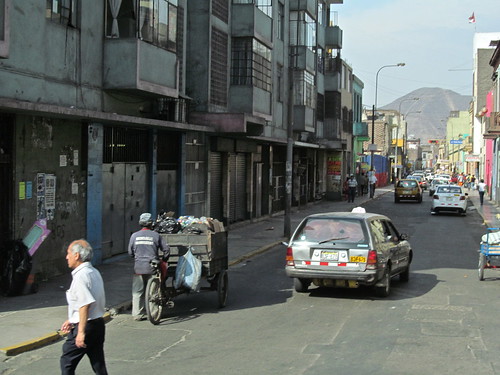
Our bus maneuvers through fast moving traffic toward the center of Lima, the end of every street revealing arid mountains covered with ramshackle homebuilt structures sprawled in growth patterns that look like lichen on rock. These suburbs are the newest and poorest parts of the city, Dante says, unlike in America where the more expensive homes are up the hills.
IMG_2722

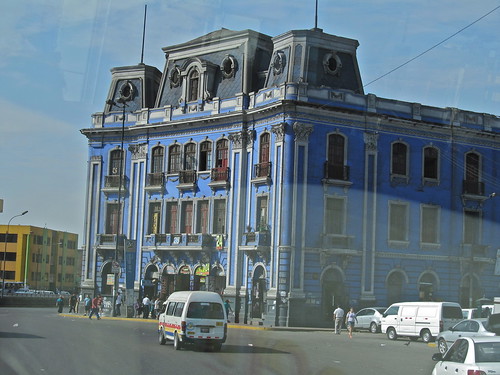
We enter a traffic circle surrounded by shabby mansions that used to be the homes of Lima’s aristocracy and are now divided into crowded apartments.  He assures us that the central square where we are headed is safe and heavily patrolled.
IMG_2719

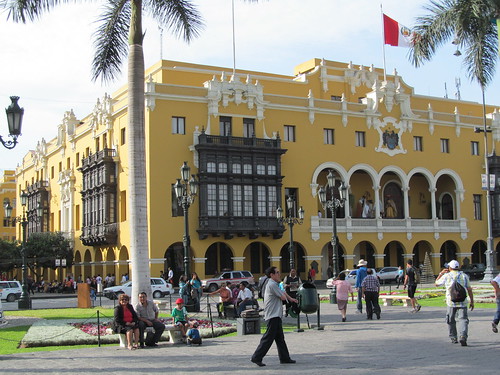
The square is fronted by a 16th century cathedral and bishop’s palace, the 19th century Presidential palace and the18th century City Hall. It’s decorated with ugly artificial Christmas trees.
IMG_2727

The atmosphere is fast and lively, the pace set by the machine gun staccato of Spanish speech and laughing children.  Dante says that Lima’s mayor is a woman and observes that it is important  for women to be involved in politics.  He’s impressed to hear that Jan is a mayor and promises to arrange a meeting between her and the city’s chief executive when we return.

The group walks a block past street vendors whose fascinating appearance and merchandise we try not to eye into a square dominated by the baroque façade of the San Francisco monastery and cathedral, as harmonious in proportion and dramatic in decoration as any churches in Europe.
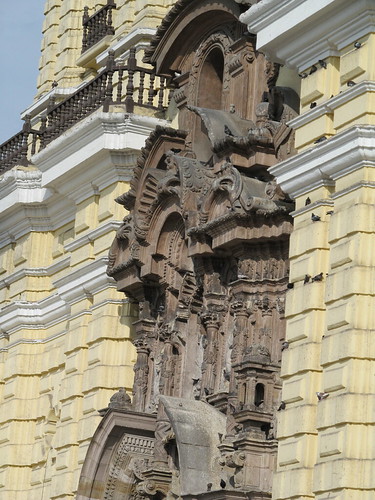
IMG_2745

We enter the adjoining monastery where photography is prohibited, stopping at the library where light pours in from clerestory windows above a three tiered gallery and illuminates the dust in the air coming off thousands of leather-bound books that seem haphazardly shelved and piled, most of them with pages rather than spines facing outward.  In contrast to air-conditioned and immaculate rare book rooms in American libraries, this place looks like 18th century paintings of royal libraries, a place as full of buried treasure for researchers as the landscape outdoors.
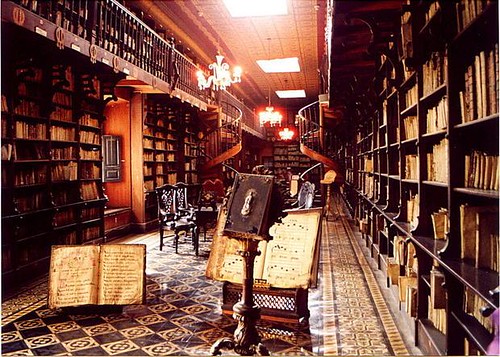
Library_San_Francisco

Dante says that the Franciscan missionaries accompanying the conquest and glorified in this building brought largely destruction and horror to this country, but two imports deserving appreciation are libraries and universities.

We walk through a wide second story colonnade surrounding a garden of mature fruit trees. Most of the pillars are out of plumb and the wide tiled floor tilts and ripples as a result of earthquakes. Then we descend through claustrophobic adobe passages crowded with other tourists to the Catacombs under the cathedral.  This was the only cemetery of Lima for its first 200 years, and it holds the bones of 25000 of its most illustrious citizens sorted into different parts of the skeleton”skulls, femurs, tibias, pelvises”arranged for display in symmetrical patterns in ditches along a maze of passages and at the bottom of circular wells 20 feet or more deep.
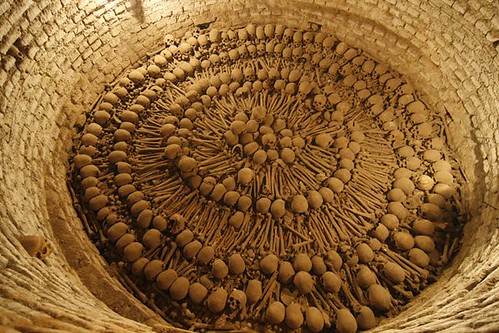
Skulls_femurs-Catacombs

Here is a foretaste of the ubiquitous presence of preserved bodily remains of the dead, in private homes, Inka temples and Christian shrines.

Arising from the catacombs, we emerge into the light of the square and the sounds of children laughing. A car backfires and we’re engulfed by a swirl of pigeons.
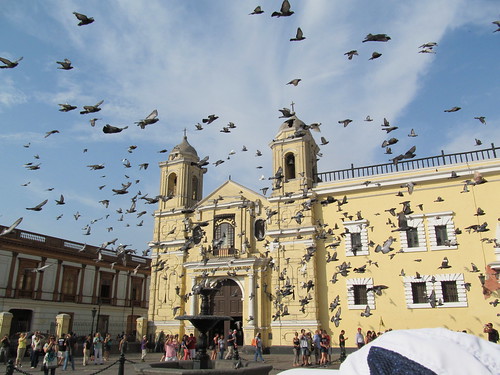
IMG_2747

After a siesta back at the hotel, Jan and I retrace our steps toward Kennedy square and find a pleasant café for a late dinner at a price similar to what we’d pay at home.  On the way back to the hotel at 9:30, we wander into the still open municipal art gallery and find a display of Peruvian arts and crafts”modernistic variations of traditional corn-beer drinking vessels, an installation of dried vegetation stuck to walls and ceilings suggesting the jungle, and whimsical ceramic musicians in colors and postures reminiscent of the ancient pottery in the museum.
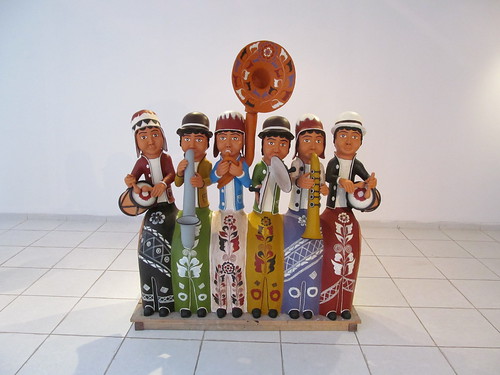
IMG_4136

IMG_4137

Slideshow of these and more full-size photos
Link to Day 2


Crossing Paths

Saturday, August 4th, 2012

Solo departure for Lund at 7:00 A.M. after tying up loose ends yesterday, including the resubmission of a reformatted version of “Genes and Genesis,” the article now rejected by five journals.  Jan cancelled her trip to stay in SLO because of late-breaking family developments.

Between Paso and Salinas, at the outset of the long drive I  listen to the podcast of one of Dan’s Dharma talks, calmed by his voice though skeptical about the comprehensive reassurance he offers on all fronts, spiritual, emotional and political. Then the Beethoven Rasoumovksy quartets bubble in my earbuds as the wheels spin up the freeway at 80 mph. Then This American Life, Science Friday and Fresh Air.  Despite disdain for Corporate Takeover, I’m grateful for what I get from the automobile, petroleum, and digital entertainment industries.

An hour before Davis, where I’ve arranged to have lunch with Caesar and Penny, my new iPhone dingalings to interrupt the podcast with a call from Chad, a former Cal Poly student organizer and political collaborator since 2007.  He and Megan have taken a day off from their five month hike on the Pacific Crest Trail in Mt. Shasta City and he just wanted to say hello and thank-you for Jan’s email to him. I’ve read their endearing blog, Trail 4 Two, and have thought of them wistfully since they started back in April.

I’ll be in Shasta City that evening.  Could we meet? I’ll get them a hotel room. He’s incredulous and hesitant.  They just had a night in a hotel and are getting back on the trail to keep to schedule.  Maybe we could meet, with further prearrangement, on my way back around the 22nd.  I say I don’t want to pressure them of course, but what a coincidence this is.  He needs to talk to Megan; they’ve just got a hitchhike ride to Castle Crags where they’ll rejoin the trail.  I know Castle Crags I say; see it from the freeway every year for the last 42 years.  He asks if I have camping gear and whether I could I meet them on the trail. Absolutely.  He says he’ll phone back. A half hour later he does; says there’s a little road at the Centralia exit that leads to a spur where they can wait for me and we can hike and camp together tonight.

Caesar bubbles with news of his second grandchild born ten days ago and cooks up a  fritata filled with his own garden’s vegetables.  By 1:30 I’m eager to get back on the road for the rendezvous at Castle Crags. In our phone conversation I came up with between 4:30 and 5:00 out of the air, having little idea how long it would take from Davis, but as the hot Central Valley rolls by, the hour looks plausible.  Chad emails  the number of the ranger which I can miraculously click on the iphone, and he gives me the specifics of the location.  Then there’s a sign about traffic delays due to a fire ahead, and just above Lake Shasta the smoke and the slowed traffic that might abort the meeting.

[January 2025 note: the plug-in that allowed for insertion of images from Flickr no longer works, so only the code below replaces the intended pictures. The album that includes them is still accessible here:

[flickr id=”7707454128″ thumbnail=”medium” overlay=”true” size=”medium” group=”” align=”left”]

But the delay is brief and at the Dog Trail  parking area, Chad and Megan are sitting under a tree. We embrace and marvel at the coincidence of our trajectory.  I load my backpack with sleeping bag and the bread and sardines Jan had sent along and we head up toward Castle Crags and the maintrail.

[flickr id=”7707443796″ thumbnail=”medium” overlay=”true” size=”medium” group=”” align=”left”]

They are concerned about whether the climb is too steep, but I keep up the pace talking the whole way along the mercifully shaded path. It was 110 in Redding that afternoon, while they carried their 35 pound packs for hours through large changes in elevation.  They brim with adventures on the trail and are curious about  SLO politics and our family drama.

Around 7 we encounter some of their fellow PCT hikers setting up camps along a stream in deep shade.

[flickr id=”7707446180″ thumbnail=”medium” overlay=”true” size=”medium” group=”” align=”left”]

We find our own flat spot and are soon joined by “Fall Risk” a  veteran of the Appalachian Trail. He hikes in special shoes that partially compensate for an orthopedic defect. Among many other roles he’s a musician and composer and has been producing fully mixed songs with a phone app and sending them to his girlfriend.

[flickr id=”7707437240″ thumbnail=”medium” overlay=”true” size=”medium” group=”” align=”left”]

Chad and Megan prepare a sumptuous dinner using vegetables they dehydrated before their trip, one example of the vast project of planning and preparation it required.

[flickr id=”7707444538″ thumbnail=”medium” overlay=”true” size=”medium” group=”” align=”left”]

Another is the coordination with “Trail Angels” who’ve met them along the way with luxury provisions and fresh company.  But despite the totally upbeat atmosphere of our brief encounter I imagine that this project has involved a great deal of endurance of both physical and emotional rigors.

Though I sleep fitfully, the night is most pleasant lying next to Megan, breathing the balmy evergreen scented air, gazing at patches of light from the full moon sprinkled throughout the forest, reveling in the sense of escape from a burdensome routine of obligation and anxiety  and the prospect ahead of staying at Knoll House and spending time alone with Joe and more time with him and his family.

We all awaken at dawn for an early departure to keep up our several travel schedules and catch up on the time time lost with this happy delay.  The goodbyes are lengthy and poignant

[flickr id=”7707437846″ thumbnail=”medium” overlay=”true” size=”medium” group=”” align=”left”]

”better too brief than too long a visit. Along the trail I feel continued companionship with the moon and the crags

[flickr id=”7707439296″ thumbnail=”medium” overlay=”true” size=”medium” group=”” align=”left”]

[flickr id=”7707438906″ thumbnail=”medium” overlay=”true” size=”medium” group=”” align=”left”]

as  I head back to the car  concerned that it may have been vandalized by the locals who littered the parking area with shotgun shells and targets.  But Jade waits intact, and I get back on the road, talk to Jan, listen to music and decide, a little recklessly, to take an alternate route to Portland, where I’ve arranged to meet Andy P. at his studio in the afternoon for coffee on the way to rendezvous with Joe that night somewhere close to the Canadian border.

The drive to Klamath Falls on route 97 through volcano country and farmland is fast and beautiful, but the road gets ugly, busy and slow on the way to Bend and beyond.  I listen to a  lecture by a Harvard Medical School Professor on recurrent Glioblastoma, Steve’s condition.  I phone Andy to postpone and then cancel our meeting, perhaps until the return trip, and hear from Joe that he was late in leaving Ketchum and wont get to Bellingham until 1:30 A.M.  So I decide to kill some time, process and upload photos and eat dinner at the Timberline Lodge near the top of Mount Hood. It’s a beautiful stone and timbered structure built by the WPA, graced with with vast views, mountain flowers in full bloom and the summer snowfields of the summit.  A walk on the heavily travelled trail in back leads to a sign indicating a junction with the PCT.
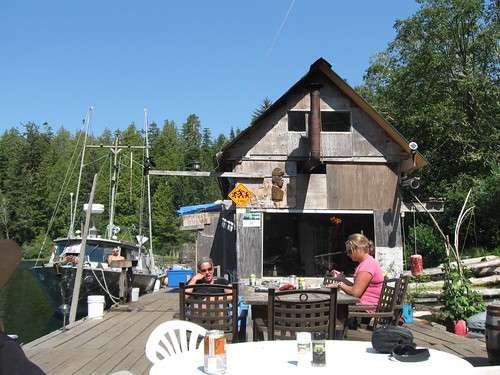
[flickr id=”7707452166″ thumbnail=”medium” overlay=”true” size=”medium” group=”” align=”none”]

Here, Chad and Megan will again cross my path, but only after several more weeks of toil and deprivation.

I drive down the shoulder of the mountain and rejoin Interstate 5 north of Portland and carrying on my musical and literary migration as night falls.  I hear Librivox recordings chapters from John Muir’s 1915 Travels in Alaska describing the beauties of the Northwest, the charm and geology of Victoria, the splendors of the inside passage and Alaskan glaciers.  At midnight I reach a rest area five miles south of the border from which we can make an early enough departure to avoid what will be lengthy delays at immigration and at the ferry at the beginning of this midsummer holiday weekend.  I fall asleep behind a picnic table, and waking for a pee at 1:30 I see Joe’s truck parked next to Jade.  I get up with the first light at 5:00 A.M. wake and embrace him, and we get through the border and onto the ferry with no wait.  His truck is loaded full with construction tools.

We buy groceries in Powell River, arrive at Knoll House in the sunshine, sleep-deprived but satisfied, and gasp at the immaculate condition of the place left to us by Tai and Theo, hardly a trace of their possessions visible, and all the Marx family stuff placed exactly where we left it.  Neatly stacked next to the half completed deck for the cabin is a pile of timbers cut from a tree near the driveway by Sam Richards.  Peter and Margaret stop by with a big zucchini and an invitation to a 70th birthday party at Pam’s, but we politely decline.

Zunoquad 4: Canoeing the Green River, Utah, 2011

Friday, October 7th, 2011

Full Slideshow

September 16

IMG_0018.JPG

Steve E., Peter U. and I strike camp in Zion National Park after two days of pre-canoe trip hiking and drive Interstates 15 and 70 through beautiful unpopulated country. We stop for breakfast in Richfield, a surprisingly prosperous agricultural town in a long, settled valley, where we joke with the waitress who brings us generous portions of  fresh, low-priced food.

A blasting rainstorm in the afternoon causes concern about how we’ll cope with such weather along the river. In the town of Green River, the next settlement located 130 miles down the road, we buy locally grown melons and visit the fair.   Pulling into Moab, we’re delayed by a high-school parade that blocks traffic.  The three of us spread out in the busy grocery store, and within a few minutes finish last minute grocery shopping for perishables. We meet up John and David, who’ve driven up from Phoenix, eat dinner at a hip Thai restaurant and head to the airport 20 miles north to meet the rest of the crew”five men flying in from Bellingham and Seattle.  Sharing a bed in the Red Stone Motel to save money, I find it hard to sleep, from excitement and also anxiety about the two hour rainstorm that pelts the town from 4 to 6 A.M. This is the kind of weather we were prepared for in the Yukon two years ago, but not here.

arrival

to start on a bus
passing thru unknown
is to be alive again

continuing in plane
after subway sky train
surviving stopped watch
during last hour
reappearing only at check in line up

end by flying back over rockies
in plane smaller than powell river’s
with flight attendant also pilot
landing fifteen miles from town
on only long enuf flat spot
˜tween peaks
met by part of other half
to crash in moab
where it never rains

Murray th K

September 17

We all gather at Tag Along, the outfitters, at 8:00 A.M.”any delays, we’d been told would be charged to us at $80/hr”but don’t depart until an hour and a half later due to their short staffing.  Two of the five canoes left for us are so dinged up we insist they substitute another two they say are reserved for a different party.  They agree and epoxy the hole in the keel discovered in one of the better boats. Dave, the crusty old river rat who drives the van and trailer that takes us to the embarkation point at Ruby Ranch, recites paragraphs from Edward Abbey, the literary voice of this part of the world. The morning’s rainclouds give way to sun beating down with an intensity as frightening as the thunderstorms, until I apply sunscreen, even under my t-shirt.

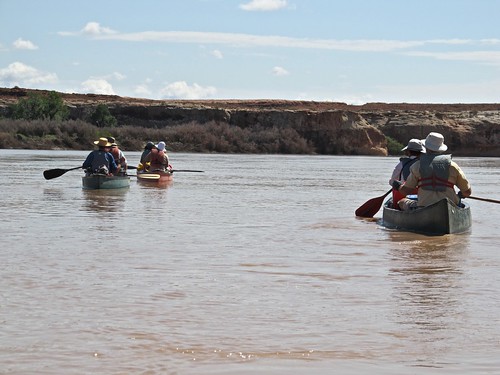
The van leaves us alone and we enjoy lunch under the shade of riverbank cottonwood trees, making quick work of dividing up the large cargo of nine-days provisions into the five boats. Lionel is appointed team leader for the day and I paddle bow in his canoe.  Entry into the swiftly flowing current of the muddy river is blissful: ten people sprung free from the connections of daily life and reattached to this old untrammeled association.

IMG_0082.JPG

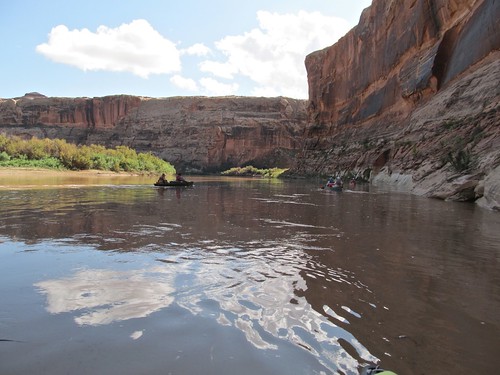
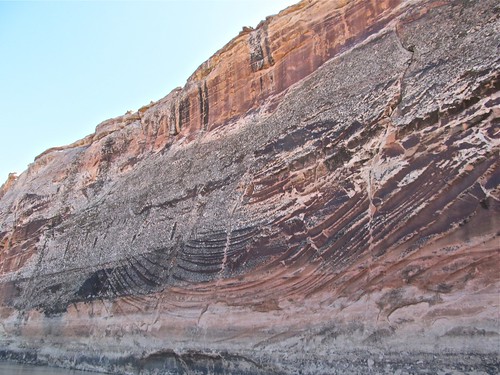
After less than an hour the flat grey desert banks transform into sculpted red sandstone cliffs revealing layers of deposition and erosion produced by the rise and fall of shallow seas over hundreds of millions of years.

IMG_0107.JPG

There are no other people on the water or signs of human impact on those banks, except for the relentless thicket of tamarisk clogging the “Bottoms” which line the inside edges of the river’s tight turns.  This impenetrable Asian vegetation has driven out most of the native cottonwoods and willows that used to provide open shade and habitat along the shores. It was introduced by  government soil conservation officers from the Great Plains to control erosion.  They didn’t realize that erosion here was the essence of the riverbank ecology for millions of years.

IMG_0157.jpg

The variety of angle, color, texture, light and shadow overwhelm the senses as the canyon deepens and the scale of its walls reduce the canoes to miniscule toys. But rhythmic repetition soon becomes evident at every level, from the immense meanders of the river’s trajectory to the parallel scratches in the rock polish, suggesting ranks of wing feathers brush-stroked by the wind with an action painter’s abandon.

IMG_0084.JPG

The air is desert-clear, the sky flat opaque blue, the sun hot enough even under hats and sunscreen to make us search out shady patches along the cliffs and revel in their momentary coolness. Occasionally we cross toward the opposite bank in search of a faster flow or to avoid the riffle indicating a submerged sandbar. Passing close to the frescoed walls, we sense the  progress of the current bearing snowmelt and silt from a thousand miles upstream down another thousand miles from here to the sea.

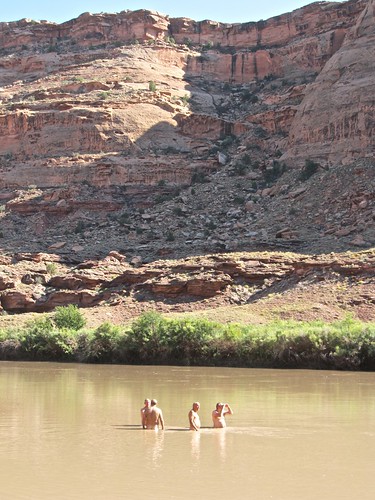
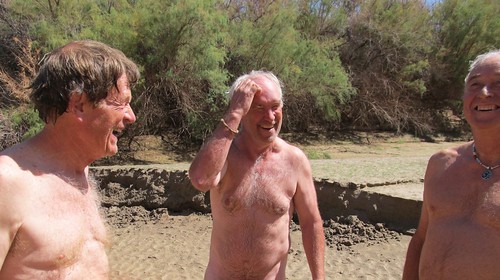
At seven miles from the starting point we stop at June’s Bottom, a sandy beach at water level with a thin margin of shade under the tamarisks, where our large 16 by 24 tarp can be rigged by tarpmeister Steve to provide shelter in case of another downpour. We strip naked and jump into the river letting tense muscles be carried by the stream, chilling hot dessicated skin in the thick cool liquid.

IMG_0148.jpg

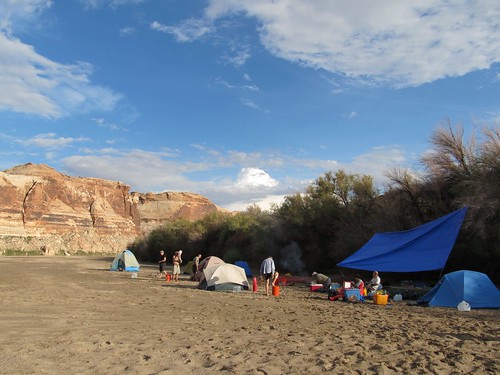
Then ten bodies swarm over the canoes hauling the cumbersome loads ashore.  Some gather firewood, some pitch the tarp and their tents, some set up the kitchen, boil potatoes and corn and then barbeque steak, the last fresh meat of the trip. Happy hour is declared and a five-liter box of wine is quickly emptied.

IMG_0121.JPG

A gray cloud passes overhead and deposits only a few drops of rain. Conversation bubbles and flows: practical coping, group problem-solving, planning the next day’s itinerary and destination, all rendered lyrical by the pure beauty of this place. The average age of the men is determined to be 64”all of us in retirement or at least heading that way, exploring the possibilities of leisure or of new careers.

IMG_0144.JPG

Mosquitos are bothersome for an hour or so around sunset, and then stars cover the black night sky, the spaces between them filling with a misty glow that can be perceived as innumerable points of light.

start

up at five-thirty
to th question of why
do we need four pounds of aluminum sulphate
before three hours
of waiting
canoe loading
and ruby ranch entry history
with mud flats desert moonscape
midst phalfalfa fields
and lunch
before push off
with quick hit of california green for some
and irridescent blue herons
nesting  above
three canyon campsite search

stop at june’s bottom
with enuf time for
dessert first trudy cake
and steak corn potato grilled
before plastic cornhusk refuge burning
over distant political drill debate
and ending before finding mom
by eight thirty or nine

Murray th K

(more…)

Hiking the West Coast Trail (7)

Saturday, August 28th, 2010

Tuesday August 17

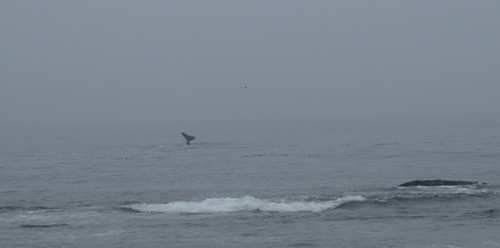
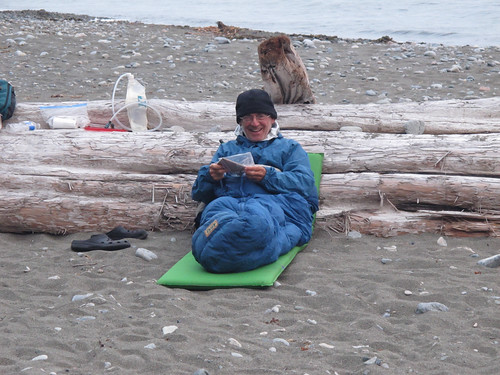
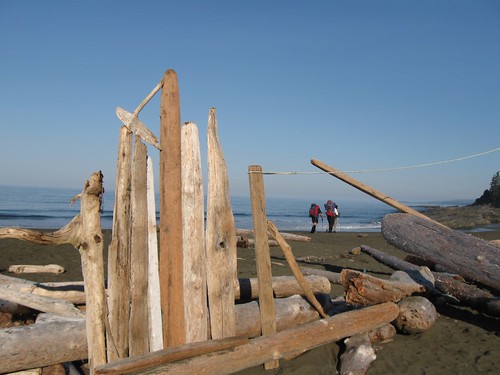
I sleep in the tent and get up early to retrieve the food, light a fire and make coffee.  Fog remains, we pack slowly and head up the beach, more than ever appreciating its variety of terrain and choice of routes and the continual activity of the water.  Offshore, humpback whales and dolphins cavort.

4914441649_0d92ee3a02_b.jpg

Back in the woods, Steve and I continue our conversation.  He describes a five-day Warrior-Sage workshop he attended last year.  He says this is the time of life to get it together, get the whole picture. Alone again, I pass through an unsettling sequence of thoughts about marriage and home life which predictably resolves itself in eagerness to return.  The fog has lifted but low overcast remains .

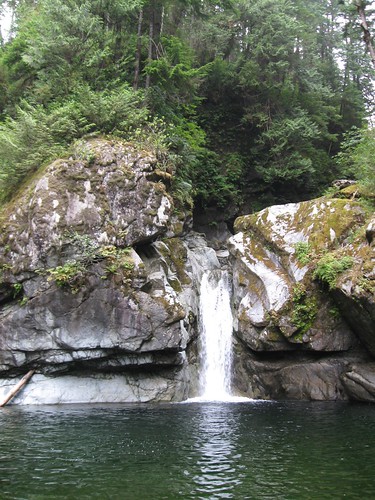
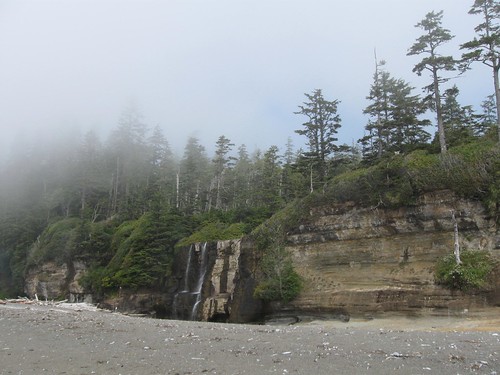
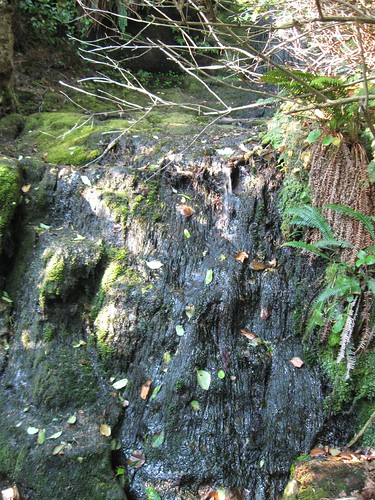
At 1:30 we set up camp at the Darling River campsite, aware of the proximity of the trail’s end.  Peter and Paul nap.  I meditate on my Thermarest, keyed in to the wave rhythm.   Steve and I head to the river to fill our Camelbacks and see two women with bathing suits and towels heading upstream.  We follow and come upon a gorgeous waterfall unmarked on the map”a loud steady flow through a dramatic cleft in rocks surrounded by higher cliffs from which tall spruces rise, their tops lost in cloud.  The pool below is clear and deep.

IMG_0888.JPG

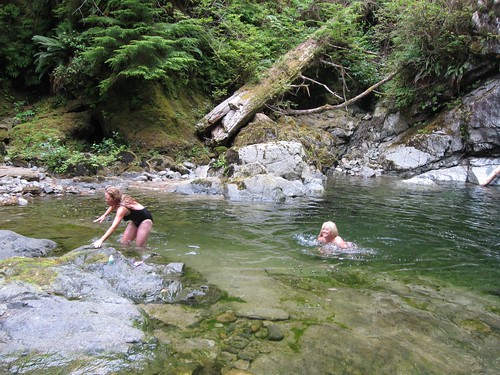
The women jump in and scream and come out and wash their hair.

IMG_0889.JPG

In the chilly weather at first I’m not inclined to swim, but I tell them they’re shaming me.  They’re proud of their ages, 55 says one, here with friends from West Vancouver who’ve never backpacked but decided in a bar to do this.  As they leave, I strip and test the water.  About the same temp as the ocean, not requiring long acclimating.  The aerated and circling water produce an intense adrenaline rush.

Back at camp I look at shots of Jan at the wedding in Oregon, still on the camera.  Steve and I figure that if we move to the next campsite and can rearrange our reservations on the bus back to the trailhead, we’d prefer to come out a day early.  Awake now, Paul agrees enthusiastically. My cellphone barely has enough juice to make the connection, but it works and they reschedule.  Peter wakes up refreshed and also agrees.  We cook dinner, pack up, hike an hour and a half further down the trail to Michigan beach where we pitch our last camp.

Wednesday August 18

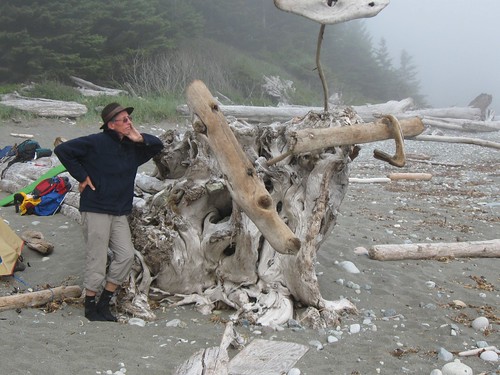
Wind blew last night, sexy dreams.  Black bear roaming on the beach.  Early departure, 12K to the parking lot. I hang back alone for most of the hike.  Elegaic mood, farewell to forest and ocean.  A great trip, with a piece of driftwood, photos and journal as souvenirs.
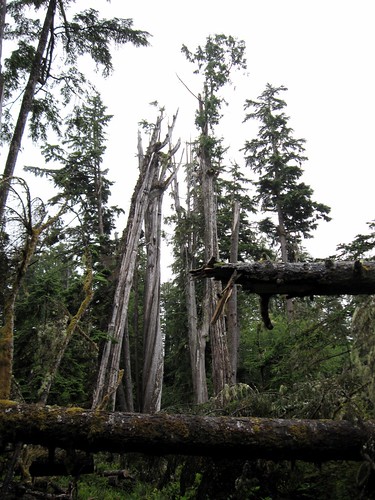
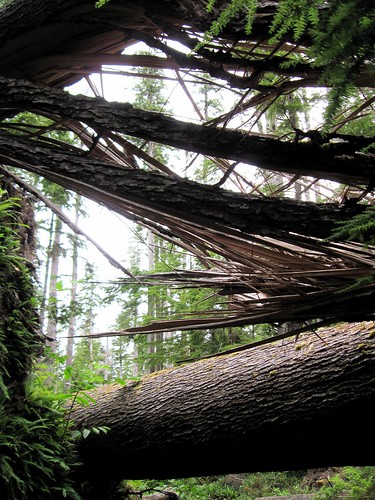
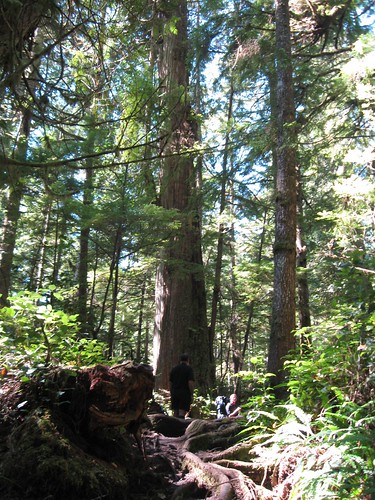
The last section of trail winds through old growth forest devastated by recent storms.  Huge trunks crisscross it, unblocked by the Indian trail maintenance crew, but the spectacle of destruction remains. 2000 ancient trees went down here.

IMG_0901.JPG

Centuries of growth, building upward and buttressing below, structures and systems strong enough to move tons of water hundreds of feet high every day, to hold immense weight aloft and to withstand storm and strain for centuries suddenly smashed and shattered.

IMG_0904.JPG

But already the great upended rootballs are growing ferns and salal and new trees on their vertical exposed surfaces, replacement plants that will take root in the ground as their hosts decompose into a new forest floor.

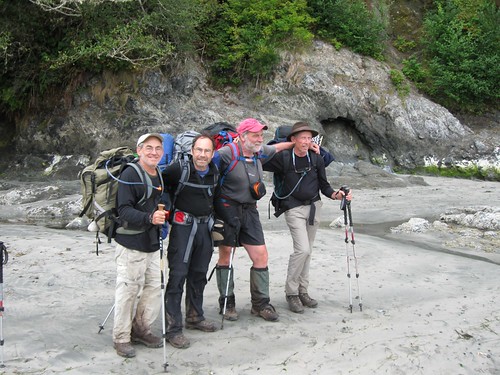
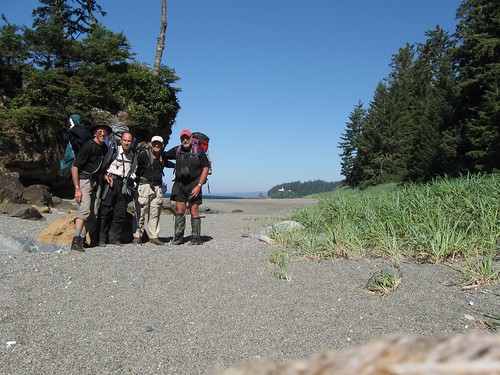
We emerge from the last stretch of forest onto the beach at Pachena Bay.  Three people are walking their dogs. They’re from a world different from the one we’ve inhabited for the last nine days.  A man asks if we’d like a final group portrait.

IMG_0907.JPG

He’s the mayor of Bamfield, the nearby town.  As we’re about to get on the Shuttle in the parking lot, the women from the waterfall and their friends go to their pickup truck and shout Oh no!  It’s been broken into, their phones, wallets and gear stolen, the dashboard and interior trashed. Our bus leaves as they come to grips with the situation.

[Full set of 196 pictures, slideshow and all sizes]

Hiking the West Coast Trail (6)

Saturday, August 28th, 2010

Monday August 16

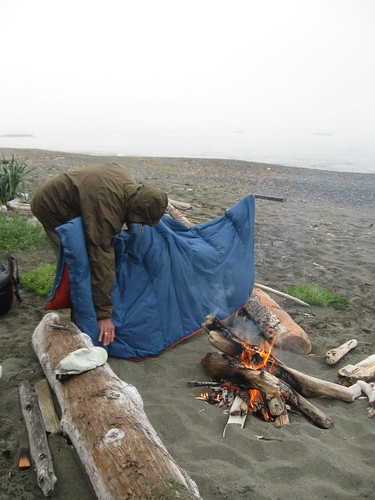
My sleeping bag is wet in the morning fog.  I’m up early and with the help of a chunk of paraffin found in the sand, build a fire to dry it out and get warm.

IMG_0833.JPG

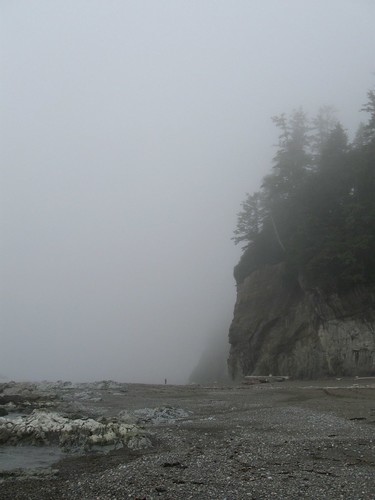
We break camp late in the morning realizing that unless we slow down, at the present rate, we’ll be at the end of the trail a day early.  The fog remains, erasing the long vistas of previous days’ walks and intensifying sights and sounds close by.

IMG_0844.JPG

IMG_0839.JPG

I fall behind my companions, trying a walking meditation, linking the muffled sound of the waves moving in and out with inhale and exhale and with the right-left movement of limbs.  The line of foam at the margin of each wave snakes sinuously, a white bead that thickens and then quickly dissolves as the water drains backward and percolates down through the porous grains, leaving a shimmering curtain of radiance that disappears from the smooth slope as soon as it’s seen.  At the bottom, a gaping throat opens in which pebbles dance during the instant before the next wave moves forward and swallows them.

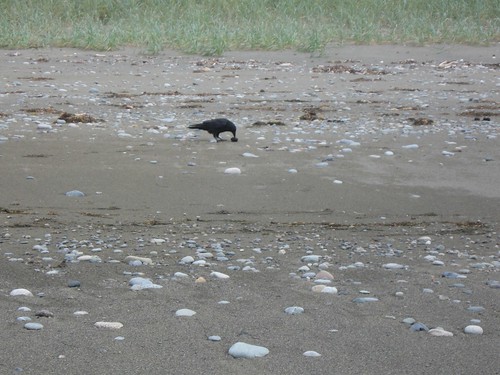
One beach is strewn with bright purple sea urchins on which crows leisurely feast.

IMG_0842.JPG

We reach the most popular camping spot on the trail, Tsuishat Falls, but the falls are almost dry and the beach camping area is full of litter.  We decide to press on.

IMG_0848.JPG

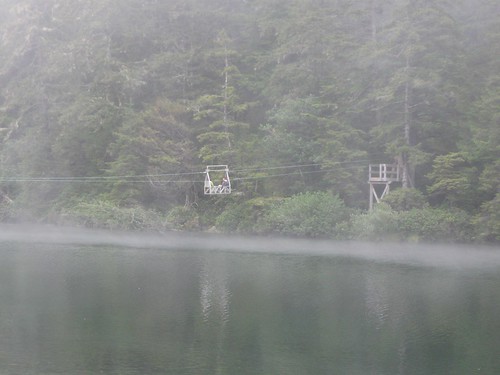
After an amusement-park ride in the self-propelled cable car across Klanawa River we stop to camp.

IMG_0854.JPG

In the thickening fog, the grove of spruces by the outhouse and bear cache feels spooky.  Mist rises from the flat lagoon of the river and the ocean is still.  More people here might be welcome.  My darkening mood is dispelled by the chance to get into the sleeping bag with all my clothes on and catch up with the journal while Peter prepares dinner and Steve creates a driftwood sculpture.

4914434727_63ec296a89_b.jpg

IMG_0852.JPG

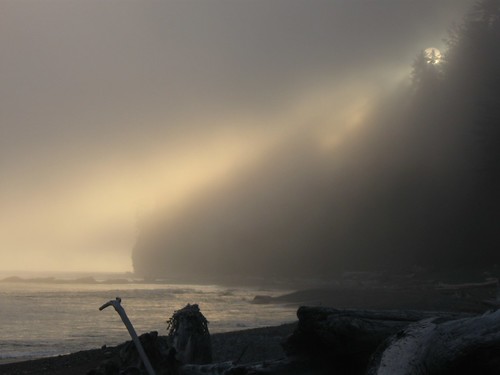
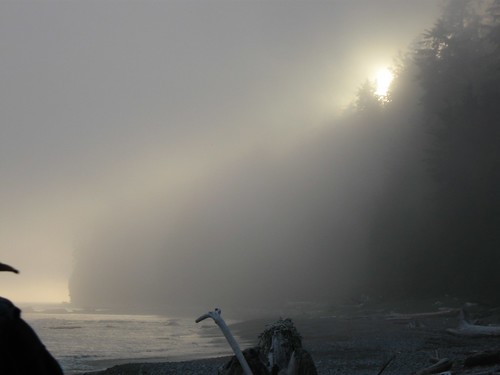
The sun appears for the first time today in melancholy grandeur. The fog luminesces above the towering headland to the north backlit by a brilliant ray descending diagonally into the ocean. Then its white disk is sharply defined, but only as bright as the full moon behind a light mist. The disk moves slowly behind the trees along the ridge sillouetting their pointed tops and branches.  The oblique ray shifts hue from white to orange and  its source dissolves into a burst of radiance, then slides below the horizon.

IMG_0859.JPG

IMG_0865.JPG

IMG_0868.JPG

[Full set of 196 pictures, slideshow and all sizes]

Hiking the West Coast Trail (5)

Saturday, August 28th, 2010

Sunday August 15

Slow morning to enjoy the sunshine and instant coffee.

IMG_0773.JPG

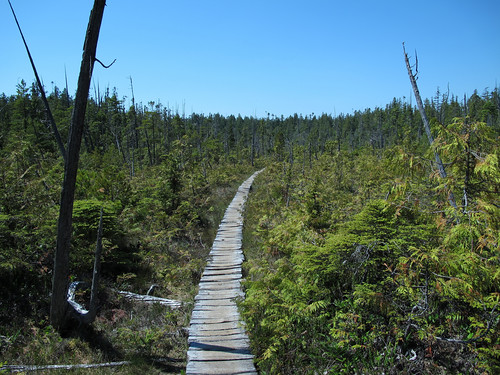
Next time it will be fine ground beans. Hike is partway on beach, partway on forest trail facilitated by boardwalks, ladders, suspension bridge, steel bridge and cable trolleys.  Views of water and rock and little coves below alternate with deep forest, ancient bogs and a beaver pond bypass.

IMG_0775.JPG

IMG_0779.JPG

4915008760_8dd90c09f4_b.jpg

Arrive at Nitinat Narrows ferry in time for another Indian Reserve restaurant lunch.  We benefit from the assertion of First Nation rights.

IMG_0792.JPG

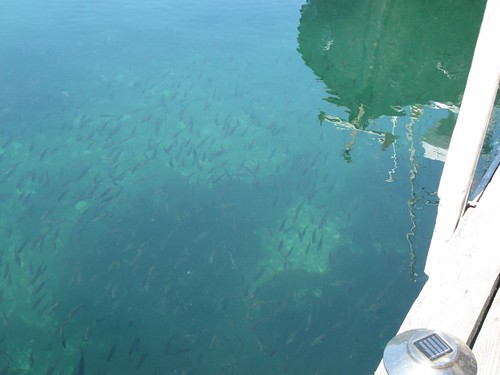
A four year old girl, strong Indian features but with blond-brown hair cavorts around the dock.  Her Daddy runs the little ferry and the family enterprise. He pulls a rope up to the dock and lifts out the crab ordered by Peter, tears it apart for cooking by his son and throws some scraps into the water where a large school of salmon fry clean them up.

IMG_0795.JPG

I get salmon caught off Bonilla Point, which we walked by yesterday, Paul gets halibut.

IMG_0790.JPG

At the next table two strapping women who passed us at intimidating speed are having lunch.  We chat.  They are carrying three bottles of booze and will finish the trail in four not our 8 days.  One with a French accent is from Montreal, has just finished school and earlier in the summer cycled down the coast to San Francisco.  Steve and she compare notes about the roads.  He did it with his son 20 years ago.

IMG_0789.JPG

The dock where we sit is anchored at the edge of Nitinat narrows, which drains and fills a huge saltwater lake (lake not inlet because it also has freshwater that flows into the ocean).  The deep green water heads upstream at an astonishing rate, the surface curled by whirlpools.  After lunch Daddy ferries us across to the trailhead.

IMG_0796.JPG

IMG_0799.JPG

Late in the afternoon we find a beach access. Paul and I search for water while Peter and Steve wait, refusing to go on further.  A spring is found hidden in the brush at an unmarked spot south of Tsushiat point where we set up for the night.

IMG_0814.JPG

IMG_0819.JPG

Wind has shifted onshore and we see the fog approaching.  Noone else in sight in all directions.  I listen to the gravelly rumble of pebbles pushed and pulled by the waves rolling against one another .

IMG_0822.JPG

IMG_0826.JPG

[Full set of 196 pictures, slideshow and all sizes]

Hiking the West Coast Trail (4)

Saturday, August 28th, 2010

Saturday August 14

Today is shoreline hike. 9km of beauty and easy travel.  Sandstone shelves, crescent beaches, otters, eagles, laughter.

IMG_0699.JPG

IMG_0703.JPG

IMG_0707.JPG

IMG_0711.JPG

IMG_0712.JPG

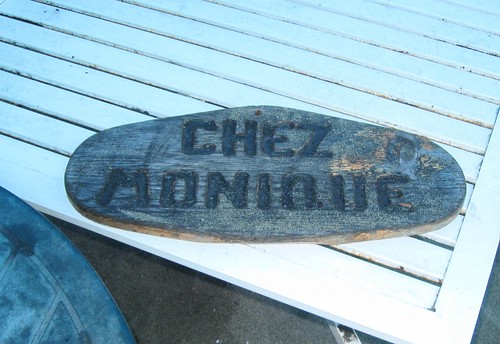
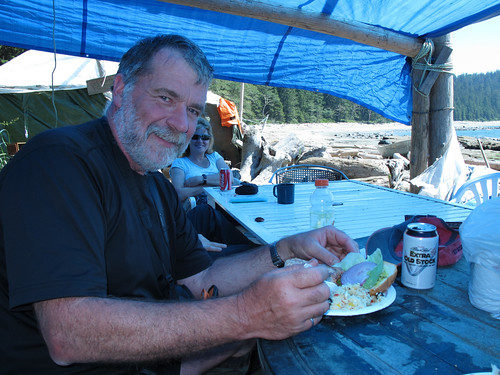
Lunch at Chez Monique next to Carmanah lighthouse, on Indian Reserve Land.  Eating freshly prepared hamburger, halibut burger, salmon burger, with cooscoos and salad.
IMG_0732.JPG

4915016090_5ce7418a39_b.jpg

IMG_0719.JPG

Three WOOFIE workers, two of them young twins from France working as waitress and cook in tarp covered driftwood kitchen:”wood you like ahliboot?”
IMG_0726.JPG

Loud dogs.  Monique is gruff and loud and forthcoming with a flow of fascinating information.  She’s 70 years old, taking MS in horticulture during the Winter in the Fraser Valley.  Strong French Canadian accent.

IMG_0722.JPG

Her husband is pureblood member of local Indian Band.   She talks to him on cell phone as he’s bringing in daily food order for the restaurant on a Zodiac. She chronicles her battles over the decades with the Provincial and Federal Governments and the Canadian Park Service and the Bureau of Indian Affairs and the neighboring lighthouse keepers and the other Indian groups that have reserve land along the coast.  She’s maintained this business, hated by all of them, because she knows her legal rights and shows an impressive mastery of local anthropology.  In addition to lunches and big breakfasts, she caters dinners for fishermen parties and backpacker tours which include the organic vegetables and flowers she grows in front of her house by the beach.  Gas is provided by bottled propane, power by solar and a small wind turbine and stored in car batteries.  The big storm of 2007 wiped her out but she rebuilt again.

IMG_0724.JPG

After luxurious lunch we pass lighthouse, move further through forest up the coast and come back to the beach at Cribs Creek.

IMG_0735.JPG

IMG_0744.JPG

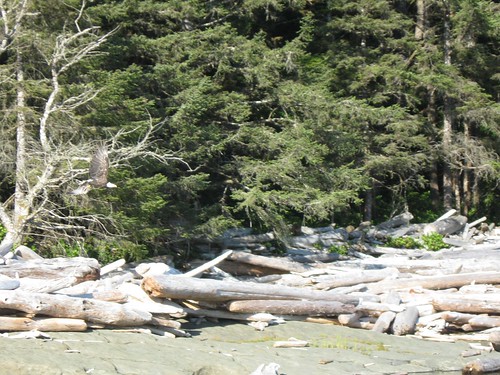
Another lagoon and freshwater swim.  An eagle lands on a log and tears at a seagull it’s caught, then takes off as I approach.

IMG_0769.JPG

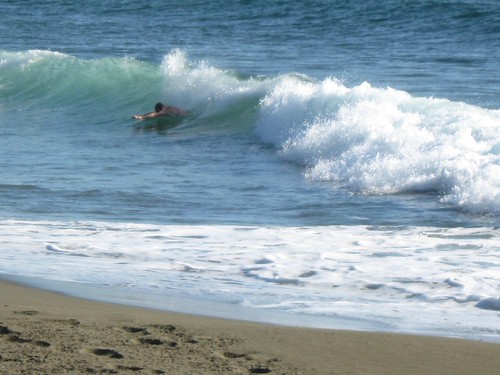
Peter body surfs and Steve and I try unsuccessfully to launch a raft through the breakers.

IMG_0761.JPG

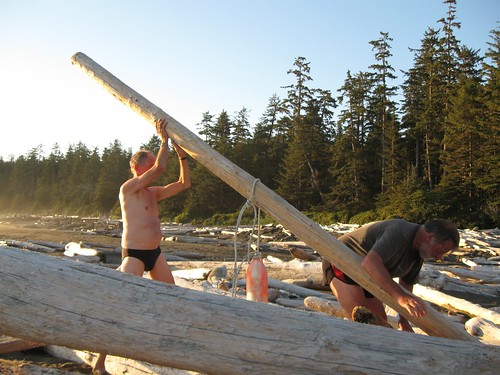
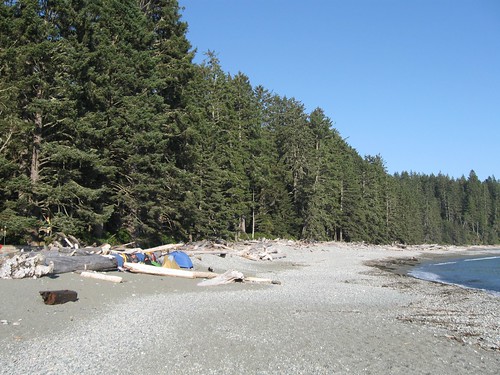
We build a sunshade and kitchen area with driftwood and raise our own bear cache in a secluded campsite several hundred yards down the beach from the central one, which again is crowded.

IMG_0770.JPG

Paul was given a wallet left behind at Monique’s by one of the Ontario women and he leaves it for her at her campsite.  She comes to the lagoon with word that her sister is carrying too much and got some sunstroke but is recovering.  She’s an eighth grade science teacher.  We talk pedagogy.

Sleep under stars again. Sunset and crescent moon over water.  Milky Way bright.  A satellite moving overhead brightens like an outsized shooting star. I wonder if it’s a landing spaceship.  But it dims and continues its smooth silent progress.  Probably caught the sun after it set here down below.

[Full set of 196 pictures, slideshow and all sizes]

Hiking the West Coast Trail (3)

Saturday, August 28th, 2010

Friday August 13

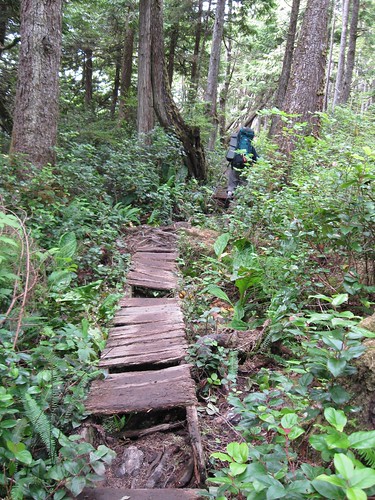
Eight hours hiking, lots of ladders, less vertical elevation change than first day and no terrible boulders to negotiate. Feeling stronger due to conditioning.  Most of the time in the woods.  Boardwalks in rough shape.  We’re thankful it’s not muddy and slimy as it must be most of the time here in the rainforest.  Lots of conversation, especially between Steve and me who hang back. Hemlock needles falling like snow; sunlight in patches.

IMG_0620.JPG

IMG_0629.JPG

IMG_0643.JPG

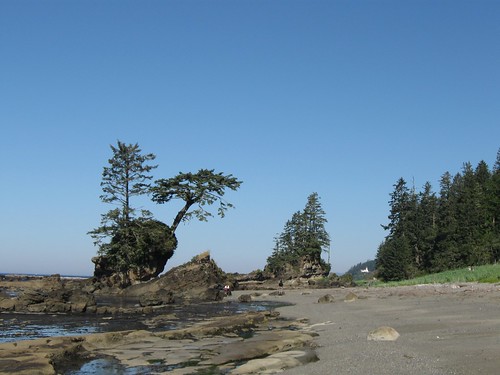
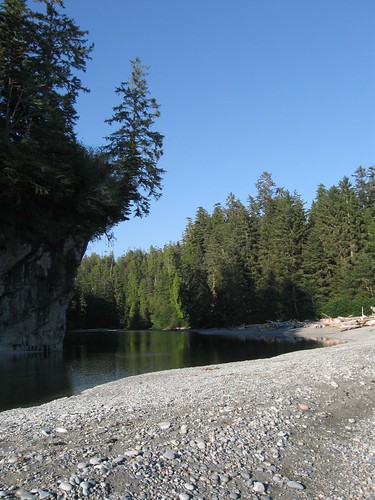
Arrive at Walbran Creek campsite, grateful to be back on the  shoreline. A large lagoon and expanse of beach.  Many people here, but no crowding.  Cloudless skies.  Swim in big lagoon under an outcrop gripped by a large spruce growing vertically from under its overhang.

IMG_0672.JPG

IMG_0676.JPG

IMG_0668.JPG

The sea here warmer than at Thrasher Cove.  Peter swims in it and rests.

IMG_0695.JPG

Fog and cloud gone.  Wide ocean vistas, Cape Flattery in Washington to the South.  A constant parade of container ships entering Juan de Fuca Straight bound for Vancouver and Seattle and China.  Here’s where our camping gear enters the country on its way to REI and MEC.  Steve says they carry Treasury Bills back. Paul and Peter work with neighboring Swiss couple to string our bear caches up in a tree.

IMG_0690.JPG

Steve cooks excellent Pad Thai, complemented by Chanterelles found on the trail.

IMG_0663.JPG

Sleep under the stars.  Sunset and moonlight on water.

IMG_0692.JPG

[Full set of 196 pictures, slideshow and all sizes]

Hiking the West Coast Trail (2)

Saturday, August 28th, 2010

August 12

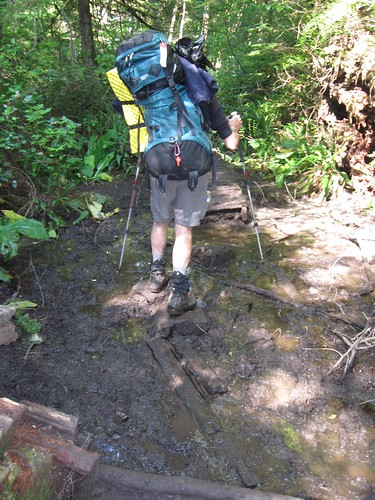
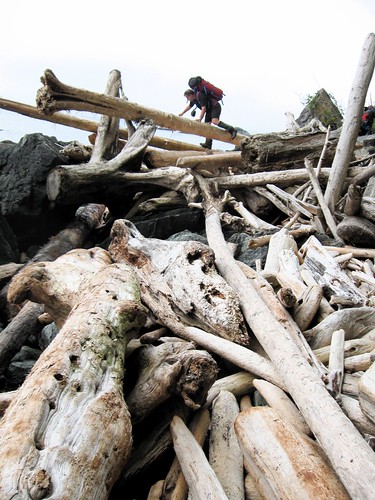
First two hours this morning were brutal.  Climbing over house-sized, sharp, slippery boulders and huge piles of logs with heavy packs.

IMG_0563.JPG

Steve fell twice.  I watched him go down and get back up.  Each could have been the end of his trip, adding to this summer’s 62 evacuations.

4914997334_a78d2b4803_b.jpg

Paul, eager and strong, always in the lead.

IMG_0567.JPG

I enjoy approaching my limit.  Pain, sweat, fatigue, and breathing hard focus the mind on here and now.

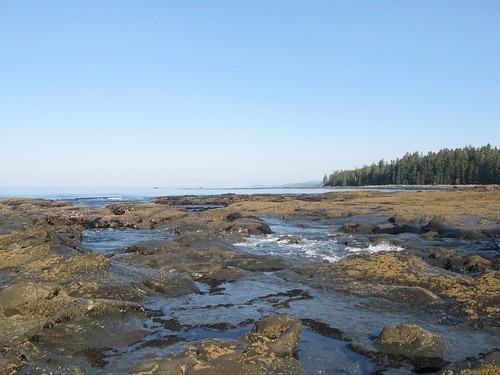
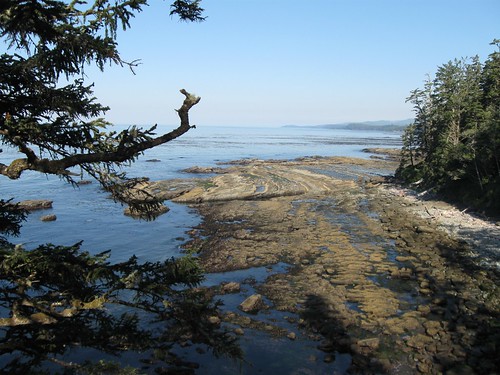
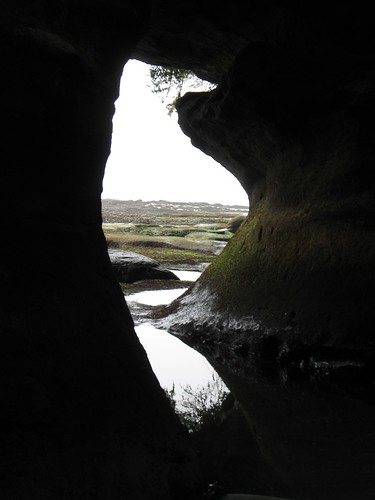
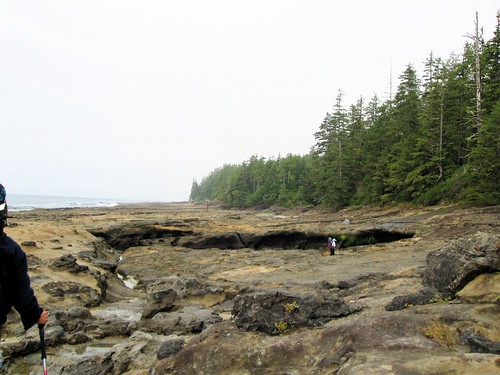
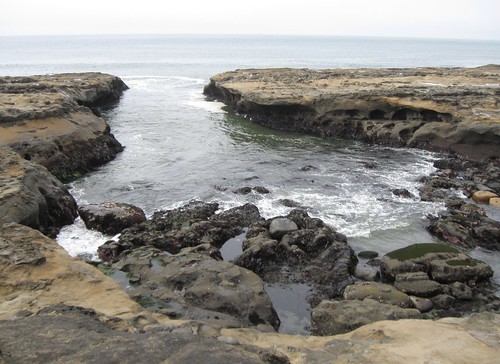
Scenery gains beauty as we approach sea stacks on the point.  Once around it, the beach flattens, the broken granite and basalt now blanketed with a wide sandstone shelf. We enter a dark network of softly sculptured channels that reflect rainbow-colored bands of algae growing on walls supporting the ancient forest above.  Views are framed by sculpted arches and windows opening inward on a labyrinth of caves and outward on offshore islands covered with the rounded bodies of basking sea lions.

IMG_0581.JPG

IMG_0585.JPG

IMG_0597.JPG

IMG_0604.JPG

IMG_0605.JPG

We put down packs and wander through this wonderland, then sit and munch crackers and salami.  Two young women I’d greeted at Thrasher Cover come round the point carrying packs larger than ours. We share relief at the change in topography and excitement at the splendor of the caves. They set down packs and the blond removes her sweater revealing a nicely rounded belly.

A walk on the flat beach, skirting the surge channels impassable at any but low tides and then back up to the bush trail with more steepness, ladders, wooden walkways.

IMG_0606.JPG

IMG_0608.JPG

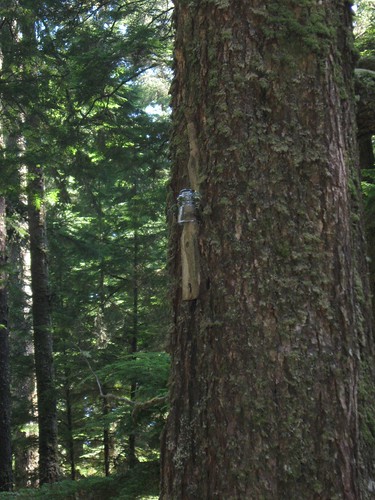
The history of the trail as a rescue route for shipwrecked mariners is evidenced in telegraph wire insulators embedded in tree bark.

IMG_0739.JPG

A few old logging sites are marked by “derelict donkey” and cable.

IMG_0880.JPG

IMG_0625.JPG

IMG_0630.JPG

4915014854_51b6149808_o.jpg

We stop at Camper Bay, appropriately named since its every inch of beach and forest margin is packed with tents, despite the strictly limited number of permits issued.  One of the two compost toilets is filled to capacity and despite our fatigue and the beauty of the location, we’re grossed out by the smell and the traffic.  Everyone who has come here for wilderness and solitude shares the same distaste, but it’s overcome by affability.  We schmooze with the two young women, who hail from Ontario, a couple from Saskatoon who’ve taken the hike seven times before with their six children and who sit by their campfire drinking tea out of china cups and saucers they packed in, and members of an all female guided group of civil servants from Victoria.  I swim in the clear water of the lagoon created by a rock dam of the creek along the beach, and Paul cooks supper of beans, rice and bacon bits.  Afterwards I find quiet around the point now exposed by low tide.

[Full set of 196 pictures, slideshow and all sizes]

Hiking the West Coast Trail (1)

Saturday, August 28th, 2010

This trip was tentatively planned during our hike of the Nootka Trail last summer. Peter had done it 27 years ago with his ten year old son and it retains the reputation of being one of the world’s best hiking trails. Paul did the prep work of determining the best time for tides and weather and being  first in the lineup for reservations, which came to close to $200 per person. Access is tightly controlled by Parks Canada which allows about 6000 people a year to make the trip.

The trip concluded a long summer holiday which involved Jan and my driving from San Luis Obispo to Knoll House in Lund B.C., spending ten days there with children and grandchildren, driving to Eastern Oregon for the wedding of a relative, driving to Portland, from where Jan and the dog flew back to San Luis in time for her City Council meeting, and my driving from Portland to Port Angeles, where I left the car and ferried to Victoria to meet Peter on the way to the trailhead.

August 9 Heart of the Hills Campground, Olympic National Park WA

Inside a cloud, dark and grey under the old-growth spruces and cedars. The campground quiet and underpopulated.

A family pulls up to the neighboring campsite: 2 parents, black and white, and their five-year old boy.  His high, loud voice echoes in the forest stillness.  His parents are patient, loving, full of instruction and rule.

I used my senior passport to get in free and pay only 6$ to camp. Sinus pressure and cough just returned. Will I need more antibiotics before the hike?

I repack my backpack for the third time on the picnic table, always subtracting. I’m worried about the weight.

August 10

Awake at 6 AM, no sign of illness. But the threat remains, increasing desire to keep trying limits while I can.  I’ll see what the weight is like on a trail this morning.

Two and a half hours later I return, glad to set the pack down, but not exhausted or in pain.  No Aleve needed now for the knees. The trekking poles work wonderfully”absorbing shock and adding forward momentum, allowing  me to walk like a quadruped.

More sorting and packing: what goes in the hike pack, what in the Victoria pack, what stays in the car. In my journalette, I map what’s where in the pack. I’ll look up those locations instead of searching for things.  Mindfulness.  I’m reading “Buddha’s Brain.”  I practise on the trail: attention to breathing, movement of feet, the quiet.

Why do this? Expend the time and money, take on the preparation, discomfort, and risks?  To encounter simple necessity, to escape family and state, to find friendship and solitude, to return with pictures and words.  For adventure, a venture, face the unknown, experience engagement, not detachment.  Jan prefers different ventures: running for mayor, facing opponents, managing organizations.

August 11

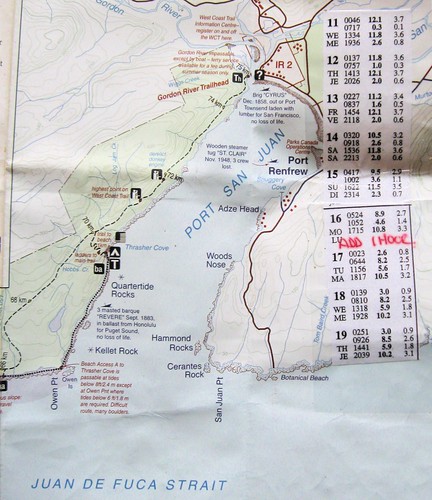
Peter picks me up at 6:00 A.M. in front of Ann’s house, where I crashed after ferrying by foot from Port Angeles.  I feel royally accommodated. At Port Renfrew we eat a big breakfast at fisherman’s restaurant and drive to the trail information center located on an Indian Reserve strewn with garbage and half-wrecked houses. The mandatory orientation lecture a fast paced forty minute Powerpoint detailing dangers and challenges to a room full of people who’ve succeeded in getting one of a limited number of reservations, eager to get going.

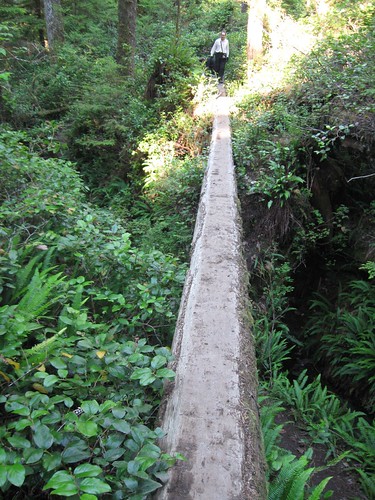
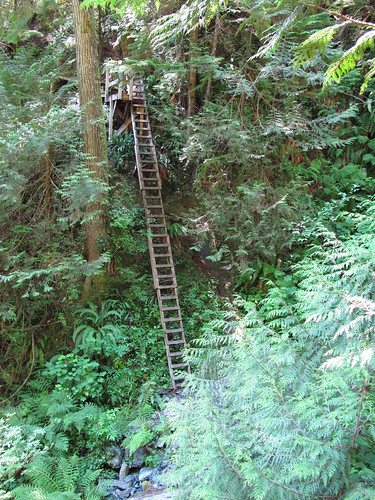
A tiny ferry ride, then five and a half hours walk through dappled first-growth forest, steep verticals, the rough trail made somewhat easier by long ladders leading into and out of deep gullies gouging impassable headlands.

IMG_0928.JPG

4914991376_d15011105d_b.jpg

It’s the shakedown experience alternating between challenge and ordeal. I’m bathed in sweat and drink 3 litres of water.

4914989276_784c2cc6f2_o.jpg

The last section descends 200 rungs to the beach at Thrasher Cove, where we share the campsite with about 30 others.  I cook quinoa and lentil curry and chocolate pudding from Trader Joes for appreciative mouths, lightening my pack 4 lbs.

IMG_0556.JPG

[Full set of 196 pictures, slideshow and all sizes]