Travel

Morro Bay Morning

Monday, January 22nd, 2007

Yesterday morning, on an impulse, I drove to Morro Bay to spend a couple of hours kayaking during the winter bird festival. The day was warmer than last year, the Bay calmer, and the tide more friendly. Already high at 9:00, when the rental opened, it provided me with two more hours of suction up the estuary before it would turn and leave me stranded. Slight dabs with the paddle propelled me across the spreading silky surface.

A friend had told me she spotted 30 species on the Bay a few days earlier. Equipped with binoculars and camera to capture a grand wildlife display, I felt guilt for possibly disturbing creatures I knew were resting here to gather energy for their long migrations. How much to take of nature’s bounty without creating harm? Sustainability in the abstract takes up much of my time, but I’ve done little to reduce my personal footprint. This has come home to me while reading a book about logging in British Columbia called The Golden Spruce that recalls my days of working in the pulp mill up there in order to be able to live close to the land. Another book about the world’s water shortage called When the Rivers Run Dry makes me anxious about running the soaker hose to establish new native plant seedlings during this drought year.

I paddled past a sandbar far enough from the receding shoreline to avoid spooking a crowd of pelicans, herons and cormorants, but close enough to admire them through binoculars. As I rounded a clump of submerging eelgrass, a grand panoply unfolded: thousands of birds lined up single file, all facing the low sun, motionless in pleasure and adoration.

(click on thumbnail then on enlargement for full size panorama)

thumnailbirdworship.jpg

2006 Yom Kippur Fast at Sycamore Glen

Tuesday, October 17th, 2006

October 1 2006 7:30 p.m.

Inside tent after a clumsy pitch in the early dark, flashlight hanging from a loop in the roof. The first time in dozens of overnights on Cal Poly Land I’ve brought a tent. Only a light rain, but enough to warrant it.

Left home on my bike at 5:30 to get settled by the sunset start of the holiday. Headed for the high ground and a view. But the overcast created a sense of quiet that made me want to stop and listen rather than look.

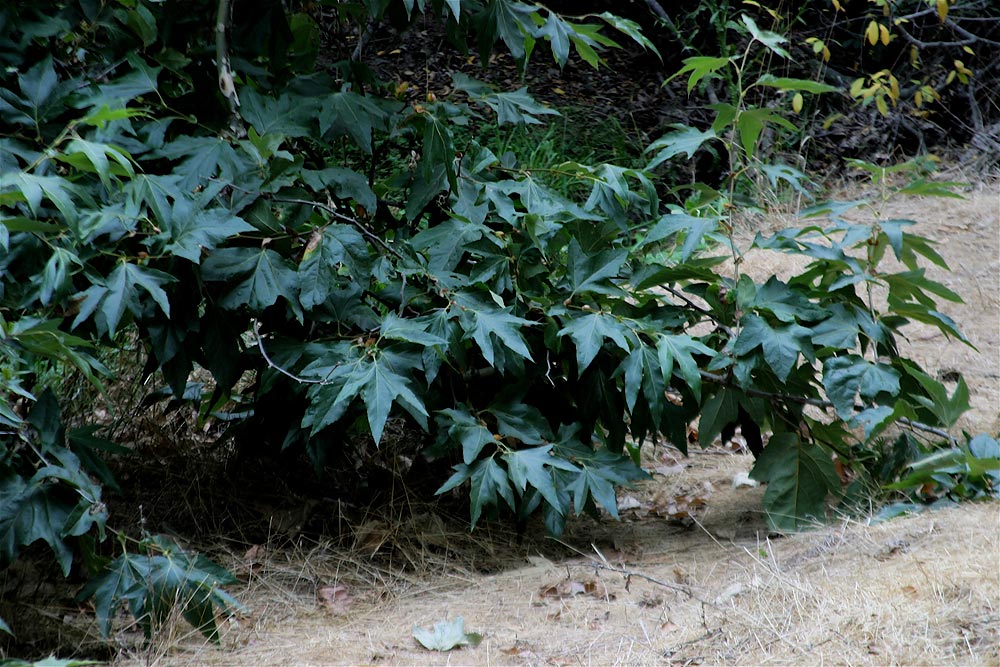
sycamoreleaves.jpgI parked the bike at the trail leading to Sycamore Glen. Normally dry this time of year, the creekbed was full of watercress and yellow monkeyflower, so wet I couldnt cross without getting muddy boots. My usual trail was overgrown this time, but I found a new one made by horses higher on the bank. The sycamore leaves were black green, thick, a foot across.

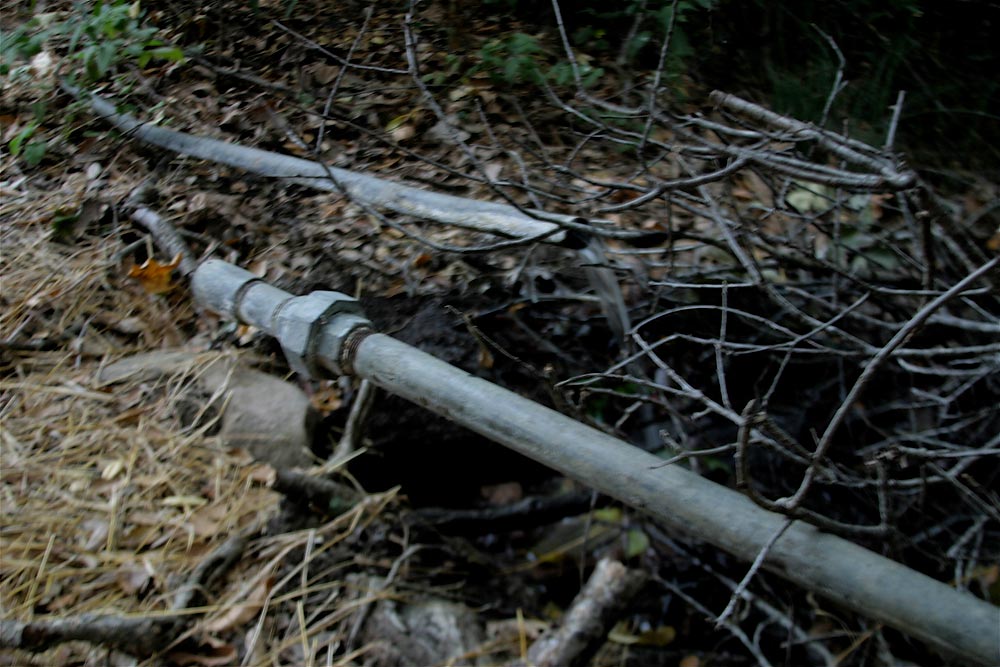
waterpipe.jpgI walked slow and wide-eyed, ready for surprises. At the end of the little canyon leading to the Glen, I heard the plash of flowing water. There was the source: a broken steel pipe. On another visit I’d found a slump in the hillside grown over with rushes, and above it a break in this pipe where a plastic coupling had come undone. I’d repaired that and wondered how the landscape might change as a result. In the waning light of this afternoon I sauntered up the Glen and saw that the former little wetland had turned to dry grass.

I decided to return to the broken pipe and camp near the old oak where I’d stayed during my Yom Kippur fast three years ago.

darkoak.jpg

The temperature is dropping. My eyes are drooping. Its only 8:00.

(more…)

An Excursion Near Home

Sunday, February 19th, 2006

Low-grade illness and a heavy schedule has kept me from fulfilling my own assignment to students: get outdoors, pay attention, write. Yesterday morning’s cool weather and dramatic light got me going. The Sierra Club’s outings web page promised a kayak trip up the Morro Bay Estuary to spot birds, but when I phoned the leader he said it had been cancelled because of uncertainty about wind and rain. The Morro Bay Natural History Association offered a talk about “Living on tectonic plate borders” which sounded appealing since I’ll have to lecture on Cal Poly Land’s geology next quarter. I took my down vest, windbreaker and packsack loaded with camera, binoculars, bird book, a loaf of sunflower seed bread and an avocado, and told Jan I’d be back in the late afternoon.

I arrived at the Marina early and walked to the point to gaze at birds, clouds and the distant dunes.

Rounding the lion rock, I came across two white egrets. I was transfixed by their yellow eyes and graceful head plumes but they werent interested in my company. They slowly flapped their huge wings, lifted their legs and flew across the flat water.


(more…)

Territoriality

Wednesday, February 1st, 2006

Today’s ecolit class was a hike to Rockslide Ridge.

We’ve been reading John Muir’s The Mountains of California. Its first paragraph contains a fine description of our home territory.

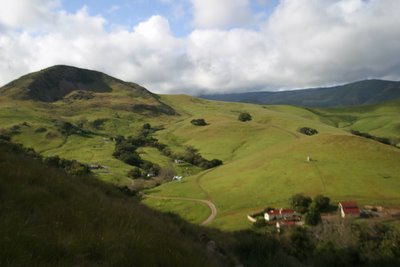
The Coast Range, rising as a grand green barrier against the ocean, from 2000 to 8000 feet high, is composed of innumerable forest-crowned spurs, ridges, and rolling hill-waves which inclose a multitude of smaller valleys; some looking out through long, forest-lined vistas to the sea; others, with but few trees, to the Central Valley; while a thousand others yet smaller are embosomed and concealed in mild, round-browed hills, each with its own climate, soil, and productions.

I’d asked students to study the Geology chapter of Cal Poly Land: A Field Guide to connect the Muir text to our walk and to help them to decipher some of the language of the landscape.

The winter weather was clear and crisp. On my way up to our meeting place at the horse unit, I biked toward Drumm Reservoir and the site of “Poly Canyon Village,” a huge new student residential development I’d spent many hours haggling about in committee during the last five years. I’d just learned from reading Christy’s ecolit journal that groundbreaking started two days before with the destruction of ancient Eucalyptus trees:

Driving up to Peterson ranch this afternoon I was shocked to come across the mass arboreal murder taking place. The beautiful eucalyptus trees that have shaded the feed mill, the feedlot, and the bull test are being savagely mown down by hairy, overweight cretins in fluorescent vests. In the summer when it gets unbearably hot, there is some much needed comforting shade under these fragrant guardians. During wind-whipped storms, their branches sway and shed leaves in all directions. They hold the land stable; they act as nice bumpers for those whose breaking skills are not up to par. To me they stand watching over year after year of Cal Poly students. They have seen the succession of eager high school potential, to Poly student to teacher, teacher to department head, then to retirement. …Just five days ago, I walked to my car parked under those fated Eucalypts, listening to the eerie creaking and groaning of the trees, despite the dead stillness in the air. They knew, and they were broadcasting their goodbyes through the song of their branches.

I found only huge stumps, cut close to the ground. The rings werent visible enough to be counted.

While we waited for stragglers, I pointed out the borders of Cal Poly Land on the map. Our destination was just outside the property line. At exactly 10:15 by my watch, we started up the hill. Every minute counted if we were to be back in time for the next scheduled class at noon.

The horse corral above the stables provided a lesson in erosion and land misuse. As a flock of crows cawed in the twisted sycamore limbs, one student pointed out a foot-high gap between the ground and the concrete foundation of a watering trough, measuring the loss of topsoil.

At the top of the corral we came upon Indonesian reservoir, designed and built by a group of Indonesian students in the ’60’s to impound runoff from Horse canyon creek in front of us and water pumped uphill from the system of reservoirs, ditches, pipes and creeks that serve as plumbing to irrigate campus farm facilities. I pointed out Kestrel Crest, the serpentinite ridge above the reservoir. Kestrel was defined as a small raptor, a sparrow hawk. Kiell mentioned that it was also a verb that meant hovering in flight. As if on cue, two small birds with white spots on their wings–not kestrels–appeared below the crest and kestrelled for us. Another bird flashed grey-blue and light orange. I recognized it and three more that joined it, as female Western Bluebirds, Sialia mexicana. Not as impressive as the more brightly colored male I had photographed last year from my deck
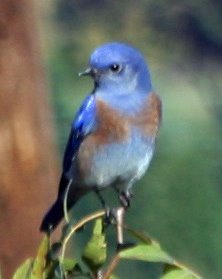
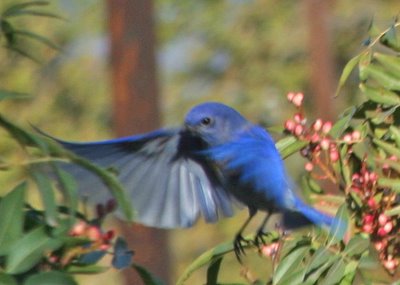
they nevertheless gave me a thrill when their gray wings suddenly turned blue as they angled in the sun.

After a brief stop at bedrock mortars surrounding a grove of bay and hollyleaf cherries under the high voltage lines bringing power to the campus from the grid in Morro Bay, we huffed uphill on a deeply eroded dirt road past some recent slumpage in the Franciscan melange soils on the bank, passing through a shaded oak woodland along the creek. The woodland gave way to grassland and then to rock outcrop plant communities growing on the base of the steep upper slopes that constituted Rockslide Ridge. Despite an increase of wind, the temperature went up, and I had to remove my sweater and take a drink.

At the saddle dividing Horse Canyon from Poly Canyon, some people decided to ascend no further, while the rest of us left the road and found various paths through the unstable rock and gravel, avoiding the needle pointed tips of Spanish Dagger that thrived without much competition on the infertile serpentinite soil. Most of the group had never seen this backcountry before. Other people delighted in the escape during class hours. I watched the clock, knowing we had to reach the top by 11 in order to have fifteen minutes there before going back down.

I was one of the last near the summit to clamber over a barbed wire fence that ended in a vertical drop-off where half the mountain had shaken loose and slid down into the valley that was now the Architectural Area. Instructed by Professor Chipping’s explanations in the Field Guide, one could see where springs erupting from impermeable layers of rock covered by the slides secreted watercourses lined with green black clumps of trees–oaks, bays, sycamores and willows.

I collected papers due today and then people dispersed on the summit plateau, just outside the University property line to write in their journals.
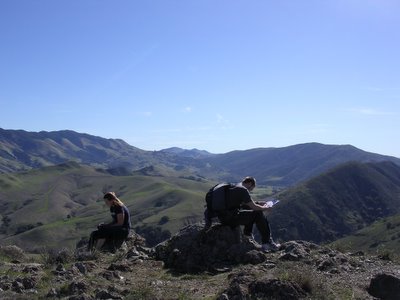
(photo by Danielle O’Neill)

I found a natural rock bench, drank some water, munched on a chunk of olive bread and looked for a subject to describe. Just to my west, on a dried flower stalk of Yucca whipplei, perched another female bluebird. I approached her slowly to get a picture, and she let me come within 20 feet.
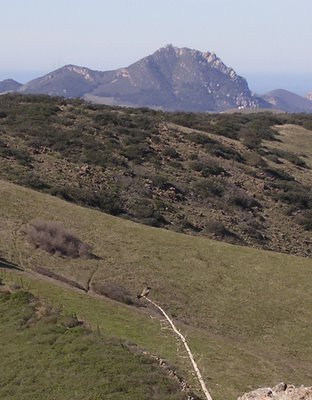

Then she disappeared and I went back to my seat. Looking to the south, over the campus toward the city in the distance, I saw her on another stalk, watching me.
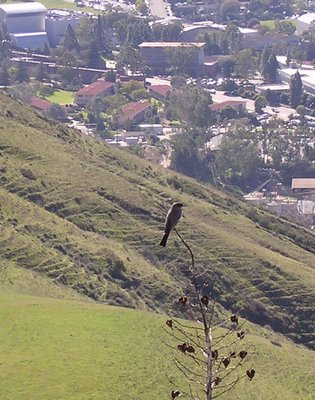
I approached again. This time she flew directly toward me and fluttered in an arabesque a few feet from my eyes. At first I told myself she was rewarding my attentions. But then I realized this was threat behavior. I was doubly trespassing, my sit-spot in the middle of her territory, between her guard towers. I checked my watch. It was three minutes after the time to leave.

Waves

Wednesday, December 21st, 2005

I read this yesterday in the SLO Tribune

“The ingredients are now in place to produce a huge wave event,” said John Lindsey, Diablo Canyon weather forecaster.

…Wednesday’s waves are generated by a storm 1,100 miles to the west and will hit the coast more directly.

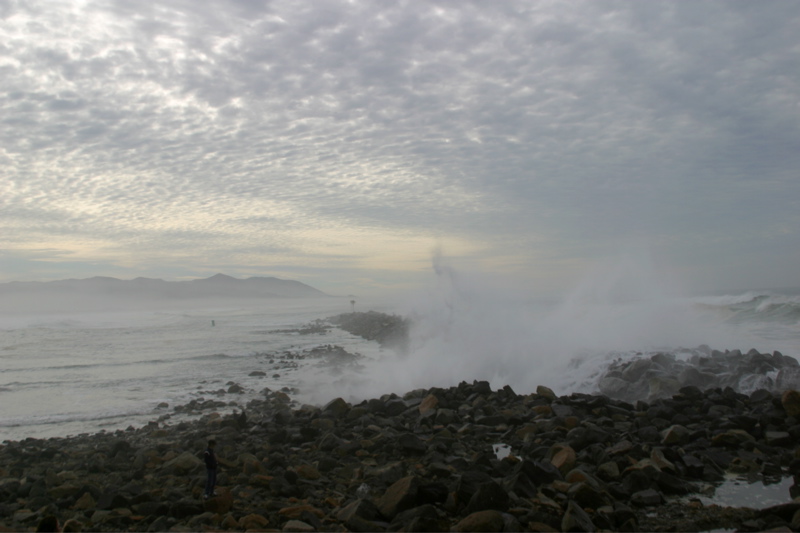
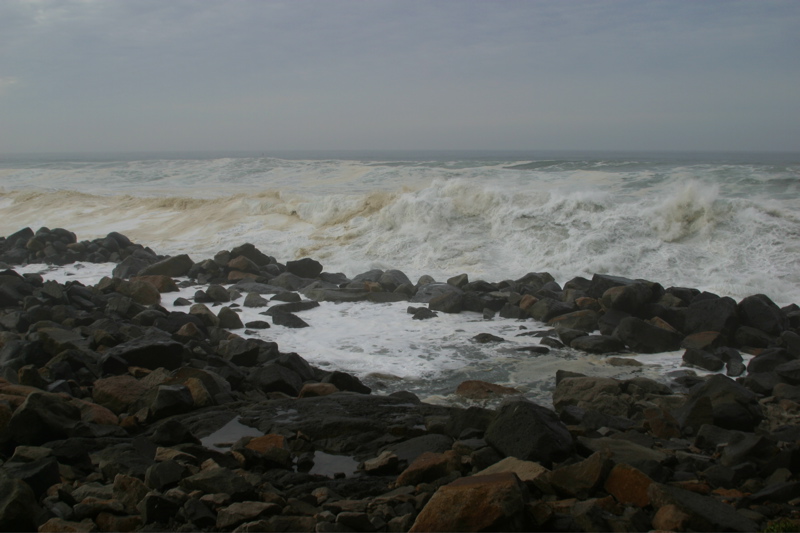
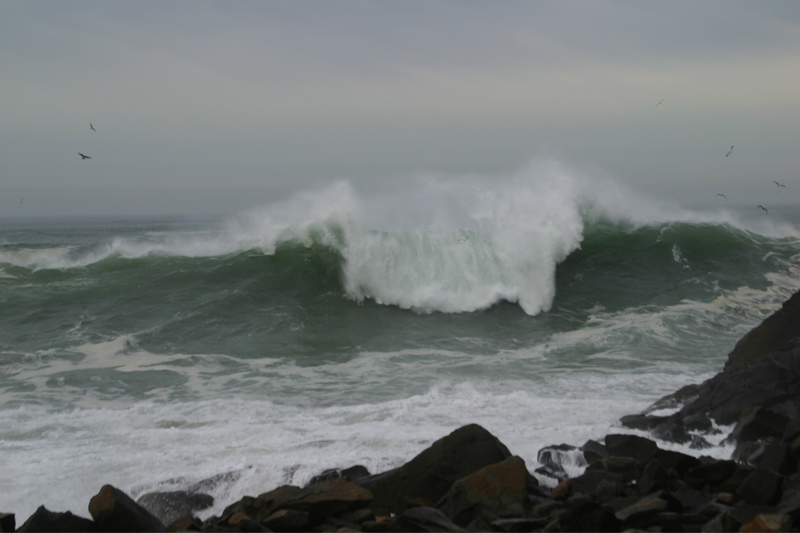
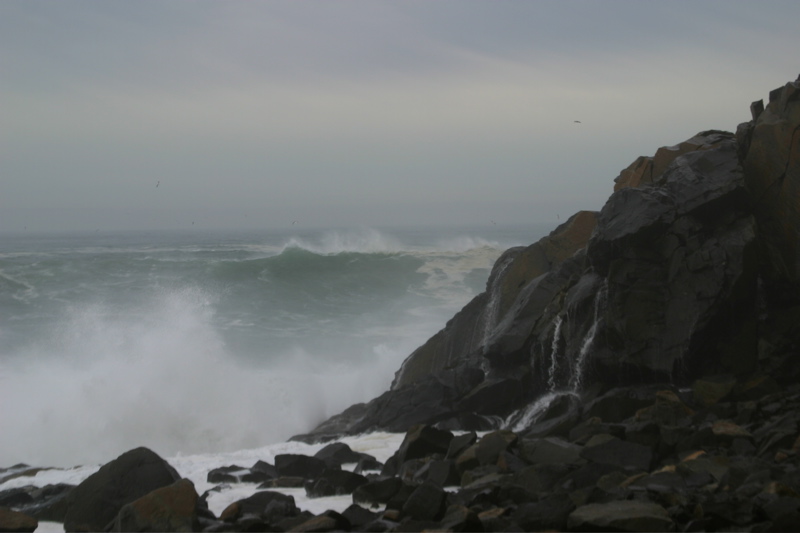
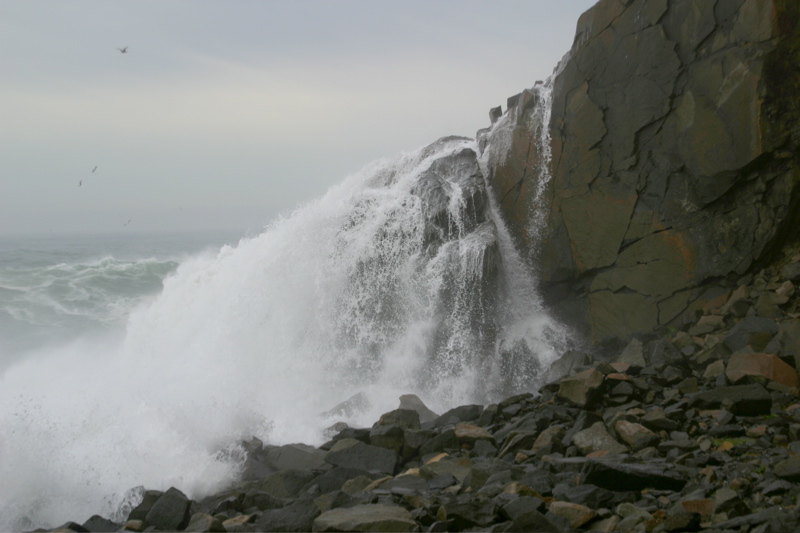
After attending the Christmas pajama parade at Ian’s nursery school with Claire this morning, I celebrated the winter solstice by driving to Morro Bay to look at the waves.

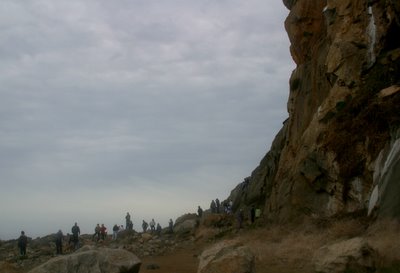
During a stop in town I took in a deep breath of sea-smell–much further ashore than usual. Driving down the hill, I saw a crowd of cars at the foot of the Rock. I wondered if people were there for the Salinen Indian Winter Solstice ceremony announced in this morning’s paper or like me, to welcome the waves at the end of their long journey. Then I saw the blasts of spray above the breakwater.


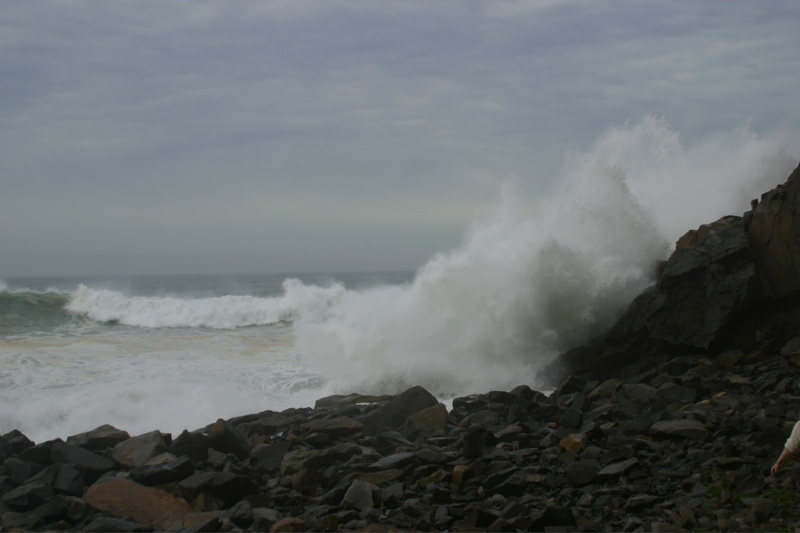
The heavy camera and tripod made me self-conscious among the dozens of people there with palm-sized digitals, but they added to my sense of purpose. As I rounded the corner toward the open ocean, I heard the crashes echoing from the hollow stone bowl overhead and felt the ground shake. I was reminded of those disaster movies, when the thunk of a landslide or a mortar round makes your pelvic bones rather than your ear drums vibrate. The atmosphere was a mixture of church and amusement park, reverence and sensation-seeking. It may be like this for the solstice ceremony too, as it might have been during the parting of the Red Sea.


I couldnt tell how much of the water’s angry turbulence was natural surf and how much was due to meeting the artificial impediment of piled boulders.


The slight offshore breeze lifted scarves of spray from the tops of the breakers, and the wild air they pushed before them made a playground for the gulls.


I could feel it blow as the explosions of water on rock grew more intense.


After one of them brought a shower down over the camera, I packed up and left.

Thanksgivings

Sunday, November 27th, 2005

Jan suggested a hike this Sunday morning, since she no longer has to go to church with her mother. We agreed to catch the sunrise on San Luis Mountain. There were already three cars in the parking lot when we got there and started up the hill in the chill wind. The sun crested the southern horizon as we passed below a great boulder surmounted by two large coast live oaks, and slowly lit up the red, yellow and purple rock. Behind it you could see the sky turn from gray to lapis lazuli blue. As we descended from the summit after enjoying the view of the city surrounded by agricultural fields mountains and ocean and drinking coffee from a thermos, I said that the older I get the more I think its unlikely we’ll move away from this place. On the way home we stopped at Home Depot for a new pickaxe. The one I’d been using broke off at the tip after hitting one too many rocks.

Now I sit at the top of the hill in the backyard on the “60th Anniversary Bench” we gave to my parents, inscribed with the old proverb about love. Its the only spot at our place that gets sun this time of year and the warm rays feel good in the chilly air. The light at midday is better than early morning or late afternoon at this time of year–both low and strong, intensifying shadows and highlights.

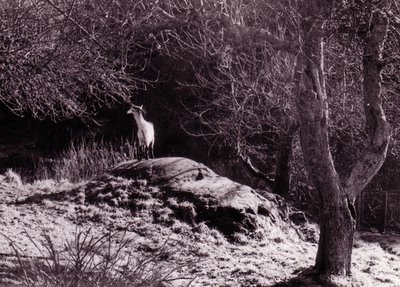
I’m reminded of November on our old homestead in British Columbia in the ’70’s. Only on the bank above the driveway, high on the south facing slope could you get out of the shadow of the cliffs and tall trees surrounding the pasture. Here the goats and the cat would lounge all afternoon whenever it was clear.
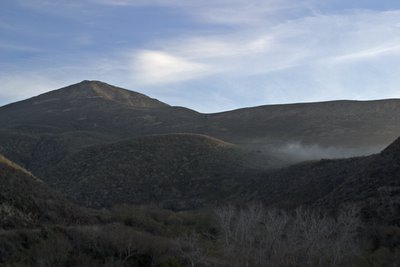
I’ve been scanning and restoring old pictures of that time from mouldering photo albums.

Its been a long Thanksgiving holiday whose approaching end is marked by the sound of students’ cars returning to campus. On Tuesday morning Ian and I packed provisions and headed for Montana de Oro. We found a site near the trailhead at the end of the campground. As we were setting up the tent, a midsized healthy looking coyote sauntered by and stood scratching itself and watching us as we watched it, for about ten minutes. I was too enthralled to take out my camera. At first I thought it was a dog belonging to another camper.

At the Spooner’s Cove beach we climbed a tilted sandstone outcrop and came to spot on top where the waves roared through a crack below us. I foraged eucalyptus branches for firewood and as we returned to the camp, Jan drove up after seeing her afternoon clients. The three of us took a hike up the Islay creek trail and watched fingers of fog creeping down into the canyon over Reservoir Flats. On the way back to camp Jan told the story of the three little pigs in great detail to keep Ian from thinking about being tired, and we watched the sun dip into the marine layer as we came back to the camp. As the sky turned florescent pink, then purple then black, we grilled dinner with only three candle stubs sheltered by the apple juice container for light.
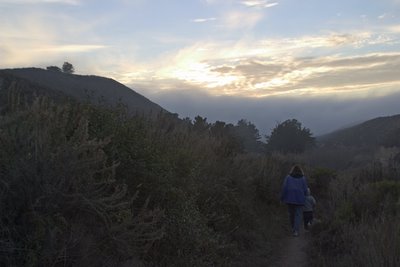
Inside the little backpacking tent we hung a small flashlight from the ceiling and played Chutes and Ladders till Ian threw the spinner away in rage and then immediately fell asleep. When Jan went out to pee in the middle of the night she heard cellophane crackling and in the morning we discovered that the cookies we had forgotten to put away were missing.

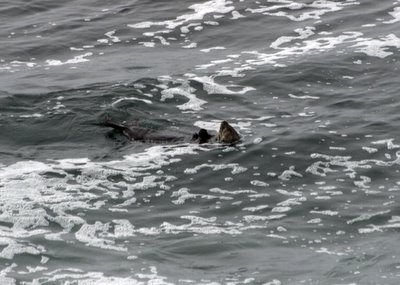
Claire drove up in a big truck in time to join us for breakfast and more games. After Jan left to go back to work, Ian Claire and I struck camp and hiked the bluff trail along the ocean, sighting quail, sparrows, herons, cormorants, herons, and male and female brown pelicans which Ian identified with the bird book. We also spotted an otter relaxing in the surf between protruding outcrops.
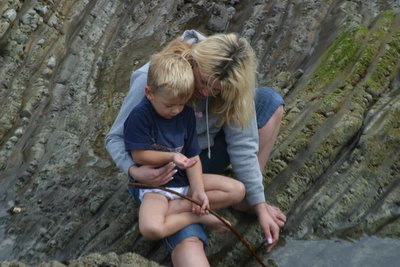
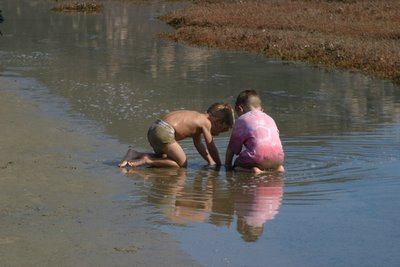
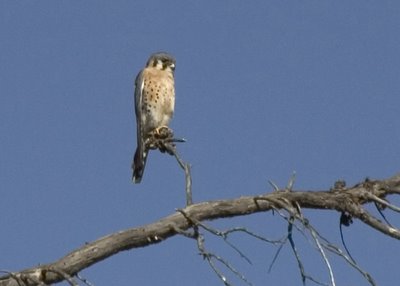
The sun hid in the mist and then appeared briefly intensifying colors and shapes. We stayed for two hours in Corallitos Cove, throwing rocks, chasing waves, poking anemones, investigating crabs and observing the comings and goings of the pelicans. In the late afternoon we drove to Los Osos for ice cream cones.

Assignment

Friday, November 18th, 2005

Preparing for my next quarter’s class, Ecolit: Reading and Writing the Landscape, I modified the Journal writing requirement to include a weblog option. At least twice a week students must write an entry. I must follow suit.

I’ve been going to Nature Explorers with my grandson Ian every Thursday morning. Its a program for kids up to age 8 and their parents and grandparents, part of the Coyote Road School in San Luis Obispo. The school focuses on outdoor education and nature study with an emphasis on tracking that derives from the educational philosophy of Tom Brown’s Tracker School.

We’ve been to Bishop’s Peak, Reservoir Canyon, Cuesta Park, Laguna Lake, the Sand Spit and Morro Bay Estuary, a few of the hundred wonderful natural preserves within 20 minutes of home. All the kids are enthralled with these sessions, especially Ian, and the adults seem to enjoy them with just as much enthusiasm. There’s alot of philosophy and expertise that goes into the program, but each excursion feels casual and slow paced and leaves plenty of time for adventure and pure fooling around.

Alot of what goes on is similar to what happens in my University classes, although less information is conveyed. As a student rather than a teacher, however, I find myself marvelling at the knowledge of wildlife, vegetation, and Indian lore drawn upon by Dave and Evan, the leaders, especially the kind of reading of the landscape they do with the kids by studying the inscriptions left by animals in tracks, scats, and bones.

Each session has ended with some unscripted but dramatic sighting–yesterday, the last of the quarter, it was a peregrine falcon mobbed by a merlin–the two raptors noisily squabbling overhead at the Morro Bay Marina in the estuary. The week before it was discovery of the skeletal remains of a seal or a sea lion on the Sandspit. The week before, a kestrel sitting in the sun for his portrait at Laguna Lake.

Most of the students and parents attending Coyote Road classes are being home-schooled. I remember that one of the most well informed and talented writers in my ecolit class two years ago was home-schooled in North County. A full generation below me, the Coyote Road parents and instructors seem to have resurrected or retained the spirit of the sixties and seventies whose demise I’ve mourned since returning from exile in Canada in 1979. But at Tuesday night’s general meeting of the Sierra Club, I saw more traces in the presentation about his Environmental Studies curriculum by a Paso Robles High School Teacher, Mark DeMaggio.

My Ascent of Mount Maggiore

Thursday, October 27th, 2005

photo gallery

During our visit to Fornello, Brenda reminded me twice that the final day of our trip was Yom Kippur, the highest holiday in the Jewish Calendar. I wished she hadn’t mentioned it so I could have let it pass unnoticed. I woke up Thursday morning feeling guilty”in part for the privilege of enjoying Italy during the time of year I would normally be staggering under my Fall quarter workload, and more specifically at the prospect of going on our scheduled gastronomic and wine tour of the Chianti region on this fast day. I hadnt attended a synagogue service in decades, but refraining from food for 24 hours and going into the woods alone on this holiday was one religious duty I had regularly observed. I decided to skip breakfast, excuse myself from the tour, and head for countryside. It took me a cranky uncaffeinated hour to negotiate buying a ticket from the Tabak shop and find the right bus stop, but by 11 a.m. I had reached Monteriggioni, where my Italian Alpine Club map indicated the beginning of an excursion leading to the top of Monte Maggiore.

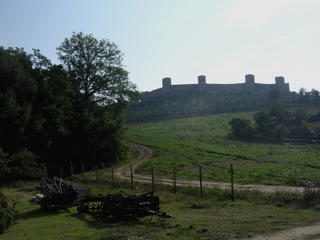
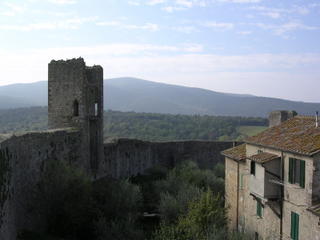
I got off the bus and bounded up the steep pedestrian approach to the castle famously described by Dante

As, when the fog is vanishing away,
Little by little doth the sight refigure
Whate’er the mist that crowds the air conceals,

So, piercing through the dense and darksome air,
More and more near approaching tow’rd the verge,
My error fled, and fear came over me;

Because as on its circular parapets
Montereggione crowns itself with towers, 41
E’en thus the margin which surrounds the well

With one half of their bodies turreted
The horrible giants, whom Jove menaces
E’en now from out the heavens when he thunders. (Inferno Canto 31)

I wandered through the tiny village inside the fortress, sat for a moment in the empty chapel, and left 50 cents in the offering box. I paid a Euro to the lonely young man guarding the stairway that led to the top of the wall from which I could see the mountain towering in the mist. In the car park on the south side of the wall, I found a large sign with a maps and historical information about the trail ahead. Like the piazza between the Siena Duomo and the Ospedale, this too was part of the Via Francigena, the pilgrim itinerary from Compostela to Rome that put me on a venerable path of discomfort, wanderlust and spiritual aspiration. My route through the wilderness of “Montagnola” would take me to the summit and then on what a sign called “La Grande Traversata,” down to the villages of Fungaia and Santa Columba on the other side, where I could catch another bus back to the city.

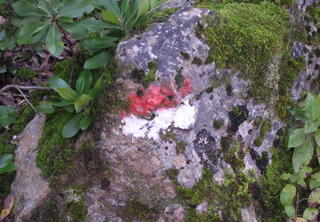
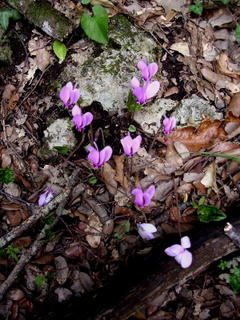
A dirt road led me into thick woods which occasionally opened up to fields, olive groves, and old villas and ended at an organic farm and meditation center named Ebbio, where several guests stood in the courtyard looking nervous and smoking cigarettes. Here the road gave way to a steep trail that tunnelled through forests of small trees, some thick with brush, others recently thinned and coppiced. I was serenaded by unfamiliar melodies that sounded as if they could only have been sung by birds called “larks.” Exertion and solitude and the growing distance from the valley occasionaly visible through a break in the trees contributed to the pleasant buzz in my head created by the emptiness in my stomach. A small trail branched to the left which I thought might lead to the summit. I noticed a cluster of delicate pink cyclamen growing in the deep shade at my feet, fresh blooms in mid-autumn.

I followed the side trail uphill for several minutes, but rather than reaching a summit, it headed back downhill. Conscious that it was well past noon and that I hadnt seen any signs or trail markers for the last hour, I no longer could locate myself on the map with certainty. I returned to the patch of cyclamen and continued heading toward the westering sun, hoping soon to find a junction that would lead to the south and then east. The bird song had ceased and now in the distance I heard the whine of one, then two chainsaws. The trail came to a clearing at a junction of several tracks filled with deep mud, sign of the recent passage of skidders, the huge insect-like machines which drag timber out of the forest. Across a plateau miles ahead of me I could see land that had recently been cleared but no evidence of civilization or indications of where I could make my way out of this endless Montagnola. I walked faster and then half ran toward the ugly sounds of the chainsaws but seemed to get no closer and found new paths heading off in all directions. I felt stirrings of fear and confusion. I checked my watch and told myself that if I found no landmark within ten minutes I would have to admit defeat, turn around and retrace my steps. Twenty minutes later, with an unmistakeable taste of panic in my mouth, I did just that.

The walk back was long and boring. Having neither reached the summit nor accomplished “La Grande Traversata,” once I knew my way, I took an alternative dirt road down to the valley that passed by a memorial to WW II partisans who hid in this wilderness but finally were captured and executed by the Nazis. I passed several men with guns and dogs who were out hunting, probably for larks. The road was steep, viewless and littered with trash. It emerged at Abbadia de Isola, which the historical signs told me was the site of an Abbey and military outpost for Siena that was rendered obsolete with the construction of Monteriggione back in the eleventh century. The buildings were standing, but restoration had not proceeded. Inside, on rutted dirt streets, I saw decrepit old people coming and going from apartments built into the decaying ruin.

A sign on the road through the village indicated that the last bus to Siena had departed hours ago. By now footsore and fatigued as well as hungry, I trudged toward a junction with the main highway. The prosperous American Elderhosteler had no choice but to hitchhike. I stuck out my thumb”probably not even the right gesture”and for fifteen minutes got nothing but puzzled stares from occasionally passing cars. Then in the distance I saw it”the Blue Bus. As it approached I could read “Siena Direct” in little yellow lights above the windshield. I don’t think I was at a real bus stop, but in my pocket I carried the return ticket I’d purchased for 90 cents that morning at the Tabak shop, so I stood in the road, and it stopped and opened its door. Back in the city and feeling triumphant, I stepped off at the Piazza Diavoli near our hotel. I was greeted by Tom, a member of our group, who was eager to fill me in on their day’s excursion and to give me a slide show on the back of his little camera until the local bus he was waiting for pulled up and took him downtown.

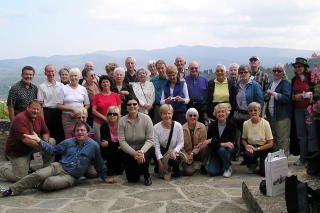
I walked through the Hotel’s entry arch and up the tree-lined promenade, a genial variation of the trail through the dark wood on Monte Maggiore. At the top, I enjoyed my last view of the towers of Siena in the waning light. Jan welcomed me with some bread and wine to break my fast. At our final meal together in the brightly lit dining room, I joined 35 Elderhostlers in toasting our caring hosts and bidding each other farewell.

Expatriates

Monday, October 24th, 2005

photo gallery

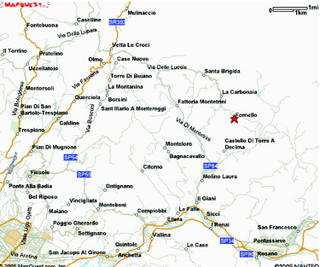
A member of our group asked Louise, our graceful guide in Cortona, whether she knew Frances Mayes, the author of Under the Tuscan Sun, the bestseller book and film story of an American woman who falls in love with Italy, buys an abandoned farmhouse and olive grove near that town and settles in for good. Louise answered, “Sort of¦that is I hear about her from my plumber. He also works for her.” Until Wednesday, the next to last day of the Elder Hostel program, this was as close as we’d come to a real local resident. So Jan and I were excited to use our only day off to accept our old friend Brenda’s repeated invitation to visit her and her partner Don at their country home at Fornello in the hills above Florence.

We knew Brenda in the late sixties when I was a probationary instructor and she and Jan were graduate students at Columbia University. The two of them were in the same Dante seminar, and we crossed paths as visitors to Florence the summer of 1969, our last time in Italy. One hot evening the three of us attended a concert in the courtyard of the Pitti Palace, and during intermission, Brenda struck up a conversation with a clarinet player in the orchestra, later married him, moved to Florence and has lived there ever since. The following year Jan and I emigrated to live at the end of the road in coastal British Columbia, where we remained for nine years. In the intervening time, we had heard a bit about Brenda through a mutual friend in California, and before this trip we reestablished contact by email.

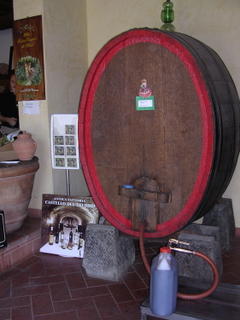
The train ride from Siena to Florence on the Eurostar was brief and cushy. There we boarded a local branch line which passed through the less glamorous districts of the city, full of grafitti, litter, and drab apartment blocks but brightened by ever-present backyard and trackside vegetable gardens. The flat suburbs soon gave way to hills, small towns and picturesque views of the Arno, which we followed upstream. Brenda greeted us at the station in Sieci, near where the river took a sharp turn and descended over a small waterfall. She drove us up a narrow, winding road into the foothills of the Appenines, a green rural landscape dotted with farmhouses, fortresses, churches and tiny villages. First stop was a crenellated stone castle on a narrow ridgetop, Castello del Trebbio, which served as the headquarters for a winery and agritourismo. Brenda got a cannister normally used for gasoline out of the trunk, greeted a demented looking feather-hatted old man in the parking lot, and took us into the building where she filled her plastic five-liter container from a hose connected to a huge barrel. “Don bottles it at home,” she told us, as she paid the proprietor what looked to be the cost of an equivalent amount of my home-town favorite, “Two-buck Chuck.”

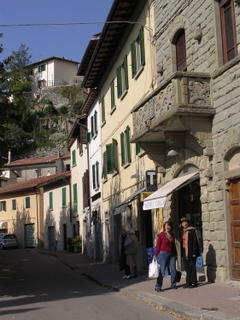
As we continued up the mountain, the views longer and more pristine, it was hard to believe that she could commute several times a week to teaching jobs in Florence and Bologna. Santa Brigida was just a few houses and a church hanging onto the mountainside along the roadway, and there we stopped in her little local market for bread, cheese, prosciutto and salad vegetables. It took a good twenty minutes before she and Jan emerged from what looked like a Romanesque stone balconied façade with some of the makings for lunch.

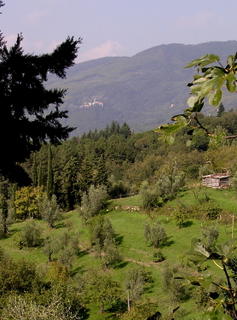
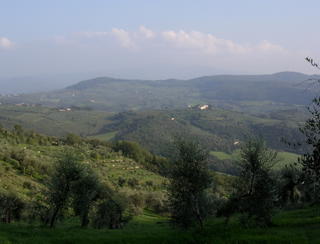
Another couple of miles, past a large villa that used to house the noble that owned all the land in this valley, and we turned up an impossibly steep driveway, passed an assemblage of plastic playground equipment belonging to the people who owned the main house, and stopped alongside a converted brick barn set on a terrace above a sloping olive orchard. This was the landscape described in Vergil’s Eclogues. It was a familiar two thousand year old dream: the subject of my doctoral dissertation on Renaissance pastoral.

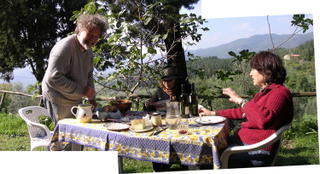
A transplanted Scotsman from near Edinburgh, Don came out from his study where he works as a translator from Italian to English”everything from marketing materials to fine books, one of which he showed me about the cultural history of the Vespa, and another a photo essay about the Tuscan landscape. He decanted some of the new wine into a pitcher, Brenda laid a colorful tablecloth over the plastic patio furniture, dressed up the antipasto and we sat down to begin a three hour midday meal. Don went into the kitchen and cooked up a fine pasta while the rest of us tried to reconstruct some colorful common experiences of the sixties . After lunch he returned to his work, and Brenda led us on a hike down the lane by a small country church, through a thick forest, past a sign about a newly discovered early medieval monastery, and out to an isolated house with a view of another great valley to the east that opened before us for the first time in the golden evening light

Yet here¦you might repose with me,
On green leaves pillowed: apples ripe have I,
Soft chestnuts, and of curdled milk enough.
And, see, the farm-roof chimneys smoke afar,
And from the hills the shadows lengthening fall! (Eclog 1)

Like it was for Vergil’s shepherds however, so this perfection was imperilled. As age creeps up, wages and pensions are frozen and the cost of living rises–especially gas for commuters and rents for possible recreational property now on the global real estate market. In the dark, on the way back down to the train station at Sieci, Brenda mentioned that they may soon be forced to move.

Utopia

Saturday, October 22nd, 2005

picture gallery

This is the word associated by our Elderhostel hosts, the Green Guide, travel websites, and real estate agents with the town of Pienza, which was on the itinerary for Tuesday October 11. In 1516, the English Humanist Sir Thomas More coined the term”stemming from eu-topia, “the good place” in Greek but also from ou-topia, or “no place””to name an ideal city state, but also to lightly mock the notion of such an ideal. Pienza was created by our local hero with the funny name, Pope Pius Piccollomini, an Italian Humanist crowned poet-laureate and later head of the Catholic Church. Like More, he tried unsuccessfully to bring peace and justice into a world more amenable to agression and greed. PPP dedicated some of his considerable resources to turning his sleepy home town into a showpiece of social engineering and architectural perfection with the help of a great Renaissance builder known as Rossellino.

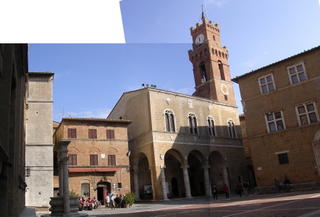
Like the other hilltowns we had visited, Pienza today is vehicle-free and immaculate. We left the bus in the car-park outside the wall and walked through floral window-box lined streets and discreetly signed shops offering specialties of the countryside into a small but indeed perfectly designed town square. It was all elegant and discreet high Renaissance style, which by now I was clearly differentiating from the cruder medieval and crasser Baroque forms. The city hall to the left, housing a tourist information center, was an airy miniature of Siena’s. Before us was the Duomo’s chaste but lucious travertine facade, backlit by the sun shining on the valley below. To the right stood an unostentatious but imposing structure recalling the Villa Antenori that had lured me in Florence. This was the Piccollomini Palace, through which we were conducted by a local guide whose Italian-accented English was even thicker and more savory than that of our native Elderhostel facilitators.

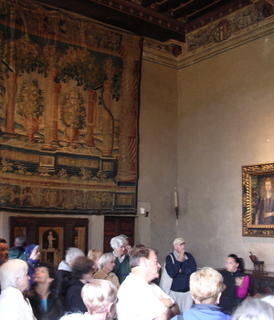
The place was inhabited by PPP’s descendants until 1968 and then maintained in the condition they left it”sparely furnished with centuries-old portraits and tapestries accentuating 20 foot ceilings, wall frescoes, and the light pouring in through large stained glass windows ornamented with the family coat of arms signifying either accommodation between the cross and the crescent or the triumph of the latter over the former. Also in evidence were 20th century photographs showcasing the blood connections between this family and the royal Italian house of Bourbon along with the heroic expoits of pilots in Mussolini’s air force. Out on the three story loggia we learned that the lovely though too misty view of the formal gardens and Val D’Orcia below was itself a UNESCO world heritage site.

Jan and I roamed slowly through the village, trading photo-ops with another couple under the street sign placed here to promote tourism in the nineteenth century, joining those window shopping for real estate, and buying Pinocchio puppets for our grandsons and some typical Tuscan ceramics I have faith were not produced in China.

After lunch the bus wound through the painterly countryside of La Crete and left us off in nearby Montalcino, home of the legendary Brunello, allegedly the crème de la crème of Italian wines. Seeking some exercise and adventure trekking through the steep streets of this larger town, we found ourselves suddenly marooned at the bottom of the hill, far from any restroom. The relief provided by facilities in the Enoteca we finally came upon eclipsed the pleasure of drinking a seven dollar glass of the house specialty.