St. Fratty’s Day

March 15th, 2020

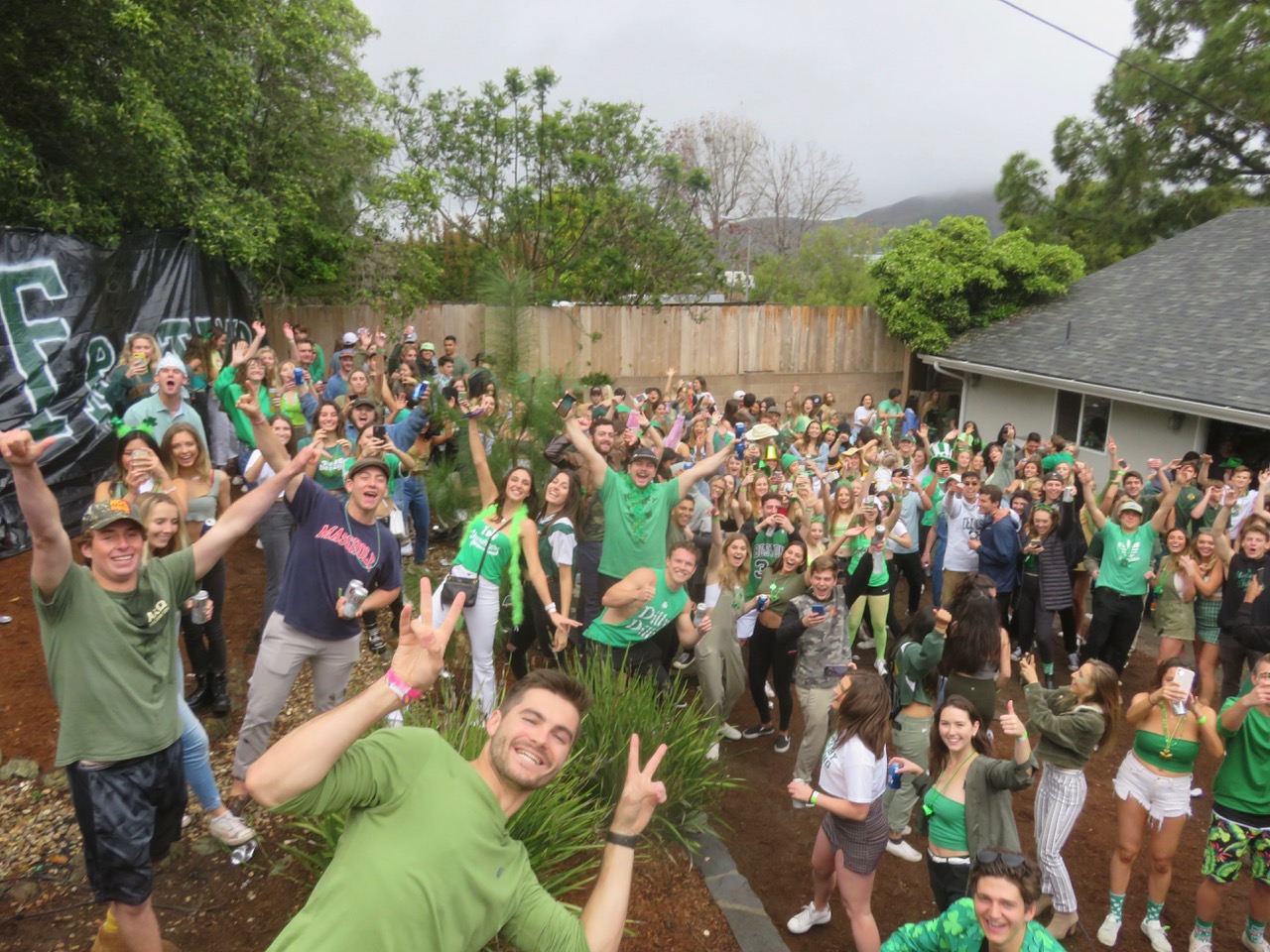
Our next door fraternity boy neighbors, who are careful not to have parties at night and are friendly and courteous, threw what in SLO is a traditional “St. Fratty’s Day” 8:00 AM bash the Saturday morning before St. Patricks Day.  They had told us of the plan the day before and neither of us were concerned, since we had planned a Saturday morning rendezvous for 6:30.  Once the festivities started I went up the hill in back and looked over the fence and gave a thumbs up, which produced this response:

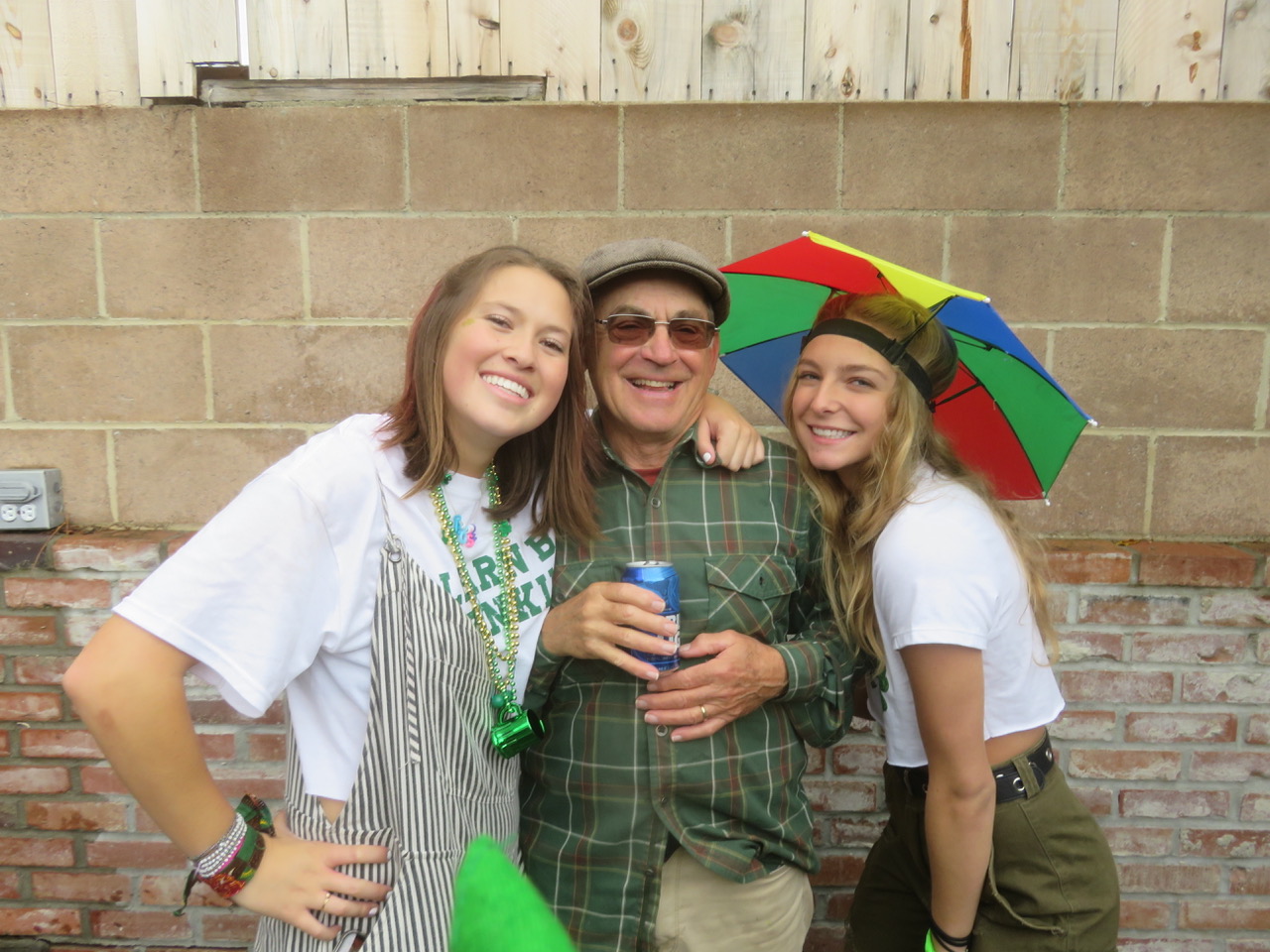
They urged me to join them, which I did, thinking I was being  discreet by elbow bumping instead of hand shaking.  Sky high on endorphins from the earlier activity, reinforced by avid attentions of the sorority girls, I did not resist many much closer contacts and couldnt help thinking if the end of the world was near, this was the way to go.

When I got back home Jan was not amused.  She’d been reading the morning’s news about the urgent necessity for “social distancing,” and told me immediately to take off all my clothes and put them in the washing machine and to shower thoroughly, soaping everywhere.  I did as she said, but still felt the glow of being a “celebrity””their word”among the neighbors, and so sent you the photos.  Fortunately I left it at that, though Jan put her picture from our yard up on Facebook.  But as the day went on and the news got steadily grimmer, she  got more and more pissed at me, and I felt stupider and guiltier, realizing that the party itself, and my succumbing to it was precisely what the Surgeon General and even the President now was cautioning against. We’ll only know in a couple of weeks whether that lapse will have led to serious   consequences.  But Jan did acknowledge this morning, that though she chose not to join me at the party, she didnt try to stop me going.

As of Friday all schools in the County are closed until April 15, and our burgeoning educational Farm programs are shut down.

Exchange with Richard Powers

February 28th, 2020

From: “Powers, Richard S” <[email protected]>

Subject: RE: ATTN: Richard Powers

Date: February 28, 2020 at 8:52:00 AM PST

To: “Steven R. Marx” <[email protected]>

Dear Steven Marx,

What pleasure it was to get your good and thoughtful letter.  Your words were very satisfying to hear, and I was delighted to hear of the connections between your personal journey and the journey I made while writing The Overstory.  It also moved me to learn of Eagle Waltz, whose productive response to a challenging situation would have made a wonderful addition to my fictional version of that challenge.  I look forward someday to hiking that trail he mapped and built.  Thanks for telling me about it, and for taking the time to write me with your generous words.

With gratitude,

Richard Powers

From: Steven R. Marx
Sent: Wednesday, February 26, 2020 3:31 PM
To: [email protected]; Powers, Richard S
Subject: ATTN: Richard Powers

Dear Richard Powers

I’ve been meaning to write to you since last September when I finished reading The Overstory.  I kept putting it off until now because I felt shy of requesting the attention of an author I so admired. The fact that the book affected me so deeply and personally was outweighed by reluctance to add to what must be a heavy load of fan mail from others in whom it’s created a need to share some of their stories.  But after all this time, and as I ready to tackle The Echo Maker, the resistance has crumbled.

I learned about The Overstory from Eagle Waltz, an old friend from back-to-the-land hippy days near the end of the road in Lund, British Columbia, where I moved from New York with my wife Jan in 1970, lived in the woods for nine years, and where we return annually with our children and grandchildren. Eagle was another exile at the time, from Germany, who was entranced by the wilderness and horrified, like all of of us, by the systematic destruction of old growth forests whose grave markers we lived among in the form of gargantuan springboard-nicked stumps.  Rather than merely learning to live with that grief, Eagle decided to try to save the few grand specimens still scattered through endless slash and second or third growth plantations by mapping and building a 150 mile-long hiking trail  connecting the old sages. He calculated that opening the back country to locals and eventually tourists would produce support for his lifelong efforts to negotiate with logging companies and the government to spare the last remnant, which it has done.

The book’s connection with Eagle and its portrayal of the pain of outsiders who moved to the woods and ended up in industrial logging zones created one bond.  But then there was Stanford/Palo Alto/East Palo Alto.  I had moved there first in 1963 to go graduate school in English in order to avoid the draft after being kicked out of the Peace Corps for being “too intellectual” and having “the wrong attitude toward authority.” Jan and I met at a poetry seminar In the Free University of Palo Alto, got into lots of trouble and fun as student activists, married in the backyard of a cottage we rented in EPA, moved to NYC  where I taught at Columbia for three years and then emigrated to Canada. Nine years later we returned to Palo Alto so I could complete the dissertation on pastoral ideals and the life cycle I’d started fourteen years earlier. My interest in trees was rekindled when, unable to secure decent academic employment, I became  a part-time arborist.  A couple of years later upon yet another return to Stanford as lecturer I also worked on the tree crew and wrote a piece for the Stanford Magazine about the combination. After four years, and having secured  a tenure track job at Cal Poly San Luis Obispo, I gave a  capstone talk for “Literature and  the  Arts in Western Culture” entitled “Everythihg’s Dead but the Tree.”

Its clear from descriptions of other books of yours I plan to read that trees are but one region of your exploration, and I look forward to discovering some of the others. But the striking intersections between the incidents, places and passions so compellingly narrrated in this novel and episodes in my life make me feel uniquely part of The Overstory.

Gratefully,

Steven Marx

Metta and Peta: Buddhist reflections on humans’ relations with other animals

September 16th, 2019

An address to the White Heron Sangha, September 15, 2019

A variety of encounters with non-human animals over the past year have opened new areas of experience for me and left me mulling some troubling questions. They’ve led to conversations with family members, friends and co-workers, to reflections on past experiences, to scientific research and to guidance from Buddhist authorities.

One area of experience is my relationship with our two year old family dog, Sophie. Another is a series of cardiovascular incidents which have motivated  me to refrain from eating animals for medical reasons. And another is my work at City Farm SLO, where the production of organic vegetables by small farmers and students is subject to the ravages of gophers and ground squirrels.

Sophie came into my life a year after the traumatic death of our previous family dog, a Yorkshire Terrier who had bonded closely with my wife Jan and our two live-in grandchildren but with whom my relationship was distant.  By the time that Jan acquired Sophie, we were empty nesters, and I was a goner.

1 sophie

Read the rest of this entry »

Lund Kid Revisionist History

July 19th, 2019

By Anna Gustafson

Zunoquad 2019: Kayaking Nuchatlitz Archepelago

July 1st, 2019

Note: for a full collection of photos and slide show, click here

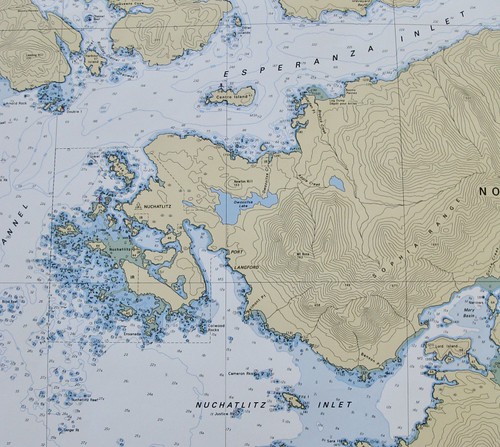
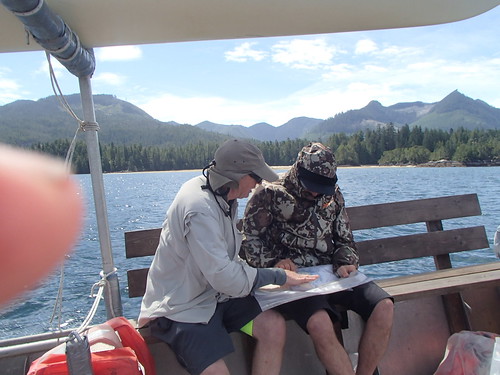
This expedition originated in early March with Bear and Lion (aka Peter Behr and Lionel Webb) tossing around the idea of west coast kayaking. It came into focus in April with the selection of Nuchatlitz location and gradual winnowing of participants to them, Bob Dice, Rick Backman, Andy Greenshaw and Steven Marx and their sons, Eman and Joe. Most are adventure travel companions for thirty years and we span the decades of age: twenties, forties, fifties, sixties and seventies. Bob took on the task of organizing kayak rentals and transport, regaled us with 50 pages of information about the area culled from a book by Heather Harbord, Sea Kayak Nootka and Kyuquot Sounds, along with extensive notes and Google Earth maps assembled by Paul Clements. They helped with preparation and enlivened fantasies for the next couple of months.

Ax304dmRR3C8iRP+sfrLOA_thumb_249a7

I meet Joe in the South Terminal on the Summer Solstice after flight and immigration delays that required rescheduling the trip to Campbell River, where we’re picked up by Bob, taken to Walmart for last minute food purchases and to his house for rendezvous with Peter and a comfortable sleepover before early morning departure. The three hour drive to Zeballos is enriched with Bob’s recollection of places and incidents along the gravel road he managed maintenance and construction for during a fifteen year career there with the BC Forest Service. At the tiny town at the end of the road and the head of Esperanza inlet we buy a case of cold beer and load our gear and two kayaks on the charter boat that takes us to our meeting point on Rosa Island with our four companions who arrived there the day before, travelling from Gold River on the MV UChuck.

2

5

9

Read the rest of this entry »

All Is True

May 27th, 2019

Last night I went to see All Is True, the new Kenneth Branagh movie written by Ben Elton.  I was motivated by curiosity more than expectation, wondering where the creator of the hilarious and erudite “Upstart Crow”  BBC sitcom series would go in revisiting the life and works of Shakespeare.

During the first fifteen minutes I found the somber lighting, lugubrious pace and bleak expressions of the familiar sprightly characters alienating, but at a certain point I got oriented to the genre and recognized Elton’s earlier constructions of Will, Anne, Judith and Hamnet presented behind tragic instead of comic masks.

By the scene of the encounter between Ian McKellen’s Southhampton and Branagh’s Shakespeare that concludes with the double recitation of sonnet 29, “When in Disgrace with Fortune and Men’s Eyes,” my tears flowed along with theirs. I was stirred by its enactment of a “marriage of true minds” for whom the approach to immortality brought human limitations into highest relief.

By the end of the film this seemed its central tone and idea, brought home by the titles that followed the happy ending insisted upon by the Ben Jonson character–titles stating that the three sons of Judith, who seemed to fulfill Will’s obsessive wish for a male heir, all died as children, and by the song from Cymbeline behind the final credits:

Fear no more the heat o’ the sun,
Nor the furious winter’s rages;
Thou thy worldly task hast done,
Home art gone, and ta’en thy wages:
Golden lads and girls all must,
As chimney-sweepers, come to dust.

Fear no more the frown o’ the great;
Thou art past the tyrant’s stroke;
Care no more to clothe and eat;
To thee the reed is as the oak:
The scepter, learning, physic, must
All follow this, and come to dust.
¦
Quiet consummation have;
And renownèd be thy grave!

As I left the theatre I felt that “All is True” achieved the aspiration uttered by its protagonist: with a patent fiction to express reality–in this case the notoriously elusive reality of the author’s personality. It did that by combining the few known facts with astute readings of his work to imagine the inner and outer life of his last silent years. In the words of Jonson’s tribute, it made “My Shakespeare rise!”

Albert Drive

March 24th, 2019

The mockingbird returned
on Spring’s first day
filling the silence
left by students
gone on break.
Its bebop warbles
replaced their hiphop grunts
with a memory of hope.

The Negative Space of Buddhism in Michael Pollan’s book, How to Change Your Mind: What the New Science of Psychedelics Teaches Us About Consciousness, Dying, Addiction, Depression, and Transcendence

August 27th, 2018

A talk to the White Heron Sangha, Sunday August 26, 2018

1.

One afternoon last May on my way home from working at City Farm San Luis Obispo, the car radio came on with my favorite program, Science Friday. I was surprised to hear the genial voice of Michael Pollan speaking with its host Ira Flaytow. Before I could could pick up the thread of the conversation, out popped the words psilocybin, LSD and mescaline. So that’s what he’s up to now, I thought.

Ever since I heard Pollan read The Omnivore’s Dilemma (2007) during a long drive to Canada ten years ago, he’s been one of my favorite writers and most informative teachers.  That book’s comprehensive reflections on the history, biology, economics, politics, and morality of America’s food system altered my tastes, motivated me to design a required general education course in argumentation at Cal Poly around its subject, and inspired me to spend a good part of my retired working life on our local urban farm. The broad impact of his work was demonstrated by a local incident that received national notoriety.  When Pollan was invited to give a public lecture here by Hunter Francis, the director of Poly’s center for sustainable agriculture, large agribusiness funders pressured the university administration to deny him an opportunity to speak unless he was part of a panel that included a professor of Beef Science from Kansas.

That book and two later short ones”In Defense of Food and Food Rules”mainstreamed attitudes about industrial agriculture, factory farming of animals, and healthy eating that had been elements of the counterculture of the sixties. As effective manifestos for change, they contributed to the revival of organic and local food movements. It struck me as fitting that he was now addressing another suppressed strain of that culture of my youth.

The conversation I tuned into was promoting a new book by Pollan called How to Change Your Mind: What the New Science of Psychedelics Teaches Us About Consciousness, Dying, Addiction, Depression, and Transcendence. Flaytow was dwelling on the opening theme of the subtitle”the New Science of Psychedelics.  What turned me on, however, was its coupling of Science with Consciousness and Transcendance incorporated into a “how-to” book promising doubled satisfaction, with a pun on “change your mind.” Read the rest of this entry »

Verandah

July 2nd, 2018

Yesterday’s elegy dispatched me
on a search for “waggle dance.”
By URL I found it out on YouTube:
the manic moves of worker bees
that vector angle and distance
of nectar to their sisters.
On the drive home last night from sangha,
a podcast announced that science now
can eavesdrop on those numbers.
Coincidences abound
in reunion’s aftermath.
The hive is a web.
The end of the road
Leads back to corners.

The Better End? Euthanasia and Buddhist Values

February 4th, 2018

A talk to the White Heron Sangha
February 3 2018

As a child, I grew up in a small family consisting of my mother, Lise, my father, Henry, and my grandmother, Elise, all refugees from Hitler’s Germany who arrived in New York in 1938. Elise and I adored one another all through my childhood and youth. Though she spoke little English, she was vibrant and irreverent and eloquent in expression and gesture.  She was also adored by the customers for whom she worked as a seamstress and to whose homes all over the City she travelled by subway until well into her eighties.

After my first year in graduate school in California, I returned to New York for the summer of 1964, spent nights in Greenwich Village with a friend and days in upper Manhattan studying for my Latin qualifying exams at Elise’s small apartment. She’d make me sumptuous hot lunches and watch admiringly as I practiced my conjugations.

A couple of months after I returned to California my parents wrote me that Elise had suffered a massive stroke that paralyzed her left side and left her unable to walk or speak. They had no choice but to place her in a nursing home and expected it would be over soon. But by the time I came back for a visit at Christmas, it wasn’t. Read the rest of this entry »