The Sunset Limited (4)

January 5th, 2014

Friday December 27, 2013

Though optimally located in the center of the French quarter, Jan and I are uncertain of what we should do for the day. Roaming its tourist-crammed streets yet another time is getting old.  We think of taking one of the carriage tours recommended by friends but are put off by the drivers and prices. Instead we sign up for a two-hour full city bus tour beginning at 2:00 p.m.

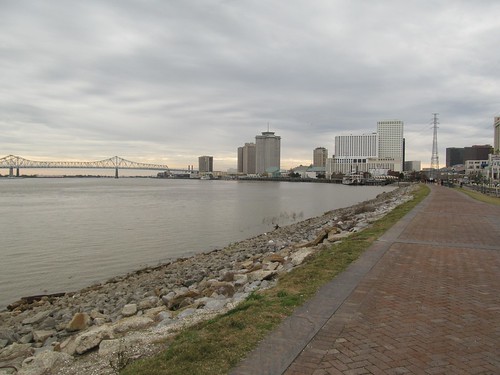
To make use of the time before then without extensive walking, we take the streetcar along the levee to the river ferry terminal. Probably due to its major diversion by dams upriver, the Mississippi isn’t as impressive here as we’d expected.
IMG_7794.JPG

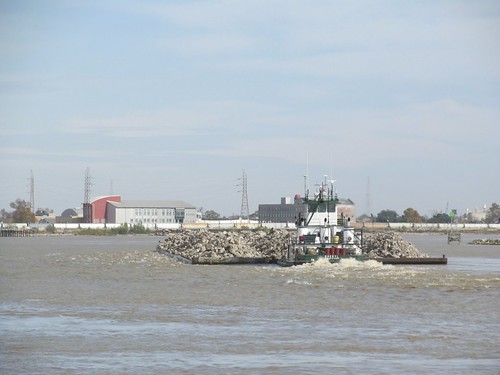
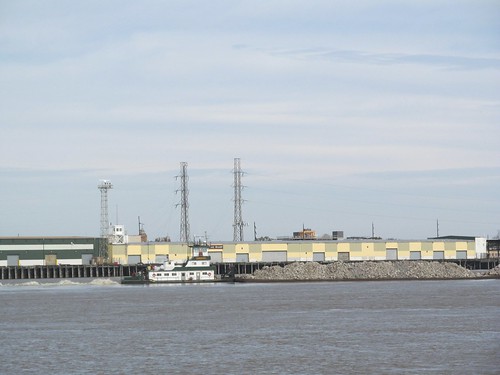
But on the ride across, the sight of a tug maneuvering a huge barge through the current at the crescent curve which accounts for the City’s original location gives a sense of being at the drain point of a whole continent.
IMG_7872.jpg

IMG_7876.jpg

Following a suggestion in The Unfathomable City, we pick historic Mandina’s Restaurant as a destination for lunch. It’s another gratifying streetcar ride to an outlying district, partly through a vast construction site of new medical facilities. The restaurant is located in a charming old frame house and packed with animated locals, but the supposedly distinctive Italian-Creole food is not worth the cost or the long wait.

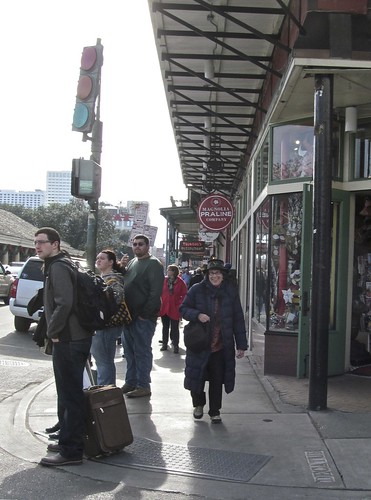
The streetcar back is delayed by traffic jams and we are concerned that we will miss our tour.  I run ahead to reach the meeting point just in the nick of time, and the dispatcher tells me the bus is late but will wait for Jan.  I’m relieved to see her shouldering her way through the crowd before it arrives, but then it turns out to be an hour late.
IMG_7883.jpg

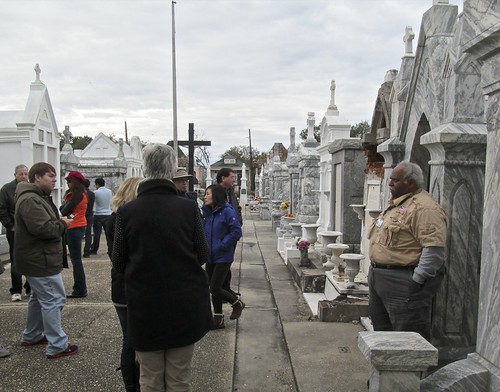
Sipping Vodka daiquiris from the adjoining dispensary relieves our impatience, but most of the other waiting passengers ask for their money back and leave. The apologetic young man who finally shows up explains that the delay was caused by unexpected traffic congestion and the dispatcher’s mistakes.  He offers little information about the city sights we pass, but stirring stories about his family’s escape from the flooding and his sister’s permanent mental derangement resulting from it. Only when he stops behind another tour bus outside a cemetery in the Ninth Ward do we learn that he’s just a driver delivering us to the guide and the rest of the group.

By this time the confusion of the delays combined with the effects of the daiquiri have rendered us receptive to whatever happens next.  The real guide, whose name I regret not learning,  is a round, white-haired gentleman with a sonorous voice and a preacherly eloquence.
IMG_7884.jpg

He regales us with the some of the peculiarities of NOLA’s necropolis culture, among them that bodies cannot be buried but are housed in weighted above-ground tombs to accommodate flooding  and that crypts are continually recycled because the summer heat quickly decomposes earlier remains.

Sinking into the driver’s seat as if it were a bathtub, he drives us through the adjoining neighborhood, pointing out the modest homes of legendary musicians like Fats Domino and the Marsalis brothers, all of whom he knows personally, and tells us that the government was interested in reconstructing this district after the failure of the ship canal dykes because its artists form an important part of the economy. He assures us that contrary to earlier occasions when dykes around low-income areas were deliberately breached to protect the precincts of the wealthy, the worst destruction of Katrina was caused merely by the negligence of the Army Corps of Engineers.

The onset of dark and the heavily tinted windows of the bus make it impossible to see or photograph the features of the city through which he drives us for the next two hours.  But he’s a good enough story teller to keep the tour group engaged and laughing.

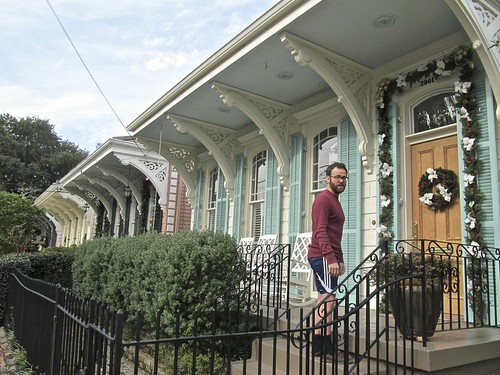
Many of the district’s modest houses have been refurbished by Habitat for Humanity and lifted three feet off the ground on cinder block piers.  Some remain dilapidated and some lots are cleared while owners wait for property values to rise. Many are only about ten feet wide.  At first I think they were former slave quarters, but then see that they extend far toward the back of the lot.  Called Creole Cottages or Shotgun houses, we learn they were designed like this before the advent of fans or air conditioning to promote cross ventilation in the unbearable summer heat.

We hear of the  development of the different faubourgs or neighborhoods by ingenious and often scandalous land developers over two centuries, the division of the city into downriver Creole and upriver “American” districts, the unceasing corruption of city politicians, many of whom go directly from office to jail, about universities and private schools and mardi-gras parade routes and the demolition of sections of the French Quarter replaced by disastrous city housing projects, of the outrageous number of annual murders, of the benefits and losses of gentrification since Katrina, and about the architectural styles  and residents’ private lives of countless houses.

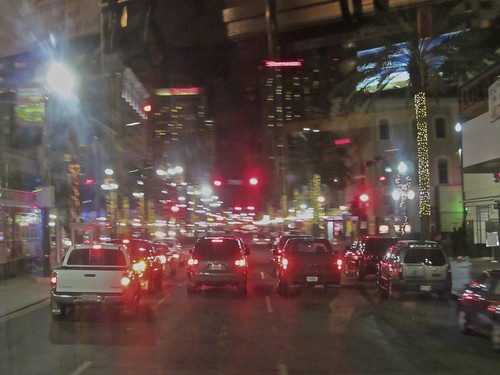
We’re dropped off in another traffic jam a block from our hotel, the city now packed with  New Year’s eve visitors arriving as we prepare to leave.  Thrashed by our colds, we retreat to our hotel, again forgoing the chance to taste the nightlife and the music, but inspired enough by the surroundings to seek more alcoholic relief. A big bouncer at a strip joint on Bourbon Street informs me that the best place to buy a bottle is the CVS around the corner. Hurrying back to our room with my paper bag through the earsplitting noise of revelers, I feel as excited as any of them.

The Sunset Limited (5)

For more and full-size pictures, click here
 

The Sunset Limited (3)

January 5th, 2014

Thursday December 26

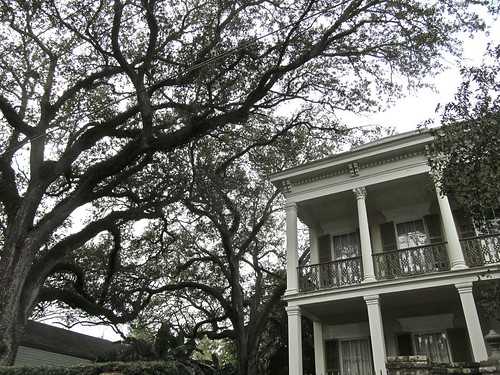
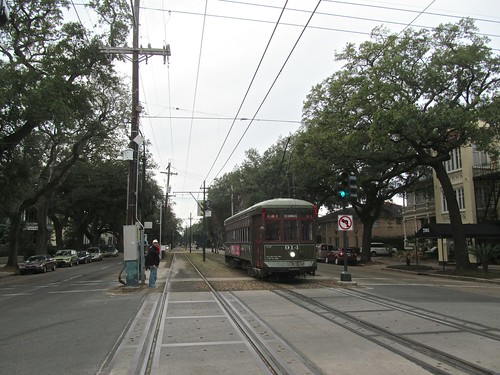
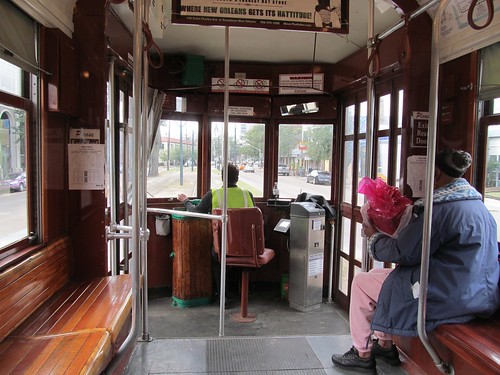
Drawn by the promise of beautiful buildings and streets uncrowded with tourists, this morning we head for the Garden District, a section of the City in the opposite direction from the French Quarter, upriver and “Uptown.”  The St. Charles St. streetcar takes us there along the wide tree-lined median traditionally known as “neutral ground.” Its varnished wooden seats and thick painted steering handle bring me back to the noisy trolleys I loved to ride on Broadway and Dyckman Street in New York before we got a car and moved to the suburbs in 1950.

IMG_7812.JPG

IMG_7804.JPG

IMG_7805.JPG

Relying on the information available on our phones instead of getting an adequate guidebook to the City was a mistake, but we know enough to find the cross street leading to a breakfast place kitty-corner from the the centrally located Lafitte Cemetery.

IMG_7813.JPG

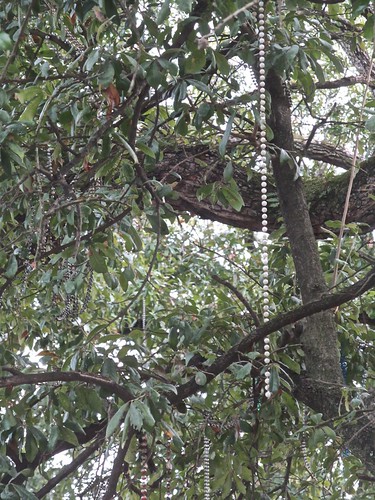
The trees along the boulevard are festooned with beads and we realize that this must be a  main  parade route of the Mardi Gras whose influence remains here all year long.

IMG_7814.jpg

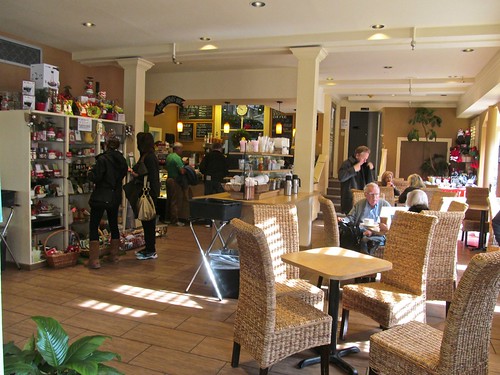
Though Gustave had referred to it contemptuously as a mini-mall, the coffee shop here is warm, welcoming and full of cosmopolitan looking residents.

IMG_7817.JPG

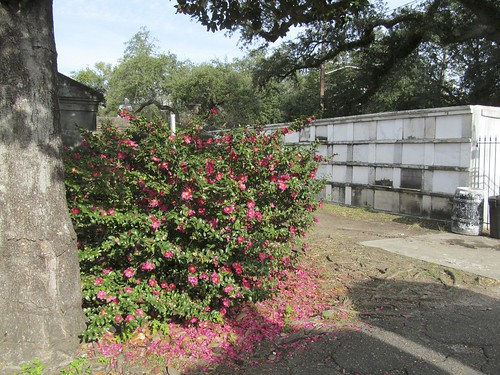
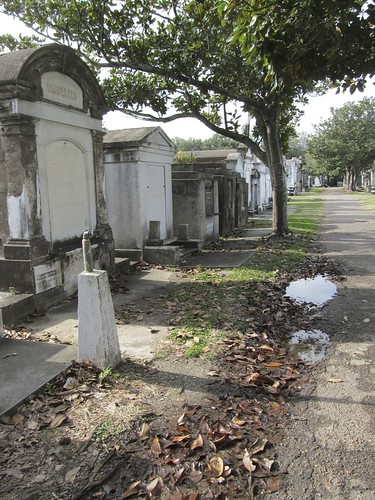
Fortified by a bagel and cup of the local café au lait, whose flavor is strengthened by the addition of chicory, we explore the cemetery, which features multigenerational crypts and stacked stone graves.

IMG_7820.jpg

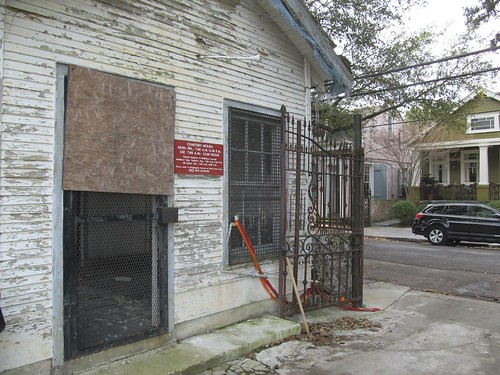
The puddles in the walkways demonstrate why bodies are not buried in this city and the need for a specialized technology to keep them where they’ve been placed.  The remnants of a shredded blue tarp and a dilapidated entry building show that even in this ritzy part of town, Katrina still leaves traces.

IMG_7821.jpg

IMG_7825.jpg

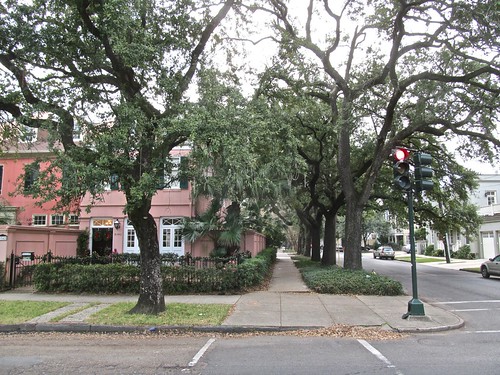
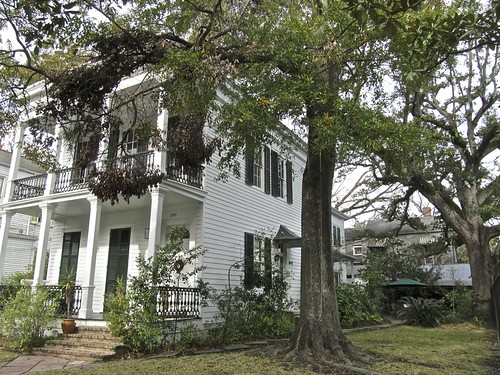
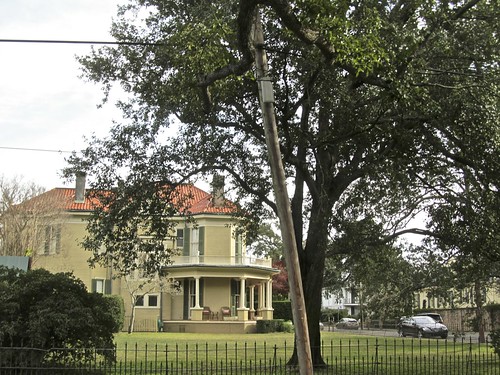
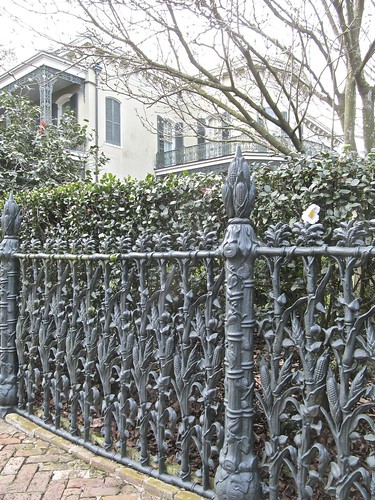
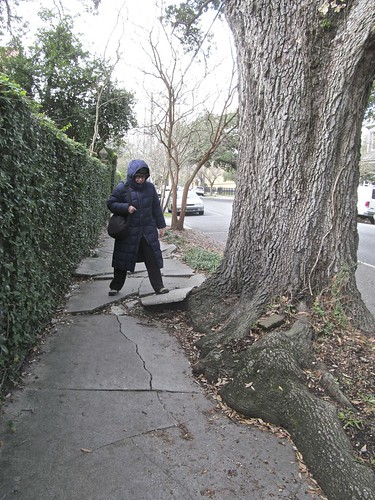
Now we walk along streets tunneling through the oak canopy of this real urban forest admiring the elegant and varied architecture and marvelling at the challenge of upkeep of both plants and structures in this corrosive tropical climate.

IMG_7829.jpg

IMG_7828.jpg


IMG_7832.jpg

IMG_7840.jpg

IMG_7839.jpg

At a corner of more modest houses, an amiable man sweeping the steps talks to us  about the joys of living here, the regeneration of many sections of the City after Katrina, the satisfaction of gutting and refurbishing his young family’s home.

IMG_7833.jpg

Needing a rest we head back to the minimall, where we find a bookstore next to the coffee shop offering a selection of works about New Orleans.  Rather than a conventional guide, I find a recent volume called The Unfathomable City, by Rebecca Solnit, whose name I recognize as a powerful writer for Orion magazine. Billed as an atlas, the book consists of 22 beautifully designed and annotated maps accompanied by essays categorizable as cultural geography or place studies.  Each has its own stylistic flair and dissident political slant. This book could provide an initiation to many of the City’s mysteries hidden from us three-day visitors. Exploring it during our rest periods and on the train ride back home feels like extending our stay.

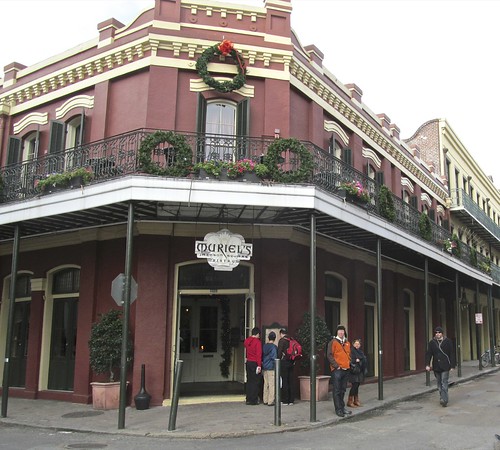
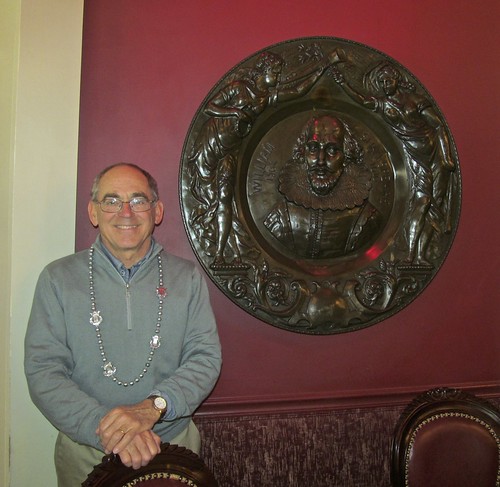
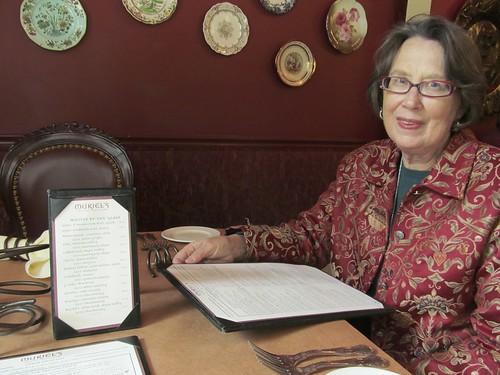
Back on St. Charles Street, while waiting for the trolley, I snatch a little Mardi Gras by climbing  a tree and grabbing some beads. We check out of La Pavillon and move into Le Mazarin hotel, located in the middle of the French Quarter. It’s comfortable but expensive and disappointing by comparison.  We walk a new route to Jackson Square and find a table for late lunch at Muriel’s, whose setting, décor, service and distinctive Creole cuisine live up to its reputation.

IMG_7862.jpg

IMG_7861.jpg

IMG_7855.jpg

After a late siesta, Jan remains in the hotel and reads while I take another trolley up and down Canal Street, too late for the ferry but not for encountering some loud and scary characters in the terminal. More wandering fails to discover any of the music venues I’d been hoping to come across.

IMG_7866.jpg

Instead I’m repulsed by the huge complex of Harrah’s Casino at the foot of Canal street, its valet-parking drop-off crowded with Cadillacs and fancy pickup trucks, evidence, I assume,  of Las Vegas colonization.

For more and full-size pictures, click here
The Sunset Limited (2)

January 5th, 2014

December 25

It’s Christmas morning.  There’s coffee in the lobby, and we’re up earlier than most in this night-living town. The very friendly concierge, Gustave von ¦ claims parentage of German Royalty but offers erroneous geographic information about the location of his castle.

IMG_7852.jpg

He advises us that Daisy Duke’s is the only place to get breakfast at this hour. It’s a jolly spot near the hotel at the edge of the French Quarter, more Georgia than Louisiana, but the fine-featured copper-colored waitress appears like the essence of Creole.

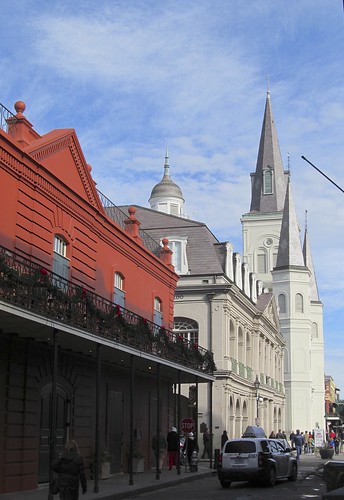
Jan suggests we go to the Cathedral for Christmas mass being celebrated by the Archbishop.  The narrow  freshly washed streets of the Quarter are almost empty, allowing unimpeded views of its preserved and restored architecture.

IMG_7781.jpg

IMG_7782.jpg

The shop windows on Chartres street display beautiful craftwork and antiques reminiscent of Venice or Kyoto. Almost every building sports a plaque indicating its age and provenance.

IMG_7783.jpg

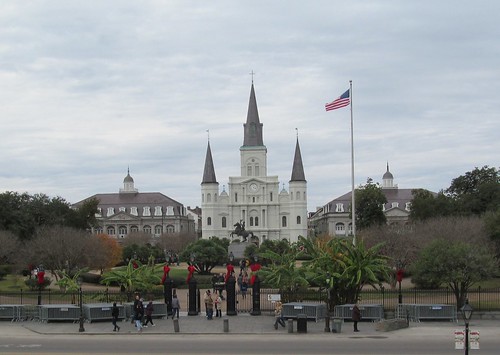
As the Cathedral towers rise above us, we’re joined by converging flows of people heading for the 11 o clock service.

IMG_7786.jpg

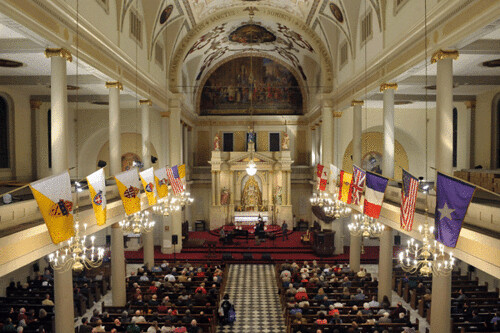
The light and spacious interior is full by the time an elegant alto leads the parishioners in an opening hymn.  This is followed by a sequence of familiar carols belted out by a chorus and orchestra highlighting timpani and brass hidden in the balcony. Readings from the Bible are familiar and the sermon is amiable, though it seems peculiar to see the altar area crowded with grandly robed men and no women.

cathedral.gif
[picture source
]

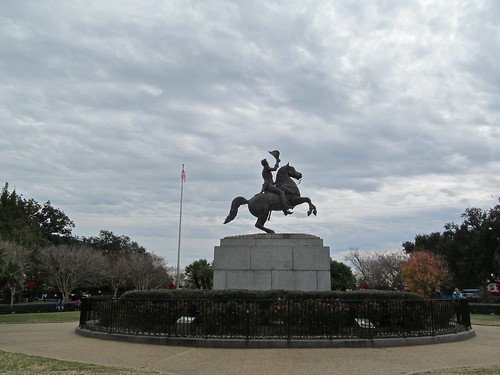
After the service we wander with other visitors through Jackson Square dominated by an equestrian statue of the hero of the Battle of New Orleans and surrounded by eighteenth century balconied buildings.

IMG_7790.JPG

IMG_7792.JPG

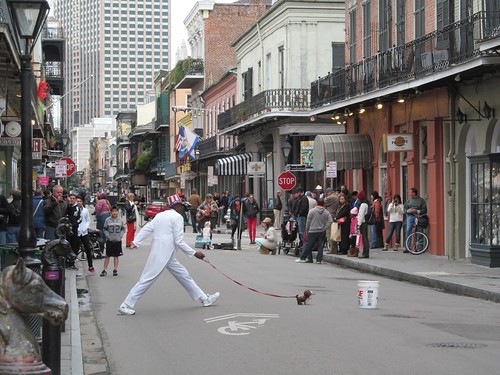
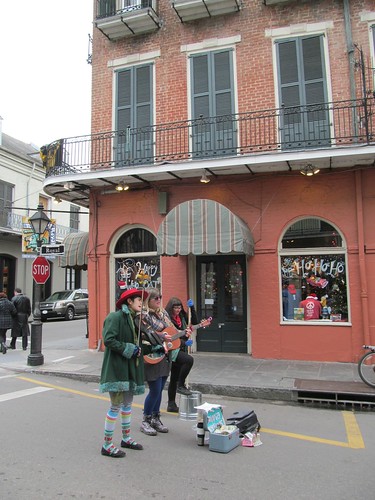
Not finding an appealing place for Christmas dinner and longing for a rest, we head back to the hotel along a street enlivened by buskers and a mime.

IMG_7800.JPG

IMG_7802.jpg

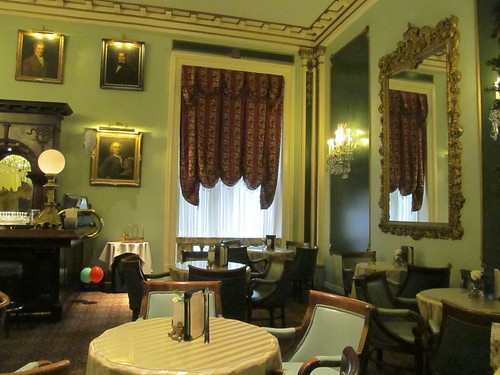
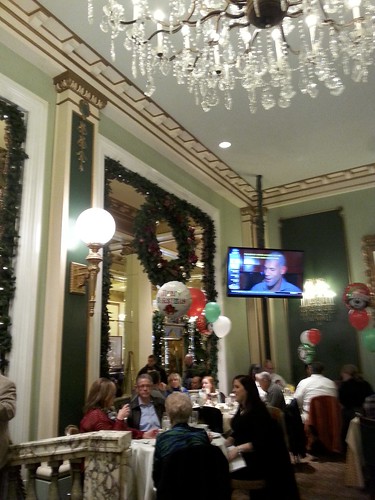
Last evening we saw a sign advertising brunch in the glittering hotel restaurant for twenty dollars, a good alternative to searching for reservations in the French Quarter.  At 2:30 the place echoes with the talk of well-dressed multiracial families and the singing of an elderly cocktail pianist.  We’re seated at a table in the bar, but free to help ourselves to anything we want from the splendid buffet.

IMG_7850.jpg

Jan enjoys myriad dishes prepared with local shellfish, to which I’m allergic, but the duck in blueberry sauce, the fresh sliced prime rib, the nova scotia lox and the array of rich deserts leave me satisfied.  Though we dont engage anyone else in conversation, we still feel part of the select crowd letting the good times roll.

20131225_140627.jpg

Not until we’re brought the tab are we aware that this special holiday meal has cost us $75 each. But we agree it was worth it.

For more and full-size pictures, click here

The Sunset Limited (1)

January 5th, 2014

IMG_8044.jpg

In early November, as soon as we learned that circumstances beyond our control would provide childcare between Xmas and New Year’s for the twelve-year old grandson in our custody, we gleefully deliberated about where to go.  The choice was narrowed by Jan’s still limited mobility after her recent knee replacement surgery and by her growing aversion to the cold. Going abroad was too ambitious for me, and I was drawn by the prospect of  a long train trip to the South. New Orleans was praised by several people we knew, and I’ve wanted to return to Tucson with Jan ever since seeing an old college friend there five years ago. We decided to reserve hotel rooms for the six nights out of ten we’d be off the train, and after discovering how much lower prices were outside California, we selected the most appealing rather than the cheapest accommodations in the two cities.

December 22

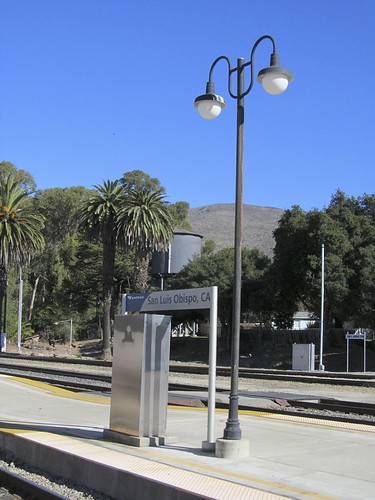
Our journey begins with the 2pm departure of the Pacific Surfliner originating at the quaint San Luis Obispo Amtrak station, whose newly restored historic facilities draw railroad aficionados from far and wide, and where long-term parking is free.

IMG_7732.jpg

IMG_7723.jpg

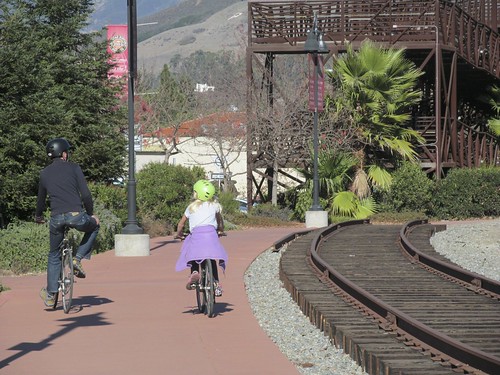
We stow our suitcases and climb the staircase to the second story of the huge coach, and imperceptibly it eases into motion.  It slides alongside the railroad safety bicycle trail that forms the route connecting our daughter and grandson’s house with ours. I relish the organ music of the muted horn at the Orcutt Road crossing, where normally I wait impatiently in the car for the train to pass.

IMG_7736.jpg

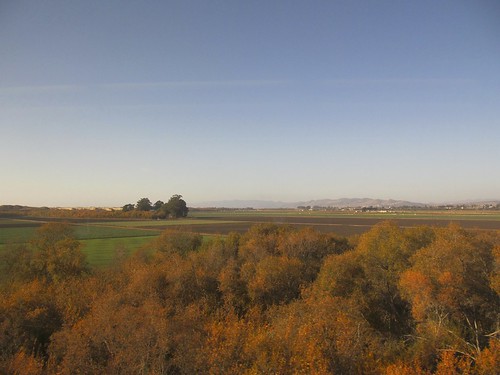
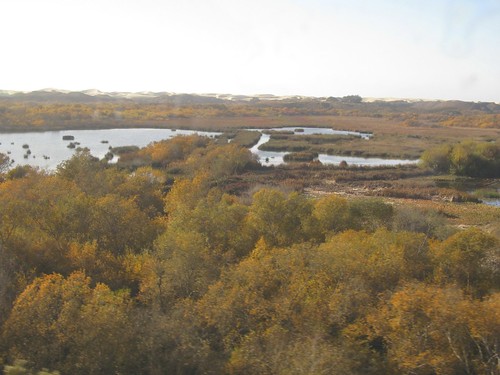
We roll through vistas available only to rail passengers: the Edna Valley Vineyards, the oilfields of Price Canyon, the seaside crop fields in the Arroyo Grande Creek Delta, the private hunting preserves of the freshwater lakes in the Nipomo-Guadalupe Dunes and the endless coastal scrub and missle launches of Vandenberg Air Force Base.

IMG_7738.jpg

IMG_7741.jpg

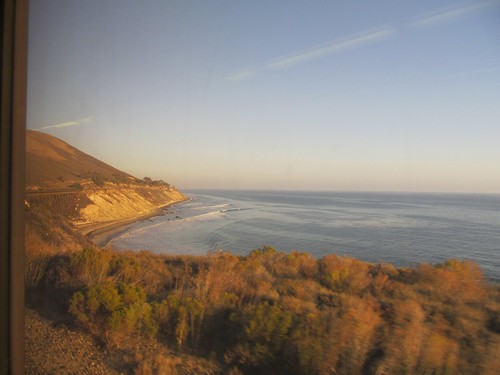
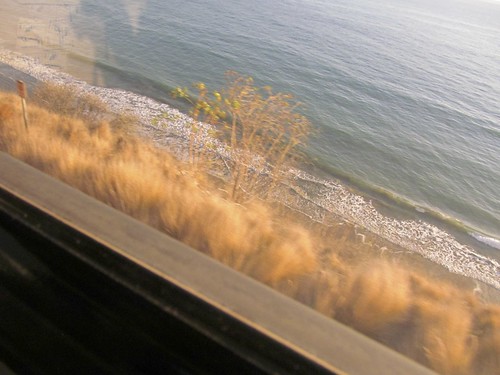
Turning the corner from southerly to easterly travel at Point Conception, we pass people and birds enjoying the sunset at secluded beaches while our juggernaut races along, often mere inches from the edge of the sand cliffs.

IMG_7747.jpg

IMG_7755.jpg

As the light drains from the horizon I’m hypnotized by the sensation of the train’s movement synchronized with the fixed line of the breaking surf.

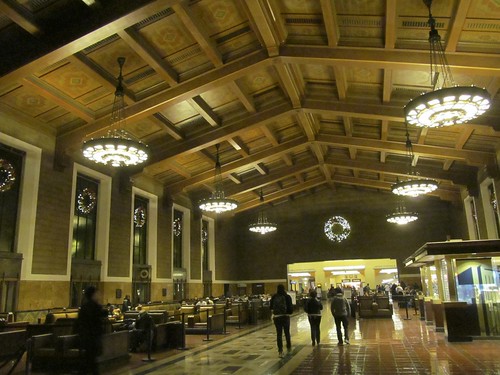
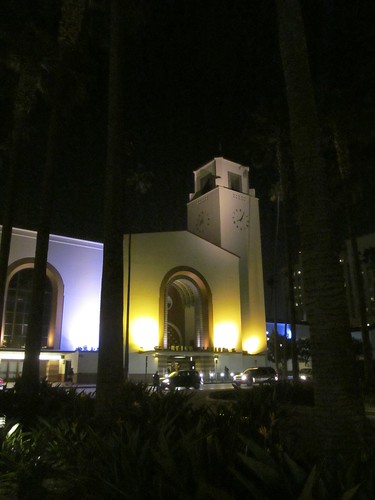
At 5:30 we arrive on schedule at the platform of L.A.’s Union Station and pull our wheeled suitcases alongside the behemoths rolling in and out of the adjoining quays. An underground passage opens into the central waiting room buzzing with excited travelers–an immaculately restored art deco cathedral rather than the squalid homeless encampment that was feared.

IMG_7774.jpg

IMG_7773.jpg

Our sleeper car reservations entitle us to leave our baggage with a welcoming attendant in the Metropolitan Lounge while we wander across the plaza to Olveira Street where the holidays are being celebrated in front of the old Mexican church with a costumed parade.

IMG_7769.jpg

We score a quick spicy dinner served by an ancient abuelita.

Back at the Lounge we’re ferried to the sold-out eastbound train by red caps on carts.  Marjorie, the car attendant, informs us that due to an error, we’ve been upgraded from a roomette to a full bedroom with ensuite toilet, sink and shower. Pumped with the excitement of a 9 p.m. departure, we plug in to power up our various devices, push back the seats and climb into our upper and lower berths to read novels and eventually be rocked to sleep swaying through the dark at 100 miles per hour.

I forgot to mention the head cold that gripped Jan the day before we left is getting worse and now I have it too.  It seems to be held at bay with Mucinex, Ipubprofen and Naproxen, but I’m resigned to the familiar syndrome of adventure under duress.

Monday December 23

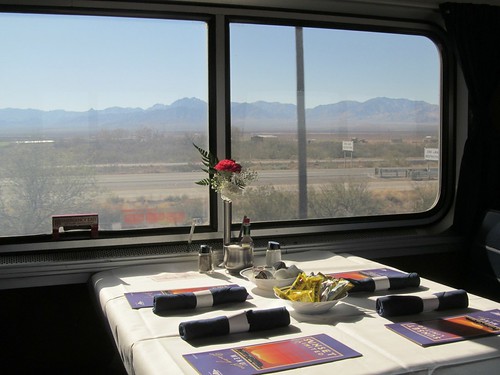
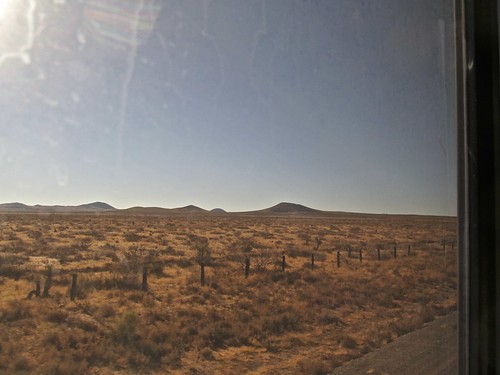
It’s light when we wake up and the Google map on my iphone”never used for travel before, but immediately indispensable”informs me that we are in the desert between Phoenix and Tucson.  As the Joshua trees and mesas whiz by the dining car, we eat breakfast at a table with two college girls  on their way to the Galapagos with family, happy to accept their old Grandpa as patron and guide.

IMG_7798.jpg

At lunch we sit with a large single man on his way to Chicago for a conference of government health care consultants.  His job is to figure out how Obamacare can be extended to indigents for whom it makes no provision.

IMG_7785.jpg

Crossing the desert is a good occasion to read a lengthy new book entitled The Bible in Shakespeare that I was invited to review by Renaissance Quarterly.  It’s billed by the author as the first “full length critical study” of the subject, implicitly dismissing my book, Shakespeare and the Bible, also published by Oxford University Press thirteen years ago. The book is well written and exhibits a vast knowledge of 16th century religious culture that I could never approach.  But its scope seems disappointingly limited to tracing thousands of  allusions without venturing into interpretations that could aid understanding and production of Shakespeare’s plays.  I find little in it about how Shakespeare responded to some of the Bible’s distinctive larger literary features, especially the framing of a narrative whose main character is also its author.

IMG_7804.jpg

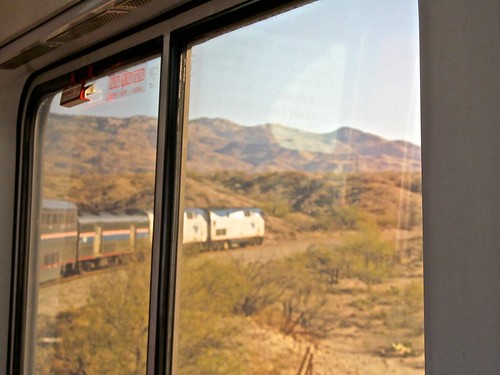
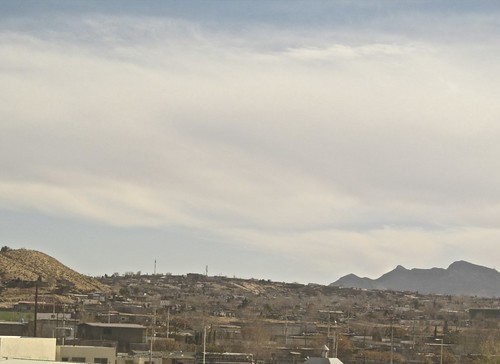
A hundred fifty pages or so into the desert, I glance up from the book and find myself face to face with a dense array of shacks tucked into some barren hills fronting the railroad tracks.

IMG_7902.jpg

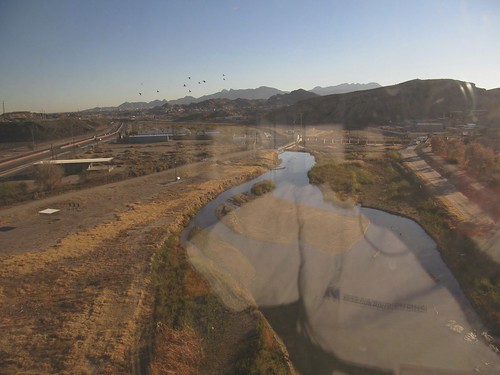
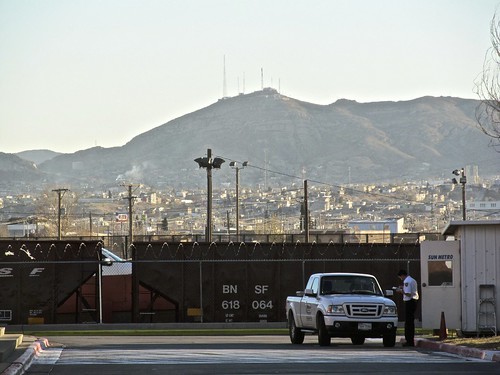
I’ve never seen a cityscape like this in the USA, but I flash on the communities of homemade houses we visited a year ago in Peru.  This must be Mexico. As the favela disappears behind a curve in the tracks, I see a white pickup labeled Border Patrol, and around the next curve, a parched river. It must be the Rio Grande.

IMG_7706.jpg

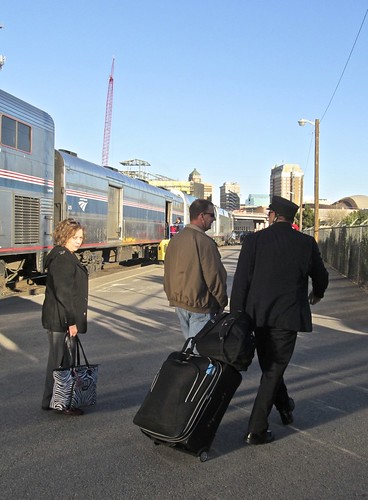
The train pulls slowly into El Paso, a modern American metropolis on the left bank of the River, then lurches and stops.  A few minutes later on the platform, I hear the conductor with a Latino accent telling another passenger that two homeless men with dogs”Americans–crossed the track right in front of the train.  They also talk of how Juarez, the city on the Mexican side of the river, has experienced 70 murders in the last month, 1200 in the last year, and those are only the ones reported.

IMG_7713.jpg

IMG_7718.jpg

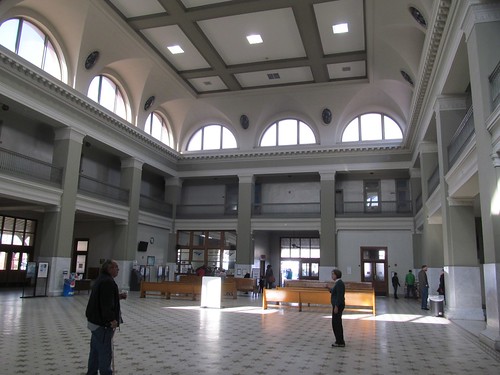
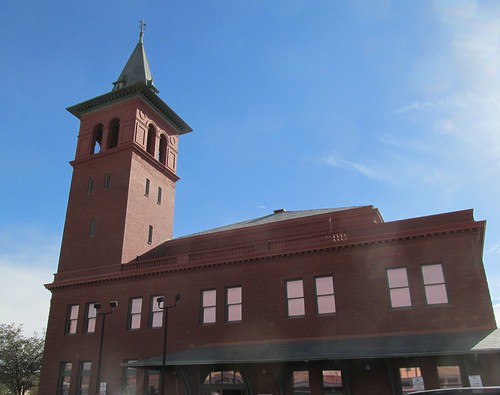
Though sadly empty on the inside, the El Paso Amtrak station is a beautifully restored early 20th century monument.

IMG_7897.JPG

IMG_7899.JPG

I imagine someday traveling around the country  to enjoy the classic routes, trains and stations.

We share dinner with a couple traveling to Pittsburgh to see one of their daughters”he a Pentecostal preacher, banker and bank janitor.  He’s had assignments in different parts of the country every three years.

Both of our colds are worse, but we’re helped to sleep the second night on the train by Benedryl and a little bit of Scotch.

Tuesday December 24

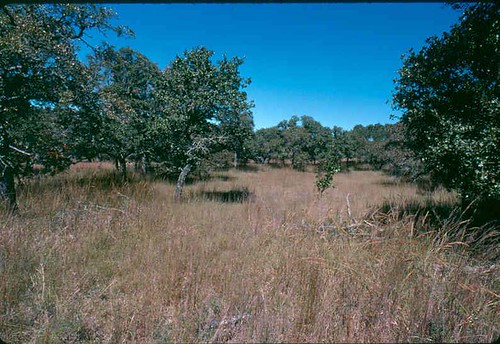
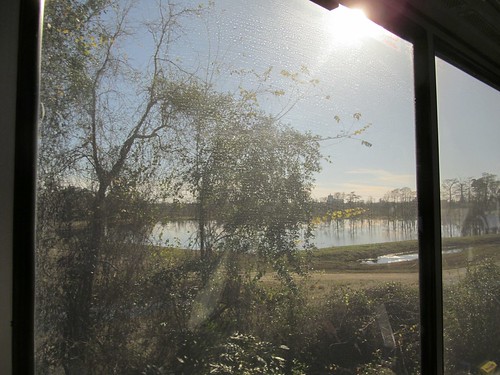
I’m awake for Christmas Eve sunrise above middle Texas. The desert has given way to oak savannah, an inviting landscape of rolling hills, grassland and sculpted trees.  Coming from the driest year in San Luis Obispo’s history, I envy its green fertility.

texasoaksavannah.jpg

We have breakfast in the dining car with Katharine, a young writer of blogs for law offices. Her enthusiastic manner, pattern of speech and build remind us of our recently departed friend Patricia.  Katharine moved to New Orleans (NOLA) with her husband for the music and loves it there, part of the new generation’s influx since Katrina.  She writes us a list of restaurants we must try.

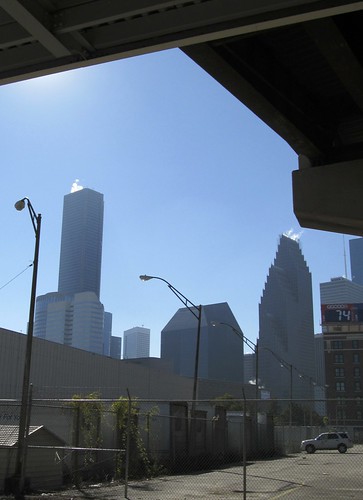
In Houston, I get off  and walk the platform, since the train station in this proud and prosperous city is little more than a shack.

IMG_7737.jpg

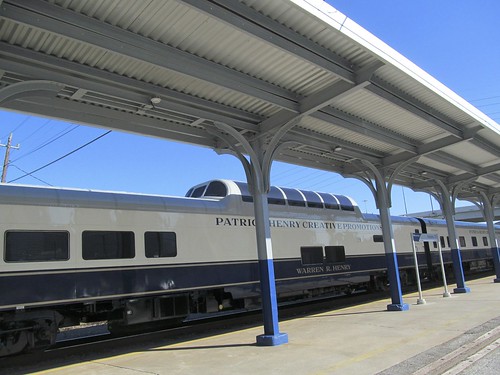
Attached to our rear end, I find two private cars used for corporate parties that we’ve been towing since El Paso.

IMG_7740.jpg

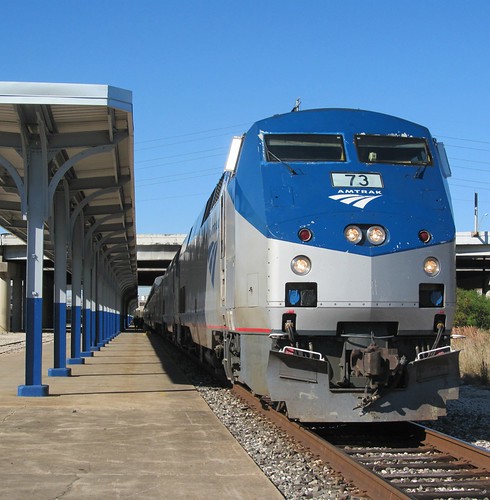
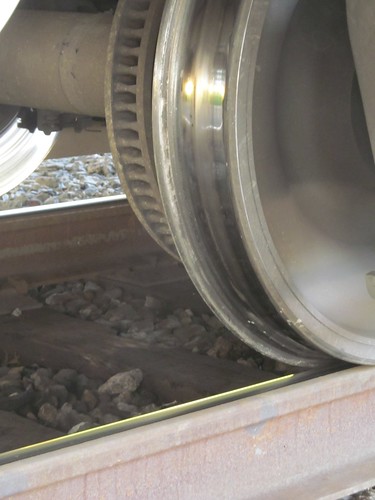
At the front, I admire the massive engine and wheels.

IMG_7742.JPG

IMG_7744.jpg

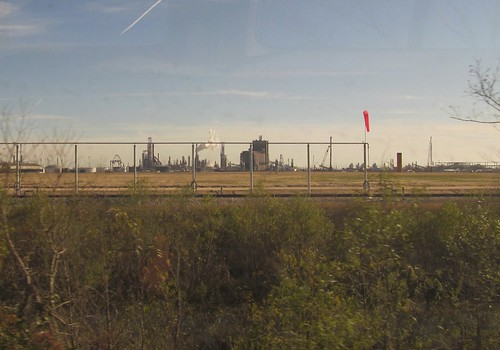
Houston is not far from the Gulf Coast, and after departure we cruise through bayou and rice fields alternating with scary chemical plant complexes.

IMG_7749.jpg

IMG_7745.jpg

At lunch with a single mother and her irrepressible seven-year old daughter, we are told cryptically that the refugees from New Orleans displaced by Katrina now in Houston have created a painful situation that no one wants to discuss..

After Merry Christmas wishes by phone from both our children, I feel a little displaced myself on this night, away from them and approaching a strange city in the dark. I use my miraculous new portable speaker to fill our compartment with the music of Bach’s Christmas Oratorio stored on my laptop, and the touch of forlornness disappears.

The lights of New Orleans appear in the distance during our traverse of the 25 mile Huey P. Long elevated viaduct.  Crossing the Mississippi, we’re greeted by fireworks.

IMG_7767.jpg

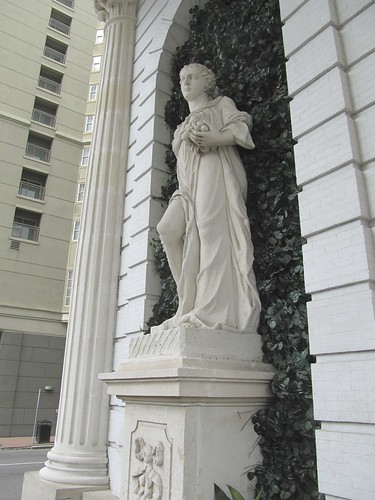
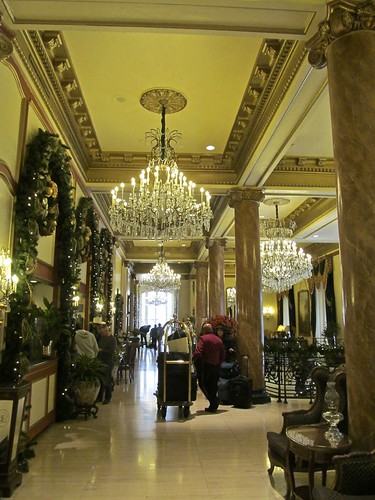
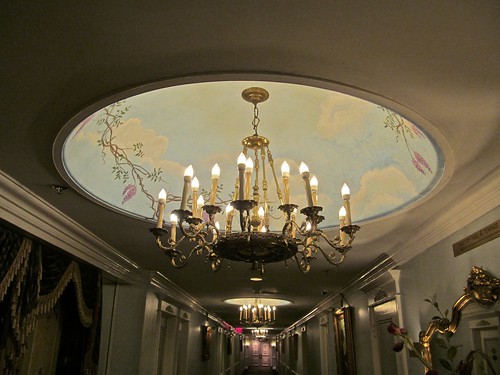
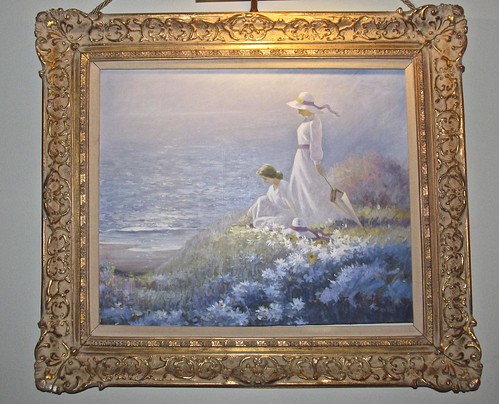
Our hotel, Le Pavillon, feels like a square-block Christmas decoration from the ancien regime:  statues and pillars at the entrance, chandeliers in the lobby, every surface minutely decorated and fitting into pattern within baroque pattern, original paintings lining the hallways, exquisite room furnishings lovingly coordinated.

IMG_7853.jpg

IMG_7851.jpg

IMG_7848.jpg

IMG_7803.jpg

IMG_7846.jpg

IMG_7847.jpg

IMG_7841.jpg

IMG_7844.jpg

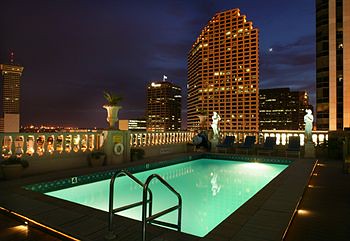
There’s also a swimming pool on the roof that I must try out despite my sinus congestion.

Le-Pavillon-Hotel-New-Orleans-Swimming-Pool.jpg
[picture source]

I’m tempted to wear only a swimsuit and the lush monogrammed bathrobe hanging in the closet, but I don’t dare appear like that in the hall. Yet waiting for the elevator on my floor on their way to the hot tub I see two young people in bathrobes making faces in the mirror. I swim a few short laps under stars and towering skyscrapers, then join them in the Jacuzzi. In New Orleans on holiday from Memphis, they don’t look or sound Tennessean. The only people I know who reside within 500 miles of this place are academic transplants–the family of an English Professor at a small college in Memphis who recently alerted me to the publication of the book I was reading on the train.  Yes K. and P. are close friends with them and he teaches Philosophy at the same college. Hearing about my recent commitment to regular swimming and lessons inspired by our grandson’s daily practices with the San Luis Obispo Seahawks, she enthusiastically recommends a new book called Swimming Studies which celebrates the sport and unique pools around the world.

Back in our room, I report the coincidence to Jan. She is opening a bottle of wine she’s brought along from San Luis Obispo.  The label pictures a famous palace and the appellation “Downton Abbey.”

For more and full-size pictures click here and here
The Monkey’s Paw

October 20th, 2013

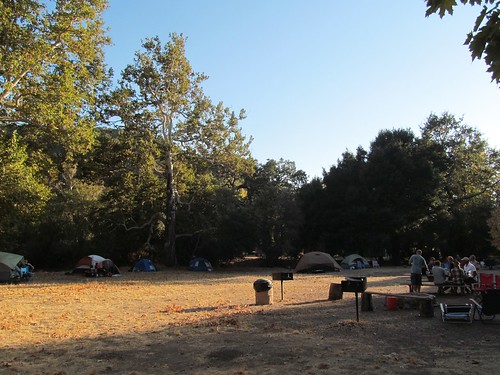
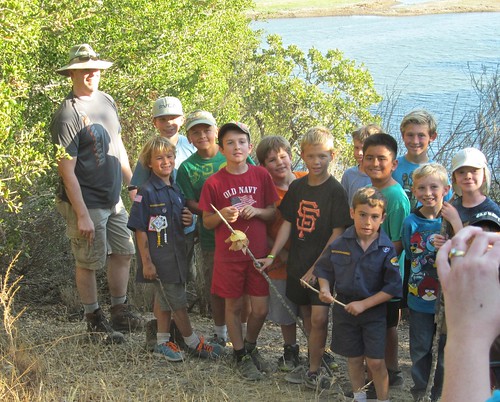
Adapted from the story by W.W. Jacobs in preparation for telling around the campfire at the Cub Scout overnight on October 19-20 2013 at Camp French

This campfire reminds of my first campout with Cub Scouts across the river from where I lived in New York City 61 years ago.
It was a dark, windy night out in the woods, far away from any lights, a little before Halloween. We were sitting around the fire as we are tonight and someone said, “Does anyone know any scary stories?”  There was no answer. After a couple of minutes, one person spoke up. It was a new kid who’d just joined the Den named  Georgie Roberts.  He was quiet and pale and had dark circles under his eyes. “I can tell you a very scary story about what happened to me and my family down in the tropics.” I didn’t really want to hear it, but a most of the guys couldn’t resist and begged him to go on.
Georgie spoke in a shy voice:

“My Mom and Dad and I were living in Brazil for a year because my Dad was running a business there exporting tropical hardwood. At first, the three of us were having lots of good times, going to the carnival, exploring the old city of Manaos, taking boat rides up the Amazon River, where we’d eat lunch, see the birds and monkeys in the jungle and watch the crocodiles grabbing animals that came out of the forest to drink along the bank and pulling them into the water and mangling them.

On one of those rides we met an anthropologist/explorer from Germany named Anton who had spent a lot of time with some of the last few native tribes that still survived in the jungle and who’d participated in some of their religious rituals.  He always struck me as kind of strange, maybe because of that.

Anyway six months after we got there, my Dad’s business was not going well and we were going to have to leave Brazil. But my father had borrowed money and had a debt of $5000 he needed  to pay back on a bank loan. If he didnt, we’d lose our home in New York that we’d planned to return to.

A few days before we were supposed to leave, my parents invited Anton over for a good-bye dinner.  After we ate, we sat around the fire ring in the back yard remembering some of our trips together.  At one point Anton got up and pulled something weird and ugly-looking out of his pocket. It was a clawlike hand, with small nails, ragged fur and dried skin hanging off the end. ‘There’s something I want to share with you before you go,’ he said. ‘This is the Monky’s Paw.'”

Georgie stood up and his voice got lower and stronger.  It seemed to come from the huge figure of his flickering shadow cast by the firelight against the surrounding trees.

“Anton, said it was left to him by a friend who got it from an native medicine man who’d put a spell on it.  It had the mysterious power to grant three wishes to the family who possessed it. Anton shuddered and said his friend’s last wish was for death.  He was about to throw it into the fire, but my father grabbed his wrist and said, ˜Stop, I know this is ridiculous, but I’m in a situation where some magic wishes are all I have to save our family home.’

My Mom said,  ˜No, don’t mess with magic,’ but my Dad grabbed the paw from Anton, held it by the forearm bone, and made a wish: ˜Bring us $5000.’  The claw seemed to vibrate in his hand and glow slightly for a few seconds.  Anton cried, ‘O my Gosh,’ and ran from the backyard into the house, and we heard a slam of the front door. Nothing more happened and my Dad said, ˜He must be continuing the joke.’

Next day was Sunday and my Mom left the house to go on a last boat trip up the river with her friends. Dad and I stayed behind and packed our suitcases for the flight to New York.  When Mom didn’t return by evening we both got worried.  At 7:00 o’clock the doorbell rang and Dad answered it to find two people standing there, a policeman in uniform and a man in black derby hat.

The policeman said, ˜May we come in please.’  My Dad let them in and the policeman said, ˜There’s been a terrible accident Mr. Roberts. There was an explosion in the riverboat Mrs. Roberts was on today, and all the passengers were thrown into the water, where they were killed by crocodiles before they could be rescued.’

My Dad and I were both frozen with shock.  Before he could say anything, the man in the derby hat identified himself as representative of the company that ran the boat.  He said, ˜I’m so sorry to be bringing you this tragic news.  Even though it was not our fault, our company wants to provide you with some monetary compensation to express our regret.’ And he handed my Dad a check for $5000. Then the policeman asked my Dad if he could come with him down to the morgue to identify the remains of Mrs. Roberts”my Mom.

My Dad called next door and asked the neighbor to look after me for a little while and  left with the two men.  An hour or so later he returned looking pale and shaken, thanked the neighbor and sent her away.  To me, he said, ˜I know that this is an awful thing that happened, but at least we’ll be able to have a place to go home to.’ I wasn’t yet able to absorb what was going on, but I asked him if there was a connection between his wish with the Monkey’s paw and the accident. He replied,   ˜No way, son, that’s just a crazy coincidence.’

After we were back in our old house in New York for a few days, his business started improving.  But I began to really feel the loss of my Mom, and I got sadder and sadder.  There was only one thing I could think of doing: ask my Dad to make another wish with the Monkey’s Paw to bring her back.  But he refused, saying ˜No, that’s ridiculous, that couldn’t possibly work, and anyway, I got rid of it.’

But I didn’t believe him, and when he was at work, I searched through his stuff and found it stashed at the back of his underwear drawer.  I pulled out the yucky thing and stuck it under my pillow.  That night, as my Dad was tucking me in to sleep, I sat up and pulled it out from its hiding place and held it up.  Before he could do anything, I said, ˜Bring back my Mom!’ It vibrated a little in my hand and gave off a slight glow.  My Dad’s jaw dropped and his eyes widened.

At that moment the front door bell rang. I sprang up thrilled and yelled ˜Momma, Momma’ and ran toward the door.  My Dad called ˜No, No, No.’ I turned on the porchlight, and through the window by the door saw something unspeakably horrible.  Then with a flash, it disappeared.  I turned around and there was my Dad, holding the Monkey’s Paw, vibrating and aglow.'”

IMG_7309.JPG

IMG_7287.JPG

More campout pictures

Beatnik Buddhism in Jack Kerouac’s The Dharma Bums

October 7th, 2013

A talk to the White Heron Sangha, October 6, 2013

I was introduced to the writings of Jack Kerouac by a trumpet-player friend in high school who gave me a copy of On the Road just after it came out in 1957.  But though I’d already done some hitchhiking around New England and hung out in Greenwich Village on Friday nights, I was put off by the book’s frenetic style and its praise of aimless, restless travel.  Twelve years later, in 1969, I encountered The Dharma Bums, Kerouac’s second most popular book, while selecting works to place on the syllabus of a class at Columbia University I called “Pastoral and Utopia, Visionary Conceptions of the Good Life.” This book’s triumphant celebration of free love, wilderness adventures, bohemian companionship, and Buddhist meditation made a perfect fit.  Forty four years later, while looking for a topic for a Sangha talk to follow up on the one about Thoreau’s Buddhism I offered last Spring, I picked The Dharma Bums in order to consider how my perspective on the novel and its Buddhist themes might have changed in the meantime. Read the rest of this entry »

from The Magic Flute

September 1st, 2013

Mann und Weib
Und Weib und Mann
Reichen an
die Gottheit an.

(Wife and husband
husband wife
together reach
for godly life.)


Deliverance

August 8th, 2013

July 16 2013

[click images for full-screen view]

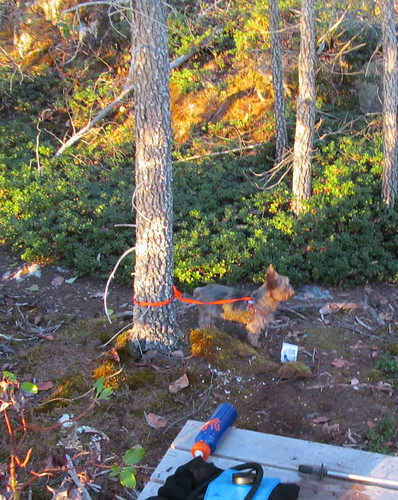
Up at 5:00 for bath and sitting. I pack for the  trip on the Sunshine Coast Trail, including dry and wet dog food.  I deliberate about whether to take Tai’s harness because it might hang her up in the bush, but opt for doing so for a better connection to the leash and because it has all her tags in case she were to get lost and be found.  I think about adding the area code to the tag with Jan’s number but its presence on the animal services tag would be sufficient if the worst should happen.

We’ve reserved a ride on the water taxi since the trailhead is well beyond access by either of our vehicles.  We arrive at the dock at 8:15 as scheduled and find that it will only cost us each twenty dollars  because we’re joined by two younger couples also hiking the trail.  We make a dicey landing on the rocks at Sarah Point which requires me to jump with the dog in my arms.

IMG_6600

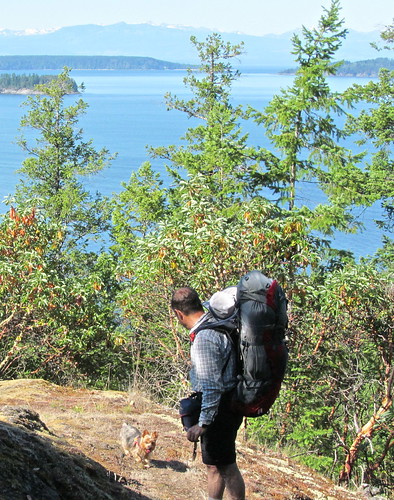
Once onshore, she seems to love the trail, running out ahead, coming back between us, her little feet trotting along jauntily, her fur silky soft, her sides rock-hard muscle.  There’s no need for the light leash I carry in my pocket during the  40 minute  ascent to Desolation View, a clearing with vistas of the Sound and mountains beyond.

IMG_6603

I sign the guest book hanging on a tree with an expression of thanks to Eagle and the trail-building and maintenance volunteers, stating that after 43 years of summertime stays in this area, it’s my first time on this magnificent section of the trail.

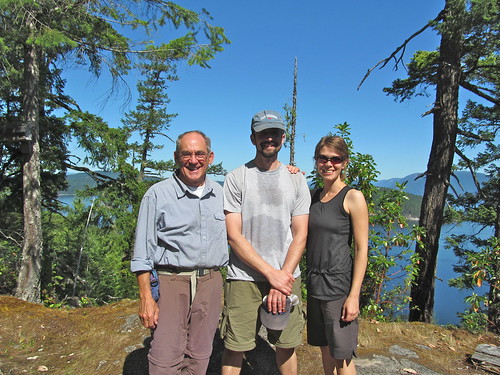
As we sit snacking on gorp, our fellow hikers come to the viewpoint and one of them comments on my hat, “I’ve been to San Gregorio.”  This is an opening I’ve looked forward to since first spotting the hat for sale last March while roaming through the store in the rain during a camping trip with Claire and the boys.  “Really,” I chirp.  “How’d you find it?” “We went to University in the Bay Area,” he says, “and loved that part of the coast.”  Turns out he and his wife are from Vancouver, met at Berkeley, and now are both professors of chemistry in St. Paul MI. The other couple are their friends since childhood and own an international coffee roasting business in North Vancouver called “Worldwide Bean.”

IMG_6604

Another 40 minutes down the trail, we arrive at Feather Cove, a crescent beach facing Zephine Head across the mouth of Malaspina Strait.  I give the dog water from my Camelback and get into my bathing suit, but then our new friends arrive and the conversation continues.  Peter swims off the point and returns, and then I head into the water and swim for fifteen minutes and come out enthusiastic about the view of Mt. Denman visible from down the beach.

I half notice Tai’s absence and assume she’s exploring and will return soon.  The two couples head down the trail and now I realize the dog is missing.  As I lace up my boots I call and whistle hoping for her to pop up, then feel uneasy. Could she have chased a chipmunk and gotten her harness stuck? Could she have followed the folks further down the trail? What else could have motivated her to leave? The only thing I can think of doing is return to our starting point at Sarah Point, since she may have decided to go back to where the trip started.  Without a backpack, it should take about two hours round trip.  Peter says fine, he’ll wait and take a nap.

I hurry up the trail with a one-liter water bottle in my pocket feeling more anxious at every step. I whistle and call Tai’s name.  I know by now its most unlikely I’ll find her, but at least I have to make the effort.  I realize I wont be able to stop torturing myself.  I hear Jan’s voice repeating, “she’s not a bush dog, she’s a lap dog, don’t take her hiking.  You can leave her at a kennel in Powell River.”  I imagine the dog lost on the network of trails or getting stuck in the deadfalls, or worn out with exhaustion and lack of water and food or attacked by cougar or coyote.  I envision Jan’s horror and anger at the news. This is one of  the worst things I’ve ever done, comparable to leaving four year old Joe up in a tree house I was trying to repair and falling 20 feet to the ground 37 years ago. In that situation, disaster was averted only by good luck. But this time I will have to face tragedy and forever carry the weight of guilt for causing the dog to die miserably and Jan to grieve and this vacation to be spoiled for her, the kids and the grandkids.

As I approach the start of the trail, I indulge a slight hope the dog will be there waiting for me, but of course she’s not.  Now I must turn around and head back to Peter and the packs and figure out what to do next.  I rehearse my words to Jan: “the dog is lost¦it’s my fault¦I’ve searched for hours and given up hope¦I’m so sorry.” On the way uphill I start gasping, stopping every few steps to catch my wind as if I were at eleven thousand feet, and I feel a painful tightness in my chest.  I remember the German proverb I recently translated: “Disasters seldom come alone.”  Is this an incipient or progressing heart attack?  How long must I rest to get back my wind?  I’m out of breath even on the level and downhill. Dying out here will at least relieve my guilt for losing the dog.  Will it make Jan hate me less or more?

I get back to the beach exhausted and wake up Peter. As I describe my symptoms, my breath slowly returns along with alarm about the dog.   What about the miniscule chance that the dog is found by someone with a working cell phone and they call Jan with no information about us. That might disturb her even more than the loss of the dog. She would call Peter’s wife, so we must find a way to reach Margaret to let her know that we are all right. But here there’s neither cell nor shortwave reception. We need to go back up the trail to the viewpoint for that.

IMG_6605

It’s another hour before we reach it, my third time there and four hours since the dog went missing. No longer breathless even with the pack during the climb, I talk out my sad thoughts with Peter–the need to deal with bad outcomes.  I’ve experienced that with my father’s terrible last days, but he was 89. Peter had to deal with his father’s worsening pain and death when he was a teenager. I accept the need to tell Jan the terrible truth rather than put it off with a contingency call to Margaret. Jan may decide not to come on the trip at all; she may come and be depressed and angry the whole time; or we may be able to grieve together.  I keep rehearsing the conversation as we hike.  At the vista point there is cell reception, but the battery is low.  I ask Peter to give me the phone and a minute to compose myself. I sit down, take deep breaths and dial Jan’s number.  After one ring she answers, and before I can say a word she shouts, ” You lost the dog.”

Instantly I know we are saved. My mind calculates that the probability of her intuiting the dog’s loss from this unexpected call is even tinier than the tiny probability that the dog was found by someone in the bush who called her number on the tag.  To confirm, I say, “I am calling to tell you that, how did you know?” With fury in her voice, she says she got a call from someone named Nancy, who found Tai and can be reached by cell. Peter stands by me and writes down the numbers as I dictate.  As I repeat each of the numbers after her, Jan shouts “stop talking and listen.” I feel blissful at being unfairly yelled at. She says, “I’m not sure I wrote the last four numbers correctly.  I’ll check in my phone and call you back if they need correcting.” I know I will treasure this moment for the rest of my life.

She calls back and corrects the number and tells me she’s just about to head into a closed session at City Hall and that she feared just this and that if I want a dog to go in the bush I should damn well get my own dog, and that Tai is a lap dog and belongs to her, and she is really angry at me and will have more to say later.  I’m flooded with shame, but still joyous, and the ferocity in her voice excites me. When she pauses I say, you’re right, I’m sorry that you’re being put through this, but I want you to know that no matter how sorry I feel, it’s nothing compared to the sorrow I felt for the last four hours assuming that the dog was gone.

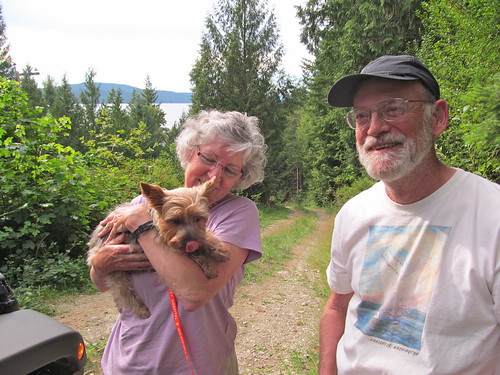
She hangs up, and I call Nancy’s number and express my gratitude through a choppy connection. Nancy says she and her husband found the dog on the road between Bliss Landing and Sarah Point and  had a hard time catching her.  They’re now heading back to Lund but they can turn around and drive back toward Sarah Point and meet us within an hour.  Peter and I race toward the campsite at the Point, leave our packs, and then continue along the trail and then on the very rough road up a long steep hill that Peter is sure no vehicle can negotiate. I’m exhausted again but happy to press on. A new Jeep Rubicon appears at the top of the hill and heads toward us and stops.  In the passenger seat Nancy is smiling and cuddling Tai on her lap. I take the leash from my pocket and put it on her harness and then greet her.  She’s relieved to see me, but not ecstatic.

IMG_6608

Nancy and her husband Don are our age and fun to talk to. They stopped at Sharp’s Bay and called the local SPCA as well as Jan before reaching us.  Peter determines that Don was at UC Berkeley during the sixties as a reporter on the FSM for the student newspaper. He’s a Physics Ph.D. at Hanford Nuclear Reseration in Washington State and she’s a contract officer.  They used to visit Lund in their sailboat and now come in a motor home.  They accept my invitation to come for dinner at Knoll House after Jan arrives.

We say goodbye and then walk back toward the campsite, looking for water along the way without success.  We’d planned to be at Wednesday Lake tonight, not here on the rock bluffs. We are down to a liter and a half, for a thirsty dog and two dehydrated men.  We’ll phone the water taxi and order a ride back for tomorrow morning but in the meantime we’ll be dry. At the tent platform I tie up Tai and give her all the food and water she wants.

IMG_6621

Its 8:30 pm and I’m ready to sleep. But the wet ocean looks inviting.

IMG_6639

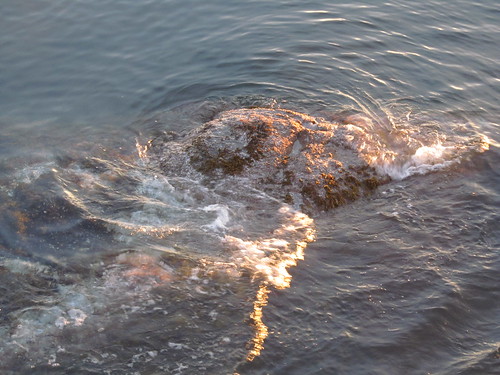
I dive in and luxuriate in its buoyancy. I swim toward a boat fishing off shore and ask if they can spare a liter or two of drinking water.  They say yes but are suddenly preoccupied with a ten pound salmon on their line.  I swim back to shore and get dressed and then the boat speeds toward us.  Aboard are three bearded young men heading to Toba Inlet with mountain bikes.  They have water in liter bottles frozen for their cooler and can spare one, which they toss to me on shore and then take off into the sunset.

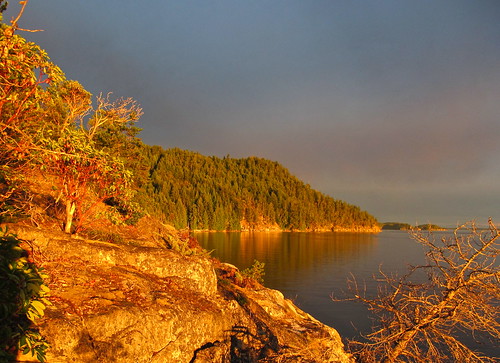
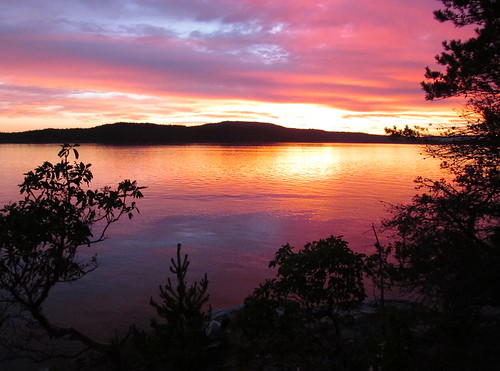
And what a sunset.  The water flattens, the horizontal rays gild the arbutus trees and nearby cliffs and distant islands.

IMG_6630

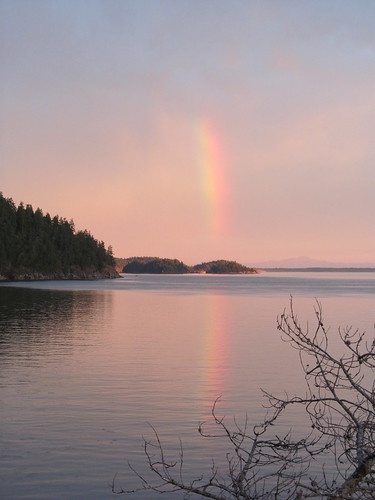
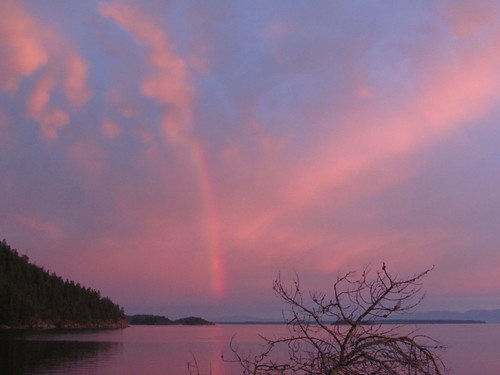
To the south over the Ragged Islands a vertical column of rainbow color suddenly appears, extending from high in the sky down to just above the land and is reflected by the placid surface of the water.

IMG_6645

Then the clouds surrounding it turn pink but the column of color doesn’t lose brilliance.

IMG_6669

After 20 minutes it fades, replaced by a final display toward the north: rainbow colors radiating from all the sky and water.

IMG_6676

As this light finally darkens, Peter sets up the tent, I blow up my mattress, grab the dog, climb inside, and drop off to sleep overwhelmed with gratitude, wonder and love.

Thoreau’s Buddhism

June 24th, 2013

A presentation to the White Heron Sangha June 23 2013

Henry David Thoreau was born July 12, 1817 and died at 45 years of age on May 6, 1862. His name is a household word, especially among those of us who grew up during the 1960’s, when his two most famous works, Walden and “Civil Disobedience” offered compelling guides to non-conformity, self-reliance, appreciation of nature, reduction of one’s environmental footprint, opposition to war and injustice and spiritual quest.

Although not widely appreciated during his life, since the late 19th century Thoreau’s works have become classics, admired by later writers, assigned in schools, and the subject of a burgeoning scholarly industry. He produced more than 20 volumes in a dense and quirky literary style, at times pompous and bombastic, at others intimate and funny. Read the rest of this entry »

Reminders of the “Good Old Days”

April 9th, 2013

[Updated June 30 2013]

gute alte zeit_2.jpg

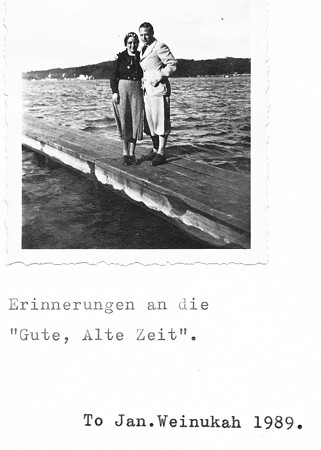
Soon after their move to San Luis Obispo in 1989, my parents, Lise and Henry Marx, presented Jan and me with a gift they’d been working on for several years: a collection of German proverbs they had learned from their parents and grandparents.

I remember continually hearing these sayings from my earliest childhood until their final days. Each time one was uttered there was a moment of satisfaction”the speaker pleased to have found a way to make familiar sense out of some new experience and the hearer gratified to grasp the connection.  Growing up as a first generation American, I reacted to these old-world pieties with boredom and embarrassment.

Read the rest of this entry »