Peru Day 2

January 15th, 2013

On the way south after breakfast, Dante has the bus stop for a look at Lima’s long beach front and pelicans on a fish processing plant’s roof.
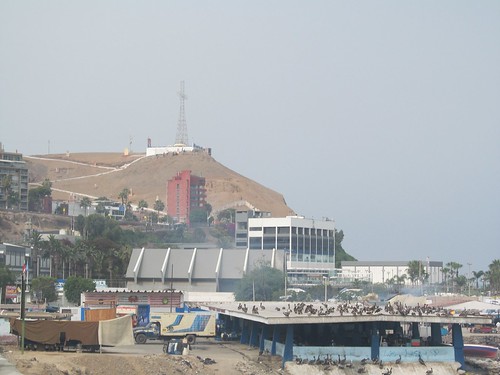
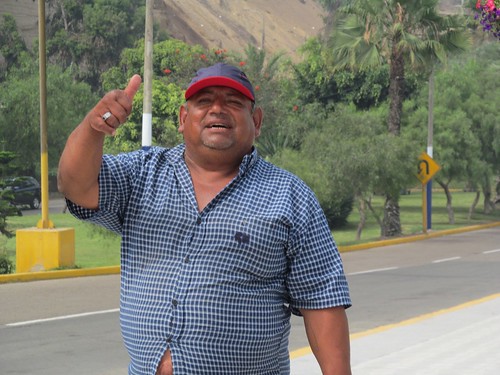
IMG_2755.JPG Fishing is a major industry because of the upwelling of the cold Humboldt current just off the coast. A hearty stranger approaches and hails us.
IMG_2756.JPG

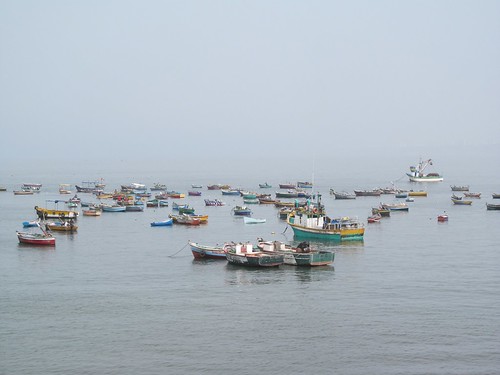
He says the large green boat in the foreground of the picturesque fleet is his.
IMG_2754.JPG

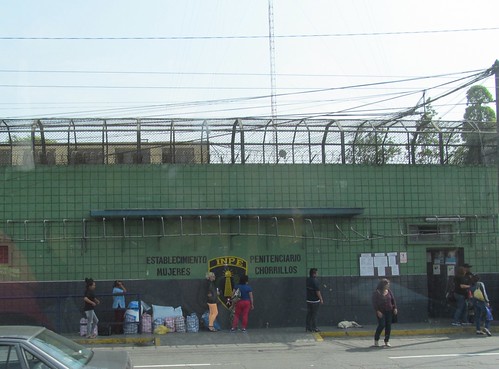
We pass a woman’s prison that incarcerates not prostitutes”the trade is legal in Peru”but mules”young women recruited by dealers to carry illegal drugs out of the country in their body cavities.
IMG_2765.JPG

A mountainous sand dune reminds us that we’re in a coastal desert, one of the driest places on the planet. The top and steep slopes are crisscrossed by bulldozers harvesting sand used in a factory at the base of the dunes to manufacture bricks.
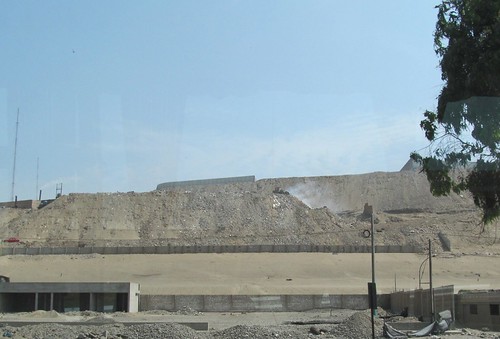
IMG_2780.JPG

The mined dunes are succeeded by a grove of young orange trees planted on the slope, and then by a dense colony of shacks.
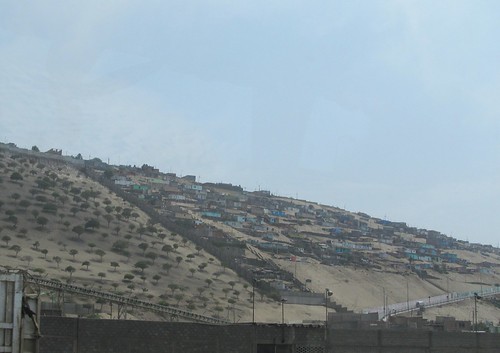
IMG_2788.JPG

This is one edge of Villa El Salvador, a sprawling zone of improvised and unplanned buildings that constitutes the rapidly expanding suburb that now houses about 400,000 people. Most have left their ancestral homes in the Andean highlands and other regions of Peru and migrated to the city–fleeing the terror inflicted on peasants by Shining Path guerillas, forced off their land by famine and drought, or in search of a better life for their children.  Known as “invaders,” they squat on unused private and public property, build with scavenged materials and survive without basic services like water, sewage or electricity. They eke out a living selling services and labor at low wages or creating small-scale businesses peddling food or souvenirs on the street.

In 1980, after a series of violent conflicts with police who tried to evict the squatters, the government created a new policy: if a group of squatters lived on the land for ten years and came up with a lawyer to represent them, they would be granted ownership of their lots.  And if they continued to organize and pool resources, they could petition for the construction of roads and the delivery of other basic services for which they would pay monthly bills.  The older these squatter communities, the more established and prosperous they have become, and now they are classified as class 1, 2, 3, and 4, the last including conventional stores, hospitals, factories and other locally owned businesses. But at no stage, Dante insists repeatedly, do the residents of these communities receive welfare from the government. They are responsible for supporting themselves through hard work, austerity, persistence, ingenuity and most important, cooperation.  He confides that he himself grew up in a community like this.

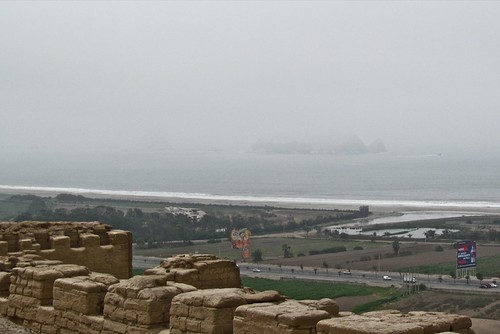
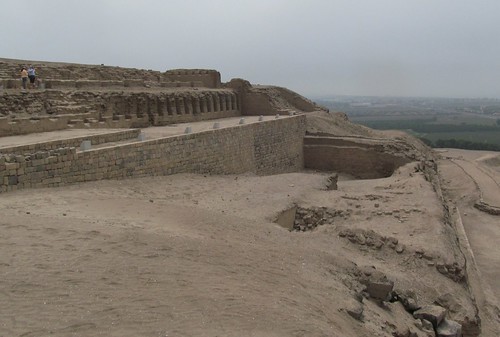
We get out  at a complex of Inka structures. A partially reconstructed dormitory for priests and sacred virgins fronts on a wetland oasis created by aqueducts conducting water from a river flowing down through the coastal desert from the Andes.
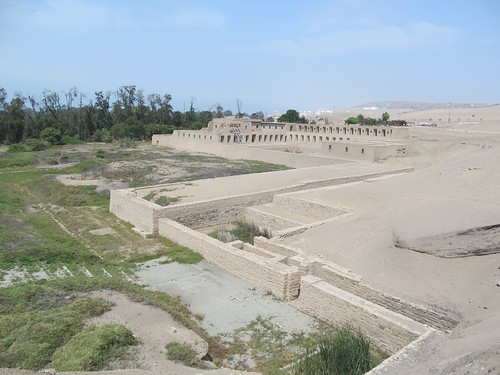
IMG_2796.JPG

A hilltop Temple of the Sun overlooks offshore islands that were assumed to be the residence of gods who required sacrifice of the virgins to continue providing crops and fish.
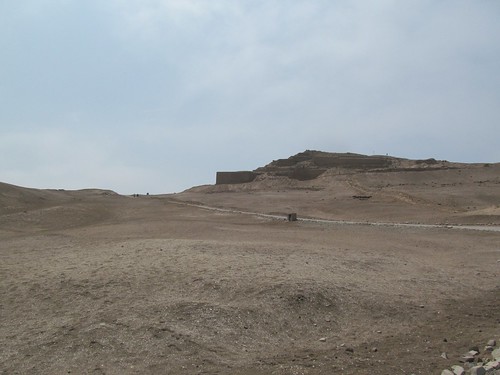
IMG_2802.JPG

IMG_2817.JPG

IMG_2819.JPG

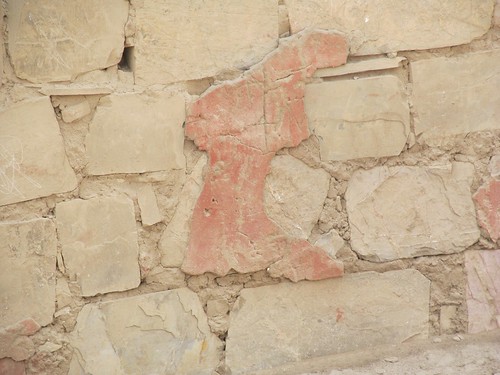
The structures are built out of adobe bricks of the same color and texture as the soil from which they’re hewn. Occasionally we see evidence that originally the structures were surfaced with sharp angled stucco painted with the red cochineal dye.
IMG_2813.JPG

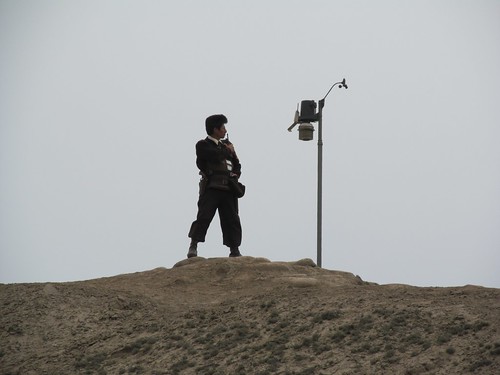
At the summit of the temple a heavily armed soldier stands at attention, part of a contingent protecting the site 24-7 from continuing harm by looters.
IMG_2816.JPG

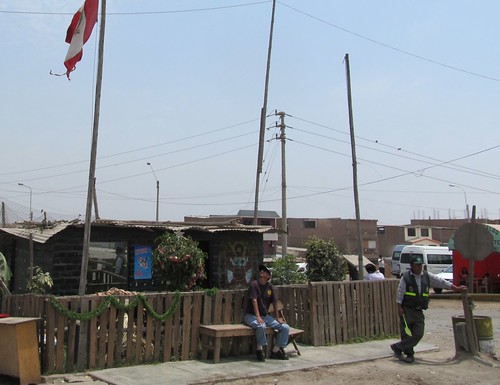
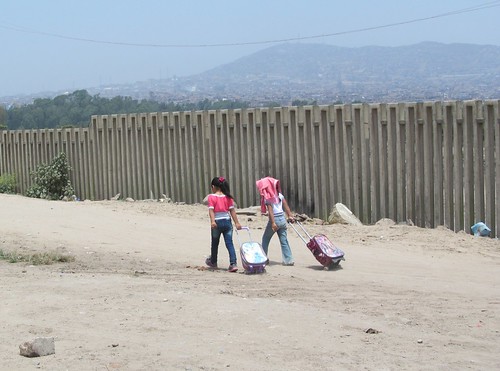
Back in the bus Dante says we are about to visit a stage 1 squatter community nearby which has a special relation with our OAT tour company.  On every visit, the guides bring bags of rice and beans and provide other necessities in kind. We pass through a checkpoint staffed by local residents who patrol the unpaved streets to make them safe for children, who would otherwise be threatened by abusers and sex traffickers.
IMG_2821.JPG

IMG_2837.JPG

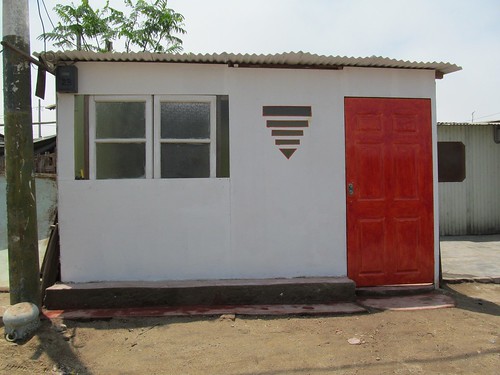
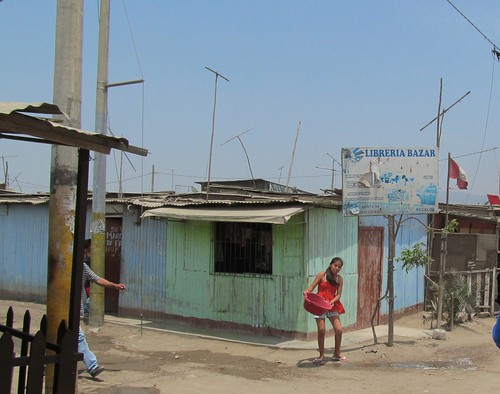
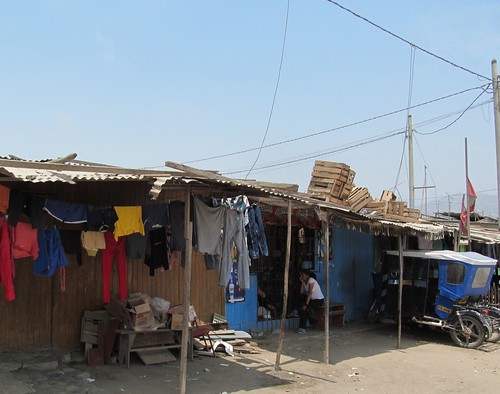
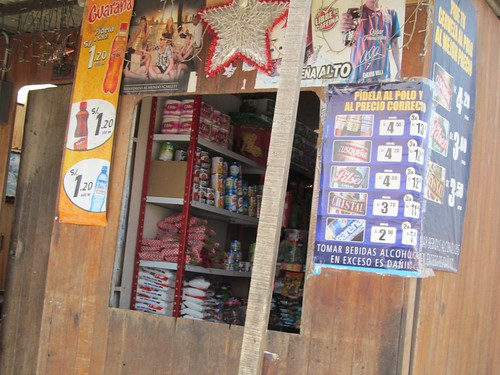
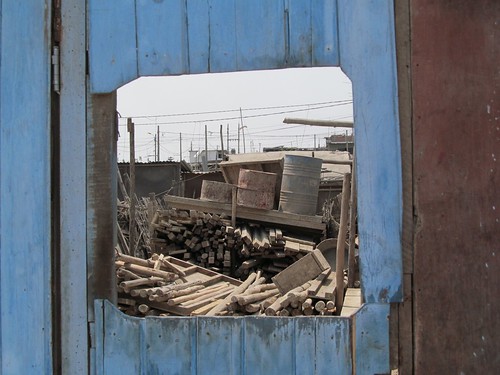
Dante greets the guardians who let us through the gateway. Tiny shops are scattered among the houses crammed side by side, some no more than a patchwork of cardboard and tin roofing, others ambitious and creative in style.
IMG_2825.JPG

IMG_2840.JPG2840

IMG_2842.JPG

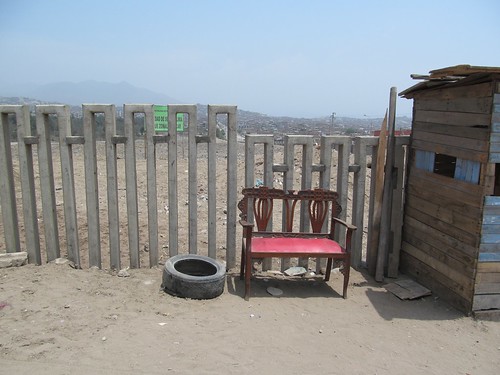
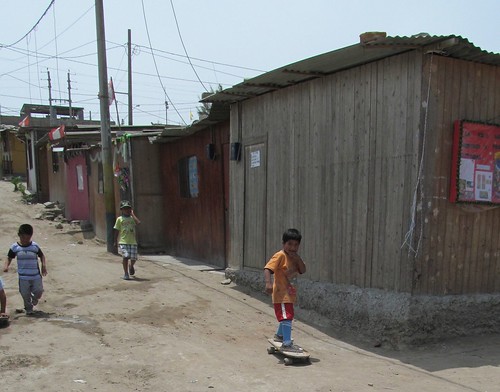
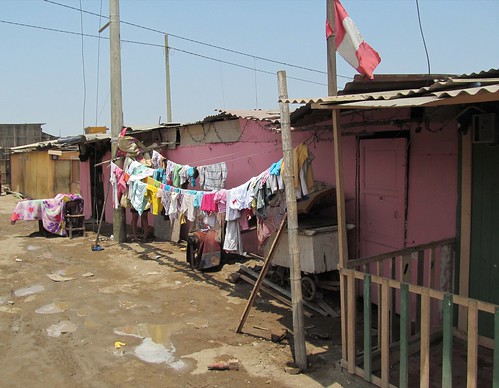
Almost everything here is salvaged, recycled and improvised, but the atmosphere seems secure and cheerful.
IMG_2832.JPG

IMG_2838.JPG

IMG_2827.JPG

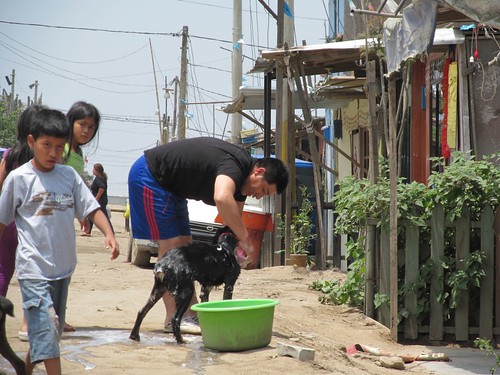
Children play in the narrow lanes, a mother holding a baby hangs up laundry, a man washes his dog.
IMG_2863.jpg

IMG_2844.JPG

IMG_2861.JPG

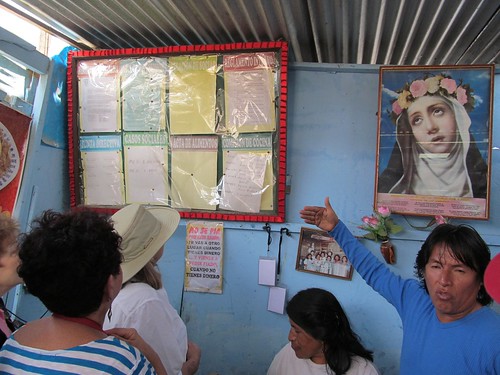
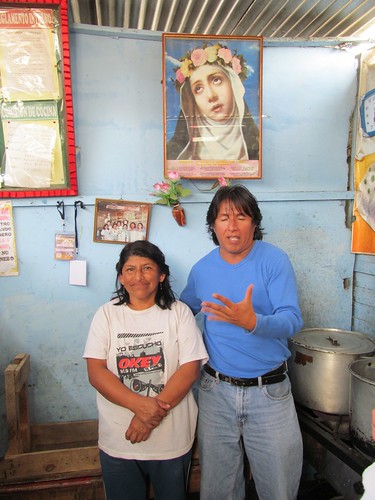
Dante leads us to a corner building deep inside the grid of streets.  The mothers here have organized a soup kitchen to feed those who don’t have enough to eat.  Nourishing food is offered, not free but at very low cost along with information about nutrition and health. There is one of these kitchens for each 70 families.  Some support is supplied by NGOs but not by the government.  The woman who runs this kitchen shows us the large clean pots, the propane stove and tank, the sign on the wall that warns against cheating or hoarding.  She is proud of the place, but not happy today, because for unknown reasons no food has arrived.
IMG_2858.jpg

IMG_2859.JPG

This community has been nominated for a Nobel Peace Prize for its successful experiments with alleviating poverty and promoting community development. Its approach struck me as diametrically opposite to that in our home town, where a complex permitting and review process by the existing community is required before any new construction can take place. It also takes an opposite approach to our growing problem of homelessness which assumes that the government and existing community provide housing, food and safety for those in need who play by the rules.

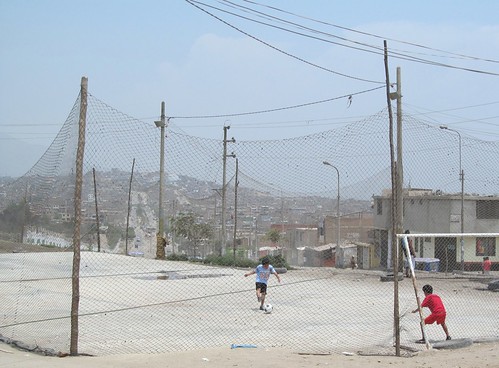
As we board the bus I see two boys starting up a game of soccer in a well-fenced dirt field.
IMG_2866.JPG

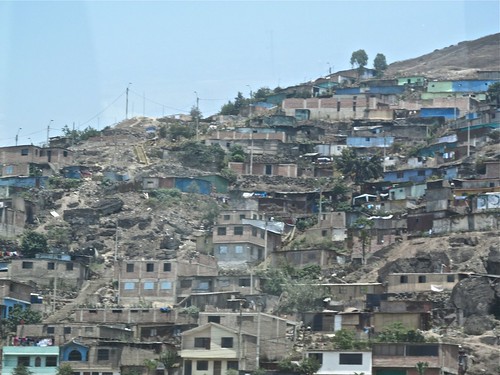
Now we drive through a stage 2 community perched on a steep hillside. The ground here seems as unstable and incoherent as the teetering structures.  There’s little danger of erosion since it never rains in Lima, but I envision the whole warren sliding down the hill in case of am earthquake. Rather than roads or sidewalks, one sees only footpaths and cart tracks.
IMG_2876.JPG

But the people who construct and continually add to these structures with locally manufactured bricks and cement seem to have inherited the Inca tendency to never stop building on near-vertical slopes. To many people, improvised structures like these are merely an eyesore, but I find them more aesthetically appealing and mechanically intriguing than the modernist architecture of the luxury hotels of Miraflores.

Our tour of Villa El Salvador concludes with a bus ride through a stage 4 section of this “new town.”  In narrow paved streets we see into small furniture and shoe manufacturing operations, the merchandise being loaded onto small pickup trucks or motorcycle driven carts.
IMG_2881.JPG

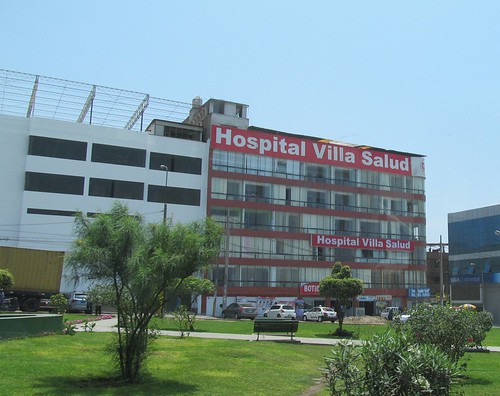
And then a main boulevard with grassy medians, a large hospital, and an unrelenting barrage of billboards.
IMG_2879.JPG

We return to our posh hotel for a rest and then are driven to dinner in a restaurant in the even more exclusive seaside enclave of Barranco.

Slideshow of these and more full-size photos
 

Link to Day 3


Peru Day 1

January 15th, 2013

Preface

Back in September 2011 Jan and I purchased a three week tour of Israel and Jordan scheduled for February 2012 from Overseas Adventure Travel (OAT), the company that had provided us with a remarkable experience in Japan two years earlier. In early December we were forced to cancel the trip to deal with a family crisis. The insurance policy we’d bought to cover such situations would only refund a fraction of the cost and the balance could be credited to another trip only if taken before February 2013.

Our disappointment was kept alive by the diminishing possibility of redeeming the credit. In the meantime we had been assigned court-appointed custody for our eleven-year old grandson. In September 2012, we found out that he’d be visiting his father in Georgia for the winter school holiday and therefore we might have a two- week interval around Christmas to travel.

Ready to go anywhere in the world on an excursion already paid for, we searched the OAT catalog and came up with “Real Affordable Peru.” It fell within the allotted time and offered an appealing itinerary, including Lima, Cuzco, the Sacred Valley and Machu Picchu, which had intrigued me ever since I learned about it at age 10 in Richard Halliburton’s Book of Marvels. Throughout Jan’s hectic fall re-election campaign for Mayor, our bedtime reading consisted of Kim Macrorie’s The Last Days of the Incas, Mario Vargas Llosa’s The Storyteller, Mark Adams’ Turn Right at Machu Picchu, and Charles Mann’s 1491: New Revelations of the Americas before Columbus. But as the departure date approached, another problem loomed.  The  surgery that Jan had undergone in October destabilized rather than repaired her left knee, and she now needed a brace and continual icing just to walk city streets.  How would she fare clambering in the heights of the Andes?

Day 1

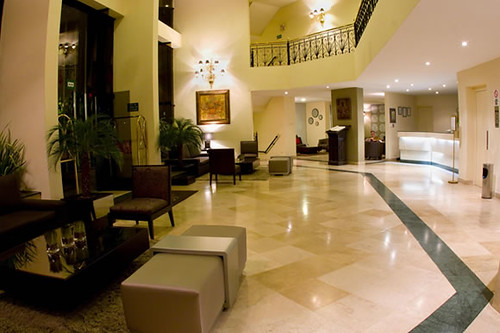
We land in Lima 12:30 A.M. December 26 and are greeted at the gate by Jonathan, the OAT representative, along with a couple of intrepid fellow travellers from Chicago a few years our seniors. In the downtown, every building is protected by high walls or fences, and some of them have guard towers at the corners.  The minivan drives along the Pacific shore toward Miraflores, the affluent tourist-friendly section of this city of 10 million.  Jonathan assures us that the district has three levels of protection: municipal police, semi-official companies that contract with the police, and private security. We’re welcomed to Hotel Jose Antonio by a large African-Peruvian doorman in a suit and tails.  It’s an upscale facility typical of those chosen by OAT and several notches above the motel 6 level I usually patronize.

joseantoniohotel

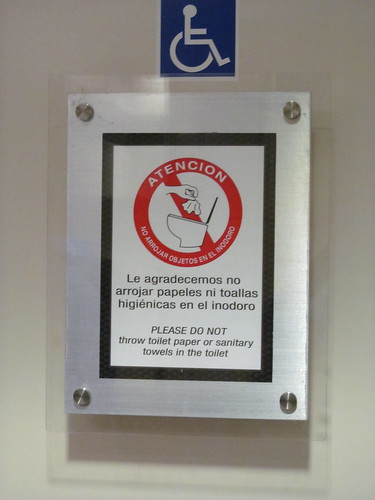
In the bathroom we encounter the trip’s first culture shock: a sign tells us to dispose of all paper in the adjacent wastebasket, not in the toilet.

IMG_4127

Our guide affirms that this means all paper, in order not to overtax the capacity of municipal sewage systems. It’s a contrast to the equally foreign peculiarities of Japanese toilets, which provided a warm water rinse of one’s undercarriage after every use. But it’s no more an adjustment than having to remember to always use bottled water for toothbrushing and sinus rinsing, as well as drinking.

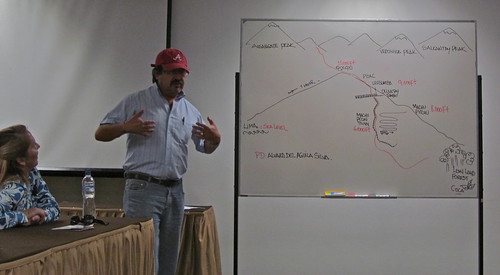
The morning’s generous breakfast buffet includes a thick, sour distillation of coffee one renders palatable by diluting with hot milk and water and a variety of delicious fresh fruit. Afterwards our group of 12 travelers assemble in a conference room for an introductory lecture by our trip guide Alvaro, illustrated with a timeline and map of the upcoming journey and including a strong recommendation that we ignore medical prescriptions for altitude sickness and instead drink coca tea and chew coca leaves, the time-honored cure.

IMG_2648

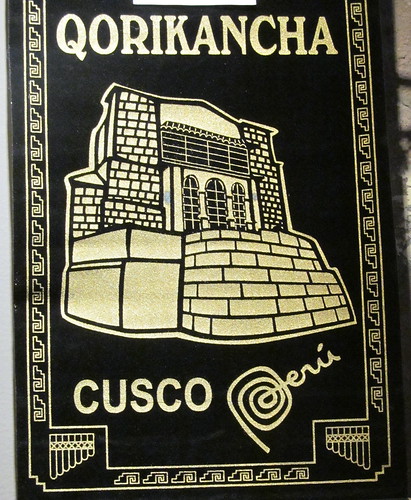
Alvaro is a native of Cuzco”to be pronounced correctly as Qosco (just like Costco) in Quechua, the native language still spoken by the Andeans. He espouses a nationalism hostile to the Spanish conquistadores, ambivalent toward the short-lived Inca empire that they conquered, and partisan toward the decentralized pre-Incan native cultures whose histories extend back ten to twenty thousand years.  He points out that modern Peru has recently rebranded itself with a new logo containing a spiral that’s found on inscriptions and also represents the concentric ancient terraces we will discover throughout the mountainous countryside.

IMG_4076

We learn that his father’s family comes from the Amazon”most likely from Spanish ranchers–his mother’s from Andean Qosqo, making him a mestizo  like most other Peruvians since the Conquest. There’s a familiar anti colonial, anti-imperial bias in his views, but they are mixed with great enthusiasm for his longtime employer, OAT, which is dedicated to educating Americans about foreign cultures and environments, promotes international understanding, underwrites local social service programs and has provided his family with the resources to send his three children to University.

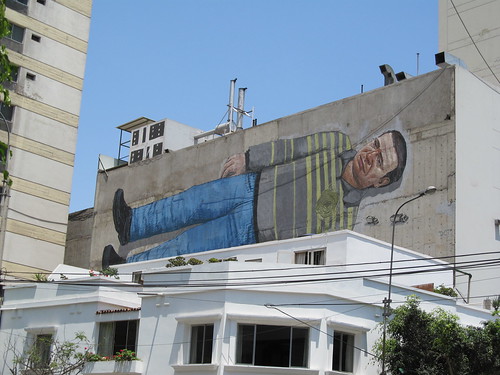
We depart for a group promenade down the busy main boulevard of Miramontes. There are no beggars or street sellers and a prominent presence of kevlar-vested gun-toting police and private security patrols. A building across the street sports a huge mural depicting a prostrate Gulliver-like figure with tiny trucks driving away from a hole near his heart.  Alvaro interprets: this is the heart of Peru being eviscerated by the mining industry.

IMG_2649

We amble through Kennedy square and down another boulevard to a restaurant for our first meal of legendary Peruvian cuisine, passing a long line of respectable but unhappy-looking people lined up at one of the many prominent banks. These, says Alvaro, are civil servants lining up to cash (or receive?) their paychecks.  Jan and I both order ceviche, and the raw fish marinated in lime juice and a light cream sauce with sliced onions reminds me of the sashimi which introduced our culinary adventures in Japan.

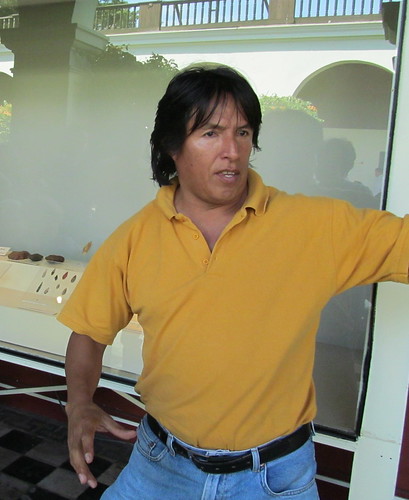
Back at the hotel we are introduced to Dante, our local guide, a compact man with glossy black hair, shiny eyes, a mime’s expressive gestures, a shaman’s intensity and a distinctive profile like those on Aztec and Mayan reliefs.  He was born in a small village north of Lima into a family of subsistence farmers and moved with his parents and brothers to the city when he was nine years old.  He hated to leave his beautiful rural village but since then has learned why it was the right choice for his parents.

IMG_2661

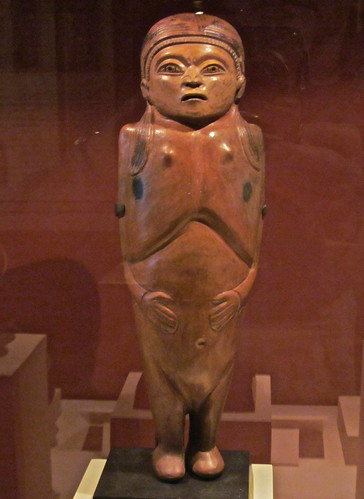
We arrive at the National Museum of Archaeology and Anthropology, an attractive ochre and white colored building with a central courtyard graced by brightly flowering trees and loudly chirping birds. First stop for the group is under an arch bearing the ubiquitous “S” for Sismo sign”a supposedly safe sanctuary in case of Seismic disturbances.  Peru’s history and culture is dominated by earthquakes; the last big one in 1970 rocked Lima for two full minutes and caused a hundred thousand deaths.  The damage to this museum has still not been fully repaired due to the government’s according higher priority to developing the infrastructure–roads and bridges facilitating commerce across the extraordinarily difficult terrain separating the three primary areas of the country: coastal desert, mountains, and Amazonian jungle. Peru’s immense archaeological riches have only been properly excavated and preserved with foreign financing.

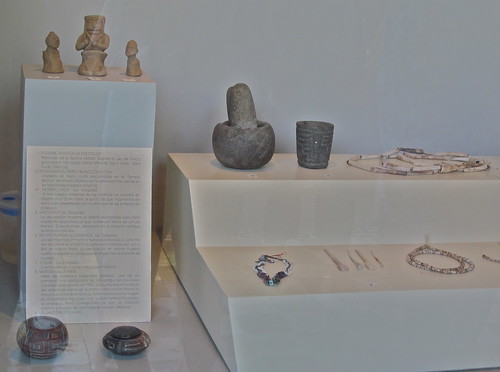
The Museum’s exhibits are displayed in chronological sequence and Dante emphasizes the ingenious technology for resource use of the earliest strata”stone age tools similar to those of the early California Chumash I saw on a recent school visit with my grandson to the Rancho El Chorro Education center.

IMG_2665

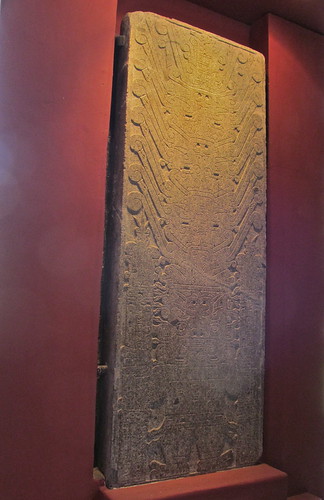
As we move to the display of a stela depicting the puma god holding staffs of peyote cactus, he points out that the physical evidence here suggests the existence of an agriculturally based civilization even older than Egyptian, Sumerian or Hindu”the Chavin culture. This new view of the age, size and complexity of New World cultures is amplified in the book that Jan and I are continuing to read as we travel, Charles Mann’s 1491.

IMG_2666

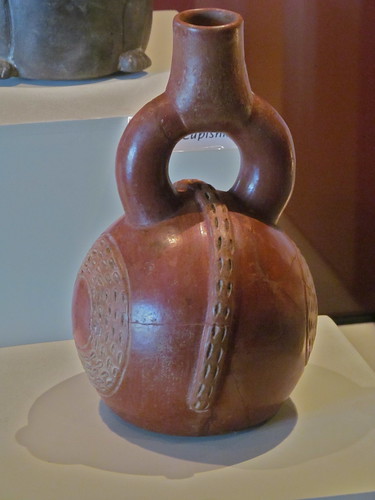
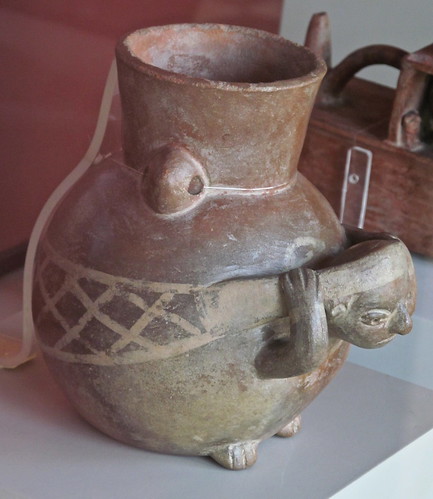
Though none of the New World cultures seem to have invented the wheel or the metallurgy that could produce powerful weapons, their hand-formed pottery glazed with characteristic red ochre looks as if it was thrown, and both human and animal figures are elegant and expressive.

IMG_2671

IMG_2677

IMG_2684

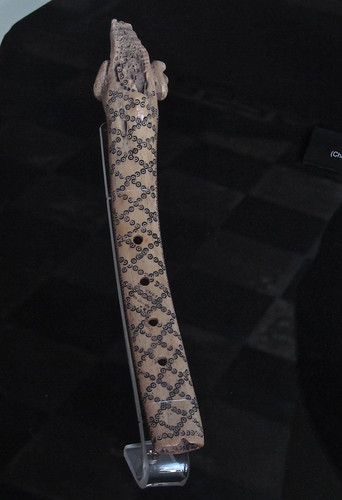
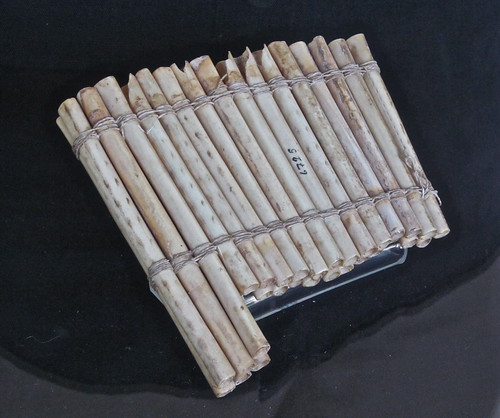
From early times onward music has been ubiquitous in religious ritual as well as daily life, and the instruments displayed are themselves beautifully sculpted artifacts.

IMG_2690 

IMG_2691

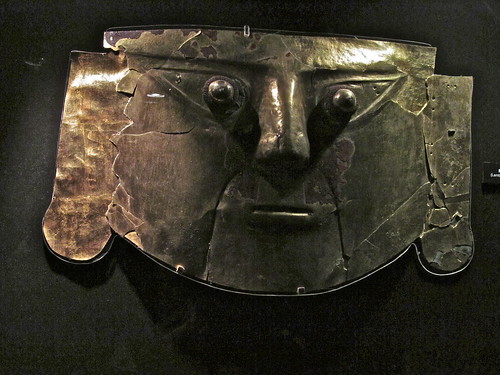
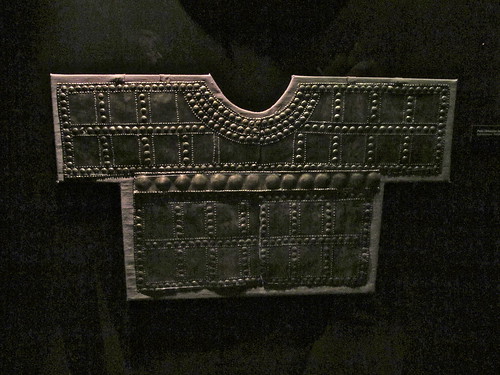
A darkened room displays Inka treasures, some of the few remaining examples of the vast trove of gold and silver architectural features, sculptures, ritual instruments and costumes that Pizarro and his tiny band of invaders pillaged, melted into ingots, and sent back to Spain during the sixteenth century.

IMG_2700

IMG_2701

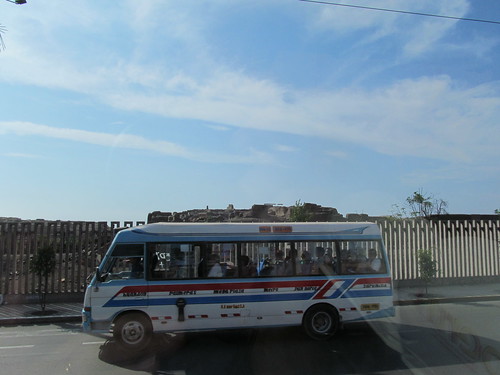
On the bus trip to the City Center, Dante points out a fortress-like structure rising behind a large fenced area, one of more than 40 major excavations now being carried out within the city limits, an indication of the nation’s hidden reserves of archeological resources.

IMG_2718

We pass a heavily fortified complex of buildings suggesting an Inca temple that he identifies as the Japanese Embassy–the scene of the 1996 drama initiated by the Shining Path guerillas who took over the complex, held  people hostage for 126 days and finally were defeated by police and military commandos under the direction of then president Alberto Fujimori.  Dante says he voted for Fujimori and found him an effective leader whose strong-arm tactics were necessary to combat the murderous Maoist movement wreaking havoc in the country. But like most Peruvians, he became disillusioned with Fujimori after the brutality of his methods approached those of the revolutionaries and after revelations of large scale corruption caused him to flee the country.

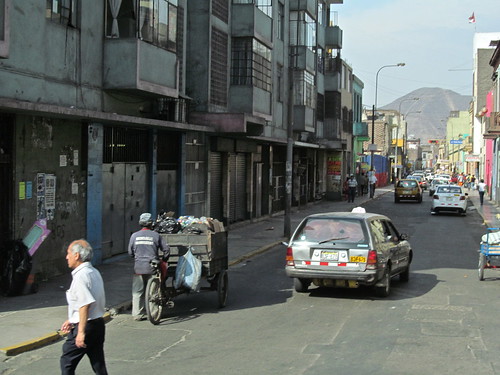
Our bus maneuvers through fast moving traffic toward the center of Lima, the end of every street revealing arid mountains covered with ramshackle homebuilt structures sprawled in growth patterns that look like lichen on rock. These suburbs are the newest and poorest parts of the city, Dante says, unlike in America where the more expensive homes are up the hills.

IMG_2722

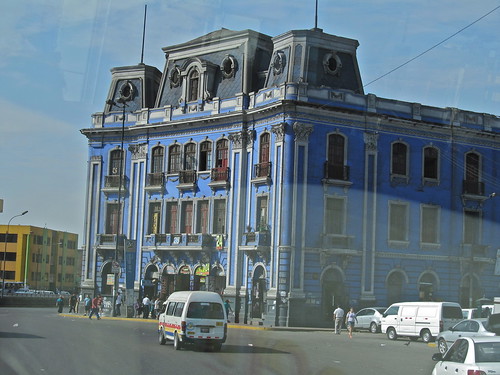
We enter a traffic circle surrounded by shabby mansions that used to be the homes of Lima’s aristocracy and are now divided into crowded apartments.  He assures us that the central square where we are headed is safe and heavily patrolled.

IMG_2719

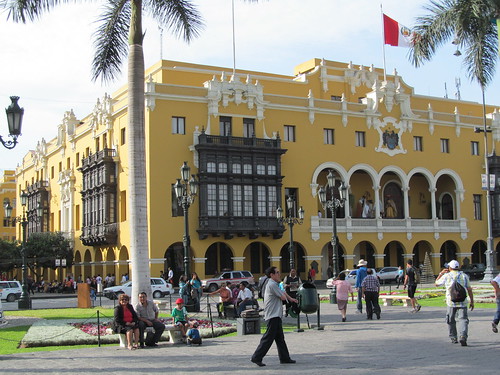
The square is fronted by a 16th century cathedral and bishop’s palace, the 19th century Presidential palace and the18th century City Hall. It’s decorated with ugly artificial Christmas trees.

IMG_2727

The atmosphere is fast and lively, the pace set by the machine gun staccato of Spanish speech and laughing children.  Dante says that Lima’s mayor is a woman and observes that it is important  for women to be involved in politics.  He’s impressed to hear that Jan is a mayor and promises to arrange a meeting between her and the city’s chief executive when we return.

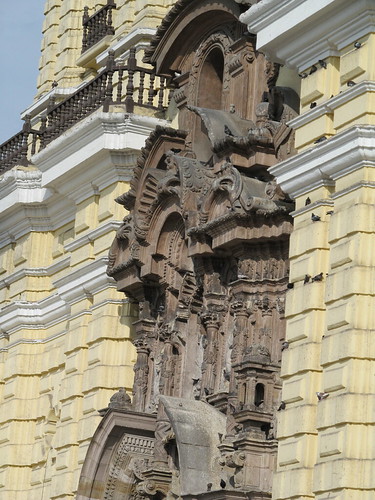
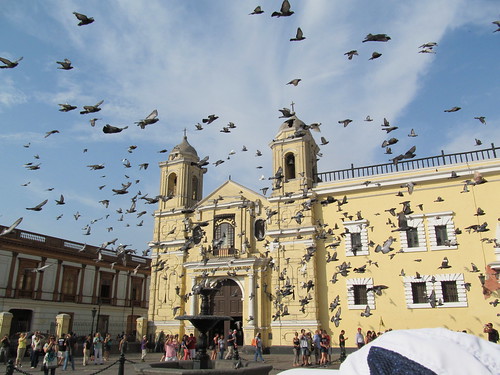
The group walks a block past street vendors whose fascinating appearance and merchandise we try not to eye into a square dominated by the baroque façade of the San Francisco monastery and cathedral, as harmonious in proportion and dramatic in decoration as any churches in Europe.

IMG_2745

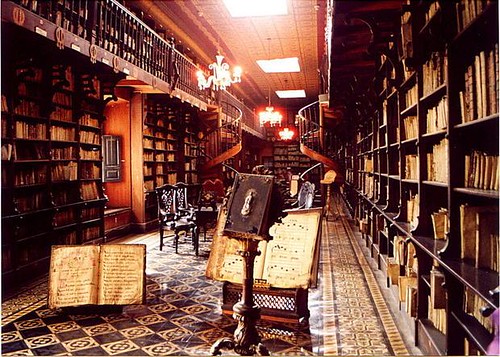
We enter the adjoining monastery where photography is prohibited, stopping at the library where light pours in from clerestory windows above a three tiered gallery and illuminates the dust in the air coming off thousands of leather-bound books that seem haphazardly shelved and piled, most of them with pages rather than spines facing outward.  In contrast to air-conditioned and immaculate rare book rooms in American libraries, this place looks like 18th century paintings of royal libraries, a place as full of buried treasure for researchers as the landscape outdoors.

Library_San_Francisco

Dante says that the Franciscan missionaries accompanying the conquest and glorified in this building brought largely destruction and horror to this country, but two imports deserving appreciation are libraries and universities.

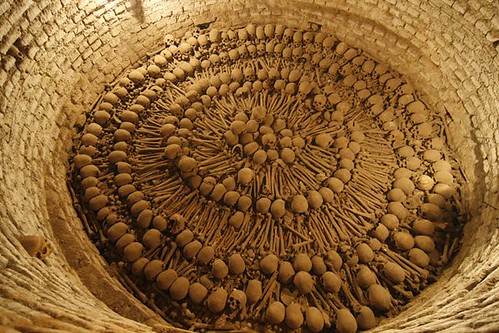
We walk through a wide second story colonnade surrounding a garden of mature fruit trees. Most of the pillars are out of plumb and the wide tiled floor tilts and ripples as a result of earthquakes. Then we descend through claustrophobic adobe passages crowded with other tourists to the Catacombs under the cathedral.  This was the only cemetery of Lima for its first 200 years, and it holds the bones of 25000 of its most illustrious citizens sorted into different parts of the skeleton”skulls, femurs, tibias, pelvises”arranged for display in symmetrical patterns in ditches along a maze of passages and at the bottom of circular wells 20 feet or more deep.

Skulls_femurs-Catacombs

Here is a foretaste of the ubiquitous presence of preserved bodily remains of the dead, in private homes, Inka temples and Christian shrines.

Arising from the catacombs, we emerge into the light of the square and the sounds of children laughing. A car backfires and we’re engulfed by a swirl of pigeons.

IMG_2747

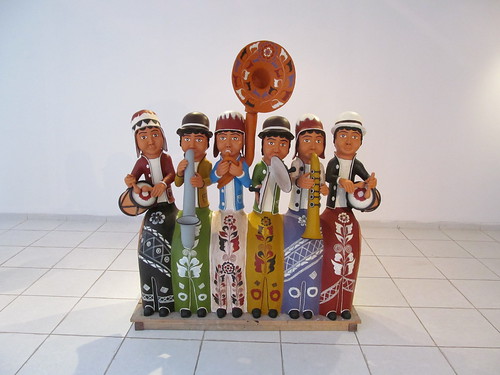
After a siesta back at the hotel, Jan and I retrace our steps toward Kennedy square and find a pleasant café for a late dinner at a price similar to what we’d pay at home.  On the way back to the hotel at 9:30, we wander into the still open municipal art gallery and find a display of Peruvian arts and crafts”modernistic variations of traditional corn-beer drinking vessels, an installation of dried vegetation stuck to walls and ceilings suggesting the jungle, and whimsical ceramic musicians in colors and postures reminiscent of the ancient pottery in the museum.

IMG_4136

IMG_4137

Slideshow of these and more full-size photos
Link to Day 2


Crossing Paths

August 4th, 2012

Solo departure for Lund at 7:00 A.M. after tying up loose ends yesterday, including the resubmission of a reformatted version of “Genes and Genesis,” the article now rejected by five journals.  Jan cancelled her trip to stay in SLO because of late-breaking family developments.

Between Paso and Salinas, at the outset of the long drive I  listen to the podcast of one of Dan’s Dharma talks, calmed by his voice though skeptical about the comprehensive reassurance he offers on all fronts, spiritual, emotional and political. Then the Beethoven Rasoumovksy quartets bubble in my earbuds as the wheels spin up the freeway at 80 mph. Then This American Life, Science Friday and Fresh Air.  Despite disdain for Corporate Takeover, I’m grateful for what I get from the automobile, petroleum, and digital entertainment industries.

An hour before Davis, where I’ve arranged to have lunch with Caesar and Penny, my new iPhone dingalings to interrupt the podcast with a call from Chad, a former Cal Poly student organizer and political collaborator since 2007.  He and Megan have taken a day off from their five month hike on the Pacific Crest Trail in Mt. Shasta City and he just wanted to say hello and thank-you for Jan’s email to him. I’ve read their endearing blog, Trail 4 Two, and have thought of them wistfully since they started back in April.

I’ll be in Shasta City that evening.  Could we meet? I’ll get them a hotel room. He’s incredulous and hesitant.  They just had a night in a hotel and are getting back on the trail to keep to schedule.  Maybe we could meet, with further prearrangement, on my way back around the 22nd.  I say I don’t want to pressure them of course, but what a coincidence this is.  He needs to talk to Megan; they’ve just got a hitchhike ride to Castle Crags where they’ll rejoin the trail.  I know Castle Crags I say; see it from the freeway every year for the last 42 years.  He asks if I have camping gear and whether I could I meet them on the trail. Absolutely.  He says he’ll phone back. A half hour later he does; says there’s a little road at the Centralia exit that leads to a spur where they can wait for me and we can hike and camp together tonight.

Caesar bubbles with news of his second grandchild born ten days ago and cooks up a  fritata filled with his own garden’s vegetables.  By 1:30 I’m eager to get back on the road for the rendezvous at Castle Crags. In our phone conversation I came up with between 4:30 and 5:00 out of the air, having little idea how long it would take from Davis, but as the hot Central Valley rolls by, the hour looks plausible.  Chad emails  the number of the ranger which I can miraculously click on the iphone, and he gives me the specifics of the location.  Then there’s a sign about traffic delays due to a fire ahead, and just above Lake Shasta the smoke and the slowed traffic that might abort the meeting.

[January 2025 note: the plug-in that allowed for insertion of images from Flickr no longer works, so only the code below replaces the intended pictures. The album that includes them is still accessible here:

[flickr id=”7707454128″ thumbnail=”medium” overlay=”true” size=”medium” group=”” align=”left”]

But the delay is brief and at the Dog Trail  parking area, Chad and Megan are sitting under a tree. We embrace and marvel at the coincidence of our trajectory.  I load my backpack with sleeping bag and the bread and sardines Jan had sent along and we head up toward Castle Crags and the maintrail.

[flickr id=”7707443796″ thumbnail=”medium” overlay=”true” size=”medium” group=”” align=”left”]

They are concerned about whether the climb is too steep, but I keep up the pace talking the whole way along the mercifully shaded path. It was 110 in Redding that afternoon, while they carried their 35 pound packs for hours through large changes in elevation.  They brim with adventures on the trail and are curious about  SLO politics and our family drama.

Around 7 we encounter some of their fellow PCT hikers setting up camps along a stream in deep shade.

[flickr id=”7707446180″ thumbnail=”medium” overlay=”true” size=”medium” group=”” align=”left”]

We find our own flat spot and are soon joined by “Fall Risk” a  veteran of the Appalachian Trail. He hikes in special shoes that partially compensate for an orthopedic defect. Among many other roles he’s a musician and composer and has been producing fully mixed songs with a phone app and sending them to his girlfriend.

[flickr id=”7707437240″ thumbnail=”medium” overlay=”true” size=”medium” group=”” align=”left”]

Chad and Megan prepare a sumptuous dinner using vegetables they dehydrated before their trip, one example of the vast project of planning and preparation it required.

[flickr id=”7707444538″ thumbnail=”medium” overlay=”true” size=”medium” group=”” align=”left”]

Another is the coordination with “Trail Angels” who’ve met them along the way with luxury provisions and fresh company.  But despite the totally upbeat atmosphere of our brief encounter I imagine that this project has involved a great deal of endurance of both physical and emotional rigors.

Though I sleep fitfully, the night is most pleasant lying next to Megan, breathing the balmy evergreen scented air, gazing at patches of light from the full moon sprinkled throughout the forest, reveling in the sense of escape from a burdensome routine of obligation and anxiety  and the prospect ahead of staying at Knoll House and spending time alone with Joe and more time with him and his family.

We all awaken at dawn for an early departure to keep up our several travel schedules and catch up on the time time lost with this happy delay.  The goodbyes are lengthy and poignant

[flickr id=”7707437846″ thumbnail=”medium” overlay=”true” size=”medium” group=”” align=”left”]

”better too brief than too long a visit. Along the trail I feel continued companionship with the moon and the crags

[flickr id=”7707439296″ thumbnail=”medium” overlay=”true” size=”medium” group=”” align=”left”]

[flickr id=”7707438906″ thumbnail=”medium” overlay=”true” size=”medium” group=”” align=”left”]

as  I head back to the car  concerned that it may have been vandalized by the locals who littered the parking area with shotgun shells and targets.  But Jade waits intact, and I get back on the road, talk to Jan, listen to music and decide, a little recklessly, to take an alternate route to Portland, where I’ve arranged to meet Andy P. at his studio in the afternoon for coffee on the way to rendezvous with Joe that night somewhere close to the Canadian border.

The drive to Klamath Falls on route 97 through volcano country and farmland is fast and beautiful, but the road gets ugly, busy and slow on the way to Bend and beyond.  I listen to a  lecture by a Harvard Medical School Professor on recurrent Glioblastoma, Steve’s condition.  I phone Andy to postpone and then cancel our meeting, perhaps until the return trip, and hear from Joe that he was late in leaving Ketchum and wont get to Bellingham until 1:30 A.M.  So I decide to kill some time, process and upload photos and eat dinner at the Timberline Lodge near the top of Mount Hood. It’s a beautiful stone and timbered structure built by the WPA, graced with with vast views, mountain flowers in full bloom and the summer snowfields of the summit.  A walk on the heavily travelled trail in back leads to a sign indicating a junction with the PCT.
[flickr id=”7707452166″ thumbnail=”medium” overlay=”true” size=”medium” group=”” align=”none”]

Here, Chad and Megan will again cross my path, but only after several more weeks of toil and deprivation.

I drive down the shoulder of the mountain and rejoin Interstate 5 north of Portland and carrying on my musical and literary migration as night falls.  I hear Librivox recordings chapters from John Muir’s 1915 Travels in Alaska describing the beauties of the Northwest, the charm and geology of Victoria, the splendors of the inside passage and Alaskan glaciers.  At midnight I reach a rest area five miles south of the border from which we can make an early enough departure to avoid what will be lengthy delays at immigration and at the ferry at the beginning of this midsummer holiday weekend.  I fall asleep behind a picnic table, and waking for a pee at 1:30 I see Joe’s truck parked next to Jade.  I get up with the first light at 5:00 A.M. wake and embrace him, and we get through the border and onto the ferry with no wait.  His truck is loaded full with construction tools.

We buy groceries in Powell River, arrive at Knoll House in the sunshine, sleep-deprived but satisfied, and gasp at the immaculate condition of the place left to us by Tai and Theo, hardly a trace of their possessions visible, and all the Marx family stuff placed exactly where we left it.  Neatly stacked next to the half completed deck for the cabin is a pile of timbers cut from a tree near the driveway by Sam Richards.  Peter and Margaret stop by with a big zucchini and an invitation to a 70th birthday party at Pam’s, but we politely decline.

Father’s Day 2012

June 17th, 2012

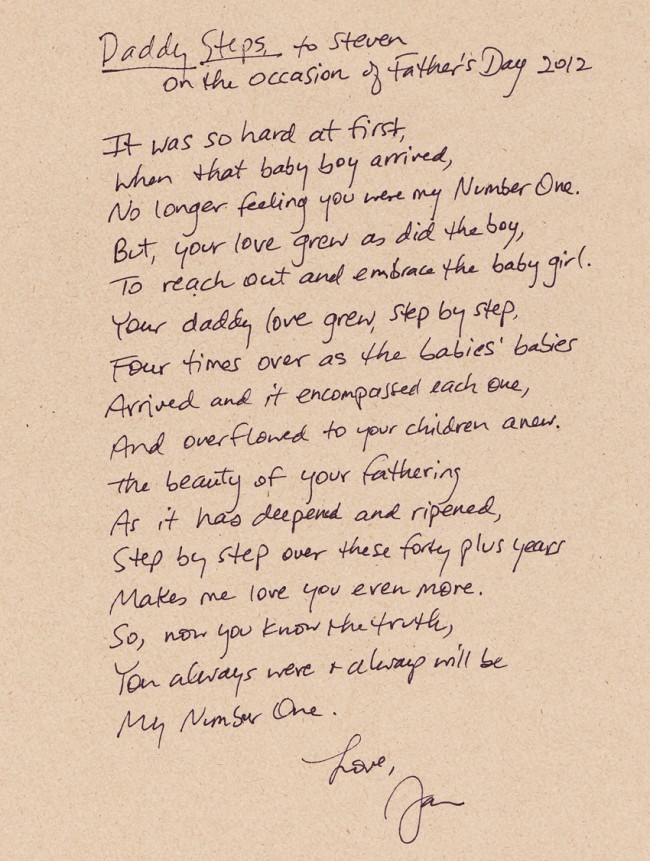
Jan wrote this amazing poem for me this morning.

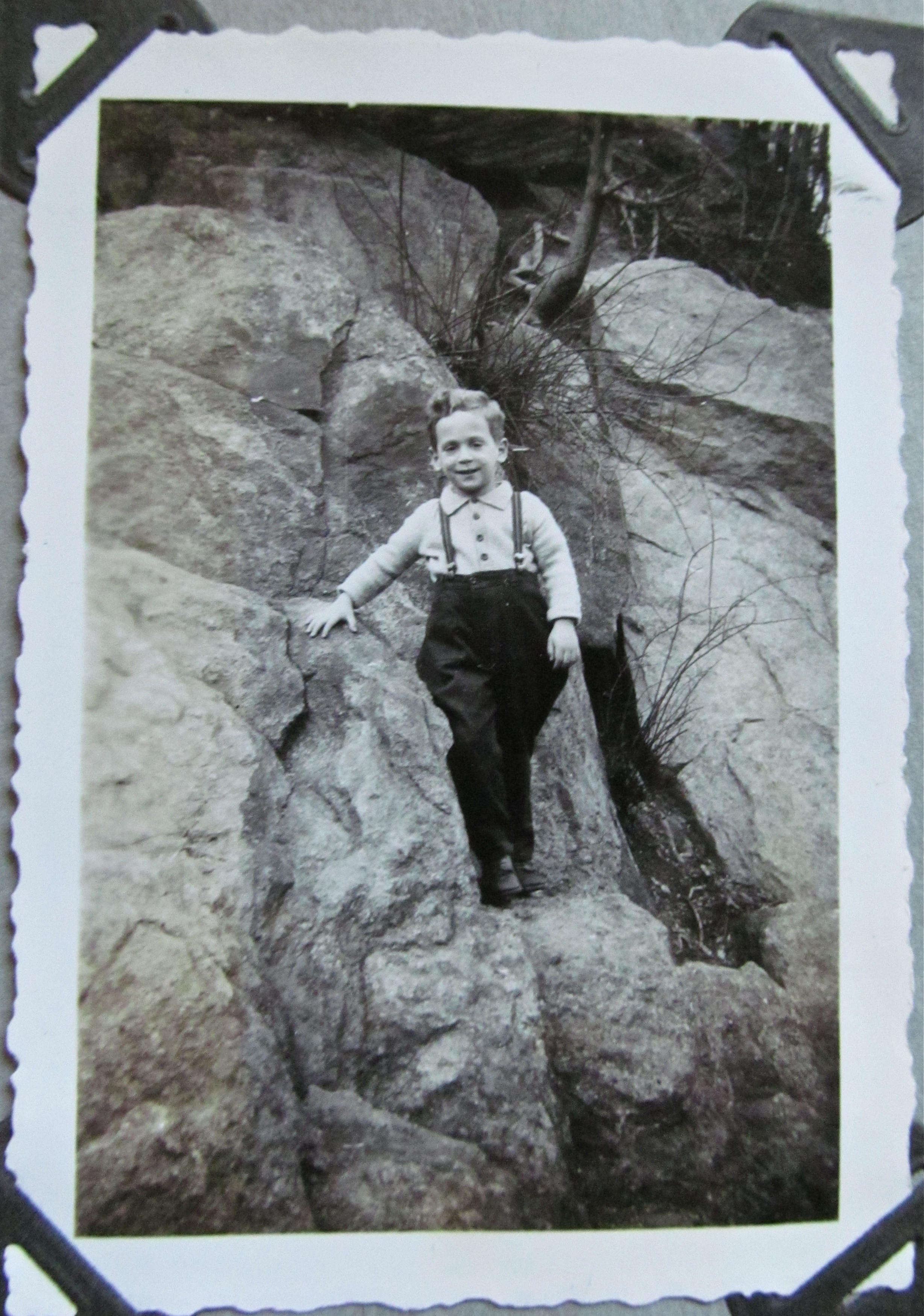
Her title,”Daddy Steps” is a phrase I invented when I was three years old to denote little granite stairways and trails that diverged from the paved footpaths in Fort Tryon Park, near our tiny upper Manhattan apartment. My Daddy and I would love to follow them together off the beaten track.


When I first saw the steep undeveloped backyard of the house we moved to in San Luis Obispo in 1988, I looked forward to making some Daddy Steps for my grandchildren.


Biopsy

June 10th, 2012

(for Steve E.)

Sometimes you pass without notice
into a new state
and look back later
and say, “how it’s all changed,
how did it happen?”
And sometimes there’s this:
a teetering on the sharp edge
of everything being different.
And if you go over, sometimes,
gradually you come back.
And if not, then you’re there,
looking around, getting by,
just like here.

Grandparenthood

April 5th, 2012

Amor vincit omnia
says the Prioress’ golden brooch
in a Middle English prologue
I recited yesterday to my class.
Love conquers all:
all order, constraint, justice
hope and resignation
dissolved
in the assault
of horned buck, spurred cock
and rival knights,
in the swoon of a smitten queen,
in a country parson’s charity.
When offspring wander wayward
with their brood
it herds them home
undaunted.

Book Review: Shakespeare, the Bible, and the Form of the Book: Contested Scriptures

January 7th, 2012

Shakespeare, the Bible, and the Form of the Book: Contested Scriptures, edited by Travis de Cook and Alan Galey, Routledge, New York and London 2012.

Published in Religion and Literature 44:2, Fall 2012

This is a collection of essays about relationships between the production, dissemination and reception of books and the pairing of two books: Shakespeare and the Bible.

Many recent scholars have studied the either the Bible or Shakespeare in terms of the history of the book”ways that material media have determined their form and message.  Intertextual relationships between Shakespeare and the Bible is also a familiar, if sparse, field of critical inquiry.  But investigating the coupling of Shakespeare and the Bible itself with the methods of textual materialism is a novel and narrowly focused undertaking.

The editors’ discussion of Rudyard Kipling’s whimsical 1934 fantasy about Shakespeare’s drafting language of the King James Bible introduces the book’s overall polemical argument that the consideration of historical and physical conditions of texts should counter the tendency to canonize them and “naturalize” their assumed unity and completeness.

The book’s first group of essays examine ways in which Shakespeare’s use of the specific editions of the Bible he’s presumed to have read affected plot, characterization, theme and language in individual plays. Read the rest of this entry »

New Year’s Eve 2012

December 30th, 2011

The invitation from our esteemed host
Requested that his guests would bring along
Some ceremonious way to make a toast
For this occasion with a poem or song.

Hence, without a moment’s hesitation
I consulted Google for a clue.
It spewed forth many hits for contemplation
Of the old year’s end and welcome of the new.

I found verse by Shakespeare, Ralegh, Clare
Robert Burns and Frost and Service too
All grieving for the loss time makes us bear
All hopeful for what next it brings in view.

There’s little more to say than what they said,
So lets just try to love life, till we’re dead.

Zunoquad 4: Canoeing the Green River, Utah, 2011

October 7th, 2011

Full Slideshow

September 16

IMG_0018.JPG

Steve E., Peter U. and I strike camp in Zion National Park after two days of pre-canoe trip hiking and drive Interstates 15 and 70 through beautiful unpopulated country. We stop for breakfast in Richfield, a surprisingly prosperous agricultural town in a long, settled valley, where we joke with the waitress who brings us generous portions of  fresh, low-priced food.

A blasting rainstorm in the afternoon causes concern about how we’ll cope with such weather along the river. In the town of Green River, the next settlement located 130 miles down the road, we buy locally grown melons and visit the fair.   Pulling into Moab, we’re delayed by a high-school parade that blocks traffic.  The three of us spread out in the busy grocery store, and within a few minutes finish last minute grocery shopping for perishables. We meet up John and David, who’ve driven up from Phoenix, eat dinner at a hip Thai restaurant and head to the airport 20 miles north to meet the rest of the crew”five men flying in from Bellingham and Seattle.  Sharing a bed in the Red Stone Motel to save money, I find it hard to sleep, from excitement and also anxiety about the two hour rainstorm that pelts the town from 4 to 6 A.M. This is the kind of weather we were prepared for in the Yukon two years ago, but not here.

arrival

to start on a bus
passing thru unknown
is to be alive again

continuing in plane
after subway sky train
surviving stopped watch
during last hour
reappearing only at check in line up

end by flying back over rockies
in plane smaller than powell river’s
with flight attendant also pilot
landing fifteen miles from town
on only long enuf flat spot
˜tween peaks
met by part of other half
to crash in moab
where it never rains

Murray th K

September 17

We all gather at Tag Along, the outfitters, at 8:00 A.M.”any delays, we’d been told would be charged to us at $80/hr”but don’t depart until an hour and a half later due to their short staffing.  Two of the five canoes left for us are so dinged up we insist they substitute another two they say are reserved for a different party.  They agree and epoxy the hole in the keel discovered in one of the better boats. Dave, the crusty old river rat who drives the van and trailer that takes us to the embarkation point at Ruby Ranch, recites paragraphs from Edward Abbey, the literary voice of this part of the world. The morning’s rainclouds give way to sun beating down with an intensity as frightening as the thunderstorms, until I apply sunscreen, even under my t-shirt.

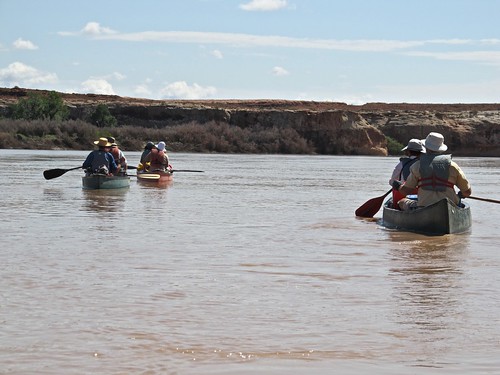
The van leaves us alone and we enjoy lunch under the shade of riverbank cottonwood trees, making quick work of dividing up the large cargo of nine-days provisions into the five boats. Lionel is appointed team leader for the day and I paddle bow in his canoe.  Entry into the swiftly flowing current of the muddy river is blissful: ten people sprung free from the connections of daily life and reattached to this old untrammeled association.

IMG_0082.JPG

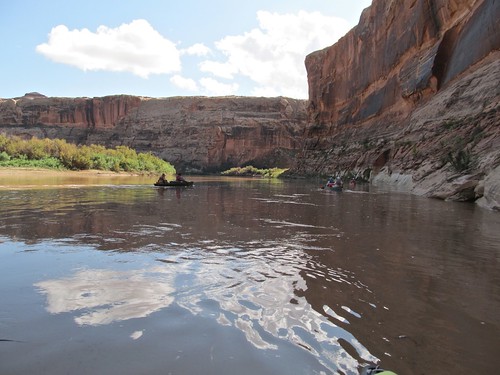
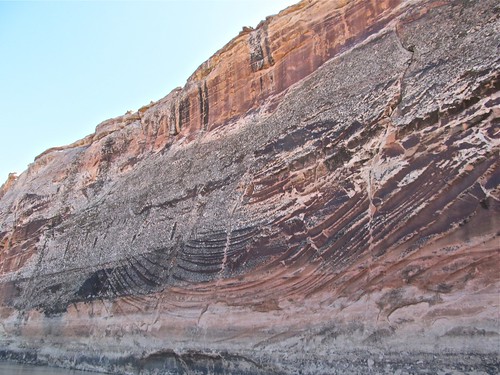
After less than an hour the flat grey desert banks transform into sculpted red sandstone cliffs revealing layers of deposition and erosion produced by the rise and fall of shallow seas over hundreds of millions of years.

IMG_0107.JPG

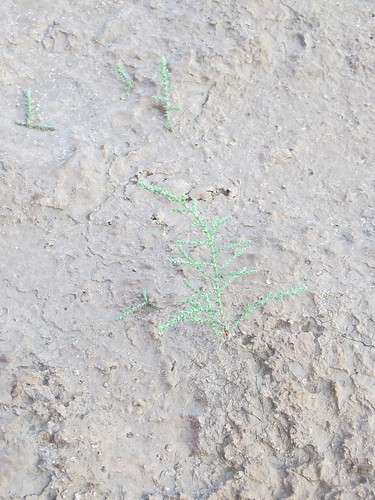
There are no other people on the water or signs of human impact on those banks, except for the relentless thicket of tamarisk clogging the “Bottoms” which line the inside edges of the river’s tight turns.  This impenetrable Asian vegetation has driven out most of the native cottonwoods and willows that used to provide open shade and habitat along the shores. It was introduced by  government soil conservation officers from the Great Plains to control erosion.  They didn’t realize that erosion here was the essence of the riverbank ecology for millions of years.

IMG_0157.jpg

The variety of angle, color, texture, light and shadow overwhelm the senses as the canyon deepens and the scale of its walls reduce the canoes to miniscule toys. But rhythmic repetition soon becomes evident at every level, from the immense meanders of the river’s trajectory to the parallel scratches in the rock polish, suggesting ranks of wing feathers brush-stroked by the wind with an action painter’s abandon.

IMG_0084.JPG

The air is desert-clear, the sky flat opaque blue, the sun hot enough even under hats and sunscreen to make us search out shady patches along the cliffs and revel in their momentary coolness. Occasionally we cross toward the opposite bank in search of a faster flow or to avoid the riffle indicating a submerged sandbar. Passing close to the frescoed walls, we sense the  progress of the current bearing snowmelt and silt from a thousand miles upstream down another thousand miles from here to the sea.

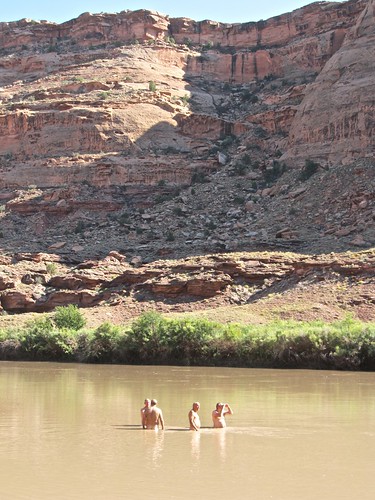
At seven miles from the starting point we stop at June’s Bottom, a sandy beach at water level with a thin margin of shade under the tamarisks, where our large 16 by 24 tarp can be rigged by tarpmeister Steve to provide shelter in case of another downpour. We strip naked and jump into the river letting tense muscles be carried by the stream, chilling hot dessicated skin in the thick cool liquid.

IMG_0148.jpg

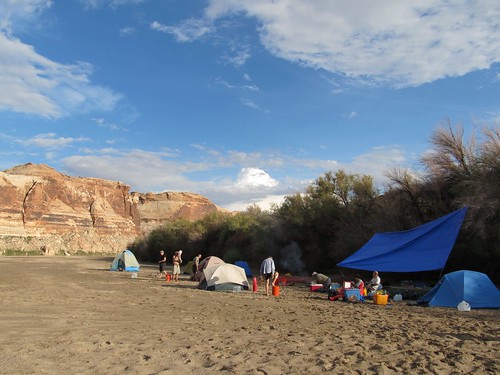
Then ten bodies swarm over the canoes hauling the cumbersome loads ashore.  Some gather firewood, some pitch the tarp and their tents, some set up the kitchen, boil potatoes and corn and then barbeque steak, the last fresh meat of the trip. Happy hour is declared and a five-liter box of wine is quickly emptied.

IMG_0121.JPG

A gray cloud passes overhead and deposits only a few drops of rain. Conversation bubbles and flows: practical coping, group problem-solving, planning the next day’s itinerary and destination, all rendered lyrical by the pure beauty of this place. The average age of the men is determined to be 64”all of us in retirement or at least heading that way, exploring the possibilities of leisure or of new careers.

IMG_0144.JPG

Mosquitos are bothersome for an hour or so around sunset, and then stars cover the black night sky, the spaces between them filling with a misty glow that can be perceived as innumerable points of light.
start

up at five-thirty
to th question of why
do we need four pounds of aluminum sulphate
before three hours
of waiting
canoe loading
and ruby ranch entry history
with mud flats desert moonscape
midst phalfalfa fields
and lunch
before push off
with quick hit of california green for some
and irridescent blue herons
nesting  above
three canyon campsite search

stop at june’s bottom
with enuf time for
dessert first trudy cake
and steak corn potato grilled
before plastic cornhusk refuge burning
over distant political drill debate
and ending before finding mom
by eight thirty or nine

Murray th K

Read the rest of this entry »

A Visit to EldrBill

August 28th, 2011

There’s alot for an environmentalist to feel hopeless about these days, from calls for the militarization of the Arctic Ocean as a response to the melting polar icecap to the prospect of our local chapter of the Sierra Club running out of money. So I decided to take a little trip to Nipomo to express a treasurer’s appreciation to a donor whose generosity has allowed us to keep going for one more year, and also to get my spirits raised.

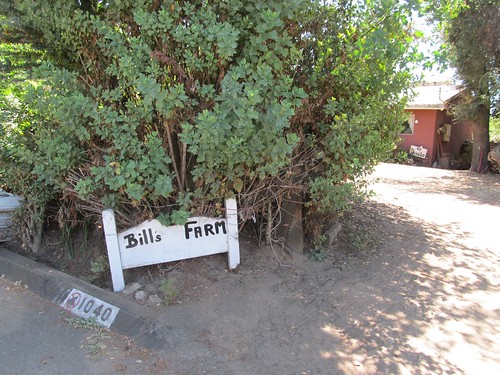
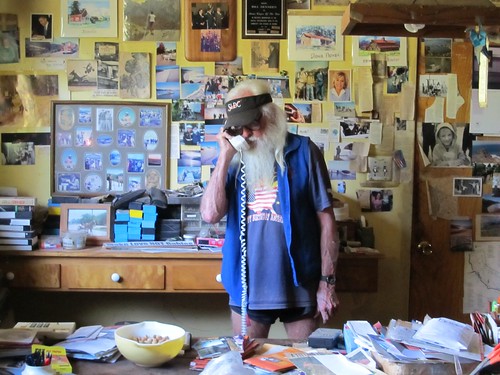
“Bill’s Farm” looked no worse for the wear since the last time I stopped by three years ago. I noticed an ancient carriage almost hidden by the gaggle of bicycles kept here for the use of his hostel visitors from all over the world and the array of solar panels on the roof setting off the “No Diablo” sign by the corner of the house.

IMG_0075.JPG

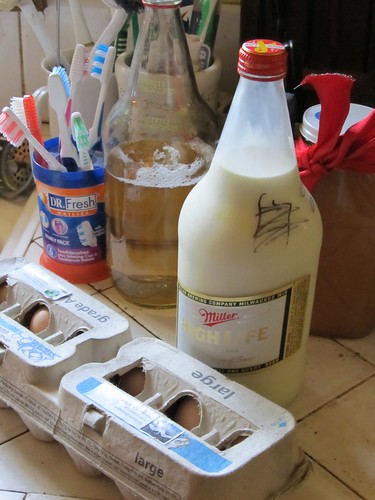
I was welcomed by a high ringing voice, and once inside surrounded by walls and tables completely covered with pictures and clippings. On the counter was a half-empty quart bottle of beer next to another one full of milk.

IMG_0080.jpg

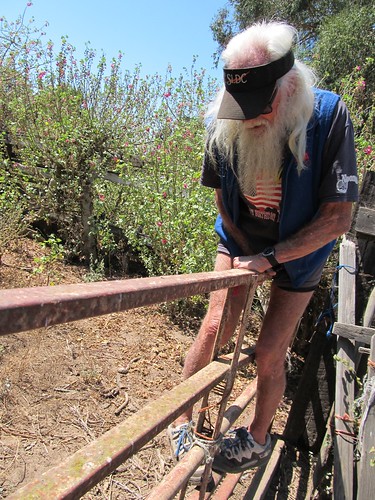
“Just did the goats,” giggled the man with flowing white hair, cascading beard, cabled arms and frighteningly tough legs revealed by his short-shorts.

“I love goat’s milk,” I said, “reminds me of my days on an old homestead in British Columbia.”

“Take it,” he answered, “and that dozen eggs from my chickens.”

“Bill, I came to say thanks,” I replied, “and here you keep giving me more.”

The phone rang and he spoke briefly to someone about the Santa Maria Times article on the table that reported his $500 environmental award to the graduating High School Senior who’d volunteered in the Nipomo Native Garden and was now heading for UCSB.

IMG_0079.JPG

“These young people inspire me,” he said. They’re our only hope. I’m 86 and starting to lose it, but they carry the torch. Here’s another one of my heros,” he declared, pointing to a picture of Jordan Hasay: “While I was doing a triathlon a couple of years ago and just ready to throw in the towel, she came up behind me. ˜You can make it,’ she said, ˜just keep going.’ And she was right.

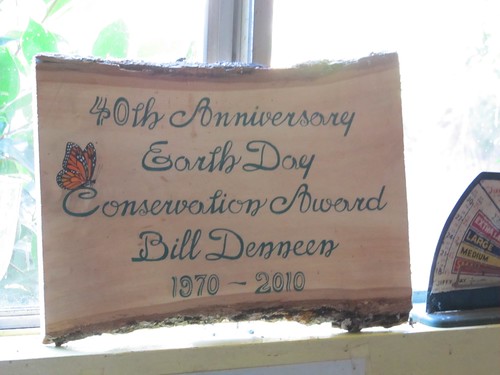
Then here’s Virginia Souza, she’s the President of the Natural History Museum in Santa Maria. It’s tiny, but she just hosted an event there for the Chamber of Commerce which brought out forty people. In Santa Maria! She was a biology student of mine way back when. I introduced her to the idea of ecology. Here’s an award for the 40th anniversary of Earth Day she gave me last year.”

IMG_0085.JPG

“And this is my woman’s wall. Next to the fridge, pictures and articles about Barbara Boxer, Lois Capps, Hilda Zacarias, Lisa Jackson, Dixie Chicks, Sonia Sotomayor, Ruth Coleman, Marion Jones, Steph Brown, Kathy Goddard Jones. “I remember your Dad, Henry,” Bill chuckled. “He used to tell me how the dunes were ˜so sensual.'”

That must have been 20 years ago, when my father was just about Bill’s age now. “How old are you?” he asked.

“Sixty nine,” I answered, “just retired.”

“My sixties were my best decade,” said Bill. “Learning how to appreciate things because the end was in sight, but still capable.”

He brought over a stack of postcards and said, “here, take a few.” The top one was a photo of a sand dune gracefully curved against the sky. Running up it was a black lab next to a perfectly formed naked young woman. “I’ve worked to save those Dunes and Point Sal for 50 years–from a Nuclear Power Plant, from a Coal Fired power plant, from a housing development, from developers. And now they’re safe in perpetuity, since the SLO Land Conservancy just purchased the last developable property. Lets go out back.”

We passed his desktop computer surrounded by magazines and books, where Bill composes his “Nipomo Free Press,” an email newsletter that includes commentaries on the latest news and on long term issues as well as responses from his readers”precursor of the blog. We talked of another hero, writer and 350.org organizer Bill McKibben, who was sitting in a Washington jail after leading a protest against Obama’s approval of the XL Pipeline. We passed the chickens scratching in the sand, the empty pigpen”the pig was in the freezer”and the goat corral. He climbed nimbly over a high gate into an overgrown orchard of apple and tangello trees heavy with fruit that I sampled and picked. “I just cant keep these up any more,” he said with a twinkle. Don’t get old.”

IMG_0089.jpg

On my way back to the car weighted down with eggs, milk and fruit, I felt lightened. Instead of dreading yet another meeting to discuss grant applications, budgets, and liability insurance, I was eager to share Eldr Bill’s harvest with the volunteers at the potluck that night.