“Fortunate Senex”: The Pastoral of Old Age
April 18th, 1985
Studies in English Literature 15 (1985)

April 15th, 1985
Book published 1985
Dissertation completed 1981
Dissertation started 1966
March 11th, 1985
A plenary lecture to “Literature and the Arts in Western Culture.”
Stanford University March 11 1985
I first came across Candide when I was seventeen, the age of its protagonist at the beginning of the story. I can remember that simple title staring out at me from the spine of a thin volume on the musty shelves of Baron 1 s, the used bookstore that I frequented with my sidekick Weiskopf on Friday afternoons–after our last High School class and before we took the subway downtown to hear music at Jazz on the Wagon, the one place in Greenwich Village you could get into without I.D.
I had heard the name Candide before; it was known in the grapevine as one of those books–intellectual, bohemian and intimate–that our parents wouldn 1 t approve of, books with titles like You Can’t Go Home Again, On the Road, Howl and The Catcher in the Rye. I slipped the book down from the shelf, noticed the “privately printed” inscription, the mannered art-nouveau illustrations of thin bare-breasted girls, the sixty cent price, and I took it to the register.
From the opening sentence, I was entranced. Here was another Holden Caulfield, still a sincere, naive and gentle child, cruelly punishe9 for simply following his natural desires, abruptly booted from a secure nest in what was just beginning to feel like Paradise, and set adrift in a human jungle of repression, hypocrisy, violence and greed. I could relate to that heavy tale–especially since it moved along so lightly, with a little sex and a lot of laughs on almost every page. I too felt adrift in a world of wandering hands and kicks in the backside, of atmospheric H-bomb tests and classroom shelter drills, of Anne Frank and Joe McCarthy.
I finished reading the book at two in the morning on the Staten Island ferry, where we would ride back and forth across New York harbor when the jazz club was too crowded. Thereafter, Candide became another one of those few voices which confirmed my adolescent sense that I lived in a pretty screwed up place-despite the assurances of Doris Day, Dwight Eisenhower and Dr. Norman Vi.11cent Peale that middle-class America was indeed the best of all possible worlds. Read the rest of this entry »
April 1st, 1984
On American Airlines flight 510 to Kent Ohio
For two days I’ve been shopping and packing, provisioning for this expedition: 10 copies of a résumé, my article in progress, financial statement on Laurel tree care, family picture, three piece suit, hiking boots, dissertation, Index cards. My excitement has intensified since the Monday night phone message from the Davey Tree Company which said “we want you to come spend a week at corporate headquarters in Ohio as soon as possible.” Rescue and opportunity!
I sought out this company and this field of work both out of desperation and hope. The academic career I qualified for had dead ended again while working with trees is “a path with heart.” Since the termination of Jan’s job as Dean at Scripps College, the support of the family shifts to me. She needs the kind of space she has provided me, and someone must supply the family with peanut butter and running shoes. Read the rest of this entry »
December 27th, 1983
[Published in the Western Chapter News of the International Society of Arboriculture, March 1983]
Readers of The Western Chapter News may be interested in two remarkable tree books published in recent years but not reviewed in the trade journals. They are Trees by Andreas Feininger (New York: Penguin, 1978, $9.94) and The Tree by John Fowles and Frank Horvat (New York: Little Brown, 1980, $24.95). Large formatted and lavishly produced, both books combine stunning photographs with informative, provocative and beautifully written texts. Their authors enjoy worldwide artistic reputations: Feininger exhibits in major museums and has published numerous other photographic studies; Fowles is a best-selling British novelist, author of The French Lieutenant’s Woman; Horvat is an eminent French landscape photographer.
Though none of these artists is a tree professional, their work displays extensive knowledge; more important, it expresses the kind of lifelong respect and affection for trees that lies at the heart of the arborist’s vocation. Like truly skilled tree work itself, these books represent a labor of love, an outpouring of praise, and and application of human art inspired by the art of nature. By deepening awareness of the value and meaning of trees, the authors hope ultimately not only to enrich human experience but also to save trees and forests from the wanton destruction to which they are still subjected.
In his introduction to Trees, Feininger states that he has created
…a new kind of book not a text nor a manual
nor a tree identification book, nor still another book proving
trees are beautiful, but a tree appreciation book.
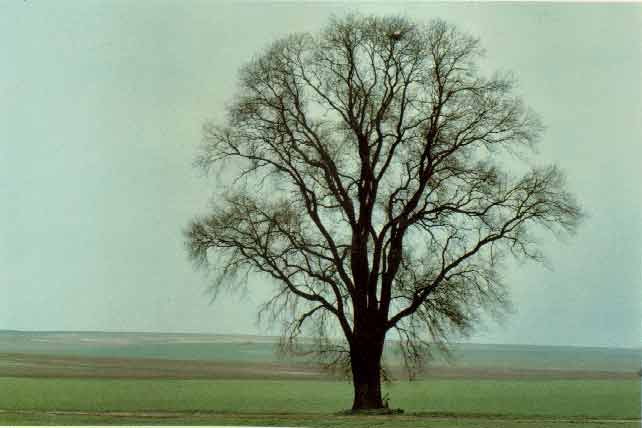
In fact both these books promote tree appreciation in similar ways. First is through simple presentation. By selecting, composing and framing each tree portrait, the photographer brings forward aesthetic qualities–qualities of strength and fragility, of symmetry and variation, of balance and tension–that normally pass unobserved. Recalling Feininger’s shot of the massive central trunk of a twisted oak in a German park, I stop my morning run to admire the gnarly Quercus agrifolia in my neighbor’s yard. Or stuck in freeway traffic, I flash on Horvat’s portrait of the Wych Elm silouetted by a January mist, and suddenly I’m greeted with the sight of an Ulmus americana arching its limbs over an Arco station.
Appreciation of trees is also fostered by these books’ focus on detail. They slow and thereby enrich our perceptions of pattern, texture and light: Horvat’s row of pollarded sycamore crowns, Feininger’s mulberry leaves outlined black against the white sky, or his sweetgum leaves outlined against the dark background foliage. In such treatments of detail, the artist’s gift emerges. For while a lengthy series of photographs of bark in a tree identification book becomes schematic and dull, Feininger’s seventeen-shot sequence on trunks manages to build steadily to a dramatic visual climax. Each full-page portrait varies light, camera angle, distance, background and composition, delighting us with the variety contained in repetition. Read the rest of this entry »
November 14th, 1983
*
The trees are there
when talking stops.
They wait
for the runner.
*
At the track
before dawn
no sound
beyond breathing
but the freeway.
Exhaust
tires
and scares the runner; he stops
and notices the green-wattle tree
survives.
It softens the noise,
it freshens his blood.
*
Pursuing a youth
made lovelier yet by flight
through woods he runs
unloved,
imploring recognition.
Outdistanced and breathless
she prays for escape
then stands.
Her heart still beats against his touch
as bark encloses the soft breast,
arms twist into branches
hair flattens to leaves,
and swift feet root underground.
They are crowned
with laurel.
*
Last night’s storm
cleaned the branches
but left a mess
of yellow liquidambar leaves
on the wet, black pavement.
The runner’s eye arranges them
in passing.
*
The trees help the runner
reach his goal.
For his motion
they exchange stillness.
*