April 28th, 1983
An Address to Philosophy 152: Theories of the Good Life
Claremont McKenna College
April 28 1983
I want to talk about this week’s topic–The Good Life as Living in the Country–by loosely braiding three strands of material into a single line of argument. These strands consist of your assigned readings by Carolyn Lewis and Scott and Helen Nearing, a discussion of the pastoral tradition in literature, and an account of some of my own experiences with living in the country for the better part of nine years.
The idea that the Good Life is to be found outside the limits of civilization in a rural, natural setting is as old and as widespread as civilization itself–a word whose root signifies the culture of cities. Urban people have often reacted to the conflicts and tensions of their existence with the wholescale rejection of their artificial environments and with affirmations of what they imagine to be the simple, happy lives of those who live in the country. This attitude has been dubbed “primitivism” by historians of philosophy, who have discovered its traces in some of the earliest Sumerian and Babylonian texts.
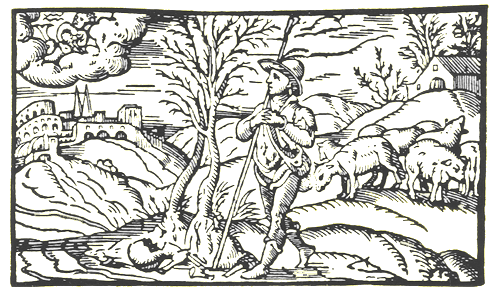
Primitivism has always been especially popular among writers–poets, dramatists, essayists, novelists. Their utterances of love of nature and hatred of the city have constituted a distinct literary genus called pastoral or bucolic–after the shepherd or cowherd whose occupations seem to embody the primitivist ideals of simplicity, unpossessiveness, rapport with nature, and the leisure for erotic, artistic and contemplative pursuits. Some pastoralists assert the theory of the Good Life in the country from the heart; others do so primarily to display their ability with words.
One can see evidence of the breadth and self-consciousness of this pastoral tradition in the way each chapter of the Nearings’ book begins with numerous epigraphs from sources ranging from ancient Chinese proverbs to Shakespeare and Thoreau. These epigraphs indicate that much of what follows has been said many times before and for that very reason bears repeating. The pastoral theory of the good life in nature and of the corruption of civilization dominates the Bible. We find it also in Homer and Hesiod–who project visions of the Golden Age before cities were founded; in the Phaedrus–where Plato paints an idyllic scene of erotic philosophizing outside the city walls; and in the Bucolics and Georgics of Vergil”which praise the quality of life far from the seat of Empire.
Read the rest of this entry »
Posted in Miscellaneous, Scholarship, Teaching | No Comments
July 13th, 1982
Posted in Family, Heritage | No Comments
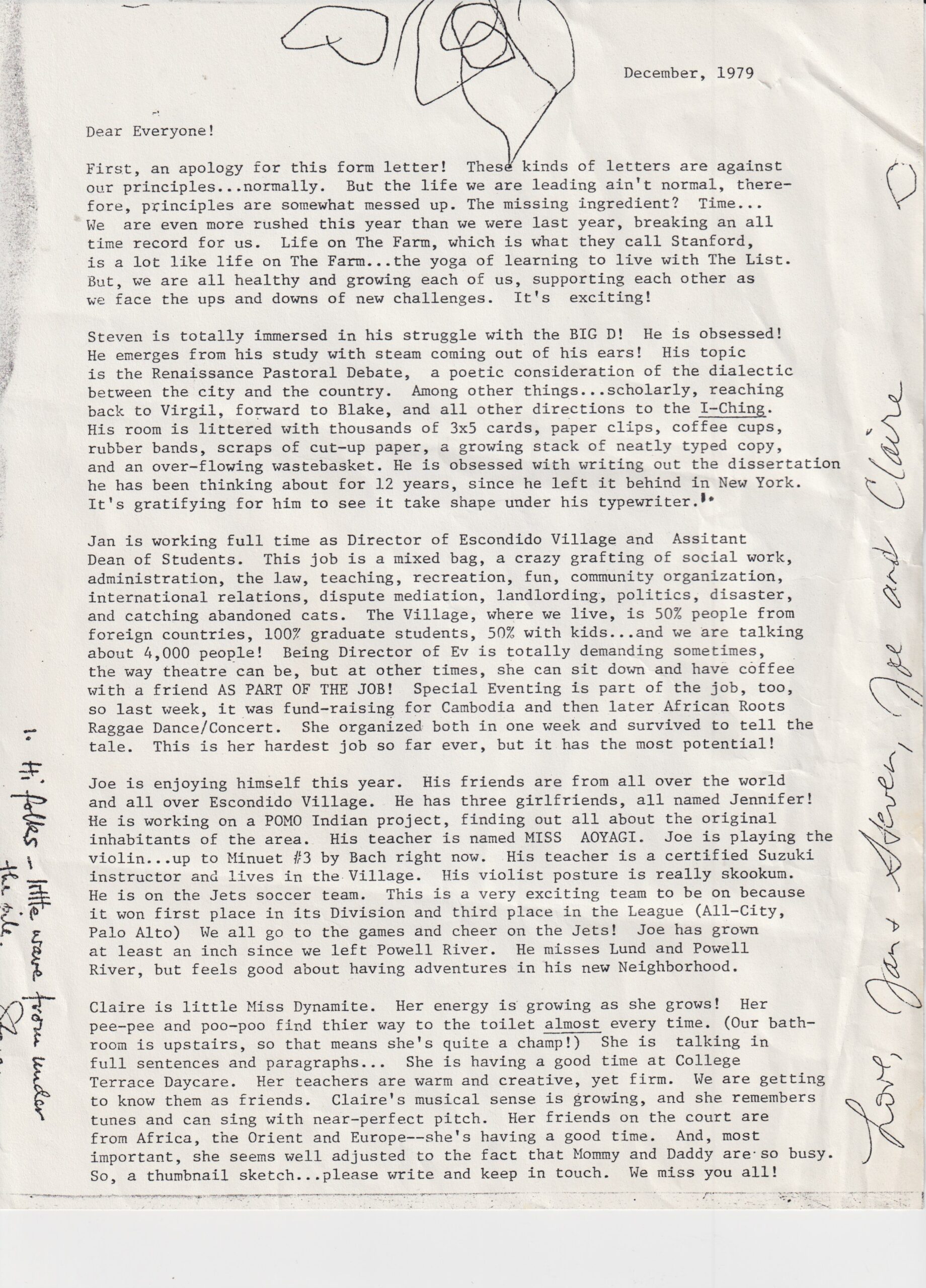
March 21st, 1981
5

The Backstretched Connexion:
Youth and Age
in The Shepheardes Calender
This chapter proposes an interpretation of The Shepheardes Calender which places the debate of youth and age at the work’s core. Spenser used both the thematic content and the formal structure of this minor bucolic convention as the central shaping principle of his major pastoral work. Such emphasis was particularly appropriate, first because pastoral’s rural settings on the periphery of civilization correspond to the peripheral states of the human life cycle, and second, because pastoral’s projection of dual worlds inspires debate-like comparisons of perception and judgment.
But Spenser did not simply reprocess these essential elements of the pastoral tradition. Rather he modified and enriched his conventional models by disclosing the debate of youth and age through the viewpoint of a narrative persona, a viewpoint which shifts in the course of the poem from identification with youth to identification with age. That is to say, Spenser used the pastoral debate of youth and age as a means by which to externalize the inner conflicts of past and future, of regression and maturation, endemic to adolescence. By patterning his series of eclogues with a phased succession of such debates, Spenser allowed the reader to participate in the reversal of perspective that constitutes the subjective transformation of boy into man. Moving from premises about the psychology of pastoral and about the philosophy of debate laid down previously, this chapter arrives at the conclusion that The Shepheardes Calender–a product of its author’s youth and addressed to youthful readers-has as its deepest unifying subject the life stage of youth itself. Read the rest of this entry »
Posted in Miscellaneous, Scholarship, Teaching | No Comments
October 20th, 1980
Posted in Scholarship, Teaching | No Comments
April 2nd, 1980
Love is whatever you make it
Just like the song that I sing
A cage or a perfect circle
This golden wedding ring.
We made a vow in a garden
Twelve years ago today
To build our lives in common
To link arms on our way.
Now look back on that moment
Where once the seal was set
And see our path returning
To the place where we first met.
We’ve lived in the big bad city
We’ve moved out on the land
But location no longer matters
It’s where we are we stand.
We blasted through the sixties
A searchin’ to be free
Came down to earth in the seventies
Accepting the limits of “me.”
And everything we wanted
And everything we tried
Has come and gone in the rushing stream
Has flourished and withered and died.
Except for one thing only
That stands against the flow
That time, instead of eroding,
Has strengthened and helped to grow.
And that’s what always is April
The moment under the tree
The love that we make together
The source of our family.
Palo Alto, April 2 1980
Posted in Poems | No Comments
December 8th, 1979
Posted in Family | No Comments
April 28th, 1978
Posted in Family, Lund 1970's, Travel | No Comments
April 3rd, 1978
I had been feeding the pigs extra ration all week to use up what was left of the Hog Grower. They sounded even angrier than usual on Saturday morning, when I didn’t stop at their pen on my round of chores. By the time I finished rinsing the milk strainer, Jonah had already belted himself into the front seat of the car.
I floored the accelerator for the five mile trip down the highway to his friend Jimmy’s house, where I had arranged for him to spend the day. The inside of “the wagon wheel place” felt strange to me, its walls lined with trophies and racks of guns.
Back home, 1 started preparing. I redug the old fire–pit in the backyard, split a good sized pile of dry cedar and alder, and scoured out the forty gallon drum. I set the drum over the pit, staked at a 45 degree angle against the heavy work table, so that we would be able to dip and pull while scraping the hides. As water from the hose slowly filled the drum, I kindled the fire. Then I went over to the collapsing root cellar and sawed off two maple branches growing through its roof. I sharpened them at both ends to make spreading sticks and placed them on the table next to the coiled ropes, the pile of folded gunny sacks, the whetted knives and the .22.
I was feeling anxious, but more focused than usual. I had to be ready by 11:00 o’clock, when Terry K., my experienced neighbor, was coming over to help out. As I had explained to our visitor from the city a few days earlier, slaughtering animals no longer disturbs me, as long as the process is carried out with order, precision and respect for the animal’s gift. Read the rest of this entry »
Posted in Family, Lund, Lund 1970's, Miscellaneous | No Comments
October 22nd, 1976
Peace, composure. Gladiola in the red teapot in the blue kitchen. Dahlia in the medicine bottle on the little table. Pumpkins on the mantle. Two days of being with children, processing food: apples, tomatoes, hemp. The plants watered, the dog sleeping by the stove. Cleaning house. The dust and cobwebs and foodstains are gone, the outlines of the furniture, walls, floor are clear not fuzzy. It feels good to look around.
Posted in Lund 1970's | No Comments
October 4th, 1976
Last night: The Seventh Seal at the College, followed by Roy and Eileen’s wedding reception at Lund. Neil walked up while I was eating smoked salmon and drinking champagne and told me that it was Kol Nidre evening. This morning I decided to fast and pray, but first a furious cleanup of Jonah’s room and the bedroom.
I dug out the bag of Tfillin I received at my Bar Mitzvah. The blue velvet covered with dust and mold, the zipper seized with rust, the leather inside cracked and twisted, a hole worn through the gold embroidered star of David. It was left under a leak in the cooler for two years. Inside a stained piece of paper with Aunt Marta’s history of the Wertheimer family back five generations: “Steven Marx, great grandson of daughter Rose of Baruch Loeb Wertheimer, wife Jeannette, is Professor at Columbia University.”
Last night at the reception, June urged me to write and stop mucking around with distractions like theatre. A dream recurrent: I’m in a cafeteria line, very anxious. I have several classes to attend during my senior year. I have an excellent record but I haven’t been to these last required classes in a long time. I forget what the courses are, what the assignments, don’t know what the consequences will be, they may be terrible. I wake up unhappy.
The crankiness and stomach pains from fasting have passed into a slow passive contentment like that I felt after the Gestalt group in the tipi. Reading prayer book, beating breast, dubbining the Tfillin straps and taping up the boxes, unsure of what’s inside. Jan comes home and I work with her canning tomatoes.
Posted in Miscellaneous | No Comments