Author Archive

Technotravel

Sunday, October 16th, 2005

Saturday September 24. Sitting on the floor in LAX international terminal next to the only electric outlet on a mile of concourse. Many wall receptacles have been removed and the holes spackled over. There’s no wireless internet connection here, so I will try to simulate the Blogger interface in Microsoft Word.

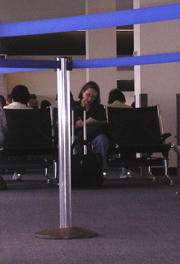
Here’s Jan in a chair across the carpet as this area fills with passengers waiting for a JAL jumbojet. I took her picture, downloaded it to the laptop, put it in here. With a camera phone I could have snapped and sent it directly to the blogger server. Once again I’m technically behind. A good consumer of technology, I find the new tools inspire creative play. How does this mesh with a primitivist preference of the simple and natural”in gardening, eating, economic exchange, and child rearing? How can I teach Ecoliterature as a web based class in which we exchange journal entries and photos about wilderness experience online?

Last night was insomniac again”I got up at 1:20 and at 4:00 and wrote emails. There was plenty of time to load up and lock down the house this morning before we left, but once we got to the airport I realized I’d forgotten the computer power supply chord. Between flights, we took a short cab ride to Fry’s, a huge L.A. electronics supply house near the airport where we found a replacement that would work with my Mac. Without it I’d have been unable to keep this journal.

Words on a Page

Tuesday, September 20th, 2005

Fossils in rock
Footprints in sand
Paths in a chamber of cloud.

To mark the beginning of early retirement, I’ve spent the summer clearing out shelves and file cabinets at home and in my office at the university. On a table in the hallway I left dozens of books bequeathed to me by my retiring predecessor in 1989–hardcover volumes of Shakespeare criticism he longed to have someone take off his hands, only one of which I ever read. This morning I said goodbye to a multivolume German gothic print history of European art packed into their lift van by my parents when they fled Berlin in 1937 and a 75 pound 1955 edition of the Encyclopedia Brittanica that I asked for as a Bar Mitzvah present. Our second hand bookstore proprietor had no use for them and told me that unlike junkmail, you cant recycle books, they have to go to the landfill.

I’ve written three books. When the first one–Youth against Age–went out of print, the publisher sold me the last 40 copies for five dollars each. Thirty five are still in the closet. Yesterday I went to the local Borders to try to get them to carry the two books that are still in print. The young store manager looked at me mockingly and told me to get in touch with his assistant, who would need to see hard copies before making the decision whether or not to order one of each.

A friend died of lung cancer a few years ago. He was my digital mentor. I was delegated to clean out his office to make room for a replacement. I filled a dumpster with stuff, and saved what I could on a website called Legacies When another friend was stricken with mesothelioma and given about a year to live, I said in his situation I would spend part of the time assembling an electronic archive of my life. Six months after he died, the college secretary gave me a CD which contained his memoir, easily uploaded. I expect to maintain this site until I become part of it.

Though disposing of the past has become a preoccupation since I turned 60, passing into a new stage of the life cycle excites me about the future and prods me to produce more. I take alot of pictures, especially of my grandsons. Not having a captive audience of students for six months of the year makes me look for other listeners. Prosperity and health send me on new adventures. And the end is always nearer.

In four days my wife and I will embark on a trip we have planned for a year–our Italienreise to Florence, Venice and Siena. At first I thought I’d leave my laptop home, save photos in a portable hard drive, and write in a journal. But instead I’m trying something different.

in Memoriam: Richard Simon

Thursday, April 7th, 2005

Richard Simon

November 19 1944–April 4 2005

Dick Simon taught in the English Department at Cal Poly from 1988 to 2004. He inspired respect and affection in colleagues and students. His life was celebrated at a ceremony in the College of Business auditorium, the venue that filled for years with people eager to hear his multimedia lecture presentations. Brief asbestos exposure during his college days caused his untimely death. He met it with courage and grace.

Dick’s website archives his extensive intellectual legacy as teacher and scholar. He published two books and was working on a third. His Memoir, produced during his last year and completed a month before he died, provides a 304 page illustrated retrospective of his life and times.

Richard Simon’s Website

Richard Simon’s Memoir

Publisher’s website devoted to Dick’s second book, Trash Culture: Popular Culture and the Great Tradition

Program for Memorial Celebration

Cal Poly News Obituary

Mustang Daily Obituary

Eulogy by Steven Marx

Eulogy by Dean Harry Hellenbrand

“The American Debate over Mass Culture, 1947-1960”–Draft of a chapter of the book Dick was working on at the time of his death.

To add to this memorial, please contact [email protected]

Back to Cal Poly College of Liberal Arts Legacies Page

Louise Marx–Obituary

Wednesday, January 19th, 2005

Louise Marx  of San Luis Obispo,  died at the age of 94 on Wednesday January 19 2005 at a San Luis Obispo Care Center after several years of failing health. She was a devoted and loving wife and mother.

Louise (or Lise) was born in Stuttgart Germany September 6, 1910, daughter of Adolph and Mathilde  Gruenwald.  After the early death of her mother, she was raised by her father and stepmother Paula, who bore three siblings,  Hannelore, Gabrielle,  and HansPeter.  She attended public  and private schools in Germany and Switzerland where she learned English,  French and Spanish, and she also completed two years of business college.  During the early 1930’s she moved to Berlin to work for a sheet music publisher and to be near her fiance, Henry Marx, businessman.  Because the Nazi regime outlawed Jewish marriages, she and Henry married in secret in 1934.

Louise and her husband emigrated to New York City in 1937 and after one year brought his mother from Germany to live with them.  Her father, stepmother and siblings fled Germany to Sao Paulo Brazil, where the family continues to reside.  She worked as a secretary and then parttime as a masseuse after their son Steven was born in 1942. Besides serving as a Den Mother for the Cub Scouts, she was active in Hadassah, the Jewish women’s service organization, and was one of the founders of the Riverdale Bronx Chapter.

When their child left home, she worked  as a secretary for physicians,  scholars, the Jewish agency and the Leo Baeck Institute.  Later she tutored elementary school students in Harlem and attended to veterans in hospitals. In 1972 Louise and Henry retired to Denver Colorado, taking full advantage of its opportunities for hiking and skiing. She volunteered and took several Community College courses. In 1989 they moved to San Luis Obispo to live near their son and his family.  Here she continued  to do volunteer work and to take college courses, now at Cal Poly.  Her husband of 63 years died in 1995. Shortly before he died,  she completed  a memoir of her life experiences that spanned most of the twentieth century.

Louise Marx is survived by her sisters Hannelore and Gabrielle,  her son Steven and daughter in law Jan Howell Marx, her grandchildren Joe and Claire,  and her greatgrandchildren Ian Fisher and Ethan Marx.

The Day My Mother Died

Wednesday, January 19th, 2005

Louise Marx: September 6 1910”January 19 2005

I wake up at 3:30 am  praying for Lise’s smooth passage, knowing the end is near.  When the alarm goes off at 5:30 I feel weak and vulnerable from a lingering cold that  I suspect results from teaching anxiety,  stage fright about two presentations last week,  and unconscious stress from the impending end.  Instead of my regular swim,  I  take a hot bath to relax tense muscles and  reduce sinus pressure.  I decide to wear a white shirt, tie and sport jacket and carry a cell phone to work in case the call should come today.  My morning meditation brings a burst of tears when I think of Jan and the transiency of life.

I give my all to the morning composition class and a lecture on Shakespearean  tragedy. When it’s over at noon, I’m drained but exhilirated.  As students leave the room, the phone rings in my pocket.  A person at the nursing home reports that Lise has just died.  I say I’ll be there soon.  I phone Jan while walking to my office; she’s just pulling up to Cabrillo to check on Oma on her way to the gym.  I tell her the news and she comes to get me.  I reluctantly decide not to try to get back in time for my 1:30 class and ask the secretary to run a videotape of Othello for the students to watch.

We enter Cabrillo for what may be the last time, the odor more pungent than usual.  Josephine, the reserved  nurse’s assistant who tended my father Henry in 1995 and who has been with my mother for the last four years,  is tearful and gives me a hug.  Curtains are closed around Lise’s bed.  She lies flat, skin silken smooth, facial bone structure,  nose and closed eyes in fine relief: a perfected mask.  There is still color in her cheeks and warmth  on her brow.   She feels receptive to my stroking and comfortable with my presence for the first time in many years, the ever- thickening wall between us now departed along with her spirit.  I feel free to start replacing the resistant body and resentful soul that it irked me to call Mom with  memories of the delight I enjoyed in her presence as a young boy”the one she called “Schlumbie.” Those memories have been recalled lately when  I am with  Ian,  our three year old grandson.

We sort through the closet and nightstand, selecting the few items to keep, the rest to leave in the communal  pool of nursing home laundry, hearing aids and spectacles.  Long ago we’d liquidated Lise’s condo and then her unit in the Assisted Living facility at Garden Creek. While Jan takes a load to the car, I go to the storeroom to find the scissors I used to cut the stem bottoms off the flowers I brought every week.  I clip a lock of her white  hair, which is still thick and wavy.  The empty hearing aid box I place it in slips into my pocket.  By 1:15 we  leave  through the main lobby making no eye contact with  those remaining.

At home,  I collapse on the bed, sleep for an hour and then walk to Cal Poly for my 2:50 office hour.  Thankfully nobody shows up, and I meet Jan at the Benefits Office at 4:00 for a long planned conference with the retirement  counselor.  We spend an hour figuring out how to maximize the monthly sum we will receive until our deaths.  Neither of us mentions that we have just come into an inheritance.  Right now,  loss means gain.  May it be so too for Lise.

We walk home and I nap again,  then call our son Joe.  He knew this was coming,  and finds words to amplify the positive that  we  no longer need to think of her as the presence in the nursing home, the wraith awaiting transport across the river, but as someone we can remember fondly.  There will be no funeral or memorial,  though he’d be willing to come  for one.  He suggests a scattering of ashes on a mountain  in the Rockies, which she and Henry made their own, when we visit in March.

I phone our daughter Claire, who has asked about Oma at one of our infrequent encounters.  I leave a message suggesting this might be an occasion for her and Jan and me to get together for the first time in a year.

As evening comes on I feel briefly energized for the task of remaking Mother,  of undoing some of her last ten years.  It was at the memorial for Henry in November 1995 that she said her life was over.  A year before that she concluded her autobiography, “My Story.”  I will go back to it, add some scanned photos and print a second edition.

Jan and I go to Tsurugi’s for Sushi dinner and walk in the dark along the creek downtown.   We share our sense of the solemnity of the day, of our own mortality,  of the awareness that gain also means loss. Recent long-needed rainstorms have caused the creek to crest and wipe out a large chunk of the bank.  The fence protecting the natural riparian vegetation will have to be moved  back.

When we  get home there is a voice message: Ethan, our two year old grandson in Idaho, warbles  “Hello Boppa, Hello Boppa, I love you.” It’s the first time he’s spoken to me on the phone.  This is followed by expressions of sympathy from Amy his mom.  A few minutes later,  Claire calls and agrees that we three should meet.  We are,  as always during these conversations,  halting, guarded, over polite.

I open the packet that had arrived in the morning from British Columbia.  It’s Steve and Juliet’s Christmas letter and photo calendar loaded with pictures of  Lund folk– including three generations of Marxes–and news of deaths and grandparenthood among our contemporaries.

I dig in the closet and find the pictures that Jan had put together for Lise and Henry’s sixtieth anniversary showing them in their twenties and eighties,  radiant in both pairs.  I set them on the bureau and get into bed with “My Story,” which I havent  looked at since editing and typing it with her.  For an hour, I read and marvel  and pity and laugh.

Thanksgiving 2004

Tuesday, November 30th, 2004

Jan suggested a hike this Sunday morning, since she no longer has to go to church with her mother. We agreed to catch the sunrise on San Luis Mountain. There were already three cars in the parking lot when we got there and started up the hill in the chill wind. The sun crested the southern horizon as we passed below a great boulder surmounted by two large coast live oaks and slowly lit up the red, yellow and purple rock. Behind it you could see the sky turn from gray to lapis lazuli blue. As we descended from the summit after enjoying the view of the city surrounded by agricultural fields mountains and ocean and drinking coffee from a thermos, I said that the older I get the more I think its unlikely we’ll move away from this place. On the way home we stopped at Home Depot for a new pickaxe. The one I’d been using broke off at the tip after hitting one too many rocks.

Now I sit at the top of the hill in the backyard on the “60th Anniversary Bench” we gave to my parents, inscribed with the old proverb about love. Its the only spot at our place that gets sun this time of year and the warm rays feel good in the chilly air. The light at midday is better than early morning or late afternoon at this time of year–both low and strong, intensifying shadows and highlights.

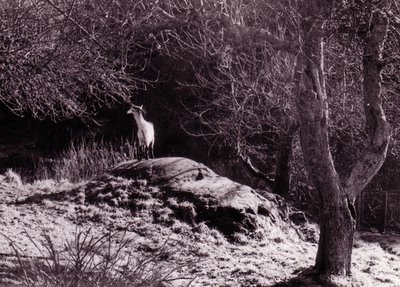
I’m reminded of November on our old homestead in British Columbia in the ’70’s. Only on the bank above the driveway, high on the south facing slope could you get out of the shadow of the cliffs and tall trees surrounding the pasture. Here the goats and the cat would lounge all afternoon whenever it was clear. I’ve been scanning and restoring old pictures of that time from mouldering photo albums.

Its been a long Thanksgiving holiday whose approaching end is marked by the sound of students’ cars returning to campus. On Tuesday morning Ian and I packed provisions and headed for Montana de Oro. We found a site near the trailhead at the end of the campground. As we were setting up the tent, a midsized healthy looking coyote sauntered by and stood scratching itself and watching us as we watched it, for about ten minutes. I was too enthralled to take out my camera. At first I thought it was a dog belonging to another camper.

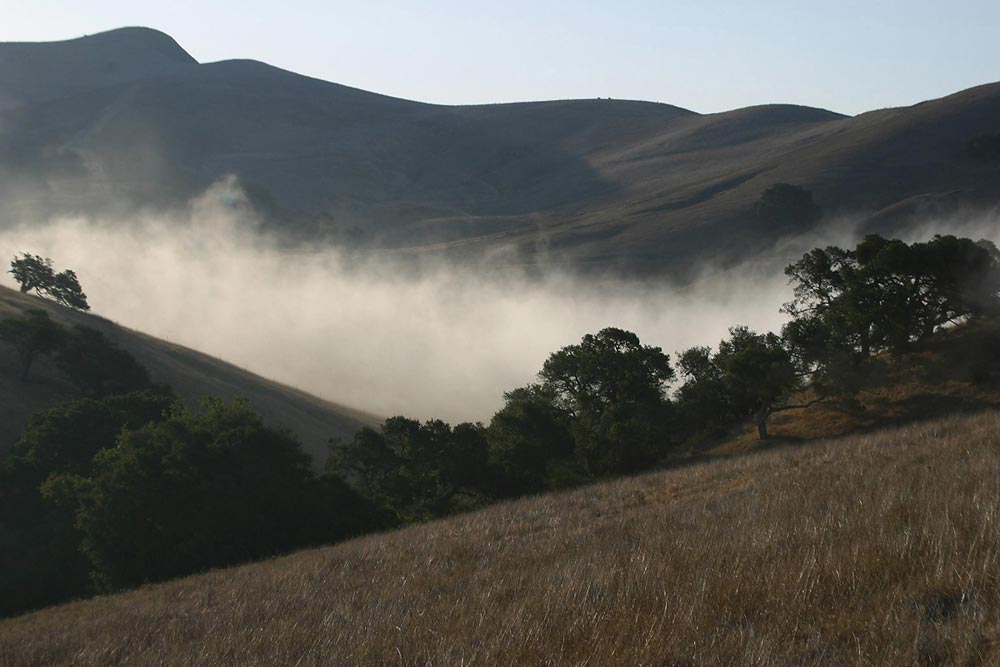
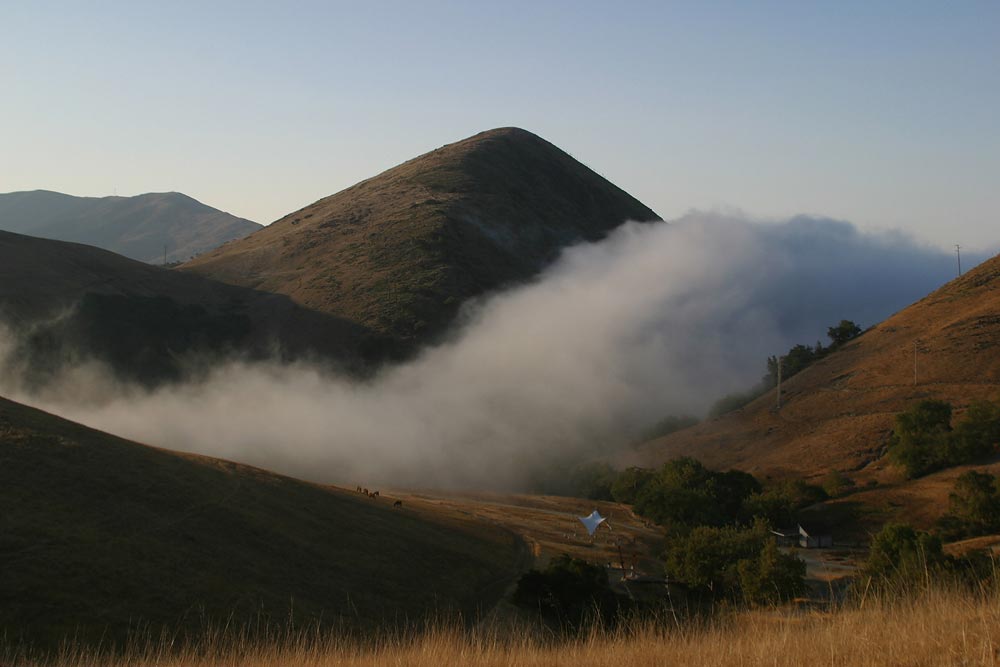
At the Spooner’s Cove beach we climbed a tilted sandstone outcrop and came to spot on top where the waves roared through a crack below us. I foraged eucalyptus branches for firewood and as we returned to the camp, Jan drove up after seeing her afternoon clients. The three of us took a hike up the Islay creek trail and watched fingers of fog creeping down into the canyon over Reservoir Flats. On the way back to camp Jan told the story of the three little pigs in great detail to keep Ian from thinking about being tired and we watched the sun dip into the marine layer as we came back to the camp. As the sky turned flourescent pink, then purple then black, we grilled dinner with only three candle stubs sheltered by the apple juice container for light.

Inside the little backpacking tent we hung a small flashlight from the ceiling and played Chutes and Ladders till Ian threw the spinner away in rage and then immediately fell asleep. When Jan went out to pee in the middle of the night she heard cellophane crackling and in the morning we discovered that the cookies we had forgotten to put away were missing.

Claire drove up in a big truck in time to join us for breakfast and more games. After Jan left to go back to work, Ian Claire and I struck camp and hiked the bluff trail along the ocean, sighting quail, sparrows, herons, cormorants, herons, and male and female brown pelicans which Ian identified with the bird book. We also spotted an otter relaxing in the surf between protruding outcrops.

The sun hid in the mist and then appeared briefly intensifying colors and shapes. We stayed for two hours in Corallitos Cove, throwing rocks, chasing waves, poking anemones, investigating crabs and observing the comings and goings of the pelicans. In the late afternoon we drove to Los Osos for ice cream cones.

2003 Yom Kippur Fast at Sycamore Glen

Sunday, October 5th, 2003

img_2615.jpgOctober 5, 8:50 p.m.

Moon a bit more than half-full followed by Mars as if in tow. Bright still but no longer red or fat. Temperature dropping since I arrived around 7:00, just as it was getting dark. The creek is silent, though there’s still a little standing water in the pools.

Broken trees blocked the trail”sycamore and oak”the cattle making new trails in the red weathered basalt soil to get around them. Two red-tailed hawks in the dead branches of an oak at the entrance to the glen. One took off with a skreer and I just heard another. A doe and fawn walked along the ridge line above Poly Canyon.

Fragrance of tarweed: sweet and astringent”and barn smell of old hay, still golden not yet gray. The sycamore trunk behind me glows white in the moonlight when the gauzy clouds drift away. Little light pollution from the city, but I hear invisible traffic on the grade.

Sounds of the cicadas came up louder as the light drained out around 7:15. The sky lost opacity, allowing stars to slowly emerge. When I first arrived here, after the exertion of riding my bike up the canyon wearing a pack, I lay down on the air mattress and napped”immobile and comfortable”like I imagine my mother feeling in her nursing home bed.

The moon seems to be racing across the sky from southeast to southwest. At this rate it will set in a couple of hours. ¦

October 6 7:00 a.m.

Kestrel at ridgeline near the bedrock mortars, img_2620a.jpgred tail overhead. Morning clear, mild and still, but looking toward Brizzolara Creek, I see thick plumes of white fog rushing up the valley, keeping low to the ground. Then gone. Then returning. Quick breezes brush by me, one warm, one chill.

(more…)

Cal Poly Land: A Field Guide

Tuesday, February 11th, 2003

[To view full book, scroll to bottom of this graphic and click on successive pages]

Cal Poly Land A Field Guide

Retrospection

Friday, July 26th, 2002

Wasting desire in rare and fleeting joy
Infinite promise unfulfilled
Brought despair in youth

Now age astonished with store
And pleasure daily reached
Exults in limitation

Surfliner

Thursday, July 25th, 2002

Back on the train to Santa Barbara, coffee in front of me, Ocean on the right, rocket launch towers on the left, smooth rocking.  It recalls the train’s passing during the concert last night in San Miguel mission where we celebrated Jan’s 57th birthday and sat with Eric G. who told me about this early morning ride. I’m carrying some sample page files for prefroofing according to Mary’s instructions.  The concert was memorable”an a capella performance of Mexican Baroque music sung by Chaunticleer, highlighted by Corey McKnight, a countertenor doubling as soprano whose soaring melismata took me on a flight with the dove painted above the altar.

I see flocks of snowy plovers on the beach as we stop at Surf.  No people for miles.  Offshore a towering oil platform.

Joe and Amy want us to buy a condo in Ketchum for 350K. Stock market is crashing.  I call broker and tell him to sell 100K. The market goes up 500 points.

Working all week at the computer lab on the Field Guide page layouts.  Mary sits next to Brian and points with her finger at the screen telling him precisely what changes to make in Photoshop and Quark.  Bob H., who wrote the book on Photoshop gives me advice on how to improve some difficult slide scans.  The confusion and misinformation  circulating among us is partially cleared up.  Brian working in the lab till 11:00 p.m. I pick it up there after the concert.

Claire is working as a “bookkeeper” for a friend’s garage.  I’m looking after Ian, whom I take to Laguna lake to visit ducks and playground and then to computer lab.

Train has just rounded Point Conception, heading east now, sun’s out, fog on mountain top, ocean white caps ignited.