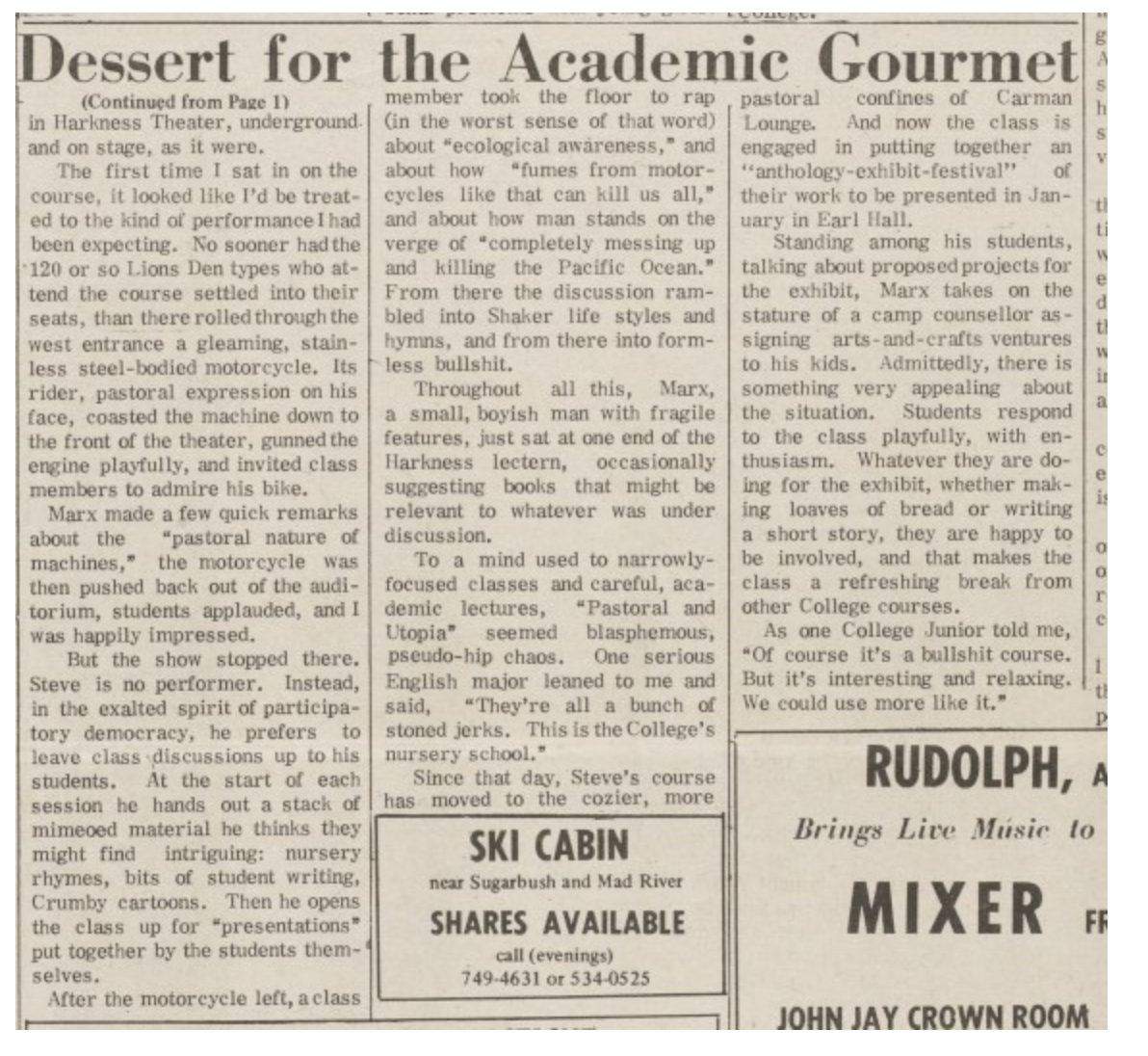
Youth Against Age: Generational Strife in Renaissance Poetry
Monday, April 15th, 1985Book published 1985
Dissertation completed 1981
Dissertation started 1966
Title Page Table of Contents Preface Introduc Chap1 Chap2 Chap3 Chap4 Chap5 Bibliog

Book published 1985
Dissertation completed 1981
Dissertation started 1966
Title Page Table of Contents Preface Introduc Chap1 Chap2 Chap3 Chap4 Chap5 Bibliog
A plenary lecture to “Literature and the Arts in Western Culture.”
Stanford University March 11 1985
I first came across Candide when I was seventeen, the age of its protagonist at the beginning of the story. I can remember that simple title staring out at me from the spine of a thin volume on the musty shelves of Baron 1 s, the used bookstore that I frequented with my sidekick Weiskopf on Friday afternoons–after our last High School class and before we took the subway downtown to hear music at Jazz on the Wagon, the one place in Greenwich Village you could get into without I.D.
I had heard the name Candide before; it was known in the grapevine as one of those books–intellectual, bohemian and intimate–that our parents wouldn 1 t approve of, books with titles like You Can’t Go Home Again, On the Road, Howl and The Catcher in the Rye. I slipped the book down from the shelf, noticed the “privately printed” inscription, the mannered art-nouveau illustrations of thin bare-breasted girls, the sixty cent price, and I took it to the register.
From the opening sentence, I was entranced. Here was another Holden Caulfield, still a sincere, naive and gentle child, cruelly punishe9 for simply following his natural desires, abruptly booted from a secure nest in what was just beginning to feel like Paradise, and set adrift in a human jungle of repression, hypocrisy, violence and greed. I could relate to that heavy tale–especially since it moved along so lightly, with a little sex and a lot of laughs on almost every page. I too felt adrift in a world of wandering hands and kicks in the backside, of atmospheric H-bomb tests and classroom shelter drills, of Anne Frank and Joe McCarthy.
I finished reading the book at two in the morning on the Staten Island ferry, where we would ride back and forth across New York harbor when the jazz club was too crowded. Thereafter, Candide became another one of those few voices which confirmed my adolescent sense that I lived in a pretty screwed up place-despite the assurances of Doris Day, Dwight Eisenhower and Dr. Norman Vi.11cent Peale that middle-class America was indeed the best of all possible worlds. (more…)
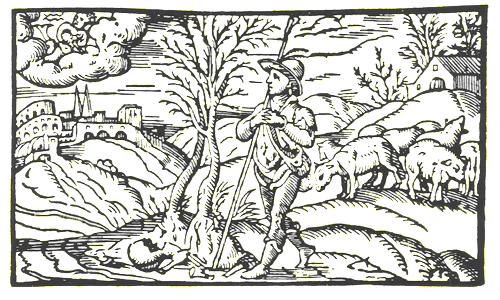
An Address to Philosophy 152: Theories of the Good Life
Claremont McKenna College
April 28 1983
I want to talk about this week’s topic–The Good Life as Living in the Country–by loosely braiding three strands of material into a single line of argument. These strands consist of your assigned readings by Carolyn Lewis and Scott and Helen Nearing, a discussion of the pastoral tradition in literature, and an account of some of my own experiences with living in the country for the better part of nine years.
The idea that the Good Life is to be found outside the limits of civilization in a rural, natural setting is as old and as widespread as civilization itself–a word whose root signifies the culture of cities. Urban people have often reacted to the conflicts and tensions of their existence with the wholescale rejection of their artificial environments and with affirmations of what they imagine to be the simple, happy lives of those who live in the country. This attitude has been dubbed “primitivism” by historians of philosophy, who have discovered its traces in some of the earliest Sumerian and Babylonian texts.
Primitivism has always been especially popular among writers–poets, dramatists, essayists, novelists. Their utterances of love of nature and hatred of the city have constituted a distinct literary genus called pastoral or bucolic–after the shepherd or cowherd whose occupations seem to embody the primitivist ideals of simplicity, unpossessiveness, rapport with nature, and the leisure for erotic, artistic and contemplative pursuits. Some pastoralists assert the theory of the Good Life in the country from the heart; others do so primarily to display their ability with words.
One can see evidence of the breadth and self-consciousness of this pastoral tradition in the way each chapter of the Nearings’ book begins with numerous epigraphs from sources ranging from ancient Chinese proverbs to Shakespeare and Thoreau. These epigraphs indicate that much of what follows has been said many times before and for that very reason bears repeating. The pastoral theory of the good life in nature and of the corruption of civilization dominates the Bible. We find it also in Homer and Hesiod–who project visions of the Golden Age before cities were founded; in the Phaedrus–where Plato paints an idyllic scene of erotic philosophizing outside the city walls; and in the Bucolics and Georgics of Vergil”which praise the quality of life far from the seat of Empire.
(more…)
5
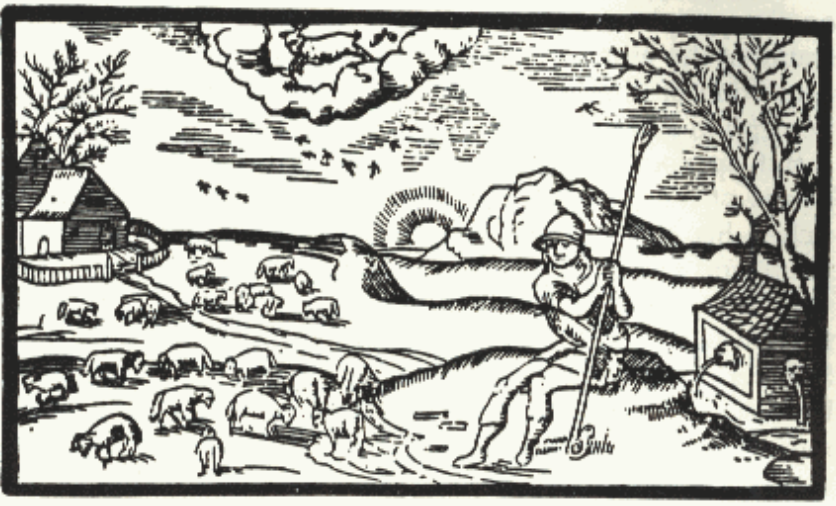
The Backstretched Connexion:
Youth and Age
in The Shepheardes Calender
This chapter proposes an interpretation of The Shepheardes Calender which places the debate of youth and age at the work’s core. Spenser used both the thematic content and the formal structure of this minor bucolic convention as the central shaping principle of his major pastoral work. Such emphasis was particularly appropriate, first because pastoral’s rural settings on the periphery of civilization correspond to the peripheral states of the human life cycle, and second, because pastoral’s projection of dual worlds inspires debate-like comparisons of perception and judgment.
But Spenser did not simply reprocess these essential elements of the pastoral tradition. Rather he modified and enriched his conventional models by disclosing the debate of youth and age through the viewpoint of a narrative persona, a viewpoint which shifts in the course of the poem from identification with youth to identification with age. That is to say, Spenser used the pastoral debate of youth and age as a means by which to externalize the inner conflicts of past and future, of regression and maturation, endemic to adolescence. By patterning his series of eclogues with a phased succession of such debates, Spenser allowed the reader to participate in the reversal of perspective that constitutes the subjective transformation of boy into man. Moving from premises about the psychology of pastoral and about the philosophy of debate laid down previously, this chapter arrives at the conclusion that The Shepheardes Calender–a product of its author’s youth and addressed to youthful readers-has as its deepest unifying subject the life stage of youth itself. (more…)
This thesis was retrieved and posted here on November 15, 2025, fifty six years after it was completed. The 64 page typescript facsimile appears below in four separate files to fit the document size limits for uploads. The bottom of the first page of each file includes a link allowing access to the following pages.