Teaching

Sustainability Book Club 2009-2010

Thursday, May 27th, 2010

Friday May 7 was the thirteenth and final meeting of the Sustainability Book Club.  I looked forward to that conclusion with mixed feelings.  Since I had deferred my last year of part-time teaching until 2010-2011, it constituted my only regular contact with the University and a small remnant of the teaching obligations that had weighed heavily as complete retirement approached.  I welcomed the relief and dreaded the loss.  It was also an occasion to evaluate the project”through the judgments of participants who’d filled out a questionnaire circulated by the Center for Teaching and Learning which hosted and supported it, and through my own reflection. The gift of a collection of environmental writings signed by most of the seminar members a few months ago made me less anxious about their verdict than about my own.  The drama of the moment lay in a choice I’d have to make about whether or not this outcome warranted the effort of trying to renew the program for next year.

The last meeting’s moderator was Rob Rutherford, Professor of Animal Science, Director of the Sheep Unit, veteran Sustainability activist, voracious reader whom I liked to call our Good Shepherd. He’d selected a book called Resilience Thinking, as our text for the day. It introduced a concept new to me, which for some people was replacing the idea of Sustainability at the cutting edge of environmental discourse.  It emphasized 1)observing processes from multiple scales to understand how very small and very large changes interacted and 2)studying universal cyclic stages of growth, solidification, decay and reconstitution. I’d found the book poorly organized–often redundant, yet in several places too dense in its use of models plotted with three dimensional calculus.  However, its elaboration of the idea of tipping points–when systems lose the capacity to absorb disturbance and flip into conditions with new baselines of equilibrium–seemed applicable to the Deepwater Horizon Oil Spill two weeks old at the time, after which the return to the kind of stability implied by “sustainability” seems increasingly unlikely.

Rob had suggested that instead of meeting in our regular location on the fifth floor of the library, we get together at Cheda Ranch, the home of the sheep unit, where he would show us around a landscape that embodied some of the resilience concepts and where he could serve us some of its highly sustainable fruits: fresh lamb, bred, raised and barbequed by his students.

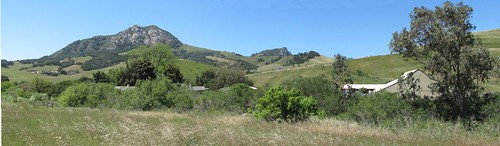
I biked out a little early on that glorious May morning, approaching the ranch through a gate across the road from the Poultry Unit, one of those notorious CAFO’s, which kept five hens in each two foot square cage, which I had visited with my Cal Poly Land students a few years ago.  The sight of the old Cheda barn nestled in the vegetation around Stenner Creek and guarded over by the monolith of Bishop Peak, recalled the many times I had made the pilgrimage to this historic hardly known corner of the University’s large land holdings.
chedabishop.jpg

larger image

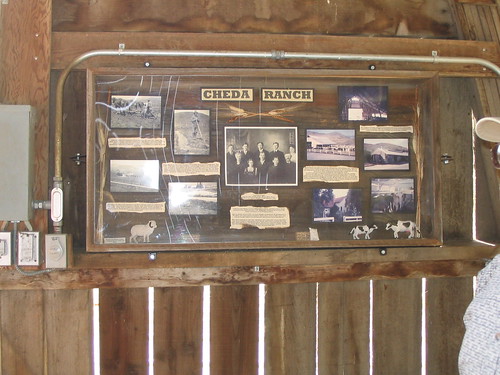
I crossed the creek and sat on a haybale in the old barn making some notes for the seminar, and glanced at the student historical project framed on the wall,
IMG_0657.JPG

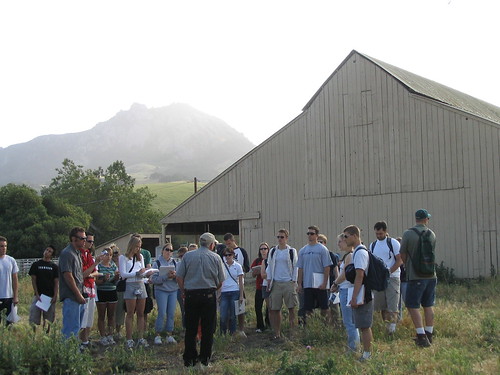
used on the website that one group produced to spread the word about this place after Rob had given them a tour
IMG_0663.JPG

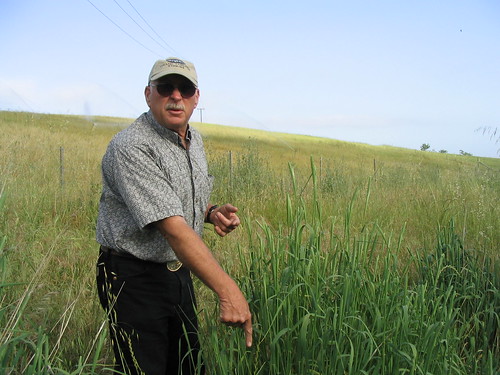
and introduced them to the idea of holistic management.
IMG_0664.JPG

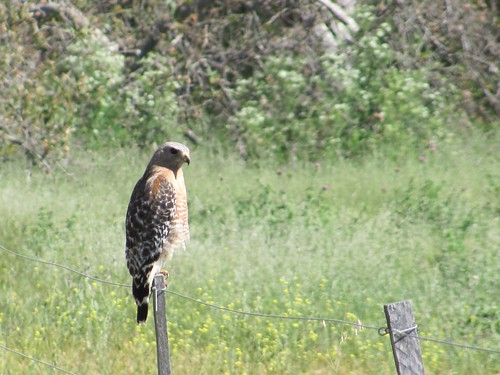
A red shouldered hawk fat from hunting gophers that lived in the barn’s basement settled on a fencepost,
IMG_2657.JPG

reminding me of the hawk in Mary Oliver’s poem that my environmental literature class read by the little reservoir up the hill while watching the raptors she described

This morning
the hawk
rose up
out of the meadow’s  browse
and swung over the lake”
it settled
on the small black dome
of a dead pine,
alert as an admiral,
its profile
distinguished with sideburns
the color of smoke,
and I said: remember
this is not something
of the red fire, this is
heaven’s fistful
of death and destruction,
and the hawk hooked
one exquisite foot
onto a last twig
to look deeper
into the yellow reeds
along the edges of the water
and I said: remember
the tree,  the cave
the white lily of resurrection
and that’s when it simply lifted
its golden feet and floated
into the wind, belly-first,
and then it cruised along the lake”
all the time its eyes fastened
harder than love on some
unimportant rustling in the
yellow reeds”and then it
seemed to crouch high in the air, and then it
turned into a white blade, which fell.

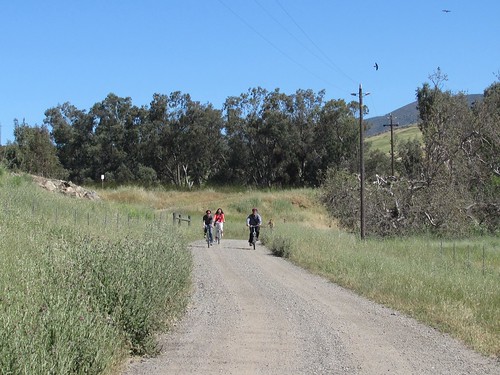
Not noticing me, Rob drove a little cart past the barn entrance loaded with folding chairs and tables and headed toward the sheep paddock where he’d arranged for us to meet.  Down the road from the reservoir four members of the book club came racing on their bicycles and scaring off the hawk.
IMG_2652.JPG

Four more people moseyed over from the parking lot. Rob returned to lead us by foot across the creek and riparian corridor which had recently been returned to health as a result of proper sheep grazing management after decades of degradation caused by earlier overuse and later neglect.  Last winter two good sized steelhead trout were observed there, illustrating the principle of resilience.

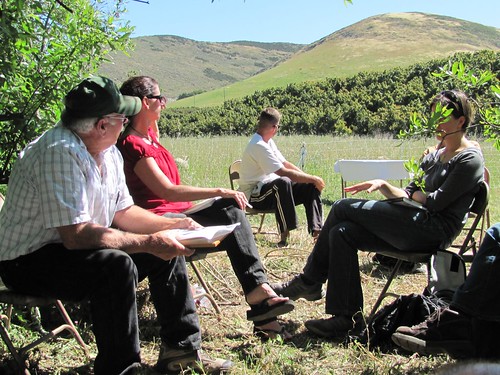
At our meeting place upstream, Rob had placed paper bags full of raw wool (yessir, yessir) on chairs for each of us arranged to enjoy sunshine or shade.  This was the perfect fibre, he noted, stronger than steel, durable, waterproof, and produced by animals transforming vegetation created from water, soil and sunshine with no other inputs. I said nothing about the classic account of the effect of sheep on landscape and rural economy found in Thomas More’s Utopia and cited at length by Vananda Shiva.

We exchanged widely divergent impressions of Resilience Thinking, a couple of people planning to assign it in their classes, others having no use for it.  The sheep flock came as close  as the electric fence permitted, occasionally bleating their opinions.
IMG_2659.JPG

An hour later, three students arrived in the cart and set barbequed lamb, chopped heirloom tomatoes and other fixings for pita pockets on the white linen covered table.  Even those of us who’d recently converted to vegetarianism couldn’t resist partaking of the marvelous offering grown in our own back yard.
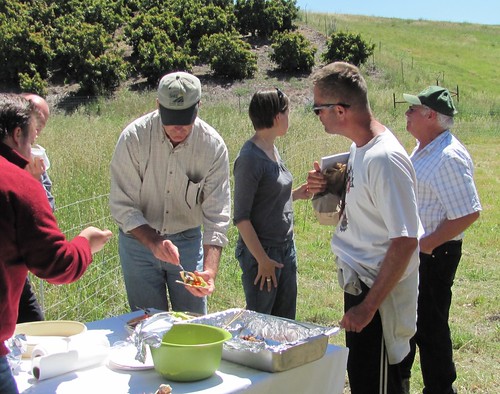
IMG_2661.JPG

On the walk out to the paddock, Christine had handed me her tabulated results of the questionnaire.  It’s taken me several weeks to consider them. As opposed to student evaluation forms, which I rarely found useful, there was no way to discount the opinions of faculty colleagues.  Ten questionnaires were returned out of probably about twenty distributed by email.  Twelve people were “presenters,” that is actually enrolled in the program, recipients of free books and a stipend and obligated to moderate one session. Seven respondents identified themselves as presenters and five identified themselves as “participants,” regular attendees who were not enrolled.  The non-response rate suggests that the results were skewed positive. Eight respondents were ladder faculty, two were lecturers. Five respondents had been here five years or less and five ten years or more.

Evaluation questions were answered with a number between 1 and 5 along a scale from Disagree to Agree

1.  The readings and discussions were useful to me.    7 fives 3 fours
2.  The time and effort required to participate was well spent.    7 fives 2 fours 1 three
3.  I liked the overall format of the discussion.    7 fives three fours
4.  I would participate in a continuation of the Sustainability Book Club next year with the understanding that copies of the books would be supplied but that stipends would not.  5 fives, 2 fours, 2 threes, 1 two
5. I would recommend participation next year to colleagues.  7 fives and three fours

Two discursive questions followed. “What did you find valuable about the program?” elicited these responses:

  • I had two motivations to join the book club “ I wanted the encouragement to read new books and I wanted the opportunity to meet and better know colleagues across the colleges who are interested in sustainability (broadly defined). I met both of those objectives.
  • The opportunity to read about sustainability from a different perspective.  It was also wonderful to learn that others in our community were interested in advancing their knowledge about sustainability.  Finally, I really enjoyed the conversations.
  • Networking… breaking down the Cal Poly silos…
  • The presentation of books that I would not read outside this opportunity.  The presentation by other participants and the opinions about issues raised in the books.
  • The discussions by colleagues from different colleges, and the monthly schedule for reading one book by all.
  • I am roundly enthusiastic about my experience in the SBC and might list any number of things here.  In broad form, it was most illuminating to have a truly interdisciplinary conversation about a series of excellent, often challenging books and ideas.  I learned as much from my colleagues as from the texts and am grateful for the various perspectives to which I was introduced.  My whole notion of “sustainability””what it is, who the stakeholders are, to whom it applies, etc.”has been significantly revised and expanded over the course of the last year and a half.  This workshop has been extremely important to the development and reinforcement of my research and pedagogical interests and approaches.
  • Discussion with colleagues from other disciplines that I didn’t previously know.
  • A few books like Biomimicry and Deep Economy
  • Books I wouldn’t normally read, perspectives from other members I wouldn’t have thought of myself, getting to know (just a little) instructors from other areas of the university
  • Hearing other perspectives because of the interdisciplinary membership.  Presenters did an excellent job.

Each of these echoed my own positive responses. I was nervous before the meetings and excited by them from the first minute to the last.  Having an extended voluntary conversation on a shared topic allowed me to appreciate the wit and wisdom of colleagues. Reading the books closely, whether or not I liked them, offered bracing mental exercise and brought me current on important topics.  A high standard was maintained by each moderator’s prepared introduction of the book, which was preserved for useful reference on the wiki, along with detailed notes on the discussion, outlines of the books’ content and some written reflections by seminar members, including Alypios regular trenchant reviews.

The second question, “Which aspect(s) of the workshop could use improvement?” yielded these comments:

  • Attendance was very spotty.
  • Quality of the books.  The content was at times more rhetoric than useful, and the essence also got repetitive which became boring.
  • More discussion/work on how to tie to curriculum.
  • Connection to curriculum development
  • Would like to know if there was any consensus on the learning gained and how the learning is going to be actually utilized.  What has the core decision making group achieved.

They also confirmed my assessment. Spotty attendance was partly due to people being away at conferences and having conflicts with teaching schedules and partly to voting negatively with their feet.  However, only one session, last May’s, drew fewer than ten and most drew fourteen or more.

Another concern for me was a sense that a number of attendees hadn’t done much of the homework. This was partly due to the uneven quality of the readings, some of which were poorly edited, overburdened with rhetoric, and overlapping in content. Even two classic Sustainability books that felt like world-changing prophecy when they first came out, Biomimicry and Cradle to Cradle, seemed overly optimistic or questionably argued when reread in the cold light of recent history.

Conditions two years ago, at the time this project was planned were perhaps more hopeful.  Sponsored by the Academic Senate Sustainability Committee, itself an outgrowth of Cal Poly’s becoming signatory to the Talloires Declaration and joining the burgeoning Association for the Advancement of Sustainability in Higher Education(AASHE), one of the Book Club’s stated intentions was to be an incubator of a large university-wide Introduction to Sustainability course.  A year ago three Club members met to start planning such a class.  Implicit also was an aspiration to follow the strategy for institutional transformation of the kind proposed in Peter Senge’s “The Necessary Revolution.”

But these aspirations never materialized, a significant factor being my own flagging commitment to them.  And what accounts for that?  In the big world, the new Congress and Administration’s being swamped with economic catastrophe and stymied by Republican obstructionism, the failures of Copenhagen, the slowing of progress toward a sane energy policy, the expansion of our wars in Asia, and the general continuation of business as usual in the face of growing crises. Cal Poly history took a parallel course:  budget cuts, threats, and furloughs undermined hopes for experiment and reform, the sudden disappearance of the UNIV program eliminated any institutional framework for mounting interdisciplinary courses, and the Academic Senate Sustainability Committee itself was threatened with dissolution.

Over time, the Book Club itself settled into a comfortable groove. Presenters gave polished introductions, discussion was fluent, strangers became familiar, and  the activity seemed sufficiently satisfying without moving toward goals. The Necessary Revolution was put on hold.

With one exception.  The most prominent theme running through all the books that we read related to food.  Whether in McKibbens call for localism in agricultural production and distribution, Pearce’s account of the water lost and polluted by industrial agriculture around the world, Foer’s expose of CAFO’s and story of his conversion to vegetarianism, Louv’s report on the value of school vegetable gardens, Shiva’s call for resistance to global chemical-food monopolies and rescue of small farmers, all seemed to reinforce the vision of sustainable agriculture and sensible eating habits presented in Michael Pollan’s In Defense of Food.  This was amplified in the talks Pollan gave at Cal Poly last October, hosted by our Book Club member, Hunter Francis, and the Sustainable Ag Resource Consortium, recently reinvented as the CAFÉ Center for Sustainability. Cal Poly’s role in the food system controversy put him and fellow member Rob Rutherford in worldwide headlines for a couple of weeks,  highlighted the contrast between sustainability and its opponents, and appears now to be in a state of real transformation.

Our readings on food changed at least two of our members’ behavior in significant ways, turning us from omnivores into qualified vegetarians (fresh lamb raised by friends being an exception, as noted above). In addition they contributed to my tripling the size of my vegetable garden and focusing my own activist energy into developing a working farm, processing facility and distribution system to school lunch and food bank programs on city-owned land. Food seems an arena where on a personal level it’s possible to make strong changes toward sustainability without the major sacrifice of giving up one’s car or one’s  travel plans, and where on a political level, promoting localism can have some appreciable consequence.

The questions on the survey I  had most difficulty answering dealt with the future of this project. Seven out of ten respondents said they would continue in it if offered next year and ten out of ten said they would recommend it to faculty colleagues.  The Center for Teaching and Learning has offered continuing financial and logistic support.  But given my misgivings, do I want to stay involved?

After weeks of vacillating now I can say yes.  Yesterday I started hunting for possible titles and came up with nine books published in the last two years that sound intriguing.  I’d like to try alternate formats for some meetings, such as reading and commenting on blogs like Andrew Revkin’s dot.earth or Real Climate.com, or picking a theme like oil addiction instead of a book to discuss.  So whether or not the Club will meet again next year will now, as they say, depend upon enrollment.
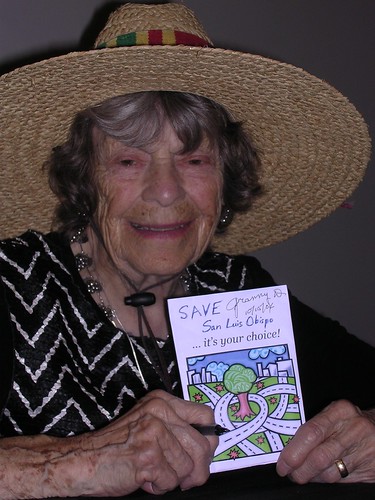
Doris Haddock (Granny D) 1910-2010

Thursday, March 11th, 2010

DSCN1586.JPG

Doris “Granny D” Haddock died peacefully today in her Dublin, New Hampshire family home at 7:18 p.m. Tuesday, March 9, 2010. She was 100 years old. Born in 1910 in Laconia, New Hampshire, she attended Emerson College and lived through two world wars and the Great Depression. She was an activist for her community and for her country, remaining active until the return of chronic respiratory problems four days ago.

I only met Doris once briefly when she visited San Luis Obispo in connection with the Cal Poly Preface Reading Program but she touched me permanently.  As I seek ways to adapt to growing old in a world that feels easy to abandon, her love of life, her pride in her past, her urgent concern with the future, her fighting spirit, and her refusal to give up in spite of disappointment, provide me with guidance and inspiration.  What a sad irony it is that during her last few months, the Supreme Court handed down a decision that, for the time being at least, reverses so much of what she worked for. Finally now she gets a break from that relentless struggle.  Or perhaps, somewhere, her spirit still is on the march.

Two freshman student responses to Granny D’s visit to Cal Poly in 2004

Go Granny Go!

When I got to Cal Poly this fall, I soon learned that not too many people actually read the shared reading book, Granny D., You’re Never Too Old to Raise a Little Hell.  Furthermore, those who did read it did not really like it.  I was surprised because I loved reading the book!  I love to travel and have been to most of the states of our country, so I loved hearing about her adventures in the different states.  In addition, I have gotten really into politics over the summer, and I have loved forming my political identity and views.  Doris “Granny D” Haddock is very inspirational, and she demonstrates what a difference one person can make.

I have looked forward to hearing Granny D. speak since I read just a few pages of the book.  I was very excited to finally have the opportunity last Friday night when Granny D. gave her speech entitled “I am in the Example Business.”  She is an engaging speaker, and it was delightful to hear her.  I liked how her speech started regarding writing a cheaper and shorter book, although I was not one of the students with an “independence streak” (at least as far as this book goes).  I liked how she drew us in with her stories of New England autumns, which I remember vividly from the year I lived in Massachusetts.  Additionally, I loved all the “political stuff” and her stories of life in New Hampshire.  My favorite part of her speech was when she said, “We cannot move the world toward our wisdom and love so long as we permit political systems that run on greed and fear instead of love and ideas.”  At the end of the speaking, I enjoyed the question and answer time.  For example, her sticker that said “Vote Dammit!” and when Dennis Burke told her that a question was “regarding Iraq.”  Throughout her speech, I loved to applaud her and give her standing ovations.

Attending Granny D’s speech was one of the most enjoyable things I have done at Cal Poly.  It was motivational, and I felt “the hero inside my heart.”  Granny D. is one of my heroes, and she is what this country is all about!

Granny D

When I found out Granny D was coming to speak at Cal Poly, I was excited but did not think it would be worth my time. Looking back to the event and reflecting on what she said, I am extremely glad that I decided to attend! As in her book, her speech was filled with inspiration, politics, life lessons, biographical anecdotes, and of course humor. Her opening statement “Had I known that 3,000 of you would be forced to buy and read my book instead of enjoying your summer, I certainly would have written a cheaper and shorter book” had the crowd roaring with laughter. That statement was a perfect example to explain her personality. She is a person who loves life and has made her mark in the world and will continue to do so in the United States Senate if she gets elected.

I enjoyed learning about life in her small hometown of Peterborough, New
Hampshire. Her description of autumn made me want to become a “Leaf Peeper”! Peterborough seems to have a lot in common with San Luis Obispo and through the examples she gave, it made me want to get involved here in my new hometown and find out about local issues since I am a citizen. The fact that a play was written about the town struggles showed what a tight- knit community Peterborough is and how it is good that people don’t take things too seriously in the end. There has to be a sense of humor to get through life and not let differences divide one another. That message was strong throughout her talk.

It was nice that the forum was opened for questions. It was good to hear about local issues and hear what Granny D had to say. She is a person who knows her stuff and is not afraid to tell you. She has and will continue to fight for what she believes in until she gets what she knows is right. The United States Senate is a good move for Granny. She will be a strong influence and I believe a good influence to the senators. She will make changes for the better. Granny D will make America better and keep its ideals alive and on track.

My notes in preparation for the discussion of Granny D, during the 2004 Preface Program at Cal Poly
(more…)

Down to the Wire: Confronting Climate Collapse

Friday, March 5th, 2010

Notes in preparation for a discussion of the book by David Orr, published 2009, at the Sustainability Book Club at Cal Poly.

David Orr is one of my gurus, but the first time I read this book I was disappointed by its repetitiousness, vagueness, lack of sequential structure or sustained, fully supported and defended claims, and its preaching to the choir, who have already heard most of this many times.  The central points were hardly controversial or new for us, but still unacceptable to the great majority of citizens who are looking more than ever at short term rescues or pleasures. For that reason the urgency and insistence of the tone seemed irritating and disrespectful of the audience. Compared to his last book, Design on the Edge, which contained a fascinating autobiographical narrative and a detailed account of the remarkable history of the building he was responsible for planning, designing and financing at Oberlin College, this book felt vague, uninspired, and sentimental. What does it mean after all to insist that what we should do is “deepen our humanity.” (202)

I also found it sadly dated.  Though filled with topical references to the impending Obama adminstration, the events of the fifteen months since his inauguration made many of the proposals about transforming governance and launching a revolution in Washington seem painfully overoptimistic.

Nevertheless I decided to give it another try, either to be able to articulate specifically what I found wrong with the book or to give it a more sympathetic and engaged reading.

First, I confirmed what I suspected about the book’s process of composition.  Most of the material here was previously published in the form of essays that Orr writes for the journal Conservation Biology and others.  Many of these can be found at the website, http://www.davidworr.com/index.html.  That accounted for and in a way justified the sense that each chapter recovered much of the same territory and started from scratch rather than building on what preceded.  Viewed from this perspective, each chapter had the coherence and scope of his remarkable speeches, such as the one I heard at the organizing conference for Focus the Nation in Las Vegas.  And even when general points were repeated, Orr seemed in each essay to summon up different examples and sources.

A second reading also revealed an overall structure of chapters that moved forward from beginning to middle and end despite the backtracking.  Preface and Introduction both state the predicament and his solutions. We are facing what has been called a long emergency or a bottleneck, a worldwide period of crisis brought on by the environmental degradation and climate change that misguided human impacts have produced over the last 200 years. The way out will be long and arduous, and only possible with strong, transformative leadership, primarily in the presidency but also at all levels of government and society.  Leaders have three leading tasks: move the citizenry out of a state of denial to a recognition of the dangers, develop energy policies that reverse our dependence on carbon and promote renewables, and foster a deepening of public morality emphasizing fairness, compassion, nonviolence and a sense of purpose and reverence for nature grounded in appreciation and gratitude. These three mandates are reaffirmed throughout the book.

The three chapters of section I, Politics and Governance, assert that Government is the only agency strong enough to effectively address the emergency but that government needs to be transformed. Chapter 1, Governance, asserts that the challenges of mitigating and adapting to climate change and its associated catastrophes can be faced by reversing the trend toward unregulated corporate power, trivialized and ineffective journalism, excessive consumerism and rule by lobbyists.  This can be done by redistributing wealth and privilege, publicly funding elections, smartening land use and agricultural policy, guaranteeing universal access to communication media and promoting small community autonomy.  But first government itself must be transformed from its present corrupt and dysfunctional state to a just, effective and elevating one. This will have to be accomplished through a mechanism like a new Constitutional Convention and the establishment of a new consensus.

Chapter 2 is a meditation on democracy, the form of government most likely to succeed despite its faults, the failures of its alternatives, like natural capitalism, and unregulated free-market capitalism, and the proposal of a legal, constitutional framework for instituting the kinds of social transformation needed to address climate change based on the new idea of the legal standing of future generations. Chapter 3, Leadership in the Long Emergency, compares today’s crisis with those faced by Lincoln and Roosevelt, and concludes that Obama can learn leadership lessons from both his great predecessors, which include the necessity of understanding and framing those crises both as legal-constitutional issues requiring preservation of law and tradition and as moral issues requiring deep personal insight and unshaken commitment. Orr repeats the laundry list of reforms mentioned earlier that Obama needs to accomplish.  Chapter 4, Leadership, defines true leadership, like that of those predecessors, as the capacity to energize and give direction to the populace.
Part II, Connections, is transitional in the overall structure of the book, but provides a sample of some of Orr’s strongest qualities as a writer, manifested when he lets a more imaginative, associative principle guide his design.  Chapter 5, The Carbon Connection, juxtaposes two powerful narrative descriptions: nature’s devastation of humans in New Orleans by Katrina, presumably caused by climate change, and humans’ devastation of nature in Coal Companies’ mountaintop removal, causing climate change. This is connected to Chapter 6, The Spirit of Connection, which explores spiritual and religious perspectives on Climate Change, differentiating the apocalyptic fundamentalism that both affirms and brings it on with the subjective experiences of wonder, reverence and gratitude for the gift of life that provide meaning and hope for those struggling to protect it.

Part III, Farther Horizons, contains three chapters overlapping earlier chapters and one another in content.  Chapter 7, Milennial Hope, lists factors blocking us from taking the steps necessary to confront and deal with the coming crisis and solutions, psychological, political, and spiritual, concluding with a story of Gandhian non-violence displayed by Amish toward a mass murderer who shot a number of their children. Chapter 8, Hope at the End of our Tether, expands the emphasis on anti-militarism, Gandhian Satyagraha and other Gandhian principles like anti-materialism”shift from wealth to happiness”social justice, and localism.
The final chapter, The Upshot: What is to be Done? echoes both Aldo Leopold and Lenin, verbally in the titles of two of their well known works, and thematically in calling for the creation of a community that includes natural beings and systems and in calling for a total revolution to be initiated by a vanguard of leaders, giving direction and energy to an awakened populace. The first section covers the same ground as the preceding chapters, but the chapter and section ends with a powerful vision of a desireable outcome from the long emergency only ten years in the future, imagined in his home town of Oberlin Ohio, where the  programs he has set in motion as an activist and educator have run their course.  The vision is startlingly similar to the kinds of programs and visions activists at Cal Poly and in San Luis Obispo County have dedicated themselves. More than anything in this book, these few pages (212-215) provide some of the grounds for hope that present conditions don’t encourage in regard to most of the books larger recommendations.

“Postscript: A Disclosure” is vintage Orr.  It’s a recollection of the  extraordinarily hot summer of 1980 when he and his brother worked like slaves on a farm in Arkansas, as the temperature reached 111 degrees and stayed there. It was then that he became interested in climate change.  He says he felt it viscerally, the memory recorded in his body.  That’s why it’s presented as a disclosure.  But the impact of that memory, I’m afraid is unlikely to be felt until the rest of us consistently experience such nasty conditions, and by then it’s likely to be too late.

Taking issue:

  • “leadership””is Obama like Lincoln and Roosevelt, sticking to the moral vision, keeping legal and constitutional integrity at the fore, reaching the people?
  • Seemed so at inauguration, but less so now, largely because of loss of confidence resultant from bailouts and compromises, failure to seize the opportunity with courage”e.g. Copenhagen
  • The long emergency”less perceivable now than in 2006, when much of this was written and when Katrina and An Inconvenient Truth and IPCC and oil spike converged to shake people up.
  • Non-violence, Satyagraha”true, and a manifestation of deeper humanity, but turmoil is less likely to bring it to the fore, especially when the rulers and perpetrators are becoming more brazen
  • Coupling peace, justice and sustainability has advantages but also makes any progress seem hopeless, because it will leave so much undone.

(more…)

Letter to the Chancellor

Wednesday, December 23rd, 2009

Dear Chancellor Reed:

At the advice of your office, I am submitting some input on the search for the successor of Warren Baker as President of Cal Poly University San Luis Obispo.

I have taught here since 1988 and am recipient of the University’s Distinguished Teaching Award, the College of Liberal Arts Outstanding Scholarship Award and the CSU Systemwide Quality Improvement Award.

During his tenure President Baker has led Cal Poly to become one of the country’s preeminent Polytechnic Universities. I believe the primary mandate of his successor should be to transform Cal Poly into one of the country’s leaders in Education for Sustainability”the long-term approach to integrated solutions of economic, social and environmental problems.

It is crucial that the Trustees Committee for the Selection of the President incorporate terms in the job description and advertisement that call for successful experience in leading such institutional transformation and that they make promise in advancing sustainability an important criterion for final selection.

Doing so would serve the interests of Cal Poly’s students, who seek employment in emerging fields, of the institution, which needs more cross-disciplinary collaboration in teaching and research, and of the larger community, whose health and welfare depend upon the next generations’ commitment to addressing these problems effectively. (see  http://presidentsclimatecommitment.org/documents/Leading_Profound_Change_ExecSum_final7-28-09.pdf)

In support of this opinion, I refer you to the University Sustainability Learning Objectives recently adopted by Cal Poly’s Academic Senate and ratified by President Baker:

Cal Poly defines sustainability as the ability of the natural and social systems to survive and thrive together to meet current and future needs. In order to consider sustainability when making reasoned decisions, all graduating students should be able to:
¢    Define and apply sustainability principles within their academic programs
¢    Explain how natural, economic, and social systems interact to foster or prevent sustainability
¢    Analyze and explain local, national, and global sustainability using a multidisciplinary approach
¢    Consider sustainability principles while developing personal and professional values

It also bears mention that the “Top Ten Best College Presidents” selected by Time Magazine in November 2009 are all Sustainability Champions. (http://www.aashe.org/blog/top-ten-college-presidents-also-sustainability-champions)

In recent years Cal Poly faculty and students have collaboratively demonstrated initiative and talent in developing major sustainability projects in and out of class”e.g. the Solar Decathlon (http://www.solardecathlon.calpoly.edu/mainpage.html),
Focus the Nation (http://focusthenationslo.wordpress.com/about-focus-the-nation/), the Sustainable Agriculture Resource Consortium (http://www.sarc.calpoly.edu/), the Business of Green Media Conference (http://www.californiagreensolutions.com/cgi-bin/gt/tpl.h,content=2983) ”and Facilities Departments have moved forward in conserving money and resources, thereby teaching by example (http://www.afd.calpoly.edu/facilities/sustainability.asp). What is now urgently needed is creative, daring and seasoned leadership at the top to articulate the vision and summon the resources to strengthen this focus.

Bit Rot and Digital Remastering

Saturday, October 31st, 2009

This website is the beginning of my endgame.

My aim is to do this kind of sifting of grain from chaff with the motley collection of journals and letters that fill my file cabinet. I’m content with the belief that this life is all I get. Rather than a mess to clean up, I’d like to leave behind an ordered recollection of what I’ve learned and enjoyed.
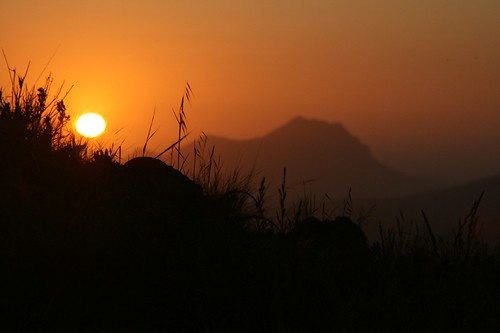
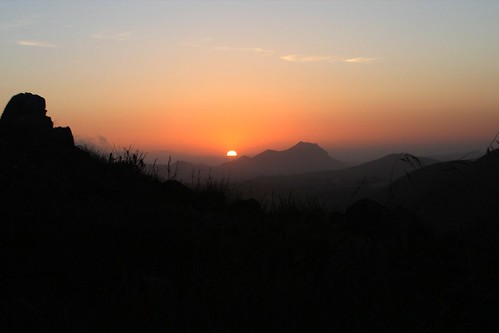
I wrote that three years ago on the  “about” page  of this weblog.

I knew then I was starting a big project.  The more I work on it, the larger it gets. Not really then an endgame.

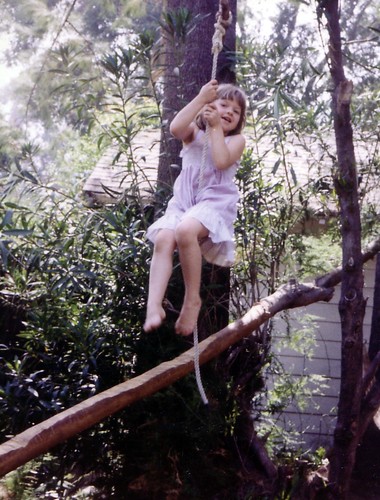
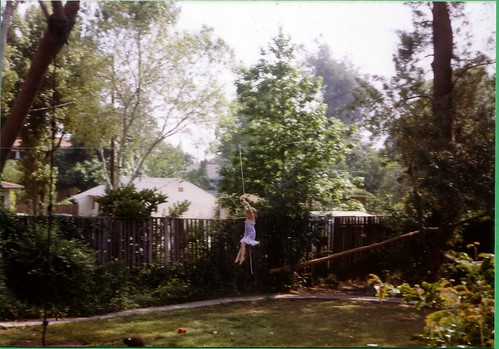
Next week mother-in-law Ruth will be 93. This morning I visited her in Sydney Creek, the Dementia Facility.  As usual when I arrive, she is asleep in her chair, but she perks up immediately, light streaming from her almost blind eyes, her voice clear and joyful.  She tells me her dreams and hallucinations and memories.  She picks up our last conversation where it left off.  I report on Claire and the two great-grandkids, she listens and laughs and says, “I remember those playground toys you built for her in your backyard in Claremont.”

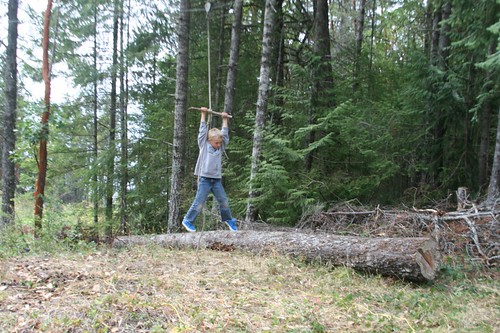
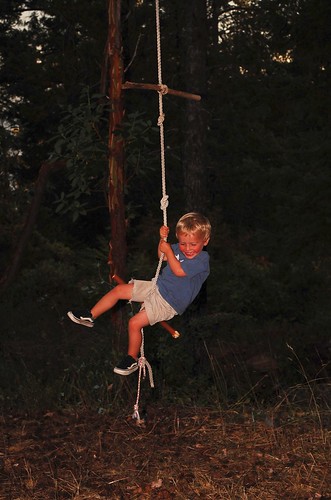
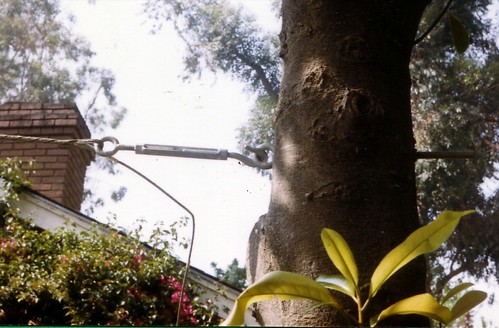
That was 1983.  I tell her that just this summer the cable and hardware for that tree trolley, which I’d stowed  in an old carpenter’s chest salvaged from the farm, returned to Canada, where Joe rigged it up at Knoll House for the use of his kids, their friends, parents and grandparents.

Back home I dig old pictures out of a huge lateral file drawer  and scan a few to match with this summer’s.

1983trolley2.jpg

IMG_7988.JPG

1983trolley1.jpg

DSC_4205.jpg

1983trolley4.jpg

IMG_7974.JPG

The galvanized steel of the cables and eyebolts and the polyethelyne of the rope are more durable than other artifacts I’ve been excavating.  Week before last I spent many hours in the Cal Poly Art Resource Library using its expensive equipment to scan 250 35mm slides that had been boxed in cassette trays in my garage. They record moments from our wedding, from early days on the farm, from our family trips to Europe in 1978, to Hawaii in 1984, from our time in Claremont and Palo Alto. The slides were covered with dust and grease and their colors were faded and distorted. The scanner software and adjustments in Photoshop brought them back to life, some almost as good as new, many better.  I gasped as our images of thirty years ago revived on the monitor.

Slide_Scans_063.jpg

Slide_Scans_037.jpg

scan126.jpg

I  spent much of the previous week in the CLA computer lab converting old VHS videotapes of English 510 Players productions of Twelfth Night (1990) and The Winter’s Tale (1994) to binary files.  Like the slides, they needed to be restored to a more accessible and permanent medium.  I’d discovered that the dozens of short segments I’d digitized nine years ago and placed on the University Media Server to provide material for my Triangulating Shakespeare website had decomposed over time into a kind of pixel jelly. Now I could replace them in larger, clearer format and at full length.  But the new digital files will probably be no less fragile than the previous ones I’d assumed would last forever.  The problem is called “bit-rot.” See the entry called “Data decay: even computers forget” on the Australian blog,  Time, etc.; Humans in the big scheme of things.

This echoes the title of the work that Shakespeare rewrote as The Winters Tale, Thomas Greene’s The Triumph of Time. As I played and rewound and spliced the recitation of the character named “TIME”  in Act 4, Scene 1 (performed fifteen years ago by the daughter of my wife’s best friend in elementary school) I slipped into the allegorical role myself:

I, that please some, try all, both joy and terror
Of good and bad, that makes and unfolds error,
Now take upon me, in the name of Time,
To use my wings. Impute it not a crime
To me or my swift passage, that I slide
O’er sixteen years and leave the growth untried
Of that wide gap, since it is in my power
To o’erthrow law and in one self-born hour
To plant and o’erwhelm custom. Let me pass
The same I am, ere ancient’st order was
Or what is now received: I witness to
The times that brought them in; so shall I do
To the freshest things now reigning and make stale
The glistering of this present, as my tale
Now seems to it.

When I watched the final scene, where a memorial statue comes to life after its subject was thought to have been dead for sixteen years scripted  as a theatrical resurrection in a chapel, I felt that moment  of performance on the altar of San Luis Obispo’s  1762 Mission Church quickening again, wrinkled now but still warm.

POSTSCRIPTS:

January 20 2010: Wow! Just watched the old Measure for Measure video. Really amazing that you managed to get such solid performance out of non-acting students. I found the play charming and — most importantly — the language really came alive. You should do some directing for community theater. — Elizabeth

November 30 2009: It was wonderful to hear from you. I just got started on Facebook. Wishing you happy holidays, Don

November 28 2009: How wonderful to hear from you! Unfortunately I can’t seem to open this link – which might be a good thing as I think I was a pretty shockingly bad actress–Ann

November 24 2009: Thanks Steven–it’s amazing!  Tom

November 24 2009: Hi Steven! Wow. Thanks for this treasure trove! I remember lending my VHS copy of”Twelfth Night” to a friend soon after I received it. Never got it back. Almost twenty years later, my kids are saying “Daddy, you look weird. And why are talking so funny?” Congrats on leaving lasting wonderful impressions on your old students!–Greg

November 23 2009: What fun! Good to hear from you. Patty

November 23 2009: Participating in the English 510 Players Production of “Measure for Measure” was one of the highlights from my Cal Poly years. I’m sure I’ll cringe as I watch my performance but what an awesome experience it was. Thank you, Dr. Marx! –Candice

November 21 2009: This is great! Thanks for doing this Steven.  We’ll give you a call for lunch next time we’re down–we had a really good time with you guys last time. Take care. –Craig

Morning Glory Trail Bikeride

Wednesday, July 22nd, 2009

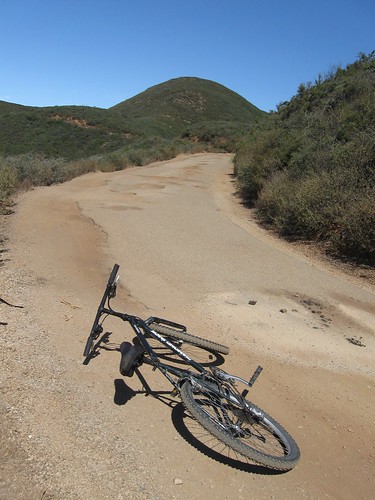
To celebrate finishing the Bible as Literature article and get a workout, I decided to go on a bikeride. Checked the web for places I hadn’t been and came up with “Morning Glory,” a descent from the top of Cuesta Ridge that sounded appealing.  Jan agreed to drive me to the top of Cuesta Pass and I convinced her to take me and the bike up TV Tower Road until she refused to go further through the ruts and bumps.

It was pretty hot outside the car at 10:15 in the morning, though nothing like the 110 degree temps they were having in North County.  With plenty of water and slavered-on sunscreen I started up the road feeling a rare sense of “No Hurry.”

IMG_2474.JPG

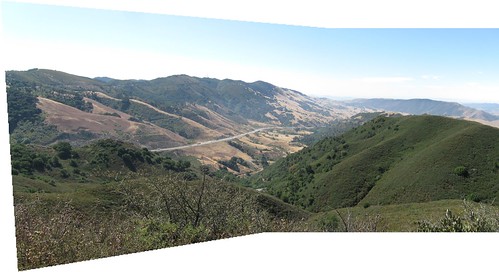
Once out of the oak forest and into the chapparal, the road stays close to the top of the steep ridge, revealing new prospects at every turn.

First was back down to the freeway going up Cuesta Grade.

cuestapasspan.jpg

clickpic for larger size (more…)

Overnight above the Tracks

Sunday, May 10th, 2009

By the Eucalyptus Grove above the hairpin rail turn in Stenner Canyon.

IMG_7492.JPG

Yet another pipeline coming through, this time the Nacimiento project.  A great berm topped by the two excavators that piled it over the place where wildflowers and snakes flourished in years gone by.  Behind me the rush of skidding mountain bikes coming down from Shooters on this temperate May afternoon.  Aaron L., the new Cal Poly ranch manager we met at the trailhead says forty or fifty a day pass his house at Serrano.  Rockslide Ridge lit from behind and to the left, Poly Mountain.  The oat grass swaying, creeks on either side tumbling lightly, peaceable murmur of student conversation, while some write and others gaze.

IMG_7491.JPG

The new trail up here from the tracks on land just acquired by the city switchbacks through oak groves crossing and recrossing Stenner’s central fork on artfully curved, banked wooden bridges.

____

The students leave at 5:20, after I read a parting prose-poem by Mary Oliver

Look, it’s spring.  And last year’s loose dust has turned into this soft willingness.  The wind-flowers have come up trembling, slowly the brackens are up-lifting their curvaceous and pale bodies.  The thrushes have come home, none less than filled with mystery, sorrow, happiness, music, ambition.

And I am walking out into all of this with nowhere to go and no task undertaken but to turn the pages of this beautiful world over and over, in the world of my mind.

Chad back from Japan and Nancy back from Germany have joined the hike and have brought food to share  somewhere down the trail.  He called at 3:15 to ask if the class would go today and if they could join it. The fellowship of Focus the Nation revived. Alex comes along to explore the section between here and the great oak, where I plan to stop for dinner. As we traverse the three-dimensional curves of the path through grassland and oak canyon, they relate the night before’s adventure of staging a Renewable Energy Education Program for the Sierra Club in Atascadero.  The POPRs (Protect Our Property Rights) turned out en masse, some to harrass, others to learn.  I try to turn their attention to the long prospects down the canyons to the sea, to the the colorful Jasper boulders, the little wetlands, and then the tree.

IMG_7496.JPG

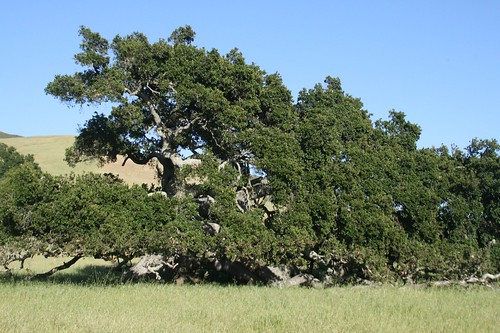
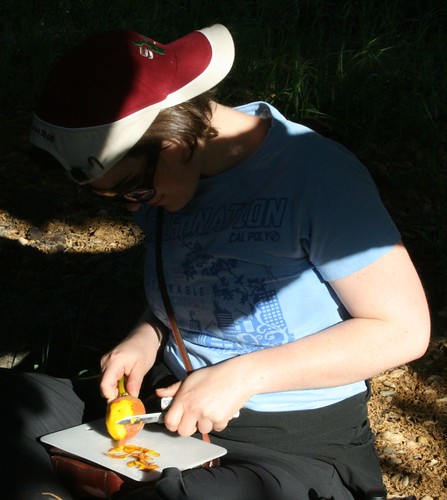
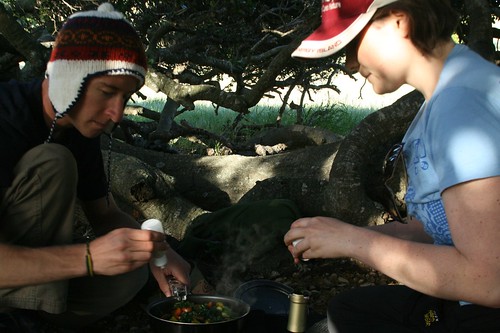
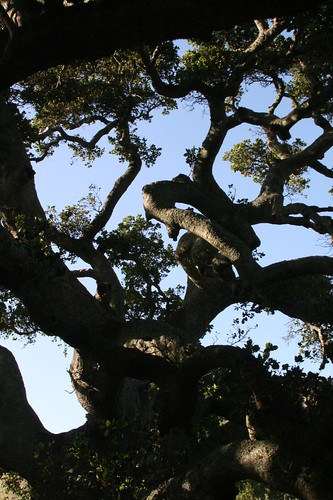
They discover a dramatically lit canopy under the kneeling limbs and unpack a wine bottle, fresh produce from the organic farm where I went this morning to pick up veggies with Lucas, a little baggie of bulgar wheat and a campstove.  While they prepare the feast,

IMG_7499.JPG

IMG_7504.JPG

I climb to the top of the tree, salivating now at the thought of eating something more than the trail mix in my pack.

IMG_7500.JPG

I’m invaded by memories: the Durand Oak, and the meals of vegetables and rice with students and ex-students at Columbia in the Sixties.

As the sun goes down, I direct them to the path looping back to Serrano, happy to find the solitude I was anticipating yet grieving for their departure.  Nancy is leaving San Luis for good within weeks.  Chad has graduated. They are trying to maintain the bonds of Empower Poly and Focus the Nation against the entropy of dispersal with plans for a California Energy Tour and  other world-changing enterprises. I look for them on the trail below, but it is too dark and too late.

IMG_7532.JPG

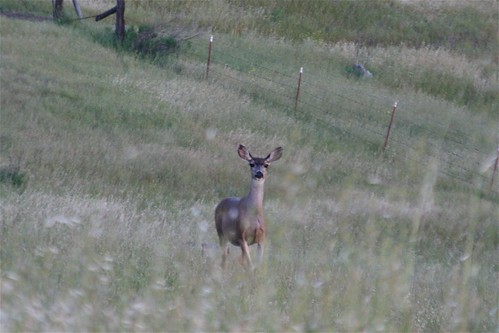
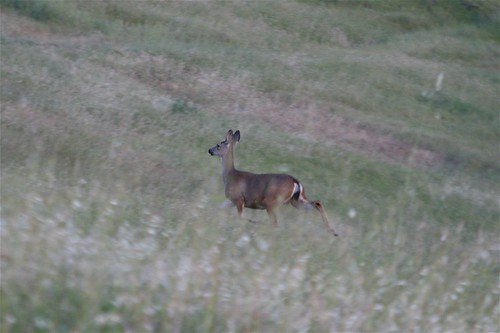
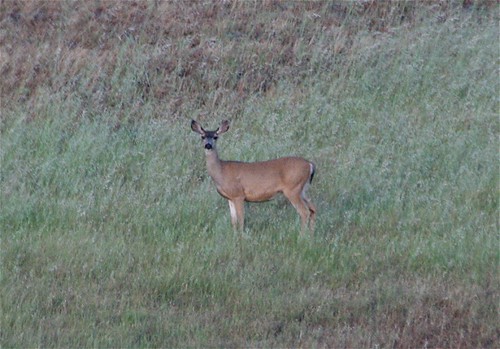
I hoist my pack and walk through tall grass over a rise into an encounter with a black-tailed doe.

IMG_7514.JPG

She poses for me then prances off, then poses again.

IMG_7515.JPG

IMG_7517.JPG

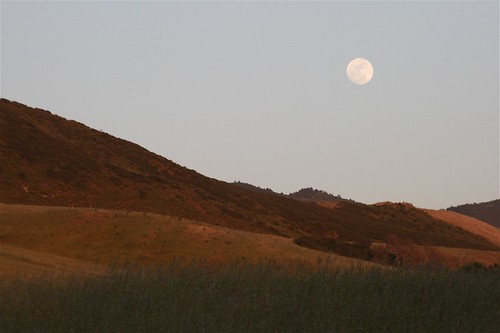
The full moon rises fat over East Cuesta Ridge.

IMG_7512.JPG

As the dusk deepens and the wind picks up, I pass from the Stenner watershed to Poly Canyon’s and find a relatively flat spot beside one of the springs that source Brizzolara Creek. I’m too tired to read or write or even look at the stars.  The northwest wind has picked up, harrying the trees and grasses, recalling Muir’s description of “A Windstorm in the Forest,” which we read last week:

when the grand anthem had swelled to its highest pitch, I could distinctly hear the varying tones of individual trees,…and even the infinitely gentle rustle of the withered grasses at my feet. Each was expressing itself in its own way,–singing its own song, and making its own peculiar gestures…The profound bass of the naked branches and boles booming like waterfalls; the quick, tense vibrations of the pine-needles, now rising to a shrill, whistling hiss, now falling to a silky murmur; the rustling of laurel groves in the dells, and the keen metallic click of leaf on leaf.

The wind is warm, but not as dry as the hot sundowners that make you feel like wildfire is just a spark away.

IMG_7549.JPG

Next day I find out that while I thought that the hills above Santa Barbara were burning and much of the city was evacuated.  I burrow into my bag and the unrlenting wind tugs at it all night, shaking me awake every hour or so to see the moon progressing across the sky.

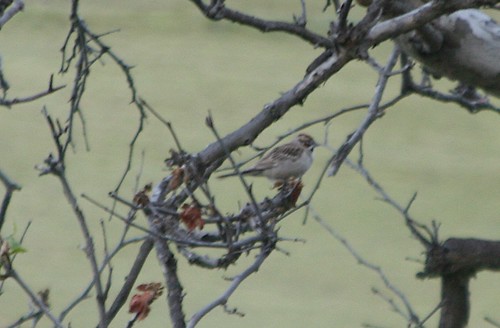
Friday morning I drop down cross country into Poly Canyon, knees and ankles grateful for the bracing of my heavy boots. An interesting bird in a dessicated Sycamore lets me take its picture

IMG_7553.JPG

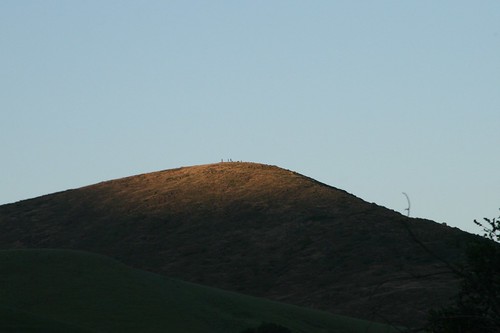
At 6:30 am the rising sun spotlights the top of Poly Mountain, just where I slept two weeks before.  It’s greeted by a group of students!

IMG_7555.JPG

Ecolit Hikes Rockslide Ridge

Friday, May 1st, 2009

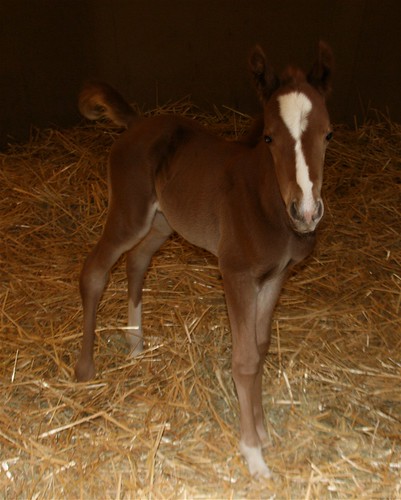
In the equine unit where we assemble, a filly born at 12:15 a.m. that morning.

IMG_7464.JPG

The arboretum in full flower.  This morning I biked up here with Lucas in the backpack and we ate wild strawberries under the redwoods.

Out through the back gate, up the little creek still flowing from a single spring at the junction of the serpentine and the lodo soil.

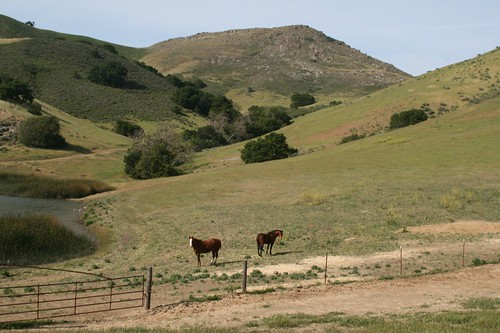
Through the gate at Indonesian Reservoir, where ducks take off and thoroughbreds run over hoping for a treat.

IMG_7469.JPG

Dylan shows me a picture on his phone of the fat bass he caught here.  I asked if it tasted good.  He threw it back, he says.

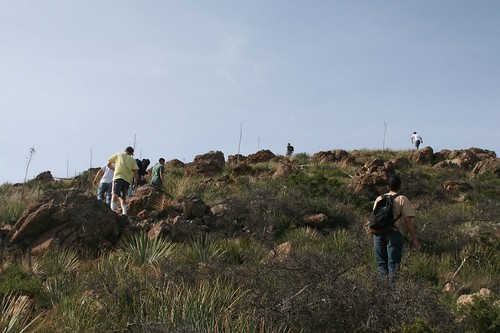
Bedrock mortars under the hollyleaf cherries. Volunteer artichokes spreading in the meadow.  At the divide between Horse Canyon and Brizzolara watersheds,  half the group remains and the rest head upward.

IMG_7471.JPG

We have 40 minutes to get to the top and back.

Dylan finds his own stopping place and calls out that he’s spotted a bald eagle.

IMG_7474.JPG

At the summit, we take in the big view.

IMG_7479.JPG

I read out the first paragraph of John Muir’s The Mountains of California:

The Coast Range, rising as a grand green barrier against the ocean, from 2000 to 8000 feet high, is composed of innumerable forest-crowned spurs, ridges, and rolling hill-waves which inclose a multitude of smaller valleys; some looking out through long, forest-lined vistas to the sea; others, with but few trees, to the Central Valley; while a thousand others yet smaller are embosomed and concealed in mild, round-browed hills, each with its own climate, soil, and productions.

Five minutes to write in  journals.

Edge of escarpment–feels like looking into a volcano, but it’s just rotten serpentine slumped down into the melange through which it floated to the surface 100 million years ago.  The blinding green of the grasses three weeks ago has paled, fitfully retaining some chloroplasts, the drier areas now tan yellow after releasing seeds to the wind.  Soon all the grassland will be white against the black of riparian corridors.

The call of a meadowlark fills the big valley:  key-ho-trillabittle.

Endorphins released by the scramble up the mountain tingle through veins in my chest and flow toward my heart.  Sweat drying in the warm breeze cools my brow.

DSC02878.JPG

Photo by Ben Taylor (click for large size)

Cedar Waxwings

Sunday, April 26th, 2009

On the way to class on a gray chill Thursday afternoon overloaded with the lesson plan in my head and the computer:

  • to complete discussion of last paragraphs of Thoreau’s “Sounds”– the negative formula divesting the saunterer of worldly encumbrances: “No yard but unfenced nature reaching up to your very sills, A young forest growing up under your meadows.”  The irony of 600,000 people a year visiting Walden today, the edge of the  pond “restored” with rebar grid and imported rocks, sand and tree plantings. My afternoon there in the rain, in 2003, swimming in my underpants.
  • moving on to “Solitude””its insistence on the refusal to grieve”for the lost younger brother and the lost beloved, the only two people Thoreau was really close to”and the insistence on the cockerel’s joyful exuberance felt even by the “misanthrope and most melancholy man,” except for the one hour of “a slight insanity in my mood,”  after which “every little pine needle expanded and swelled with sympathy and befriended me.”  The desire to dwell not in a neighborhood but rather “most near to the perennial source of our life, whence in all our experience we have found that to issue, as the willow stands near the water and sends out its roots in that direction.”  The conclusion of that most transcendent chapter, the cry for a drug to repair the rent that tears us from our essence: “What is the pill which will keep us well, serene, contented?” And the answer””a draught of undiluted morning air.”

As I approached the English building I was distracted by a gaggle of bird calls overhead. In the flat backlight I couldn’t make out their shape”were they starlings or grackles?  One bunch was rustling in the top leaves of the holly trees alongside the door, while another was spinning cartwheels just above it, and several individuals dashed toward Eucalyptus trees back by the Plant Conservatory.  Then the group overhead descended to the hollies, the group in the trees blasted together to the Eucs and different individuals shot up and down over the building.  I noticed the birds in the tree were gobbling the red holly berries. Now it registered: a migrating flock of Cedar Waxwings  drunk on fermented fruit.  I had seen such a flock seven or eight years ago on the sycamores where Via Carta crosses Brizzolara Creek, but they were sitting at rest, illuminated by the morning sun, their chamois-smooth bodies glowing, their graceful crests  and eye masks on stately display.

I begged them to stay  for another ten minutes.  As the students assembled in the classroom, I googled “Cedar Waxwing Drunk” and put up this webpage on the screen.

After the’d all arrived, I led them through the long corridor of building 10 and out the door on a sixty second hike. The party was still in full swing.

“Walking” Poly Mountain

Saturday, April 18th, 2009

IMG_7345.JPG

The sun sets on some retired meadow, where no house is visible, with all the glory and splendor that it lavishes on cities, and perchance, as it has never set before…where there is but a solitary marsh hawk to have his wings gilded by it

IMG_7336.JPG

¦ and there is some little black-veined brook in the midst ¦ We walked in so pure and bright a light,

380polymtpan.jpg

gilding the ¦ grass and leaves, so softly and serenely bright–

IMG_7347.JPG

I thought I had never bathed in such a golden flood, without a ripple or a murmur to it. The west side of every wood and rising ground gleamed like the boundary of elysium,

IMG_7353.JPG

and the sun on our backs seemed like a gentle herdsman, driving us home at evening.

April 16 7:15 pm

IMG_7359.JPG

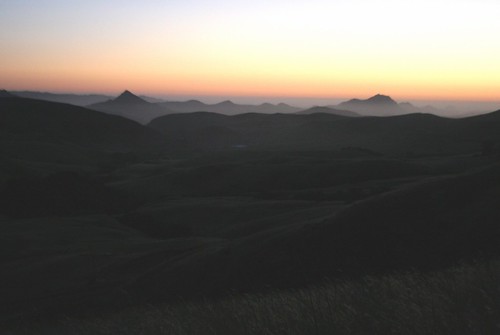
Sun dropping toward mist on the horizon.  Temperature dropping as the sleeping bag warms. Bits of remaining light in the needlegrass awns. An hour and a half since I departed from the class down in the oak grove and its words still echo”the words of Thoreau’s essay  “Walking” and his chapter, “Sounds,” along with our improvisations upon them.

The longing for the wild and the new, the demand for fresh and expansive experience, the unfamiliar, the virgin. The westward march and its ultimate demise with humanity’s dark dominion”the “End of Nature” in anthropogenic climate disruption. The sound of silence in the snap of sumac twigs too heavy to support their own growth.

Sounds now of the invisible traffic on Cuesta Pass and my stomach growling. A meadow lark.  A cow’s moo. A haunting ullulation across the valley. What is that familiar call”like a loon’s, but no loons here. Perhaps not a bird?  I struggle to find the memory, fail,  surrender to another diminution of capacity.  Shifting my gear to support my shoulder recalls previous sleepouts and the line “My pillow is my boot,” which I put on Tuesday’s reading quiz.  And the preceding stanza:

The silence of the valley
Breaks with a coyote’s sound
That’s followed by responses
From all the hills around.

Hello! it’s coyotes.

The sun dips under the cloud bank behind Hollister Peak.

IMG_7365.JPG

I told students I hadnt planned on camping tonight, but rereading “Walking” seduced me again with its invitation to saunter, to wander a creek or scramble up a mountain with no plan or destination, to sleep where I felt tired. The sensation of freedom at 6:00 p.m. Thursday, the end of my week’s classes compounded with such a walk enabled “a fair return to my senses.”

Ironically, so does the camera and computer. The viewfinder provides concentration, the monitor focus, the harddrive memory. The pictures of sunset I just took recall those I took six years ago from a spot close by after another April class on Thoreau and just last week placed in a slideshow to accompany the first movement of Beethoven’s pastoral symphony.

Would William or Henry David or Ralph Waldo allow for technology to be the agent of this return to the senses? Not if Nature is the Wild or the “not-human.”  But also, yes,

the meadows and the woods,
And mountains; and … all that we behold
From this green earth;… all the mighty world
Of eye, and ear,–both what they half create,
And what perceive

Thoreau exults, “Man and his affairs¦I am pleased to see how little  space they occupy in the landscape.”  But as Dylan observed as we sat in the deep  grass above campus, yes if you look north, but not if you look south, at the city and the freeway extending to L.A.

Now against the background of  darkened peaks and glowing sky emerges a panoply of orange lights: the state prison.

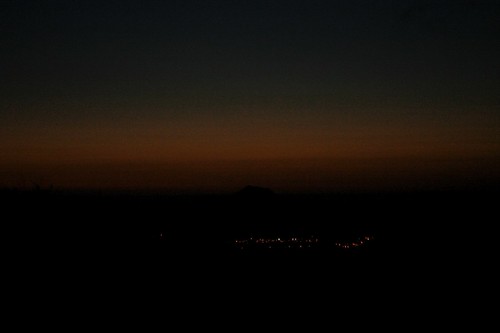
IMG_7373.JPG